Plant Based Poly Mailers for Ecommerce: How to Choose
Plant Based Poly mailers for ecommerce can sound like a simple packaging swap, yet the decision behind them is usually more grounded than glossy marketing language suggests. A brand wants less virgin plastic, lower shipment weight, and a cleaner sustainability message. Operations wants the parcel to survive conveyor belts, tote stacking, truck vibration, and the occasional rough return trip. If the mailer falls apart anywhere in that chain, the environmental story gets overshadowed by a damage claim or a customer complaint.
Plant based Poly Mailers for Ecommerce deserve a close look for that reason. The category is not one material, one finish, or one disposal path. Some versions rely on bio-based resin content, some use blended films, and some include plant-derived additives inside a familiar poly structure. The label on the spec sheet may sound promising, but it does not replace performance data, sample testing, or clear end-of-life language.
For ecommerce teams, the attraction is easy to understand. Plant based poly mailers for ecommerce can speed up pack-out, cut back on corrugated usage for soft goods, and reduce freight weight when every ounce matters. The harder work is keeping the claim honest, the cost under control, and the package strong enough to protect against punctures, tears, and moisture during transit.
That balance is the real subject here: how plant based poly mailers for ecommerce work, what to compare, where the pricing gets hidden, and how to roll out the switch without slowing fulfillment.
Plant Based Poly Mailers for Ecommerce: What They Solve
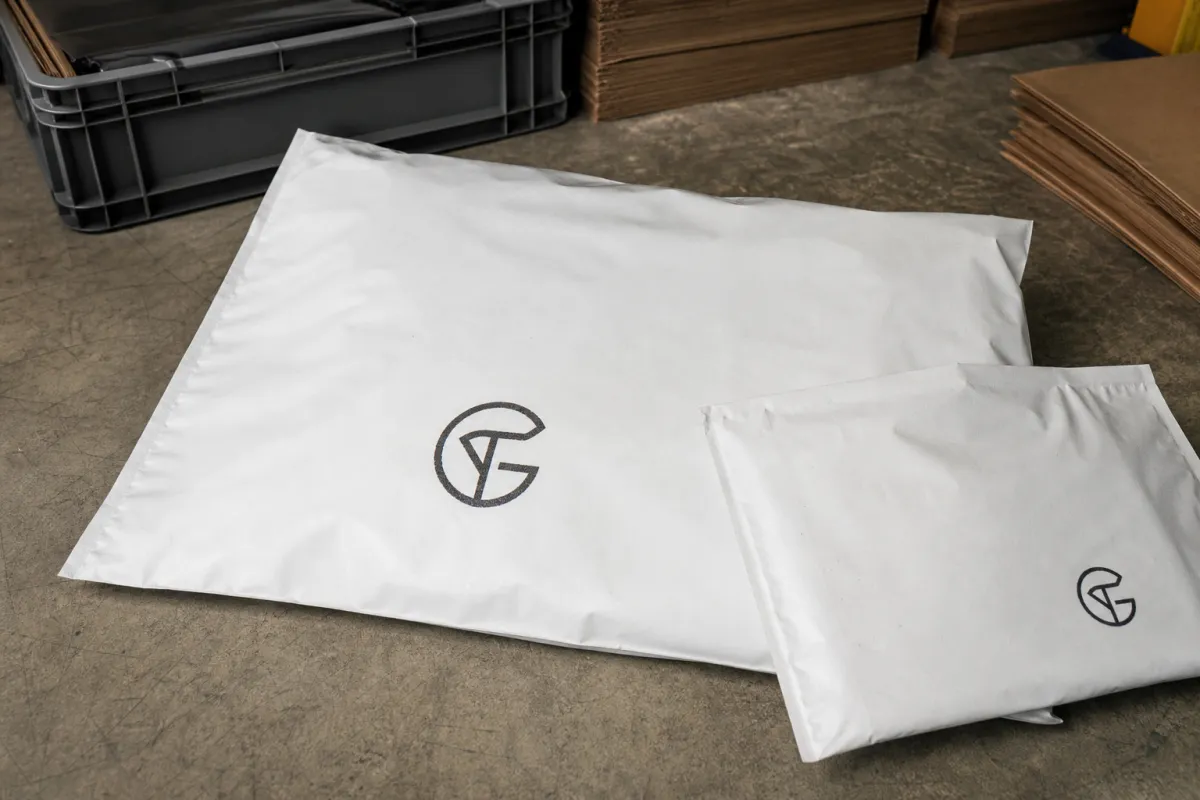
Picture a fulfillment team packing 1,200 apparel orders a day. If each order ships in a rigid box, labor time climbs, carton cube grows, and the shipping bill follows. Plant based poly mailers for ecommerce solve a very specific problem in that setting: they reduce package bulk while still giving the brand a more responsible packaging story than a conventional virgin-plastic mailer. That is the operational promise, and it is more practical than decorative.
In practice, plant based poly mailers for ecommerce are best suited to products that are soft, flexible, or already protected by an inner bag. Tees, socks, scarves, small accessories, and lightweight replenishment orders fit the format well. The mailer is fast to load, quick to seal, and easy to handle at high-volume pack stations. A conveyor worker can usually insert, peel, and close one without the extra motions needed for a box, insert, and tape strip.
There is a customer-facing side too. Many shoppers notice packaging more than brands expect. A mailer can signal thoughtfulness, efficiency, and waste awareness, or it can look like a cost-cutting shortcut. Plant based poly mailers for ecommerce can help create a better first impression if the print, opacity, and finish are chosen with care. A flimsy, cloudy, or badly sealed mailer does the opposite.
The pressure point is simple: plant based poly mailers for ecommerce only deliver value when three things work together. The film has to protect the product in transit. The price has to fit the margin structure. The end-of-life claim has to stand up to scrutiny. Miss one of those, and the packaging change becomes more about messaging than strategy.
Packaging truth: a sustainability claim is only as strong as the weakest detail behind it. If the film performs but the disposal language is vague, the brand still has a problem.
That is why buyers should ask a blunt question early: are we trying to reduce virgin plastic, improve recyclability messaging, support a bio-based sourcing story, or move toward compostability? Those goals are not interchangeable. Plant based poly mailers for ecommerce can support several of them, but not automatically all of them. The spec should describe the product for what it is, not for what a marketing deck hopes it might be.
For brands comparing options, it helps to look at the wider packaging mix as well. Some items fit better in a rigid mailer or a paper solution, while others sit comfortably inside Custom Poly Mailers with a better film spec and a cleaner print layout. For multi-channel brands, Custom Packaging Products can serve as a useful benchmark when evaluating where a mailer belongs in the full shipping system.
Plant based poly mailers for ecommerce are not miracle packaging. They are a packaging choice with trade-offs. Used well, they can trim materials, simplify pack-out, and strengthen a brand's sustainability story. Used poorly, they turn into an expensive label change with little operational gain.
How Plant Based Poly Mailers for Ecommerce Are Made
Most buyers do not need to become polymer chemists, but the basic structure is worth understanding. A typical mailer includes an outer film, a sealed seam, a closure strip or adhesive flap, and sometimes a printed layer or opaque additive. Plant based poly mailers for ecommerce bring bio-based inputs into one of those stages, usually through the resin blend or film formulation. The finished mailer may still look and handle like a conventional poly mailer, which is exactly why the spec details matter.
The easiest mistake is assuming the word “plant-based” describes the whole package. It does not. One supplier may use a resin with bio-based content, another may blend plant-derived material with fossil-based plastic, and a third may use a processing additive that changes performance without changing the primary feedstock. Plant based poly mailers for ecommerce can sit anywhere along that spectrum. The label alone will not tell you whether the product is compostable, recyclable in common store-drop streams, or simply lower in fossil content than a standard film.
That distinction matters because buyers often mix up three separate ideas:
- Bio-based content means part of the material comes from renewable plant sources.
- Compostable means the material is designed to break down under a defined composting standard and environment.
- Recyclable means the material fits a collection and reprocessing stream that actually exists where the customer lives.
Those are different claims. Plant based poly mailers for ecommerce may support one, two, or none of them, depending on the exact formulation and the documentation behind it. A buyer should ask for written proof, not just a product name with a leaf icon and a hopeful description.
Performance still comes first. The three numbers that matter most in real use are puncture resistance, tear strength, and seal integrity. Moisture barrier matters too, especially for apparel and paper goods that can sit in damp trailers or get exposed to rain during the last mile. A mailer that looks sustainable but pops open under pressure is gonna cost more in the long run because the failure turns into a return, a reshipment, and a larger footprint than the packaging saved.
For spec reviews, actual test language is more useful than broad claims. Ask whether the supplier can provide tensile or elongation data, dart impact or puncture numbers, and seal strength results. Many teams also request distribution testing aligned with common industry practices such as ISTA protocols, because the question is not whether the film looks good on a table. The question is whether plant based poly mailers for ecommerce survive the route from packing bench to front door. The ISTA test framework is a useful reference point when packaging teams want to compare real-world distribution stress.
The comparison with conventional poly mailers is instructive. In appearance, the two can be almost indistinguishable. In use, they may feel nearly identical. The difference lives in sourcing, proof documents, and end-of-life story. That is why plant based poly mailers for ecommerce need a more careful purchasing process than a generic mailer reorder. The film may be familiar, but the decision is not.
One more practical note: print and coating choices can influence both function and claim clarity. Heavy ink coverage can affect recyclability messaging depending on local guidance and the substrate. If you plan to make any environmental claim, ask the supplier how print coverage, adhesive, and additives shape the final wording. Plant based poly mailers for ecommerce should not create a communication problem just because the artwork looked attractive in a proof.
Key Factors to Compare Before You Buy
Strength is the first place to start, and it should be. Plant based poly mailers for ecommerce need to match the product, not the wish list. A 5 oz apparel order with soft edges has a very different film requirement than a boxy accessory kit with zippers, clasps, or corners that want to punch through a seal. Thickness alone is not the answer, but it is the most useful place to begin.
For many ecommerce programs, thickness is discussed in mils rather than microns. A light apparel mailer may work in the 2.5-3 mil range if the seal design is sound and the product is soft. Rigid items, mixed-SKU orders, and returns-heavy categories often need 3.5 mil or more. That does not mean thicker is always better; it means the right gauge depends on the item weight, the amount of empty space inside the mailer, and the distribution stress the order is likely to see.
Second, ask for documentation. Good plant based poly mailers for ecommerce should come with a spec sheet that explains resin composition, film thickness, closure type, print method, and any relevant certification or test result. If the supplier claims compostability, look for the exact standard. If they claim bio-based content, ask how that content is measured. If they claim recyclability, ask where that recycling stream actually exists. General language is not enough.
Third, look at the customer experience. A mailer can perform perfectly and still feel cheap if the opacity is uneven, the closure strip is weak, or the print registration is sloppy. Plant based poly mailers for ecommerce often live or die on the unboxing moment, because a customer opens them with their hands, not with a spec sheet. If the adhesive tears the film, the seam wrinkles badly, or the graphics smear during handling, the brand loses polish quickly.
Fourth, examine operational fit. Can the mailer fit your packing tables without causing pile-ups? Does it load smoothly into a bagging station? Can it take a thermal label cleanly? Does storage temperature affect the adhesive? These questions sound minor until a shift supervisor has to work around them for six months. Plant based poly mailers for ecommerce should improve throughput, not create a new bottleneck.
Finally, compare the actual sourcing and support. A supplier that can explain the material clearly, suggest the right gauge, and help with sample testing is worth more than the cheapest quote. If you need a broader benchmark across formats, browsing Custom Packaging Products can help teams compare how mailer specs sit alongside other shipping options. For brands with a dedicated mailer program, Custom Poly Mailers can be a useful way to assess print flexibility, sizing options, and closure design against the plant-based version.
There is also a claim-quality angle that gets overlooked. If the mailer is not certified compostable, do not call it compostable. If the supplier has not documented recyclability against a recognized stream, do not imply curbside acceptance. Recycling rules vary by region, and store-drop programs are not the same as curbside pickup. The Federal Trade Commission is not the only audience that notices vague environmental language; customers notice too. For disposal guidance and broader waste context, the EPA recycling guidance is a practical reference point for teams that want their message to stay grounded.
When comparing plant based poly mailers for ecommerce, I would prioritize the decision in this order: product protection, documentation, operational fit, customer perception, then price. That order may sound obvious, but plenty of teams reverse it. They shop the quote first and the performance later. That is backwards.
Process and Timeline: From Sample to Delivery
The buying process for plant based poly mailers for ecommerce should move in a sequence, not a sprint. Start with samples. Then review specs. Then approve artwork. Then confirm size, thickness, and closure style. Only after those steps should production begin. Skipping one stage usually creates a change order, and change orders are where time and budget quietly disappear.
Sampling is where the real differences show up. A mailer that sounds right on paper may feel too slippery, too thin, or too brittle once the team loads actual products into it. That is why plant based poly mailers for ecommerce should be tested with your real SKU mix, not empty bags. Put in the folded tee, the boxed accessory, the item with a zipper, the item with a sharp corner. Then check seal behavior, shelf feel, and opening experience.
Lead time depends on whether the order is stock or custom. Stock plant based poly mailers for ecommerce can move quickly, especially if the supplier already has the right size and film in inventory. Custom print adds setup time, proofing time, and usually some back-and-forth on artwork. First orders often take longer because teams need internal approval from operations, marketing, sustainability, and sometimes legal. That is normal. It becomes a problem only when nobody plans for it.
Typical production timelines vary, but a realistic custom order often takes 12-20 business days after proof approval, with additional time for shipping. If the artwork is complex or the claim language needs extra review, that can stretch. If the supplier is starting from a stock base with a light print change, it may be faster. Plant based poly mailers for ecommerce are no different from other custom packaging in that the long pole is usually not the press run. It is the approval chain.
Where do delays happen most often? Three places. First, artwork revisions after the proof is already in motion. Second, sustainability-claim review when the team is unsure what language is allowed. Third, low-MOQ ordering when the program is still being tested and the supplier needs a special setup. A fourth delay can happen when the size is close but not quite right, which forces a new sample round and resets the clock.
A good launch calendar builds in slack. I would give plant based poly mailers for ecommerce enough room for one testing round, one internal review round, and a reorder window before the old packaging runs out. That means launching the new mailer before inventory becomes tight. Too many teams wait until the last carton of the old packaging is on the shelf. Then a minor delay becomes a fulfillment issue.
Here is a practical sequence that works well for many ecommerce teams:
- Request 2-3 samples in the target size and one backup thickness.
- Test with actual products on the packing line.
- Confirm claims language with marketing and legal.
- Approve artwork only after the material spec is settled.
- Place the first order with a backup reorder date already mapped out.
That process sounds cautious, but that is the point. Plant based poly mailers for ecommerce should reduce risk, not create it. A measured rollout usually costs less than an emergency reorder after a packaging mistake.
Cost and Pricing: MOQ, Unit Cost, and Quote Variables
Pricing is where plant based poly mailers for ecommerce become very real very quickly. The final quote can swing based on resin blend, size, gauge, print colors, closure style, and quantity. A plain unprinted stock mailer will sit at the low end. A fully custom printed mailer with high ink coverage and a tighter environmental spec will cost more. There is no way around that.
For planning purposes, many brands will see unit pricing somewhere in the rough range of $0.12-$0.30 per mailer depending on order size and print complexity, with lower costs at higher volumes. That is not a promise. It is a working range. Small programs often pay more per unit because setup, freight, and production minimums get spread across fewer pieces. Larger programs tend to improve unit economics, especially if the supplier can optimize palletization and shipping.
MOQ matters because it shapes both risk and flexibility. A 5,000-piece order may be ideal for a test launch or seasonal SKU, while a 25,000-50,000-piece order usually drops the unit cost and improves freight efficiency. Plant based poly mailers for ecommerce often sit in that tension: lower MOQ helps a brand experiment, but higher volume usually rewards commitment. If the packaging change is strategic, not cosmetic, the economics should be evaluated over a full reorder cycle.
Comparing quotes is where many teams go wrong. Some prices exclude shipping. Some exclude plates or setup. Some exclude artwork prep. Some exclude testing or add-on certification documents. That means the lowest quote on paper can become the highest landed cost once freight, revisions, and delays are counted. Plant based poly mailers for ecommerce should be evaluated on total cost, not just line-item cost.
| Option | Typical MOQ | Approx. Unit Cost | Best For | Watch For |
|---|---|---|---|---|
| Stock plant-based mailer | 1,000-5,000 | $0.12-$0.20 | Testing, fast launches, simple SKU sets | Less branding control, fewer size choices |
| Custom printed plant-based mailer | 5,000-25,000 | $0.18-$0.30 | Retail-ready branding, established programs | Proofing time, setup charges, freight variability |
| Higher-gauge or specialty film | 10,000+ | $0.22-$0.38 | Heavier items, returns, sharper products | More material cost, less flexibility on price |
That table only tells part of the story. The landed cost of plant based poly mailers for ecommerce also includes labor savings from easier pack-out, reduced carton fill material, and potentially lower shipping weight. A lighter package can save a little on every order. Across tens of thousands of units, those small savings matter. The same is true on the downside: a weak mailer creates re-pack labor, replacement shipments, and customer service friction that can erase the packaging savings quickly.
Think of the purchase as a business case, not a product purchase. If the new mailer reduces outbound weight by even a fraction of an ounce, and if it trims five to ten seconds from pack-out, the program may pay for itself through throughput and reduced waste. That only happens when the mailer performs reliably. Plant based poly mailers for ecommerce do not need to be the cheapest option to be the best one. They need to be the best-fit option once all the costs are visible.
Another variable worth asking about is freight configuration. Some suppliers can optimize carton size, pallet count, and case pack in ways that reduce shipping expense. Others quote a favorable piece price and then recover margin in transport. A smart buyer asks for the full landed quote and compares it against the current packaging system, not against a theoretical best-case number.
Common Mistakes When Switching to Plant Based Poly Mailers for Ecommerce
The first mistake is the easiest one to make: assuming plant-based means compostable. It does not. Plant based poly mailers for ecommerce may contain renewable content and still be designed for the same disposal path as a conventional mailer. That difference matters because a compostability claim without certification can create confusion, complaints, and compliance risk. If the supplier cannot show the proof, the claim should stay off the package.
The second mistake is buying the thinnest film available to save money. On paper, that sounds efficient. In practice, it is usually expensive. A too-thin mailer can tear at the seam, puncture on corners, or split during return transit. Each failure triggers more labor, more reshipping, and more customer frustration. Plant based poly mailers for ecommerce should be specified for the product and the distribution route, not squeezed into the lowest possible gauge.
The third mistake is skipping real-world testing. A sample that holds an empty tee may fail the moment a product has a zipper, a box insert, or an awkward fold. Test the actual SKU mix. Test the label placement. Test the adhesive after the mailer has been sitting in a warehouse for a week. Plant based poly mailers for ecommerce should be judged under your normal operating conditions, not idealized ones.
The fourth mistake is ignoring label and adhesive behavior. Thermal labels can curl, smear, or peel on certain film surfaces. Ink adhesion can vary too. If the mailer is too glossy, the printer may struggle. If the surface is too slick, labels may lift. These are small things until the scanning station starts rejecting packages or the pack line starts slowing down. A good packaging spec anticipates those details before volume starts.
The fifth mistake is selecting a supplier based on quote alone. A cheap price means very little if the documentation is poor, lead time is unreliable, or support disappears after the order is placed. Plant based poly mailers for ecommerce should come with responsive communication, clear specs, and honest answers about certification, MOQ, and production timing. That support saves time later.
Here are the mistakes I see most often, compressed into one short checklist:
- Assuming the environmental claim is broader than the proof.
- Choosing a lighter film than the product actually needs.
- Approving artwork before the material is locked.
- Ignoring label, ink, and adhesive compatibility.
- Skipping a pilot run on live orders.
One more subtle mistake: launching plant based poly mailers for ecommerce without aligning the language across the website, customer service scripts, and package copy. If the site says compostable and the inside flap says recyclable, customers will ask questions. If the support team cannot answer them cleanly, trust drops. Packaging and messaging need to move together.
Plenty of sustainability projects get undermined by a gap between the material choice and the language around it. The packaging may be solid. The claim may be well meant. If the proof is thin, the program still invites confusion, and plant based poly mailers for ecommerce end up feeling like a branding exercise instead of a packaging improvement.
Expert Tips and Next Steps for a Smarter Rollout
Start with a one-page spec sheet. It sounds basic, but it kinda saves time. Include the product size, mailer dimensions, target film thickness, closure type, print needs, monthly volume, and the exact sustainability claim you want to make. Plant based poly mailers for ecommerce get easier to source when the supplier knows what problem they are solving before the first sample ships.
Request at least two samples, and preferably three if the item mix is varied. Test them with real goods, then watch how they behave through the full packing sequence. Look for load speed, seal strength, edge stress, label adherence, and opening experience. If you have a returns flow, test that too. A mailer that performs on outbound orders but falls apart on returns is only half a solution.
Run a pilot on one lane or one product family before switching the whole program. That gives you a controlled reading on damage rate, pack speed, customer feedback, and reorder friction. Plant based poly mailers for ecommerce should prove themselves in a limited environment before they become the default. A small pilot is much cheaper than a broad rollout correction.
Bring legal, operations, and marketing into the same review loop. That may sound bureaucratic, but it prevents the ugliest packaging problems, especially around environmental claims. If the website, the package, and the supplier literature all say slightly different things, confusion grows. If they all say the same accurate thing, the story is much stronger.
Use standards as anchors, not as decoration. ASTM data can help you compare film performance. ISTA testing can help you understand transit stress. If paper components enter the mix, FSC matters for those parts. None of those standards replace real-world testing, but they give plant based poly mailers for ecommerce a more credible evaluation framework than “looks good to me.”
Keep a record of the final approved spec, the print file, and the reorder trigger point. That way, the next purchase order does not start from scratch. A mature packaging program treats plant based poly mailers for ecommerce like any other operational asset: documented, repeatable, and easy to reorder without guesswork.
If your team is still weighing where this packaging fits inside the broader mix, compare one live SKU against your current mailer, one return scenario, and one label test before you make the switch. The best choice is the one that protects the product, keeps the line moving, and holds up under a real customer shipment, not just the one that sounds nicest in a meeting.
My final advice is straightforward: buy plant based poly mailers for ecommerce for the package you ship today, not the package you hope to have later. Match the film to the product, match the claims to the proof, and match the launch timing to your inventory cycle. If those three pieces line up, you have a packaging change worth keeping.
FAQ
Are plant based poly mailers for ecommerce actually compostable?
Not always. Plant based poly mailers for ecommerce may contain renewable content without being compostable. Compostability depends on the exact blend, the testing standard, and the certification behind the product. Some are designed for industrial composting, while others are still meant for recycling or disposal through normal waste streams. Ask for written proof instead of relying on a generic green claim.
How durable are plant based poly mailers for ecommerce compared with standard poly mailers?
Many plant based poly mailers for ecommerce can perform very similarly to conventional poly mailers if the film thickness, seam design, and closure strip are specified correctly. The better comparison is not a label comparison; it is a transit comparison. Use drop, puncture, and seal testing with your actual products. Heavier or sharper items usually need a stronger gauge regardless of the resin source.
What thickness should I choose for plant based poly mailers for ecommerce?
Start with the product weight, the shape of the item, and how much movement happens inside the mailer during shipping. Light apparel may work in a lighter film, while boxed accessories or rigid items usually need more material and a stronger seal. If you are unsure, request samples in two thicknesses and test them under real packing conditions.
How much do plant based poly mailers for ecommerce cost?
Pricing depends on the resin blend, the size of the mailer, print complexity, MOQ, and freight. A common working range is roughly $0.12-$0.30 per unit, though specific quotes can land outside that depending on order volume and artwork. Compare the full landed cost, not just the unit price, and include the savings from reduced weight or faster pack-out if those benefits apply.
How long does a custom plant based poly mailer order for ecommerce take?
Stock items can move quickly, while custom printed plant based poly mailers for ecommerce usually add time for proofing and production setup. A first order often takes longer because sample review, artwork approval, and sustainability language all need sign-off. Ask the supplier for a schedule tied to your launch date so you can plan testing and avoid fulfillment interruptions.
For teams that want a lighter shipping package without giving up speed or clarity, plant based poly mailers for ecommerce work best when the material spec, testing plan, and claim language are all locked before production. Compare the live SKU, test the return path, and approve the exact wording that will appear on the package; that is the cleanest way to make the switch stick.


