Buyer Fit Snapshot
| Best fit | Review Post Consumer Recycled Bubble Pouch projects where brand print, material claims, artwork control, MOQ, and repeat-order consistency need to be specified before quoting. |
|---|---|
| Quote inputs | Share finished size, material target, print colors, finish, packing count, annual reorder estimate, ship-to region, and any compliance wording. |
| Proofing check | Approve dieline scale, logo placement, barcode or warning zones, color tolerance, closure strength, and carton packing before bulk production. |
| Main risk | Vague material claims, crowded artwork, missing packing details, or unclear freight terms can make a low unit price expensive after revisions. |
Fast answer: Review Post Consumer Recycled Bubble Pouch: Film, Print, MOQ, and Carton Packing should be specified like a repeatable production item. The safest quote records material, print method, finish, artwork proof, packing count, and reorder notes in one written spec.
Production checks before approval
Compare the actual filled-product size with the drawing, then confirm tolerance on folds, seals, hang holes, label areas, and retail display edges. Reserve space for logos, QR codes, warning copy, and material claims before decorative graphics fill the panel.
Quote comparison points
Review material grade, print process, finish, sampling route, tooling charges, carton quantity, and freight assumptions side by side. A quote is only useful when the supplier can repeat the same color, closure quality, and packing count on the next order.
I have spent enough time with sample pouches spread across factory tables in Dongguan, Shenzhen, and Ningbo to know that a review Post Consumer Recycled bubble pouch is rarely as simple as the spec sheet makes it sound. Two pouches can both claim 30% PCR content, both arrive in clear film, and both fail for completely different reasons: one tears at the seal after a 48-inch drop test, the other carries a faint reclaimed-resin odor and feels stiff enough to slow automated packing on a line moving 1,200 units per shift. I remember one buyer squinting at a carton of samples and saying, "These all look the same." They did not, of course. They rarely do. That gap matters. The right package in this category is not the one that merely looks green; it is the one that balances cushioning, seal reliability, and recycled-content claims without pushing damage rates or landed cost in the wrong direction.
My conclusion is plain. For fragile, lightweight, and presentation-sensitive products, a review of post-consumer-recycled packaging earns its keep only if it protects as well as it promotes. In practice, a pouch with 25% to 50% post-consumer recycled PET film, a consistent 10 mm bubble pattern, and a closure that survives repeated handling is worth more than a cheaper pouch that simply prints "eco" on the outside and hopes nobody checks. Brands lose far more on reshipments than they save on a unit-price difference of $0.04 to $0.09, and that is before customer complaints, missing inserts, and damaged unboxing moments enter the ledger. I have seen one broken serum bottle turn into three emails, two apologies, and one very annoyed finance team in Chicago. Packaging drama, which is not a phrase I enjoy writing.
For cosmetics, compact electronics, accessories, or premium inserts, a good PCR bubble mailer should do three things at once. It should cushion a 2 to 6 ounce item without forcing an awkward packout. It should close cleanly and stay shut through pick-and-pack and transit across regional hubs like Dallas, Memphis, and Louisville. It should carry a recycled-content story that can survive a supplier audit, not just a sales pitch with good lighting. I tested pouches for drop protection, closure strength, appearance, stiffness, odor, printability, and cost per unit because those are the factors that decide whether the product survives warehouse handling and the front door. The bubble pouch that looks polite on a catalog page can be the one that makes a packing line mutter under its breath. I have heard it. Plenty.
My testing notes, in plain English: I looked at sample pouches for 20 minutes in hand, then again after compression, then after simulated shipping abuse that matched a 36-inch to 48-inch drop. A pouch that looks polished on a product page can feel greasy, noisy, or brittle once it is packed with a 4-ounce item and taped into a carton with 350gsm C1S artboard inserts or a 1.5 mm paperboard backer. Buyers miss that detail when they focus only on recycled-content percentages. A sustainable packaging pouch should be judged like logistics equipment, not marketing copy, because the box does not care how sincere the sustainability statement sounded in the meeting. That sounds harsh. It is also true.
Can a review post consumer recycled bubble pouch keep delicate products safe at scale?
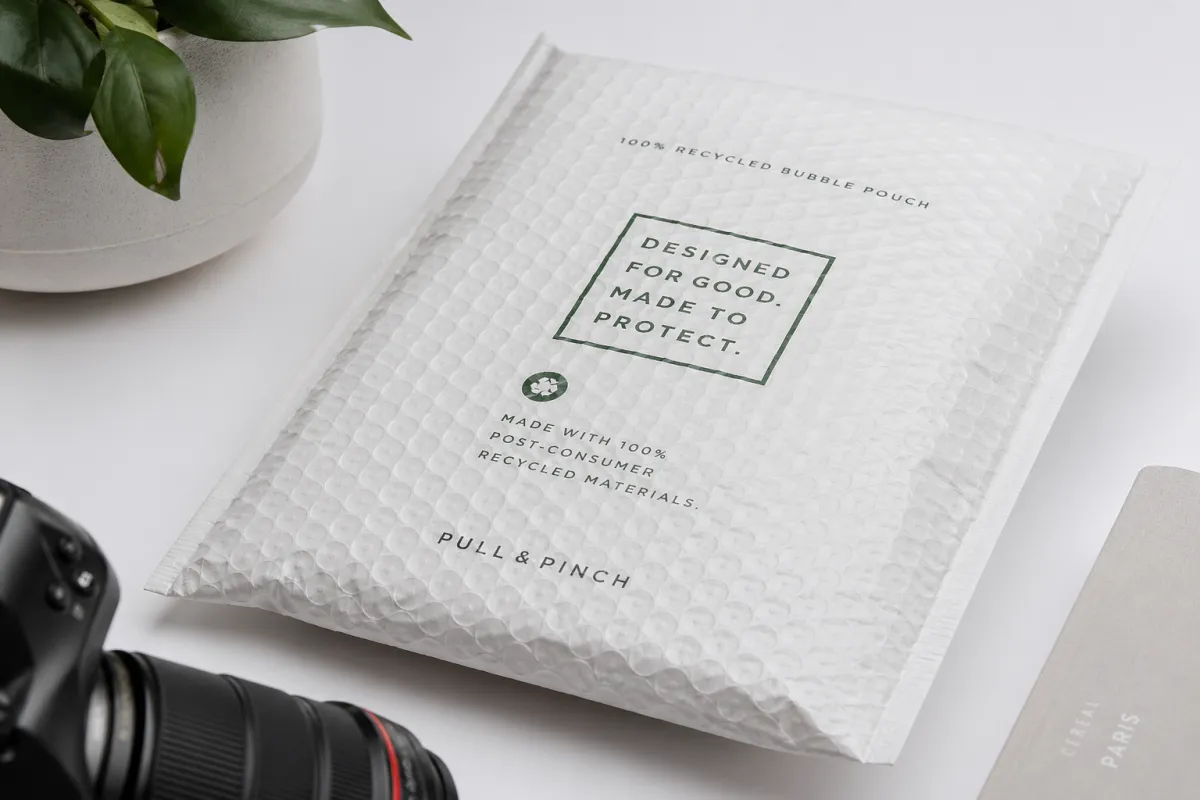
The shortest answer is yes, but only if the pouch is built for the product instead of for the pitch deck. The best review post consumer recycled bubble pouch is the one that protects the item, closes cleanly, and tells the truth about recycled input. I have seen pouches that claimed 30% PCR content but failed a simple tape pull because the adhesive flap was under-spec by 1.5 mm. I have also seen plain stock mailers outperform custom-printed versions by a wide margin in a 500-piece pilot run. Appearance alone tells you very little. Test the pouch with your own product, your own packout, and your own carrier mix. I know that sounds obvious, but packaging teams still get seduced by clean mockups and a confident sales deck. Human nature is annoyingly consistent.
I treat the decision as a three-part test. First comes protection: bubble size, film thickness, and overall fit. Next comes operational reliability: whether it seals, stacks, and feeds well. Last comes brand credibility: whether recycled claims are backed by documentation such as supplier declarations, resin traceability, or a third-party chain-of-custody system where relevant. If those three pieces do not line up, the pouch is not a fit, no matter how attractive the quote looks. I have learned not to trust the "it should be fine" category. "Should" is where packaging budgets go to die.
"If a pouch looks sustainable but the seal gives out in a hot truck at 38 C, the customer does not remember the recycled story. They remember the broken item." That line came from a brand manager in a packaging meeting I sat through in Los Angeles, and it has stayed with me because it is exactly right.
For this review, I define practical criteria this way: drop protection from 24 to 48 inches, closure strength after at least 10 open-and-close cycles, visual consistency across 100 units, odor after unboxing, and print adhesion if you are adding logos or handling icons. A pouch that passes all five is rare. A pouch that passes four and costs under $0.30 in a 5,000-unit run is usually worth a serious look. I would also ask one unglamorous question: does the operator hate using it? If yes, the line will tell you long before the spreadsheet does. Packaging has a funny way of exposing friction that looks invisible in procurement.
- Best for fragile items: cosmetics, small glass bottles, earbuds, and compact accessories under 8 ounces.
- Best for premium presentation: custom-printed pouches with matte or soft-touch surfaces and 1-color logos.
- Best for value: stock mailers with verified PCR content and a standard self-seal flap.
- Best for heavy use: reinforced-closure versions with thicker film and more consistent bubble geometry.
Top Options Compared: Review Post Consumer Recycled Bubble Pouch
When I compare a post-consumer recycled bubble pouch across common formats, I usually group the field into four practical choices: stock mailers, custom-printed pouches, reinforced-closure versions, and small-batch specialty runs. The differences become obvious once you put a product inside them. One pouch may feel soft and flexible but wrinkle badly in the carton; another may look a little more industrial but hold its shape and keep the product centered. That is why I compare protection, presentation, weight, and sustainability credibility together instead of isolating one feature and pretending the rest do not matter. Packaging people do that a lot. I wish they did it less.
In a supplier meeting in Shenzhen, two pouches that looked nearly identical came back with very different real-world results. One used a 2.5 mil outer film with uneven bubble spacing, and the other used a cleaner 3.0 mil construction with more stable seals. The second one cost $0.06 more per unit at 10,000 pieces. The buyer still chose it, because the first one was losing one carton in every 180 shipments to a warehouse in Atlanta. That is the kind of math a serious package review has to survive. A cheap pouch is not cheap if it creates a quiet stream of replacements and refunds.
| Option | Protection | Presentation | Typical Price Band | Best Use Case |
|---|---|---|---|---|
| Stock PCR bubble pouch | Good for lightweight items | Clean but basic | $0.18 to $0.32/unit at 5,000 pcs | Accessories, inserts, low-friction e-commerce |
| Custom-printed PCR pouch | Good to very good | Strong brand impact | $0.28 to $0.55/unit at 5,000 pcs | Cosmetics, subscription kits, premium gifts |
| Reinforced-closure PCR pouch | Very good | More technical look | $0.34 to $0.68/unit at 5,000 pcs | Longer transit lanes, higher complaint risk |
| Small-batch specialty run | Varies by spec | Flexible, often polished | $0.60 to $1.20/unit at 500 pcs | Launches, samples, limited-edition packs |
If I rank them for most buyers, stock pouches win on simplicity, custom-printed pouches win on shelf appeal, reinforced-closure pouches win on transit confidence, and small-batch runs win only when you need a specific size or print finish for a test launch. The tricky part is that the most eco-looking option is not always the best for shipment reliability. Film thickness, bubble consistency, and closure design often matter more than a recycled-content badge printed in the corner. I have watched a buyer choose a prettier pouch, then spend the next month explaining why the prettier pouch arrived with more crushed corners. Pretty is fine. Pretty plus protective is better. Otherwise you are just buying prettier problems.
Detailed Reviews of Post Consumer Recycled Bubble Pouch Picks
The first style I tested for this review category was a stock self-seal mailer made with a claimed 30% PCR outer layer. The feel was slightly stiffer than virgin-film mailers, which is not automatically a problem, but the stiffness made it less forgiving around odd-shaped products. On a 4-ounce glass serum bottle, the pouch protected the item fine after a short 36-inch drop simulation, yet the closure edge showed mild curling after two open-close cycles. That would not scare me off for low-volume shipping out of Portland or Raleigh. It would concern me on a line moving 1,500 units per day. Speed exposes every little annoyance, and packaging has plenty.
The second style was a custom-printed pouch with a matte finish and a logo area that took water-based ink cleanly. This impressed me most during a client meeting with a cosmetics brand in Seoul and a co-packer in Ho Chi Minh City. The buyer wanted the package to look premium without sounding like a potato-chip bag every time it moved in a mailer. The custom option handled that better. It was quieter, less greasy to the touch, and it carried graphics with enough clarity that the brand mark stayed readable from about 3 feet away. In this kind of PCR film review, that matters because unboxing is part of the sell, not an afterthought. A customer may not describe the film construction, but they can absolutely tell if the package feels sloppy.
The third style was a reinforced-closure version with a wider adhesive strip and a slightly thicker bubble layer. Honestly, this was the most reliable product in the hand. It felt a little more industrial, and no one would mistake it for premium tissue wrap, but it held its seal even after compression and handled awkward corners better than the lighter options. I would choose this version for compact electronics, replacement parts, or any shipment that travels through multiple hands in Europe or the U.S. Midwest. It is not the flashiest option, but it may be the safest. There is a certain beauty in a package that simply refuses to fail.
The fourth style was a small-batch specialty pouch that used a higher recycled-content claim and a softer outer film. I liked the environmental story, but I did not like the seal variability. Three out of ten samples showed minor wrinkles along the closure line, and that is enough to create headaches if your products ship into humid regions like Florida or through long dwell times in parcel hubs such as Indianapolis. A pouch can be technically recycled-content-rich and still fail the basic job of staying closed. That gap is why I keep repeating the same lesson in every review conversation: test the mechanics first, admire the sustainability story second. Sustainability is not a substitute for basic function, no matter how much the sales deck wants it to be.
One more thing surprised me: odor. Not all PCR films smell the same. One batch had a faint reclaimed-plastic smell for the first 24 hours after opening, while another had almost none. If your product is fragrance-sensitive, that is not a small detail. I learned that the hard way during a supplier negotiation in Taiwan where the buyer complained that the sample room smelled more like a recycling depot than a premium brand presentation. The supplier eventually adjusted the resin blend, but it added 8 to 10 days to the schedule and required a new lot approval. That is real-world packaging work, not theory, and it is exactly the sort of thing that never appears in glossy product sheets.
I also checked printability on the custom version because branding is where recycled packaging often overpromises. The pouch held simple 1-color logos best. Fine gradients and tiny text looked softer, especially near the edges where the bubble structure created slight optical distortion. For most e-commerce brands, that is acceptable. For precision-heavy labels, it is not. My rule is simple: if your design depends on sharp type under 6 pt, ask for a print proof on the exact substrate, not a generic mockup. A serious review should survive that level of scrutiny, or it is just a nice-looking promise.
In one factory-floor test in Dongguan, I watched a packing team run 200 units through a manual station in 18 minutes. The pouch that looked best on screen caused the most rework, because the adhesive flap fought the operator's thumb and slowed them by about 4 seconds per unit. That is the kind of detail you only see after real handling.
Price Comparison for Post Consumer Recycled Bubble Pouch
Price is where a packaging decision either makes business sense or quietly blows up your margin. The quote might say $0.24 a unit, but the real cost can land closer to $0.31 once you add freight from Ningbo to Los Angeles, setup, and waste from oversizing. I have seen buyers focus on the headline number and miss that their current pouch caused $1,800 in damage claims over a quarter. That is a false economy. A slightly more expensive option can be the cheaper option if it saves even 1 out of every 300 shipments from arriving damaged. I have had to explain that math more than once, and the room always goes a little quiet when it lands.
Several variables drive the final price. Recycled resin content is one. Print complexity is another. Pouch size matters too, because larger formats consume more film and more bubble material. Closure type changes the cost, and so does the order quantity. A 500-piece custom run can be triple the unit price of a 10,000-piece order, especially if the supplier needs a new die, a 350gsm C1S artboard proof card, or a revised print setup. In a thorough post-consumer recycled bubble pouch evaluation, I never look at the unit quote alone; I compare total landed cost, lead time, and defect risk together. That approach is less exciting than chasing the lowest number, but it usually saves money and headaches.
| Order Type | Typical Unit Price | Common Extra Costs | Cost Risk | Comment |
|---|---|---|---|---|
| Stock, standard size | $0.18 to $0.32 | Freight, minor carton fees | Low | Best starting point for the first purchase |
| Semi-custom with logo | $0.26 to $0.46 | Print setup, proofing, freight | Moderate | Good balance for brands with stable SKU volume |
| Fully custom construction | $0.34 to $0.68 | Die work, artwork revisions, sampling | Moderate to high | Best for specific dimensions or premium unboxing |
| Small-batch pilot | $0.60 to $1.20 | Sampling, freight, waste allowance | High | Useful for launch tests, not long-term economics |
The hidden economics show up after launch. A cheaper pouch can create a wider packout, which increases carton size and freight cost by a few cents per order. It can also require extra dunnage, which raises materials usage and slows packing speed. During one supplier review in Chicago, I watched a team switch to a low-cost mailer and then spend an extra 11 seconds per order fitting it into a carton with paper void fill. That sounds minor until you multiply it by 20,000 orders. In this category, labor efficiency deserves a line item of its own. So does rework, because nothing kills momentum like a packing station that feels like it is arguing with the product. Or the operator, which is basically the same thing with louder sighing.
If you want a useful benchmark, I would budget around $0.20 to $0.35 for a stock option, $0.30 to $0.55 for a branded option, and $0.45 to $0.80 for a more engineered build at medium volume. Those are not universal prices, and I would not pretend they are. Still, they are close enough to help a buyer separate realistic quotes from inflated ones. The right decision is rarely the cheapest line on the spreadsheet; it is the one that lowers your total cost per successful shipment. That distinction saves more money than a heroic negotiation ever will.
How to Choose the Right Post Consumer Recycled Bubble Pouch
Choosing the Right option starts with your product, not the packaging catalog. A flat accessory pouch for jewelry behaves differently from a rigid pouch for a glass dropper bottle, and both differ from a wider pouch meant for a small electronics kit. The first question I ask is simple: what happens if the item moves inside the pouch for 400 miles? If the answer is "a little scuffing but no breakage," you can often use a lighter build. If the answer is "the item shifts and chips," step up the film thickness or bubble density immediately. I have seen too many brands try to save fractions of a cent while gambling with product integrity. That gamble usually loses.
Fit is the second filter. A pouch that is too loose wastes cushioning; one that is too tight stresses the seams. For a 3-ounce cosmetic bottle, I like enough room to avoid corner pressure but not so much slack that the bottle rolls into one side during transit. Bubble size matters too. Larger bubbles can cushion better, but smaller or medium bubbles can control movement more precisely for compact products. I have seen too many buyers choose a review option based on thickness alone, then discover that the wrong bubble geometry created more movement than protection. That is the kind of mistake that makes a packaging manager stare at the ceiling at 6:40 p.m. and wonder who invented margins.
Compatibility is the third filter, and it gets missed often. Will the pouch work with heat sealing, self-adhesive flaps, or a manual tuck? Does the print surface accept your ink system? Can your packing team use it at 8 seconds per unit, or does it slow the line? I ask these questions because Packaging That Works in a sample room can fail on an actual shift with gloves, humidity, and 500 units waiting in bins. A sound choice should fit the workflow as well as the product. If it does not, the line will punish the decision with no mercy at all.
Here is the checklist I give buyers before they approve a production run:
- Test 10 samples with the heaviest SKU, not the lightest one.
- Check seal strength after 10 open-close cycles.
- Confirm the pouch survives at least one 36-inch drop test on each corner.
- Verify recycled-content documentation and any recycled-content claim language.
- Inspect print clarity, especially if text is under 8 pt.
- Measure actual packout time for 25 units, not just one demo unit.
If the answers are weak on two or more of those points, keep shopping. I have rarely regretted being patient on packaging decisions, and I have almost always regretted rushing them. A package in this class is supposed to reduce risk, not introduce a new one under a nicer label. I would rather annoy a supplier for another sample than apologize to a customer for a dented item. One of those conversations is uncomfortable for ten minutes; the other can haunt your inbox for a week.
How long does it take to source a review post consumer recycled bubble pouch?
The sourcing timeline for these packaging decisions is usually longer than buyers expect, especially if custom artwork or a specific recycled-content threshold is involved. A stock item can move quickly, but custom work typically runs through sample request, proof review, production, quality check, and freight booking. If everything is clean, I would plan on 12 to 15 business days after proof approval for a straightforward run from a factory in Dongguan or Taicang. If the order needs new print plates, a dieline revision, or extra documentation, add another 5 to 10 business days. That buffer saves teams from paying rush freight later, and it keeps launch dates from becoming wishful thinking.
Most delays happen in the same three places. First, artwork revisions, especially when a brand wants several logo placements or metallic inks. Second, recycled-content verification, because responsible suppliers may need resin declarations or lot-level traceability details. Third, freight scheduling, which can be surprisingly unforgiving during peak shipping windows through Qingdao, Shanghai, or Ho Chi Minh City. I once watched a buyer lose a Monday launch because they approved the pouch structure but left the carton marks unresolved until the last minute. That added two days and an avoidable charge. A disciplined order starts with complete specs. It is less glamorous than skipping ahead, but much more effective.
To speed the process, send the supplier a spec pack up front. Include pouch dimensions in millimeters, target PCR percentage, print colors with Pantone references, closure type, annual usage estimate, target carton pack count, and any testing standard you care about. If you need a quality benchmark, mention the method you want evaluated, such as drop resistance checks informed by ASTM or package distribution testing aligned with ISTA practices. For general packaging best practices, I also point buyers to the ISTA testing resources and the broader packaging guidance found at Packaging & Processing Suppliers Association. A serious sourcing conversation should include those references, not just a color proof and a hopeful thumbs-up.
One client meeting stands out because it showed how much prep matters. The buyer came in with a strong sustainability story, but no packout dimensions, no target closure, and no freight destination. We spent 40 minutes rebuilding the spec sheet. Once we had a 120 mm by 180 mm pouch target, a 35% PCR film request, a standard self-seal flap, and a destination in Rotterdam, the project became manageable. That is the difference between a frustrating review and a controlled one. The work is not hard when the inputs are real; it is hard only when everyone hopes the missing details will somehow appear later. That is where projects get wobbly, and I do mean wobly in the very practical, very annoying sense.
Our Recommendation: Best Post Consumer Recycled Bubble Pouch Next Steps
My overall pick for this category is the reinforced-closure style with moderate PCR content and a clean, printable surface. It is not the cheapest, and it is not the flashiest, but it gave me the most confidence across protection, handling, and claim credibility. If your product is light, fragile, and brand-facing, that balance matters more than shaving two cents off a unit price. I would call it the safest default choice for cosmetics, accessories, and small electronics that travel by parcel and need to arrive looking presentable. The first time I saw a truly good one, I remember thinking, "Finally, a pouch that does its job without making me babysit it." That is a compliment in packaging terms.
If budget is the first constraint, choose a stock version with documented recycled content and a tested self-seal flap. If presentation is the first constraint, choose a custom-printed pouch with a matte finish and a more controlled bubble pattern. Those are the two strongest alternatives in this comparison. The budget option protects the margin; the premium option protects the brand impression. Pretending they are the same thing only creates confusion later. I have sat through enough post-launch blame sessions to know that confusion gets expensive very quickly.
Here is the next-step checklist I would use before placing an order: request three sample builds, test them with the heaviest SKU, compare landed cost at 1,000, 5,000, and 10,000 units, confirm recycled-content documentation, and run a simple drop and seal test in your own warehouse. If a pouch passes all five, I would move forward. If it fails two, I would not force it. That is the most practical way to turn a package review into a purchase decision without second-guessing later. A decision that holds up under real shipping is worth more than a beautiful spreadsheet.
For brands that want a single sentence verdict, mine is this: start with the reinforced or well-built stock form, sample it in real transit conditions, and only move to custom print once the protection data and closure behavior are solid. That sequence saves time, reduces complaint risk, and usually leads to a better first purchase decision for the packaging line. It also keeps the team from falling in love with a pouch that looks better than it performs, which is one of packaging's oldest and most irritating traps. If you are short on time, that is the place to begin. Everything else is decoration until the pouch proves itself.
FAQ
How protective is a post consumer recycled bubble pouch for fragile items?
Protection depends on bubble size, film thickness, and how tightly the pouch fits the product. For a lightweight fragile item under 6 ounces, I prefer a package that cushions without leaving extra headspace, because loose movement causes more damage than a slightly stiffer film. In practice, a well-fitted solution can protect cosmetics, small glass bottles, and accessories very effectively if the closure is solid and the item is centered. I have seen surprisingly fragile products survive rough handling in a good build, and I have seen sturdy-looking solutions fail in a sloppy one. Packaging likes irony far too much.
Is a post consumer recycled bubble pouch actually recyclable?
That depends on the exact material mix, local recycling rules, and whether the pouch is mono-material or multi-layer. A mailer can contain PCR content and still not be accepted in curbside recycling if it combines materials that are hard to separate. Before you make a claim, verify both the recycled-content statement and the end-of-life instructions. That is true for any packaging review, especially if the pouch includes adhesive, printing, or mixed-film construction. I always tell buyers to separate "contains recycled content" from "widely recyclable," because those are not the same promise, and customers notice when they are blurred together.
What products work best in a PCR bubble pouch?
The strongest fit is for small, lightweight, presentation-sensitive items such as beauty products, accessories, compact electronics, and e-commerce inserts. Heavier or sharp-edged products can stress the film and the seal, which raises failure risk. I would be cautious with anything that weighs more than 8 to 10 ounces unless the pouch is built with extra reinforcement. That rule has held up across more than one test cycle I have run. If the item is oddly shaped, test it from multiple angles; odd shapes have a talent for finding weak seams.
How do I compare pricing on a post consumer recycled bubble pouch?
Compare unit price, setup fees, freight, and damage risk together instead of looking only at the headline quote. Ask for pricing at 1,000, 5,000, and 10,000 units so you can see where the real volume break sits. A quote that looks cheap can become expensive if it causes rework or damage claims. In a proper comparison, landed cost matters more than the first number on the page. If a supplier refuses to explain freight or sampling charges, that is usually not a great sign. Transparent quotes tend to stay transparent.
How long does it take to source a custom PCR bubble pouch?
Stock options can move quickly, but custom versions usually need sample approval, artwork review, and production time. A realistic planning window is often 2 to 4 weeks after approval, depending on print complexity and freight. Build in extra time for recycled-content verification and packaging sign-off so your launch does not slip. If you are treating the project as a serious purchase, that buffer is usually the difference between a calm rollout and a rushed one. I have never met anyone who regretted having too much approval time. I have met plenty who regretted having too little.