Buyer Fit Snapshot
| Best fit | Custom Recycled Cotton Canvas Bags projects where brand print, material claims, artwork control, MOQ, and repeat-order consistency need to be specified before quoting. |
|---|---|
| Quote inputs | Share finished size, material target, print colors, finish, packing count, annual reorder estimate, ship-to region, and any compliance wording. |
| Proofing check | Approve dieline scale, logo placement, barcode or warning zones, color tolerance, closure strength, and carton packing before bulk production. |
| Main risk | Vague material claims, crowded artwork, missing packing details, or unclear freight terms can make a low unit price expensive after revisions. |
Fast answer: Custom Recycled Cotton Canvas Bags: Pricing and Process should be specified like a repeatable production item. The safest quote records material, print method, finish, artwork proof, packing count, and reorder notes in one written spec.
Production checks before approval
Compare the actual filled-product size with the drawing, then confirm tolerance on folds, seals, hang holes, label areas, and retail display edges. Reserve space for logos, QR codes, warning copy, and material claims before decorative graphics fill the panel.
Quote comparison points
Review material grade, print process, finish, sampling route, tooling charges, carton quantity, and freight assumptions side by side. A quote is only useful when the supplier can repeat the same color, closure quality, and packing count on the next order.
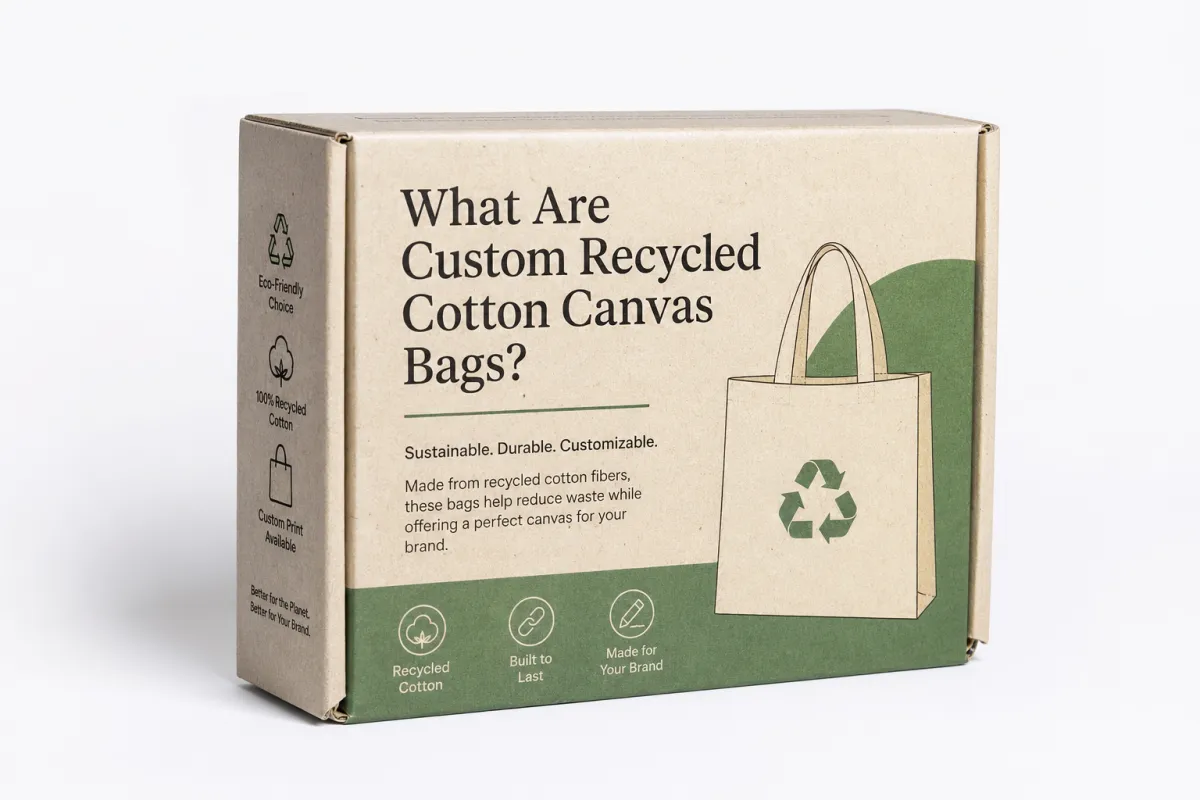
What Are Custom Recycled Cotton Canvas Bags?
The first time I saw a bin of cotton offcuts in our Shenzhen facility, it looked like waste headed for a container and then a landfill. Frayed edges. Dust. Odd blue-and-beige scraps mixed together like the leftovers from a factory cutting room in Dongguan. I remember thinking, “That pile will never become anything useful.” Then I watched those scraps get sorted by fiber length, shredded, and spun back into fabric, and the finished custom recycled cotton canvas bags felt better in the hand than many bargain virgin-cotton totes I have touched over the years.
That is the part most buyers miss. Custom recycled cotton canvas bags are not just “eco totes” with a green label and a leaf icon. They are usually made from recovered cotton fibers pulled from pre-consumer cutting scraps, post-consumer textile waste, or a blend of both, then re-spun into canvas for retail, events, and branded merch. Some suppliers blend in a small amount of recycled polyester, often around 10% rPET, to improve tensile strength and reduce breakage during weaving. The finished bag carries a more honest waste story, and the texture usually tells you the material was recovered instead of newly grown, which is the whole point.
Recycled cotton is not organic cotton, and it is not the same thing as standard cotton canvas either. Organic cotton tells you how the fiber was grown, often on certified acreage in places like India or Turkey. Standard canvas tells you almost nothing beyond weave and weight. Recycled cotton tells you the fiber came from recovered material, and that changes the story, the feel, and the price. In practice, custom recycled cotton canvas bags often show a softer matte finish, a speckled surface, and slight shade variation that is normal, not a defect. On a 10 oz or 12 oz bag, that variation is often the visual proof that the material was actually recovered. I always ask suppliers for the composition, the recycled-content claim, and any supporting paperwork; not every “recycled” bag is backed by clean documentation, and that is where claims can get kinda fuzzy.
I think that variation gives the bag some character. A brand choosing custom recycled cotton canvas bags is usually trying to say something sharper than “we ordered another disposable giveaway.” The goal is a bag that feels intentional, prints cleanly, and supports retail packaging or branded Packaging Without Looking throwaway. I have seen a trade show booth in Las Vegas go from forgettable to memorable because the tote on the counter used a 12 oz recycled canvas and a tight one-color logo instead of a flimsy, overprinted promo bag. Small thing. Weirdly big effect.
There is also a practical side. Custom recycled cotton canvas bags handle retail carry, conference swag, gift packaging, and product packaging insert programs with real credibility. They can carry books, apparel, and boxed goods if you Choose the Right fabric weight and stitch construction. A 10 oz bag is fine for a t-shirt and a brochure; a 14 oz bag with reinforced handles is better for a hardcover catalog, a candle, and a folded sweater. Give it the right spec, and it earns its keep quickly instead of sagging after one use.
If you are comparing them with other branded packaging options, I usually remind clients that the tote is part of the package branding, not just a container. A bag with a 250 x 250 mm print area, a clean silhouette, and a 10 cm gusset can act like a flyer, a showroom handout, and a walking ad all at once. That is one reason so many teams pair Custom Packaging Products with custom recycled cotton canvas bags instead of treating the bag as an afterthought. I have never once seen a brand regret looking more put together at a launch in New York or Singapore.
How Are Custom Recycled Cotton Canvas Bags Made?
The production chain starts long before anyone approves artwork. Recycled cotton usually begins as pre-consumer scraps from cutting rooms or post-consumer textile waste collected and sorted by color and fiber type. In a typical Shenzhen or Ningbo workflow, those materials get shredded, cleaned, and re-spun into yarn, then woven into canvas on looms that may run 120 to 150 picks per inch depending on the fabric weight. From there, the fabric is dyed, finished, cut, sewn, printed, and packed. It sounds tidy on paper. The factory floor makes it messier, because each step can change the final feel of custom recycled cotton canvas bags.
I remember standing in a sample room in Guangzhou while a technician pulled two bolts of recycled canvas from the rack. Same nominal weight, both labeled 12 oz, both from the same supplier. One had a tighter weave and a smoother face; the other had more slub and frayed at the cut edge like it had a personal grudge against me. That is why I never trust a quote alone. Custom recycled cotton canvas bags can look identical in a PDF and behave very differently in production, especially once a screen printer in Dongguan starts registration on a textured surface.
The biggest quality shifts usually happen in three places: fiber sorting, re-spinning, and weave density. Longer fibers generally make a smoother yarn, which gives you a cleaner print and stronger seams. Shorter fibers can create more slub and a rougher face. Blend ratio matters too. Some recycled cotton canvas is blended with virgin cotton or recycled polyester to improve strength and consistency, and a common ratio is 80/20 recycled cotton to virgin cotton when a buyer wants a cleaner print surface. That is not a problem by itself. It only means You Need to Know exactly what you are buying before you order 5,000 pieces of custom recycled cotton canvas bags. Otherwise you are basically gambling with your launch date, and I do not recommend gambling with launch dates.
Construction choices matter just as much as the fiber. A flat tote is cheaper and lighter. A gusseted tote adds depth and carries better. Reinforced handles stop the bag from feeling flimsy when someone drops in a water bottle and a hardcover catalog. Hemmed edges reduce fraying. Inner pockets, zippers, magnetic snaps, and button closures push the bag into a more premium bracket. Every one of those details affects custom recycled cotton canvas bags in cost and in perceived value. I have seen a single pocket make a tote feel like retail, not freebie-bin leftovers, especially at a store opening in Austin or London.
Decoration is another fork in the road. Screen print is usually the best starting point because it handles most logo work cleanly and keeps the price sensible. For a one-color print on a 5,000-piece run, many factories in Jiangsu or Guangdong quote setup fees around $35 to $80 per color, then print at scale without making the unit price explode. Heat transfer works for more complex graphics, though it can feel less natural on textured canvas if the art is too detailed. Embroidery looks excellent on heavier bags, but it adds labor and can pucker on lighter fabric. Woven labels are a strong finish for premium custom recycled cotton canvas bags when you want the branding to feel retail-ready without shouting.
A normal production flow looks like this:
- Confirm the spec: size, fabric weight, handles, print method, packaging, and delivery location.
- Review artwork and make sure the print area actually fits the bag panel.
- Approve a sample or preproduction sample so you can check stitch line, color, and logo placement.
- Move into bulk production once the sample is signed off.
- Run packing and carton checks before shipment so the finished custom recycled cotton canvas bags arrive without a surprise.
For teams that care about transit durability, I always point them toward the ISTA test standards. A tote is not a corrugated carton, but the logic still applies: if the load fails in transit, the pretty spec sheet does not matter. I once had a client in Chicago ship a 12 oz tote with a sample insert and a ceramic mug, then fail a rough-handling test after two drops from waist height. The first thing we changed was seam reinforcement and handle tape width, not the artwork. The mug survived, which felt suspiciously like the bag had accepted the blame on purpose.
What Drives Custom Recycled Cotton Canvas Bags Pricing?
Pricing starts with the basics: size, fabric weight, handle length, stitch construction, print coverage, and extras like zippers or inner pockets. A 10 oz flat tote with one-color print is a very different animal from a 14 oz gusseted bag with reinforced cross-stitch handles and a woven label. A factory in Guangzhou may quote both as “canvas tote bags,” but the real materials and labor are not even close. That is why two quotes for custom recycled cotton canvas bags can look wildly different and both still be correct.
Here is a realistic pricing snapshot from jobs I have seen or quoted over the last few years. These are not fantasy numbers pulled from a spreadsheet. They are the kind of landed ranges you actually get once a factory accounts for material, labor, and setup on custom recycled cotton canvas bags:
| Bag Spec | Typical Quantity | Estimated Factory Price per Unit | Notes |
|---|---|---|---|
| 10 oz flat tote, one-color screen print | 5,000 pcs | $1.08 - $1.42 | Good entry level for retail packaging or event giveaways |
| 12 oz gusseted tote, two-color print, reinforced handles | 3,000 pcs | $1.55 - $2.05 | Balanced choice for branded packaging and store use |
| 14 oz heavy tote, embroidery, inner pocket | 2,000 pcs | $2.60 - $3.90 | Better for premium merch and retail packaging programs |
| Custom shape, zipper, woven label, full trim package | 1,000 pcs | $3.20 - $4.80 | Higher setup, more labor, and slower sampling |
The recycled angle can add cost compared with a bargain-bin cotton tote, and that surprises people who only skim the headline. Sorting, reprocessing, and tighter quality control are not free. If the supplier is using better fiber separation or a more consistent recycled blend, you will usually pay more, but you will also get fewer ugly surprises in the bulk run of custom recycled cotton canvas bags. I would take a slightly higher price over a mystery pile of weak seams any day, especially if the bags need to survive a three-day conference in Berlin or a retail launch in Seoul.
Setup fees matter more than most buyers expect. A screen charge might run $35 to $80 per color, depending on size and complexity. A preproduction sample can land at $40 to $120, especially if you want zipper testing, color matching, or a revised handle length. Freight can also wreck your math. I have seen a tote quote look fantastic at $1.28 per unit, then jump by 18 percent once carton count, cubic volume, and destination fees were added to the order for custom recycled cotton canvas bags. That part always feels like a prank, but it is usually just freight math doing what freight math does.
MOQ changes the equation too. At 500 units, the factory spreads setup costs across fewer bags, so the price stays stubbornly high. At 5,000 units, that same setup gets diluted hard. This is why small runs often pay a premium and larger runs drop fast. I once negotiated a run where the unit cost fell from $2.14 at 800 pieces to $1.31 at 4,000 pieces just because the same screen, same fabric, and same carton size were reused for custom recycled cotton canvas bags. That kind of drop feels almost unfair until you remember how much setup gets buried inside the first few thousand units.
If you need a sustainability benchmark for the broader claim set, the EPA recycled content guidance is worth a quick read. It will not price your tote for you, but it does help explain why recycled-content sourcing requires cleaner documentation than a generic fabric buy. That matters if your marketing team wants the bag to support a serious waste-reduction story instead of a vague green sticker, especially for retail programs in California or the UK.
“We thought the cheap tote would save us money. It cost us three rounds of revision, a rush sample, and a carton change. The second spec was more expensive on paper, but the landed cost was actually lower.”
Step-by-Step: Ordering Custom Recycled Cotton Canvas Bags
Start with use case. Retail handout, conference swag, grocery-style carry, gift packaging, or premium brand merch. Each one needs a different weight, a different silhouette, and a different tolerance for cost. If the bag has to carry a hardcover catalog and two products, I will spec it differently than I would a lightweight event giveaway. That sounds obvious, but it is exactly where people blow money on custom recycled cotton canvas bags. They picture the nice part and forget the load part, which is how a 6 oz tote ends up pretending to be a 12 oz workhorse.
Next, lock the spec in order. Dimensions first. Then fabric weight. Then handle length. Then closure or pocket details. Then decoration method. Only after that should you ask for quotes. If you send five suppliers a half-finished brief and expect apples-to-apples pricing, you are going to get apples, oranges, and one guy quoting a paper bag. A clean one-page brief is the fastest route to usable pricing for custom recycled cotton canvas bags.
Here is the order I recommend to clients:
- Choose the bag purpose and carrying load.
- Set finished size, gusset depth, and handle drop.
- Pick fabric weight, usually 8 oz, 10 oz, 12 oz, or 14 oz.
- Select print method and number of colors.
- Decide if you need extras like a pocket, zipper, or label.
- Request a sample and review it before bulk production.
The sample stage is where real work happens. I have watched a client approve artwork on a phone screen, then panic when the logo sat too close to the seam on the physical sample. That is normal. A screen view does not show handle interference, stitch allowance, or edge distortion. A preproduction sample lets you inspect color, stitch quality, and logo placement before the factory cuts 3,000 units of custom recycled cotton canvas bags. I always tell people: if you would not trust a blurry photo of your own face, do not trust a blurry mockup of your bag.
Timelines usually break into three parts: sampling, bulk production, and freight. Sampling might take 5 to 15 business days depending on how many revisions you need. Bulk production often runs 12 to 20 business days after proof approval for a simple 10 oz tote, or 20 to 30 business days for a heavier bag with embroidery or a zipper. Freight adds its own clock, and that clock is usually rude. A ship delay from Ningbo or a customs hold at the port of Los Angeles can add another week or two. If your launch date is fixed, say it early. Nobody likes a last-minute panic order for custom recycled cotton canvas bags, and the factory team is not thrilled either.
Comparing suppliers only works if the specs match exactly. Same size. Same fabric weight. Same print method. Same delivery terms. Same packing count. If one vendor quotes FOB Shenzhen and another quotes delivered-to-door in Chicago, the numbers are fake math. I have had brand teams hand me three quotes that looked miles apart, then realize the “cheap” one excluded packing and the “expensive” one included local freight and carton labels. That is not a price difference. That is paperwork wearing a costume on custom recycled cotton canvas bags.
If your broader packaging line matters too, I often suggest aligning the tote with matching branded packaging and custom printed boxes so the customer sees one design language across the whole unboxing moment. That is how package branding starts to feel considered instead of random, especially when the same Pantone appears on both a tote and a folding carton.
Common Mistakes With Custom Recycled Cotton Canvas Bags
The first mistake is assuming recycled cotton should look perfectly uniform. It should not. Minor shade variation, a slightly speckled surface, and occasional fiber flecking are part of the material story. If you expect laboratory-level consistency from custom recycled cotton canvas bags, you are setting yourself up for ugly disappointment and a stack of unnecessary emails. I have seen people complain about “imperfection” in recycled canvas and then ask for a material story in the same breath. That always makes me laugh a little, usually while I am staring at a 12 oz sample from a factory in Jiangsu.
The second mistake is under-specifying fabric weight and stitch construction. A thin tote with a big logo and no reinforcement sounds cheap until the handle tears at the first trade show. I saw that happen on a booth floor in Chicago, after a buyer picked an 8 oz bag for a load that really needed 14 oz and an X-stitch at the handle. The print was beautiful, but the seam was light, the handle drop was short, and the shoulder stress point failed by noon. The fix was simple: heavier canvas, reinforced stitching, and a better handle tab on the next run of custom recycled cotton canvas bags.
The third mistake is choosing a decoration method without checking adhesion and print clarity on the actual fabric. Recycled canvas is textured. That texture matters. Fine-line gradients, tiny serif type, and low-contrast art can disappear into the weave. If your logo needs to be readable from ten feet away, print it bold and keep the palette tight. A one-color black or navy print often reads cleaner than a complicated four-color image on custom recycled cotton canvas bags. That is not drama. That is how fabric behaves in the real world.
The fourth mistake is ignoring shipping weight and carton size. A tote can be light on its own and still cost a lot to move because of volume. Big cartons eat freight. Bad carton counts create surprise charges. I have watched a project go from acceptable to annoying because the packaging team packed the bags two per poly instead of one, and the carton cube jumped enough to hurt the landed cost. On paper, the bags were cheap. On the freight invoice, they were not cheap. Freight has no mercy, which is rude but consistent.
The fifth mistake is approving artwork before checking print area, bleed, and handle clearance. The worst version of this is a logo that lands half an inch too high because somebody forgot the gusset eats into the front panel space. That is the kind of error that makes a factory look careless when the spec sheet was the real problem. I have seen it more than once with custom recycled cotton canvas bags, and every time the root cause was the same: nobody measured the actual panel.
For brands that want a stronger sustainability story, I also suggest asking whether the outer carton, insert card, or tag can be FSC-certified. The bag may be the hero, but the rest of the package branding still matters. If you want a deeper paper trail on that side, the FSC site is a cleaner starting point than a generic marketing claim, especially if your packaging ships through Rotterdam or Hamburg.
Expert Tips for Better Custom Recycled Cotton Canvas Bags
My first tip is simple: use one strong logo hit instead of cluttering the bag with five messages. Recycled canvas already has texture, so it usually looks best when the design is clean and decisive. If your team wants a retail look, resist the urge to cram in a paragraph, three icons, and a slogan that nobody reads. One bold mark on custom recycled cotton canvas bags often sells the idea better than a crowded layout, especially on a 12 oz or 14 oz panel.
Second, match the fabric weight to the brand tier. For premium retail, I usually start at 12 oz or 14 oz. For a conference gift that will be used a few times and then parked in a closet, 8 oz or 10 oz may be enough. Lighter is not always smarter. It is only cheaper on the quote line. If the bag feels flimsy, the whole brand feels cheaper, and that hurts the value of custom recycled cotton canvas bags fast. People notice that stuff even if they cannot explain why, especially when they compare your bag to a 350gsm paper carry bag from a competitor.
Third, ask for seam strength, shrinkage, and color-consistency checks before bulk. Factory promises cost nothing until you test them. I learned that the hard way while visiting a supplier that swore a bag would “hold fine.” We loaded it with 9 kilograms of catalog stock and walked it across the floor. One handle survived. One did not. After that, I started requesting actual load tests and stitch photos for premium custom recycled cotton canvas bags. A little skepticism saves a lot of apology emails.
Fourth, keep the spec sheet short but complete. One page is enough if it includes dimensions, fabric weight, artwork file, print colors, quantity, packaging requirements, and destination zip code. A clean brief saves days of revision. It also gives the supplier less room to interpret your idea creatively, which is another way of saying wrong. When I am sourcing custom recycled cotton canvas bags, I want the factory to spend time making the product, not guessing my intention. A brief with exact handle drop in centimeters is better than a three-paragraph note that says “make it feel premium.”
Fifth, plan for natural variation and make it part of the brand story. Do not apologize for a slightly speckled weave if that is the actual material. Own it. Tell the customer it is recycled fiber. Tell them why the finish looks a little softer. Honest storytelling feels better than pretending every bag rolled off a precision machine. Brands that understand this usually end up with better product packaging, better retail packaging, and fewer complaints about a bag that is doing exactly what it was designed to do.
One more practical note: if your broader rollout includes boxes, tissue, inserts, or mailer systems, pair the tote with matching branded packaging options so the whole kit feels consistent. I have seen that small move lift perceived value more than adding another print color ever did. That is package branding working the way it should, which is refreshing because not every branding decision earns that compliment.
What To Do Next Before You Request a Quote
If you want accurate pricing, build a one-page brief before you start emailing suppliers. Put the bag size, fabric weight, print method, quantity, packaging needs, and delivery location in one place. Include the art file in vector format. Mark logo placement in millimeters, not vibes. That one habit saves a ridiculous amount of time on custom recycled cotton canvas bags, especially if your supplier is in Shenzhen and your team is in Toronto.
Then ask every supplier for three things: unit price, sample timeline, and total landed cost. Not just the unit price. Unit price alone lies by omission. A bag that looks cheap at $1.18 can become a $1.84 headache once sampling, cartons, inland freight, and duty are added. I have watched that happen enough times to stop pretending otherwise with custom recycled cotton canvas bags. It is one of those budget lessons people only seem to learn the hard way.
Compare quotes only after the specs match. If one supplier offers 10 oz canvas, one-color print, and folded bulk packing while another is quoting 12 oz canvas, two-color print, and individual polybags, you are not comparing suppliers. You are comparing three different jobs and calling it procurement. That is how budgets get weird and deadlines get blamed on the wrong department. I have seen the wrong person take the heat more than once, which is never fun, especially when the shipment is already on a truck outside Ningbo.
If you are still deciding between a simple tote and a more finished merch piece, ask yourself one direct question: will this bag be seen once, or used often? If the answer is “used often,” spend the extra money on the fabric weight, the handle construction, and the print method. That is where the value lives. If the answer is “seen once,” keep it clean and practical. Either way, the best custom recycled cotton canvas bags are the ones ordered from a real spec, not a hopeful guess.
My advice is boring because it works: write the brief, request samples, compare landed pricing, and approve only when the actual bag matches the job. If you do those four things, you cut out most of the expensive surprises before they start. That is how custom recycled cotton canvas bags stay useful instead of turning into an expensive lesson. And if somebody on your team says, “Can we just wing it?” feel free to say no on my behalf.
How much do custom recycled cotton canvas bags usually cost?
Pricing depends on size, fabric weight, print colors, and quantity, but simple bags at higher volume are usually far cheaper than fully finished premium totes. On a real factory quote from Guangdong or Zhejiang, I would expect a basic 10 oz tote to start around $1.08 to $1.42 at 5,000 pieces, while heavier or more detailed custom recycled cotton canvas bags climb quickly once you add reinforced handles, extra print colors, or a zipper. The spread is annoying, but it is very real.
How long do custom recycled cotton canvas bags take to produce?
Sampling is often the first bottleneck, then bulk production follows after approval. A normal timeline might be 5 to 15 business days for samples and another 12 to 20 business days for bulk after proof approval, plus freight. If you have a hard launch date, tell the supplier early so they can say whether the schedule is realistic or fantasy for custom recycled cotton canvas bags. I have seen “fast” turn into “why is this still in transit?” more times than I care to count, especially when the port of Ningbo is backed up.
Are custom recycled cotton canvas bags durable enough for retail use?
Yes, if you Choose the Right fabric weight and seam construction for the load they need to carry. For heavier retail items, specify stronger stitching, reinforced handles, and a heavier canvas instead of hoping the bag will magically behave. I have seen custom recycled cotton canvas bags hold up well in stores and trade shows when the spec was built around the actual use case, such as a 12 oz or 14 oz canvas with X-stitch handle reinforcement. That part matters more than the hero photo ever will.
Can I print full-color artwork on custom recycled cotton canvas bags?
Yes, but the print method has to match the fabric texture and your color expectations. Bold logos and simple art usually look sharper on textured canvas than tiny gradients or hairline type. If your artwork is detailed, ask for a sample first so you can see how it behaves on custom recycled cotton canvas bags instead of guessing from a screen. Screens are lovely. Reality is bossy, especially when a four-color image gets pushed onto a slub-heavy 10 oz weave.
What should I send to get an accurate quote for custom recycled cotton canvas bags?
Send dimensions, fabric weight, quantity, artwork file, print placement, closure details, packaging needs, and delivery zip code. If you leave out any of those, you are basically asking the supplier to guess, and guesswork is how budgets get weird. The more complete your brief, the cleaner the quote for custom recycled cotton canvas bags. I would rather spend five minutes making the brief better than five days fixing a bad quote, especially if the supplier is building the bags in Shenzhen and shipping to a warehouse in Los Angeles.