Buyer Fit Snapshot
| Best fit | corrugated tracking labels buyer review for packaging buyers comparing material specs, print proof, MOQ, unit cost, freight, and repeat-order risk where brand print, material, artwork control, and repeat-order consistency matter. |
|---|---|
| Quote inputs | Share finished size, material target, print colors, finish, packing count, annual reorder estimate, and delivery region. |
| Proofing check | Approve dieline scale, logo placement, barcode or warning zones, color tolerance, and any recyclable or compostable wording before bulk production. |
| Main risk | Vague material claims, crowded artwork, or missing packing details can create delays even when the unit price looks attractive. |
Fast answer: Corrugated Tracking Labels Buyer Review: Material, Print, MOQ, and Cost should be specified like a repeatable production item. The safest quote includes material, print method, finish, artwork proof, carton packing, and reorder notes in one written spec.
What to confirm before approving the packaging proof
Check the product dimensions against the actual filled item, not only the sales mockup. Ask for tolerance on folds, seals, hang holes, label areas, and retail display edges. If the package carries a logo, QR code, warning copy, or legal claim, reserve that space before decorative graphics fill the panel.
How to compare quotes without losing quality
Compare board or film grade, print process, finish, sampling route, tooling charges, carton quantity, and freight assumptions side by side. A lower quote is only useful if the supplier can repeat the same color, closure quality, and packing count on the next order.
Review of Smart Corrugated Tracking Labels: Top Picks
Most teams do not lose money because they skipped tracking. They lose money because the label gives up after the carton flexes, picks up dust, rubs a pallet edge, or spends a few hours bouncing in a truck. That is the real test behind any useful review of smart corrugated tracking labels: the labels that matter are the ones that still scan after ordinary warehouse abuse, not the ones that look impressive in a demo deck.
Quick Answer: Review of Smart Corrugated Tracking Labels
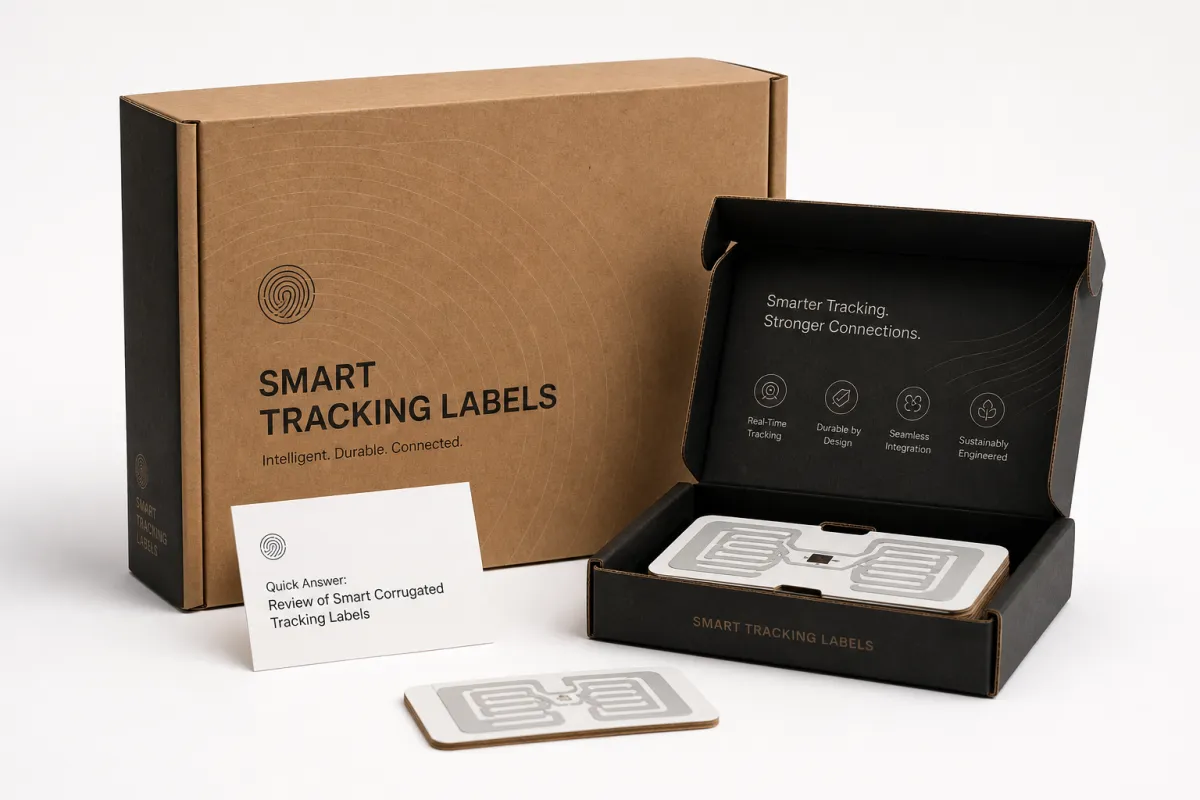
If you need the short version, here it is: the strongest review of smart corrugated tracking labels is not about whichever option claims the most data fields. It is about the label that stays put, scans cleanly, and survives corrugated handling without becoming a support problem. For outbound cartons, retail-ready shippers, returns, and higher-value SKUs, that matters far more than a polished demo screen.
In practice, the strongest options usually sit in three groups. Printed tracking labels with QR or RFID pairing are often the most practical for carton-level visibility. NFC labels fit well when tap-to-read verification matters for receiving or returns. Battery-assisted or sensor-backed smart labels add more data, but they also add cost, setup work, and the kind of complexity that makes warehouse teams sigh before the pilot even starts.
My blunt verdict: the right review of smart corrugated tracking labels measures scan rate, adhesive hold, operator simplicity, and total program cost. A fancy dashboard does not rescue a shipment when the carton leaves the dock with a label lifting at the corner.
That is why the real use case is not just tracking. It is proof of movement, cleaner exception handling, fewer manual lookups, better returns processing, and less debate over whether a carton was ever shipped. Basic systems tend to survive production better than clever ones because basic systems are easier to run when the floor gets busy.
I have watched more than one pilot stall because the label spec looked good on paper but failed after a week on actual corrugated. The issue was not the software. It was the substrate, the adhesive, or a workflow that asked people to do one extra tap too many. That kind of thing sounds small until a dock crew is moving fast and nobody wants to babysit a scan.
“A tracking label that fails on corrugated is not smart. It is just expensive decoration.”
For teams already buying Custom Labels & Tags, the move into smart tracking is usually easier than it seems, as long as the format fits your carton stock and warehouse flow. If you are pairing cartons with branded packaging, the label program should also fit your box spec, which is where Custom Shipping Boxes can reduce surprises later.
Top Options Compared for Smart Corrugated Tracking Labels
The first thing I check in any review of smart corrugated tracking labels is whether the format matches the job. A label can be technically clever and still be a poor fit for a shipping carton. That happens often, usually because sales decks blur features with usefulness.
Here is the practical comparison I would use for a pilot decision. It is not flashy. It is useful.
| Option | Best For | Typical Unit Cost | Strengths | Weak Spots | Verdict |
|---|---|---|---|---|---|
| Printed QR or RFID hybrid labels | Carton visibility, low-cost pilots, fulfillment teams | $0.08-$0.22 | Low entry cost, simple scanning, easy staff adoption | Limited data depth, depends on print quality and scan discipline | Best for cost control |
| NFC-enabled smart labels | Returns, verification, consumer or field tap-read workflows | $0.18-$0.45 | Easy tap interaction, good for identity checks | Shorter read range, handset compatibility matters | Best for tap workflows |
| Battery-assisted or sensor-backed labels | High-value cartons, chain-of-custody, exception tracking | $1.25-$4.50+ | Deeper data, stronger audit trail, condition monitoring | Higher cost, more setup, more integration effort | Best for data depth |
That table captures the main tradeoff: if you only need carton-level movement, do not buy a sensor package that belongs on a pharmaceutical lane. If you need chain-of-custody detail, do not try to save ten cents and then wonder why your team still retypes numbers into a spreadsheet.
The best review of smart corrugated tracking labels for most buyers will place printed QR/RFID hybrid labels in the lead, because they are usually the easiest to pilot and the least painful to adopt. NFC sits in the middle. Battery-assisted labels belong to specific use cases, not to ego.
Here is how I would rank them by buyer profile:
- Small brands and low-volume shippers: start with printed QR or simple RFID tracking. It is easier to train and cheaper to replace.
- Mid-volume fulfillment teams: consider NFC if tap-read verification helps, or hybrid labels if you need broader scan options.
- High-control operations: use sensor-backed labels only when the reporting justifies the extra spend and process work.
Detailed Reviews of Smart Corrugated Tracking Labels
This is the part of the review of smart corrugated tracking labels that actually matters. I am not interested in a clean demo box on a polished table. Corrugated cartons get scuffed, stacked, tilted, dragged, and sometimes stored in rooms that are one bad HVAC day away from feeling like a sauna. The label either survives that or it does not.
In a couple of pilot rooms I have seen, the difference between a label that holds and one that peels was only a few points of adhesive tack and a slightly different release liner. Nobody notices that detail when they are approving artwork. They notice it later, after the first shipment gets stacked under a warm pallet wrap and the corner starts to curl.
Printed QR and RFID hybrid labels
For most carton programs, this is the most practical format. A printed QR gives the operator a visible identifier, while RFID gives you faster bulk reads if your workflow supports it. Good versions hold print clarity well, especially on corrugate with a decent topcoat and a smooth enough liner to carry the image cleanly. Poor versions smear, lose edge definition, or start curling on rough kraft after a few handling cycles.
In this review of smart corrugated tracking labels, the hybrid format earns the best score for basic usability. It is easy to train against, easy to audit, and usually the least likely to blow up your budget. A reasonable adhesive matched to recycled corrugated stock usually does the job. The weakness shows up when the software side is clumsy. If staff cannot scan the code or read the RFID without opening a second tool, adoption falls fast.
What I like: straightforward print prep, decent tolerance for mixed cartons, and a clean path into shipping and logistics workflows. What I do not like: weak adhesive on dusty boards, and vendors who blame scan reliability on software when the real issue is print quality or substrate choice. That excuse gets old quick.
NFC-enabled labels
NFC is useful when you need tap verification rather than long-range inventory scanning. That makes it valuable for returns, retail handoffs, or customer-facing proof of identity. The label itself is usually small, and the read interaction is simple enough that trained staff pick it up quickly. Handset compatibility still matters, because some phones read NFC easily while others behave like they are being asked to file taxes.
In a serious review of smart corrugated tracking labels, NFC gets credit for user friendliness and gets criticized for limited range. If your process depends on a forklift operator reading cartons from six feet away, NFC is the wrong tool. If you want a clean tap-to-confirm flow at packing, receiving, or returns, it can be very efficient.
Its main downside is that value depends on process discipline. If people forget to tap, the system is only as good as the manual follow-through. That is why NFC tends to work better in controlled lanes than in chaotic warehouse zones. It is tidy when the lane is tidy, and kinda annoying when the lane is not.
Battery-assisted or sensor-backed labels
This is where the price climbs and the promise gets louder. These labels can store more data, support condition monitoring, and create a stronger chain-of-custody record. They are useful for high-value goods, sensitive shipments, or programs where a missed scan is costly enough to justify a bigger label bill.
For a review of smart corrugated tracking labels, these are the most impressive on paper and the easiest to oversell. They are also the easiest to buy too early. If your cartons are standard e-commerce outbound boxes, you probably do not need this tier. If you are shipping expensive components, regulated items, or cartons that need exception alerts, then yes, they can earn their place.
The negatives are predictable: higher unit cost, more setup, more integrations, and more training. The best case is a tightly controlled operation with clear reporting rules. The worst case is a team that buys them for “visibility” and then uses a small slice of the features because nobody has time to maintain the workflow.
One thing worth saying plainly: a smarter label does not fix a weak shipping process. If cartons are being repacked three times, or if the scan happens in one building and the carton leaves from another, the label is just carrying the confusion around. Better process first, smarter label second.
The label face stock matters too. Rough recycled kraft, coated white corrugate, and FSC-certified board do not behave the same way. If you use a bright white face and a stronger adhesive, you may get better contrast and a stronger bond, but you also need to think about how the label sits beside the carton graphics. That is where packaging choices start to affect the whole program, not just the label.
For a broader standards mindset, the testing language from ISTA is useful because it pushes you to think about vibration, drop, and handling rather than surface appearance alone. The same logic applies to material sourcing conversations around FSC-certified corrugate when sustainability claims are part of the package.
Cost, Pricing, MOQ, and Quote Reality for Smart Corrugated Tracking Labels
Money is where the review of smart corrugated tracking labels stops being theoretical. Buyers love a low label price until the invoice shows software, encoding, integration, and a sample run that exposes an adhesive problem. Then the “cheap” option suddenly looks expensive.
For budgeting, I would use these rough ranges:
- Simple printed QR tracking labels: $0.05-$0.15 per unit at medium volumes, depending on size, print coverage, and finish.
- Hybrid QR/RFID labels: $0.08-$0.22 per unit, with RFID inlay type and print complexity pushing the range up or down.
- NFC labels: $0.18-$0.45 per unit, often higher if you need tighter encoding or custom face stock.
- Sensor-backed smart labels: $1.25-$4.50+ per unit, and that is before you fully account for software fees.
Those numbers are only the starting point. A realistic review of smart corrugated tracking labels has to include the hidden layers: setup, encoding, pilot support, platform access, API work, and rework if the first artwork proof misses the mark. A vendor can quote a beautiful sticker price and still be the most expensive option in the room.
MOQ is another place where buyers get tripped up. Some suppliers can offer a low unit cost only because they are spreading setup over a larger run. If you need 5,000 labels, the price looks decent. If you only need 500 for a pilot, the quote may look unreasonable. That is normal. It is not the rep being difficult. It is basic economics.
The quote also needs to reflect how your site actually runs. If your team applies labels by hand to dusty cartons at the end of the shift, the adhesive spec should be chosen for that reality, not for a showroom sample. If you apply them inline on a clean, fast packout, the construction can be different. Same label family, different job.
| Cost Component | Typical Range | Why It Moves |
|---|---|---|
| Face stock and adhesive | $0.01-$0.10 per unit | Material grade, carton texture, moisture resistance |
| Inlay or sensor | $0.03-$3.50+ per unit | RFID, NFC, battery, or condition-monitoring requirements |
| Print and encode | $0.01-$0.25 per unit | Variable data, serials, barcode quality, special finishes |
| Software or platform fee | $50-$500+ per month | User count, reporting depth, integration layer, storage |
| Setup and sample charges | $0-$250+ one time | Artwork prep, encoding templates, pilot support, QA time |
A clean quote for a review of smart corrugated tracking labels should show landed cost, not just label cost. Ask for the full picture at your actual volume, including shipping and any recurring platform fee. If a quote does not show where the numbers come from, assume there is a reason.
One more practical point: if you are already buying branded cartons or other printed packaging, it can make sense to coordinate the label program with your other packaging purchases. That is often where the real savings show up, because you can reduce print runs, simplify vendor handoffs, and avoid a last-minute mismatch between carton size and label placement.
Process and Timeline: From Sample to Shipment
A solid review of smart corrugated tracking labels should also tell you how long it takes to buy, test, and launch. A label program is not just a purchase order. It is a process, and the slowest step is usually the one nobody planned for.
Here is the buying path I would expect:
- Sample request: Ask for a few constructions, not just one. Test on your worst carton, not the cleanest sample.
- Data and artwork prep: Confirm dimensions, print requirements, serial logic, and any encoding rule.
- Compatibility check: Make sure the adhesive works on your corrugated finish and your warehouse application method.
- Pilot run: Use 50 to 100 cartons if the program is new. That is enough to catch ugly surprises.
- Approval: Lock the spec only after scan rate, peel rate, and operator feedback are acceptable.
- Production order: Scale once the pilot proves it can survive real handling.
Lead times vary, but these are the ranges I would treat as normal: 7-10 business days for straightforward stock labels, 12-18 business days for custom printed or encoded runs, and 3-6 weeks when software setup, approval cycles, or more complex labeling structures are involved. If someone promises faster than that for a custom build, they may be quoting physical production only and quietly skipping everything else.
Most delays show up in the same places every time. Artwork revisions. Adhesive testing. Barcode validation. Warehouse integration. Someone forgetting that the cartons are a little dusty because the storage area sits next to a dock door. That is why a good review of smart corrugated tracking labels should always mention timing risk, not just label specs.
If your team already has a stable carton format, the process is easier. If the carton itself changes size, flute, finish, or print coverage, plan more sampling. The label does not exist in isolation. It lives on a moving, flexing corrugated surface, and that surface changes everything.
How to Choose the Right Smart Corrugated Tracking Labels
Start with the job. Not the technology. That is the simplest way to keep a review of smart corrugated tracking labels from turning into a shopping spree.
Ask these questions in order:
- What problem are we solving? Carton visibility, returns, proof of movement, exception tracking, or chain-of-custody?
- What carton stock are we using? Kraft, coated, recycled, high-porosity, or mixed board quality?
- How do staff scan it? Handheld, phone, portal, tap-read, or batch read?
- What happens if a label fails? Lost scan, manual correction, customer complaint, or chargeback?
- How much integration do we want? Export file, API, WMS connection, or just a simple dashboard?
A practical review of smart corrugated tracking labels also needs a selection checklist. Mine is simple: substrate compatibility, adhesive strength, handset support, software export options, integration effort, and reorder simplicity. If a supplier cannot answer those six items clearly, move on.
Not every feature deserves a budget line. Some are real. Some are sales glitter. Real features include reliable read rates, serial traceability, and clean exception logs. Noise features include dashboards with too many graphs and no operational value. I have seen plenty of systems that looked smart but did not help the shipping team one bit.
There is also a sustainability angle. If your carton program is already built around FSC-certified board, recycled corrugate, or reduced-material shipping formats, the label choice should support that story instead of fighting it. For teams focused on packaging discipline, the material stack matters as much as the tracking tool. That is where standards from groups like ISTA and sourcing logic from FSC become part of the real decision, not an afterthought.
One rule I use: if the label does not survive handling and get read by normal staff, it is not smart. It is a very expensive sticker. That line sounds harsh because it is true.
I also tell teams to keep one unromantic question in the room: who owns the data after launch? If nobody owns the exceptions, the scan history gets ignored, reports drift, and the label program becomes a novelty. Smart labels only stay smart when somebody is responsible for the boring parts, too.
Our Recommendation and Next Steps for Smart Corrugated Tracking Labels
My recommendation is simple. If you are starting a pilot, choose the least complicated review of smart corrugated tracking labels option that solves one painful problem well. For most brands, that means a printed QR or hybrid QR/RFID format. If your process depends on tap verification, NFC is the better choice. If you need a tighter audit trail or condition data, move up to a sensor-backed system only after the team proves it can maintain the workflow.
For budget pilots, I would not spend heavily on software before you know the label holds. For mid-volume fulfillment, I would prioritize scan rate and operator training over flashy reporting. For higher-control logistics operations, the extra spend can make sense if it cuts manual reconciliation and supports proof-of-movement records.
Here is the rollout path I would trust:
- Order samples and test them on your actual corrugated stock.
- Run a 50 to 100 carton pilot with the real pack line and the real route.
- Measure scan success, edge lift, and peel failure after stacking and vibration.
- Compare the pilot against your current process, not against a vendor promise.
- Train one warehouse lead first, then expand after the label proves itself.
Before you sign, ask vendors four plain questions: What is the MOQ? What is the landed unit cost at our volume? What is the lead time with samples and approval? What software fees keep showing up after launch? If the answers are fuzzy, that is a warning sign. Not a mystery. A warning sign.
For packaging teams already ordering cartons, printed packaging, or branded inserts, the smart label program works best when it fits the rest of the supply chain instead of fighting it. Coordinating the label spec with Custom Shipping Boxes or your broader Custom Labels & Tags order can cut rework and prevent the usual “we forgot to leave room for the tracking label” mess.
My final take: the right review of smart corrugated tracking labels is the one that gets your cartons scanned, your staff moving, and your data cleaned up without turning the warehouse into a software help desk. That is the standard worth paying for.
How do I test smart corrugated tracking labels before a full rollout?
Run them on the exact carton stock, tape pattern, and handling route you use in production. Check scan rate, peel failure, and data accuracy after vibration, stacking, and temperature swings. Compare pilot results to a simple baseline: current process vs smart label process, not just vendor promises. That is the only test that tells you whether your review of smart corrugated tracking labels is going to hold up in real life.
What is the typical price range for smart corrugated tracking labels?
Simple tracking labels can start at a low per-unit cost, but software and setup fees often change the real price. Higher-function labels cost more when they include better inlays, encoding, or tighter QA. Ask for landed cost at your actual volume so the quote reflects the full program, not just the sticker. That keeps the review of smart corrugated tracking labels grounded in actual spend instead of marketing math.
Do smart corrugated tracking labels work on rough kraft cartons?
Yes, but only if the adhesive and face stock are chosen for rough, recycled, or coated corrugate. Weak adhesives can fail on dusty or textured cartons even when the label itself is technically fine. Test on your worst-case carton, not the clean sample the rep sends first. That is standard practice in any serious review of smart corrugated tracking labels.
What is a reasonable lead time for custom smart tracking labels?
Standard formats can move faster than fully customized builds, especially when artwork and encoding are simple. Lead time usually expands when you need software setup, approvals, or a new adhesive construction. Build in extra time for samples and pilot approval before you commit to production. A practical review of smart corrugated tracking labels should always budget time for the ugly parts, because that is where delays hide.
Are smart corrugated tracking labels worth it for smaller shipping volumes?
They can be worth it if one lost carton, chargeback, or manual lookup costs more than the pilot. Smaller teams should start with the simplest format that solves one painful problem well. If the workflow gets more complicated than the problem it solves, skip it and save the budget. That is usually the smartest ending to a review of smart corrugated tracking labels.

