Buyer Fit Snapshot
| Best fit | Rigid Boxes Comparison projects where brand print, material claims, artwork control, MOQ, and repeat-order consistency need to be specified before quoting. |
|---|---|
| Quote inputs | Share finished size, material target, print colors, finish, packing count, annual reorder estimate, ship-to region, and any compliance wording. |
| Proofing check | Approve dieline scale, logo placement, barcode or warning zones, color tolerance, closure strength, and carton packing before bulk production. |
| Main risk | Vague material claims, crowded artwork, missing packing details, or unclear freight terms can make a low unit price expensive after revisions. |
Fast answer: Rigid Boxes Comparison: Materials, Cost, and Use Cases should be specified like a repeatable production item. The safest quote records material, print method, finish, artwork proof, packing count, and reorder notes in one written spec.
Production checks before approval
Compare the actual filled-product size with the drawing, then confirm tolerance on folds, seals, hang holes, label areas, and retail display edges. Reserve space for logos, QR codes, warning copy, and material claims before decorative graphics fill the panel.
Quote comparison points
Review material grade, print process, finish, sampling route, tooling charges, carton quantity, and freight assumptions side by side. A quote is only useful when the supplier can repeat the same color, closure quality, and packing count on the next order.
Rigid Boxes Comparison: Materials, Cost, and Use Cases
A rigid boxes comparison can look simple on a spreadsheet and still go sideways in the room where samples are being handled. I have watched teams choose the prettier mockup, only to discover later that the lid drags, the insert shifts, or the freight bill makes the box feel a lot less premium than it looked in proof. Same dimensions, different result. That is the odd little truth of rigid packaging: the details do the heavy lifting.
Rigid boxes are set-up boxes built from thick paperboard or greyboard, then wrapped in printed, coated, or specialty stock so they keep their shape and present cleanly in hand or on shelf. That construction is why they feel premium, but the premium effect is not just about vanity. A careful rigid boxes comparison helps a brand decide whether the structure supports the product, the budget, and the schedule without creating avoidable friction. For a brand like Custom Logo Things, the question is rarely only about appearance; it is about whether the packaging earns its keep in the supply chain.
The most useful rigid boxes comparison looks at fit, protection, shelf presence, perceived value, and the way the package behaves during packing, storage, and freight. It also needs to account for the cost drivers that actually show up on the quote: board caliper, wrap paper, insert type, print coverage, and finishing. Compare those pieces honestly and the right format usually starts to reveal itself pretty fast.
From a packaging buyer's point of view, the strongest rigid boxes comparison is not the one with the glossiest finish. It is the one that matches the product story and still makes sense once labor, freight, warehousing, and rework are added in. That is the lens used here.
A rigid box should justify itself twice: once by protecting the product, and again by making the buyer feel the value before the product is even visible.
Rigid Boxes Comparison: What It Really Means
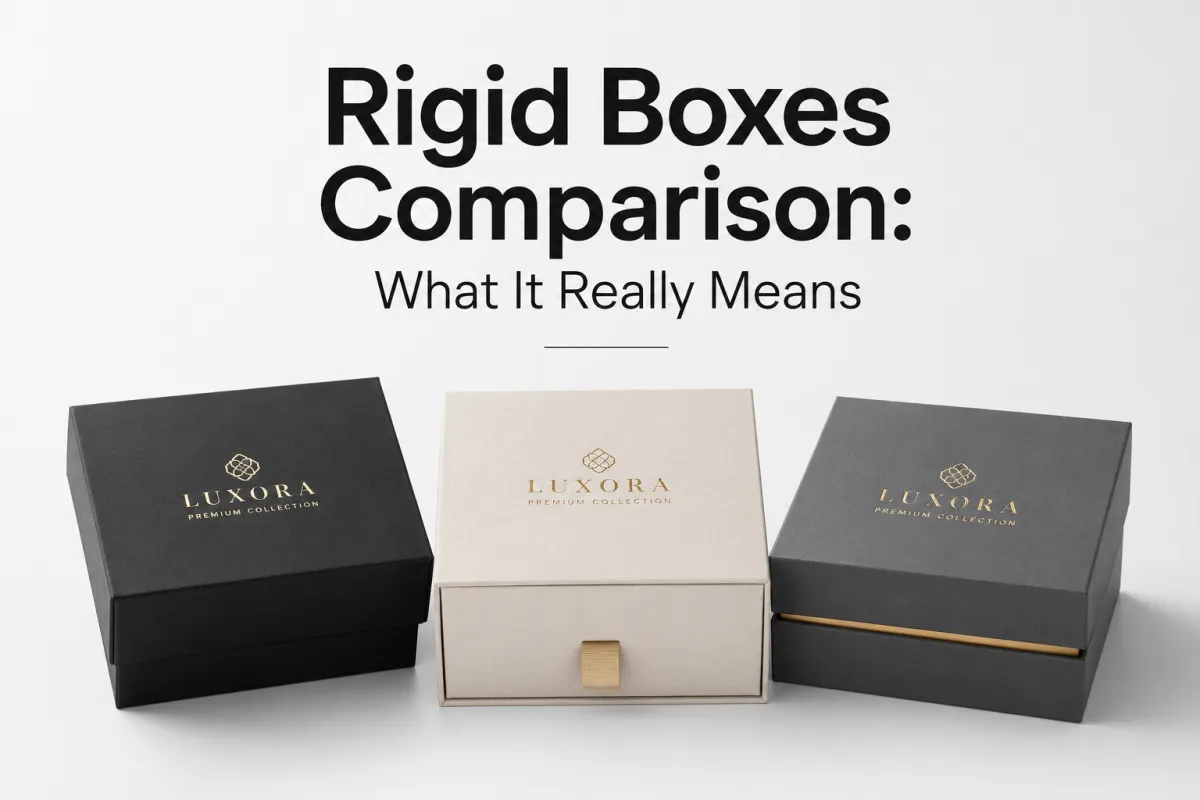
The phrase rigid boxes comparison gets used loosely, but the actual decision is much more practical than it sounds. It is not only a matchup between matte and gloss, or between one printed design and another. It is a comparison of structure, hand feel, warehouse footprint, production method, and how well the box supports the product from the moment it is packed to the moment it is opened.
Two boxes can share the same outer dimensions and still perform very differently. One might use 2 mm greyboard with a 157 gsm art paper wrap. Another may use 3 mm board, a textured specialty paper, and an EVA foam insert. On the spec sheet, both qualify as rigid boxes. In a real rigid boxes comparison, though, the first may feel restrained and efficient while the second reads heavier, more ceremonial, and better suited to a higher-priced item. Customers notice that difference immediately, even if they cannot name the materials.
Rigid packaging shows up most often in categories where presentation has commercial weight: cosmetics, electronics, premium apparel, gift sets, subscription kits, and launch items that need a stronger first impression than a folded carton can usually deliver. In those categories, a rigid boxes comparison becomes part brand strategy, part logistics planning, and part cost control. A package can look beautiful and still fail if it strains the budget or slows fulfillment.
There is a simple test worth using. Does the box protect the product? Does it reinforce the brand story? Does it fit the shipping and storage plan? Does the premium feel justify the added material and labor? If the answer is yes across the board, the format is probably doing real work rather than decorative work.
If you want a wider view of available formats, it also helps to review the rest of the Custom Packaging Products lineup alongside rigid packaging. Many brands use rigid boxes with folding cartons, inserts, or mailers depending on the SKU, channel, and margin profile.
How Rigid Boxes Work Compared With Other Packaging
A rigid boxes comparison starts with construction. The shell is usually made from chipboard or greyboard, then wrapped with printed paper, textured stock, foil-finished paper, or specialty liner material. Folding cartons collapse flat after die-cutting and gluing. Rigid boxes are built as set-up boxes, wrapped around board, and assembled into a structure that already carries a premium feel. That stiffness is the point, but it also means more board, more adhesive, and more hand assembly in many programs.
Comparing rigid packaging with folding cartons is really a comparison of two production philosophies. Folding cartons are scored, glued, and shipped flat so they can be erected later. Rigid boxes are constructed into their final shape before they leave production. That build method changes labor, storage, and the way the package holds up over time. A rigid boxes comparison that ignores that distinction misses the part operations teams care about most.
Several rigid box formats deserve side-by-side comparison:
- Magnetic closure boxes - popular for electronics, luxury gifts, and kits where the lid feel matters.
- Two-piece lift-off lid boxes - common for apparel, candles, cosmetics, and presentation sets.
- Drawer-style boxes - often used when the reveal is part of the product experience.
- Shoulder boxes - good for products that need alignment, a snug reveal, and a more architectural look.
- Hinged book-style boxes - useful for launch kits and items that benefit from a story-driven opening sequence.
Each style changes the rigid boxes comparison in a meaningful way. A drawer box adds motion and ceremony, but it usually needs tighter dimensional control. A two-piece box is simple and elegant, though it can rattle if the product is undersized. A magnetic closure box feels refined, yet the closure hardware and panel construction often push the price up. The right format depends on what the product needs to communicate before the customer touches it.
Compared with corrugated mailers or standard cartons, rigid boxes usually deliver higher perceived value because of wall thickness and cleaner construction. The trade-off is just as real: they cost more, take up more space, and tolerate bad dimensions less gracefully. A smart rigid boxes comparison respects both sides instead of treating premium packaging like a free upgrade.
Key Factors in a Rigid Boxes Comparison
The Best Rigid Boxes comparison starts with board and wrap selection. Board thickness usually falls between 1.5 mm and 3 mm, and that difference is easy to feel in hand. Thicker board adds stiffness and durability, but it also adds weight, material cost, and a bit more resistance during assembly. Wrap paper matters too, because a smooth coated sheet prints differently from a textured specialty paper, and each one changes how corners and edges finish after wrapping.
Board and Wrap
A 2 mm greyboard with a 157 gsm printed art paper wrap can work well as a middle-ground choice for many retail programs. For heavier products or a package that needs a more substantial feel, 2.5 mm or 3 mm board may be worth the extra spend. A rigid boxes comparison should also ask whether the wrap is CMYK only or enhanced with spot color, foil, embossing, or soft-touch lamination. Each choice changes the look and the cost structure, sometimes more than buyers expect.
Edge behavior gets overlooked more often than it should. A premium finish does not stay premium if the corners crack, the paper pools at the folds, or seams show glue. That is why a rigid boxes comparison should consider not only the mockup but also the wrap stock's stretch, grain direction, and adhesion properties. Packaging looks simple until it has to survive a production run of 5,000 units and a warehouse that is moving fast.
Inserts and Protection
Inserts are where a rigid boxes comparison becomes concrete. EVA foam gives strong product hold and a polished silhouette, though it is not always the best fit if sustainability is a top priority. Molded pulp can be a better option for a recyclable story and solid cushioning, while paperboard fitments are often easier to print, fold, and recycle. Some brands use thermoformed trays or chipboard partitions when the product set has multiple components that need orderly placement.
The right insert should hold the product still without making the box oversized. Too loose, and the item shifts while the unboxing feels careless. Too tight, and the customer struggles to remove the product or scuffs the finish while trying. A strong rigid boxes comparison weighs protection against usability, because a box that frustrates the customer is not doing its job.
Finishes and Brand Signal
Finishing can change the tone of a rigid boxes comparison more than almost any other detail. Soft-touch lamination gives a velvety hand feel and usually reads as more upscale. Foil stamping adds shine and draws attention to logos or focal marks. Embossing and debossing create tactile depth. Spot UV can highlight a pattern or logo, though it works best when the art direction is already disciplined. Specialty textures can be memorable, but they also demand cleaner production control.
Surface hierarchy matters. Which side gets the first visual hit? Is the lid the hero, or does the side panel matter more on shelf? Does the inside need print, a message, or a reveal? A good rigid boxes comparison includes those branding decisions because the customer experiences the package in sequence, not all at once.
For technical validation, some teams align their transit testing with ISTA test methods, especially if the package needs to survive drops, vibration, or parcel handling before the customer sees it. That discipline gives the rigid boxes comparison more credibility because the decision is based on performance rather than visuals alone.
How Do You Compare Rigid Boxes for the Best Fit?
The simplest way to Compare rigid boxes is to rank them against three questions: does the structure protect the product, does the finish match the brand, and does the total cost fit the program? A clear rigid boxes comparison should also account for labor, freight, storage, and the unboxing experience, because those factors can change the real value more than the quoted unit price.
Start with the product's physical needs. If the item is fragile, heavy, or shipped with accessories, the insert and board grade matter first. If the item lives on a retail shelf or inside a gift set, shelf presence and opening sequence may matter more. Once the priority is clear, compare each rigid box style against the same measuring stick. That keeps the rigid boxes comparison focused and stops decoration from distracting the team too early.
It also helps to compare samples in hand. Renderings can hide awkward lid tension, loose drawer motion, or a closure that feels too stiff. A physical sample reveals the truth in a few seconds. That is often the moment when a rigid boxes comparison becomes obvious.
For teams building a broader packaging line, the comparison should extend beyond the hero box. Matching inserts, mailers, and secondary cartons can reduce friction in fulfillment and improve the overall product story. A rigid boxes comparison works best when it sits inside a complete packaging system rather than standing alone.
Rigid Boxes Comparison: Cost, Pricing, and Timeline
Cost is where a rigid boxes comparison becomes tangible. The main drivers are box size, board thickness, wrap stock, insert complexity, print coverage, finishing steps, and quantity. A small run with heavy decoration can come surprisingly close to a larger run with simpler construction, because setup labor, hand assembly, and finishing overhead do not disappear just because the order is small.
As a working framework, plain rigid boxes in modest quantities often land in a different price band than boxes with specialty wrap, foam inserts, magnetic closures, and multi-step decoration. As a ballpark, a simple two-piece rigid box at 1,000 units might run roughly $1.60-$3.25 per unit depending on board, wrap, and print coverage, while a more complex drawer box with insert and foil detail may move into the $2.75-$5.50 range or higher at the same quantity. At 5,000 units, those numbers can drop noticeably because setup cost is spread across more pieces. Every rigid boxes comparison should be quoted with the same assumptions, or the numbers will mislead you.
A structured checklist keeps quote review from turning into guesswork. Ask what board grade is included, what wrap stock is specified, whether the insert is EVA foam, molded pulp, or paperboard, what finishing is included, and whether the supplier is quoting assembled units, nested components, or flat-packed kits. That is the difference between a useful rigid boxes comparison and a misleading one.
| Rigid Box Style | Typical Use Case | Common Price Range per Unit | Typical Lead Time | Notes |
|---|---|---|---|---|
| Two-piece lift-off lid | Gift sets, apparel, candles | $1.40-$3.25 | 10-15 business days after proof approval | Straightforward rigid boxes comparison option, often the easiest to scale. |
| Magnetic closure | Cosmetics, electronics, premium kits | $2.10-$4.80 | 12-18 business days after proof approval | Closure feel and board alignment matter a lot. |
| Drawer-style | Jewelry, accessories, launch kits | $2.75-$5.50 | 14-20 business days after proof approval | Often chosen for reveal-driven presentation. |
| Shoulder box | Luxury retail, curated sets | $2.40-$5.25 | 12-18 business days after proof approval | Snug fit and clean reveal make a strong impression. |
Those ranges are not universal, and they should never replace a supplier quote, but they do help a buyer frame the discussion. A rigid boxes comparison becomes much more useful when everyone is talking about the same board thickness, the same print method, the same insert complexity, and the same quantity. If one quote includes assembly and another assumes the customer will build the inserts in-house, the comparison is not fair.
Timeline is another point where rigid packaging differs from folding cartons. Because the boxes are built rather than simply folded flat, there is usually more proofing, more hand assembly, and more time for adhesive cure or wrap finishing. A realistic rigid boxes comparison should allow time for sampling, proof approval, production, quality checks, and freight. For many custom programs, 12-15 business days after proof approval is a reasonable estimate for simpler builds, while more complex boxes can stretch beyond that depending on finishes and material availability.
If sustainability is part of the buying decision, checking the fiber claims against a recognized standard is worth the time. The FSC program is one of the clearest references for responsibly sourced paperboard and wrap stock, and it gives a rigid boxes comparison more credibility when you need to justify material choices to procurement, retail, or compliance teams.
Step-by-Step Rigid Boxes Comparison Checklist
A good rigid boxes comparison gets easier when it follows a fixed sequence. Start with the product itself. Measure the item at its widest, tallest, and deepest points, then include accessories, chargers, cards, or retail components that travel with it. A box that is two millimeters too tight creates friction. A box that is too generous can make an expensive product look lost inside the cavity.
- Define the product profile. Record dimensions, weight, fragility, and whether the item ships direct to consumer, to retail, or both.
- Choose the box structure. Decide whether the best rigid boxes comparison points toward a two-piece box, magnetic closure, drawer, shoulder box, or book style.
- Select the insert method. Compare EVA foam, molded pulp, paperboard, or tray systems based on protection, sustainability, and assembly speed.
- Review the finish stack. Compare lamination, foil, embossing, debossing, spot UV, and texture only after the structure is settled.
- Request samples or mockups. Check lid alignment, insert fit, opening force, and edge quality in hand rather than relying on renderings alone.
- Compare full quotes. Make sure every rigid boxes comparison quote includes the same assumptions for board, print, insert, assembly, and freight.
- Validate the schedule. Confirm proofing, sample approval, build time, and shipping windows before the order is released.
That sequence keeps the discussion grounded. Too many teams jump straight into decoration, then discover the insert is weak, the box is oversized, or freight has climbed because the design was never storage-friendly. A disciplined rigid boxes comparison prevents those problems before they turn into costly change orders.
Testing multiple constructions side by side is worth the effort. A physical mockup often reveals what a CAD file or quote sheet will not. The magnetic flap may feel too stiff. The drawer may slide too loosely. The lid may feel more premium than the cost delta suggests. A rigid boxes comparison based on samples tends to be more reliable than one based on renderings alone.
For teams building a wider packaging program, it helps to review matching formats on the Custom Packaging Products page so the rigid box can work with shipping mailers, inserts, and secondary packaging rather than fighting them. The cleanest rigid boxes comparison is the one that fits the whole system, not just the hero carton.
Common Mistakes in a Rigid Boxes Comparison
The biggest mistake is comparing unit price only. A lower number can hide thinner board, a weaker closure, a less precise print process, or an insert that looks fine on a drawing but performs badly in production. A serious rigid boxes comparison should always show what is included, because the cheapest quote on paper is not always the least expensive box in practice.
Ignoring freight and storage is another problem. Rigid boxes usually ship and store as assembled units or nested components rather than as fully collapsed cartons, so the warehousing footprint can be meaningful. If the fulfillment team has limited space, that may change the final decision. A rigid boxes comparison should include the operational footprint, not just the carton itself.
Oversizing is easy to miss too. A package that looks elegant in a render can waste board, increase material spend, and let the product rattle during transit. That slack undermines the premium impression quickly. A better rigid boxes comparison asks whether the design is efficient as well as attractive.
Finish selection can create headaches as well. Some foil and texture combinations behave differently on coated versus uncoated wrap stocks, and soft-touch lamination can mute color if the artwork was not built with that in mind. That is why a rigid boxes comparison should never lock in decorative details before the production method is settled. Sequence matters.
Finally, sustainability claims need to match the actual materials. If the box uses recyclable board but a problematic insert or mixed-material laminate, the story gets muddy. Comparing FSC-certified board, paper-based inserts, and realistic end-of-life options gives the rigid boxes comparison more integrity and keeps the brand from overclaiming. For a brand that cares about credibility, that matters as much as the visual finish.
Expert Tips for Making the Right Choice
The most useful rigid boxes comparison starts by naming the moment that matters most. Is the goal shelf impact, gift presentation, ecommerce unboxing, or product protection during transit? Once that priority is clear, the construction choices get easier. A box built for retail display is not automatically the best box for parcel shipping, and a shipping-first package does not always have the refinement a luxury launch needs.
Use prototypes to compare real feel, not just specs. A paperboard insert may be lighter and cleaner than foam, but foam might hold a fragile product more securely. A magnetic closure may elevate the opening experience, but a two-piece box can be faster to pack and easier to store. A thoughtful rigid boxes comparison looks at those trade-offs without forcing one format to do every job.
Reserve the most expensive embellishments for the surface the customer sees first. If the lid is the hero, put the budget there. If the inside reveal drives the experience, spend on the interior print or insert. That kind of discipline keeps the rigid boxes comparison balanced, because not every square inch needs the same amount of decoration.
Think about what happens after purchase. Some customers keep rigid boxes for storage, gifting, or reuse, which can extend the brand presence far beyond the first opening. Others discard the package quickly, so the structure has to justify itself immediately. A practical rigid boxes comparison accounts for that behavior and does not assume the box will live a showroom life forever.
I have seen teams win with a surprisingly simple build because the product itself was already doing the heavy lifting. I have also seen a budget swell because the packaging tried to carry too much personality on its own. That is the part nobody loves hearing, but it is usually true: the right box is the one that makes the product look more intentional, not the one that shouts the loudest.
Here is the clearest way to close the loop: build a comparison sheet, gather samples, request detailed quotes, align on timeline, and choose the version that fits the product, the budget, and the brand value you want to signal. If you are staring at three samples on a table, start by eliminating the one that misses fit or freight, then choose between the remaining two based on how the box behaves in hand. That is the actionable takeaway, and it usually keeps the decision from drifting into guesswork.
Honestly, the right answer is not always the most ornate one. Sometimes the best rigid boxes comparison leads to a cleaner two-piece setup with a smart insert and a sharp print finish. Sometimes it points to a more elaborate magnetic box because the product needs the ceremony. Either way, the final choice should be grounded in fit, function, and the customer experience the brand is trying to create.
Frequently Asked Questions
What should I compare first in a rigid boxes comparison?
Start with product size, weight, and fragility so the box structure matches the real packaging need. Then compare board thickness, insert type, and closure style, because those three choices have the biggest impact on protection, feel, and the overall rigid boxes comparison outcome.
Are rigid boxes always more expensive than folding cartons?
Usually yes, because rigid boxes use thicker board, more labor, and more assembly steps. The value in a rigid boxes comparison comes from stronger structure, better presentation, and a more premium customer experience, not from being the lowest-cost option.
How do I compare rigid box pricing from different suppliers?
Check whether the quotes include the same board grade, wrap stock, printing method, inserts, and finishing. Ask for a clear breakdown of setup charges, unit cost, assembly assumptions, and freight so the rigid boxes comparison is based on the same terms on both sides.
What affects rigid box production timeline the most?
Sample approval, material availability, and the amount of hand assembly are usually the biggest schedule drivers. Complex finishes or custom inserts can add time, so confirm the workflow before you approve the order and build the rigid boxes comparison around a realistic production window.
Which products benefit most from rigid boxes?
Premium cosmetics, electronics, gift sets, luxury accessories, and subscription kits often benefit because the packaging adds protection and perceived value. Any product with a strong unboxing moment or higher price point can be a good fit if the packaging supports the brand story, and that is where a careful rigid boxes comparison pays off most clearly.


