If you are sourcing a Satin Care Labels Manufacturer private label partner, the first thing to understand is simple: a care label is judged on the garment, not in the mockup. If it scratches, curls, fades, or becomes unreadable after washing, the cost shows up later in returns, complaints, and rework.
Satin care labels sit in a narrow but demanding category. They need a soft hand-feel, clear print, durable construction, and enough room for required information. That is why the brief matters so much. A vague request often produces a label that looks fine on screen and fails in production.
Private Label Sourcing usually means the supplier manufactures to your specifications: your logo, wording, fold style, finishing, and often packaging. The factory controls the production method; you control the brand content and commercial requirements. That only works when the buyer supplies exact specs.
What a satin care labels manufacturer private label actually handles
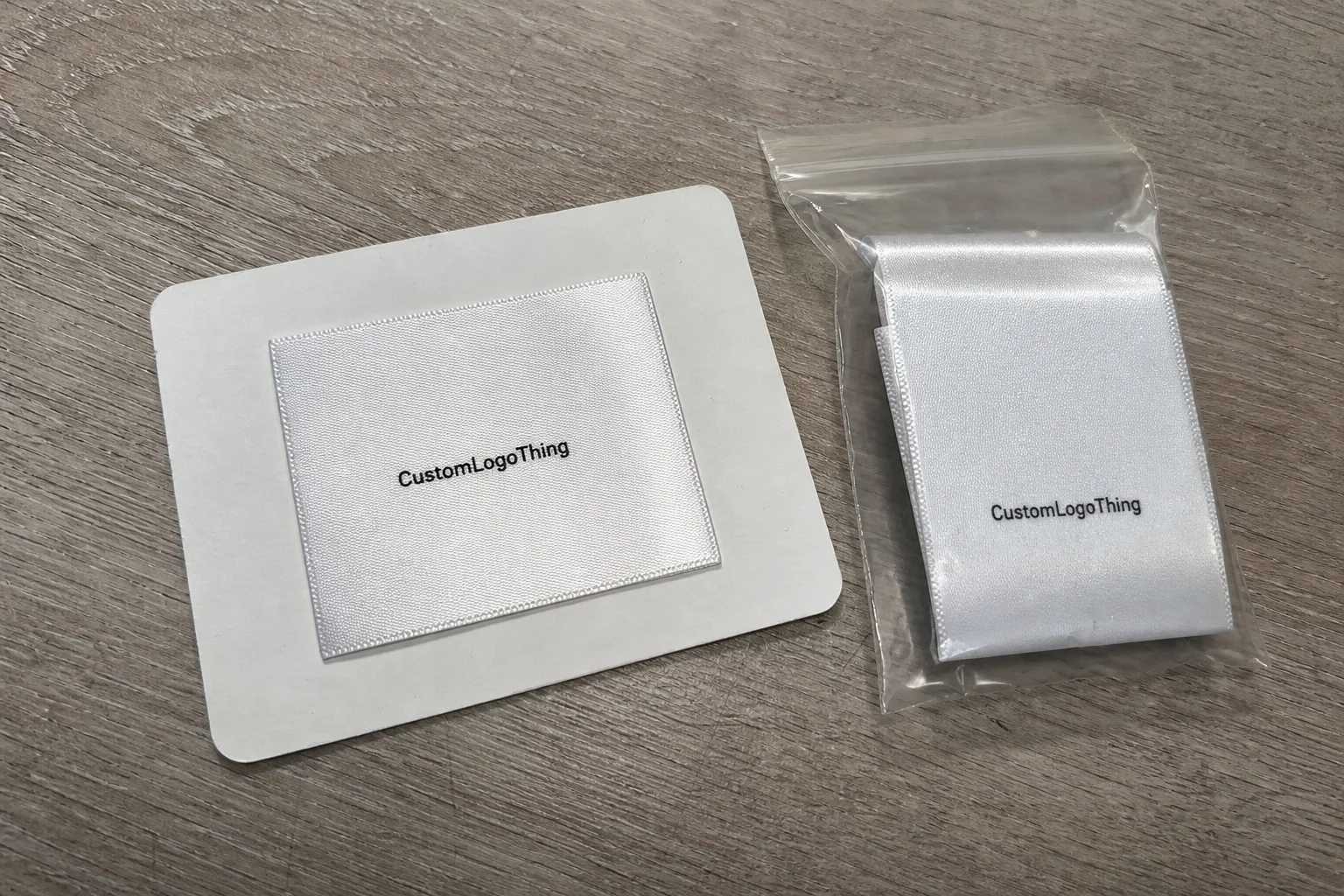
A satin care labels manufacturer private label supplier should do more than print a logo and ship a roll. The useful part of the service is translating brand artwork into a label that can be sewn into garments at scale. That includes material selection, print method advice, fold guidance, and basic layout checks.
Most satin care labels are made from a smooth woven or printed satin stock chosen for comfort and readability. Buyers in lingerie, children’s apparel, sleepwear, athleisure, and premium basics often prefer satin because it is softer against skin than harsher label materials. The comfort difference is small in a sample and obvious in wear.
Private label support should also catch practical issues before production starts: whether care symbols have enough space, whether multilingual copy fits, and whether the text will still read clearly after folding and stitching. Those are the details that separate a workable spec from an expensive remake.
Soft is not enough. A care label has to stay readable, stay intact, and stay comfortable after the garment enters real use.
A good supplier should explain the tradeoff between printed satin and woven-look satin. Printed satin often handles text-heavy labels better because it supports finer detail and faster setup. Woven-look options can feel more textile-like, but dense copy can reduce clarity and raise cost. For compliance-heavy labels, readability should come first.
- Material options: printed satin, woven-look satin, satin blends
- Print methods: thermal transfer, screen print, digital print depending on content and volume
- Fold styles: end fold, center fold, book fold, straight cut
- Branding support: logo placement, packaging, carton labeling, SKU grouping
Good suppliers also spot obvious problems early: awkward line breaks, symbols too close to the edge, or a size that leaves no room for mandatory information. That kind of feedback is part of the job, not an extra.
How the private label labeling process works
The process is usually straightforward: inquiry, artwork review, proof approval, manufacturing, finishing, and shipment. The difficult decisions happen before anything is made. Most delays start with missing information, not with the machines.
Buyers often underestimate how much information a small label still has to carry. A 25 mm x 40 mm label can disappear into a garment quickly, but that does not mean the copy can be vague or cramped. If the layout looks crowded in proof, it will be worse after folding and sewing.
When requesting a quote from a satin care labels manufacturer private label supplier, the strongest briefs include the label size, fold style, exact content, vector logo file, quantity per style or size, and attachment method. Sewn-in labels and heat-applied labels behave differently, so that detail matters. A quote based on guesses usually turns into a revision loop.
- Label size in millimeters or inches
- Fold type
- Exact content copy
- Logo file, ideally vector
- Quantity per size or per style
- Application method, such as sewn-in or heat-applied
The distinction between printed satin and woven-look satin matters more once content gets dense. Printed satin usually gives a cleaner result for small type, care icons, and multilingual lines. Woven-look options may look more textile-like, but texture can reduce detail sharpness.
Proofing is the step most often rushed. A proper proof check should cover color accuracy, font legibility at actual size, symbol alignment, washability expectations, edge placement, and the way the text reads after the chosen fold is applied. What looks balanced in a PDF can become cramped at production scale.
Review the label as a production component, not as a graphic design piece. If the layout only works when enlarged on screen, it is not finished.
For sourcing context and broader packaging or labeling considerations, the Packaging Machinery Manufacturers Institute and the U.S. Environmental Protection Agency can be useful references when sustainability, packaging handling, or materials questions overlap with trim decisions.
Cost, pricing, MOQ, and unit cost factors
Pricing for satin care labels is shaped by size, print coverage, fold style, finishing, quantity, and shipping terms. The less predictable part is how quickly the quote changes once the label grows a few millimeters or the content expands to include multiple languages.
For small runs, the unit price sits higher because setup costs are spread across fewer pieces. Mid-volume orders usually bring the price down enough for seasonal programs and repeat styles. Large-volume orders deliver the best unit cost, but they require more upfront commitment.
Here is a practical planning range. It is not a quote, but it helps compare supplier offers that otherwise look hard to read.
| Order Type | Typical Quantity | Approx. Unit Cost | Best For |
|---|---|---|---|
| Small run | 500-2,000 pcs | $0.12-$0.28 | Launches, samples, tight SKUs |
| Mid-volume | 3,000-10,000 pcs | $0.05-$0.14 | Seasonal collections, repeat styles |
| High-volume | 20,000+ pcs | $0.02-$0.07 | Core programs, steady replenishment |
Hidden costs are where comparisons get distorted. Artwork corrections, color adjustments, rush fees, special packaging, and freight can move the final number enough to make one quote appear cheaper than another when it is not. If the supplier cannot break out setup, sampling, production, and shipping, the comparison is not clean.
The right comparison is total landed cost, not just label price. That includes unit cost, tooling or setup, sample cost, freight, and any import charges. A low unit price that arrives too late for garment production is a schedule problem, not a bargain.
For brands managing trim across several categories, it helps to keep care labels, hangtags, and brand tags in one sourcing plan. Our Custom Labels & Tags category is one place to organize those items without splitting the order logic across multiple vendors.
Production steps and lead time from approval to delivery
Once the artwork is approved, production typically moves through material preparation, printing, cutting, folding, quality inspection, and packing. For a straightforward satin label order, a common turnaround is 10-15 business days after proof approval. More complex orders take longer, especially when content is dense or finishing is not standard.
The real bottleneck is usually approval, not machine time. A missing fiber-content line, a last-minute logo move, or a revised wash symbol can push the schedule back by days. A factory can only produce what has been signed off.
Rush service exists, but it comes with tradeoffs. Expect higher pricing, fewer finish options, and less room for correction. Multilingual labels, custom folds, or special packaging stretch the schedule further. Shipping matters as well: air freight shortens transit but adds cost; sea freight lowers transport cost but adds weeks.
For overseas production, the buyer has to plan for review time, not just manufacturing time. A label order that lands after garment cutting or sewing has started can create rework across labor, inventory, and shipping.
Simple rule: place care label orders before bulk cutting begins. Better yet, finalize them before the garment schedule locks. That gives you time to inspect the actual label format instead of relying on a screen render and an estimate.
If your brand is thinking about transport durability or retail packaging handling, the ISTA guidance can help frame broader logistics expectations, even though care labels themselves are only one piece of the shipment.
How to choose specs that keep labels soft, legible, and compliant
The best satin care label is soft enough not to irritate, readable enough to survive real use, and durable enough to hold up through repeated washing. Those goals compete with one another more than many buyers expect.
Satin usually performs well on hand-feel. It is smoother than many basic woven labels and is often preferred on garments worn close to skin. But gloss can work against thin type or an overloaded layout. A label can look polished in a sample and still read poorly once reduced to production size.
Label size is one of the most practical choices in the spec sheet. A 15 mm x 40 mm label cannot carry the same amount of content as a 25 mm x 70 mm version. If the garment needs care symbols, fiber content, brand name, size, and country of origin, the layout needs room to breathe.
Fold style and attachment matter more than people think
End fold, center fold, book fold, and straight cut each solve a different production problem. End fold works well when the edges need to tuck into a seam. Center fold is common for side-seam placement. Book fold can help organize content on a small label. Straight cut is efficient, but it depends more on clean edges and consistent sewing.
Placement matters too. A neck label, side-seam label, and waistband label face different space limits and comfort expectations. One spec rarely fits every garment category, so a multi-style brand often needs more than one label version.
Compliance basics are not optional
Your label content should match the requirements of the market you are selling into. In many apparel programs, that means care symbols, fiber content, country of origin, and brand identification. The exact rules vary by market and product type, so the final wording should be checked before printing starts.
Print method matters for durability. If the label has to stay readable after repeated washing, ask how the ink or print layer behaves under laundering and abrasion. A sample or pre-production proof is worth the extra time when the label carries a lot of information.
For brands that want more credible sourcing language around packaging and materials, the FSC site is a useful reference point. It does not replace label testing or compliance review, but it helps when sustainability claims need a careful foundation.
Common mistakes buyers make with private label care tags
The most common mistake is trying to fit hangtag thinking onto a care label. Hangtags can carry more visual detail because they are not constrained by comfort, laundering, or long-term legibility. Care labels live inside the garment and have to work under harsher conditions.
Another frequent error is selecting the softest material without testing print quality. A label that feels great but loses detail after folding or washing is not a win.
Timing mistakes are expensive. Buyers often wait until garments are already in production, then ask for urgent labels and faster shipping. That usually increases both production and freight cost.
Skipping sample approval is another easy way to create avoidable problems. Color shifts under shop lighting, type weights change at small size, and spacing that looked balanced on screen can become cramped in print.
- Using oversized artwork on a tiny label
- Ignoring wash durability until after production
- Ordering one layout for multiple garment types
- Approving a proof without checking readability at actual size
- Leaving compliance text until the last minute
Babywear, lingerie, and activewear deserve special attention because comfort and compliance demands are not identical. A layout that works for a sweatshirt may fail on a lightweight undergarment. Different fabrics, seam structures, and wear conditions often call for different label constructions.
Next steps for ordering satin private label labels confidently
Before requesting quotes, gather the essentials: brand logo, label text, target quantity, garment type, size, fold preference, and launch date. If you already know the attachment method and compliance language, the quote becomes more accurate and the revision cycle gets shorter.
Ask each supplier to separate unit cost, setup or tooling, sample cost, and shipping. That makes comparisons much easier. A low unit price can hide a higher setup fee or heavy freight.
If the label contains dense text or regulated information, request a sample or pre-production proof before full production begins. That check catches spelling mistakes, line breaks, symbol placement, and readability issues while they are still inexpensive to fix.
An internal approval checklist helps too. Marketing can confirm brand consistency. Operations can confirm application and quantity. Compliance can confirm required text. That keeps the file from being final three times in one afternoon.
From a practical sourcing standpoint, the best satin care labels manufacturer private label partner is not simply the cheapest one. It is the supplier that asks useful questions, catches bad artwork early, and produces labels that feel right, read clearly, and hold up after repeated use.
FAQ
What does a satin care labels manufacturer private label service include?
Usually custom production under your brand specifications, including size, fold style, print method, and packaging. It often also includes artwork review, proofing, and manufacturing support for care content and branding. Some suppliers offer sample runs or pre-production proofs before the full order is released.
What is the usual MOQ for satin private label care labels?
MOQ depends on size, print method, and finishing. Smaller custom runs usually cost more per label because setup is spread across fewer pieces, while higher quantities reduce unit cost and work better for ongoing collections. Ask for tiered pricing so you can compare realistic order levels instead of estimating.
How long does private label satin care label production take?
Typical turnaround includes proof approval, production, quality inspection, and shipping. Simple orders move faster; custom finishes, multilingual content, or special packaging add time. Approval delays are the most common reason schedules slip.
Are satin care labels durable enough for repeated washing?
Yes, if the material and print method are chosen for the garment’s wash requirements. Legibility, edge finish, and application method matter as much as the fabric itself. A sample or proof is the best way to confirm performance before a full run.
What information should I prepare before requesting a quote?
Prepare logo files, label text, size, fold type, quantity, and target delivery date. Include garment category and any compliance text needed for your market. Clear specifications reduce revisions and make quotations more accurate.


