Buyer Fit Snapshot
| Best fit | Sauce Packaging Pouches Custom projects where brand print, material claims, artwork control, MOQ, and repeat-order consistency need to be specified before quoting. |
|---|---|
| Quote inputs | Share finished size, material target, print colors, finish, packing count, annual reorder estimate, ship-to region, and any compliance wording. |
| Proofing check | Approve dieline scale, logo placement, barcode or warning zones, color tolerance, closure strength, and carton packing before bulk production. |
| Main risk | Vague material claims, crowded artwork, missing packing details, or unclear freight terms can make a low unit price expensive after revisions. |
Fast answer: Sauce Packaging Pouches Custom: Artwork Proof, Packing Count, and Landed Cost should be specified like a repeatable production item. The safest quote records material, print method, finish, artwork proof, packing count, and reorder notes in one written spec.
Production checks before approval
Compare the actual filled-product size with the drawing, then confirm tolerance on folds, seals, hang holes, label areas, and retail display edges. Reserve space for logos, QR codes, warning copy, and material claims before decorative graphics fill the panel.
Quote comparison points
Review material grade, print process, finish, sampling route, tooling charges, carton quantity, and freight assumptions side by side. A quote is only useful when the supplier can repeat the same color, closure quality, and packing count on the next order.
Sauce packaging pouches custom solve three headaches at once: they cut freight weight, reduce breakage, and make storage a lot easier than glass jars or rigid bottles. For a packaging buyer, that matters quickly, because the right pouch can hold flavor, support branded packaging, and still fit the realities of filling equipment, shelf display, and shipment. The tricky part is not picking the prettiest pouch. The tricky part is matching the pouch structure to the sauce itself.
That sounds simple until viscosity, acid content, particulates, hot-fill temperatures, and the sales channel all enter the picture. Sauce packaging pouches custom show up everywhere, from single-serve ketchup sachets to stand-up pouches for marinades and spouted pouches for soups, and each format behaves differently on the line and in the hand. Good packaging design turns those differences into advantages instead of friction.
For brands that want packaging to do more than hold product, sauce packaging pouches custom need to protect the sauce, support the label story, and still feel practical for the person opening, pouring, or resealing the pouch. That balance is where smart buying begins, and it is also where rushed specifications quietly add cost. I have seen a pouch look perfect on a screen and then cause trouble the first time it hits a warm fill line, so I always tell teams to treat the package as a working system, not a pretty render.
What Are Sauce Packaging Pouches Custom?
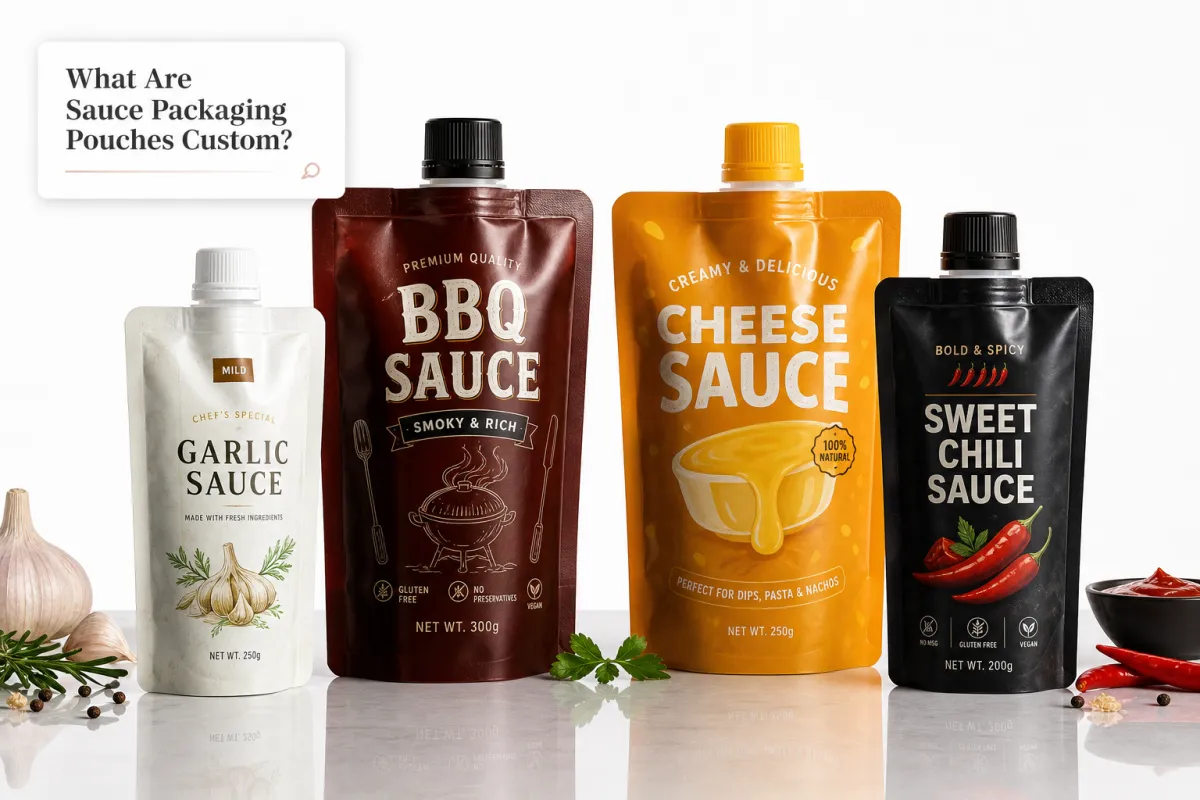
Sauce packaging pouches custom are flexible containers built around a specific sauce, a specific fill method, and a specific customer experience. In practice, that can mean premade pouches, stand-up pouches, spouted pouches, flat pouches, or sachets. A pouch may hold 10 ml of hot honey for a foodservice tray or 500 ml of salsa for retail shelves, but the core idea stays the same: use a lighter package that does the job of a heavier one without sacrificing protection.
The format matters because sauce behavior changes the package. A thin vinaigrette behaves very differently from a thick barbecue sauce with onion pieces, and both behave differently from an oil-heavy chimichurri. Sauce packaging pouches custom let you choose seal geometry, wall thickness, barrier level, and closure style so the pouch is built around the product instead of forcing the product into a generic shape. That is one reason sauce packaging pouches custom often outperform jars in logistics-heavy programs.
The pouch itself is usually built from three functional layers. The outer print layer carries graphics and branding. The middle barrier layer helps resist oxygen, moisture, and aroma loss. The inner sealant layer gives the pouch its heat seal and product contact surface. On some programs, a spout, fitment, or zipper is added for controlled dispensing or resealability. Sauce packaging pouches custom depend on those layers working together, because a sharp print job does not help if the sealant layer gives out after thermal processing.
Channel matters too. Sauce packaging pouches custom work differently for shelf retail than they do for foodservice or direct-to-consumer shipping. In retail, the pouch must stand up, face forward, and compete visually with other branded packaging. In foodservice, portion control and mess-free dispensing matter more. For ecommerce, drop resistance and carton efficiency become part of the package brief. That is why sauce packaging pouches custom should be chosen as part of a system, not as a standalone item.
- Premade pouches work well when the line uses a filling machine built for formed pouches and you want predictable shelf presentation.
- Stand-up pouches are a strong fit for retail packaging because they display well and offer a stable footprint.
- Spouted pouches suit controlled dispensing, thicker sauces, and reuse after opening.
- Sachets and flat pouches are usually the lowest-weight option for single servings, samples, or condiment packs.
From a buyer's standpoint, sauce packaging pouches custom are not just a container decision. They shape freight costs, warehouse cube, display impact, and even consumer perception of quality. A well-specified pouch can make a small sauce brand look disciplined and premium. A poorly matched pouch can make a strong recipe look cheap, messy, or inconvenient, and that is a packaging problem, not a recipe problem.
How Sauce Packaging Pouches Custom Work on the Filling Line
There are two main ways sauce packaging pouches custom are produced on the floor. The first is premade pouches, which arrive formed and are filled on a dedicated machine. The second is form-fill-seal, where film is fed from rollstock, formed into a pouch, filled, and sealed in one continuous process. Premade pouch lines usually offer more presentation flexibility, while rollstock systems can be very efficient at high volumes. The right choice depends on line speed, labor, and how much complexity the sauce can tolerate.
Seal design is where many programs succeed or fail. Sauce packaging pouches custom need enough seal width, enough dwell time, and the right sealant layer to hold up under product weight and handling. In many plants, a 6-10 mm seal width is common, but the exact spec depends on pouch size and product stress. If the sauce is filled warm, headspace control becomes more sensitive. If it contains particulates, the fill nozzle has to be sized so solids do not interfere with the seal area. Those details matter more than most brand teams expect.
Heat exposure changes the picture further. Sauce packaging pouches custom may need hot-fill compatibility, pasteurization resistance, or full retort performance if shelf stability is a requirement. A pouch that handles chilled marinade just fine may not survive the pressure and temperature swings of a retort cycle. The same is true for closures. Tear notches make opening simple, zippers improve reuse, and spouts make pouring cleaner, but each feature adds complexity to sealing and inspection. The machine has to run the package, not the other way around.
Lead time is another piece buyers often underestimate. Sauce packaging pouches custom usually move through quoting, artwork review, structure approval, sample production, line testing, and final scheduling before full production begins. A basic program might reach production in 12-15 business days after proof approval, while a spouted or retort-ready structure can take longer because tooling, sample checks, and component sourcing add steps. If imported closures are involved, the timeline can stretch again. That is normal, not a failure.
A pouch only earns its keep if it runs cleanly on the line, protects the sauce through the trip, and still feels easy in the hand when the customer opens it.
For brands that want a broader view of packaging options, the Custom Packaging Products catalog is a useful place to compare pouch formats with other product packaging styles. Many teams also use temporary mockups before locking in the final run, especially when the filling line has tight timing or the sauce contains pieces that can bridge a narrow nozzle. I have also seen teams bring a sample pouch to the line with a spoon and a stopwatch, which sounds low-tech, but it can tell you plenty about fill behavior before anyone spends money on a full order.
Key Factors That Shape Cost, Shelf Life, and Performance
Pricing for sauce packaging pouches custom comes down to a handful of practical choices, and the biggest one is material structure. A simple PET/PE pouch is usually easier on cost than a high-barrier PET/nylon/PE laminate or a foil structure. Add print complexity, special finishes, a spout, or a custom fitment, and the number moves up. For many buyers, the most useful quote is not just a unit price; it is a landed cost that includes freight, setup, tooling, and any outer carton requirements.
Barrier performance has a direct effect on shelf life. Sauce packaging pouches custom used for acidic sauces, oil-based sauces, or products with active spices often need stronger oxygen and aroma protection than a simple cold-fill pouch. PET gives print quality and strength, PE gives sealability, nylon adds puncture resistance, and foil gives very high barrier when flavor retention is critical. Metallized films can be a middle ground. The structure choice is not about picking the fanciest laminate; it is about matching the sauce's real sensitivity to air, light, and temperature.
Shelf life also influences sealant selection and laminate thickness. If a sauce is refrigerated and turns quickly, the pouch can be simpler. If it needs extended ambient stability, the package may need a stronger barrier and tighter seal controls. Sauce packaging pouches custom for retort use usually require validated films that can survive heat, pressure, and cooling without delamination or seal creep. That is not always the case with standard snack-style pouches, even if the print looks similar on the shelf. A glossy pouch is not automatically a food-safe process pouch.
Minimum order quantities and proofing rounds affect cost more than many brands expect. Smaller runs often carry higher setup charges per unit, especially if a new spout or closure tool is needed. Reprint cycles, artwork corrections, and secondary packaging like custom printed boxes for club packs or display cartons can all move the final number. If you only compare the quoted unit price, you can miss the real cost of getting the product from press to shelf.
| Format | Best Use | Typical Structure | Cost Drivers | Practical Notes |
|---|---|---|---|---|
| Sachet / flat pouch | Single-serve condiments, samples, foodservice packs | PET/PE or nylon/PE | Print coverage, size, seal width | Lowest weight; ideal for high-volume portion control |
| Stand-up pouch | Retail sauces, marinades, dressings | PET/NY/PE or high-barrier laminate | Barrier level, zipper, matte finish | Strong shelf presence; good for branded packaging |
| Spouted pouch | Pourable sauces, family-size packs, reuse after opening | Barrier laminate with fitment | Spout tooling, fitment insertion, leak testing | Cleaner dispensing, but more complex to source and fill |
| Retort-ready pouch | Shelf-stable sauces requiring heat processing | High-temp laminate with validated sealant | Film grade, validation, process testing | Highest performance requirement; tests should mirror the process |
One more cost issue deserves attention: freight efficiency. Sauce packaging pouches custom reduce weight compared with glass or rigid plastic, but the savings only show up if the pouch is packed intelligently. Carton count, pallet pattern, and overwrap decisions all change the final shipping profile. From a sustainability angle, organizations sometimes review the U.S. EPA sustainable materials management guidance to think more clearly about material reduction and recovery, especially if the brand is building a packaging design story around lighter-weight formats. That said, reduction only counts if the package still protects the sauce and survives the supply chain.
Step-by-Step: From Brief to Production Timeline
The cleanest way to start sauce packaging pouches custom is with a brief that is specific enough to stop guesswork. Include the sauce viscosity, ingredients, fill temperature, target shelf life, serving size, closure preference, and where the product will be sold. A 2-ounce hot sauce sachet for foodservice is a different job from a 12-ounce refrigerated pesto pouch. The more precise the brief, the fewer surprises later, and the easier it is to compare structural options fairly.
Next comes the spec phase. Sauce packaging pouches custom need a defined width, height, bottom gusset or lay-flat dimension, seal widths, artwork area, and any functional feature like a tear notch or spout. This is where the package starts to become real. If the brand wants a matte finish for premium retail packaging, that should be stated now. If the pouch has to fit a case pack or a shelf tray, those outside dimensions need to be in the spec too. Good packaging design is part art, part engineering sheet.
Sampling and testing are where the theory gets checked against the line. You want to see the pouch with the actual sauce, not a substitute that behaves differently. Fill tests should confirm nozzle fit, headspace, and seal integrity. Drop testing helps reveal weak corners or poor seal dwell. If the sauce is going through distribution, transit testing should follow something close to an ISTA procedure so the team can understand how the pouch behaves under vibration, compression, and repeated handling. Sauce packaging pouches custom that survive the lab and fail the truck are not finished products; they are warnings.
After the sample passes, approvals and scheduling take over. Final artwork signoff should happen before production slots are assigned, because any correction after plate or cylinder work can add delay and cost. Imported fitments or specialty closures may also extend timing if they are not already in stock. A realistic production flow is quote, spec, proof, sample, line test, approval, then run. Once that pattern is understood, sauce packaging pouches custom are easier to manage because the brand knows where the clock is actually running.
- Write a brief with sauce type, shelf life, fill temperature, and sales channel.
- Choose two or three pouch structures and compare barrier, cost, and lead time.
- Review artwork early so print area, copy, and barcode placement all fit the pouch.
- Request samples that use the actual sauce whenever possible.
- Test on the filling line before committing to the full production run.
Common Mistakes When Ordering Sauce Packaging Pouches Custom
The most common mistake is buying on appearance alone. Sauce packaging pouches custom can look excellent in a rendering and still be wrong for the product. A sauce with oil, acid, or fine particulates may need a stronger barrier or a more forgiving sealant than a basic pouch offers. If the buyer chooses the pretty option first and the process option second, the result can be leaks, flavor loss, or shortened shelf life. That is expensive in a way that never shows up in the mockup.
Another problem is mismatching the package to the filling process. Some closures slow the line down, some seal patterns trap product in the seal area, and some spouts simply do not fit the equipment or operator flow. Sauce packaging pouches custom have to respect the machine. If the line is built for high-throughput foodservice packs, a pouch with complicated reclose hardware may create stoppages. If the line is designed for retail pouches with stable stand-up geometry, a flat sachet may waste the machine's strengths.
Many teams also underestimate the role of product behavior. Thick sauces need larger nozzles and more forgiving fill paths. Particulate-heavy sauces need fill windows that keep bits out of the seal. Hot-fills need materials that can tolerate thermal expansion. Ignoring those details can lead to uneven fill weights, weak seals, or pouch distortion after cooling. Sauce packaging pouches custom should be tested with the actual product, because a clean water run means very little if the sauce is more viscous or more aggressive chemically.
Finally, some buyers only order enough for the first shipment and then pay for it later. Small purchase quantities can mean repeated setup charges, duplicate proof cycles, and extra downtime while the next batch is sourced. Sauce packaging pouches custom are usually cheaper in the long run when annual volume is planned from the start. That does not mean overbuying; it means aligning the quantity with the sales plan, storage space, and the supplier's realistic production windows.
If the pouch has not been tested with the real sauce, the real line, and the real transit route, it is still a concept, not a packaging solution.
- Do not choose structure by shelf appeal alone.
- Do not skip line trials when the sauce is thick or particulate-heavy.
- Do not assume the cheapest quote is the lowest landed cost.
- Do not ignore closure compatibility with operators and equipment.
Expert Tips for Better Sauce Packaging Pouches Custom
Start with the person using the pouch, not the person buying it. Sauce packaging pouches custom perform better when the end user can tear, pour, reseal, or store the package without frustration. For a family-size pasta sauce, a spout may be worth the extra cost because it improves control. For a restaurant ketchup pack, a simple tear notch may be better because the use case is disposable and speed matters. That user-first thinking is what turns product packaging into a practical advantage.
Use the graphics to build hierarchy. Sauce packaging pouches custom should not ask the shopper to hunt for the flavor, the use occasion, or the brand promise. Strong package branding usually puts the product name, sauce type, and most relevant benefit in the first visual tier. Secondary details can follow. That same logic helps retail packaging stand out in a crowded cooler or on a shelf. If the brand also uses custom printed boxes for multipacks or display cartons, the pouch and box should tell the same story so the lineup feels intentional.
Ask for samples that simulate the real run. Sauce packaging pouches custom can look fine in a flat proof and still misbehave when filled, handled, or stored. A line-simulation sample helps reveal whether a zipper interferes with filling, whether a spout sits too close to the seal, or whether the pouch leans once it is full. For higher-value sauces or export programs, this step is worth the time because one bad pallet can erase the savings from a lower unit price. Real testing is cheaper than a recall, and nobody likes learning that lesson the hard way.
Think about sustainability with a practical lens. Sauce packaging pouches custom often reduce shipping weight and can use less material than rigid formats, but the structure still has to protect the sauce first. Downgauging works only when the film still passes drop, seal, and storage checks. If the brand wants to talk responsibly about material reduction, it helps to understand how recovery and recyclability claims are treated in the market. Paper-based secondary packaging can support that story, but it does not magically make the whole pouch recyclable, and that distinction matters more than a lot of marketing copy admits.
One more practical tip: keep the sourcing conversation broad. Sauce packaging pouches custom may be the star of the program, but the total package still includes cartons, inserts, labels, and pallet patterns. If those pieces are planned together, the brand gets better consistency and fewer surprises. That is especially true for emerging brands that are scaling from small trial lots into retail programs and need their packaging design to hold up under more scrutiny. I kind of think this is where a lot of packaging teams save themselves headaches: by planning the boring pieces with the same care as the eye-catching pouch.
- Prioritize opening, pouring, and resealing behavior for the intended user.
- Use a clear visual hierarchy so the flavor reads fast from a distance.
- Validate fit on the actual line before committing to volume.
- Balance downgauging with barrier and puncture resistance.
- Coordinate pouches, cartons, and other branded packaging elements together.
Next Steps for Sauce Packaging Pouches Custom
If you are getting ready to buy, start by gathering the information that removes uncertainty. Sauce packaging pouches custom are easiest to quote and refine when you can share the sauce type, viscosity, fill temperature, shelf-life target, pouch size, closure preference, annual volume, and line speed limits. Add artwork files if you have them, even if they are only rough. That gives the supplier a better shot at estimating print coverage, structure choice, and setup cost without padding the quote for unknowns.
It also helps to request more than one structural option. Sauce packaging pouches custom can often be built in a lighter, lower-cost laminate and a higher-barrier, higher-protection laminate, and the difference may be more relevant than the brand expects. Compare the options on unit price, lead time, and performance, not just on how they look in a render. If the sauce is thick, particulate-heavy, or heat sensitive, ask for a pilot run or short test batch first. That small step can save a lot of trouble later.
Do not forget the full landed cost. Sauce packaging pouches custom may look economical at the pouch level, but freight, outer cartons, setup charges, and any closure tooling can change the picture fast. A quote that looks lower on paper may cost more once you add shipping, storage, and production delays. That is why a good sourcing conversation should always include the machine, the product, and the commercial plan together. If you are still building the program, the Custom Packaging Products page can help you compare pouch formats with other product packaging options and decide where the fit is strongest.
Sauce packaging pouches custom work best when the package brief matches the sauce, the equipment, and the market goal. Get those three things aligned, and the pouch becomes more than a container; it becomes part of the product's value. For a brand that is moving from concept to shelf, the smartest move is simple: lock the sauce specs, the line limits, and the shelf-life target before you ask for pricing, then test the pouch with the real product before you sign off on volume. That one habit saves time, money, and a whole lot of guesswork.
How much do custom sauce packaging pouches usually cost?
Cost depends on pouch size, barrier level, print complexity, closure type, and total quantity. For many programs, a simple laminated pouch can sit in a lower range than a spouted or retort-ready structure, but the real number only makes sense when freight, setup, and tooling are included. Sauce packaging pouches custom should be quoted on landed cost, not just on the unit price, because that is the number that tells you what the program actually costs to run. If a supplier only gives you a neat per-piece price and skips the rest, you are not looking at the full picture yet.
What materials work best for acidic sauces?
Use a structure with strong oxygen and moisture barrier, plus a sealant layer that can handle the sauce's acidity. PET/PE can work for shorter-life or chilled applications, while higher-barrier laminates are often better when aroma retention matters. If the sauce is oil-based or spice-heavy, barrier performance becomes even more important. Sauce packaging pouches custom should always be tested with the exact product, because acidity, salt, and spice load can all affect real-world performance. The chemistry is small on paper and very real on the shelf.
How long does it take to produce custom sauce pouches?
Timeline usually includes quoting, artwork, proofing, sample review, production, and shipping. Simple projects move faster than pouches with spouts, special barriers, or complex print requirements. A standard pouch program may be ready in a couple of weeks after approvals, while more complex structures can take longer. The fastest way to avoid delays is to send final specs and artwork together at the start, because sauce packaging pouches custom tend to slow down when details are still changing. Clean inputs usually make for cleaner timelines.
Can custom sauce pouches handle hot-fill or retort processing?
Yes, but only with a structure designed and tested for that process. Hot-fill and retort both stress seals, films, and closures, so material selection matters a great deal. Sauce packaging pouches custom intended for heat processing should be validated before production, not after, because the wrong film can fail under temperature and pressure. If the product needs shelf stability, ask for process-specific testing and make sure the sample conditions match the real run. A pouch that passes the wrong test does not help anybody.
What should I send to get an accurate quote?
Include product type, viscosity, fill temperature, shelf-life goal, dimensions, closure style, and annual quantity. Send artwork files or at least a layout concept so the printer can estimate print coverage and setup needs. Share your filling method and any line limitations, since compatibility affects both price and timeline. When buyers give complete information up front, sauce packaging pouches custom are easier to price accurately, easier to sample, and much easier to move into production without avoidable back-and-forth.

