Buyer Fit Snapshot
| Best fit | Seasonal Easter Shipping Boxes for Retailers projects where brand print, material claims, artwork control, MOQ, and repeat-order consistency need to be specified before quoting. |
|---|---|
| Quote inputs | Share finished size, material target, print colors, finish, packing count, annual reorder estimate, ship-to region, and any compliance wording. |
| Proofing check | Approve dieline scale, logo placement, barcode or warning zones, color tolerance, closure strength, and carton packing before bulk production. |
| Main risk | Vague material claims, crowded artwork, missing packing details, or unclear freight terms can make a low unit price expensive after revisions. |
Fast answer: Seasonal Easter Shipping Boxes for Retailers: Material, Print, Proofing, and Reorder Risk should be specified like a repeatable production item. The safest quote records material, print method, finish, artwork proof, packing count, and reorder notes in one written spec.
Production checks before approval
Compare the actual filled-product size with the drawing, then confirm tolerance on folds, seals, hang holes, label areas, and retail display edges. Reserve space for logos, QR codes, warning copy, and material claims before decorative graphics fill the panel.
Quote comparison points
Review material grade, print process, finish, sampling route, tooling charges, carton quantity, and freight assumptions side by side. A quote is only useful when the supplier can repeat the same color, closure quality, and packing count on the next order.
Seasonal easter shipping Boxes for Retailers have to do two jobs at once. They need enough spring personality to support the campaign, and enough structure to survive fulfillment, carrier handling, and the occasional freight disaster that turns a nice carton into scrap. That is a tougher brief than it looks. I have seen pretty boxes arrive looking like they got dragged behind a truck, which is always a fun little reminder that graphics do not stop compression.
Retail buyers do not pick seasonal easter shipping Boxes for Retailers because they want another decorative carton. They need packaging that can hold gift sets, limited-run assortments, ecommerce orders, and retail replenishment without slowing the packing line to a crawl. The good ones make the product look intentional and keep the operation from turning into a tape-and-prayer situation.
The strongest seasonal programs stay disciplined on structure. Seasonal easter shipping Boxes for Retailers do not need wild die-cuts or overcomplicated construction to work. They need the right board grade, a fit that keeps product from wandering around inside the carton, print that supports the brand, and a pack-out that does not punish the warehouse team. Get that right and the box helps cut damage claims, contain freight spend, and make the unboxing feel planned instead of improvised.
If you are comparing Custom Packaging Products or sorting through a few Custom Shipping Boxes, the same rule applies: the package has to fit the product, the carrier network, and the seasonal calendar. Seasonal easter shipping boxes for retailers perform best when planning starts early enough to allow sampling, testing, and one round of fixes before the holiday rush shows up.
Seasonal Easter Shipping Boxes for Retailers: What They Are and Why They Matter
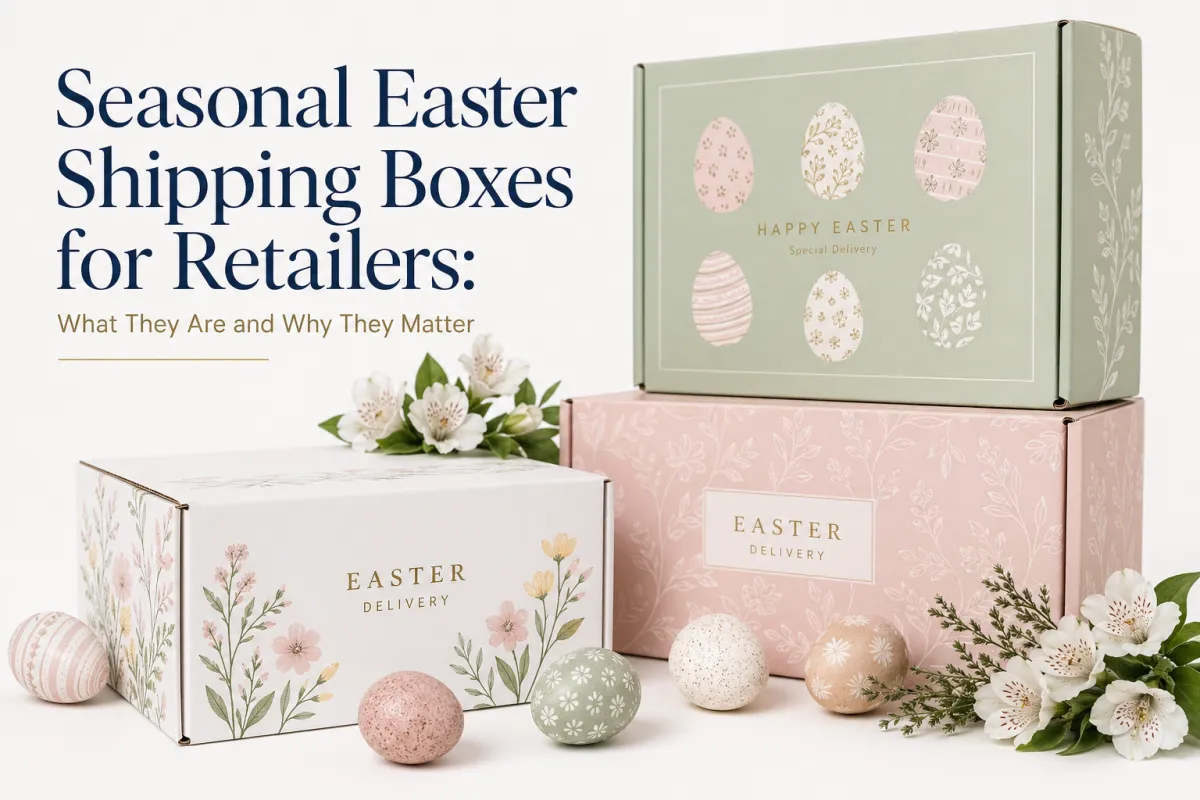
Seasonal easter shipping boxes for retailers are packaging formats built for spring promotions, gift bundles, and limited-run product lines that need a holiday look without giving up real shipping protection. That can mean a printed corrugated shipper, a paperboard gift box nested inside a stronger outer carton, or a mailer-style box for lighter retail kits. Different structures, same job: look seasonal, survive transit.
The gap between shelf appeal and shipping reality is where packaging earns its keep. A carton can look right on a styling table and still collapse when the corners get hit, the closure is weak, or the contents shift under stack pressure. Seasonal easter shipping boxes for retailers have to close that gap because carriers are not impressed by pastel graphics.
Structure matters as much as artwork. A useful seasonal pack limits movement, matches board strength to product weight, and closes in a way That Holds Up through repeated handling. For retailers managing ecommerce and store replenishment at the same time, the best seasonal easter shipping boxes for retailers are the ones that remove guesswork at pack-out. Less guessing means fewer mistakes and a faster flow through order fulfillment.
Brand consistency matters too. Easter assortments sit in one of the most visual parts of the retail calendar, so the package can carry a lot of the campaign before anyone opens it. Seasonal easter shipping boxes for retailers can add color, pattern, and messaging that extend the spring story into the shipping experience, but the print still has to leave room for barcode placement, carrier labels, and handling marks. A pretty box that breaks scanner logic is just a problem in a better outfit.
That is where many buyers get stuck. They want a festive box, but they also need to stay inside shipping budgets and warehouse limits. A strong seasonal design usually keeps the print plan focused, uses board efficiently, and relies on a structure that can be packed quickly with standard shipping materials. Seasonal easter shipping boxes for retailers get judged on more than appearance. They get judged on what happens across the full supply chain.
A nice-looking carton that arrives crushed is not seasonal packaging. It is a return label with ambition.
For teams who need a starting point, seasonal easter shipping boxes for retailers work best as a bridge between promotion and logistics. They should support the campaign, but they also need to respect the cost realities of package protection, stacking, and carrier surcharges. A box that looks great and ships badly costs twice: once in freight and again in replacements.
What buyers usually want from the box
Most seasonal programs want a box that can protect a fragile item, hold a bundled gift set, or create a strong first impression at opening. Seasonal easter shipping boxes for retailers often need to do all three. The spec should give each priority enough attention without creating needless complexity that slows the warehouse down.
Why size and shape matter so much
Oversized cartons create more void fill, more movement, and more dimensional weight. None of that is friendly to freight spend. Seasonal easter shipping boxes for retailers usually work best when the product can be packed with minimal empty space and without forcing the team to pile in extra dunnage just to make the parcel feel stable.
How Do Seasonal Easter Shipping Boxes for Retailers Cut Damage and Packing Time?
They cut damage by controlling movement, matching the board to the load, and using inserts or partitions where the product actually needs support. They cut packing time when the structure is simple, the closure is obvious, and the box size works with the warehouse’s standard shipping materials. Seasonal easter shipping boxes for retailers should make the job easier, not give the crew one more thing to fight before lunch.
A good seasonal box is built to do two boring but valuable things well: keep the product in place and move through the line quickly. That usually means a corrugated box with the right flute, a fit that limits void fill, and a print layout that leaves space for labels and handling marks. Seasonal easter shipping boxes for retailers that miss those basics tend to create more labor, more damage claims, and more noise in the system.
In my experience, the best box is the one the team barely thinks about. That sounds unexciting because it is. But boring packaging is usually profitable packaging.
How Seasonal Easter Shipping Boxes for Retailers Work in the Fulfillment Chain
Seasonal easter shipping boxes for retailers do not begin in the delivery truck. They start at the packing table, where a worker has to assemble, fill, close, label, and move each order fast enough to keep the queue moving. If the carton is easy to build and the insert fits properly, the whole operation becomes more predictable. During a short spring sales window, predictable is gold.
In the fulfillment chain, the box has to survive several stress points. It gets picked from storage, folded or erected, loaded with product, closed, labeled, sorted, stacked, and handed to a carrier network that treats it like one of thousands of parcels. Seasonal easter shipping boxes for retailers need enough structural margin to handle all of that, not just the moment they are photographed for a catalog.
What happens between packing and delivery
The box is hit with vibration, compression, drops, conveyor impacts, and temperature swings. Board selection, glue quality, and closure design matter because of that. Corrugated cartons with the right flute and edge-crush performance do far more for package protection than extra void fill alone, especially when the contents are dense or fragile.
Internal fit matters just as much as the outer shell. Inserts, partitions, molded pulp trays, and tailored paperboard cradles keep items from moving inside the carton. For candy assortments, cosmetics, candles, ceramics, or apparel bundles, the internal pack should match the product shape instead of forcing the product into a generic cavity. Seasonal easter shipping boxes for retailers work better when the interior is built around the actual load, not a guessed one.
The print layer has a job too. Seasonal graphics can make the package feel more valuable and more gift-ready, but the exterior still needs room for shipping labels, barcodes, and handling marks. A design that covers every inch with artwork and forgets the label panel usually creates slower processing and more scanner issues. A lot of experienced buyers leave one side calmer on purpose. Sensible move.
Teams that test packaging seriously usually look at procedures from ISTA when checking drop, vibration, and transit performance. They also review guidance from the EPA when recyclability and waste reduction matter. Those references do not replace real pack-out trials, but they keep the conversation grounded in something better than gut feel.
Seasonal easter shipping boxes for retailers also need to fit the warehouse. If the carton requires extra assembly, a special tape size, or a weird loading sequence, labor cost can wipe out any savings from a lower unit price. A carton that speeds up order fulfillment is usually worth more than one that is slightly cheaper and noticeably harder to use.
One practical way to judge performance is to think like the carrier. If the carton survives a controlled drop, resists side compression, keeps product centered, and stays readable after label application, it is much more likely to arrive intact. That is where seasonal easter shipping boxes for retailers prove value: not in the rendering, but after the box has been stacked with a dozen others and sent through a sorting network.
Soft goods follow a slightly different playbook. Retailers shipping apparel or light accessories sometimes pair seasonal cartons with Custom Poly Mailers for lower-cost transit protection, then save printed boxes for gift sets or premium assortments. That hybrid setup can reduce shipping materials spend while still keeping the Easter campaign visible.
Key Factors That Shape Seasonal Easter Shipping Boxes for Retailers
Product weight comes first. A lightweight candy assortment may work in a single-wall corrugated box with a simple insert, while a ceramic figurine, glass jar set, or multi-item retail kit usually needs stronger board, tighter fit, and better edge protection. Seasonal easter shipping boxes for retailers should be designed around the heaviest likely pack, not the easiest one. The weak shipment always exposes the weak spec.
Shape matters just as much as weight. Tall narrow products can tip inside the carton and create pressure points, while flat items may need a wider footprint to spread the load. Seasonal easter shipping boxes for retailers should reflect the geometry of the product line because a better structural match reduces both movement and the amount of void fill needed to stabilize the parcel.
Material choices that make sense in practice
Corrugated board is usually the workhorse for shipping cartons. Flute choice, liner weight, and board grade all affect puncture resistance, crush performance, and overall package protection. E-flute can create a cleaner print surface and a lighter profile for display-oriented packs, while B-flute or C-flute usually offers better stiffness for shipping. If the product is delicate or the route is rough, structure should favor protection over thin-looking packaging.
Paperboard still has a place, just not usually as the main transit shell. It works well for sleeves, wraparound cartons, inserts, and premium printed layers that sit inside a stronger outer pack. Seasonal easter shipping boxes for retailers often use this layered approach because the outer shipper does the heavy lifting while the visible inner structure carries the seasonal design.
Recycled content and fiber sourcing matter too. Many buyers ask for FSC-certified paper or board because it supports a more responsible sourcing story, which is useful in spring campaigns when customers pay attention to packaging waste. Certification does not rescue a weak design, though. Sustainable shipping materials are helpful only when they are right-sized and structurally sound. Otherwise, they are just expensive filler with better branding.
Print compatibility is another practical issue. Heavy ink coverage, spot color builds, matte coatings, and gloss finishes all change the feel of the package and can affect cost. Seasonal easter shipping boxes for retailers with full-coverage art usually look polished on shelf and in unboxing photos, but the artwork should still be planned around the board surface. Some stocks hold fine detail cleanly. Others are better with bold shapes and fewer gradients.
Logistics shapes the spec as well. Dimensional weight can turn a slightly too-large box into a margin problem fast, especially for ecommerce shipping where carriers compare physical size to actual weight. A few extra inches in each direction may not look dramatic on a drawing, but across hundreds or thousands of orders that extra air turns into freight spend and more warehouse storage space. Seasonal easter shipping boxes for retailers need to respect that math.
Retailers also need to decide whether the carton is only a shipper or whether it will be seen on a shelf. Shelf-ready packaging puts more pressure on print, opening style, and clean presentation after the box is opened. If the same pack is used for direct-to-consumer fulfillment and store replenishment, the structure should stay simple enough to perform in both channels without creating a separate SKU for every use case.
There is a useful question to ask during spec reviews: does the packaging improve the product or just decorate it? Seasonal easter shipping boxes for retailers should do both only where it matters. A small amount of print on a strong carton usually beats a heavy decorative build that ships badly and costs more to store. That is especially true when several spring SKUs need one packaging family.
| Option | Best Use | Typical Unit Cost at 5,000 Pieces | Notes |
|---|---|---|---|
| Plain corrugated shipper | Back-of-house fulfillment, low-graphic shipping | $0.42-$0.78 | Strong value for package protection; easiest to store and re-order |
| Printed corrugated box | Gift sets, retail-forward ecommerce shipping | $0.68-$1.25 | Better brand impact; higher setup and print-related cost |
| Corrugated box with insert | Fragile assortments, multi-piece kits | $0.92-$1.85 | More transit packaging control; often lowers damage claims |
| Paperboard sleeve plus shipper | Premium presentation, layered packaging | $1.10-$2.10 | Useful when the outer shipper handles strength and the sleeve handles graphics |
Those ranges move around with size, print coverage, board grade, and quantity, so treat them as a planning frame rather than a quote. Seasonal easter shipping boxes for retailers are rarely decided by unit price alone. A box that costs a little more and cuts breakage, reduces void fill, and keeps line speed steady can be the cheaper choice overall. Packaging procurement teaches that lesson fast.
Another factor is whether the box has to act as part of the unboxing experience. If yes, the cost model should include ink coverage, coatings, and the time spent building the box at pack-out. Seasonal easter shipping boxes for retailers often justify a higher spec because the package becomes part of the product story, especially for gift-oriented lines where presentation drives repeat purchase.
Seasonal Easter Shipping Boxes for Retailers: Cost and Pricing Basics
Seasonal easter shipping boxes for retailers are priced by a lot more than size. Box dimensions, board grade, print complexity, coating, number of colors, insert design, tooling, and order quantity all influence the number. A plain stock-size shipper with light print can be very reasonable. A custom die-cut box with a tailored insert and full seasonal artwork can rise fast if the run is small.
Planning works better when direct cost and indirect cost stay separate. Direct cost is the quoted unit price. Indirect cost is freight, storage, packing labor, waste, and the cost of damaged product. Seasonal easter shipping boxes for retailers can look more expensive on paper and still save money if they reduce claims and speed up order fulfillment. The cheapest quote is not automatically the best buy. That usually becomes obvious after the first damage report.
Here is the tradeoff buyers keep running into: a stronger carton may add a few cents per unit, but it can prevent an expensive replacement shipment or a refund on a fragile item. If the campaign includes glass jars, molded chocolate items, ceramic decor, or mixed gift sets, package protection is usually worth protecting. A spring return rate can eat through box savings faster than people expect.
What drives the price up
Large format boxes use more board and more freight volume. Heavy print coverage adds ink, press time, and make-ready cost. Inserts add labor and die complexity. Custom closure styles can require extra tooling. Seasonal easter shipping boxes for retailers with specialty finishes, window cutouts, or foil effects cost more because every extra feature adds another step to production or assembly.
Quantity matters a lot. Moving from a small run to a more efficient lot size often drops the unit cost sharply because setup gets spread across more pieces. In plain purchasing terms, a retailer that orders a few hundred cartons for a campaign test may pay much more per box than a retailer that commits to a larger seasonal program. That is not always the right move, but it is what shorter runs cost.
Freight is another hidden cost. A carton that ships flat and nests efficiently is cheaper to receive and store than one that arrives as a bulky component kit. Seasonal easter shipping boxes for retailers should be evaluated as part of total landed cost, not just the factory quote. If the box occupies more shelf space than needed or demands extra inbound handling, the real cost rises even when the unit price looks fine.
Last-minute reorders are where budgets get hurt. Rush freight, expedited press time, and split shipments can turn a decent seasonal plan into a mess. Seasonal easter shipping boxes for retailers should be ordered with a small safety buffer, especially if the campaign depends on one packaging style across multiple SKUs. A 10% to 15% cushion is usually easier to justify than a panicked emergency reorder.
Buyers usually want a simple comparison, so here is the practical version:
- Lower print, stronger board is usually the best value when product protection is the top priority.
- Higher print, moderate board works when presentation matters and product weight is light to medium.
- Insert-based systems make sense for mixed kits, but only if they truly reduce movement.
- Oversized cartons almost always create extra dimensional weight and more void fill.
Seasonal easter shipping boxes for retailers also need to be compared against the rest of the packaging stack. A beautiful box may not be worth the spend if the same campaign could use a cleaner insert, a smarter folding sequence, or a simpler outer label panel. Good packaging teams usually look for savings in the structure before they start cutting the artwork apart.
From a procurement standpoint, a useful question is simple: what is the box saving? Is it saving freight because it is smaller? Is it saving labor because it erects quickly? Is it saving damage because it holds the product in place? Seasonal easter shipping boxes for retailers should return value in at least one of those areas, and ideally in more than one.
Step-by-Step Timeline for Seasonal Easter Shipping Boxes for Retailers
Seasonal easter shipping boxes for retailers reward early planning more than evergreen packaging does. Spring campaigns move fast, artwork is tied to the marketing calendar, and the box may need approval alongside photography, pricing labels, and retail merchandising materials. If packaging slips, the launch starts wobbling before anyone has a chance to notice.
A sensible timeline starts with the brief. The team should define product dimensions, unit weight, fragility, packing method, shipping environment, and target quantity. That information lets the packaging partner recommend the right board grade, structure, and print path. Seasonal easter shipping boxes for retailers are much easier to develop when the basic specs are locked before design starts.
Next comes structure and sampling. A prototype or sample carton lets the buyer test pack-out fit, closure performance, and label placement. This is also where insert dimensions should be checked against the actual product, not a drawing. If the sample shows too much movement or a weak closure, it is far cheaper to change the design now than to find out after production is already moving.
A practical planning window
Design and sampling often take a couple of weeks, especially if artwork revisions are involved. Production usually runs several more weeks depending on quantity, material availability, and print method. Add inbound freight and receiving time, and the safe move is to start earlier than the first launch date suggests. Seasonal easter shipping boxes for retailers do not leave much room for slow approvals or three rounds of tiny color debates.
A working timeline should run like this: brief and fit review first, sample approval next, production release after final sign-off, and inbound receiving well before the spring order rush. That sequence sounds basic because it is basic, but it prevents a lot of expensive mistakes. Retailers who wait until merchandising is nearly done usually end up making packaging decisions with too little information.
There is also a calendar issue people forget. Packaging approval should line up with promotional photos, channel launch dates, and warehouse labor scheduling. If the warehouse team is trained on one closure style and the final box changes a week before launch, the pack line slows down. Seasonal easter shipping boxes for retailers work best when the approval window leaves enough time for training and one final dry run.
The best seasonal projects also include a small contingency. If the first sample needs a color correction, a board adjustment, or a tighter insert, the extra week matters. Seasonal easter shipping boxes for retailers are much easier to manage when the critical path is written down and the team knows which dates cannot move. Surprises do not belong anywhere near a holiday launch.
Retailers balancing multiple packaging types can use the broader strategy to stay sane. Some spring assortments may use branded shippers, while others use lighter-duty cartons or mailers based on product sensitivity and margin. The key is to tie the packaging plan to the product mix, not just to the seasonal art concept. That is where shipping materials become a planning tool instead of a panic purchase.
Common Mistakes Retailers Make with Easter Shipping Boxes
The most common mistake is oversizing the carton. A box that is too large increases void fill, raises dimensional weight, and gives the product room to move. Seasonal easter shipping boxes for retailers should be sized close to the load because extra space almost always turns into extra cost and extra damage risk. In shipping, air is expensive. Nobody is shocked by that except the people who keep ordering oversized boxes.
Another mistake is making the box look seasonal without checking the structure. Pretty graphics do not make weak compression strength disappear. If the carton is going to be stacked in a warehouse, loaded into trailers, or sent through a sorting line, it needs real board performance. Seasonal easter shipping boxes for retailers should always be tested as transit packaging, not as decorative sleeves with delusions of grandeur.
Last-minute artwork changes create a different kind of mess. A revised logo, a color correction, or a new promotion line can push production off schedule, and then the team starts paying for rush freight. The packaging may still arrive on time, but the cost climbs fast. Seasonal easter shipping boxes for retailers are much cheaper when the artwork is frozen early and the approval chain is short.
It is easy to forget what happens after the holiday too. If the box is too Easter-specific, leftover inventory may not be useful for spring promos or later seasonal campaigns. Some retailers can reuse the structure if they keep the graphics broad enough to work beyond one holiday. Others cannot. Seasonal easter shipping boxes for retailers should be designed with the carton’s second life in mind, not just the first campaign.
There is a labor mistake as well: too many packaging variations. When every SKU needs a different box, insert, or label setup, the packing table slows down. A cleaner system usually works better: one or two shared box families, a small set of insert sizes, and clear rules for which products go into which pack. That approach reduces confusion and can improve order fulfillment during the busiest stretch of the spring season.
Another issue is ignoring carrier limits and warehouse realities. If the chosen carton pushes a parcel into a higher rate tier or creates storage inefficiency, annual cost can rise even when the box itself is cheap. Seasonal easter shipping boxes for retailers should be checked against the carrier matrix and the warehouse rack plan because the carton has to work in both places.
Here is the blunt version: if the box is hard to build, hard to store, hard to label, or hard to recycle, it is probably causing trouble somewhere else in the chain. Most packaging headaches are not mysterious. They show up as extra labor, extra freight, or extra returns. Smart buyers simplify seasonal easter shipping boxes for retailers before they simplify anything else.
Expert Tips for Better Seasonal Easter Shipping Boxes for Retailers
One of the best moves is to design a packaging family instead of a one-off box. If several Easter SKUs can fit into the same outer carton with only an insert change, the program becomes easier to buy, easier to store, and easier to explain to the warehouse. Seasonal easter shipping boxes for retailers work better when the structure is flexible enough to support a few sizes without forcing a full redesign every time the assortment shifts.
Testing should be realistic. A sample that survives a hand carry does not prove much. Retailers should test the packed carton with real product weight, likely void fill, and the actual closure method the warehouse will use. If the assortment is fragile, check drop risk, vibration, and compression before launch. Seasonal easter shipping boxes for retailers are only as strong as the weakest part of the pack-out, which might be the insert instead of the outer shell.
Leave some room in the artwork. That does not mean making the design dull; it means keeping enough flexibility so the box can handle a broader spring promotion if leftover inventory rolls forward. A small message panel, a calmer side panel, or a seasonal motif that does not lock the carton to one exact holiday can extend the box’s useful life. Seasonal easter shipping boxes for retailers can do more than one job if the design is planned with that in mind.
Use the box to support the business, not just the brand. If the pack cuts breakage by 2% or saves a few seconds per order, that matters. Across a few thousand units, those small gains add up quickly. Seasonal easter shipping boxes for retailers should be reviewed with the same seriousness as any other operational spend, because the savings usually show up in freight, labor, and returns rather than on the box line itself.
Internal teams need to stay aligned early. Marketing may care most about the look, operations may care most about line speed, and purchasing may focus on price. A solid packaging spec bridges all three. Seasonal easter shipping boxes for retailers are strongest when those priorities are settled before the first proof, not after production is already rolling.
If I had to boil the whole thing down, I would say this: choose the structure first, the graphics second, and the price third. That order keeps the program honest and avoids the kind of mistake that looks cheap for a week and expensive for a whole season.
So the practical next move is simple. Audit the products, measure the pack-out, estimate the order volume, and request samples before the calendar gets crowded. Compare the quote against the real cost of damage, labor, and freight instead of treating the carton as a standalone purchase. Seasonal easter shipping boxes for retailers are best locked in early, while there is still time to test, refine, and receive stock before demand spikes. That is the cleanest way to keep the holiday packaging plan from getting kinda silly at the finish line.
FAQ
What makes seasonal easter shipping boxes for retailers different from standard shipping cartons?
They combine seasonal branding with transit protection, so they need to look right for a spring campaign and still survive stacking, vibration, and carrier handling. Seasonal easter shipping boxes for retailers often include inserts, specialty print, or gift-ready construction that standard cartons do not need.
How far in advance should retailers order seasonal Easter shipping boxes?
Order early enough to allow for structure review, sampling, artwork approval, production, and inbound freight before the campaign starts. Seasonal easter shipping boxes for retailers usually need more lead time than plain stock cartons, especially if inserts or custom printing are involved.
What materials work best for seasonal easter shipping boxes for retailers?
Corrugated board is the most common choice for shipping protection and stack strength. Lighter paperboard can work as a sleeve or gift layer, but the outer pack still needs to handle the transit load. Seasonal easter shipping boxes for retailers should always match the material to the product weight and fragility.
How can retailers reduce costs without weakening Easter packaging?
Right-size the carton, simplify the print where possible, and use one shared box platform across several SKUs if the product family allows it. Seasonal easter shipping boxes for retailers often get cheaper in the long run when the design reduces dimensional weight, damage claims, and packing labor.
Can seasonal Easter shipping boxes be reused after the holiday?
Yes, if the design is flexible enough to work as a spring or general seasonal package. Seasonal easter shipping boxes for retailers are easier to reuse when the graphics are broad, the structure supports multiple product types, and the inserts can be adapted for a second campaign.

