Buyer Fit Snapshot
| Best fit | Personalized Gift Boxes for Retail Stores projects where brand print, material claims, artwork control, MOQ, and repeat-order consistency need to be specified before quoting. |
|---|---|
| Quote inputs | Share finished size, material target, print colors, finish, packing count, annual reorder estimate, ship-to region, and any compliance wording. |
| Proofing check | Approve dieline scale, logo placement, barcode or warning zones, color tolerance, closure strength, and carton packing before bulk production. |
| Main risk | Vague material claims, crowded artwork, missing packing details, or unclear freight terms can make a low unit price expensive after revisions. |
Fast answer: Personalized Gift Boxes for Retail Stores: Structure, Print Proof, Packing, and Reorder Risk should be specified like a repeatable production item. The safest quote records material, print method, finish, artwork proof, packing count, and reorder notes in one written spec.
Production checks before approval
Compare the actual filled-product size with the drawing, then confirm tolerance on folds, seals, hang holes, label areas, and retail display edges. Reserve space for logos, QR codes, warning copy, and material claims before decorative graphics fill the panel.
Quote comparison points
Review material grade, print process, finish, sampling route, tooling charges, carton quantity, and freight assumptions side by side. A quote is only useful when the supplier can repeat the same color, closure quality, and packing count on the next order.
Personalized Gift Boxes for Retail Stores That Sell
Personalized gift Boxes for Retail stores do more than hold a product; they often decide whether a shopper pauses, picks up, and buys. In a crowded aisle, packaging makes the opening pitch before a staff member says a word. That is not fluff. It is retail behavior, plain and simple. For many merchants, Personalized Gift Boxes for Retail stores turn a plain SKU into something that feels ready to give the moment it reaches the shelf.
Retail gifting runs on speed. Shoppers want something that looks thoughtful without a second stop for ribbon, tissue, or wrapping supplies. When the box already communicates brand, value, and occasion, the purchase feels easier. Easier usually means faster, and faster usually means more units moving through the register. It also means less friction for store teams, which is why retail gift packaging keeps showing up in holiday sets, loyalty gifts, and checkout add-ons. I have watched that pattern repeat across categories that look unrelated at first glance, from cosmetics to stationery to specialty food.
What Personalized Gift Boxes for Retail Stores Are
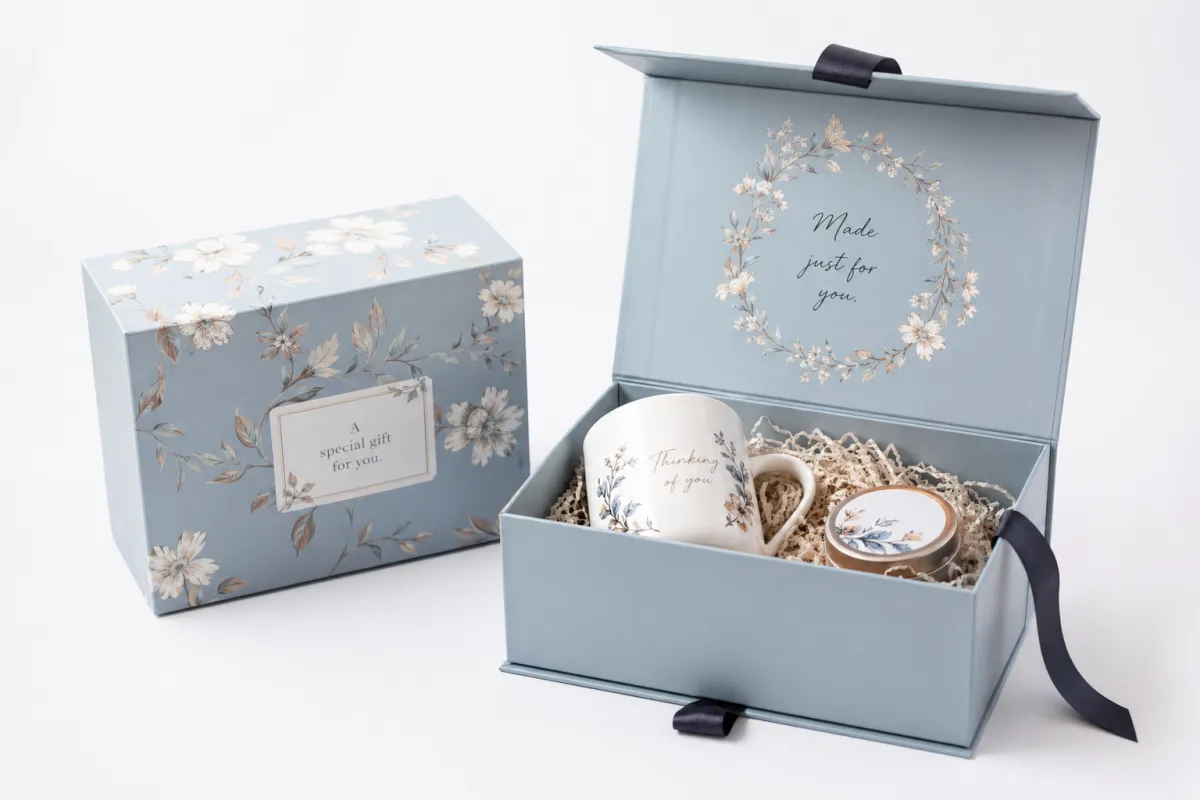
At the simplest level, personalized gift boxes for retail stores are packaging systems shaped around a retailer's brand, audience, product mix, and occasion. That sounds straightforward until you compare a plain printed carton with a box built to support shelf appeal, gifting, and resale at the same time. A logo on a stock box is branding. Personalized gift boxes for retail stores go further because the size, structure, insert, graphics, and finish are selected around the way the product will actually be sold.
The strongest boxes usually do three jobs at once. They protect the product during handling and transport. They present it in a way that feels gift-ready. They also make merchandising easier for the store team by reducing the need for extra wrapping or loose add-ons. That mix is why personalized gift boxes for retail stores appear in holiday sets, loyalty gifts, premium bundles, seasonal promotions, and checkout upsells. They also sit comfortably alongside Custom Presentation Boxes and shelf-ready packaging programs, which matters when the box has to do more than one job.
Think of the box as a silent salesperson. A candle in a clear plastic tray tells one story. The same candle in a rigid setup box with a molded insert, embossed logo, and short gifting message tells a very different one. The product has not changed, but the perception has. Personalized gift boxes for retail stores are built around that shift, because many buying decisions in retail begin with feeling and are justified later with logic.
Custom and personalized are not identical terms, even though people use them that way. Custom can mean the structure is engineered from scratch, often with a unique size, closure, and insert. Personalized can mean a retailer starts from a proven template and adapts it with brand colors, logo placement, occasion wording, and finish choices. Both can work. The better fit depends on volume, price point, and how tightly the box needs to wrap the product. In practice, the right answer is usually the least dramatic one that still does the job.
Retailers usually see the strongest return from personalized gift boxes for retail stores when the product feels more complete inside a presentation package: skincare sets, gourmet food assortments, accessories, stationery, candles, small electronics, and curated gift bundles. Even a lower-ticket item can feel more premium when the packaging supports the story, which helps when the margin can carry it. Not every product deserves a premium build. The package should match the role the item plays in the assortment.
If the product category is already set, start with a packaging family that fits the use case. Compare structures in Custom Packaging Products before committing to artwork. The structure usually shapes the economics more than the graphics do, and that is something teams sometimes learn the hard way after they have already approved a flashy mockup.
How Do Personalized Gift Boxes for Retail Stores Work?
The workflow for personalized gift boxes for retail stores is usually simple enough on paper, but only if the brief is precise. It starts with the product summary: dimensions, weight, fragility, retail price, channel, and whether the box needs to sit on a shelf, ship in transit, or do both. From there, the team chooses the box style, closure, insert, print method, and finish. Artwork setup, proofing, sampling, approval, and production follow. Most delays trace back to one of those decisions staying vague too long.
Several core components define the box. Board or carton stock comes first. Folding carton board works well for lighter goods and high-volume programs. Rigid board feels more premium and handles heavier presentation pieces better. Corrugated material is the practical choice when the package needs more crush resistance, especially for shipping or multi-pack gifting. Structure comes next: tuck end, sleeve, two-piece rigid setup, magnetic closure, mailer style, or a hybrid format. Each one sends a different message to the shopper.
The details are what make personalized gift boxes for retail stores feel deliberate instead of generic. Inserts keep the contents from shifting. Paperboard trays do the job in many cases. Molded pulp is another option. EVA foam, PET blisters, and custom die-cuts enter the conversation depending on the product and budget. Print method matters too. Offset printing is common for larger runs and sharper image work. Digital printing can be better for shorter runs or multi-SKU programs. Coatings and embellishments such as matte lamination, soft-touch film, spot UV, foil, or embossing all change how the box reads at arm's length and in hand.
Retailers also need to choose between a fully custom build and a semi-custom system. A semi-custom system uses a proven base structure and changes the branding, insert, and finish. That can reduce complexity and help keep turnaround predictable. Fully custom builds are worth the extra effort when the product is unusual, the margin is strong, or the brand wants the packaging to become part of the product story. Either way, personalized gift boxes for retail stores should be reviewed as a physical object, not just a PDF on a screen.
That review usually includes a prototype or at least a detailed digital proof. A proof shows where the graphics land. A sample shows whether the product fits, whether the closure behaves properly, and whether the box still looks premium after repeated handling. For a retail buyer, that is the difference between packaging that photographs well and Packaging That Actually performs on the shelf.
A box that photographs well but packs badly is not premium; it is expensive friction with foil on top.
For teams that need a packaging benchmark, it helps to compare distribution requirements against ISTA test methods and verify material sourcing against FSC options where responsible sourcing matters. Personalized gift boxes for retail stores do not exist in a vacuum; they need to survive warehouse handling, store replenishment, and customer carry-out.
Cost and Pricing for Personalized Gift Boxes for Retail Stores
Pricing for personalized gift boxes for retail stores comes down to a handful of variables that are easy to list and hard to ignore. Size is the first. Larger boxes use more board, more print area, and more freight space. Material choice follows. Folding cartons are usually the least expensive, rigid boxes sit higher, and corrugated gift boxes often land somewhere in the middle depending on the finish. Print coverage, special finishes, and inserts can push cost upward quickly. Quantity matters too. Once setup cost is spread across more units, the unit price usually falls.
To make the trade-offs easier to see, here is a practical comparison retailers can use as a starting point. These are broad planning ranges, not quotes, because personalized gift boxes for retail stores vary a lot by size, artwork coverage, and shipping lane.
| Box Type | Typical Use | Estimated Unit Cost at 5,000 Units | Strengths | Tradeoffs |
|---|---|---|---|---|
| Folding carton | Lightweight gifts, cosmetics, accessories, low- to mid-priced sets | $0.18-$0.45 | Lower cost, compact shipping, efficient for high volume | Less rigid feel, lower premium perception |
| Rigid setup box | Premium gifting, limited editions, higher-margin retail bundles | $1.10-$3.50 | Strong shelf appeal, premium presentation, durable structure | Higher freight, higher labor, more material cost |
| Corrugated gift box | Shipping-safe gift sets, heavier products, retail-to-home programs | $0.70-$1.80 | Good protection, useful for transit, sturdy handling | Can feel less luxurious without strong print and finish choices |
Those numbers still leave out some of the budget that first-time buyers miss. Setup, tooling, and freight can shift the real total in a hurry. A sample round might add a few hundred dollars. Structural tooling may be minor for a basic carton but meaningful for a custom insert or molded component. Rush fees can add 10% to 25% depending on timing and capacity. Warehousing is another hidden line. If the retailer does not want all of the boxes delivered at once, storage and phased releases may need to be priced in.
Labor is easy to miss too. A box that ships flat and needs assembly can look inexpensive on paper, but it may cost more once store or distribution center labor is included. If the contents must be packed into the box by hand, pack-out time becomes part of the economics. That is why personalized gift boxes for retail stores should be evaluated on total cost per gift-ready unit, not just on the print quote.
The better comparison is value returned. Does the box increase sell-through? Does it reduce the need for separate gift wrap? Does it support a higher ticket item or a bundle with stronger margin? A retailer may pay $1.35 for a rigid box and gain far more than that in perceived value, especially if the package helps the product move faster in a seasonal window. On the other hand, an overbuilt box for a low-margin item can quietly cut into profit. Personalized gift boxes for retail stores need a financial case, not just a visual one.
From a packaging buyer's point of view, the smarter question is not "What is the cheapest option?" It is "What is the right structure for this product, this audience, and this shelf?" That question usually produces better economics, because it stops the team from paying premium prices for features the customer will never notice. It also keeps the project from drifting into pretty-but-pointless territory, which happens more often than people admit.
If budget is still uncertain, compare a few structures in Custom Packaging Products and ask for quotes at two or three quantities. The spread between 2,500, 5,000, and 10,000 units can reveal whether the program is worth scaling or whether a smaller pilot makes more sense. Sometimes the lower quantity is the smarter move, not because it is cheaper in the abstract, but because it protects margin while the retailer figures out what shoppers actually want.
Process and Timeline for Personalized Gift Boxes for Retail Stores
Most personalized gift boxes for retail stores take longer than people expect, not because production is mysterious, but because the approval chain is larger than it looks. A realistic timeline begins with discovery and ends with shipping. Discovery usually takes a few days if the product specs are already clear. Design and structural planning can take another several days. Proofing and sample approval often take the most time because the box has to pass through marketing, operations, merchandising, and sometimes finance before anything is locked.
A common timeline for a straightforward program is about 12 to 15 business days from final proof approval for a simple print run, with custom structural work adding more time. Complex personalized gift boxes for retail stores with premium finishes, rigid construction, or special inserts can stretch into 20 business days or longer. If a retailer needs the boxes for a holiday floor reset or a promotional event, the calendar gets tight fast. The safest move is to work backward from the in-store date, then add buffer for sampling, freight, and any revision cycle.
Delays usually show up in familiar places. Artwork revisions sit near the top. One stakeholder wants a stronger logo. Another wants the copy shorter. Then someone asks for a finish change after the proof is already moving. Structural changes are more disruptive because they can affect the dieline, insert fit, and print layout at the same time. Material shortages happen less often than they used to in many categories, but they still surface, especially on specialty papers or niche finishes.
Seasonal retail programs deserve extra caution. If the box is tied to a holiday or gifting event, the packaging team should be involved before the assortment is frozen. That way the product dimensions and the package dimensions can evolve together. Waiting until inventory is locked is how retailers end up ordering personalized gift boxes for retail stores that are too tight, too loose, or too late. It also makes the operations team grumpy, which never helps.
A few moves reduce risk. Lock the dimensions early. Approve the insert before approving the graphics. Request a physical sample when the product is fragile, irregular, or valuable. Build in a cushion for store cluster rollout if the boxes are going to a multi-region network. A regional launch lets the team catch problems in one area before the whole chain is affected.
For retailers running multi-SKU programs, standardization helps. One base size for small items. One for mid-size bundles. One for premium sets. That kind of ladder keeps personalized gift boxes for retail stores easier to reorder, easier to warehouse, and easier to train on. It also gives the operations team fewer surprises during replenishment.
If the timeline feels compressed, remember that speed usually comes from clarity, not heroics. A clean brief, one decision-maker, and locked contents can move a program forward faster than a frantic rush through multiple redesigns. Personalized gift boxes for retail stores are much easier to deliver on time when the retailer knows what success looks like before the quote goes out.
Key Design Factors That Shape Shelf Appeal and Performance
Brand fit comes first. Personalized gift boxes for retail stores should feel like they belong to the retailer, not like generic packaging that borrowed a logo and stopped there. A luxury brand usually benefits from restraint, a tight color palette, and tactile finishes. A playful brand may use bold illustration, brighter color blocking, or window shapes that show off the product. Eco-conscious brands often do better with uncoated stocks, minimal ink coverage, and clear sustainability messaging. Value-focused retailers need clarity and strong shelf readability more than ornate detail.
Size and structure matter just as much as graphics. A box that is too large wastes material and can make the product feel smaller than it is. A box that is too tight can crush corners or slow pack-out. Personalized gift boxes for retail stores should leave enough room for inserts, tissue, or accessories without creating loose movement. That balance is one reason physical samples are so useful. A screen can show where the artwork lands. It cannot tell you whether the product rattles.
Finishes change perceived value in a very direct way. Soft-touch lamination gives a velvety feel that works well for premium beauty or lifestyle products. Embossing and debossing add depth without adding much visual noise. Foil can lift a logo or seasonal accent, though too much of it can make a box feel louder than the brand wants. Spot varnish can create contrast on matte stock. Window cutouts help when the product itself is attractive enough to show. The trick is to choose one or two features with purpose, not five features because they sound expensive.
Color and typography deserve more attention than they usually get. A package has to be readable from several feet away, especially in a retail environment with mixed lighting and crowded shelves. High contrast helps. So does a hierarchy that makes the brand name, product line, and occasion clear in under two seconds. Personalized gift boxes for retail stores should not ask the shopper to decode a puzzle. The box should answer the most obvious question immediately: what is this, and why should I care?
Sustainability signals also influence buying behavior. Recyclable paperboard, FSC-certified material choices, reduced plastic, and reusable box construction can all matter, especially for shoppers who want gifting without waste. The claim must be accurate, though. If the pack uses mixed materials that are hard to separate, the sustainability story gets weaker. Honest packaging claims build more trust than inflated ones. Retail buyers are reading closer than they used to, and they can smell vague claims from a mile away.
Durability is the final filter. Personalized gift boxes for retail stores have to survive pallet stacking, tote transport, replenishment, and customer carry-out. Corners should resist scuffing. Closures should stay aligned. Surface finishes should not mark too easily. If the box is going to ship directly, it needs enough compression resistance to handle a rougher route. That is where standards and testing come in. For shipping-safe programs, it is smart to align with distribution testing methods such as those published by ISTA.
In retail packaging, the best design is usually the one that can survive a warehouse, a shelf, and a customer without losing its first impression.
Simple often wins here. A clean box with strong proportions, disciplined branding, and a smart insert often outperforms a crowded package with too many messages. Personalized gift boxes for retail stores should earn their visual complexity, not default to it.
Common Mistakes Retailers Make With Personalized Gift Boxes
The most common mistake is designing for appearance only. Personalized gift boxes for retail stores that look great on a mood board but fail during packing, stacking, or shipping are a bad trade. Retail packaging has to function in the back room, the distribution center, and the customer's hands. If the box slows the team down or increases damage, the pretty finish will not save it.
Overbranding creates another problem. A retailer may want every surface to carry the logo, the tagline, the campaign message, the social handle, and the seasonal line. The result can feel crowded rather than premium. Good packaging uses hierarchy. It gives the eye one main idea, then one or two supporting ideas. Personalized gift boxes for retail stores usually sell better when the message is crisp and selective.
Weak size planning causes a lot of pain. Some retailers try to use one box for very different products to keep things simple. That usually creates too much void space for one SKU and too much squeeze for another. Neither is ideal. Excess void space looks wasteful and can make the product appear smaller. A tight fit can crush packaging or delay pack-out. The better move is to design around actual product families rather than hope one box fits everything.
Skipping fit tests is expensive. A sample may look fine on paper, but the real item can sit higher than expected, catch on a flap, or slide inside the insert. Fragile products are especially vulnerable. One crushed corner or misaligned tray can turn a launch into a write-off. Personalized gift boxes for retail stores need a prototype review for the same reason a shoe needs a fitting: size is not theory, it is behavior.
Timeline mistakes are common during the holidays. Retailers often start thinking about packaging after the assortment is already locked and freight capacity is already claimed. By then, the packaging team has less room to adjust materials, finishes, or quantities. The result is rushed approvals and compromised choices. It is a familiar pattern, and it is usually preventable with a longer lead plan.
Budget errors hide in the details. Sample rounds, freight, and finishing upgrades can quietly push a project beyond the target number. So can labor if the boxes need to be assembled or packed by hand. A retailer may approve personalized gift boxes for retail stores at a quoted unit price and then discover the real cost is higher once all the supporting pieces are included. That is why total landed cost matters more than a single line item.
There is another mistake that shows up often: assuming the box only needs to impress the buyer. In reality, it has to work for the stock associate, the store manager, the shopper, and sometimes the shipping team too. Personalized gift boxes for retail stores sit at the intersection of all those needs. If one group is ignored, the whole package suffers.
Expert Tips and Next Steps for a Pilot Launch
If the program is new, start small. A pilot with one high-margin SKU, one seasonal bundle, or one store cluster tells you more than a large rollout with no learning loop. Personalized gift boxes for retail stores are easier to refine in a controlled launch because you can track what actually happens: sell-through, return rate, damage rate, and pack-out time. Those metrics are far more useful than a vague impression that the box "looks nice."
Testing two or three variations can be worth the extra effort. One version might use a matte finish and restrained branding. Another might use foil and a window cutout. A third might reduce material weight to lower cost. The goal is not to make more options for the sake of it. The goal is to see which version gives the best mix of perceived value, handling, and margin. Personalized gift boxes for retail stores often reveal their best form only after a comparison run.
Merchandising, operations, and creative should get into the same room early. If merchandising wants a seasonal message, operations wants a fast pack-out, and creative wants a complex finish, the box can become a compromise in the worst sense. A better process is to define the non-negotiables first: product protection, target cost, launch date, and brand cues. Once those are clear, personalized gift boxes for retail stores become much easier to shape.
A pilot also gives the team a chance to refine language. Sometimes the box is over-explaining the product. Sometimes it is under-explaining the gift occasion. Sometimes the logo is too small to read from the shelf, or the callout is too loud for the brand. Small corrections can produce a large change in sell-through because shoppers make fast judgments. Retail packaging is visual shorthand, and when it works, it feels almost invisible.
Use the pilot to validate the operational side too. Check whether the box assembles in a few seconds or takes too long. Check whether it stacks cleanly on a shelf. Check whether customers ask for extra gift wrap less often once the packaging is introduced. These are the practical signs that personalized gift boxes for retail stores are doing real work, not just posing for the camera.
For teams building a broader packaging roadmap, a curated starting point from Custom Packaging Products can make the next quote cycle faster. Once a retailer sees the structures side by side, the discussion gets more concrete. That usually leads to better decisions and fewer revisions.
Here is the simplest next step: define the product, set the budget, request a sample, and test the box in a real retail setting before expanding. Personalized gift boxes for retail stores reward that kind of discipline. The brands that treat packaging as a working part of the assortment usually get the strongest results, because the box is not just carrying the product. It is carrying the sale.
Frequently Asked Questions
How much do personalized gift boxes for retail stores usually cost?
Price depends on size, material, print coverage, finishing, inserts, and quantity. Folding cartons are usually the least expensive, rigid boxes cost more, and corrugated options sit in the middle depending on protection needs. The best comparison is total cost per gift-ready unit, not just the printed box price. Personalized gift boxes for retail stores can look inexpensive at quote stage and still be costly once labor, freight, and setup are added.
What is the typical turnaround time for personalized gift boxes for retail stores?
Simple programs can move in about 12 to 15 business days after final proof approval, while fully custom structures or premium finishes often take longer. Proofing and sample approval usually take more time than retailers expect. Seasonal demand can stretch lead times, so buffer time matters. Personalized gift boxes for retail stores are fastest when dimensions, artwork, and contents are locked before the quote request goes out.
Which materials are best for personalized gift boxes for retail stores?
Rigid board works well for premium presentation and heavier products. Folding cartons suit lighter items and higher-volume programs. Corrugated options are better when shipping protection or durability is a priority. The right answer depends on the weight, retail price, and whether the box needs to travel far. Personalized gift boxes for retail stores perform best when the material matches the customer expectation and the handling conditions.
Can personalized gift boxes for retail stores be reused or shipped safely?
Yes, if the structure is designed for repeated handling and secure closure. Inserts and board strength should match the product weight and shipping method. Retailers should test both carry-out and transit conditions before launch. If the box is meant to do double duty, ask for a sample that reflects the real route. Personalized gift boxes for retail stores are much easier to trust after a few test cycles.
How do I choose the right size for personalized gift boxes for retail stores?
Measure the product with any inserts, tissue, or accessories included. Leave enough room for protection without creating a loose, wasteful fit. Use a sample or prototype to confirm appearance and pack-out speed. When in doubt, build from the actual product family rather than a rough guess. Personalized gift boxes for retail stores are strongest when the dimensions are driven by the contents, not by the artwork template.
The cleanest path is still the most practical one: Choose the Right structure for the product, sample it with the actual contents, and only then scale the run. Personalized gift boxes for retail stores work best when the decision is grounded in handling, margin, and shelf behavior rather than hope. That is the difference between packaging that looks good in a meeting and packaging that quietly helps the sale happen.