Buyer Fit Snapshot
| Best fit | Secure Seal Poly Mailers Supplier projects where brand print, material claims, artwork control, MOQ, and repeat-order consistency need to be specified before quoting. |
|---|---|
| Quote inputs | Share finished size, material target, print colors, finish, packing count, annual reorder estimate, ship-to region, and any compliance wording. |
| Proofing check | Approve dieline scale, logo placement, barcode or warning zones, color tolerance, closure strength, and carton packing before bulk production. |
| Main risk | Vague material claims, crowded artwork, missing packing details, or unclear freight terms can make a low unit price expensive after revisions. |
Fast answer: Secure Seal Poly Mailers Supplier: Film, Print, MOQ, and Carton Packing should be specified like a repeatable production item. The safest quote records material, print method, finish, artwork proof, packing count, and reorder notes in one written spec.
Production checks before approval
Compare the actual filled-product size with the drawing, then confirm tolerance on folds, seals, hang holes, label areas, and retail display edges. Reserve space for logos, QR codes, warning copy, and material claims before decorative graphics fill the panel.
Quote comparison points
Review material grade, print process, finish, sampling route, tooling charges, carton quantity, and freight assumptions side by side. A quote is only useful when the supplier can repeat the same color, closure quality, and packing count on the next order.
Secure Seal Poly Mailers Supplier: What Buyers Should Know
A mailer can look thick, glossy, and expensive, then fail exactly where it matters most: the seal line. That is how a cheap shipment turns into a customer complaint, a re-ship, and a pile of avoidable labor. A secure Seal Poly Mailers supplier is not just selling film and ink; they are selling closure strength, handling confidence, and a package that stays shut through sorting, stacking, and transit.
That sounds basic, yet buyers still get pulled toward surface-level details. Heavy film does not automatically mean better protection. Pretty print does not make up for weak adhesive. From a packaging buyer's point of view, the real question is simple: will the mailer stay closed after it gets tossed, compressed, and dragged through a carrier network that does not care about your brand story?
For apparel, cosmetics, supplements, small parts, and subscription kits, the seal is often the first failure point. If you are comparing a secure seal poly mailers supplier against a cheaper vendor, judge the closure before you judge the color. That one shift saves time, returns, and a lot of dumb headaches.
I have watched teams spend weeks debating print gloss while missing the fact that the adhesive was the weak link from the start. That sort of miss is frustrating because it is so preventable. A mailer That Ships Well is usually boring in the best way: it closes cleanly, holds pressure, and does not give you a second thought after dispatch.
Secure Seal Poly Mailers Supplier: Why the Seal Matters Most
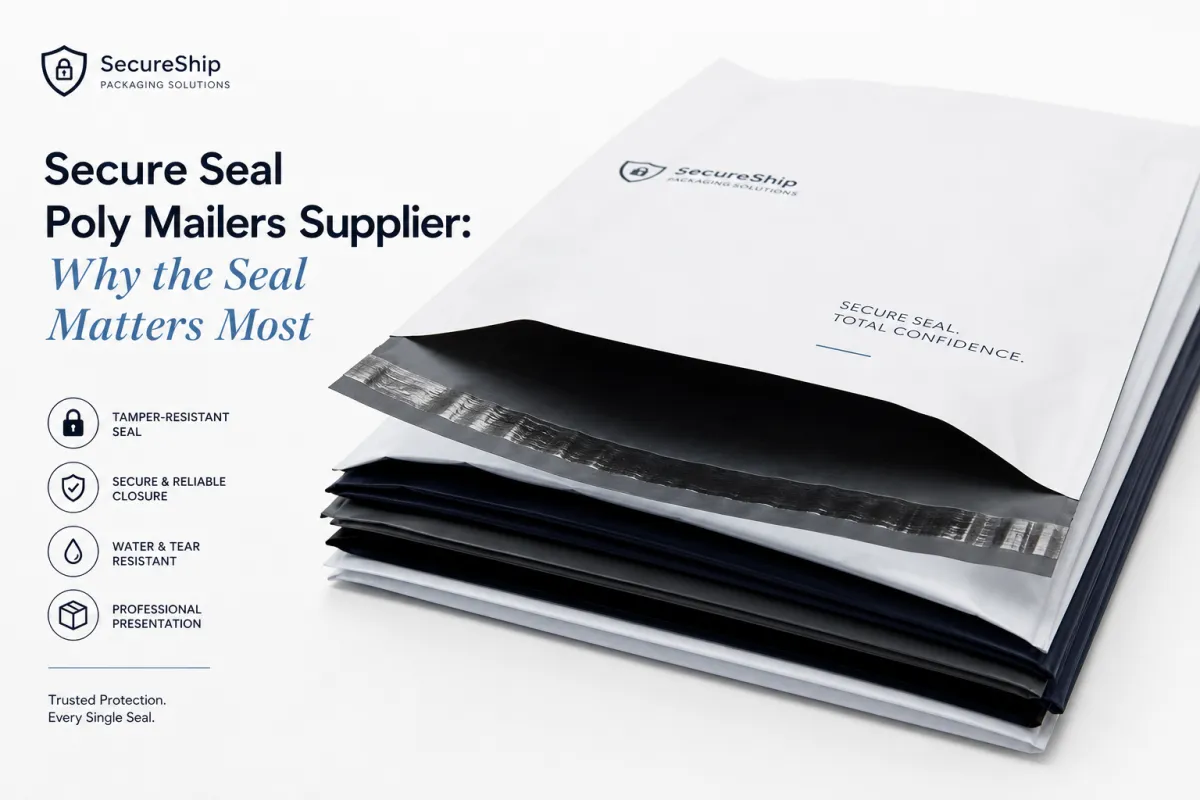
A secure seal poly mailers supplier should be able to explain more than size options and print method. The supplier should talk about adhesive consistency, seal width, closure strength, and how the mailer performs after repeated handling. If they cannot explain those basics without wandering off into marketing fluff, that is not a great sign.
In practice, a seal is only as good as three things: the adhesive formula, the surface condition of the film, and the way the flap is engineered. A mailer with a weak or uneven seal may still look fine in a photo, but once the bag gets squeezed by other cartons or exposed to heat, the closure can peel. That is why a secure seal poly mailers supplier is judged on performance, not glossy presentation.
Visual quality and functional quality are not the same thing. A vibrant custom print can hide a flimsy film, and a thicker-looking bag can still split at the seam if the resin mix is poor. I see buyers confuse those two categories all the time. They order what looks premium, then discover the bag was never built for the way their product actually ships.
A glossy poly mailer is not a protective spec. The seal has to do the real work.
The business cases are easy to spot. Apparel ships cleanly but needs a seal that survives sorting and resale returns. Cosmetics need a closure that stays shut and keeps dust out. Supplements need tamper-resistant presentation and consistent pack-out. Small parts can create puncture risk if the film gauge is too light. Subscription boxes often need a mailer that balances shelf appeal with real transit durability. In every one of those cases, a secure seal poly mailers supplier matters because a failed closure is not a design problem. It is an operations problem.
If you are narrowing options, do not start with the cheapest quote. Start with the question that matters: will the bag hold under your product weight, your route, and your carrier mix? A secure seal poly mailers supplier should help answer that with samples, data, and clear specs. If they dodge the details, move on. That is usually a clue, not a coincidence.
For buyers comparing broader packaging options, the right fit may sit alongside Custom Packaging Products or a more specific run of Custom Poly Mailers. The point is not to buy more packaging. The point is to buy packaging that closes properly and ships without drama.
There is also a testing angle that gets ignored. Carrier networks are rougher than most in-house teams realize. ISTA testing methods, especially drop and vibration-style protocols, exist for a reason, and they are worth reading about at ISTA. If a secure seal poly mailers supplier understands how closures behave under transit stress, they are already ahead of the bargain-bin crowd.
Secure Seal Poly Mailers Supplier Process and Timeline
The sourcing process should be predictable, even if the timeline is not always fast. A solid secure seal poly mailers supplier usually follows the same path: inquiry, spec review, sample request, proof approval, production, inspection, and shipping. If any of those steps is skipped, you are probably buying speed at the expense of control.
Here is the basic flow. First, you send size, product weight, print needs, and target quantity. Next, the supplier confirms whether the mailer is stock or custom, and whether the adhesive, film thickness, and size are actually suitable. Then you review samples or a digital proof. After that comes production, quality check, packing, and shipment. Sounds simple. It is simple. The trouble starts when one of those steps is rushed.
What slows the job down
Turnaround depends on a few predictable variables. Print complexity adds time because more colors, more coverage, or special finishes usually mean extra setup. Film availability matters because not every gauge or resin blend is sitting on a shelf. Custom sizing adds more work than a stock size. Adhesive type can also affect lead time, especially if the supplier uses a specific seal construction for cold storage, humid lanes, or heavier products. A secure seal poly mailers supplier should be able to state these tradeoffs plainly.
For stock mailers, a reorder may move in 3 to 7 business days if the supplier has inventory ready. Custom printed orders often take 12 to 20 business days after proof approval, and that is before transit. Overseas production can push that longer once ocean freight or customs enters the picture. A good supplier does not promise fantasy timelines just to land the order.
Timeline pressure creates bad decisions faster than almost anything else. A buyer who is under the gun will often accept an untested bag just to keep a launch date intact. I get why that happens, but it is a risky habit. If the closure fails, the emergency you were trying to avoid shows up anyway, only louder.
Why sample approval matters
Samples are not a formality. They are the fastest way to catch weak seal performance before you commit to volume. If you test a sample immediately after sealing, then again after compression, you learn a lot about closure behavior. If you skip that step, you are gambling that production will magically perform better than the sample. That is not a smart bet.
Some buyers slow themselves down by being vague. A proper approval cycle is faster when the artwork is final, the dimensions are confirmed, and the supplier has a clear use case. If the bag is for lightweight apparel, say that. If it is for a heavier boxed item with sharp edges, say that too. A secure seal poly mailers supplier can only tune the build if the brief is specific.
Plan around your launch calendar, not the other way around. If you need mailers for a seasonal drop, build in time for samples, revisions, and freight delays. Reorder planning matters as well. A supplier with strong closure performance is only useful if you have inventory before stock runs dry. The best secure seal poly mailers supplier relationship is the one that never turns into an emergency.
Secure Seal Poly Mailers Supplier Cost, Pricing, and MOQ
Price is where people get sloppy. They compare quote totals without checking the actual spec behind the number, then act surprised when one bag feels thinner, prints differently, or seals less reliably. A secure seal poly mailers supplier should be compared on landed cost and material performance, not headline pricing alone.
Several variables drive unit cost. Film thickness is one of the biggest. A 2.5 mil bag usually costs less than a 3 mil or 4 mil construction, but the cheaper film may not be the right fit for sharp corners or heavier loads. Size matters too; bigger mailers use more material. Print coverage adds cost, especially if the artwork uses full bleed ink on both sides. Matte and glossy finishes can shift pricing. Adhesive grade is another driver, because better seal performance usually costs more than a basic closure strip.
MOQ tradeoffs are straightforward. Lower minimums help new brands test the market without tying up cash in inventory. Higher minimums usually reduce unit cost and improve consistency. That is not some magical supplier trick. It is just how production runs work. A secure seal poly mailers supplier with a sensible MOQ will help you test without forcing you into a giant commitment.
| Order Type | Typical MOQ | Unit Cost Range | Lead Time | Best For |
|---|---|---|---|---|
| Stock plain mailers | 500-1,000 units | $0.07-$0.14 | 3-7 business days | Fast restocks and internal testing |
| Stock printed mailers | 1,000-3,000 units | $0.12-$0.22 | 7-12 business days | Simple branding with moderate volume |
| Custom printed mailers | 3,000-10,000 units | $0.16-$0.32 | 12-20 business days | Brand launches and repeat shipping programs |
Those ranges are realistic for common sizes and ordinary print coverage, but they move with thickness, freight, and market conditions. A secure seal poly mailers supplier may quote lower on paper and still cost more once you add setup, shipping, or duties. That is why comparison shopping has to include freight terms, plate or print prep fees, and any rush charges. A cheap quote without landed cost is just a teaser.
Buyers also overlook hidden costs on split shipments. If your order ships in multiple cartons or drops from multiple locations, freight can jump fast. Overseas freight may look attractive until customs delays eat the schedule. If you need a more detailed sourcing benchmark, the broader packaging industry resources at Packaging Institute guidance can help frame cost and material conversations before you place the order.
My practical rule is simple: pay for seal reliability, correct sizing, and enough film thickness before you pay for extras that do not improve shipping performance. Foil effects, overcomplicated graphics, and fancy finishes can be fine, but they do not rescue a mailer that opens in transit. A secure seal poly mailers supplier should help you spend in the right order, not the flashy order.
Key Factors That Separate a Reliable Supplier from a Risky One
The gap between a reliable supplier and a risky one is usually not mysterious. It shows up in how they talk about the seal, how they answer technical questions, and how they handle proofing. A secure seal poly mailers supplier should sound precise, not vague. If every answer feels like a slogan, that is not quality control. That is sales fog.
Start with the seal itself. Ask about adhesive type, seal width, and closure strength. Ask whether the adhesive is meant for hot lanes, cold lanes, or humid storage. Ask if the flap uses a pressure-sensitive closure, tamper-evident strip, or another construction. A supplier worth using will answer those questions without acting offended that you know what they mean.
Film and structure matter more than most buyers think
Film gauge consistency affects puncture resistance and how the mailer behaves under compression. A 2.5 mil film may be fine for soft apparel, but it is not the same as a 3.5 mil mailer with better tear resistance. Opacity matters if you are shipping products that should not be visible. Stacking behavior matters if your warehouse packs and pallets heavily. A secure seal poly mailers supplier should be able to explain how the bag holds up when boxes press against it, not just how it looks in a sample photo.
ASTM methods are useful here. ASTM D882 helps evaluate tensile properties of plastic film, and ASTM D1004 is commonly referenced for tear resistance. You do not need to become a lab technician, but you should know that real material specs exist. If a supplier cannot discuss basic film performance, they may be guessing more than they admit.
There is a practical reason to ask for these details. Two mailers can have the same stated thickness and still behave very differently because of resin blend, seal geometry, and extrusion consistency. I have seen that difference show up in simple compression tests, and it is one of those details that feels small until a pallet gets crushed in transit. Then it is not small at all.
Quality control is not optional
Reliable suppliers talk about tolerances, inspection steps, and sample consistency. They should be able to say how they check print alignment, seal integrity, film thickness, and carton pack-out before shipment. If they have no documented QC process, the risk shifts to you. A secure seal poly mailers supplier should not need to be chased for answers after the order is already in motion.
Communication is another supplier metric that buyers underestimate. Fast response time is nice, but accuracy matters more. If the proof is wrong, if the lead time keeps moving, or if reorders become an endless clarification loop, the supplier is costing you time even if the quote looked attractive. A supplier that handles issues cleanly is usually safer than one that only seems polished before payment.
Customization has limits too. Some suppliers can adjust size and print easily. Others can do it, but only by making the bag more expensive or more fragile. That tradeoff should be explained upfront. A secure seal poly mailers supplier does not pretend every idea is a good idea.
Step-by-Step Guide to Choosing a Secure Seal Poly Mailers Supplier
The best way to choose a secure seal poly mailers supplier is to slow down just enough to avoid a bad fit. You do not need a giant procurement process, but you do need a consistent method. Most packaging mistakes happen because someone guessed instead of comparing actual specs.
- Define the use case. Write down product weight, shape, any sharp corners, shipping method, and whether tamper resistance matters.
- Set the seal priority. If the closure must survive cold-weather transit or humid storage, say that before asking for price.
- Request samples. Get real samples from at least two or three suppliers and test them with the actual product.
- Compare the same specs. Match size, thickness, adhesive, print coverage, MOQ, lead time, and freight terms.
- Verify QC and proofing. Ask how the supplier checks closure strength, print accuracy, and final packing.
- Run a pilot order. Confirm the mailer before placing a full production run.
That sounds almost too basic, which is exactly why it works. A secure seal poly mailers supplier should welcome this process. If they resist samples or get annoyed by spec questions, they are telling you something useful. Ignore the sales pressure and listen to the friction.
Testing should use the actual product, not folded paper or a random filler item. If the mailer is for a soft tee, pack a tee. If it is for a small boxed item, pack that box. Then press the seal, compress the bag, and see whether the closure holds. A real test often exposes problems that a pretty proof never will.
For brands that ship at scale, one pilot order can save months of mess. You learn if the print matches expectations, if the seal holds during parcel handling, and if the mailers fit your packing line. You also get a better read on how the supplier handles a real order, which is often more revealing than any sales call. That is the kind of data a secure seal poly mailers supplier relationship should be built on.
Document the result of that pilot. Note what worked, what failed, and what needs adjustment. Then use those notes for the next reorder. Packaging teams that keep records improve faster. Teams that do not usually repeat the same mistake and call it experience.
Common Mistakes When Buying from a Secure Seal Poly Mailers Supplier
The most expensive mailer is the one that fails after you buy a cheap one. That failure can show up as returns, damaged goods, re-ships, and a brand experience that feels sloppy. A secure seal poly mailers supplier should help prevent those issues, but buyers still make avoidable mistakes before the first order even lands.
The first mistake is choosing only on price. Low cost looks clever in a spreadsheet until the bag opens in transit or tears on a sharp edge. Then the unit cost is irrelevant because the real cost includes replacements, labor, and customer complaints. A secure seal poly mailers supplier should be compared on total value, not just the number on the quote.
The second mistake is spec confusion. Buyers often grab a size from a catalog and assume it will fit. That is how you end up with a mailer that is too tight, too loose, or unable to handle the actual product shape. Size, thickness, and adhesive need to match the item, not the photo. If the product is boxed, soft, or uneven, the mailer spec needs to reflect that reality.
The third mistake is skipping sample testing. This is especially risky for heavier items, sharp corners, cold-weather shipping, or anything that gets handled more than once. If a closure peels easily during a simple in-house test, it will not magically improve in transit. A secure seal poly mailers supplier can only do so much if the buyer never checks the sample.
Artwork mistakes cause their own pain. Poor file prep, tiny text, low-resolution graphics, and vague approval notes all slow production down. If the supplier has to interpret a messy file, the proof cycle gets longer and the risk of misprints goes up. Clean artwork is not a luxury. It is basic respect for the production line.
Freight and reorder timing are the last sneaky traps. A quote can look fine until shipping, duties, and rush fees are added. Reorders can also arrive late if a buyer waits too long to restock. A secure seal poly mailers supplier is easiest to work with when you treat lead time as part of the spec, not an afterthought.
One more thing: if you are sourcing related packaging pieces along with mailers, check how those materials fit together. FSC guidance at FSC is useful for paper-based components, inserts, and mixed packaging programs. Poly film itself is a different material category, but the same discipline applies: know what you are buying, and know why.
Expert Tips and Next Steps for Your Secure Seal Poly Mailers Supplier Order
If you want cleaner quotes and fewer surprises, create a one-page spec sheet before you contact any secure seal poly mailers supplier. Keep it simple: size, product weight, seal priority, color, print coverage, target delivery date, and whether the bag needs extra puncture resistance. That one page saves a lot of back-and-forth.
Ask for a sample test plan, not just a sample. A strong secure seal poly mailers supplier should be able to outline how closure strength will be checked, how the bag should be handled during transit simulation, and whether temperature exposure matters for your route. If your products ship through hot warehouses or cold distribution lanes, that part is not optional.
Negotiate reorder terms early. Many buyers wait until they are already happy with the first run, then discover the supplier changes pricing or requires fresh setup work on the next order. Ask in advance whether repeat jobs keep the same spec, what happens if you need a quick restock, and how pricing changes at higher volumes. A secure seal poly mailers supplier should make repeat purchasing easier, not more annoying.
Document the first order carefully. Keep notes on seal performance, packaging speed, print quality, and any freight issues. If a bag passed the first round, note why. If it failed, note exactly where. That record is useful the next time you place an order, and it keeps procurement from becoming a memory contest.
For most brands, the smart move is boring in the best way: shortlist a few suppliers, compare identical specs, test samples in real shipping conditions, and then lock in the secure seal poly mailers supplier that actually performs. Not the one with the nicest sales deck. Not the one with the lowest fake headline price. The one that keeps your product closed, clean, and intact.
If you are ordering for a branded line, use that same standard every time. A secure seal poly mailers supplier should help your packaging work harder without making the buying process weird. Keep the spec tight, keep the testing real, and do not let a weak seal sneak into a program that depends on consistency.
The clearest takeaway is this: make the closure the first thing you verify, not the last. If the seal passes with the real product, under real handling, and with realistic freight conditions, the rest of the order has a much better chance of behaving the way you need it to. That is the kind of practical discipline that saves money without turning your packaging program into a guessing game.
What should I ask a secure seal poly mailers supplier before ordering?
Ask for exact film thickness, adhesive type, seal width, and whether the mailer is meant for lightweight apparel or heavier products. Confirm MOQ, lead time, freight method, and whether sample approval is required before production starts. Request a real-use sample test, not just a pretty proof. A secure seal poly mailers supplier should answer those questions without dodging the details.
How do I compare pricing from secure seal poly mailers suppliers?
Compare the same size, thickness, print coverage, and adhesive spec across every quote. Include freight, setup fees, and any rush charges so the true landed cost is visible. Watch for quotes that look cheaper only because they use thinner film or weaker adhesive. A secure seal poly mailers supplier is only a fair comparison if the spec is actually the same.
What is a normal MOQ for secure seal poly mailers supplier orders?
MOQ varies by stock or custom work, but custom printed orders usually require higher minimums than plain stock mailers. Lower MOQ is useful for testing, while higher volumes usually reduce unit cost. If a secure seal poly mailers supplier offers very low MOQ, check whether pricing or lead time gets worse elsewhere.
How long does a secure seal poly mailers supplier order usually take?
Stock orders are usually faster because they skip artwork prep and custom production steps. Custom printed orders take longer because proofing, setup, and production all add time. Lead time depends on quantity, print complexity, and shipping method. A secure seal poly mailers supplier should give you a realistic range, not a fantasy promise.
How can I test whether a secure seal poly mailers supplier has strong closures?
Fill the mailer with the actual product and press the seal through a real handling cycle. Check whether the closure stays closed after compression, vibration, and basic drop testing. If the seal opens easily or peels unevenly, do not assume bulk production will magically fix it. A secure seal poly mailers supplier worth keeping will encourage that kind of test before you buy big.