Buyer Fit Snapshot
| Best fit | Kraft Paper Mailers with Logo projects where brand print, material claims, artwork control, MOQ, and repeat-order consistency need to be specified before quoting. |
|---|---|
| Quote inputs | Share finished size, material target, print colors, finish, packing count, annual reorder estimate, ship-to region, and any compliance wording. |
| Proofing check | Approve dieline scale, logo placement, barcode or warning zones, color tolerance, closure strength, and carton packing before bulk production. |
| Main risk | Vague material claims, crowded artwork, missing packing details, or unclear freight terms can make a low unit price expensive after revisions. |
Fast answer: Kraft Paper Mailers with Logo: Branding That Ships Well should be specified like a repeatable production item. The safest quote records material, print method, finish, artwork proof, packing count, and reorder notes in one written spec.
Production checks before approval
Compare the actual filled-product size with the drawing, then confirm tolerance on folds, seals, hang holes, label areas, and retail display edges. Reserve space for logos, QR codes, warning copy, and material claims before decorative graphics fill the panel.
Quote comparison points
Review material grade, print process, finish, sampling route, tooling charges, carton quantity, and freight assumptions side by side. A quote is only useful when the supplier can repeat the same color, closure quality, and packing count on the next order.
Kraft paper Mailers with Logo do more work than their modest footprint suggests. A packing table can be noisy, crowded, and moving fast, but the mailer is often the first physical brand touchpoint a customer sees after the order leaves the building. That moment carries a lot of weight. The outside of the package has already begun the conversation before the product is even opened, and Kraft Paper Mailers with logo make that introduction feel intentional instead of improvised.
I have watched plenty of sample rounds where a beautiful product still felt unfinished because the shipping piece looked like an afterthought. A plain envelope can move an item from A to B, sure, but kraft paper Mailers With Logo add identity without turning the parcel into something flashy or overdesigned. They fit apparel, books, cosmetics, stationery, accessories, and compact direct-to-consumer kits, especially for brands that want the natural feel of kraft paper rather than a glossy film finish. The strongest version is not just nice to look at in a mockup; it closes cleanly, holds its shape in transit, and does not slow the pack line down.
For packaging buyers, kraft paper mailers with logo usually sit in a very practical middle ground. They are more branded than stock mailers, less bulky than corrugated cartons, and often easier to justify than a box for lightweight products. That balance is the real appeal. Presentation, product protection, sustainability messaging, and shipping speed all have to live in the same spec, and that can be a tricky mix. A mailer that photographs well but creates rework in fulfillment is nice for a presentation deck, not so nice for daily operations.
The branding value matters just as much as the shipping performance. A logo on the outside reinforces recognition in transit, at the doorstep, and during unboxing, while a consistent structure helps the packing team move with fewer interruptions. That is why kraft paper mailers with logo deserve more attention than a quick style choice. They are part of the shipping system, and the shipping system is part of the brand story.
Kraft Paper Mailers with Logo: Why They Stand Out
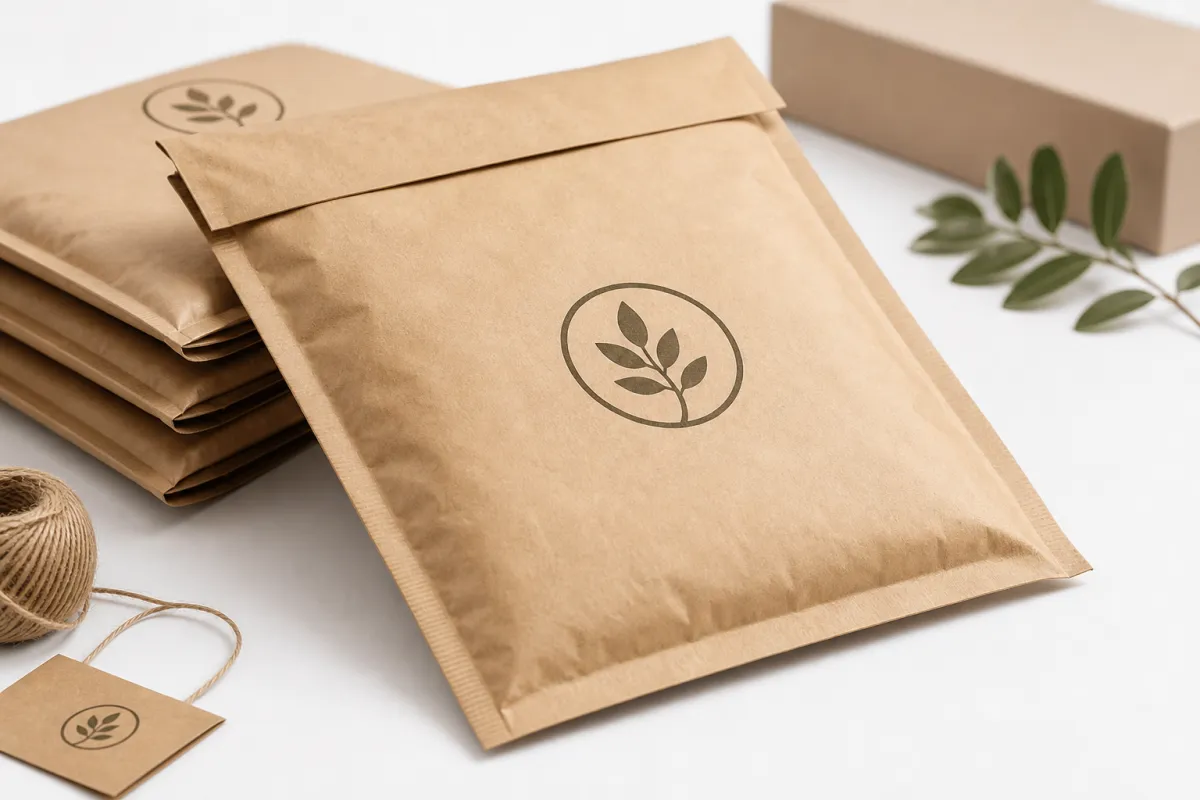
Most buyers are drawn to kraft paper mailers with logo because the material feels grounded. Kraft paper has a natural, slightly textured surface that reads as practical and honest, which works well for brands that want a tactile look without a lot of gloss or shine. It has a certain restraint to it, and that restraint is part of the appeal. Customers can usually tell whether the shipping piece was chosen with care or grabbed from a generic stock bin.
Plain mailers still have a place, especially when budgets are tight or the shipment is purely utilitarian. Kraft paper mailers with logo do something different: they turn the outside surface into a brand cue. That panel can carry a simple wordmark, a small icon, a short message, or a quiet pattern that ties into the larger packaging system without shouting over the product. For a lot of businesses, that is a smarter use of the package than putting all the emphasis inside an insert that appears after the customer has already formed an opinion.
The material choice also carries a kind of visual psychology. Kraft suggests restraint, utility, and care. It often pairs well with FSC-certified sourcing, recycled content, and packaging programs that want to tell a cleaner materials story without falling back on vague green language. Used with discipline, kraft paper mailers with logo support a voice that feels more grounded than plastic packaging while still looking polished enough for premium goods.
A mailer is not just a shipping skin; it is a brand cue that travels from the warehouse to the front porch.
That idea becomes easier to feel with smaller orders. A book, a folded tee, a beauty item, or a set of compact accessories may spend the whole trip inside the mailer, which means the shipping piece becomes one of the most visible branded surfaces in the order. kraft paper mailers with logo give that surface a purpose, and they do it without adding extra structure or much weight.
The useful question is not whether kraft looks appealing. It is whether kraft paper mailers with logo match the product, the way the team packs orders, and the cost target that keeps the program workable. A good mailer should pack quickly, seal reliably, survive carrier handling, and still look like it belongs to the brand by the time it reaches the customer.
Many brands also use the mailer as one piece of a broader packaging family. Apparel may ship in Branded Paper Mailers while fragile goods move in cartons. Inserts, tissue, stickers, and outer shippers can all work together if the visual language stays consistent. If you are building that kind of system, our Custom Packaging Products page is a practical place to compare formats that can sit beside kraft paper mailers with logo in the same program.
How Kraft Paper Mailers with Logo Work in Shipping
At a construction level, kraft paper mailers with logo usually combine an outer kraft face, some form of reinforcement or inner layer, and a closure system that keeps contents secure. Some arrive as flat envelopes with a self-seal strip. Others have gussets so the side walls can expand around thicker contents. A few include light padding or fiber-based cushioning for products that need surface protection without moving all the way to a corrugated shipper.
The seam design matters more than many buyers expect. Side seams, bottom seams, and flap folds all affect hold strength, especially when the product has a little spring or edge thickness. A flat mailer does well with thin items that fold neatly. Bulkier goods usually need a gusseted style so the mailer does not fight the contents during sealing. That is one reason kraft paper mailers with logo should be chosen for pack-out behavior, not for artwork alone.
Printing looks simple from a distance and gets more nuanced once the paper is in hand. A one-color logo is usually the cleanest route, especially on uncoated kraft surfaces where detail can soften. Two-color work can still look strong if the art stays simple and the registration is controlled. Full-coverage graphics are possible, though the paper texture can mute small type, thin strokes, and delicate gradients. With kraft paper mailers with logo, edited art usually beats crowded art.
Real shipping moves through several touchpoints: the packing table, the seal, the label, the carrier sort, delivery, and the unboxing moment. That chain explains why durability matters. A mailer that tears at the flap, wrinkles too easily, or allows the product to shift loses value quickly. Attractive mockups do not mean much if the package fails during carrier handling. That applies to kraft paper mailers with logo just as much as any other shipper format.
Size accuracy is another quiet detail with real consequences. An oversized mailer can let the product slide, which may lead to corner damage, bent edges, or a sloppy first impression when the customer opens it. An undersized mailer can slow the packing station because staff have to force folds, overwork the adhesive, or reject pieces that do not fit. The best kraft paper mailers with logo are sized so the product sits naturally, seals cleanly, and moves through the line without extra effort.
From the brand side, the goal is simple: the mailer should look intentional in transit. That does not mean flashy. It means the logo, paper choice, and structure all point in the same direction. A customer may never think about seam placement or basis weight, but they absolutely notice whether kraft paper mailers with logo arrive looking thoughtful or improvised.
If you are comparing paper mailers with softer film options, it helps to look at what is used for other lightweight parcels. Our Custom Poly Mailers page can be a useful reference point when you are deciding whether paper, film, or a mixed packaging program fits your order profile better.
For shipping validation, many buyers ask suppliers about transit testing and durability checks. The ISTA site is a solid starting point if you want to understand how parcel packages are commonly evaluated for drop, vibration, and handling conditions. That perspective helps even when the final program uses kraft paper mailers with logo rather than a box-heavy system.
Materials, Pricing, and Unit Cost for Kraft Paper Mailers with Logo
The materials behind kraft paper mailers with logo drive both performance and cost. Paper weight is usually the first lever. Heavier kraft stock feels sturdier and resists wrinkling better, but it also adds material cost and can affect how smoothly the mailer folds on the packing table. Recycled content is another factor. Some programs want post-consumer waste content because it supports their sourcing story, while others care more about the natural look and consistent forming behavior.
Coatings and adhesives play a large role as well. A plain uncoated kraft face is often the simplest route for printing and recycling pathways, though some applications need moisture resistance or a stronger closure system. A stronger peel-and-seal strip can improve packing speed, but the adhesive system may affect end-of-life handling. Padding, reinforcement, and internal lining all change the picture too. Buyers sometimes describe all paper-based mailers as biodegradable packaging, yet that label needs care. The full construction matters, not just the paper surface.
Print complexity has a direct effect on price. A simple wordmark or one-color logo generally costs less than full-bleed artwork, multiple print stations, or intricate details that demand tight registration. Kraft tends to reward restraint anyway. Strong contrast, thicker line weights, and larger type usually survive the paper texture more cleanly. That is one reason kraft paper mailers with logo can stay economical without looking cheap.
Order quantity changes the math in a very real way. Smaller runs usually carry a higher per-piece cost because setup, plates, proofing, and production changeover get spread over fewer mailers. Larger orders lower unit cost, but they also increase inventory commitment and storage needs. For many programs, kraft paper mailers with logo become especially attractive once volume reaches a few thousand pieces, provided the design stays simple and the size stays standard.
Dimensions can move the quote more than people expect. A larger mailer uses more paper, may require different tooling, and can raise freight cost because finished cartons take up more room. Custom sizing also influences lead time in some production environments because it may require a new dieline or a dedicated setup. If a brand ships multiple SKUs, standardizing a small family of sizes is usually wiser than creating a different mailer for every item.
Here is a practical pricing snapshot for kraft paper mailers with logo. These ranges are illustrative, since final quotes depend on size, paper weight, print coverage, and delivery destination:
| Mailer Type | Best Use | Typical Unit Cost at 5,000 pcs | Notes |
|---|---|---|---|
| Flat kraft mailer, one-color logo | Light apparel, books, flat goods | $0.18-$0.32 | Often the simplest and most cost-controlled option |
| Gusseted kraft mailer, one- or two-color print | Bulkier clothing, soft goods, kits | $0.24-$0.42 | Better for items that need a little expansion room |
| Padded paper mailer with logo | Items needing extra surface protection | $0.30-$0.60 | More material, more weight, more protection |
| Custom size, higher coverage print | Premium presentation or unusual pack-out | $0.35-$0.75+ | Setup, proofing, and specialized finishing can raise cost |
Those numbers only make sense when they are read alongside the packing process. A lower unit price is not a better buy if the mailer packs slowly, crushes too easily, or forces rework at the table. A slightly higher-cost option can save labor if it seals faster and fits the product correctly. That is the useful buying lens for kraft paper mailers with logo: compare total operating cost, not only the printed price.
If sustainability claims matter to your customer base, ask for details on FSC-certified fiber content, recycled materials, and any post-consumer waste percentage. The FSC site is a reliable place to understand certification basics. A clean sourcing story can help, but it should match the actual construction of the mailer. Buyers are better served by truthful material specs than by vague green language attached to kraft paper mailers with logo.
When I compare budgets, I like to look at three scenarios side by side: a plain branded mailer, a gusseted upgrade, and a padded version for delicate contents. That comparison often shows that the lowest-looking price is not the lowest-cost choice once damage, labor, and replacements are included. kraft paper mailers with logo can be very cost-effective, but only when the spec matches the shipment.
Process and Timeline for Ordering Kraft Paper Mailers with Logo
The ordering process starts with the product, not the artwork. Before requesting quotes for kraft paper mailers with logo, gather the finished product dimensions, note any thickness or edge stiffness, and decide whether the item needs a flat mailer, a gusseted style, or some padding. The more precisely the product is defined, the easier it becomes to narrow the right packaging format.
After that, choose the mailer style and prepare the artwork. A simple logo file in vector format gives the printer a clean starting point. If the brand wants a minimal outside print and a short message inside, decide that early. If color matching matters, share the Pantone reference or an accepted color target. File issues can slow kraft paper mailers with logo more than many buyers expect, especially when artwork changes are still being discussed after the quote has already started moving.
Proofing is the next checkpoint. Some orders only need a digital mockup, while others benefit from a physical sample before full production begins. A sample can reveal things that are easy to miss on screen: paper tone, logo contrast, adhesive feel, fold behavior, and whether the mailer actually fits the product without stretching. For kraft paper mailers with logo, that step can prevent expensive guessing later.
Once the proof is approved, production usually moves into scheduling, printing, converting, finishing, packing, and shipment. Standard orders with clean artwork tend to follow a more predictable path. Custom sizing, special lining, or a new print setup adds time. Freight is easy to underestimate as well. The production clock may be finished while the cartons are still in transit, which means the calendar can slip even when manufacturing stays on pace.
For planning, many buyers use a rough expectation of 12-15 business days after proof approval for standard custom work, though faster or slower timelines are both possible depending on quantity and production load. Larger or more complex orders can take longer. The useful lesson is simple: the earlier the dimensions, artwork, and seal requirements are finalized, the more predictable kraft paper mailers with logo become on the calendar.
Busy seasons matter too. Holiday peaks, product launches, and promotional campaigns can crowd production capacity, which pushes lead times out even when the design itself is uncomplicated. If the mailer is part of a launch kit or subscription start, build in extra time for sample approval and freight buffers. A well-planned order for kraft paper mailers with logo is usually the one that arrives before pressure starts building.
Here is the simplest way to think about the timeline:
- Measure the product and define the pack-out.
- Choose the mailer style and closure.
- Prepare logo files and print details.
- Review proof or sample.
- Approve production.
- Receive finished goods and test pack them before rollout.
That sequence may look basic, but it separates a controlled order from a rushed one. A clean process keeps kraft paper mailers with logo from becoming a last-minute scramble, and it gives the packing team time to confirm that the final format fits the actual workflow.
Step-by-Step Guide to Choosing the Right Mailer
The right choice begins with measurement. Start with the product’s length, width, and thickness, then add a little room for the fold and seal. If the item has hard corners, brittle packaging, or anything that can catch on the seam, the fit needs more care. For kraft paper mailers with logo, this is where practical packaging knowledge matters more than visual taste.
Next, decide on the mailer style. A flat format works well for thin items such as books, flat textiles, or documents. A gusseted mailer is better for folded apparel, bundles, or thicker retail kits. If the product needs more cushioning, a padded paper option may make sense. If the item is fragile enough to fail in a mailer, a box or corrugated shipper is often the safer route. That is not a failure of the mailer; it is just the right use case.
Brand voice comes after structure. A logo can sit bold and centered, small and understated, or paired with supporting copy that tells the customer what the packaging is trying to communicate. Some brands want a very clean exterior with only a logo and return mark. Others want a stronger retail-style front panel. The best kraft paper mailers with logo are the ones that match the rest of the packaging system instead of fighting it.
Test the pack-out in real conditions. Put the actual product into the mailer with the actual packing staff. Watch how easily it folds, seals, labels, and stacks. A design that looks fine on paper can behave very differently at the table if the adhesive strip is stiff, the flap is short, or the mailer wants to spring open. That is why sample runs are so useful for kraft paper mailers with logo; they reveal friction before volume amplifies it.
Check carrier and labeling needs next. Some shipments need room for shipping labels, barcode placement, or service instructions. Others need extra resistance to abrasion because the parcels travel through multiple touches. If the mailer surface smears, scuffs, or hides important markings, the experience gets messy fast. In a well-run program, kraft paper mailers with logo still leave enough space for the operational details that keep orders moving.
Finally, compare the option against your broader packaging stack. If the brand already uses printed inserts, branded tissue, or a custom outer box, the mailer may only need one disciplined visual cue. If it is the main branded surface, it may deserve a slightly larger logo, a cleaner panel, or a deeper paper tone. I usually tell buyers to compare not just appearance, but also storage, labor, freight, and product protection. That is the right lens for kraft paper mailers with logo.
A simple decision path helps:
- Need flat and light? Use a flat kraft mailer.
- Need room for folded goods? Choose a gusseted style.
- Need more surface protection? Look at padded paper options.
- Need stronger branding? Simplify the logo and keep contrast high.
- Need lower total cost? Standardize size and limit print complexity.
That process keeps the decision grounded. Instead of starting with a visual mood board and hoping the packaging behaves, you start with the product and build outward. That is usually how kraft paper mailers with logo end up doing real work for a brand instead of just looking good in a presentation deck.
Common Mistakes with Kraft Paper Mailers with Logo
The first mistake is choosing for appearance alone. A mailer can look lovely in a mockup and still fail if the closure is weak, the size is off, or the paper weight is too light for the product. I have seen buyers focus on the front panel art and then discover the actual pack-out does not hold up. With kraft paper mailers with logo, function always beats decoration.
The second mistake is overcomplicating the artwork. Kraft surfaces can soften very thin lines and reduce the impact of tiny type, especially when the print area is busy. High-detail gradients, microtext, and weak contrast often disappear into the texture. If the design needs to survive warehouse handling, scanning, doorstep delivery, and unboxing, simpler art usually performs better. That is why kraft paper mailers with logo often look more refined when the design is edited down rather than packed with elements.
A third issue is ignoring the actual product shape. A folded shirt behaves differently than a rigid accessory box, and a stack of books behaves differently than cosmetics. Weight, edge sharpness, and internal movement all influence how the mailer folds and seals. If the product has hard corners, a flat format can crease or split. If it has too much give inside the mailer, it can slide and arrive looking sloppy. kraft paper mailers with logo need to be matched to the contents, not the brand mood alone.
Another mistake is skipping sampling or real-world testing. A digital proof cannot show how the adhesive strip feels, how the paper scores, or whether the final size actually makes packing easier. One skipped sample can lead to a reprint, a delayed launch, or a production run that sits unused. A small test batch of kraft paper mailers with logo is usually worth far more than the cost of correcting the wrong decision later.
Sustainability messaging can get sloppy as well. Buyers sometimes call a paper mailer recyclable, compostable, or biodegradable packaging without checking the coating, adhesive, liner, or mixed material content. That creates risk. A better approach is to describe the actual material makeup and let the end-of-life path follow from that. If a mailer uses recycled materials, say so. If it uses FSC-certified fiber, say so. If it contains post-consumer waste content, give the percentage. That is how kraft paper mailers with logo build trust instead of confusion.
Pricing mistakes show up often too. It is easy to compare only the unit cost and miss the rest of the equation: setup, freight, extra storage, sampling, and the volume needed to hit the quoted rate. A cheaper mailer can end up costing more if it slows the line or causes damage. Smart buyers read the quote as a system cost, not just a piece price. That perspective matters a lot for kraft paper mailers with logo because the printed shipper is part of the operating budget, not just the branding budget.
One final mistake is forgetting that shipping is a moving environment. Boxes get stacked, conveyors vibrate, labels rub, and corners catch. If the design has not been thought through for those realities, the result can look tired before it ever reaches the customer. Good kraft paper mailers with logo should stay legible, sealed, and presentable all the way through the trip.
Expert Tips and Next Steps for Kraft Paper Mailers with Logo
If I had to give one practical piece of advice, it would be this: simplify the logo before you enlarge the mailer. A stronger wordmark, a cleaner icon, and a higher-contrast layout usually travel better than a crowded composition. On kraft paper, the texture already gives you visual interest. You do not need to force it. The best kraft paper mailers with logo often feel confident because they are restrained.
Another good move is to treat the mailer as part of a packaging family. The outside shipper, the insert, the label, and any tissue or sticker should sound like they came from the same brand system. That does not mean every element must match exactly. It means the tone, color discipline, and message are consistent. If you are building that broader structure, our Custom Packaging Products page can help you think about how kraft paper mailers with logo fit alongside cartons, inserts, and other pack formats.
Small upgrades can add value without making the job complicated. A short brand line, a QR code that points to care instructions or a reorder page, or a restrained inside print can improve the experience without turning the mailer into a printing challenge. Keep the artwork in the places people actually see. Keep the utility where the packing team needs it. That balance is where kraft paper mailers with logo start to pay off in both branding and operations.
I also recommend a small sample run whenever the product is new, the artwork is changing, or the order is large enough that a mistake would be painful. Test the seal, the fold, the print clarity, and the label placement with real staff and real products. If the mailer passes those tests, you have a much better chance of a smooth rollout. If it does not, you still have time to adjust dimensions, print placement, or closure choice before committing to volume. That is the safest way to move kraft paper mailers with logo from concept to production.
Here is a practical next-step list for buyers:
- Gather final product measurements and thickness.
- Shortlist two or three mailer styles.
- Prepare vector artwork and any color references.
- Ask for pricing at several quantities.
- Request a proof or sample.
- Compare lead time against your launch or replenishment schedule.
That sequence keeps the project focused. It also helps the supplier quote accurately, which saves time for everyone. The better the inputs, the cleaner the result. In packaging, clarity at the start usually shows up as fewer headaches at the end.
For teams that are also evaluating shipping performance and material sourcing, it can help to review broader industry guidance on packaging design, waste reduction, and transit testing. EPA resources on waste prevention, the FSC certification framework, and ISTA-style shipment testing all give useful context for decisions that affect kraft paper mailers with logo.
My honest take is that kraft paper mailers with logo work best when brand intent, structural fit, and production planning line up. If any one of those three is off, the package usually feels unfinished. If all three are handled well, the mailer becomes one of those small packaging details that quietly lifts the entire order experience.
FAQ
Are kraft paper mailers with logo strong enough for apparel orders?
Yes, as long as the mailer size and paper weight match the garment type and fold style. Light apparel usually fits well in flat or gusseted options, while heavier or bulkier clothing often needs a reinforced edge, a stronger seal, or a little extra room so the pack-out does not fight the material. For kraft paper mailers with logo, a quick test with actual folded garments is the safest way to confirm performance.
What print method works best for kraft paper mailers with logo?
Simple spot-color printing usually works best because the kraft texture can soften very fine detail. A bold one-color or two-color logo often looks cleaner than busy artwork with tiny type or thin gradients. If you want more complex graphics, ask how the printer handles registration, ink coverage, and color consistency on uncoated kraft before you approve kraft paper mailers with logo.
How much do kraft paper mailers with logo usually cost?
Cost depends on size, paper weight, print coverage, and order quantity. A standard one-color mailer can land in a lower price band, while gusseted, padded, custom-sized, or high-coverage versions cost more. Higher quantities often reduce the unit price because setup costs are spread over more pieces. The real comparison for kraft paper mailers with logo should include freight and packing efficiency, not just the printed unit cost.
How long does production take for kraft paper mailers with logo?
Timeline depends on proof approval, sampling, order size, and whether the spec is standard or fully custom. Once the artwork and dimensions are locked, many standard custom orders move faster than buyers expect, but custom sizing or special finishing can extend the schedule. If your files are ready early, kraft paper mailers with logo usually move through approval and production with fewer delays.
Can kraft paper mailers with logo be recycled?
Often yes, but it depends on coatings, adhesives, padding, and any mixed materials attached to the mailer. A paper face alone does not guarantee recyclability. Check the full construction, including seals and liners, before making claims. If the mailer uses FSC-certified fiber or recycled materials, that may support your sustainability story, but it still helps to be precise about what kraft paper mailers with logo are made of.
For brands that want packaging to do more than just survive the trip, kraft paper mailers with logo are a strong place to start. They can support visual identity, fit everyday shipping routines, and keep costs under control when the spec is chosen with care. The clearest next step is simple: lock the finished product dimensions, choose the mailer style that fits the real pack-out, and approve artwork that will still read cleanly at actual print size. If those three pieces are right, kraft paper mailers with logo tend to do exactly what good packaging should do, which is make the shipment feel considered from the moment it lands.


