Sew on Logo Patches Bulk b2b sourcing is not a decoration purchase. It is a production decision that has to survive sewing, washing, handling, and retail presentation without turning into a rework problem later. A patch can look clean in a product photo and still fray at the edge, warp under the needle, or land with color drift between batches. That is the kind of variance that quietly eats margin.
From a buyer’s point of view, the best patch order is almost dull. The sample matches production. The factory repeats the same construction across hundreds or thousands of pieces. Delivery lands on time, and nobody has to explain why the second batch looks “close enough.” That is why sew on logo patches bulk b2b sourcing should be treated as a spec-led buying exercise, not a mood-board conversation.
If you already buy Wholesale Programs for garments or branded accessories, the logic is familiar: lock the details first, then ask for pricing. The fewer assumptions left in the quote, the fewer surprises show up later in receiving, sewing, or returns.
Why Bulk Patch Orders Fail or Win on First Inspection
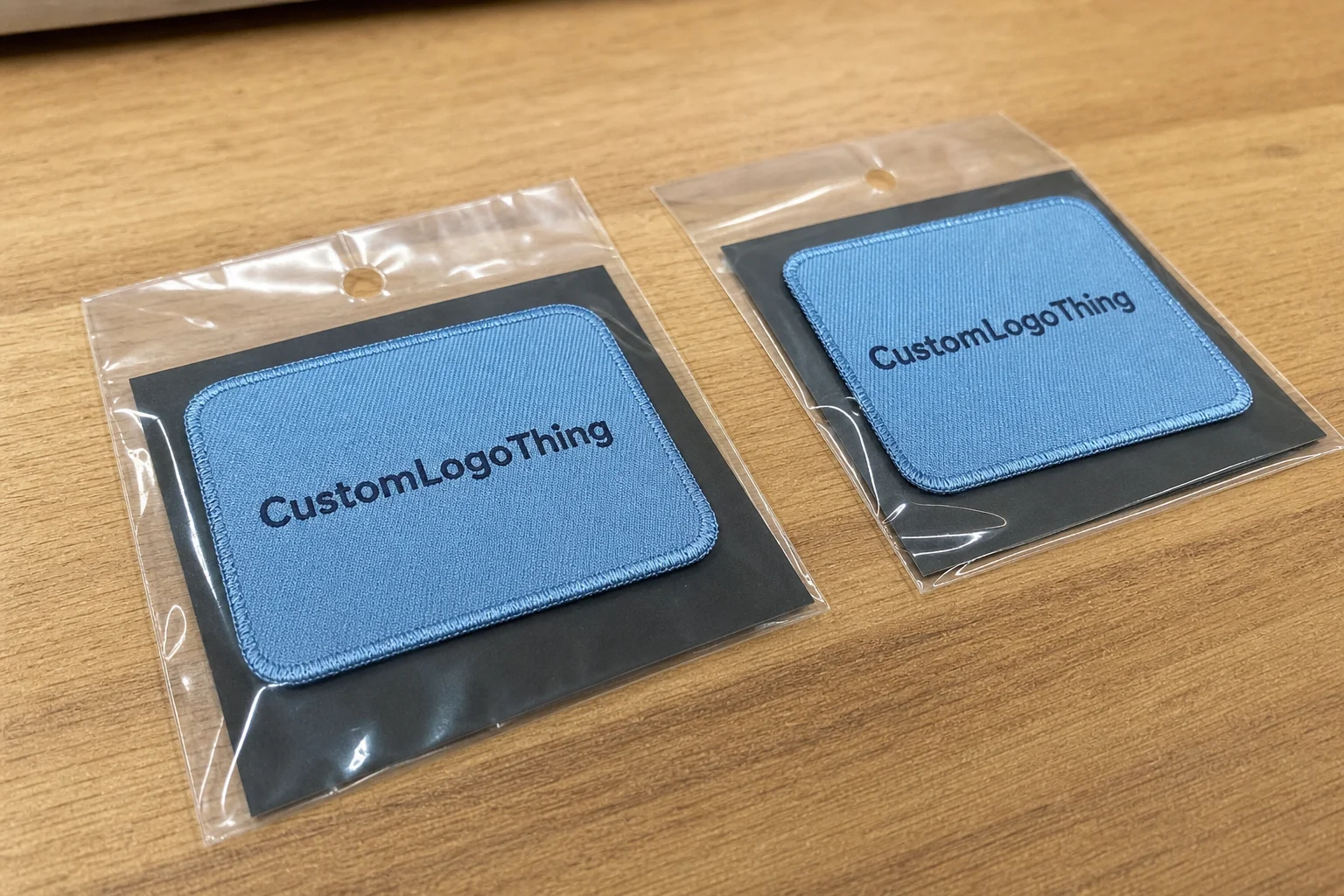
The first inspection tells you almost everything. Cheap patches usually fail in predictable ways: loose border threads, uneven stitch fill, corners that lift after trimming, or fabric that puckers once it gets sewn onto a heavier garment. None of that looks dramatic on a sample photo. It shows up at goods-in, on the sewing line, or after the first wash cycle.
Sew-on construction is the standard for outerwear, uniforms, denim, and workwear because those garments need the patch to hold through abrasion and repeated laundering. Adhesive-backed options can help with placement, but they are not the attachment method buyers should trust for hard-use apparel. Sew-on patches also give the finished piece a more permanent, deliberate look. On uniforms, that matters. On denim jackets, it matters even more.
Bulk buyers need consistency more than one beautiful sample. A factory can hand-make a perfect prototype and still miss the real production target if it changes thread density, border width, or cutting method later. In practice, the bad orders are rarely about one huge defect. They are about small drift across the run. Five percent of the patches become a problem, then fifteen percent, then the whole batch gets sorted by hand. That is how profit disappears.
“A patch that looks premium but twists, frays, or puckers in production is not premium. It is expensive cleanup.”
sew on logo patches bulk b2b sourcing works best when the buyer thinks about end use first. Will the garment be washed often? Is it a retail item or a work uniform? Is the patch for a soft knit or a heavy canvas shell? Those questions matter more than chasing the lowest unit price on paper.
Patch Materials, Backing, and Stitch-Ready Construction
Most buyers compare materials by appearance. That is the wrong order. Start with how the patch behaves under the needle, then decide how it should look. For sew-on patches, the important details are edge finish, fabric stability, and whether the body of the patch holds its shape during stitching.
Woven patches are a strong option for fine text, tight logos, and compact artwork. They usually give cleaner detail than embroidery at smaller sizes. Embroidered patches are better when the logo needs texture and a more classic badge feel. Printed fabric patches work when the art has gradients, thin lines, or more colors than a stitched patch can handle cleanly. Leather patches bring a premium, rugged look, while PVC-look alternatives can mimic a molded finish but still need to be specified for sew-on use, not just appearance.
Backing matters too. True sew-on patches usually skip heat-activated adhesives on the back because the extra layer can interfere with stitching or create thickness where the garment seam already needs to lie flat. If a factory offers a temporary tack layer for placement, that is fine, but it should not replace the sew-on construction. The edge finish should also be controlled. Merrowed borders, laser-cut edges, satin stitch borders, and folded fabric edges all behave differently under production sewing.
Shape changes labor. Standard rounds, rectangles, shields, and patches with simple corner radii are easier to sew in quantity. Custom die-cut outlines can look better, but irregular borders take more trimming care and more operator attention on the sewing line. Two patches with the same area can still produce very different handling costs.
- Outerwear: heavier woven, leather, or embroidered patches with stable edges.
- Uniforms: woven or embroidered patches with legible type and repeatable color.
- Denim: leather or embroidered patches that tolerate abrasion and repeated washing.
- Workwear: durable sew-on custom patches with simple borders and strong thread fill.
For shipping and handling standards, some buyers also ask whether packaging can be tested or specified against transit expectations. If the order is large and delicate, resources from ISTA and FSC can help frame packaging and paper sourcing decisions, especially if cartons or inserts matter to the receiving process.
Specifications Buyers Should Lock Before Quoting
Most quote delays come from missing specs, not from factory incompetence. Before asking for pricing, lock the basics: size, shape, artwork complexity, border type, base material, color count, and the intended garment. If the patch is going onto a softshell jacket, that is not the same job as a patch for a heavyweight canvas apron.
Color matching needs a real reference. If you are matching an existing uniform line, give the supplier a Pantone reference, a physical swatch, or a previous approved sample. “Dark blue” is not a spec. It is an argument waiting to happen. If your brand uses strict visual standards, define acceptable color tolerance before production starts.
Size tolerances also matter. A patch quoted at 80 mm wide should not arrive at 74 mm or 87 mm unless the factory told you that range up front. The same goes for placement tolerance if the patch is being sewn onto pre-cut garments. Buyers should also specify whether they want bulk packed, pair packed, or individually bagged units, because packing format affects receiving speed and internal handling.
Here is the level of detail that keeps quotes honest:
- Artwork: final vector file or high-resolution artwork with clear outlines.
- Size: finished width and height in millimeters or inches.
- Material: woven, embroidered, printed fabric, leather, or other sew-on build.
- Border: merrowed, satin stitch, laser cut, or folded edge.
- Backing: sew-on only, or temporary tack for placement.
- Packing: bulk carton, labeled bundles, or individual polybags.
A sample should confirm more than appearance. It should confirm sewability, edge quality, and logo legibility after the patch is attached to the real garment. A patch that looks fine loose on a table can behave differently once it is stitched through heavy fabric. That is normal. It just means the approval step has to reflect reality, not a flat sample sheet.
Cost, Pricing, MOQ, and Quote Drivers
Patch pricing is driven by a short list of variables, and buyers who understand them stop wasting time on fake comparisons. The biggest ones are size, stitch complexity, material choice, quantity, and setup work for custom artwork. The more intricate the logo, the more labor and machine time it takes. That is not a mystery. It is just manufacturing.
MOQ shifts with construction type. Simpler woven or embroidered patches often start lower because they are faster to program and easier to run consistently. Leather, specialty materials, or custom die-cut outlines usually raise the minimum because the factory has to spend more time on setup, cutting, and finishing. If a supplier is vague about MOQ, ask for tiered options. A supplier that can quote 300, 500, and 1,000 pieces gives you more control than one number with no context.
Do not confuse sample cost, setup cost, and unit price. A sample may be low-cost or even free on a future-order basis, but the factory still has to digitize artwork, prep tooling, or test edge construction. That work does not disappear because the first unit looks cheap. Buying only on the headline unit price is how teams end up with a landed cost that is 15% to 25% higher than expected once shipping and repacking are included.
| Patch Type | Typical Bulk Use | Indicative Unit Cost | MOQ Tendency | Notes |
|---|---|---|---|---|
| Woven sew-on patch | Small logos, fine text, retail apparel | $0.18-$0.45 | Lower to mid | Strong detail, clean edge control, good for compact artwork |
| Embroidered patch | Uniforms, outerwear, classic brand marks | $0.22-$0.60 | Mid | Heavier look, more texture, higher stitch labor |
| Printed fabric patch | High-color artwork, gradients, photo-style graphics | $0.15-$0.35 | Lower to mid | Fast to reproduce, but edge and fabric stability still matter |
| Leather patch | Denim, premium workwear, rugged outerwear | $0.55-$1.40 | Mid to higher | Premium feel, usually more expensive due to material and cutting |
| PVC-look sew-on alternative | Sportswear, tactical styling, specialty branding | $0.40-$1.10 | Mid to higher | Needs careful spec review for sew-on compatibility |
Those ranges are not universal. They move with quantity, color count, and finish. Still, they are realistic enough to stop a buyer from treating a $0.28 patch and a $0.92 patch as if they are the same thing. They are not. The first might suit a promotional run. The second might be the only sane option for a premium retail jacket.
Quality Control Checks That Catch Real Problems
Quality control on patches is not just a visual check under bright light. The important failures show up when the patch is handled like a product, not a sample. Thread pull, edge lift, color mismatch, and distortion after sewing all need to be checked before the order moves into the garment line.
Start with the edge. A patch can pass a quick glance and still unravel after trimming if the border stitch is too loose or the cut edge is too sharp. On woven and printed fabric patches, look closely at the perimeter after a tug test. On embroidered patches, check whether the merrow or satin border sits evenly around the full shape. A border that looks heavy on one side and thin on another usually signals process drift.
Then test the patch on the real substrate. A logo sewn onto denim behaves differently from the same logo sewn onto fleece, nylon, or canvas. The needle hole, stitch tension, and fabric recovery change the final look. Good buyers test one or two garments before releasing the bulk run. That step costs far less than unpicking hundreds of misaligned pieces.
Wash testing matters when the patch is going into uniforms or items that are laundered often. Even a simple home-style wash test can expose edge curl, thread fuzzing, or color bleed. For workwear and outerwear, abrasion resistance matters too. A patch that looks polished on a table can still pill, scratch, or lose surface detail after repeated wear.
A practical QC checklist usually covers five things:
- Dimensions: the finished size matches the approved spec.
- Color: the patch matches the approved reference under normal light.
- Edge stability: no loose threads, curling, or border gaps.
- Stitch behavior: the patch sits flat after being sewn to the target fabric.
- Packing: cartons, bundles, and labels match the receiving plan.
These checks are basic, but they catch the defects that cost the most. The goal is not perfection theater. It is preventing avoidable rework.
Production Steps, Process, and Lead Time
The normal workflow is straightforward: artwork review, proofing, sample approval if needed, production, trimming, inspection, and shipment. The fastest way to lose time is to send fuzzy artwork, change dimensions after proof approval, or leave color choices unresolved until the factory is already queued. That is not an industry problem. That is a process problem.
For clean orders, lead time is often 12 to 15 business days from proof approval. More complex shapes, dense embroidery, specialty materials, or high-volume runs can push that to 15 to 20 business days. If a supplier promises much faster than that without seeing the art, the claim deserves scrutiny. Production capacity is not magic.
Approval should be specific. Approve the patch size, edge finish, material, color standard, and packing format before full production begins. If the sample is only a visual reference, say so. If the sample is pre-production and must match final output, say that too. Ambiguity is expensive in bulk orders.
For procurement teams juggling garment cut-and-sew schedules, a simple milestone plan helps:
- Send final artwork, target size, and quantity.
- Confirm quoted specs and approved sample method.
- Approve proof or physical sample.
- Release production and lock the delivery window.
- Inspect the bulk shipment before garment attachment starts.
If the patch order has to align with an apparel launch, build in buffer time for shipping, receiving, and internal QA. A patch order that lands two days late can stall a whole production line. That is the kind of delay nobody remembers until payroll is already committed.
How to Source a Factory That Can Handle Reorders
For repeat buyers, consistency matters more than squeezing the first order to the bone. A low quote is useful only if the supplier can reproduce the same patch six months later without changing thread shade, border thickness, or backing behavior. Seasonal restocks and ongoing uniform programs live or die on repeatability.
Ask directly about artwork retention and batch-to-batch control. Can the factory keep your digitized file on record? Can it re-run the same color matching? Does it record material lot numbers or at least keep a reference sample? Good suppliers can answer those questions without hand-waving.
Capacity matters too. A supplier that can handle small pilot runs and larger bulk runs without changing construction methods is usually a better long-term fit than a shop that only wants one type of order. If the patch design is likely to evolve, ask whether they can adapt the quote without forcing a full reset every time the size changes by a few millimeters.
Use a practical checklist:
- Response speed: Do they answer clearly and on time?
- Proof accuracy: Does the mockup match the requested spec?
- Sample quality: Does the sample look production-ready, not just presentable?
- Documentation: Are size, color, and packing notes written down?
- Quote transparency: Do they separate setup, sample, and unit cost?
Reliable reorders save more money than aggressive first-order discounts. That is especially true in sew on logo patches bulk b2b sourcing, where batch consistency protects both the garment line and the brand image. A supplier that understands that is worth more than one that only knows how to send a low number.
Next Steps for Placing a Bulk Patch Order
If you want an accurate quote, send one complete request instead of six half-answers. Include the final artwork, target size, preferred material, estimated quantity, garment application, color references, and packing needs. If you already know the delivery window, state it. If samples are required, say that before the quote gets locked.
Ask for at least two quote tiers: the best unit cost and the best balance of lead time, quality control, and repeatability. The cheapest line item is not always the best buy. Sometimes it is just the one with the most surprises waiting behind it. That is why buyers should compare landed cost, not just headline pricing.
Before issuing a purchase order, confirm the approval deadline, shipping terms, and receiving format. Bulk packed patches may be fine for a production floor, while individually bagged pieces make more sense for distribution, kitting, or direct-to-store fulfillment. If your receiving team cares about carton labeling or insert materials, ask for that now, not after dispatch.
For buyers focused on sew on logo patches bulk b2b sourcing, the clean path is simple: lock the spec, approve the sample, then move into production with no loose ends. That approach keeps the quote real, the schedule defensible, and the reorders manageable.
What affects the price of sew-on logo patches in bulk B2B orders?
Size, stitch or print complexity, material, border type, and order quantity are the main drivers. Custom shapes and tight color matching usually raise setup effort and unit cost. Packing format and shipping method can change the landed price more than buyers expect.
What MOQ should I expect for sew-on logo patches bulk sourcing?
MOQ varies by construction and factory capacity, but custom patches usually need enough volume to cover setup. Simpler woven or embroidered styles often start lower than highly detailed or specialty-material patches. Ask for tiered MOQ options if you need a test run before a larger reorder.
How long does production usually take for bulk sew-on patches?
Lead time depends on artwork approval, material choice, quantity, and current factory load. Straightforward orders move faster than custom shapes or multi-color designs. The fastest schedules come from clean artwork and fast proof approval, not from pushing the factory later.
Can sew-on logo patches be used on uniforms and workwear?
Yes, sew-on patches are a strong fit for uniforms, workwear, denim, outerwear, and other hard-use garments. They hold up well because the garment stitching provides the main attachment, not adhesive alone. The patch material and edge finish should be chosen for washability and abrasion resistance.
What should I send to get an accurate quote?
Send final artwork, desired size, shape, material preference, quantity, and garment use case. Include color references, packaging needs, and whether you need samples first. The clearer the spec, the less likely you are to get a quote that changes later.


