Buyer Fit Snapshot
| Best fit | Shipping Box Price for Startups projects where brand print, material claims, artwork control, MOQ, and repeat-order consistency need to be specified before quoting. |
|---|---|
| Quote inputs | Share finished size, material target, print colors, finish, packing count, annual reorder estimate, ship-to region, and any compliance wording. |
| Proofing check | Approve dieline scale, logo placement, barcode or warning zones, color tolerance, closure strength, and carton packing before bulk production. |
| Main risk | Vague material claims, crowded artwork, missing packing details, or unclear freight terms can make a low unit price expensive after revisions. |
Fast answer: Shipping Box Price for Startups: What Really Drives Cost should be specified like a repeatable production item. The safest quote records material, print method, finish, artwork proof, packing count, and reorder notes in one written spec.
Production checks before approval
Compare the actual filled-product size with the drawing, then confirm tolerance on folds, seals, hang holes, label areas, and retail display edges. Reserve space for logos, QR codes, warning copy, and material claims before decorative graphics fill the panel.
Quote comparison points
Review material grade, print process, finish, sampling route, tooling charges, carton quantity, and freight assumptions side by side. A quote is only useful when the supplier can repeat the same color, closure quality, and packing count on the next order.
Shipping Box Price for startups rarely matches the number sitting at the top of the quote sheet. I have watched founders fixate on a tidy unit price and then react with real shock when freight from Shenzhen to Los Angeles, flute choice, die-cut tooling, and transit testing show up as line items they never expected to see. The real figure grows out of corrugated board, box style, freight zone, print method, and the kind of abuse your parcel network will hand the carton after it leaves order fulfillment. I remember one small run for a subscription snack brand in Dongguan that assumed the smallest box would be the cheapest answer, only to learn the product needed 32 ECT board, a custom die, and a stronger outer case just to survive an ISTA-style 27-inch drop sequence. The first quote looked lean at $0.29 a unit, yet the landed number moved fast once we corrected the spec and added realistic transit packaging requirements. That is the practical side of shipping box price for startups, and it matters a lot more than a polished sales pitch.
Protecting cash while shipping a package that arrives flat, square, and intact is the real task. The goal is not a bargain carton at any cost; it is a carton that protects the product, keeps dimensional weight under control, and avoids trapping you in a giant inventory buy before the SKU has proven itself in Chicago, Atlanta, or Dallas. I have sat in too many startup meetings where the buyer focused on one line item and ignored the other four that decide shipping box price for startups in the real world. Packaging looks simple until the box starts affecting returns, labor, and carrier bills. A good quote should let you compare package protection, freight, and reorder flexibility side by side, not leave you guessing after the pallet shows up. That is the mindset I bring to every buyer conversation, whether the order is 500 units or 25,000.
My aim is simple: give you the same buying roadmap I use on the factory floor, so you know what to ask, what to compare, and where a supplier may be hiding cost. I have watched teams save $0.06 per box and then lose $0.44 in damage, repacking labor, or extra void fill because the carton was not matched to the product. I still wince a little when a founder celebrates a cheaper carton and then discovers the warehouse team hates it in week two of launch, and, frankly, the warehouse team is usually right. The right shipping box price for startups comes from a fit that works through parcel handling, warehouse stacking, and the unboxing moment, not from chasing the lowest quote without context. That is the difference between a clean launch and a warehouse headache.
Shipping Box Price for Startups: A Real Shop-Floor Lesson
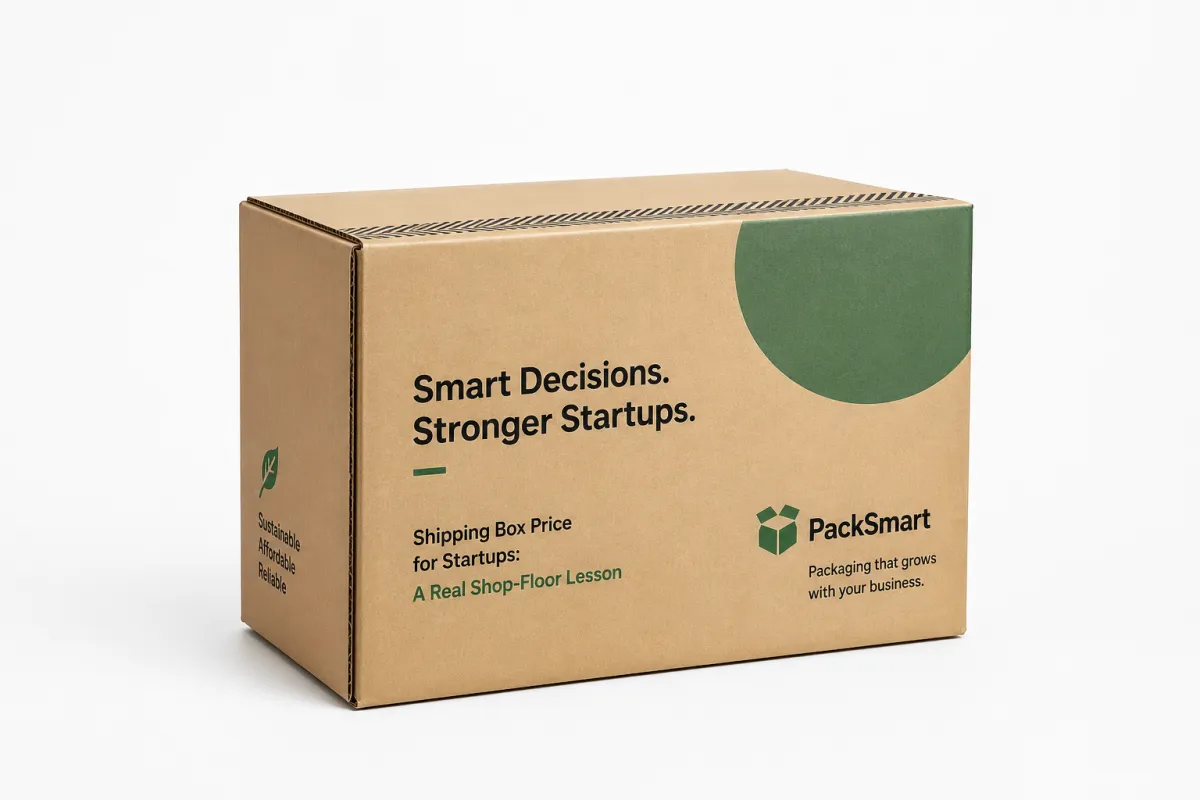
I still remember a startup founder who walked into a corrugated plant I visited near Shenzhen with a sample product in a plain poly bag and said, "I just need the smallest box possible." The product was a ceramic candle vessel with a thick glass lid, and the team had measured only the vessel, not the molded pulp insert, the headspace needed for compression, or the extra wall strength required for parcel carriers. The tiny box they wanted would have needed a die change, a heavier board spec, and more careful cutting than a slightly larger carton, so the shipping box price for startups actually went up by nearly 18% on the first order. That was a sharp lesson: smaller is not always cheaper once you account for structure, transit packaging, and the way the box behaves under load.
Here is the part most people miss. Shipping box price for startups is shaped by what happens after the box leaves your dock, not just what the box costs on the day you buy it. A carton that looks inexpensive on paper can become expensive if it forces you into extra void fill, more labor at packing stations, higher Dimensional Weight Charges on UPS or FedEx, or a higher damage rate in a rough ecommerce shipping lane from Tennessee to California. I have seen a 10 x 8 x 4 inch mailer save a company almost $0.12 in board cost and then cost them $0.38 more per shipment because it crushed sleeves in a 1A distribution cycle and sent returns through the roof. The board grade, the fit, and the route all live inside the same cost picture.
Honestly, the smartest startup buyers treat packaging like a unit economics problem, not an art project. If your carton reduces dim weight from 3 pounds to 2 pounds, or trims a second piece of dunnage from packing, the carton may pay for itself even if the shipping box price for startups is higher by $0.09 or $0.14 per unit. I have seen that play out in client meetings, especially with beauty kits and coffee subscription boxes where one inch of dead air changes the shipping bill by a material amount. A box that protects the product, keeps the unboxing consistent, and avoids repack work is often the lower-cost option over a 1,000-piece run.
"We stopped arguing over the cheapest box and started looking at the landed cost per packed order. That one change cut our damage rate from 4.2% to 1.1% on a 600-unit pilot shipped through a Nashville 3PL."
That quote came from a founder I met during a packaging review after a rough launch week, and it remains one of the clearest examples I have heard. Shipping box price for startups should be judged against the full packing process, including tape time, insert placement, freight classification, and the odds that a carton gets crushed on a top-stacked pallet in a humid 90-degree warehouse. If your packaging team can show that a better box removes 20 seconds of pack time and lowers complaints by 15%, the added unit price is not a luxury; it is a control point. A supplier who understands that is worth more than a supplier who only talks about the printed quote.
Product Details That Shape Shipping Box Price for Startups
The box format is the first major cost lever in shipping box price for startups. A mailer box with a front tuck can feel premium and ship cleanly for ecommerce shipping, but it may need more converting steps than a plain shipping case. A roll end tuck top carton gives strong side walls and a tidy closure, while a straight tuck mailer works beautifully for lighter products that need a retail-ready presentation. If your product is heavy or awkward, a corrugated shipping case or a die-cut tray with a custom insert can reduce damage enough to justify the extra board and tooling, especially during a launch where returns eat margin fast. I have seen a rigid mug set move from a 1.8 mm E-flute mailer to a 3 mm B-flute case and drop the breakage rate from 3.6% to 0.7% in a Bay Area fulfillment center.
Board construction matters just as much. I have quoted E-flute for cosmetics, B-flute for sharper compression resistance, and double-wall corrugated for items that stack in a warehouse or ride on a pallet for several days. A thinner flute can sharpen print quality and lower weight, which helps shipping box price for startups in short-run ecommerce programs, but it will not help if the product is 8 pounds and your warehouse stack height reaches 6 feet. I have stood beside a corrugator where a switch from 32 ECT single wall to double wall added $0.21 per unit, yet it saved the client from cracked ceramic parts that were costing almost $1.80 in replacement and labor on each failure. That is a fair trade in anyone's ledger.
Stock-size cartons and custom dimensions tell two very different pricing stories. Stock boxes are faster to source, usually lower in setup Cost, and Useful when the product dimensions are stable within a quarter inch, but they often leave extra space that needs kraft paper, inserts, or air pillows. A custom-fit carton can reduce shipping materials and cut dimensional weight, which is why shipping box price for startups sometimes drops in the total picture even when the carton itself costs more. On a client call for a small consumer electronics brand, we trimmed the inner height by 0.1875 inch and the UPS bill changed enough to cover the custom die after the second order. That kind of adjustment is tiny on a ruler and very loud on a freight statement.
Printing also changes the math. One-color flexographic print on kraft corrugated is generally faster and cheaper than full-coverage digital graphics, while high-coverage print with a white underlay can raise the first order cost quickly. If your brand is still testing product-market fit, I usually recommend a restrained print plan: one logo color, one panel, and a clean structural box that can be reordered without rethinking the whole spec. That keeps shipping box price for startups in a range that protects cash while still giving you a carton that looks intentional. For paper sourcing, I also pay attention to FSC chain-of-custody paperwork if the retail channel asks for it, and I point buyers to the standards body at FSC when they need to understand certification language. For product sleeves or premium inserts, I often specify 350gsm C1S artboard for crisp print and reliable crease integrity on small retail components.
Specifications to Lock Before You Request a Quote
If you want a quote that is actually useful, start with the exact inside dimensions, not the rough outside size. I mean the real numbers: inside length, width, and height in inches or millimeters, the product weight with inserts and accessories, the final ship method, and whether the carton will move as single parcels, LTL freight, or palletized inventory. That level of detail does more for shipping box price for startups than a flashy mockup ever will, because a supplier can only price what the product will actually demand. I have seen a 7.8-pound kitchen gadget quoted as a "light item" and then reclassified after the corrugator spec was adjusted for parcel handling and stack pressure in a facility outside Ho Chi Minh City.
Compression strength, burst strength, and ECT ratings are the numbers that keep a carton honest. If a seller tells you the board is simply "strong enough," ask for the rating in writing: 32 ECT, 44 ECT, 200# burst, or another specific target tied to the product and route. I like to pair that request with a practical test standard, and the International Safe Transit Association has a useful library at ISTA for buyers who need to connect packaging choices to real shipment performance. Shipping box price for startups can look lower with a lighter grade, but if your cartons are stacked 8 high in a warehouse or moved through humid summer lanes from Houston to Miami, the wrong spec can wipe out the savings fast.
Before you ask for quotes, answer these questions with exact numbers, not generalities:
- What are the inside dimensions to the nearest 1/16 inch or 1 mm?
- What is the product weight with the insert, cable, or booklet included?
- Will the box ship by parcel carrier, LTL freight, or both?
- Do you need self-locking tabs, tear strips, or a tuck closure?
- Will the carton carry barcodes, shipping labels, or a return label panel?
- Is the priority package protection, shelf presentation, or both?
Those six answers are enough to improve shipping box price for startups in a measurable way, because they tell the supplier where the real cost sits. A box with a tear strip and a second adhesive strip may cost $0.06 more, but it can save labor on returns and improve the unboxing experience for ecommerce shipping. A box without a proper label panel can force a reprint or a second label placement step, which adds 12 to 18 seconds at the packing bench. A carton designed for the process usually costs less overall than a carton designed to look inexpensive on a quote.
I have also learned to ask about the route, not just the box. If the startup ships mostly zone 2 to zone 4, one spec may work fine, but if the same carton goes into zone 7 or 8, the shipping box price for startups should be evaluated against the carrier bill, not only the board cost. A fragile glass item shipped with one air pillow in a local lane may be fine; that same carton in a national drop-ship program can fail after the third hub transfer. A good supplier should hear that and immediately ask about drop tests, stack tests, and whether the box has to survive a 48-hour fulfillment hold before the carrier picks it up.
Shipping Box Price for Startups: Pricing, MOQ, and Real Cost Drivers
The price stack is not mysterious once you break it down. Material cost, converting labor, setup or tooling, print method, finishing, carton size, and freight all touch the final number, and each one can move shipping box price for startups in a different direction. A plain stock carton may start low because the die is already in place, while a custom die-cut mailer can add upfront tooling and setup, then pay some of that back through a tighter fit and lower void fill. I have seen a buyer celebrate a $0.47 unit quote only to discover that freight, plates, and a mandatory minimum pushed the landed cost much higher than a more honest $0.61 quote from another supplier in Suzhou.
MOQ is where startup budgets feel the pressure. A small run of 500 cartons often costs more per unit than a 5,000-piece order because the setup is spread over fewer boxes, and that is normal in corrugated converting. Still, a startup should not buy too deep just to chase a better unit price, because storage, cash flow, and design changes can make a low unit cost more expensive in practice. I have watched teams order 10,000 units to save $0.08 each and then spend months moving pallets around a warehouse while the product changed shape twice. Shipping box price for startups only looks smart if the reorder plan fits the business stage.
Here is a simple comparison I use with buyers who want a clean head-to-head view of the first-order economics. The numbers below are sample ranges from recent startup-style packaging programs in Guangdong, Ohio, and northern Mexico, and they will move with region, freight lane, and print complexity, but they show the cost logic clearly:
| Option | Typical MOQ | Sample Unit Price | Best Fit | Main Watch-Out |
|---|---|---|---|---|
| Stock RSC carton, unprinted | 250 to 500 | $0.48 to $0.82 | Early tests, fast replenishment | May need fillers or labels |
| Custom-size unprinted mailer | 1,000 to 2,500 | $0.62 to $1.05 | Tighter fit, lower void fill | Tooling and sample approvals |
| Printed mailer, one-color flexo | 3,000 to 5,000 | $0.84 to $1.45 | Brand-forward ecommerce shipping | Plate/setup fees on first run |
| Double-wall shipping case | 500 to 1,500 | $1.75 to $3.20 | Heavy, fragile, or stacked goods | Higher freight and storage cost |
That table is useful only if you read it like a landed-cost buyer. A quote that looks low can hide freight surcharges, plate fees, or a carton size that still requires three pieces of void fill to make the product safe. I have seen shipping box price for startups drop by $0.05 on the board line and rise by $0.19 in the packing room because the box was too large for the product and too weak for stack pressure. If a supplier does not quote the board, the print, the setup, and the freight separately, ask for a cleaner breakdown before you compare anything.
The fairest way to compare suppliers is to calculate landed cost per shipped order, not just unit price per carton. Include inserts, tape, freight, and the labor time to pack each unit, then compare the outcome against damage rates and dimensional weight. A 12 percent reduction in void fill, or a 0.25 pound drop in billable weight, can matter more than a slightly cheaper carton because it improves cash flow every time the box ships. Shipping box price for startups is won in logistics, not just in the corrugation line.
There is one more trap I see often: hidden value in a box that is a little more expensive. A custom-fit mailer can reduce dunnage by 30 percent, a better flap design can cut pack time by 8 seconds, and a clearer print layout can keep barcode scanning accurate at the fulfillment bench. That is why I push buyers to think in terms of total packaging cost, not raw carton cost. A startup selling 2,000 units per month feels every penny, but it also feels every return, every repack, and every unhappy customer who gets a crushed product.
Process and Timeline for Ordering Shipping Boxes
The ordering process should feel orderly, not rushed. A clean job usually starts with spec review, then dieline approval, sample or prototype production, full production, a quality check, and outbound freight booking. I like that sequence because it gives both sides a chance to catch a 2 mm error before 8,000 cartons are folded and loaded for ship-out. Shipping box price for startups stays more predictable that way, because you avoid panic reprints, rush freight, and the ugly cost of working from bad measurements.
Timing depends on the box. A stock-style carton can move quickly, sometimes within 5 to 7 business days, while a printed custom mailer with a specialty finish usually needs 12 to 15 business days from proof approval, plus 3 to 5 days for ocean or domestic freight depending on the lane. In a plant visit I made to a converting line that was running a batch of retail shippers and a separate run of shipping cases, the printed job needed an extra day because the artwork proof changed after the buyer noticed the logo was 0.125 inch too close to the fold. That kind of late change sounds tiny, but it can move the ship date and change shipping box price for startups if rush service gets involved.
The most common delays are easy to name because they happen on almost every factory floor. Slow artwork approval, vague measurements, last-minute product changes, and waiting until inventory is almost gone are the big four. I have seen a launch slip by 10 business days because the founder added a bottle dropper after the sample had already been approved, which meant the insert had to be reworked and the inside height grew by nearly half an inch. Shipping box price for startups can rise quickly in that scenario because the job leaves the normal production lane and enters the rush lane.
My advice is to build a small buffer into the schedule and let your supplier know the real reorder point, not the optimistic one. If you need product in hand by a Friday, the safer target is to approve art earlier, request the sample before the warehouse is bare, and book freight while the cartons are still on schedule. That habit keeps shipping box price for startups steadier because it reduces emergency shipping, overtime, and the awkward compromise that happens when a team accepts a carton that is "close enough" just to save the launch date.
Why Choose Us for Shipping Box Price for Startups
What startup teams usually need from a packaging partner is not a pile of jargon; they need someone who understands tight budgets, shifting SKUs, and the fact that a product may change twice before it reaches repeat order stage. I have spent enough time on factory floors to know that a good quote should help a buyer avoid overbuilding the first carton, overprinting the graphics, or ordering a fancy structural feature before the product has earned it. That is why I focus on practical shipping box price for startups guidance instead of pushing the heaviest spec in the catalog. Startups do not need packaging vanity; they need a carton that supports growth and does not overcommit cash.
Experience matters because corrugation is a process, not a picture. I have watched die-cutting lines where a 1.5 mm shift in score depth changed how a tuck tab locked, and I have stood near flexographic presses where a one-color print plan saved hours of make-ready compared with a dense full-coverage job. Those are the details that shape shipping box price for startups, and they are the details many casual suppliers miss. When a quote reflects the real converting workflow, the customer gets fewer surprises and a more honest number on the purchase order. On a recent order in Foshan, a simple color reduction saved 11 minutes of plate wash time per run, which translated into a cleaner first invoice and a faster second run.
We also help buyers avoid the classic startup mistakes: overspecifying board strength for a product that weighs 6 ounces, undersizing a box and forcing product compression, or jumping to a premium finish before the market has proven the SKU. I would rather help a founder choose an exact-fit carton with a sane MOQ than sell them a larger run of a box they will never use efficiently. If your program needs a deeper packaging family, I usually point teams to Custom Shipping Boxes for the primary shipper, Custom Packaging Products for inserts, tissue, and supporting components, and Custom Poly Mailers if a lighter secondary shipper better fits soft goods or apparel. Each category can change shipping box price for startups in a different way, and the right mix depends on the route and the product weight.
Most important, I believe in clear quotes and honest MOQ guidance. If the first order needs 1,000 pieces, I will say so; if a 500-piece test run makes more sense for your cash flow, I will say that too. The best packaging support feels practical: prototype support, clean dielines, straightforward freight terms, and recommendations tied to transit packaging performance rather than generic upselling. That is how a startup buys smarter, protects margin, and keeps the order fulfillment line moving without drama. For reference, a standard sample cycle can usually be turned in 3 to 5 business days in Asia or 5 to 8 business days from a domestic converting partner in the Midwest.
How Do You Lower Shipping Box Price for Startups?
The clearest way to lower shipping box price for startups is to start with the product, not the catalog. Measure the exact inside dimensions, confirm the weight with inserts, and choose the lightest board grade that still passes the transit route, stacking load, and drop test you actually need. That single discipline keeps you from paying for extra board, extra dunnage, and extra freight when a tighter fit would have done the job better.
Next, simplify the structure and the print. A restrained one-color flexographic print on a clean mailer, or even an unprinted stock carton with a sharp label application, often gives the best mix of presentation and cost for an early-stage brand. I have seen shipping box price for startups drop meaningfully just by removing a second print panel, trimming one flap from the closure, or replacing a custom insert with a smarter internal fold. Small changes like that also reduce make-ready time at the plant, which helps keep the first run honest.
Then look at the full packing process. If a more exact-fit carton cuts void fill, shortens pack time, and reduces carrier claims, it may cost less overall even if the unit price is slightly higher. That is why shipping box price for startups should be reviewed as landed cost per shipped order, not just carton cost per unit. A box that saves 20 seconds at the bench and lowers damage on a 3PL shelf is doing real financial work, and that matters more than shaving a few cents from a quote sheet.
Last, order with a realistic MOQ. Too little volume raises the unit cost through setup, but too much volume traps cash in inventory and can leave you holding cartons after the SKU changes. The right quantity usually sits somewhere between a pilot run and a production run, depending on how quickly you expect to reorder. A supplier who understands shipping box price for startups will help you find that middle ground instead of pushing the largest number on the page.
Common Questions
What affects shipping box price for startups the most?
The biggest drivers are carton size, board grade, print method, and order quantity, and those four items can move the quote more than most founders expect. Freight can shift shipping box price for startups even harder on short runs, especially if the pallet ships across multiple zones or carries a heavy double-wall spec. Custom tooling, specialty coatings, or a tight deadline can also lift the first-order number before the unit price settles down on the second run. A 3,000-piece job in one-color flexo can land very differently from a 500-piece digital sample order with the same artwork.
How do I compare startup shipping box quotes fairly?
Compare inside dimensions, board strength, print method, MOQ, and delivery terms on every quote, because a 1/8 inch change in size or a different flute can change the real cost a lot. Ask whether tooling, plates, or setup fees are included, since shipping box price for startups can look low until those charges appear on the invoice. The cleanest method is to compare landed cost per packed order, not just the unit price per carton, so you can see the effect on total fulfillment cost. I usually ask buyers to compare at least three quotes from two regions, such as Guangdong and a U.S. Midwest converter, before making the call.
Is a custom box always more expensive for startups?
No, and that is one of the most common misconceptions I hear in client calls. A custom-fit box can reduce void fill, lower dimensional weight, and cut damage, which means shipping box price for startups may rise a little on the carton line but fall overall on the shipment line. The real answer depends on the product shape, the carrier route, and whether you plan to reorder often enough to spread the setup cost. A product that ships 1,500 units per month can recover a die cost quickly if it removes a separate insert and cuts repack labor.
What minimum order quantity should a startup expect?
MOQ depends on whether the box is stock, custom-sized, printed, or structurally special, so there is no single number that fits every job. Short-run orders usually carry a higher unit cost because setup gets spread across fewer pieces, and shipping box price for startups reflects that manufacturing reality. A good supplier should explain whether the MOQ is a hard production limit or simply the most economical run size for the board and print method you selected. In practice, 500 units may be a good pilot, while 3,000 to 5,000 units often starts to make sense for repeat ecommerce volume.
How can I lower shipping box price without hurting quality?
Right-size the carton to the product and remove unnecessary space fillers, because dead air adds cost in both board and freight. Choose the lightest board grade that still passes the transit and stacking requirements, and keep print simple until volume is proven. That approach usually gives the best balance for shipping box price for startups, especially if you are still learning how the product behaves in ecommerce shipping and order fulfillment. A shift from 44 ECT to 32 ECT, for example, can save money only if the product is not riding on a humid pallet in Houston or stacked six high in storage.
What should I do before I place my first order?
Measure the product with the insert installed, confirm the carrier lane, and ask for a sample before you commit to the full run. If the sample passes drop tests, stack checks, and a live packing trial, you are in a much better position to lock shipping box price for startups without paying for avoidable mistakes. From there, you can compare one stock option, one custom option, and one backup spec, then choose the version that protects the product and fits the reorder plan. I also recommend checking the sample against a real packing speed target, such as 25 to 35 units per hour at one bench.
If you are narrowing the first order right now, the safest move is to compare landed cost per shipped order, not just the carton price, then pick the spec that protects the product through the actual lane it will travel. That usually means one clear sample test, one honest quote breakdown, and one MOQ that matches your sales pace instead of your optimism. Do that, and shipping box price for startups stops being a guessing game and starts being a controllable part of margin.


