Buyer Fit Snapshot
| Best fit | Cube Optimization for Shipping Boxes to Cut Waste Fast projects where brand print, material claims, artwork control, MOQ, and repeat-order consistency need to be specified before quoting. |
|---|---|
| Quote inputs | Share finished size, material target, print colors, finish, packing count, annual reorder estimate, ship-to region, and any compliance wording. |
| Proofing check | Approve dieline scale, logo placement, barcode or warning zones, color tolerance, closure strength, and carton packing before bulk production. |
| Main risk | Vague material claims, crowded artwork, missing packing details, or unclear freight terms can make a low unit price expensive after revisions. |
Fast answer: Cube Optimization for Shipping Boxes to Cut Waste Fast should be specified like a repeatable production item. The safest quote records material, print method, finish, artwork proof, packing count, and reorder notes in one written spec.
Production checks before approval
Compare the actual filled-product size with the drawing, then confirm tolerance on folds, seals, hang holes, label areas, and retail display edges. Reserve space for logos, QR codes, warning copy, and material claims before decorative graphics fill the panel.
Quote comparison points
Review material grade, print process, finish, sampling route, tooling charges, carton quantity, and freight assumptions side by side. A quote is only useful when the supplier can repeat the same color, closure quality, and packing count on the next order.
Cube Optimization for Shipping Boxes to Cut Waste Fast
Cube optimization for shipping boxes looks straightforward until a $0.14 carton starts billing like a $4.60 dimensional weight mistake on a UPS Zone 6 parcel from Shenzhen to Chicago. I remember standing on a packing line in Shenzhen's Longhua district with a cosmetics client, watching 50 ml glass jars get tucked into a box that felt safe in the hand and looked polished on the shelf, yet still carried 41% air and got hit on every shipment above 2 lb. The box was cheap on paper, but the freight invoice was not, and the gap between those two numbers was exactly where the problem lived.
That is why cube optimization for shipping boxes matters to ecommerce teams, 3PL operators, and wholesale shippers alike. The job is bigger than shaving a few cents off corrugate, because it also changes pallet count, storage density, and parcel billing across lanes that may run from Dongguan to Dallas or from Ningbo to Newark. It means choosing the smallest practical carton that still protects the product, keeps pallet patterns tight, and stops dead air from eating margin one shipment at a time. I have seen people obsess over foil stamping on a retail sleeve and then ignore the empty space inside the shipping carton, which always feels backward to me.
At Custom Logo Things, I usually treat cube optimization for shipping boxes as three jobs running at the same time: fit, billing, and handling. Fit means the product has enough clearance and the right internal protection, such as a 32 ECT single-wall B flute carton for a 1.2 lb accessory or a 48 ECT double-wall BC flute box for a heavier bundle. Billing means the carrier charges for the space the parcel occupies, not the optimistic version of the package in somebody's head. Handling means the carton survives vibration, compression, and the kind of toss that makes a warehouse lead in Indianapolis stare at the ceiling for a full second before saying, "Well, that was not ideal."
I have watched teams spend serious money on foil stamping, soft-touch varnish, and a gloss aqueous finish on a 350gsm C1S artboard sleeve, then leave two inches of empty space inside the shipping carton because nobody wanted to redraw the insert. That order of priorities drives me a little nuts, to be honest. Cube optimization for shipping boxes affects freight negotiations, warehouse storage, pallet counts, and first impression all at once, which is exactly why it deserves careful design work instead of a late-night guess and a prayer. If a custom size from Dongguan takes 12-15 business days from proof approval and lands at $0.15 per unit for 5,000 pieces, the details should be planned with the same care as the print file. Right-sized packaging is not just a cost question; it is a supply chain decision with a very visible footprint.
What Cube Optimization for Shipping Boxes Actually Means
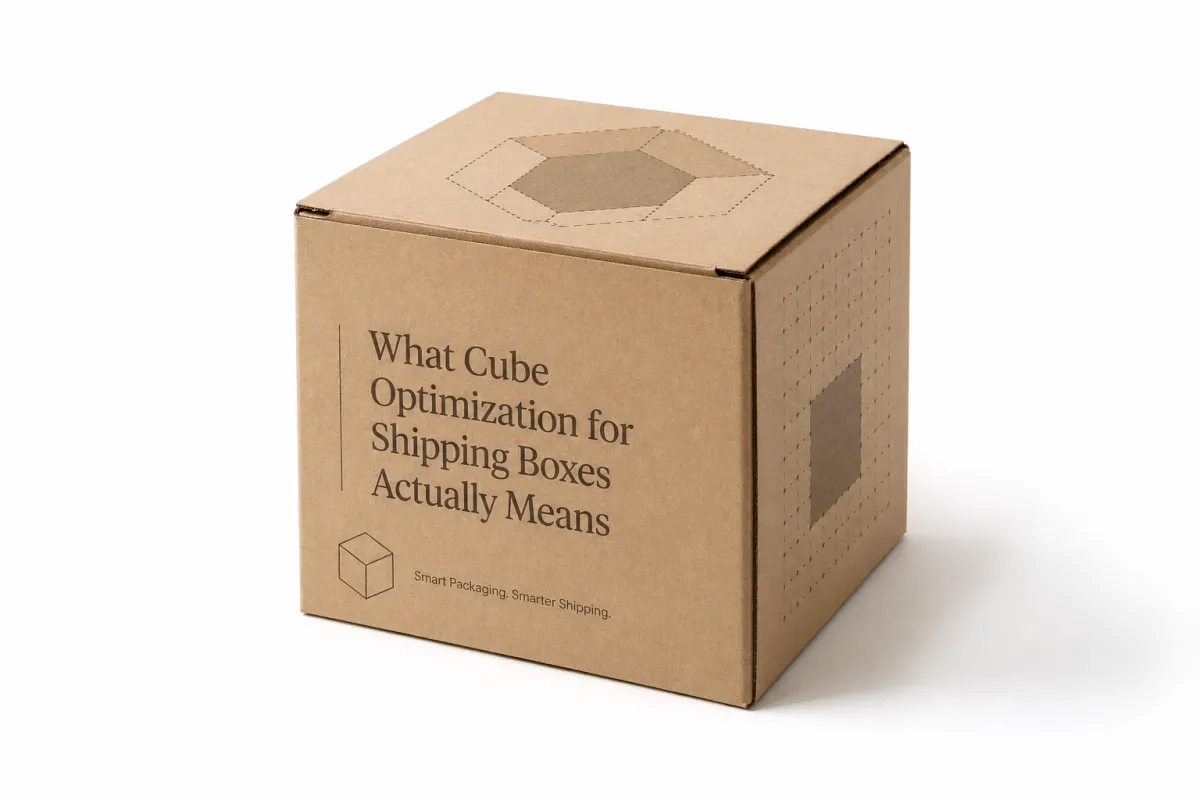
Cube optimization for shipping boxes is the practice of selecting the smallest carton footprint and depth that still fits the product, its protection materials, and the movement it will experience in transit. Put simply, the goal is to reduce wasted volume without turning the box into a damage claim. I have seen brands save $0.12 per carton and then lose $2.80 on dimensional weight for a package that barely reached 9 lb on the scale, especially on FedEx Ground lanes moving through Ohio and Pennsylvania. That is not smart packaging. That is expensive paperwork wearing a nice shirt.
One mistake shows up again and again: people confuse outside dimensions, usable inside volume, and what carriers actually bill. A carton marked 12 x 8 x 6 inches does not offer the full 576 cubic inches inside. Board thickness, flap overlap, glue joints, and tape closure all take space. With 1/8 inch board on each wall, the usable interior can shrink to roughly 11.75 x 7.75 x 5.75. Cube optimization for shipping boxes has to begin with that real interior number, not the neat spec on the dieline, and a corrugator in Foshan will usually ask for the target inside dimensions before they price the run.
Carriers care because dimensional weight turns empty volume into cost. If a parcel divisor is 139, an 18 x 14 x 10 inch box bills at about 18.2 lb before the scale even gets a say. That is how cube optimization for shipping boxes changes freight spend in a very direct way. A smaller carton can slip under a rate break, reduce oversize penalties, and make parcel pricing less punishing for everyone in the chain, whether the shipment leaves a warehouse in Jacksonville or a fulfillment center in Ontario, California. I have sat through invoice reviews where the only villain was air and the carrier's calculator was the loudest voice in the room.
Storage and pallet density matter just as much. In a warehouse, one extra inch in carton width can change a 48 x 40 pallet pattern from 24 units per layer to 20 units per layer, and that can turn into 120 fewer units per trailer if the stack height is capped at 72 inches. That sounds tiny until 600 units a week start moving through the dock and every pallet becomes a billable object. Cube optimization for shipping boxes is really about space efficiency from the corrugator in Dongguan to the trailer door in Atlanta, and the math has a way of getting personal once the warehouse starts filling up.
"Why are we paying to ship dead space?" a client asked during a lane review in Dongguan after we laid out three pallet loads of rejected cube and showed the invoice for 1,240 parcels. He was not being dramatic. He was doing arithmetic, and the room got very quiet for a second.
That is the promise of cube optimization for shipping boxes. Better sizing can influence freight class, pallet count, damage rates, and the way customers read your brand the second the carton lands on the porch in Brooklyn or Birmingham. A snug, clean box feels deliberate. A box with a giant void-fill pocket feels like somebody packed it between phone calls, which is not exactly the vibe most brands are chasing. If the same carton can go from 14 x 10 x 8 to 7 x 7 x 6 without sacrificing a molded pulp insert, the difference shows up in both the invoice and the unboxing video.
How Does Cube Optimization for Shipping Boxes Work in Practice?
Cube optimization for shipping boxes starts with a basic equation: product dimensions plus protection materials plus clearance plus stacking behavior equals the smallest viable carton. If your item measures 9.25 x 6.5 x 2.1 inches and you need 0.25 inch clearance on each side plus a 0.5 inch paperboard insert, the usable inside size is no longer a guess. It is a measurement. I have walked pack lines where that one calculation cut carton volume by 18% across a 14-SKU family without changing the product or the brand story, and the sample approval still came back from Guangzhou in under two weeks.
Dimensional weight pricing rewards tight cartons and punishes oversized packaging. A 16 x 12 x 8 box contains 1,536 cubic inches. A 14 x 10 x 6 box contains 840 cubic inches. That is a 45% reduction in space, which often shows up as a real parcel saving, especially on ecommerce shipping lanes where the package is light but bulky. Cube optimization for shipping boxes makes the carrier bill reflect what actually shipped instead of what occupied the truck. I think that is one of the few parts of packaging math that feels almost fair, particularly when the alternative is paying air freight prices for a ground shipment.
The same logic helps on pallets and inside containers. Better cube usage lets you tighten pallet patterns, reduce dunnage, and improve truck utilization. I once watched a food brand move from 56 units per pallet to 72 units per pallet by changing carton depth by 0.5 inch and rotating the pack orientation, then cut monthly outbound pallet count by 11 loads out of 64. Cube optimization for shipping boxes is not glamorous, yet it is brutally practical, and the savings show up in places the marketing team never sees, like warehouse rent in New Jersey and less rework on the dock.
Here is a simple before-and-after example. A candle brand was using a stock 14 x 10 x 8 box for a jar measuring 4.5 x 4.5 x 5.25 inches with a molded pulp insert. The box was mostly air, and every shipment got billed as if it weighed 6 lb on a 2 lb scale weight. We moved them to a 7 x 7 x 6 custom carton with the same package protection, and the average billable weight fell by 2 lb per parcel. On 8,000 units, that was a serious line item, the kind that makes finance people in Los Angeles sit up straighter in their chair.
Even so, cube optimization for shipping boxes stops where physical reality begins. The carton still needs to survive bottom-stack compression on a pallet, lateral shifting in a truck, and a drop from around 30 inches if you are qualifying to common handling standards. A smaller box that collapses or bruises the product is not optimized. It is merely small. I have seen teams learn that lesson after a "perfect" carton failed an ISTA 3A drop test because the insert stack-up was 1.5 mm too thin, and nobody wanted to be the person who had to explain that to the client in a Monday review.
Key Factors That Shape Cube Optimization for Shipping Boxes
Product fragility comes first. A glass serum bottle, a ceramic mug, and a denim hoodie do not need the same cube strategy, and a 120 ml bottle in a molded pulp tray will usually need 10 to 15 mm of buffer plus a 32 ECT or 48 ECT carton depending on the transit lane. The bottle may need a 1.5 mm paperboard sleeve or a die-cut pulp cradle, while the hoodie can usually ship in a much flatter mailer or slim box. Cube optimization for shipping boxes only works when you respect how the item moves, crushes, and nests under pressure. Nobody wants a 3% carton savings that creates a 12% breakage rate. I have seen that math go sideways, and it is not pretty.
Material choice matters just as much. A single-wall B flute box may be fine for a 1.2 lb accessory, while a heavier product may need double-wall board with stronger edge crush, such as 48 ECT BC flute for a multi-item gift set shipping from Ningbo to Toronto. Board grade, insert type, and void fill all change how small you can safely go. I think about it the same way I think about factory negotiations: if you cut the wrong spec by $0.02 and call it efficiency, you may end up paying $1.50 to replace the damaged product later. Cube optimization for shipping boxes is never only about the shell, which is why the carton spec sheet deserves more respect than it usually gets.
Order mix changes the answer. One SKU shipping alone has a clean pack-out path; a mixed order with three shapes, two inserts, and a gift note asks for a different solution. If your average basket carries 2.7 items, one carton size will not cover every case, and the pack line in Phoenix will tell you that within a week. That is why cube optimization for shipping boxes often ends with a small family of sizes instead of one heroic carton. For many ecommerce shipping programs, a three-box system beats trying to force every order into the same footprint, and it saves everybody from a daily guessing game at the packing table.
Carrier rules can make or break the economics. Dimensional weight thresholds, oversize penalties, and service-level limits vary by lane and by account, and a carton that looks efficient on the packing bench may still get hit on the invoice if it crosses a dimensional threshold by 0.2 inches. I always tell buyers to price cube optimization for shipping boxes against the actual carrier table, not a hopeful estimate from a rep with a slide deck and a smile that says "trust me." That rarely ends well, especially when the route runs through Zone 8 and every inch matters.
Operational reality is the part suppliers like to skip. If packers need 18 seconds to assemble a custom insert, the savings may vanish in labor. If carton inventory eats 60 square feet of floor space, the "efficient" solution can clog the line. If the team is changing box sizes 500 times a day, training becomes more valuable than another 1/8 inch of fit. Cube optimization for shipping boxes has to work on Tuesday at 3:20 p.m., not only in CAD, and that is the standard I keep coming back to when a plant manager in Monterrey asks whether the new size will slow the line.
On the sustainability side, sourcing matters too. If you want recycled content or FSC-certified paperboard, check supplier documentation instead of trusting a one-line brochure claim. I have asked vendors in Xiamen and Qingdao to show chain-of-custody paperwork more than once, and yes, they usually sigh first, which is fair enough, but still not enough. The point stays simple: cube optimization for shipping boxes and responsible sourcing can work together if the specs are verified. For standards and certification references, the FSC site at fsc.org is a useful starting point, especially if you need a paper trail for a retail audit in London or Toronto.
If you want a testing benchmark, the handling and drop-test guidance at ISTA is worth reading before you lock in a new size. I have seen too many teams skip the trial phase and then act shocked when a neatly sized carton fails after vibration and a corner drop from 30 inches. That is not bad luck. That is bad process. And yes, the warehouse will remember who approved it, especially when the first 250 units of a new run start coming back with crushed corners.
Step-by-Step: Improve Cube Optimization for Shipping Boxes
Start with an audit. Pull 60 to 90 days of box usage, product dimensions, damage claims, freight invoices, and pack-out data for your top 20 SKUs. If the data is messy, work from the last 500 orders per SKU and clean it as you go, even if that means building a simple spreadsheet with carton size, ship method, and claim value by lane. Cube optimization for shipping boxes gets much easier once you know which cartons are wasting space instead of just which ones sound ugly in a meeting. I have seen teams argue for an hour about "the wrong box" without a single invoice in the room, which is a great way to waste lunch.
Group products next by size, fragility, and order pattern. A candle family with three jar heights may only need one carton with a 0.5 inch insert change, while apparel may move to a flatter box or a custom mailer. This is also where Custom Packaging Products can help with a broader packaging mix, and where Custom Shipping Boxes become the obvious answer for tight-fitting SKUs. Cube optimization for shipping boxes works best when similar products are clustered instead of treated like a dozen special cases with six different opinions attached. A manufacturer in Dongguan or Foshan can usually quote that family of sizes in 2 to 3 business days if the dielines are clean.
Measure pack-out efficiency after that. Divide product volume by total carton volume and look at the percentage. A 220 cubic inch product in a 540 cubic inch box is packing at about 41%. That is a warning sign. I like to rank the worst offenders first because the biggest cube gaps usually hide in plain sight. Cube optimization for shipping boxes should focus on the cartons wasting 20%, 30%, or more, not the ones already doing an okay job and pretending to be heroic. In one apparel program, the top three SKUs accounted for 61% of the wasted cube, which made the prioritization easy once the numbers were laid out.
Prototype two or three carton options for each product family. Test fit, compression, and drop performance before you commit to a full run. One client in Guangzhou tried a smaller box that saved $0.04 per unit, then crushed the corner on a two-layer insert after a 32-inch drop test. We revised the interior geometry, switched to E/B combo board, and kept the smaller footprint while preserving package protection. That kind of compromise is what cube optimization for shipping boxes asks for, and it is usually where the real engineering work lives. If the sample program takes 12-15 business days from proof approval, use that window to inspect every tab, flute direction, and glue seam.
Roll out in a controlled pilot once the samples behave. Start with one warehouse, two SKUs, and a 30-day review window. Train packers on fill rules, label placement, and carton selection. Watch shipping cost per order, damage rate, and pack time with a skeptical eye. If cube optimization for shipping boxes saves $1.10 per order but adds 14 seconds to labor, You Need to Know that before scaling it to 50,000 units. No one enjoys finding labor creep after the cartons are printed, especially not the person who has to field the angry Slack messages at 7:45 a.m.
- Audit the top 20 SKUs and the last 90 days of invoices.
- Group products by fragility, dimensions, and order mix.
- Prototype 2 or 3 carton sizes with real inserts and real product weight.
- Test drop, compression, and vibration before approval.
- Pilot for 30 days and compare freight, damage, and labor.
Cube Optimization for Shipping Boxes Costs, Pricing, and ROI
The cost stack is wider than corrugate. Cube optimization for shipping boxes touches board cost, inserts, void fill, labor, freight charges, dimensional weight, and replacement losses. I have watched a carton move from $0.16 to $0.24 per unit and still save the business $1.73 per shipment because carrier charges dropped and the breakage rate fell from 2.9% to 0.6%. Unit price alone is a poor decision rule. If you only stare at the box quote, you will miss the much bigger bill hiding in the freight line, especially on 10,000-piece monthly programs moving through Louisville or Dallas.
Buyers always ask about MOQ, tooling, setup, and print cost. Fair questions. A custom die-cut box may bring tooling in the $300 to $900 range depending on complexity, and a first run of 5,000 units might land around $0.18 to $0.31 per unit depending on board grade and print coverage. A stock box can cost less, yet cube optimization for shipping boxes often pays back by removing hidden freight waste. The cheapest carton is not always the cheapest shipment, and I have had enough awkward purchasing meetings in Shenzhen and Los Angeles to know that those are very different arguments. If a supplier in Dongguan quotes 12-15 business days from proof approval, that timeline should be weighed against your reorder cycle, not just the unit cost.
| Option | Typical Unit Cost | MOQ | Best Use | Main Risk |
|---|---|---|---|---|
| Stock RSC box | $0.12 to $0.20 | Usually 25 to 100 pieces | Fast replacement, mixed inventory | Ships too much air |
| Semi-custom size | $0.16 to $0.27 | 1,000 to 3,000 pieces | Repeat SKUs with moderate volume | Limited fit improvements |
| Custom die-cut box | $0.18 to $0.31 | 3,000 to 10,000 pieces | High-volume, tight pack-out products | Tooling and lead time |
That table is exactly why cube optimization for shipping boxes needs a total landed cost view. If a $0.06 increase in carton price removes $1.20 in dimensional weight and $0.35 in damage replacements, the board quote does not matter much. A supplier once tried to win my business with a cheaper carton that was 1.25 inches taller than needed. Nice try. We were not paying to transport oxygen, and nobody in the room was pretending otherwise. For a 5,000-piece order, that extra height can mean the difference between a $0.15 unit and a carton that quietly costs you more in freight every week.
ROI timing depends on volume. A small catalog with 8,000 monthly parcels may see savings in one shipping cycle. A broader SKU program with 40 carton families may need two or three cycles to prove payback, especially if the team is retraining packers and changing carton storage. Cube optimization for shipping boxes moves quickly when the data is clean and the SKU count is sane. It moves slowly when nobody knows which carton belongs to which product, which happens more often than anyone likes to admit, particularly during a Q4 rush in December.
There is also a supply chain angle. Better cube usage can reduce pallet count by 10% to 25%, which matters if you are paying warehouse storage or LTL freight by the pallet. I once negotiated with a supplier in Xiamen who wanted to keep a 15% premium on custom sizes. We pushed back with lane data showing a $2.10 per-order freight reduction, and the conversation got much more productive after that. Numbers do that. Cube optimization for shipping boxes gives you a stronger seat at the table without theatrics or posturing, especially when the carton spec is built around a 44 ECT double-wall board and the route runs from Ningbo to New Jersey.
For brands shipping apparel or light accessories, it can also be worth comparing carton conversion against Custom Poly Mailers. If the product is flat, a mailer may beat a box on shipping cost and storage footprint. That is not a philosophical debate. It is packaging economics with a very short memory for bad assumptions. A 9 x 12 poly mailer might ship at half the cube of a 10 x 8 x 4 carton, and that difference can matter more than a fancy print effect on the outer layer.
Common Mistakes That Hurt Cube Optimization for Shipping Boxes
The biggest mistake is chasing the smallest possible box without testing impact protection. I watched a skincare brand in Southern California insist on a tighter carton because the render looked elegant and the numbers looked clean. The first 200 shipments brought 18 cracked jars and a return rate that jumped by 4 points. Cube optimization for shipping boxes is not a contest to eliminate every millimeter. It is a balancing act with real products and real claims, and the carton always gets the last laugh if you overdo it. In that case, the replacement cost on the damaged serum line was $6.80 per unit, which erased the carton savings instantly.
Another mistake is optimizing for one SKU while ignoring the rest of the order mix. A box that fits a single candle perfectly can become a disaster for a bundled order with a serum, a card, and a pouch. Then the warehouse keeps six different carton sizes on the line, packers grab the wrong one, and the whole system slows down. Cube optimization for shipping boxes should reflect the actual basket pattern, not the hero product on a marketing slide that nobody has looked at since launch day. A 2.7-item average order can punish a single-SKU box plan very quickly.
People also forget the internal components. Inserts, corner pads, dividers, and separators all eat space. A custom carton that looks perfect on a dieline can still waste cube if the insert assembly creates 0.75 inch of dead air on each side. I once had a buyer argue that the box was "optimized" because the outer dimensions got smaller, then we opened the pack and found a 5/8 inch void between the bottle neck and the insert wall. The corrugate improved. The cube did not. Cube optimization for shipping boxes needs the full assembly, not only the shell, and that detail matters a lot more than people think when the line is packing 700 units an hour.
Carrier thresholds can quietly wreck the economics. A box that lands 0.4 inches above a dimensional breakpoint may move into a different billing tier, which makes the carton look smart on the packing table and foolish on the invoice. That is why I always check the live freight tables, not a guess from a sales deck. Cube optimization for shipping boxes should be measured against the pricing rules you actually pay, especially on parcel-heavy ecommerce shipping programs where every small overage gets magnified. A $0.03 oversize mistake on 12,000 shipments can become a five-figure problem by the end of a quarter.
Skipping production trials is another classic mistake. CAD measurements are tidy. Forklifts are not. Tape guns are not. Human hands are definitely not. If you never run a real line trial with 50 to 100 units, you will miss slowdowns, awkward fold sequences, and the one insert tab that keeps catching on the flap. Cube optimization for shipping boxes needs floor proof, not just a neat PDF, because the warehouse will expose every assumption you made in the design room. I have seen a 9-minute pack cycle become 14 minutes just because one side panel fought the glue seam.
I also see teams ignore standards. If your package carries fragile contents, compare the design against EPA sustainable materials guidance and the handling expectations in ISTA test protocols. That does not mean every carton needs to be overbuilt. It means you should know what kind of abuse the box is expected to survive, whether it is a 30-inch drop, a 72-hour compression load, or a hot warehouse in Phoenix at 104 F. Cube optimization for shipping boxes without test discipline is wishful thinking with a ruler, and the ruler is usually not the problem.
Expert Tips and Next Steps for Cube Optimization for Shipping Boxes
Start with your highest-volume SKUs first. That is where cube optimization for shipping boxes usually pays back fastest, because 2,000 bad shipments hurt more than 40 bad shipments. I like to begin with the top five cartons by monthly volume and the top five by damage cost. Those 10 boxes usually reveal most of the waste, which is why I trust volume data more than gut feelings and meeting-room optimism. If the highest-run carton ships 18,000 units a month, even a $0.05 per-unit improvement is worth serious money.
Use a three-box test set for each product family. One size is the current carton, one is the tighter candidate, and one is the middle option that feels safe without drifting back into dead air. That gives you a real tradeoff view instead of a theoretical argument. On a recent sample run, a brand found that the middle option saved only 3% on freight but cut packing time by 9 seconds, which made it the actual winner. Cube optimization for shipping boxes is full of that kind of surprise, and that is part of what makes the work interesting, especially when the prototype cartons come back from a factory in Guangzhou or Taicang in under 10 business days.
Build a scorecard before launch. Track carton volume, damage rate, freight cost, pack time, and customer complaints for at least 30 days before and after the change. If you can, add return rate and replacement cost. I have seen teams celebrate a 12% freight reduction and miss the rise in refund requests because the item rattled inside the carton. Cube optimization for shipping boxes needs more than one line on the scorecard, or the wrong thing gets optimized and everyone wonders why the customer service inbox is suddenly on fire. A clean dashboard with five metrics is a lot better than a feelings-based rollout.
Compare custom die-cut options against stock solutions with real freight data. Not brochure math. Not gut feel. Real invoices. If a stock box plus extra void fill costs $0.22 and a custom carton costs $0.27 but saves $1.05 in dimensional weight, the custom option wins. If you only ship 300 units a month, the answer may change. Cube optimization for shipping boxes works best when the business case is tied to actual volume and actual lanes, because hypotheticals have a terrible habit of lying. A supplier in Dongguan can make a $0.27 unit look cheap until the carrier invoice shows up from New Jersey.
If your products are thin, flat, or soft goods, do not force every item into a carton. Sometimes the right answer is a mailer, and sometimes it is a smaller box with less insert complexity. For broader packaging mixes, Custom Packaging Products can help you compare shipping materials across formats instead of locking yourself into one box size. No pun intended. Fine, maybe a little one. I could not resist, especially when a 6 x 9 poly mailer at $0.08 per piece can outperform a box for apparel shipping to the West Coast.
My practical next step is simple: measure your worst-fitting box, test one tighter size, and review the shipping data after the first 30 days. If the carton saves $0.09 but cuts freight by $1.40 and damage by 1.8 points, you have something real. If it saves nothing, you learned cheaply. That is still better than keeping a carton that ships 38% empty because nobody wanted to question it. Cube optimization for shipping boxes is not a theory exercise. It is a margin exercise, and the margin is usually where the truth lives, whether the box was quoted in Xiamen, Ningbo, or Guadalajara.
For many brands, the smartest move is to start with the ugliest box in the program, the one that ships the most air and shows up most often on the invoice. Tighten that size first, test it against real product and real carrier tables, then let the data tell you whether the rest of the carton family needs the same treatment. That order of operations keeps the project grounded, and it gives you a clean answer before you print 10,000 more boxes that are already too large by the time they leave the factory.
Ready to tighten a product line? Start with the right format instead of guessing. For many brands, a tighter Custom Shipping Boxes program beats stock cartons on fit and freight. For others, the answer is a lighter mailer and less corrugate altogether. I have spent enough time on factory floors to say this plainly: the box should serve the product, not the other way around. That is the whole point of cube optimization for shipping boxes, and it is why the work keeps paying off long after the sample approval is filed away and the first 10,000-piece run ships out of port.
Cube optimization for shipping boxes is one of those rare packaging moves that can improve freight, storage, and customer satisfaction in the same project. Measure carefully, test on the line, and price against actual carrier rules, and the savings usually show up fast. Guess instead, and the box will punish you. Usually in the invoice, which is somehow always worse than the prototype stage, especially when the carton was approved on a Friday and the first shipment leaves on Monday.
What is cube optimization for shipping boxes in plain English?
It means sizing the carton so the product fits safely with as little empty space as possible. The goal is to cut wasted volume, reduce dimensional weight charges, and improve pallet efficiency. Cube optimization for shipping boxes is not only about smaller cartons; it is about the smallest box that still protects the product. I like that definition because it is practical and slightly unforgiving, which is usually what packaging needs, especially when a 7 x 7 x 6 carton replaces a 14 x 10 x 8 carton.
How do I know if my shipping boxes are too big?
If you see a lot of void fill, rattling products, or cartons that look half-empty, they are probably oversized. Compare product volume to carton volume and look for fill rates under 60% on your top SKUs. Carrier invoices can also expose the problem if dimensional weight keeps pushing the bill higher than expected. I have yet to meet a finance team that misses that clue, particularly when the overage starts showing up on 400 parcels a week.
Does cube optimization for shipping boxes lower freight costs?
Usually yes, especially for parcel shipments billed by dimensional weight. Smaller cartons can also reduce pallet count, storage space, and damage-related replacement costs. The savings are strongest when box size reductions do not require extra labor or heavier protective materials. In plain terms: if the box gets smaller and the packing line does not slow to a crawl, you are probably moving in the right direction. A 16 x 12 x 8 box can be a lot more expensive than a 14 x 10 x 6 box even when the scale weight barely changes.
How long does a cube optimization project usually take?
A simple SKU-level review can be done in a few days if your shipping data is organized. Testing and approving new box sizes often takes a few weeks because you need fit, drop, and packing trials. A full rollout can take longer if you are changing multiple carton families, print specs, or pack-line procedures. I usually tell clients to plan for the box samples to move faster than the approvals, and a 12-15 business day sample cycle from proof approval is a realistic planning number for many factories in Dongguan or Guangzhou.
Should I use stock boxes or custom boxes for cube optimization?
Stock boxes work well when your products cluster around standard sizes and you need quick, low-MOQ options. Custom boxes make more sense when the same oversized carton keeps getting used for one or two product families. The best choice depends on volume, damage risk, and whether freight savings outweigh the higher unit price. If the current box is basically shipping air, custom usually deserves a hard look, especially when 5,000 pieces can price around $0.15 per unit on a clean spec.
What is the fastest first move if I want better cube efficiency?
Pull the top shipping box by volume, measure the actual internal space, and compare it against the product plus insert stack-up. If the carton is carrying more than about 30% empty volume, prototype one tighter size and test it against a real order mix. That one move usually tells you whether the whole packaging program needs a reset or just a little sanding around the edges, and honestly, that is where most savings are hiding.

