Buyer Fit Snapshot
| Best fit | Shipping Carton Insert Sleeves Manufacturer projects where brand print, material claims, artwork control, MOQ, and repeat-order consistency need to be specified before quoting. |
|---|---|
| Quote inputs | Share finished size, material target, print colors, finish, packing count, annual reorder estimate, ship-to region, and any compliance wording. |
| Proofing check | Approve dieline scale, logo placement, barcode or warning zones, color tolerance, closure strength, and carton packing before bulk production. |
| Main risk | Vague material claims, crowded artwork, missing packing details, or unclear freight terms can make a low unit price expensive after revisions. |
Fast answer: Shipping Carton Insert Sleeves Manufacturer: Board, Finish, Dieline, and Unit Cost should be specified like a repeatable production item. The safest quote records material, print method, finish, artwork proof, packing count, and reorder notes in one written spec.
Production checks before approval
Compare the actual filled-product size with the drawing, then confirm tolerance on folds, seals, hang holes, label areas, and retail display edges. Reserve space for logos, QR codes, warning copy, and material claims before decorative graphics fill the panel.
Quote comparison points
Review material grade, print process, finish, sampling route, tooling charges, carton quantity, and freight assumptions side by side. A quote is only useful when the supplier can repeat the same color, closure quality, and packing count on the next order.
Shipping Carton Insert Sleeves Manufacturer Guide
If you are comparing packaging suppliers, the shipping carton insert sleeves manufacturer you choose can have a bigger impact on damage rates than the outer carton itself. A carton that looks strong on paper can still fail the moment the product starts shifting inside it. Packaging does not get credit for optimism.
A shipping carton insert sleeves manufacturer is not just selling paperboard. They are building an internal structure that fits the product, fits the carton, and survives the trip. For teams handling order fulfillment or ecommerce shipping, that fit can mean fewer returns, fewer crushed corners, and less time spent cleaning up avoidable damage claims.
For a broader view of packaging categories, Custom Logo Things also organizes options across Custom Packaging Products, and if your project includes the outer shipper too, compare the sleeve design against Custom Shipping Boxes early instead of pretending each piece can be decided in a vacuum.
What a Shipping Carton Insert Sleeves Manufacturer Actually Does
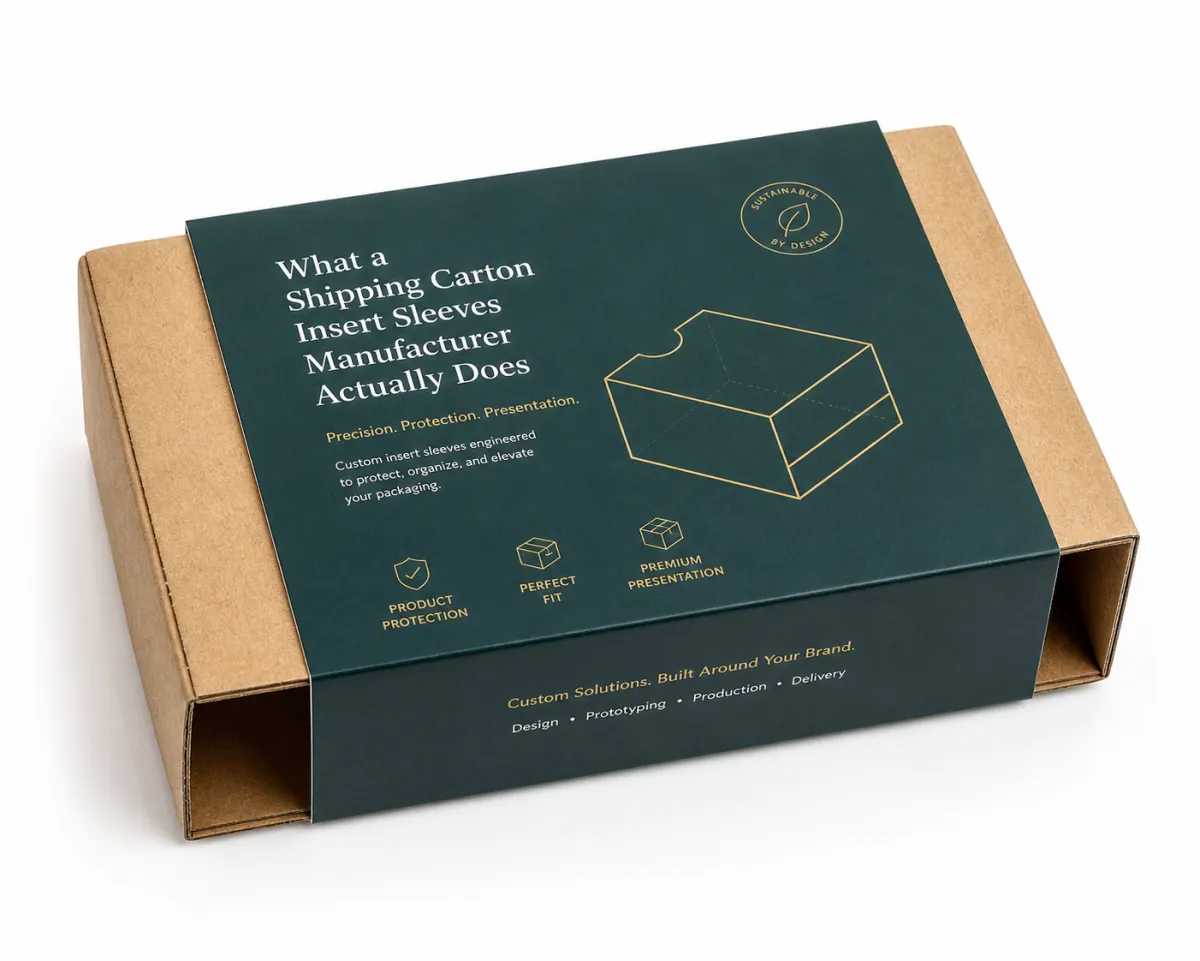
A shipping carton insert sleeves manufacturer turns a loose shipping problem into a measured internal structure. The sleeve may act as a wrap, a divider, a friction-fit wall, or a nested insert that keeps the product from sliding around inside the outer carton. Simple idea. Not simple execution. The sleeve has to fit the product, fit the carton, and still run cleanly on the packing line.
People like to blame the carton when shipping damage shows up. Sometimes the carton is guilty. Often the real offender is movement inside the box. A little side-to-side travel is enough to scuff surfaces, crush edges, mix components, or punch corners. A shipping carton insert sleeves manufacturer helps cut that motion with a tailored internal format that uses the right board grade, score layout, and locking geometry.
In plain language, an insert sleeve is a custom-fit internal piece made from paperboard, corrugated, kraft board, or another specialty substrate. It can stabilize a bottle set, separate fragile parts, create a snug inner wall, or guide multiple items into fixed positions. Unlike loose void fill, the sleeve gives you a repeatable structure. Unlike a full internal shipper, it usually uses less material and less assembly time.
Here is the practical difference buyers should keep in mind:
- Sleeve: A wrap or internal wall that controls fit and movement.
- Divider: A multi-compartment insert that separates SKUs or components.
- Wrap: A simpler protective layer around one item or bundle.
- Full internal shipper: A heavier-duty internal system for high-risk, high-value, or very fragile items.
The right shipping carton insert sleeves manufacturer will help you decide which format is actually necessary. Sometimes a sleeve is enough. Sometimes a divider system or a structural shipper is the better answer. That honesty matters. Overbuilding wastes material and slows packing. Underbuilding sends you straight into damage claims and awkward meetings.
Common use cases include fragile goods, retail-ready gift sets, subscription packs, industrial parts, cosmetics, electronics accessories, and mixed ecommerce shipping orders that need more order inside the carton. A shipping carton insert sleeves manufacturer also adds value when the product presentation matters, because an internal sleeve can make the opening experience feel intentional instead of thrown together at the last minute.
I have seen brands spend weeks arguing over outer carton print while the real fix was a sleeve that stopped a product from rattling like a loose coin in a dryer. That kind of thing is annoying, but it is also common. The insert is often where the actual protection lives.
A good sleeve does three jobs at once: it stabilizes, it protects, and it speeds the handoff from packing table to carrier truck. If it only does one of those, the design is probably too weak or too expensive.
From About Custom Logo Things, the practical mindset is the same one most packaging buyers use every day: protect the product, keep the line moving, and avoid paying for structure you do not need. That is the real value of a shipping carton insert sleeves manufacturer.
How Shipping Carton Insert Sleeves Fit Into the Carton
The best shipping carton insert sleeves manufacturer designs around three measurements: the product, the carton, and the void space left between them. That sounds obvious because it is. Still, this is where a lot of sleeve projects go sideways. A dieline can look tidy and still fail if the final folded piece ignores board thickness, product tolerance, or the way the packer actually loads the item.
Structurally, a sleeve usually depends on score lines, fold geometry, friction fit, and sometimes locking tabs. Those details decide whether the sleeve stays square after loading or buckles into the carton. If the sleeve is doing real work, the folds need to hold shape and the dimensions need to be tight enough to stabilize without forcing the packer into a wrestling match.
Material choice changes performance a lot. A single-wall corrugated sleeve may make sense for heavier products or longer transit lanes. Folding carton board often works better for lighter goods and cleaner presentation. Kraft board can be a smart option for natural branding and recycle-friendly messaging, while laminated structures may be useful where moisture resistance, abrasion resistance, or premium appearance matter. A shipping carton insert sleeves manufacturer should explain those trade-offs clearly instead of defaulting to the cheapest substrate like that answers every question.
The sleeve also acts as a buffer. When the product is suspended or guided away from the carton wall, the paperboard absorbs some abrasion and reduces direct contact. That matters for painted parts, printed surfaces, polished metal, glass, and coated consumer goods. In multi-item cartons, sleeves can create compartmentalization so products do not slam into each other during transit.
Good design work usually starts with a CAD dieline, followed by a sample build and a fit check. A shipping carton insert sleeves manufacturer that skips this step is asking you to trust theory instead of shipping conditions. Real cartons bow slightly. Real products vary. Real packers fold with human speed, not showroom patience. The sample needs to prove the sleeve still works in those conditions.
Board direction matters too. Grain direction can make a sleeve fold cleanly or fight back on every crease. Score depth and score-to-cut ratio matter for crush control. If the score is too shallow, the sleeve can spring open; too deep, and the structure weakens along the fold. Those are small details on a drawing. They are not small details on the line.
For buyers building a broader packaging system, compare the sleeve against other transit packaging pieces such as custom shipping boxes, inserts, and even Custom Poly Mailers for lighter SKUs. The sleeve is one part of the system, not the whole system.
Key Factors When Choosing a Shipping Carton Insert Sleeves Manufacturer
Not every packaging supplier is a strong shipping carton insert sleeves manufacturer. Some can quote a dieline fast but do not have much depth in board engineering. Others can print beautifully but stumble on dimensional tolerances and repeatability. If the sleeve has to live inside an active fulfillment operation, technical skill matters more than a polished sales pitch.
The first question I would ask is simple: does the shipping carton insert sleeves manufacturer understand how board caliper, score depth, flute profile, and compression strength affect the way a sleeve behaves after folding and loading? That is the difference between a structure that looks fine on a sample table and one that survives vibration, stacking, and seasonal humidity changes without falling apart or turning weird.
Product fit matters too. A supplier that is great for lightweight cosmetics sleeves may not be the right partner for heavy industrial parts, sharp-edged components, or products with temperature sensitivity. The best shipping carton insert sleeves manufacturer should have examples of similar work, even if they cannot disclose customer names. They should also be able to explain why a certain board grade or insert structure was chosen.
Branding is another practical factor. If the sleeve is visible at opening, you may want one-color marks, a short instruction panel for packers, barcodes, lot codes, or simple branded graphics. That is often enough. Not every sleeve needs full coverage print, and a shipping carton insert sleeves manufacturer that pushes decoration before function is missing the point. Clean printing still matters for retail-ready sets and premium unboxing.
Sustainability and compliance are increasingly part of the decision. Ask about recycled content, curbside recyclability, FSC sourcing, and whether the material matches your customer’s packaging standards. For teams tracking third-party guidance, the International Safe Transit Association at ISTA is a useful reference for transit testing, and FSC is the obvious source for certified fiber expectations. A good shipping carton insert sleeves manufacturer should be comfortable speaking that language.
Service depth is often the hidden differentiator. A better partner will help with prototype support, sampling speed, packing-line advice, and engineering feedback instead of just tossing over a flat quote and calling it collaboration. That support can save weeks. It can also prevent expensive rework if the first design needs another score adjustment or a different board thickness.
Finally, check quality control. Sleeves must fold cleanly, stay square, and fit consistently across production runs. A small variation in cut size can turn into a big problem when thousands of units are moving through order fulfillment. Consistency is not glamorous, but it is where a reliable shipping carton insert sleeves manufacturer earns trust.
One more filter that saves headaches: ask how they handle line-side issues after approval. If a packer says the sleeve is catching on a flap or the fit is just a hair off, does the manufacturer recheck the dieline, or do they shrug and blame the operator? I know which answer usually leads to a better launch.
Shipping Carton Insert Sleeves Manufacturer Pricing: What Drives Cost
Pricing is rarely as simple as piece count multiplied by board weight. A shipping carton insert sleeves manufacturer is pricing several cost layers at once: material, tooling, setup, print, finishing, inspection, and the labor needed to convert flat board into a sleeve that actually fits the carton. Buyers who only compare unit price usually miss the real picture.
The biggest drivers are material grade, sleeve dimensions, the number of panels, print coverage, die-cut complexity, and any special coating or lamination. A larger sleeve uses more board. A sleeve with extra folds or locking features costs more to convert. A sleeve with full-coverage branding or a protective finish can add cost, but it may also improve presentation and abrasion resistance.
Tooling and setup matter especially on custom work. If the design needs a new die line, the upfront cost can be noticeable, and a project with several rounds of sampling can carry more development cost before production even starts. A shipping carton insert sleeves manufacturer that understands your volume and timing can often suggest ways to simplify the structure without losing the fit you need.
Quantity changes the unit economics in a big way. Larger runs usually lower per-piece cost because setup is spread across more units. Smaller runs are not a problem, but they often carry higher overhead per sleeve. That is why a buyer might see a range like $0.10-$0.22 per unit for a simple high-volume sleeve and $0.28-$0.60 per unit for a more complex custom design at lower quantities. Those numbers are only directional, but they show why the quote depends so much on structure and volume.
| Material / Build | Best Fit | Typical Unit Cost Range | Notes |
|---|---|---|---|
| Single-wall corrugated sleeve | Heavier products, longer transit packaging lanes | $0.12-$0.30 | Strong stiffness, good for package protection, a little bulkier |
| Folding carton board sleeve | Light to medium products, branded opening experience | $0.08-$0.24 | Cleaner print surface, lighter weight, less crush resistance |
| Kraft board sleeve | Natural look, recyclable positioning, simple structures | $0.09-$0.26 | Often chosen for sustainability messaging and practical shipping materials |
| Laminated specialty sleeve | Premium presentation, moisture or abrasion concerns | $0.18-$0.45+ | More finish options, higher cost, useful where appearance matters |
Hidden costs deserve attention too. Freight can be meaningful on bulky transit packaging. Storage may matter if sleeves ship flat in large cartons. Assembly labor can be a bigger factor than the sleeve itself if the fold pattern is awkward. And a sleeve that looks inexpensive but slows the line by just a few seconds per pack can become expensive very quickly across a large fulfillment center.
That is why the lowest quote is not always the best value. A shipping carton insert sleeves manufacturer that holds tolerances, packs flat, and supports a stable pack-out can save more money through lower damage rates and less labor than a cheaper supplier ever will. Smart comparisons look at the sleeve, the outer carton, the packing speed, and the return rate together.
In practical terms, the right question is not “What does one sleeve cost?” It is “What does the complete shipping system cost after damage, labor, and dimensional weight are accounted for?” If a sleeve lets you tighten the carton fit and avoid oversized void space, that can lower dimensional weight and trim freight cost in ways a simple unit quote never shows.
There is also the ugly little detail of waste. If a design requires extra void fill, extra tape, or a second handling step because it is awkward to load, you are paying for the sleeve twice. Once on the invoice. Again on the floor.
Shipping Carton Insert Sleeves Manufacturer Process and Timeline
A solid shipping carton insert sleeves manufacturer follows a process that starts with discovery and ends with a repeatable production run. The best projects are the ones where the supplier asks the right questions up front, because that shortens the road to a usable sample and cuts the back-and-forth that delays launch.
The process usually begins with product review. You send exact dimensions, weight, photos, carton size, loading orientation, and any known pain points, such as corner crush, abrasion, or component mixing. If the product has tolerances or a fragile finish, say so. A shipping carton insert sleeves manufacturer can only engineer around what they know.
From there, the team typically recommends a format, builds a CAD dieline, and prepares a prototype or flat sample. For straightforward sleeves, sample timing may be only a few business days. More complex work, especially projects with multiple folds or locked partitions, can take longer because the fit needs to be checked and adjusted. Most good teams expect at least one sample round before approval; that is normal, not a red flag.
Lead time depends on material availability, print complexity, order size, and whether the design needs custom tooling. A simple board conversion on existing tools can move faster than a fully custom insert. A shipping carton insert sleeves manufacturer should be able to explain what adds time and what does not. That conversation helps purchasing, operations, and warehouse teams set a realistic launch window.
For reference, a clean project might move from sample approval to production in roughly 10-15 business days on a standard run, while more customized builds may take 15-25 business days or more depending on tooling, finishing, and freight planning. Those are planning ranges, not promises, but they are useful for scheduling order fulfillment and avoiding stockouts.
Before full rollout, I strongly recommend a pack-line test. Put real products into the real carton with the actual sleeve and watch how the team handles it. Do they fold it in one motion? Does the sleeve spring back correctly? Does the carton still close without bowing? A shipping carton insert sleeves manufacturer that encourages this test is usually thinking like a partner, not just a vendor.
It is also smart to capture feedback from the packers. They will notice whether a score line is too stiff, whether the loading sequence feels awkward, or whether the sleeve needs a small finger notch for faster handling. Those details do not always show up in drawings, but they matter a lot once the line is running at speed.
When the sleeve and carton are aligned correctly, the result is simple: less movement, fewer reworks, cleaner pack-outs, and a more controlled shipping experience. That is the payoff of a careful shipping carton insert sleeves manufacturer process.
And yes, sometimes the fastest-moving projects are the ones where operations, purchasing, and packaging engineering stop trying to be heroes and just send over the real numbers on day one. Kind of boring. Much better outcome.
Common Mistakes When Sourcing Shipping Carton Insert Sleeves
One of the biggest mistakes is designing from product dimensions alone and ignoring how the product is packaged, coated, or nested. A sleeve that is mathematically correct can still be too tight once you account for labels, wraps, secondary packaging, or slight manufacturing variation. A shipping carton insert sleeves manufacturer worth trusting will ask about those real-world details.
Another common problem is choosing a structure that is too light for the load. A thin board sleeve might look fine during a desk review, but if the carton is going to be stacked, vibrated, or shipped through rough handling lanes, it can crush, warp, or lose its shape. Then the protection layer becomes the failure point. That is a painful lesson because it usually shows up after the first claims start landing.
Skipping sample testing is another expensive shortcut. Teams sometimes approve a drawing and go straight to production because the dimensions “look right.” Then the first run reveals slow assembly, poor fold memory, or interference with the outer carton. A good shipping carton insert sleeves manufacturer will push for samples because the sample is where the hidden problems show up.
Packing labor is easy to overlook. A sleeve that looks elegant in a render may require too many hand motions, which slows the line and frustrates packers. Across thousands of shipments, a few extra seconds per order can become a major cost. In ecommerce shipping, speed matters, but so does repeatability. The best sleeves improve both.
Another mistake is treating the sleeve as a standalone item instead of coordinating it with the outer carton, tape method, and void-fill strategy. If the carton is oversized, the sleeve has to work harder. If the tape pattern gets in the way of loading, the process becomes clumsy. A shipping carton insert sleeves manufacturer should understand the whole packaging system, not just the insert itself.
Price-only sourcing is the final trap. The cheapest quote can lead to rework, late launches, or inconsistent fit. It can also increase dimensional weight if the sleeve and carton combination is not optimized. A smarter sourcing approach weighs the unit cost against damage reduction, labor savings, and the stability of the pack-out.
If the sleeve saves $0.03 but adds damage, labor, or a second handling step, it is not a savings. It is just a smaller number on the quote.
Expert Tips and Next Steps for Shipping Carton Insert Sleeves
Start with a spec sheet that is simple but complete. A shipping carton insert sleeves manufacturer can move much faster if you include product dimensions, target carton size, weight, fragility level, shipping method, and any special handling concerns. Photos help. So do notes about stack height, coating, surface sensitivity, and whether the item is going through retail shelves after delivery.
Ask for a prototype or flat sample before you commit. Then test it with real packers, real products, and the actual outer carton. Do not test only one perfect unit. Test several, because variation is where the truth lives. If the sleeve needs too much force or takes too long to fold, that will show up quickly in the line test. A shipping carton insert sleeves manufacturer that welcomes this step is usually easier to work with over the long haul.
Build your evaluation around three outcomes: protection, packing speed, and finished appearance. A sleeve that protects well but slows the line is only half successful. A sleeve that looks great but leaves the product loose is also a problem. The strongest designs improve all three, even if not perfectly. That balanced view is how most experienced packaging buyers judge transit packaging.
If you are comparing vendors, ask each shipping carton insert sleeves manufacturer the same questions. How do they handle tolerances? What material options do they recommend for your weight range? How do they test fit? What is their sample turnaround? How do they support sustainability documentation? Using the same questions makes the answers easier to compare and helps you spot the partner who is giving engineering support instead of a generic quote.
For many teams, a short pilot run is the smartest next step. It gives warehouse staff a chance to handle the sleeve in real conditions, and it gives purchasing a chance to confirm pricing against actual usage rates. After that, you can refine the dieline, adjust the board grade if needed, and scale with more confidence.
That same thinking applies if your packaging mix includes more than one format. Some lines may use sleeves for cartons, while others rely on a mix of inserts, mailers, and branded shippers from Custom Packaging Products. The key is to design for the process you actually run, not the process you wish you had.
My practical advice is simple: collect the measurements, ask for the sample, test it on the packing line, and choose the shipping carton insert sleeves manufacturer that can prove fit, consistency, and day-to-day line performance. If they cannot show you that in the real world, they are probably just selling you a tidy-looking guess. And guesses are cheap until they hit the dock.
The cleanest next move is to lock the specs, run one prototype round, and verify that the sleeve protects the product without slowing pack-out. That gives you something concrete to judge, instead of a pretty drawing and a hope.
Frequently Asked Questions
What does a shipping carton insert sleeves manufacturer actually make?
They make custom internal sleeves that stabilize products, separate items, or improve carton fit during shipping. The best versions are built around the product, the carton, and the packing process instead of a generic size. A shipping carton insert sleeves manufacturer can also help choose board grade, fold style, and print placement so the sleeve works in transit and on the pack line.
How do I choose the right material for shipping carton insert sleeves?
Match the board grade to the product weight, stacking pressure, and transit conditions. Use samples to confirm whether the sleeve needs more rigidity, better fold memory, or extra abrasion resistance. For light branded goods, folding carton board may be enough. For heavier or more demanding shipping materials, corrugated or laminated board may be the safer choice.
How long does it take a shipping carton insert sleeves manufacturer to deliver samples and production?
Sampling is often fast when measurements and specs are clear, but complex designs can need multiple rounds of refinement. Production timing depends on tooling, material availability, print complexity, and order size. A shipping carton insert sleeves manufacturer should give you a realistic milestone schedule so operations and purchasing can plan around it.
What affects pricing the most when working with a shipping carton insert sleeves manufacturer?
Material selection, sleeve dimensions, die-cut complexity, print coverage, and quantity are the biggest price drivers. Shipping, assembly labor, and hidden handling costs should also be included when comparing quotes. If a sleeve reduces damage or lowers dimensional weight, its value can be higher than a cheaper option that performs poorly in transit packaging.
Can shipping carton insert sleeves be customized for fragile or irregular products?
Yes, custom dielines can be designed to cradle odd shapes, protect delicate surfaces, and control movement inside the carton. Prototype testing is especially important for irregular products so the sleeve fits securely without slowing the pack line. A skilled shipping carton insert sleeves manufacturer will often recommend small structural changes that make a big difference in package protection.
For teams that want to reduce damage, tighten pack-out, and keep packaging practical, the shipping carton insert sleeves manufacturer you choose should feel like an engineering partner as much as a supplier. That is the difference between a sleeve that simply exists and a sleeve that improves the entire shipping system.

