A customer orders premium notebooks, sticker sheets, greeting cards, or a small stationery bundle. The package lands on a wet porch and sits there for 40 minutes. The contents may survive, but the brand impression has already been tested in the least flattering way possible. This stationery brands Waterproof Apparel Mailers sample order guide is for buyers who want to test the bag before they commit to a full custom run.
Stationery Brands Waterproof Apparel Mailers Sample Order Guide
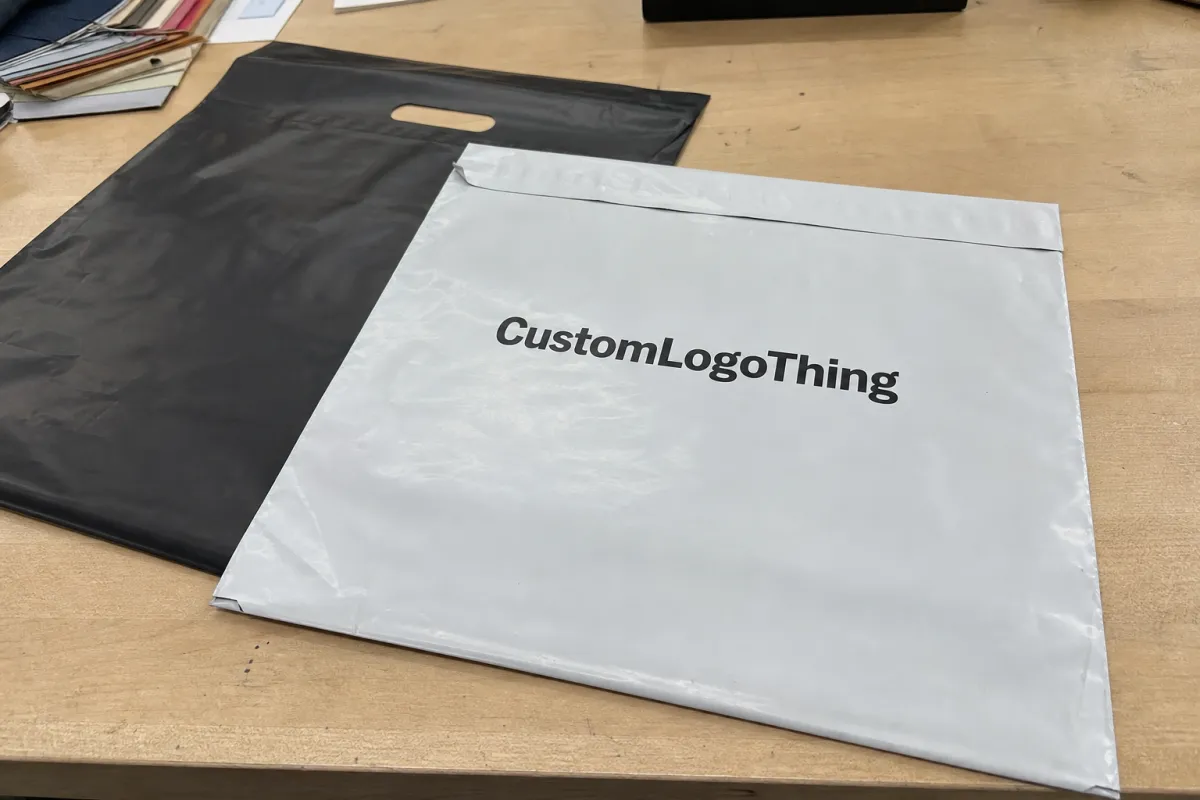
Apparel mailers are not only for T-shirts. The product category says “apparel,” but the function is broader: lightweight outer protection, low shipping weight, printable branding space, and a water-resistant barrier during small parcel delivery. A flexible poly mailer can work well for stationery bundles, planners, flat art prints, envelopes, sticker packs, washi tape sets, invitation suites, slim notebooks, and paper-based subscription shipments.
A sample order is risk control. Not a cute extra. Not something to order because the packaging mockup looked clean on a white background. A real sample lets you check size, film feel, adhesive strength, opacity, seam behavior, print coverage, and whether sharp notebook corners stress the bag after packing.
Digital mockups are useful for layout, but they hide the awkward parts of packaging. They do not show crinkle noise, edge resistance, print rub, inner-film opacity, or whether a white ink underbase keeps brand colors clean on colored film. A mockup also will not tell you if a 9 x 12 inch art print plus backing board slides in smoothly or turns fulfillment into a wrestling match.
Practical rule: if the product is paper-based, test the mailer with the packed product, not the product alone. Paper hates moisture, corners, and pressure. Shipping provides all three for free. How generous.
For a stationery brand selling $18 planners, $28 invitation sets, or $45 subscription boxes, one bad delivery photo can cost more than the sample fee. Returns, replacement shipments, damaged-product claims, and one-star reviews about soggy packaging are all more expensive than checking the mailer before bulk production.
Samples are useful for stationery startups, online shops, subscription box teams, wholesale stationery brands, event invitation sellers, sticker brands, art print sellers, and print-on-demand paper goods sellers. If your product is flat, bendable, moisture-sensitive, or presentation-driven, the outer mailer deserves attention before 5,000 pieces arrive in cartons.
The goal is not to overbuild every shipment. A thin sticker pack does not need the same mailer as a hardbound planner. The goal is to match the mailer to the product, shipping method, brand expectation, and order volume with enough testing to avoid obvious failure points.
Waterproof Apparel Mailer Details for Paper Goods
Waterproof Apparel Mailers are lightweight Poly Mailer Bags, commonly made from PE or co-extruded film. Most use a peel-and-seal adhesive strip, side-welded or bottom-sealed construction, and custom printing on one or both sides. Production films may include white PE, gray inner-layer PE, black inner-layer opaque film, frosted film, matte film, glossy film, and recycled-content PE options.
For stationery, the value is simple. These mailers resist rain, splashes, handling grime, warehouse dust, and the ordinary abuse of small parcel shipping. Paper goods need that barrier more than many buyers admit. A kraft envelope looks lovely until it absorbs porch water like a sponge with a logo.
“Waterproof” in parcel packaging usually means resistant to normal water exposure during delivery: rain, wet sorting surfaces, damp porches, and splashing. It does not mean underwater storage, refrigeration use, or being used as a canoe. If a supplier implies otherwise, ask how long the adhesive survives submerged and whether the seams were tested under pressure. The answer will become more practical very quickly.
Common stationery use cases include notebook mailers, planner refill packs, greeting card sets, invitation suites, sticker sheet bundles, branded insert kits, art prints with backing boards, envelopes, and lightweight merchandise sets. For heavy hardbound notebooks or boxed stationery, a bubble-lined version, corrugated insert, or rigid mailer may be more appropriate.
Useful style options include:
- Standard flap poly mailers: good for one-way e-commerce shipments and fast packing.
- Returnable dual-seal mailers: helpful for wholesale samples, exchanges, or customer-friendly return programs.
- Clear-front or frosted mailers: strong for presentation, weaker for privacy unless the product is wrapped inside.
- Matte finish mailers: more premium in hand, though colors may appear softer than on gloss film.
- Bubble-lined mailers: better for planners, rigid boards, and products with sharper corners.
- Recycled-content PE mailers: useful when the material performs and the claim can be supported accurately.
Appearance has tradeoffs. Glossy film makes color pop but shows crinkles more clearly. Matte film feels refined but can make ink rub more visible on dark coverage areas. White film keeps artwork flexible and clean. Colored base film can reduce ink coverage, but it limits design freedom. Black inner film improves opacity, which matters for gift orders, wholesale shipments, and higher-value planner bundles.
Print choices range from a one-color logo to full-panel patterns, front-and-back printing, QR codes, social handles, care messages, warning text, and seasonal artwork. If you print QR codes, scan them after the bag is packed and wrinkled. A perfect QR code on a flat proof means very little if it scans like a potato after fulfillment.
For paper goods, prioritize opacity, seam strength, fit, and adhesive performance before chasing the thinnest film or the lowest unit price. Cheap mailers have a special talent for looking cheap, especially next to premium notebooks, letterpress cards, or wedding stationery.
Size, Film, Closure, and Print Specifications to Check
Start with sizing. Measure the packed product, not the naked product. Include backing boards, sleeves, glassine bags, tissue wrap, thank-you cards, sticker freebies, inserts, cardboard stiffeners, and bundle thickness. A 6 x 9 inch sticker sheet does not ship as a flat mathematical concept. It ships with real materials around it.
Most stationery orders need about 0.5 to 1 inch of extra width and 1 to 2 inches of extra length, depending on thickness, insert stiffness, flap depth, and packing speed. Tight bags look tidy in theory. At a packing station, they slow people down and increase seam stress.
| Common Mailer Size | Good For | Typical Film Range | Buyer Notes |
|---|---|---|---|
| 6 x 9 in | Sticker packs, small cards, mini prints | 2.0-2.5 mil | Check opacity if contents are giftable or premium. |
| 9 x 12 in | Greeting cards, small prints, slim notebooks | 2.5 mil | Works well with backing boards and rigid inserts. |
| 10 x 13 in | Planners, journals, A4-style paper goods | 2.5-3.0 mil | Test corners carefully with thicker paper bundles. |
| 12 x 15.5 in | Larger bundles, subscription kits, wholesale packs | 3.0 mil+ | Consider dual seal or reinforced film for heavier orders. |
| Custom size | Subscription formats, mixed SKUs, branded kits | 2.5-4.0 mil | Best fit, but allow extra setup and sampling time. |
Film thickness affects protection, hand feel, weight, and cost. A 2.0 mil mailer can work for lightweight stickers or flat card sets. A 2.5 mil film is a common everyday e-commerce choice for stationery. A 3.0 mil or heavier film is better for planners, rigid boards, hardbound notebooks, or products with sharper corners. Thicker is not automatically better, but under-specifying film is a quick way to invite seam failures.
Opacity deserves a real check. Premium stationery, gift orders, and wholesale shipments should not telegraph the contents through thin film. Gray inner layers, black inner film, or heavier ink coverage can hide contents and make the mailer feel more finished. If privacy matters, ask for an opacity review in the sample stage.
Closure type matters too. A standard permanent seal works for one-way shipments. Dual adhesive strips help if returns or exchanges are part of the customer experience. Tamper-evident closures can be useful when theft or product swapping is a concern, especially for limited-run art prints, higher-value planners, or wholesale samples.
Inspect print details in the sample: logo sharpness, ink density, registration, barcode readability, QR code scanning, white ink backing, edge alignment, and whether ink cracks across fold lines. If your design uses large dark areas, rub the print with a clean white cloth after packing and flexing. Better to find ink transfer on your desk than on a customer’s hands.
Sustainability claims need careful handling. Recycled-content PE, reusable mailers, downgauged films, and recyclable film options may be available, but buyers should confirm what claims are allowed in their market. The EPA recycling resources are a useful starting point for recycling language, though local rules still vary. If you use FSC-certified inserts or backing boards, confirm claims through FSC guidance and proper chain-of-custody documentation.
Sample Order Types: Blank, Printed, Pre-Production, or Size Kit
Not every sample answers the same question. Plenty of buyers ask for “a sample” and then expect it to settle fit, print, film, color, durability, and bulk pricing all at once. Pick the right sample path or expect a blurry decision.
Blank stock samples
Blank samples are the fastest and cheapest route. They are good for checking size, film thickness, opacity, closure strength, crinkle, and how your stationery products actually fit. They are not useful for judging exact custom print color or final artwork placement.
Printed reference samples
Printed reference samples use existing artwork from previous production or stock print examples. They help you evaluate print method, ink feel, finish, opacity, and general production quality. If your team cares about matte versus gloss, print texture, and color behavior on film, this is a sensible step.
Digital printed custom samples
Digital printed samples are useful for low-volume artwork testing, seasonal designs, and visual approval. Color can be close, especially with good files and clear targets, but it may not perfectly match a mass production run if final production uses flexographic or gravure printing. Different print methods behave differently. Annoying, but true.
Pre-production samples
Pre-production samples are closest to final output. They use the intended material, size, artwork, print method, closure, and finish. They cost more and take longer because real setup, proofing, and production steps are involved. For larger custom runs, they are often worth it.
Size kits
A size kit includes several blank mailer sizes so your team can test actual packed products. This is especially helpful for brands shipping mixed SKUs, such as sticker sheets, card sets, art prints, notebooks, and planners. A size kit often reveals that one “universal” bag is not universal at all. Shocking news from packaging.
Do not pay for a full pre-production sample if the size is still undecided. Do not approve a full custom order from only a blank sample if color accuracy is critical. If the brand is new, start with a blank size kit and a printed reference sample. If artwork is final and launch timing is tight, move toward a pre-production sample.
Custom Logo Things can help narrow the choice through our Custom Poly Mailers options or broader Custom Packaging Products catalog if your stationery line also needs tissue, labels, boxes, or inserts.
Pricing, MOQ, and Unit Cost for Custom Mailer Samples
Sample pricing depends on material, size, print method, order quantity, artwork complexity, finish, and whether tooling or plates are required. That is the honest answer. Anyone promising one universal price without specs is guessing, and guessing is not procurement.
Blank sample kits may be low-cost, or the fee may be credited against a bulk order depending on the project. Printed reference samples are usually inexpensive plus shipping because they already exist. Custom pre-production samples cost more because setup time, proofing, material allocation, press preparation, and operator time are involved.
For broad planning, buyers often see blank or reference sample costs handled differently from production samples. A simple size kit may be modest. A true pre-production sample with custom print can land much higher, especially if plates, specialty film, or exact color matching are involved. Bulk pricing changes sharply across 1,000, 5,000, 10,000, 25,000, and 50,000 piece quantities, because setup and material efficiency spread differently at each level.
| Option | Typical Use | Cost Behavior | MOQ Pattern |
|---|---|---|---|
| Blank size kit | Fit, film feel, closure test | Lowest sample cost; shipping may dominate | Usually small sample quantity |
| Printed reference sample | Print feel, finish, opacity review | Low to moderate; uses existing bags | No custom production MOQ |
| Digital custom sample | Artwork preview, small campaign test | Moderate; lower setup than plate printing | Lower MOQ than flexo or gravure |
| Pre-production sample | Final approval before bulk production | Highest sample setup cost | Often tied to a planned bulk run |
| Bulk custom run | Launch, reorder, wholesale program | Unit cost drops as quantity rises | Varies by print method and specs |
MOQ depends heavily on print method. Digital printing usually supports lower MOQs. Flexographic or gravure printing usually requires higher MOQs because plates, setup, material waste, and production efficiency matter. Magic is not a manufacturing process.
Unit cost drops as quantity rises because setup costs spread across more bags. A 500-piece run will not price like a 50,000-piece run, no matter how persuasive the logo deck is. A small starter run may make sense for launch validation. A larger run usually wins on unit economics if the design, size, and order volume are stable.
Key cost drivers include bag dimensions, film thickness, number of print colors, full coverage versus a small logo, matte or specialty finish, dual seal, recycled content, rush production, and air freight. Large bags with heavy ink coverage and specialty closure cost more. Tiny surprise.
Compare total landed cost, not only unit price. Include setup, sample fee, proofing, freight, duties if applicable, storage, reorder timing, and the cost of running out. For brands selling through wholesale channels, our Wholesale Programs page may be useful if packaging volume is tied to seasonal buying cycles.
Ask for two or three quantity breaks: starter MOQ, mid-volume, and bulk pricing. This shows the cost curve before you lock into a weak order quantity. If the price drops sharply between 3,000 and 5,000 pieces, that may change the buying decision.
Process and Timeline from Artwork to Approved Sample
The usual process is straightforward: inquiry, product recommendation, quote, artwork check, digital proof, sample production, shipping, review, revision if needed, then written bulk production approval. Each step protects the final result. Skip enough steps and the cartons that arrive later may teach an expensive lesson.
Send useful information first. Include product dimensions, packed thickness, target mailer size if known, quantity range, artwork files, logo colors, preferred film color, shipping country, and launch deadline. If you have mixed SKUs, list the largest, thickest, sharpest-cornered, and most common order types.
Artwork should be clean. Vector files are preferred for logos, usually AI, EPS, or editable PDF. Raster artwork should be high resolution, commonly 300 dpi at print size where possible. Pantone references help with color matching, especially for stationery brands that already manage strict brand colors across boxes, sleeves, belly bands, labels, and inserts.
Timing varies by sample type. Blank samples can move quickly if stock sizes are available. Printed custom samples need artwork checks, proof approval, and production time. Pre-production samples take longer because setup and approval steps are real. If a supplier says every custom printed sample ships instantly, they are either not customizing it or not checking much. Neither is thrilling.
After receiving samples, test them like a buyer, not like someone admiring a pretty object on a conference table.
- Pack actual stationery products, including inserts and protective boards.
- Shake the bag for 20-30 seconds to see how corners pressure the seams.
- Check seam stress near the heaviest or sharpest product edge.
- Seal the bag and test adhesive strength after 24 hours.
- Expose one packed sample to light water spray for a practical moisture check.
- Rub printed areas with a clean cloth and inspect for ink transfer.
- Scan QR codes and barcodes after the bag is packed and flexed.
- Photograph the packed mailer in normal lighting, not only studio lighting.
Revision loops are normal. Size changes are common. Material changes may require new samples. Major artwork changes can reset proofing. This is why deciding late is expensive. Again, shocking.
Bulk production should start only after written approval. “Make it more premium” is not an approval note. It means five different things to five different people. Say what needs to change: thicker film, matte finish, darker ink, stronger opacity, tighter print placement, larger flap, or a different size.
For transit testing, brands with higher shipping risk may also review standards from ISTA, especially if mailers are part of a larger e-commerce packaging system. Poly mailers are simple, but the full shipping environment is not.
Control the timeline by approving artwork quickly, providing complete specs, avoiding size changes after proofing, and choosing ocean or air freight based on real launch dates. Air freight can rescue timing but usually punches the budget. Ocean freight is cheaper but needs planning. Packaging rewards adults who make decisions early.
What to Prepare Before Requesting a Quote
Before contacting Custom Logo Things, prepare the basics. Better inputs mean better recommendations, tighter pricing, and fewer rounds of “Can you send one more detail?” Nobody enjoys that email chain.
- Choose the products to test. Pick the largest, thickest, sharpest-cornered, and most common stationery orders. Do not test only the prettiest little sticker sheet and call it done.
- Measure packed dimensions. Include sleeves, tissue, backing board, cardboard stiffeners, inserts, samples, freebies, and bundle thickness. Send photos if the packed shape is unusual.
- Decide the sample path. Choose a blank size kit for fit testing, a printed reference sample for finish evaluation, or a pre-production sample for final approval before bulk production.
- Prepare artwork. Send vector logo files, Pantone or CMYK targets, print placement preferences, QR codes, social handles, and any required warning or recycling copy.
- Request quantity breaks. Ask for sample pricing, MOQ, setup fees, bulk unit costs at two or three quantities, and freight options. This prevents bargain-bin surprises later.
- Set approval criteria. Define acceptable fit, print tolerance, opacity, closure performance, and packed appearance before samples arrive. Otherwise the decision becomes office opinions, and office opinions are not a spec sheet.
If you want examples of packaging direction and brand presentation, review our Case Studies. If you need practical answers before requesting pricing, the Custom Logo Things FAQ covers common ordering and production questions.
A good sample order does not need to be complicated. It needs to answer the right questions in the right order: Will the product fit? Will the bag protect the contents? Does the print match the brand standard closely enough? Can the closure survive normal handling? Does the final packed mailer look like it belongs to the price point of the stationery inside?
Use this guide as a checklist, then send your specs so the recommended mailer is based on the actual product, not guesswork dressed up as packaging advice.
FAQ
What should stationery brands include in a waterproof apparel mailers sample order?
Include packed product dimensions, target bag size, film thickness preference, print artwork, quantity range, delivery country, and deadline. If size is uncertain, order a blank size kit first and test it with real notebooks, cards, prints, or sticker packs. For final approval, request a pre-production sample using the intended film, size, closure, and artwork.
Are waterproof apparel mailers safe for shipping paper stationery products?
Yes. Poly apparel mailers are a strong option for paper goods because the film resists rain, moisture, dust, and handling marks during transit. For bendable prints, invitations, or premium paper goods, add a backing board or rigid insert inside the mailer. Choose thicker film or bubble-lined mailers for heavier planners, hardbound notebooks, or sharp-cornered bundles.
What MOQ should I expect for custom waterproof mailers for stationery brands?
MOQ depends on size, print method, film type, and artwork coverage. Digital printing usually supports lower MOQs, while flexographic or gravure printing typically requires higher quantities because of setup and plate costs. Ask for multiple quantity breaks so you can compare starter pricing against stronger bulk unit costs.
How long does a custom waterproof apparel mailer sample take?
Blank samples are usually fastest because they do not require custom print setup. Printed custom samples take longer because artwork proofing, color checks, and production setup are involved. Pre-production samples take the most time but give the most reliable approval before a bulk run.
Can I match my stationery brand colors on waterproof apparel mailers?
Yes, but provide Pantone references or approved brand color values for the best match. Color can shift depending on film color, matte or glossy finish, white ink backing, and print method. Approve a printed sample if color consistency matters across your stationery packaging system.


