Stationery Shop Magnetic Boxes Lead Time: What Buyers Need
A stationery launch can look tidy on a spreadsheet and still fall apart the moment packaging enters the calendar. The phrase stationery shop Magnetic Boxes Lead time sounds neat, almost mechanical, but it usually hides a chain of decisions, approvals, and freight windows that stretch longer than buyers expect. The delays rarely begin with the box style itself. They usually begin with artwork that is not final, dimensions that drift by a few millimeters, or a sample that keeps changing after everyone said it was “close enough.”
From a buyer's point of view, stationery shop magnetic boxes lead time matters because launch dates, subscription kits, retail resets, and seasonal gift programs are fixed long before packaging is. A magnetic rigid box makes a notebook set feel more substantial in the same way a hardcover book feels different from a paperback: same content, different signal. That extra weight comes with extra steps. I have watched a one-week packaging slip turn into a three-week launch headache because the quote was approved before the spec was stable. Not fun. Not rare, either.
If you are comparing formats, start with our Custom Packaging Products page and narrow down the structure before asking for a quote. That small move often cuts down the back-and-forth that inflates stationery shop magnetic boxes lead time.
"The shortest stationery shop magnetic boxes lead time starts with final artwork, final size, and final finish. Move any of those after the quote, and the clock stops being honest."
What stationery shop magnetic boxes lead time really means for buyers
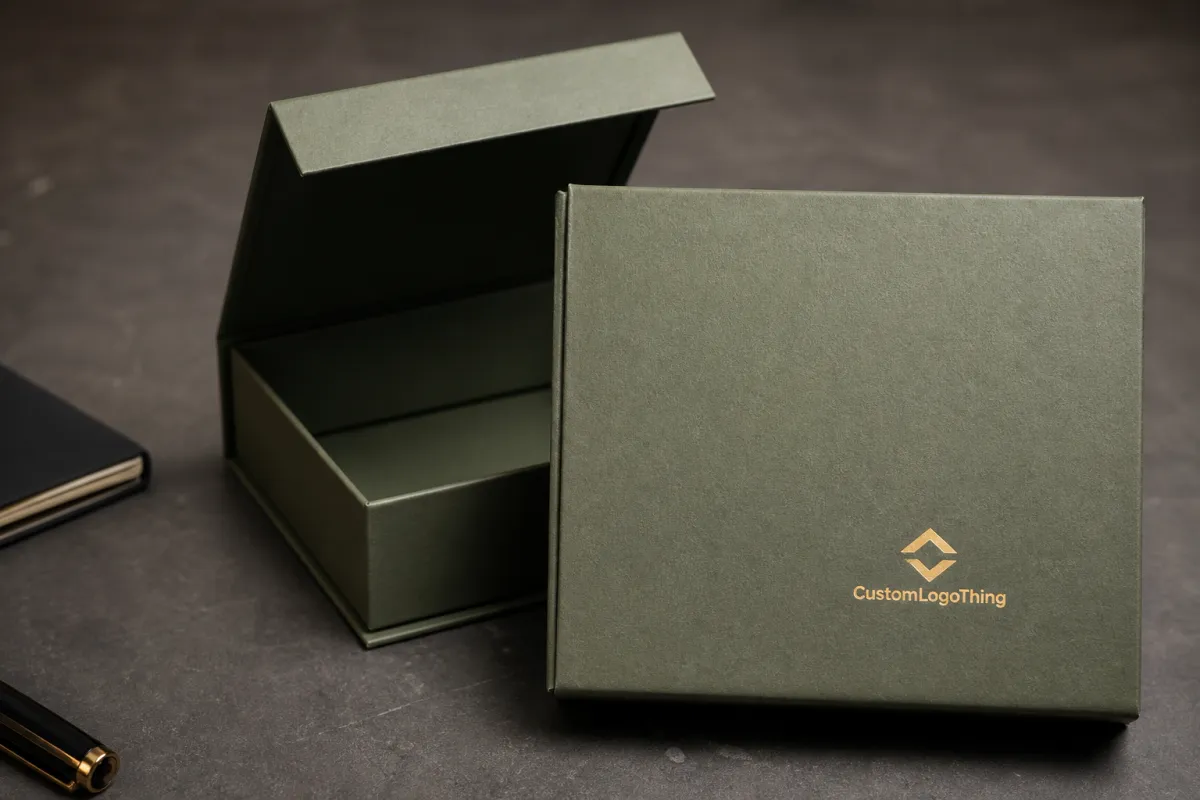
Stationery shop magnetic boxes lead time covers the full path from approved quote and final files to finished cartons leaving the factory. Proofing, sampling, printing, lamination, mounting, forming, packing, and freight handoff all sit inside that window. Buyers often compress that whole sequence into one clean number, then wonder why a “14-day” promise does not include artwork revisions or ocean transit. Packaging does not care about wishful math.
Vocabulary causes half the confusion. Quoted lead time, production time, and transit time are not interchangeable, even though people use them that way in emails all the time. Quoted lead time is the supplier's estimate. Production time is the actual factory window. Transit time is the trip from dock to door. A buyer who hears only one of those usually sees a much shorter stationery shop magnetic boxes lead time than the order really needs.
Stationery buyers feel that gap more sharply than many categories because the product launch is usually locked before the box is. A notebook launch tied to a catalog drop cannot slip by a week just because the foil color needs another round of opinions. School sets, journal bundles, and gift kits all have shelf dates and campaign dates that do not move. That makes stationery shop magnetic boxes lead time a planning issue, not a style preference.
Magnetic rigid boxes move slower than stock cartons. That is normal. A buyer pays for structure, presentation, and a stronger unboxing moment, not for speed. A rigid box is closer to a piece of furniture than a paper envelope: more parts, more alignment, more opportunities for delay. Once you accept that rigid packaging is a multi-step job, the schedule becomes manageable. Pretending it behaves like a folding carton is how people end up apologizing to retail teams.
- Quoted lead time: the estimate before files and specs are fully locked.
- Production time: the factory window after approvals are complete.
- Transit time: the shipping leg, domestic or international.
- Buffer time: the cushion that absorbs the extra email, missing file, or late sign-off.
Process and timeline: how stationery shop magnetic boxes move from quote to shipment
Stationery shop magnetic boxes lead time follows a predictable path, and the same three points create most delays: the brief, the proof, and the sample. A clean order usually starts with inquiry and spec review, then moves to quote, dieline or sample confirmation, printing, lamination, mounting, forming, packing, and shipping. Skip one decision and the calendar starts stretching like a tape measure in the wrong hands.
For a straightforward custom run, the usual range looks like this:
- Inquiry and spec review: 1-2 business days when the brief is complete.
- Quote: often 24-72 hours for a clear request.
- Dieline or sample confirmation: 3-7 business days for a plain mock-up, 7-14 days if a printed sample is needed.
- Production: 10-20 business days for simple specifications, 20-35 business days for premium finishes or larger quantities.
- Packing and freight: 2-7 business days domestically, or 20-35 days by ocean freight, plus customs and booking buffers.
That is why stationery shop magnetic boxes lead time is not one clock. It is a chain. If one link slips, the whole order slips. A factory can be efficient and still miss the launch because the proof sat in an inbox for four days waiting for logo approval. One quiet delay at the front often becomes an expensive panic at the end.
Order size changes the schedule too. Small runs are easier to set up, yet they may still wait behind larger production batches if the same board, wrap paper, or finishing line is already in use. Bigger runs can lower unit cost, but they do not magically shorten stationery shop magnetic boxes lead time. In some cases they stretch it because the line needs more assembly hours and more packing time. I have seen a 5,000-unit job take longer than expected simply because the insert crew was tied up with a different project. That kind of queueing is boring, but it is very real.
Freight can outrun manufacturing delays. Inland factories, port congestion, and booking queues can leave finished boxes sitting in limbo even after production is complete. Buyers need both clocks in view. Otherwise stationery shop magnetic boxes lead time looks healthy on paper and messy in the real world.
Stationery shop magnetic boxes lead time becomes far easier to manage when the supplier gives a stage-by-stage schedule instead of one vague delivery promise. Good suppliers can usually tell you what is waiting on approval, where the order sits on the line, and what happens next. That kind of detail is more useful than a cheerful date with no checkpoints attached.
Key factors that stretch or shorten stationery shop magnetic boxes lead time
The biggest driver behind stationery shop magnetic boxes lead time is structural complexity. A simple magnetic box with a straight lid and standard board moves through production faster than a box with thick rigid board, custom insert trays, ribbon pulls, or a window cutout. Every extra feature adds setup, inspection, and usually some hand assembly. Handwork is where schedules slow down. It looks polished. It does not look fast.
Print method matters too. A one-color logo on wrap paper usually moves faster than full-wrap art with foil, embossing, spot UV, or soft-touch lamination. Those finishes can look exceptional on stationery, but they add process steps and coordination. Buyers who want to compress stationery shop magnetic boxes lead time usually find the biggest gains by reducing finish complexity before production starts.
Material availability is another hard variable. Board stock, specialty paper, magnets, and insert materials do not always arrive at the same speed. Seasonal demand can make this worse. FSC-certified paper adds another layer of planning because the sourcing paperwork has to line up before production begins. The FSC system gives buyers a traceable route for responsible sourcing, but that route still needs documents, not guesses.
Communication quality sounds dull until it saves a week. Clean specs, one-shot approvals, and clearly marked artwork files shorten stationery shop magnetic boxes lead time more reliably than optimistic promises. The best suppliers are not the ones saying “no problem” every five minutes. They are the ones asking the awkward questions before the order becomes a mess. A slightly annoying email on Monday is a lot cheaper than a missed shipment on Friday.
- Structural complexity: thicker board, inserts, and cutouts add time.
- Print complexity: foil, embossing, and full-coverage artwork slow the line.
- Material supply: specialty wrap paper and magnets can bottleneck a job.
- Hand assembly: ribbon pulls and nested parts add labor days.
- Approval speed: one clear sign-off beats three rounds of “almost.”
If your boxes will travel through parcel networks or pallet handling, ask whether the pack-out has been checked against an ISTA transit testing method. That does not guarantee perfection. It does expose weak spots before the customer becomes the tester. A box that fails in shipping creates a lead-time problem because replacement runs are rarely quick and never cheap.
Stationery shop magnetic boxes lead time also shifts with seasonality. Peak sales periods, holiday gifting, and back-to-school pressure crowd finishing lines and freight booking windows. A launch tied to a retail reset should assume a tighter calendar than the quote suggests. That is not pessimism. That is the difference between planning and hoping. If you have ever tried to book freight in late November, you already know the mood.
Cost and pricing: what changes the quote for stationery shop magnetic boxes
Price and stationery shop magnetic boxes lead time are tied together more often than buyers expect. The price stack usually includes board, wrap paper, printing, finishing, assembly, inserts, packing, and freight. A quote that looks suspiciously low deserves a second look. Hidden assumptions are not savings. They are delays dressed up as bargains.
MOQ affects both unit cost and stationery shop magnetic boxes lead time. A small run spreads setup costs across fewer boxes, so the unit price climbs. It can also sit in a queue longer if the factory batches similar jobs together. A larger run lowers the unit cost, but it usually needs more production time and more packing labor. Volume helps, just not in a neat and painless way.
| Option | Planning price per unit | Lead time impact | Best use |
|---|---|---|---|
| Plain rigid magnetic box, matte wrap, one-color print | $2.20-$4.80 at 1,000 units; $0.85-$1.80 at 5,000 units | Usually the shortest custom rigid path, often 10-18 business days after approval | Notebook sets, simple kits, and clean retail presentation |
| Rigid box with full-color wrap and soft-touch lamination | $2.80-$5.60 at 1,000 units; $1.10-$2.35 at 5,000 units | Moderate schedule, often 15-25 business days | Gift launches and branded stationery collections |
| Foil, emboss, or spot UV with custom insert | $3.80-$7.50 at 1,000 units; $1.60-$3.50 at 5,000 units | Longer, often 18-35 business days | Premium sets and higher-end retail displays |
| Specialty paper, ribbon pull, nested components | $4.50-$9.00 at 1,000 units; $2.00-$4.80 at 5,000 units | Longest path; handwork can add 5-10 business days | VIP kits, presentation boxes, and seasonal gift runs |
Those ranges are planning numbers, not quotes. Board thickness, print coverage, finish selection, and freight distance all move them. Even so, they help buyers avoid fantasy pricing. A quote that looks too clean often hides a missing piece, and the missing piece usually shows up later as a schedule problem. A realistic quote is easier to approve, and that often shortens stationery shop magnetic boxes lead time because nobody has to renegotiate the obvious halfway through production.
If you are still choosing the format, browse Custom Packaging Products before you lock the spec. That lets you compare rigid styles, insert options, and finish levels with the actual stationery shop magnetic boxes lead time in mind instead of guessing from a single email thread.
One pricing trap deserves special attention: the quote and the schedule can disagree because they cover different scopes. A production-only price may omit sampling, tooling, or shipping assumptions. A line-by-line assumption sheet keeps the cost and the calendar honest at the same time, which matters more than most buyers realize until the deadline is already angry.
Common mistakes that blow up stationery shop magnetic boxes lead time
Most schedule disasters are self-inflicted. The first one is sending unfinished artwork and expecting the factory to guess the bleed, the dieline, or the magnetic closure placement. That is how stationery shop magnetic boxes lead time turns into a guessing game. Packaging teams can solve a lot, but they cannot read minds.
The second mistake is sample churn. Buyers request a sample, then change the dimensions, finish, and insert style after the sample is already built. Every revision costs time. Sometimes it also costs money. If the sample no longer matches the final spec, the practical stationery shop magnetic boxes lead time starts over even if nobody says the words out loud. I have seen that happen with a journal set where the logo moved twice and the insert changed once. By the end, the “sample” was basically a new project.
Underestimating shipping time is the third common miss. Overseas production can look efficient until customs, route congestion, and booking delays enter the picture. A box that is “done” but not shipped is not done for launch planning. That distinction decides whether the launch feels controlled or chaotic.
- Unfinished artwork: missing bleed, low-resolution files, or no dieline.
- Late changes: switching size, finish, or insert after sampling.
- Shipping blind spots: forgetting customs, booking, and route delays.
- Too many add-ons: piling on foil, ribbons, inserts, and specialty wraps at once.
- No written spec sheet: verbal instructions create avoidable confusion.
Skipping a written spec sheet is especially risky. Verbal instructions sound efficient until three people remember three different versions of the same box. Then stationery shop magnetic boxes lead time grows teeth. A short spec sheet with dimensions, board thickness, finish, magnet position, insert type, quantity, and shipping target beats a long chain of “I thought we meant...” every time.
A useful rule follows from that: the more custom the box, the less room there is for casual communication. That is not a supplier problem. It is a planning problem. Buyers who want stationery shop magnetic boxes lead time to stay under control need to narrow the decision set before the factory starts cutting board. Otherwise the lead time gets padded, and everybody pretends not to notice until the invoice arrives.
Expert tips and next steps to lock stationery shop magnetic boxes lead time
The cleanest way to protect stationery shop magnetic boxes lead time is to lock the spec before asking for the quote. Dimensions, closure style, board thickness, finish, insert type, and quantity should all be set first. If one of those stays open, the quote is really a placeholder dressed up like certainty. It may look helpful. It usually is not.
Build buffer into the calendar. Small domestic jobs may only need a modest cushion, but imported jobs need a wider one. A realistic buffer costs far less than a rushed shipment that still lands late. Rushed packaging is rarely elegant. It is just expensive with a deadline. And if a supplier tells you the buffer is “probably unnecessary,” I would treat that as a reason to ask more questions, not fewer.
Ask the supplier for a stage-by-stage schedule instead of one vague delivery promise. You want to know when artwork approval is due, when the sample is expected, when production starts, and when freight books. That gives early warning and keeps stationery shop magnetic boxes lead time visible instead of buried in a spreadsheet nobody opens after Monday.
- Lock the spec: size, board, finish, insert, and quantity.
- Approve one sample path: do not restart halfway through.
- Ask for a stage schedule: quote, proof, production, shipping.
- Choose standard materials where possible: save custom work for the details that matter.
- Confirm transit separately: factory time is not delivery time.
If your boxes need to survive parcel handling, pallet stacking, or retail distribution, ask for a test plan tied to a real handling standard. A supplier who can talk through routing, compression risk, and finish durability is usually easier to trust than one who only repeats a date. The stationery shop magnetic boxes lead time improves when the spec survives actual shipping conditions. Fancy is nice. Durable pays the bills.
For buyers comparing formats and finishes, our Custom Packaging Products page is a practical starting point. Use it to decide whether foil, embossing, inserts, or specialty paper are truly worth the added steps, then match the choice to the stationery shop magnetic boxes lead time you can live with.
Here is the short version: finalize the artwork, confirm the structure, ask for a sample timeline, compare quote assumptions, and add freight into the calendar from day one. Do that, and stationery shop magnetic boxes lead time stops feeling mysterious and starts acting like a process you can actually manage. That is the part buyers can control, and it matters more than any clever finish.
How long is stationery shop magnetic boxes lead time after artwork approval?
A simple run can move in a few weeks after approval, while premium finishes or inserts add more time. Production usually starts only after final files and specs are signed off, so approval timing matters as much as factory speed. Freight time should be added separately; it is not part of the factory's production window, and that is where many stationery shop magnetic boxes lead time plans become too optimistic.
What is the fastest realistic stationery shop magnetic boxes lead time for a small order?
The fastest realistic timeline usually belongs to simple specs, clean files, and a supplier with open production capacity. Small orders can still stall if they need custom inserts, specialty paper, or multiple sample revisions. Ask for rush options and the exact tradeoff between speed, cost, and finish quality before you commit, because a rushed stationery shop magnetic boxes lead time can become a costly one very quickly.
Does MOQ affect stationery shop magnetic boxes lead time?
Yes. MOQ affects both scheduling and unit cost because setup work gets spread across fewer or more boxes. A lower MOQ can be easier to approve financially, but it may not always be faster if the factory batches jobs by material or finish. Always ask whether the MOQ is tied to one production line, one material, or one finishing method, since that changes the real stationery shop magnetic boxes lead time.
Why does the quote for stationery shop magnetic boxes not match the timeline?
Some quotes only cover production, not sampling, tooling, packing, or freight, so the calendar and the price are telling different stories. A cheap quote may assume simpler finishes or longer queue times, which can hide the real delivery date. Request a line-by-line assumption sheet so the quote and schedule can be checked together before you approve anything.
How can I reduce stationery shop magnetic boxes lead time without hurting quality?
Lock the spec early, use print-ready artwork, and avoid changing finishes after sampling begins. Choose standard materials and finishes where possible, then spend your budget on one or two high-impact details. Get the supplier to confirm both production time and shipping time before you approve the order, because the smartest stationery shop magnetic boxes lead time is the one you planned before the calendar started shouting.
If you plan around the real stationery shop magnetic boxes lead time, you avoid rushed freight, sample churn, and launch-week panic. Treat the box as a production job, not a decoration, and the schedule becomes much easier to control. Finalize the spec, separate production from transit, and keep one buffer week in hand if the launch date matters. That is the practical takeaway, and it holds up better than optimism ever does.