Buyer Fit Snapshot
| Best fit | Sustainable Cardboard Inserts Manufacturer projects where brand print, material claims, artwork control, MOQ, and repeat-order consistency need to be specified before quoting. |
|---|---|
| Quote inputs | Share finished size, material target, print colors, finish, packing count, annual reorder estimate, ship-to region, and any compliance wording. |
| Proofing check | Approve dieline scale, logo placement, barcode or warning zones, color tolerance, closure strength, and carton packing before bulk production. |
| Main risk | Vague material claims, crowded artwork, missing packing details, or unclear freight terms can make a low unit price expensive after revisions. |
Fast answer: Sustainable Cardboard Inserts Manufacturer: Material, Print, Proofing, and Reorder Risk should be specified like a repeatable production item. The safest quote records material, print method, finish, artwork proof, packing count, and reorder notes in one written spec.
Production checks before approval
Compare the actual filled-product size with the drawing, then confirm tolerance on folds, seals, hang holes, label areas, and retail display edges. Reserve space for logos, QR codes, warning copy, and material claims before decorative graphics fill the panel.
Quote comparison points
Review material grade, print process, finish, sampling route, tooling charges, carton quantity, and freight assumptions side by side. A quote is only useful when the supplier can repeat the same color, closure quality, and packing count on the next order.
Sustainable Cardboard Inserts Manufacturer: Smart Guide
A sustainable cardboard inserts manufacturer does more than turn fiberboard into something that looks neat on a sample table. It keeps products from shifting, reduces breakage, and trims packaging waste in one move. That matters because the insert is often the weak point, not the outer carton. If the pack-out shifts even a few millimeters, corner crush, scuffing, and accessory damage can start stacking up fast. If you are also reviewing the shipper, Custom Shipping Boxes belong in the same conversation.
For buyers, the value of a sustainable cardboard inserts manufacturer is pretty simple: a better fit, less material, fewer returns, and fewer headaches on the packing line. Good designs use recycled or responsibly sourced fiber, die-cut efficiently, and still hold up in real transit instead of just surviving a quick sample check. If you are comparing suppliers, About Custom Logo Things is a useful starting point for the broader packaging picture.
Sustainable Cardboard Inserts Manufacturer: Why It Matters
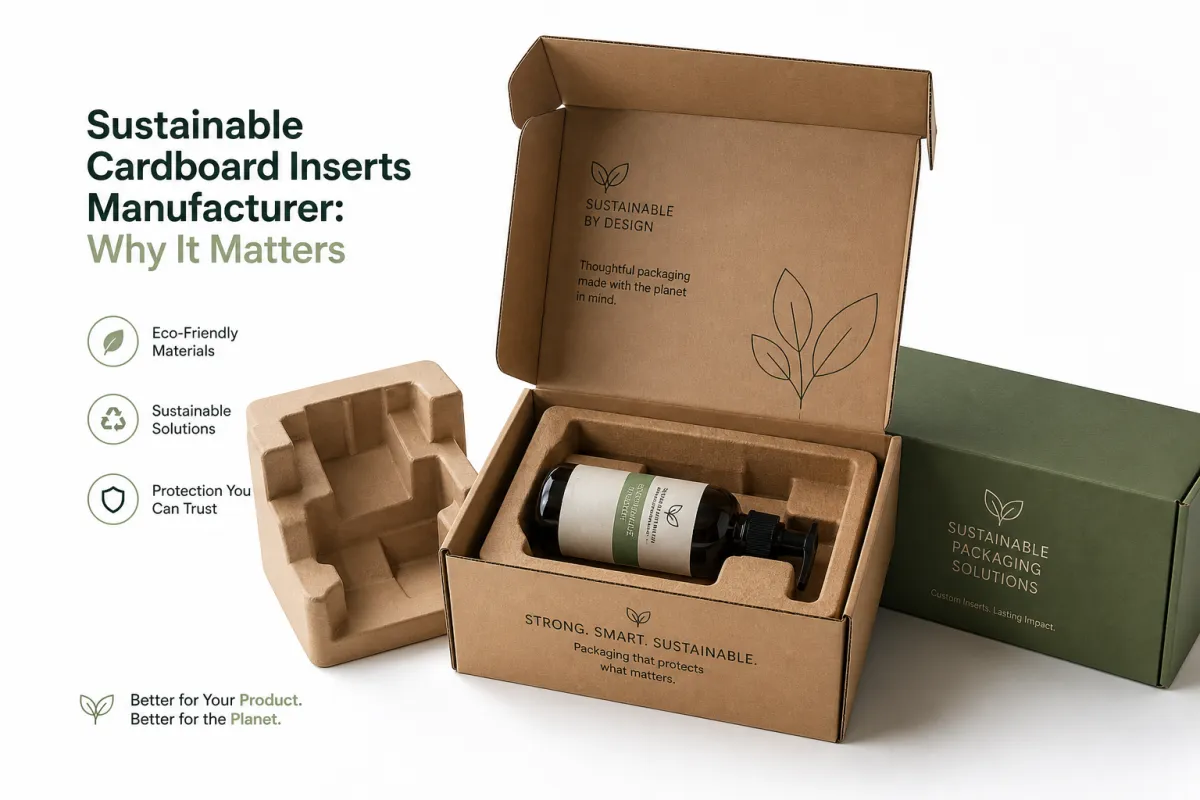
A sustainable cardboard inserts manufacturer sits at the point where protection meets waste reduction. Small job, big consequences. A weak insert can turn a good carton into a liability. A heavy-handed insert can protect well and still burn through material, budget, and disposal patience. The better approach is design-led: use only the fiber needed, put it where the load is highest, and keep recycling straightforward.
Here is the packaging truth brands keep relearning: the outer carton is rarely the first failure point. The product moves inside the box long before the box itself gives up. A sustainable cardboard inserts manufacturer looks at that movement. It checks whether the item can slide, rattle, tilt, or stack pressure onto a fragile edge. That matters for cosmetics, electronics, beverage gift sets, glass bottles, and subscription kits.
Inserts are not void-fill. They are not loose packing paper pretending to be a system. Void-fill fills empty space. Trays organize multiple items. Dividers separate loads. A sustainable cardboard inserts manufacturer builds custom structures such as die-cut cradles, folded corrugated inserts, paperboard partitions, and snug-fit trays that lock the product in place. That is a different job from stuffing paper around a package and hoping for the best. That approach works until it doesn't, which is usually right when the shipment is already on the truck.
The sustainability angle is not just recycled content. It also covers lower material mass, smarter nesting on the sheet, less trim waste, and fewer damaged units in transit. The right insert can cut material use, shipping waste, and claim costs at the same time. That is why a sustainable cardboard inserts manufacturer should be treated like a protection partner, not a print shop with a green label.
The best insert disappears into the shipping process. It holds the product still, survives transit, and does not turn into a recycling headache later.
If you want an outside benchmark for shipping performance, the ISTA test library is worth a look. A lot of insert specs are really about vibration, compression, and drop stress. The exact package test depends on product weight and route, but the idea stays the same: prove the design instead of admiring the sample.
For fiber sourcing, many teams also check FSC certification, recycled content declarations, and chain-of-custody records. A sustainable cardboard inserts manufacturer should explain those claims without hiding behind vague lines like "eco-friendly" or "green packaging." If the claim sounds fluffy, it probably is.
I have seen teams get tripped up by a polished sample that looked perfect under office lights and then failed after one rough week of parcel handling. That kind of miss is expensive. It is also avoidable if the supplier is willing to test, revise, and be honest about what the structure can and cannot do.
How a Sustainable Cardboard Inserts Manufacturer Works
A sustainable cardboard inserts manufacturer usually starts with the product, not the carton. That sounds obvious, yet plenty of projects begin with a box size and work backward from there. Better to be disciplined. Measure the product, accessories, closures, labels, and packing sequence first. Then build the insert around how the item actually gets packed.
The workflow usually runs like this: discovery call, dimensional review, CAD layout, sample build, revision, approval, then production. A reliable sustainable cardboard inserts manufacturer will want real measurements in multiple places, especially if the item has curves, chamfers, or fragile protrusions. One dimension is rarely enough. If a bottle neck sits 3 mm proud of the shoulder, that tiny detail can decide whether the insert rubs during transit.
Material selection comes next. Recycled corrugated board, paperboard, and responsibly sourced fiber grades are common choices. The right spec depends on load and fragility. A lightweight cosmetic set may work in 300-400 gsm paperboard or E-flute. A heavier electronics kit or bottle set may need 32 ECT or 200# test corrugate, or a thicker B-flute structure when vertical load is higher. A sustainable cardboard inserts manufacturer should choose based on performance, not habit. Board thickness is not a personality trait.
Fit is where the design earns its keep. If an item can move, it can damage itself or something else in the box. If the insert grips too tightly, pack-out slows and the product can scuff on insertion. The best sustainable cardboard inserts manufacturer balances retention, ease of pack-out, and material economy at the same time. That balance separates a practical solution from a sample that just looks clever.
Cosmetics make the point fast. A set with a glass serum bottle, a dropper, and a small jar may need a layered insert with finger cutouts and a shallow top restraint. If the bottle neck is unstable, the design may need a tighter ring support. If the jar cap can pop during vibration, the insert may need an internal stop. A sustainable cardboard inserts manufacturer tunes those details instead of defaulting to a thick block of board.
Sustainability shows up in specific ways. The CAD layout can nest parts efficiently, which reduces scrap on the sheet. The design can avoid overbuild, which lowers fiber use. Simpler structures can reduce assembly time at the pack line. A cleaner mono-material approach can make recycling easier for the end user. A good sustainable cardboard inserts manufacturer looks for all four wins, not just one.
Testing matters too. Depending on the product, the supplier may use compression checks, vibration simulations, drop tests, or hand-built transit trials. Many packaging teams think in terms of ASTM D4169 or similar distribution testing, and ISTA sequences help frame those discussions. The point is not to copy a lab procedure blindly. It is to confirm that the insert survives the stresses that matter for that product. If the route includes courier hubs and a lot of handling, the bar is different from a calm pallet move inside a local warehouse.
One common mistake is assuming a sample that fits by hand will behave the same way in distribution. It will not always. Vibration loosens weak geometry, and compression exposes poor stacking support. A sustainable cardboard inserts manufacturer should be willing to talk about that before the purchase order is issued. If they dodge the question, that is your cue to keep looking.
What Drives Cost and Pricing for Custom Inserts
A sustainable cardboard inserts manufacturer prices work around several variables at once: board grade, thickness, cut complexity, dimensions, print coverage, coatings, order volume, and any special assembly steps. Buyers often start with unit price. Fair enough. It also hides the real cost picture. A slightly higher-priced insert can reduce breakage, cut pack-out time, and lower freight waste. The cheapest quote is not always the cheapest outcome.
Setup matters most on low-volume runs. A prototype or short run may carry a higher unit cost because design time, die preparation, and sampling get spread across fewer pieces. A sustainable cardboard inserts manufacturer will usually quote those projects differently from production runs. As a rough guide, very small custom sample work might sit in the low hundreds for tooling and design effort, while unit pricing drops once the order reaches a few thousand pieces and the tooling is already in place.
Procurement teams often miss this part: total packaging cost includes damage claims, customer service time, returns processing, labor, and sometimes freight. If an insert saves 2% on material but increases breakage by 1%, the math goes bad quickly. A sustainable cardboard inserts manufacturer should help you compare the full cost stack, not just the per-unit quote. That full-stack view is what keeps a packaging decision from becoming a surprise six weeks later.
Material choice can move price in either direction. Recycled corrugate may be cost-effective, but if the spec has to get thicker to protect a brittle product, the savings vanish. A more efficient geometry can offset a pricier board grade. That is why a sustainable cardboard inserts manufacturer should be judged on design skill as much as board sourcing.
Clear line items make comparisons easier. Ask for material cost, tooling, print, assembly, packaging, and freight separately. That way you can see whether the supplier is competitive or just folding all the numbers into one opaque figure. A good sustainable cardboard inserts manufacturer will not dodge that request. If they act annoyed by basic transparency, that is not a good sign.
| Order Type | Typical Unit Cost | Setup / Tooling | Best Fit | Main Trade-Off |
|---|---|---|---|---|
| Prototype or sample run | $1.25-$4.50 | $150-$600 | Design validation, retail approval, fit testing | Higher per-unit cost, but faster learning |
| Small production run | $0.45-$1.20 | $250-$900 | Early launches, seasonal packs, limited editions | Setup still weighs heavily on price |
| Mid-volume production | $0.18-$0.60 | $300-$1,200 | Stable SKUs with repeat orders | Requires accurate forecasting |
| Complex printed insert set | $0.35-$0.95 | $500-$1,500 | Premium gifting, retail presentation, brand-heavy packaging | More print and finishing variables |
Those numbers are directional, not universal. Region, board market conditions, color count, coatings, and assembly method all matter. Still, they help screen quotes. If one sustainable cardboard inserts manufacturer comes in way below the rest, ask what got removed from the design. Usually it is strength, testing, or service.
Print and finishing deserve scrutiny too. Full-coverage ink, specialty coatings, foil, or lamination can raise cost and complicate recycling. For inserts, a simpler print spec usually makes more sense. A sustainable cardboard inserts manufacturer can often recommend a lighter build, like one-color branding or minimal inside-panel messaging, if the insert needs to stay recyclable and affordable. Nobody needs a hero graphic hidden inside a shipping tray.
There is a hidden labor cost as well. If the insert takes thirty extra seconds to pack, that adds up over thousands of units. If the design needs too many folds or too much hand insertion, labor becomes the real budget leak. A thoughtful sustainable cardboard inserts manufacturer will question those manual steps before they become a warehouse problem.
Compare suppliers on a simple framework: material use, protection performance, assembly time, setup cost, and recurrence. A sustainable cardboard inserts manufacturer that lowers total packaging cost is more useful than one that merely quotes the lowest line item. Cheap on paper is not the same thing as cheap in practice.
Process and Timeline From Brief to Production
A sustainable cardboard inserts manufacturer can move fast when the brief is clean. The opposite is true too. Missing dimensions, vague pack-out instructions, and late changes can stretch a simple project into a messy one. Good planning prevents most of that.
The first step is discovery. Share product dimensions, photos, weights, accessory counts, shipping method, and any retail display constraints. If the insert must work in both shipping and shelf presentation, say so early. A sustainable cardboard inserts manufacturer can design for dual use, but only if the requirement is visible from the start. Otherwise the supplier is guessing, and guessing is not a production strategy.
After the brief comes concepting and CAD. The supplier may sketch one or more geometries and identify the best board type for the load. A simple structure might take only a few hours to model. A multi-cavity or high-precision fit can take longer, especially if the product is asymmetric or has multiple fragile points. A sustainable cardboard inserts manufacturer often moves faster when it can review product samples instead of relying on drawings alone.
Sampling is where schedules usually slip. If the sample arrives and the product does not sit correctly, the team has to revise the design, recut the sample, and test again. That is normal. What slows projects down is revision after incomplete information. A responsive sustainable cardboard inserts manufacturer reduces that risk by flagging issues early and documenting changes clearly.
Lead times vary. A straightforward insert may move from brief to approved sample in about 5-10 business days, then into production in another 7-15 business days depending on volume and finishing. More complex structures, printed interiors, or high-volume tooling can push the schedule longer. A sustainable cardboard inserts manufacturer should give you a realistic range, not a polite fantasy.
The biggest delays are predictable:
- Product samples arrive late or incomplete.
- One critical measurement is missing, such as a shoulder diameter or accessory thickness.
- Stakeholders keep changing the pack-out sequence after the first sample.
- The team asks for a drop test only after approving a weak structure visually.
- Print files are not pre-checked, which creates avoidable pre-press delays.
For launch planning, work backward from the ship date. If the finished goods need a week of packing time, the insert needs 10 business days from approval, and the sample cycle may take another week, the calendar moves fast. A sustainable cardboard inserts manufacturer helps when it plans around those realities instead of pretending they do not exist.
Build in at least one revision window. A package that looks perfect on paper may behave differently once a real product, a real closure, and a real warehouse crew get involved. A sustainable cardboard inserts manufacturer that expects that usually saves time later, even if the first sample takes a little more back-and-forth.
Clear communication matters just as much. Annotated photos, specific comments, and concise approvals keep the process moving. When the supplier knows exactly what changed between sample one and sample two, the project moves faster. A sustainable cardboard inserts manufacturer should be able to work from that level of clarity without making you translate the same instruction three times.
One practical tip from the field: keep one person on your side accountable for sign-off. Too many cooks turn a clean prototype into a slow-motion committee exercise. I have watched a two-day approval drag into two weeks because five people wanted to "just check one more thing." That kind of delay is not a design problem. It is a process problem.
Key Factors to Evaluate in a Sustainable Cardboard Inserts Manufacturer
A sustainable cardboard inserts manufacturer should be judged on proof, not presentation. Nice sales language is easy. Documented sourcing, measurable quality control, and repeatable production take real work. Experienced buyers look for recycled content disclosures, FSC chain-of-custody where relevant, and a clear explanation of how scrap is handled in production.
Ask for evidence. A supplier should be able to explain what board grades they use, whether they source from certified mills, and how they verify incoming materials. If the insert is sold as sustainable, ask how that claim is measured. A credible sustainable cardboard inserts manufacturer will not dodge the paperwork or hide the limits of the claim. If the answer is hand-wavy, the claim is probably doing more marketing work than packaging work.
Testing matters more than polished pitch decks. For fragile items, structural performance should be documented with fit checks, compression testing, vibration analysis, or transit simulation. If a supplier says the insert is "good enough" without showing how it was tested, that is a warning sign. A sustainable cardboard inserts manufacturer worth trusting can explain the test method and the failure criteria in plain language.
Local manufacturing strength matters too. Nearshoring can shorten transit time, reduce communication lag, and make sampling faster. It does not guarantee better quality, but it often improves responsiveness. For brands balancing launch dates and inventory risk, a sustainable cardboard inserts manufacturer with a fast sampling loop can be more useful than one that saves a few cents and adds a two-week delay.
Minimum order flexibility matters as well. Some suppliers only make sense at scale. Others are comfortable with lower-volume launches or seasonal test runs. A sustainable cardboard inserts manufacturer that supports both trial orders and repeat production gives you more room to learn before committing large budgets.
Here is a practical red-flag checklist:
- Vague claims like "eco-friendly" without recycled content or certification details.
- No sample process, or samples that are only visual and never tested.
- One-size-fits-all insert recommendations that ignore product shape.
- Poor response time on drawings, revisions, or basic technical questions.
- No discussion of assembly labor, transit risk, or end-of-life disposal.
It also helps to compare how suppliers solve problems. Some optimize for the lowest material mass. Others prioritize crush resistance. The best sustainable cardboard inserts manufacturer will understand both and explain the trade-offs clearly. That balance is what makes the packaging usable in the real world, not just tidy on approval day.
One question I always think buyers should ask is this: does the supplier design for the product, or does the product get shoved into a generic insert family? The answer says a lot. A strong sustainable cardboard inserts manufacturer starts with the item's weak points, not with a stock template that merely happens to fit the carton.
Also look for the ability to speak about compliance and standards without overclaiming. Not every package needs the same test burden. Not every product needs the same board grade. But a serious sustainable cardboard inserts manufacturer should know the difference between visual fit, transport readiness, and validated performance. That is the line between packaging knowledge and packaging theater.
Common Mistakes When Buying Cardboard Inserts
The first mistake is designing around the outer box alone. Classic trap. A carton can be perfectly sized and still fail if the insert lets the product move. A sustainable cardboard inserts manufacturer will push buyers to measure the product, the accessories, and the packing sequence before finalizing the box.
The second mistake is chasing the cheapest unit price. Low-cost inserts can get expensive very quickly if they increase breakage, slow pack-out, or lead to returns. A sustainable cardboard inserts manufacturer that saves two cents on board but causes one damaged shipment out of fifty is not saving money. The math does not stay friendly for long.
Overengineering is the opposite problem. Too much board, too many cavities, or a rigid build spec can raise material use without adding real protection. Buyers sometimes think thicker automatically means better. It does not. A skilled sustainable cardboard inserts manufacturer will often cut fiber use by changing geometry instead of adding bulk. That is the smarter move, and usually the cheaper one too.
Skipping transit testing is another common error. A hand-fit sample may look perfect, but vibration and repeated handling can expose flaws that a desk check will never show. If the product is delicate or high value, a sustainable cardboard inserts manufacturer should encourage some form of distribution testing before the design is locked.
Teams also forget the warehouse crew. If an insert needs awkward folding, too many loose pieces, or extra taping, the line loses time every shift. Sustainable packaging still has to be practical. A sustainable cardboard inserts manufacturer that understands labor flow can usually simplify the pack-out without hurting protection.
Another mistake is treating sustainability as a label instead of a design constraint. Recycled content is useful. So is lower fiber use. So is easy recycling at end of life. But if the package is a pain to assemble or fails in transit, nobody wins. The better sustainable cardboard inserts manufacturer keeps those trade-offs in view from the start, not after the design is already printed.
The pattern is pretty clear: the best design is not the thickest, flashiest, or most expensive. It is the one that protects the product with the least material and the least friction. That is exactly where a sustainable cardboard inserts manufacturer adds value, because it brings structure, testing, and production discipline to a problem that can drift into guesswork fast.
Expert Tips and Next Steps
Start with a vulnerability map. Which part scratches first? Which edge crushes? Which accessory rattles? Which component causes frustration during unboxing? A sustainable cardboard inserts manufacturer can use that map to place support only where it matters, instead of wrapping the entire product in extra fiber.
Ask for two versions of the design: one that prioritizes lower cost and one that prioritizes higher performance. Seeing them side by side makes the trade-offs obvious. A sustainable cardboard inserts manufacturer should be able to show how board grade, score lines, and geometry affect both the quote and the transit result.
Request samples before you commit to a large run, and ask for a cost breakdown that separates material, setup, print, and freight. That gives you a clearer picture than a single lump-sum quote. A sustainable cardboard inserts manufacturer that welcomes that request is usually more transparent in day-to-day production too.
If the product is valuable, fragile, or tied to a retail launch window, test the design against real handling conditions. That can mean a basic drop sequence, a vibration simulation, or a small pilot shipment. A sustainable cardboard inserts manufacturer does not need to overcomplicate the test plan; it just needs to make sure the insert performs on the route your product will actually travel.
Before choosing a partner, score each supplier on four simple dimensions:
- Sustainability proof - recycled content, sourcing transparency, and end-of-life clarity.
- Protection - fit, compression resistance, and transit performance.
- Price - unit cost plus setup, labor, and damage risk.
- Lead time - sample speed, revision speed, and production reliability.
That process is not glamorous, but it works. It gives packaging buyers a cleaner way to compare options and keeps decisions from being driven by whichever quote landed first. A sustainable cardboard inserts manufacturer should earn the job by showing the best total value, not by shouting the loudest in the inbox.
My advice is to narrow the field to three suppliers, send each the same brief, and compare the proposed build, pricing structure, and proof of performance. Then choose the one that balances sustainability, protection, and production discipline most convincingly. For brands that want packaging decisions to support the product instead of complicating it, a sustainable cardboard inserts manufacturer is not a side vendor; it is part of the launch plan.
If you want a clearer view of how the packaging program fits together, start with the outer shipper, then the insert, then the sourcing story. That order keeps the system coherent. And if you are ready to move from theory to sourcing, the right sustainable cardboard inserts manufacturer can help you build a package that protects the product, respects the recycling stream, and keeps total cost in check.
The practical takeaway is simple: specify the product first, test the insert under real shipping stress, and compare suppliers on proof instead of polish. Do that, and the packaging stops being a gamble.
What does a sustainable cardboard inserts manufacturer do differently?
A sustainable cardboard inserts manufacturer uses board grades and geometry that reduce waste while still protecting the product. It typically tests fit, compression, and transit performance instead of relying on generic templates. It also tends to provide clearer guidance on recycled content, sourcing transparency, and end-of-life disposal.
How much do custom sustainable cardboard inserts usually cost?
Pricing depends on board grade, size, cut complexity, print coverage, and order quantity. Prototype or low-volume work usually costs more per unit because setup and sampling are spread across fewer pieces. A sustainable cardboard inserts manufacturer is often the best value when it helps reduce damage, labor, and freight costs, not just the per-unit quote.
Which cardboard materials are best for eco-friendly inserts?
Common options include recycled corrugate, paperboard, and responsibly sourced fiber grades. The right choice depends on product weight, fragility, moisture exposure, and how the insert will be assembled. A sustainable cardboard inserts manufacturer should match material strength to the actual shipping environment instead of overspecifying by default.
How long does the design and sampling process take?
Simple inserts may move from brief to sample quickly, while more complex structures need revision time. Delays usually come from missing dimensions, unclear pack-out details, or extra test rounds. A responsive sustainable cardboard inserts manufacturer can often shorten the schedule by reviewing design and prototyping early.
How do I verify a supplier is truly sustainable?
Ask for sourcing details, certifications, recycled content information, and scrap-reduction practices. Look for specific evidence instead of vague claims like "eco-friendly" without documentation. A sustainable cardboard inserts manufacturer should be able to explain how the design minimizes material use, supports recycling, and reduces transport waste.