If you ship glass candles, the packaging question is rarely just packaging. It is product integrity, freight cost, customer perception, and whether the refund queue stays quiet. That is why the search for Branded Padded Mailers for Candle brands sustainable material options is really a search for a mailer that can survive transit without looking disposable in every sense of the word.
A candle box or mailer is the first physical handshake with the buyer. They open it, judge the finish, smell the wax, and decide whether the brand feels careful or careless. A cracked jar can undo a strong fragrance story in one afternoon. A crushed corner or smeared label can do almost as much damage, even if the candle itself survives.
Bubble wrap can cushion a jar. It can also look improvised. For candle brands that sell repeat purchases, gifts, or subscription shipments, the outer pack needs to do more than absorb shock. It has to hold the product in place, present cleanly, and support the sustainability story without pretending that every material is equally good at every job.
Why Candle Shipping Needs Better Mailers Than Bubble Wrap
Bubble wrap solves one problem and creates two others: it adds bulk, and it rarely delivers the kind of presentation premium candle buyers expect. That matters because candles sit in a category where the outer package often gets judged before the product is even lit. If the shipment arrives in a wrinkled plastic cocoon, the customer reads that as a sign of low care, even when the candle inside is excellent.
Glass jars are vulnerable in predictable ways. The lid takes a hit, the base shifts, the sidewall rubs, and the package fails under pressure from stacked freight. A 10 oz jar may tolerate a short drop if the fit is tight and the closure holds. Give it too much empty space, and the same jar can crack from a minor impact. Packaging failures are usually boring, which is another way of saying preventable.
A padded mailer works best when the structure, seal, and interior clearance are designed together. The mailer needs enough stiffness to resist collapse, enough internal cushion to reduce vibration, and a closure that will not peel when the parcel gets shoved through a sorter or dropped on a porch. For heavier jars or bundles, a mailer may not be enough on its own. At that point, a rigid insert or a lightweight corrugated shipper can be the safer decision, even if it is less elegant on the shelf.
The economic piece is easy to miss. A damaged candle does not cost only the unit value. It also costs freight, handling, replacement packaging, customer service time, and sometimes the sale itself. Once a brand starts tracking the full landed cost of damage, the price gap between a flimsy packout and a better one looks smaller than it did on the quote sheet.
There is also a brand-memory effect that people underestimate. Customers remember opening a clean, sturdy package that felt intentional. They also remember cutting their hand on a jagged seam or finding shattered glass inside a beautiful exterior. The outer mailer does not have to be luxurious, but it does need to feel deliberate.
How Sustainable Mailer Construction Protects Glass Candles
Good sustainable packaging is not a label slapped onto a weak structure. It is a set of material choices that work together: face stock, cushioning layer, seal integrity, and a fit that keeps the jar from drifting inside the mailer. When those pieces line up, the package can be both easier to dispose of and better at protecting fragile goods.
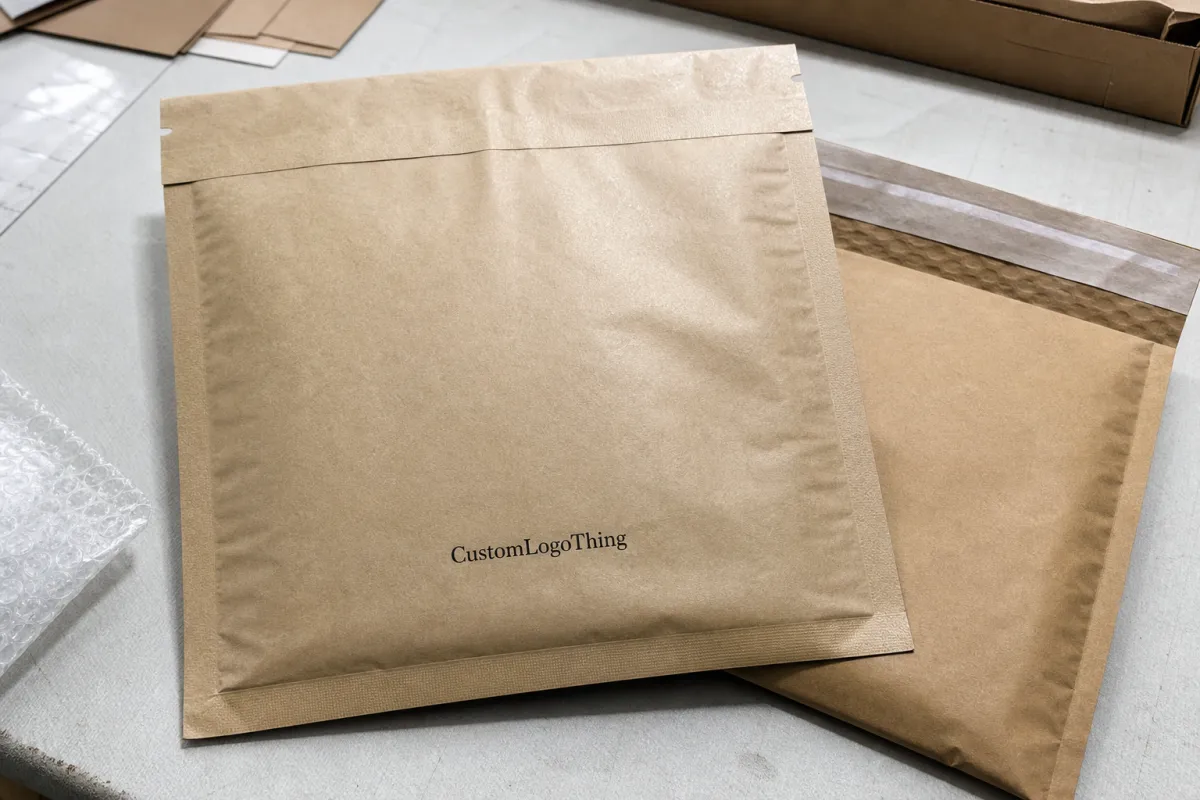
Paper-forward constructions are usually the starting point for candle brands. Kraft-faced mailers have a cleaner look than glossy plastic alternatives, and recycled fiber builds can offer enough stiffness for standard single-jar shipments. Some versions use paper cushioning or molded fiber components instead of mixed-material foams. The appeal is not only environmental. Paper surfaces tend to photograph well, print well, and fit the visual language of premium home fragrance brands.
The tradeoff is real. Paper structures can soften in humidity, lose stiffness if they are too thin, or fail if the jar is heavy and the fit is loose. A sustainable mailer that tears at the seam is not a responsible choice. It becomes waste faster than the less glamorous option that actually survives transit. That is why the material spec matters more than the marketing description.
Where these constructions tend to work best: single candle orders, small gift sets, influencer seeding, and subscription shipments with consistent dimensions. Where they are riskier: oversized vessels, multi-item bundles, or jars with metal lids and accessories that create uneven pressure points. Candle brands should assume that every extra item inside the shipper changes the impact profile.
A mailer that looks eco-friendly but splits in transit is not sustainable. It is just future waste with better typography.
Practical buyers usually ask for the paper grade, recycled content, closure type, and whether the finish will tolerate the same sort of handling that a fulfillment center actually delivers. That is the right instinct. A recycled outer layer with poor seam strength can generate more waste than a slightly heavier build that holds up across the entire route.
Branded Padded Mailers for Candle Brands: Sustainable Material Options
Here is the useful version: Branded Padded Mailers for candle brands sustainable material options usually fall into a few practical categories, and each one answers a different shipping problem. The right choice depends on jar weight, print expectations, disposal goals, and how rough the transit lane is. A mailer that works for a 6 oz soy candle may be a poor fit for a heavier 16 oz vessel.
| Option | Best For | Typical Unit Price at 5,000 pcs | Strengths | Tradeoffs |
|---|---|---|---|---|
| Kraft-faced padded mailer | Single-jar candles, standard DTC orders | $0.18-$0.30 | Natural look, good stiffness, strong print contrast on kraft | Can lose rigidity in humidity; not ideal for heavier jars |
| Recycled-content mailer | Brands balancing cost and durability | $0.22-$0.36 | Better structural strength, clear recycled-material story | Surface texture can affect fine print and color consistency |
| Plastic-free cushioning mailer | Eco-focused launches, premium unboxing | $0.28-$0.48 | Paper-forward construction, easier disposal story, good shelf appeal | Higher cost and tighter sizing tolerance |
| FSC certified custom mailer | Retail programs and larger branded runs | $0.30-$0.55 | Credible sourcing, stronger brand alignment, better control over fit and finish | Higher setup cost and longer lead time |
Paper-based options are not identical, and that is where many sourcing conversations go wrong. Kraft is not automatically recycled. Recycled content is not automatically strong enough. FSC certification tells you the paper sourcing was audited, but it does not tell you whether the structure is suited to a heavy candle jar. Those details matter more than the broad label.
If a brand wants a lower-impact story, the right question is not “Which option sounds greenest?” It is “Which material protects the candle, matches our print needs, and keeps the shipment from being overbuilt?” That may lead to a paper-forward mailer with a clean logo mark. It may also lead to a slightly heavier recycled build that costs more per unit but reduces breakage enough to pay for itself.
For buyers comparing suppliers, ask for the paper basis weight, recycled content percentage, adhesive type, closure strength, and whether the finish is suitable for the carrier network you actually use. If you need a broader packaging system, it is worth checking how the mailer works alongside your inserts, labels, and other Custom Packaging Products so the brand feels consistent from shipper to shelf.
One more practical point: a branded surface does not need heavy ink coverage to feel premium. In many candle programs, a restrained print layout on a stronger base beats a full-bleed design on a thin one. Buyers notice quality before they count colors.
Cost, MOQ, and Unit Pricing for Custom Candle Mailers
Pricing depends on more than size. Material choice, print coverage, closure style, cushioning type, and custom dimensions all move the number. A slim mailer for a lightweight jar may quote in a very different range than a wider piece built for a gift set or a large vessel. That is normal. The problem is that many brands compare quotes without comparing the actual specs behind them.
For standard custom runs, a realistic MOQ is often 1,000 to 3,000 pieces. Fully custom sizes, specialty finishes, or more complex structures often push the minimum toward 3,000 to 5,000 pieces. Smaller orders are possible, but unit pricing rises quickly because setup, plate work, dieline prep, and production overhead get spread across fewer pieces. Setup fees may be modest on some programs and more noticeable on others; a few hundred dollars is common enough that it should be expected, not treated as a surprise.
At higher volumes, the gap between stock and custom packaging narrows. That is why many candle brands start with printed stock mailers, learn from the damage data, then move to a more tailored build once they know the packout is stable. It is a rational sequence. It also prevents the common mistake of overinvesting in a full custom structure before the jar size, filler, or fulfillment flow is settled.
When comparing options, budget for landed cost, not just factory price. Freight, duties, warehousing, and breakage matter. A mailer that saves eight cents on paper but increases damage enough to create one extra replacement shipment in fifty can be the more expensive choice. Procurement math gets less romantic the moment returns start climbing.
For candle brands, there are usually three buying paths. Stock mailers are the cheapest and fastest. Printed stock gives you branding with lower setup risk. Fully custom mailers offer the best fit and the most control over the final experience, but they require more time and more committed volume. The right answer depends on order pattern, not aspiration.
Production Process and Lead Time: From Dieline to Delivery
Custom mailers move through a familiar sequence: dimensions, dieline, artwork, sample, approval, production, packing, freight. The process is simple on paper. In practice, delays usually come from changes made after the proof is already circulating, or from a candle vessel that changed after the packaging brief was written.
A realistic timeline, assuming artwork is ready and the spec is clear:
- Prototype or sample: usually 5-10 business days for a straightforward build.
- Standard production: often 12-20 business days after proof approval.
- More complex runs: 20-30 business days if you add special finishes, unusual sizing, or nonstandard cushioning.
- Freight and receiving: add transit time, customs clearance if applicable, and warehouse intake.
The slowest part is often not the press run. It is the round-trip of proofing. Artwork that ignores the print boundary, a closure that interferes with the seal, or an insert that was never measured against the actual vessel can add days or weeks. A supplier can only print what has been approved, and a production line cannot guess its way around a bad dieline.
If the shipment supports a seasonal launch, influencer kit, or holiday bundle, build slack into the schedule. Rush production exists, but it usually trades time for cost. Special recycled materials and custom finishes can extend lead times, especially if the run needs a sample revision before production begins. Speed is useful only if the spec still protects the candle.
Step-by-Step: Spec the Right Mailer for Your Candle Line
Start with measurements, not assumptions. The jar height, diameter, lid width, and packed weight should all be on the brief. If the candle includes a dust cover, insert card, or fragrance sample, include that too. A supplier cannot build a stable fit from marketing language.
- Measure the product. Provide exact dimensions and the packed weight of the candle as it ships.
- Define the use case. A single jar, two-piece gift set, seasonal bundle, and subscription order each need a different level of protection.
- Choose the structure. Lightweight jars can often use a paper-forward mailer; heavier glass may need a stronger wall or internal insert.
- Set the brand finish. Decide whether the packaging should feel natural, premium, minimal, or retail-ready.
- Request two builds. Ask for one safer spec and one lower-cost alternative so you can compare protection against spend.
Channel matters. A direct-to-consumer candle needs to feel polished because the customer sees every seam up close. A retail program needs shelf durability plus ship-to-home resilience. A sampling run is different again: weight may matter more than finish, and the packing method may favor speed over show. The right mailer for a launch kit is not always the right mailer for a replenishment order.
When requesting a quote, send the quantity, destination, deadline, print colors, and any special requirements such as recycled content, FSC sourcing, or specific closure type. Include photos of the candle if the vessel shape is unusual. A curved jar, tapered shoulder, or heavy lid can change the packout more than most buyers expect. Suppliers can only spec accurately when they can see the geometry they are being asked to protect.
It also helps to compare the mailer against your other packaging formats. Some products ship better in a corrugated box with a paper insert. Some can move into a mailer once the fit is right. There is no prize for forcing every candle into the same format. The better outcome is fewer damages and a packout that still feels like your brand.
Common Mistakes That Raise Damage Rates and Waste
The most common mistake is specing from outside dimensions alone. The outside may look right on paper, but the usable cavity is what determines movement, and movement is what cracks glass. If the jar can shift inside the mailer, the package is already at a disadvantage.
The second mistake is choosing the cheapest seal and thinnest cushioning to win a quote. That rarely stays cheap. Weak seals can pop during sorting, and thin walls can collapse under stacked freight or pressure from adjacent parcels. The returns team pays for the savings later. That is not efficiency; it is postponed expense.
The third mistake is mistaking green language for performance. Recycled content, kraft paper, and FSC certification are all useful indicators, but they do not replace testing. A sustainable mailer that fails on the first real drop is not a responsible build. It becomes waste with a better backstory.
Testing does not need to be elaborate to be useful. Many brands borrow from ISTA-style logic or other distribution checks because repeatable tests are more useful than opinions. A few controlled drops, a corner impact, and a short route through the actual carrier network can reveal more than a polished sample sitting on a desk.
Heavy ink coverage is another hidden problem. Deep print coverage can change how some paper structures flex, especially if the base stock is already thin. For a candle brand, a cleaner design on a better build often looks more expensive than a crowded design on a weak one. Customers read confidence in the material before they read the copy.
Finally, do not forget humidity and storage. Paper mailers stored in damp environments can lose stiffness before they ever ship. If your fulfillment center runs warm, humid, or seasonal stock sits too long, that should influence the material choice. A material spec that works in a dry sample room may behave differently after three weeks in a warehouse.
Expert Tips and Next Steps Before You Request a Quote
Before reordering, look at the actual evidence: breakage rates, customer complaints, replacement shipments, and any recurring damage on the same jar size or route. Patterns matter. If the same candle keeps arriving cracked in one lane and not another, the issue is likely in the packout or the handling profile, not random bad luck.
Then ask suppliers for two versions of the same concept:
- Safer build: tighter fit, stronger cushioning, and a structure that tolerates rough handling.
- Lower-cost build: leaner materials, but still enough protection to avoid obvious transit damage.
That comparison usually tells the real story. Sometimes the more expensive option is actually cheaper once breakage is included. Sometimes the simpler option wins because the candle jar is lighter than expected and the route is gentle. Good sourcing is less about choosing the most premium-looking answer and more about matching the material to the actual shipping risk.
Before committing to a volume run, ship a small test batch through the same carrier and fulfillment path your customers use. Use the real candle, the real closure, and the actual insert or filler. A sample that survives a desk test but fails after sorting, stacking, and temperature swings is not a passing sample. It is a warning.
If you are narrowing down the format, compare the mailer against your broader packaging stack. Sometimes a paper mailer is ideal. Sometimes a rigid box or mixed paper structure is the safer play. The right choice protects the candle, stays aligned with the brand, and keeps freight from swallowing margin. That balance is the practical heart of sustainable packaging, not a slogan.
What sustainable material options work best for branded padded mailers for candle brands?
Kraft-faced mailers are a strong starting point for standard candle shipments because they balance presentation and stiffness. Recycled-content mailers are useful when durability and sourcing transparency both matter. Plastic-free cushioning systems are worth considering if you want a paper-forward structure and simpler disposal for the customer.
Are kraft padded mailers strong enough for glass candle jars?
They can be, but only if the fit is tight and the jar weight is within the structure's capacity. If the candle slides, rattles, or presses against the seam, the risk rises quickly. The safest approach is to test with your actual jar size and your actual carrier lane before committing to volume.
How much do custom padded mailers usually cost for candle brands?
Pricing changes with size, print coverage, material choice, and order volume. For many runs, stock-based or lightly printed options sit near the low end of the range, while fully custom builds with better materials land higher. Setup fees can also apply, so compare landed cost rather than unit price alone.
What lead time should I plan for branded padded mailers?
Simple samples may take roughly a week, and standard production often falls into a few weeks once proofs are approved. More complex structures, special finishes, or size revisions can stretch that timeline. If the mailers support a launch date, build in extra time for proofing and freight.
What should I send to get an accurate quote for candle mailers?
Send exact jar dimensions, packed weight, order quantity, material preference, print details, and the destination. Include whether the shipper needs inserts, special coatings, or a specific sustainability requirement such as recycled content or FSC sourcing. Photos of the jar help if the vessel shape is unusual.