Buyer Fit Snapshot
| Best fit | Sustainable Carton Sleeves Manufacturer projects where brand print, material claims, artwork control, MOQ, and repeat-order consistency need to be specified before quoting. |
|---|---|
| Quote inputs | Share finished size, material target, print colors, finish, packing count, annual reorder estimate, ship-to region, and any compliance wording. |
| Proofing check | Approve dieline scale, logo placement, barcode or warning zones, color tolerance, closure strength, and carton packing before bulk production. |
| Main risk | Vague material claims, crowded artwork, missing packing details, or unclear freight terms can make a low unit price expensive after revisions. |
Fast answer: Sustainable Carton Sleeves Manufacturer: Board, Finish, Dieline, and Unit Cost should be specified like a repeatable production item. The safest quote records material, print method, finish, artwork proof, packing count, and reorder notes in one written spec.
Production checks before approval
Compare the actual filled-product size with the drawing, then confirm tolerance on folds, seals, hang holes, label areas, and retail display edges. Reserve space for logos, QR codes, warning copy, and material claims before decorative graphics fill the panel.
Quote comparison points
Review material grade, print process, finish, sampling route, tooling charges, carton quantity, and freight assumptions side by side. A quote is only useful when the supplier can repeat the same color, closure quality, and packing count on the next order.
A sustainable carton sleeves manufacturer has a very practical job: help a brand improve shelf presence, keep product information readable, and choose a better material path without forcing a full carton redesign. For a lot of teams, that sleeve becomes the middle ground that actually makes sense, because it can wrap an existing tray, slip around a folding carton, or act as a branded overwrap that uses less board than a fully enclosed box. A capable sustainable carton sleeves manufacturer can usually do all of that while keeping the structure simple enough for production, packing, and retail handling.
That simplicity matters more than people expect. A sleeve may look modest on a render, yet it still has to score cleanly, print sharply, fit the product with the right amount of friction, and survive transport without curling, crushing, or scuffing. A sustainable carton sleeves manufacturer is doing two jobs at once: Choosing the Right paperboard system and making sure the structure behaves well on the line, in the warehouse, and on the shelf. Those details are what separate a tidy concept from packaging that actually holds up.
A sleeve only earns the word sustainable when the board, inks, coating, and scrap rate all support that claim.
If your team is comparing packaging partners, the About Custom Logo Things page is a helpful place to understand how the brand approaches custom packaging work. If you need sustainability claims tied to real material choices, a thoughtful sustainable carton sleeves manufacturer should be ready to talk through the board grade, print method, coating, and converting waste instead of leaning on broad eco language.
What a Sustainable Carton Sleeves Manufacturer Does
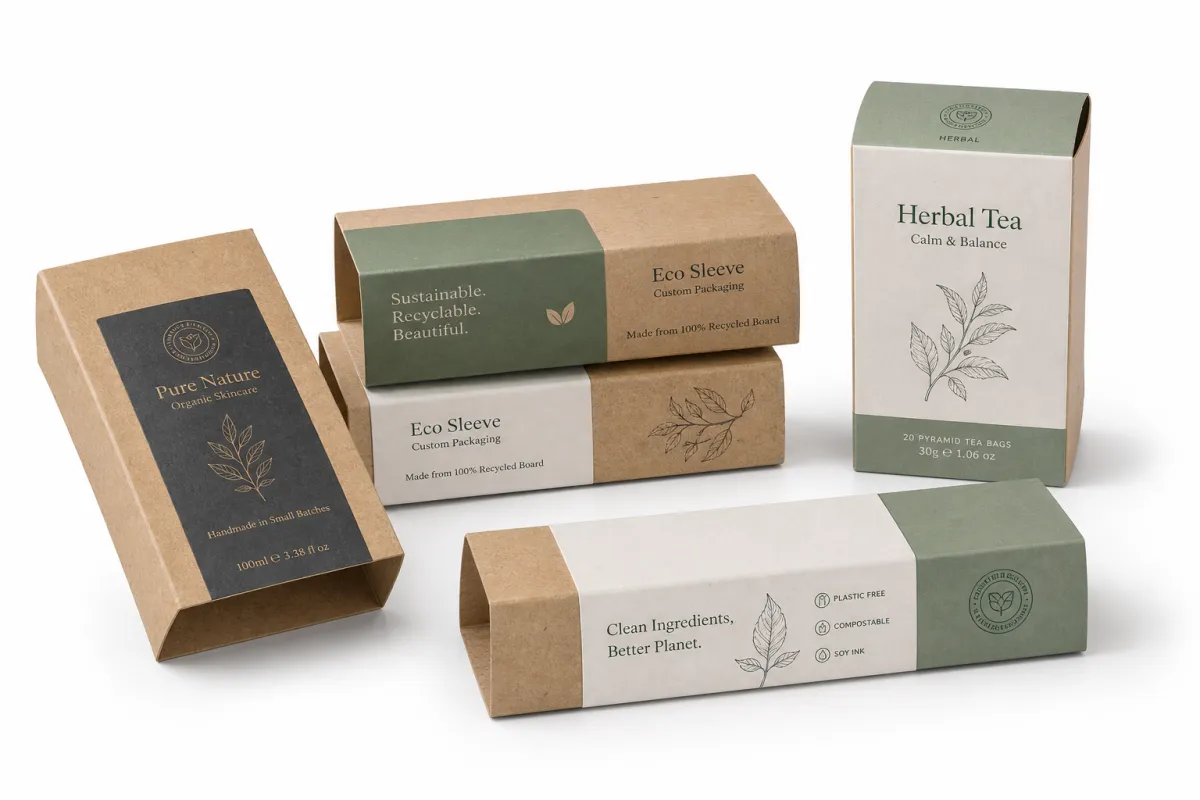
A sustainable carton sleeves manufacturer solves a familiar packaging problem: you want stronger shelf presence and better information density, but you do not want to overbuild the package. A carton sleeve can add branding, legal copy, promotions, barcodes, tamper cues, and product differentiation while still using a lean paper-based format. For many food, cosmetic, supplement, and retail multipack programs, that is enough packaging function without turning the system into a heavy carton with extra layers and unnecessary board.
Carton sleeves are usually open-ended paperboard or kraft-board wraps that rely on folds, fit, and sometimes small locking details rather than a fully enclosed box. That geometry is part of the appeal. A sustainable carton sleeves manufacturer can adapt a sleeve to a tray, a tub, a bottle cluster, a folding carton, or a hand-applied retail wrap, and the sleeve can often be sized so it uses only the board needed for structure and print coverage. Less waste is not automatic, yet the format gives you a cleaner starting point than a more complex build.
Real sustainability starts with specifics. A good sustainable carton sleeves manufacturer should be able to explain the board grade, recycled content, sourcing certification, ink system, coating choice, and how the layout reduces converting waste. If the only answer is “eco-friendly paper,” that is too vague to be useful. A buyer should know whether the board is SBS, kraft, or recycled-content paperboard, whether the inks are water-based or low-migration for food applications, and whether the finish is a light aqueous coating, an uncoated surface, or something more decorative.
That level of detail matters because sleeves sit at the meeting point of brand and operations. On shelf, the sleeve has to look intentional, hold color well, and communicate clearly. On the line, it has to fold, glue, or lock in a way that matches your pack-out flow. In the warehouse, it has to tolerate stacking, humidity, and handling. A sustainable carton sleeves manufacturer that understands all three settings will usually save you time later, because the package is built around how paperboard behaves in the real world rather than how it looks in a rendering.
There is also a compliance side to the work. If the sleeve is carrying recycled-content claims, FSC language, or product claims that need to remain legible after die-cutting, the manufacturer should review those points before approval. A responsible sustainable carton sleeves manufacturer does not just print artwork; it helps keep the claims supportable, the die line readable, and the final sleeve consistent from one run to the next. That is the difference between a supplier and a packaging partner.
- Branding: stronger shelf impact without redesigning the whole carton system.
- Material choice: board, coating, and ink systems selected for performance and recovery.
- Production fit: score depth, grain direction, and sleeve tolerances matched to the line.
- Claim support: sustainable carton sleeves manufacturer documentation that backs up FSC or recycled-content language.
How Sustainable Carton Sleeves Are Made
The process usually begins with measurements, because paperboard is unforgiving if the dieline is even slightly off. A sustainable carton sleeves manufacturer will ask for product length, width, depth, and any critical clearances around the closure area, then use that information to choose the board caliper, score depth, and grain direction. That is not a cosmetic choice. If the grain runs the wrong way, the sleeve can crack at the folds or bow after converting, especially on thicker stock. I have seen a quarter-inch mistake turn into a very expensive reprint, and it is not a fun conversation for anyone involved.
From there, the manufacturer reviews the graphics and decides how the print will run. Offset printing is common for premium color control and crisp imagery, flexographic printing can work well for simpler production runs, and digital printing is useful for short runs, product testing, or variable artwork. A sustainable carton sleeves manufacturer thinks beyond color alone and looks at how much waste the press setup will create, how much wash-up is required, and whether the chosen process supports the sustainability story without adding unnecessary complexity.
After printing, the board moves through die-cutting, scoring, stripping, and, if needed, gluing or locking operations. The sheet layout matters here more than many buyers realize. Good nesting can improve yield, reduce trim waste, and keep the number of unusable offcuts down. That does not magically make a package sustainable by itself, but it does mean the sustainable carton sleeves manufacturer is paying attention to how many square inches of board actually become sellable product.
Quality checks happen at multiple points. A competent sustainable carton sleeves manufacturer will inspect registration, fold accuracy, color consistency, barcode readability, and the cut quality at corners and open ends. If the sleeve is meant to run on a filling line, the team should also confirm how it opens, how much friction it has against the product, and whether the final pack can be assembled without extra hand labor. A sleeve that jams during pack-out can create waste very quickly, no matter how clean the paper choice looked in the quote.
For regulated or export-oriented programs, material traceability can matter as much as appearance. Many buyers ask for chain-of-custody records or certification support, especially when FSC language is part of the packaging brief. The FSC site at fsc.org is useful for understanding sourcing and certification basics, while the transit-testing guidance from ISTA helps teams think about how sleeves hold up in shipping and handling. A practical sustainable carton sleeves manufacturer can speak to both paper sourcing and distribution performance without mixing the two up.
One detail that is easy to miss: the finishing choice can influence both appearance and recycling behavior. A light aqueous coating can improve rub resistance and help a sleeve survive handling, while heavy film effects, foil-heavy graphics, or complex lamination layers can make recovery more complicated depending on local recycling systems. A sustainable carton sleeves manufacturer should explain that tradeoff plainly, because finish is not just a visual decision; it is part of the material story.
Choosing the Right Sustainable Carton Sleeves Manufacturer
The first thing I would look at is board selection. A sustainable carton sleeves manufacturer should be comfortable discussing SBS, kraft, recycled-content board, and other paper grades in terms of stiffness, printability, and moisture tolerance. Sustainable does not automatically mean rough, gray, or uncoated. Sometimes a clean white board with responsible sourcing is the better choice; sometimes a kraft face with simpler print achieves the brand look more honestly. The right answer depends on the product, the shelf, and the buyer expectations around touch, color, and durability.
Printing and finishing choices are just as important. A matte aqueous coating, an uncoated recycled surface, or a soft-touch finish can all change the feel of the package, but they also change scuff resistance, color pop, and end-of-life recovery. A reliable sustainable carton sleeves manufacturer should be able to explain where a finish helps the package and where it adds cost or complicates recycling claims. That conversation should feel technical, not vague. Ask how the coating behaves under abrasion, how it affects ink density, and whether the final package is still aligned with your sustainability brief.
Claims support is another place where a manufacturer proves its value. If the carton sleeve will carry recycled-content language, FSC marks, or a recyclability statement, the supplier should know what is documentable and what is not. The packaging may be perfectly sensible from a material standpoint, but unsupported wording can still create compliance risk. A good sustainable carton sleeves manufacturer will ask for the claim language early, check certification status, and help avoid phrases that cannot be backed up on the final artwork.
Capability matters too. Minimum order quantities, proof turnaround, conversion equipment, quality control, and repeat-order consistency all affect whether a supplier is a good fit. A sustainable carton sleeves manufacturer that can produce a lovely prototype but cannot repeat the same fit and color on the second run is not helping very much. The buyer should ask how samples are approved, how color is matched across press runs, and what tolerance window is used for critical dimensions like sleeve depth and wrap overlap.
Here is the part that saves trouble later: ask for two or three material options instead of one. That comparison often shows differences in stiffness, brightness, recycled content, and price that are not obvious from a spec sheet. A sustainable carton sleeves manufacturer that can walk you through those tradeoffs is usually more valuable than the one that simply gives the lowest number. In packaging, a cheaper sleeve that scuffs, cracks, or slows packing can cost more in the long run than a slightly better substrate with a cleaner run profile.
- Board fit: choose the right caliper, stiffness, and surface finish for the product.
- Production fit: confirm minimum order quantity, proof timing, and repeatability.
- Claim support: verify FSC, recycled-content, or recyclability language before print approval.
- Performance: test scuff resistance, fold quality, and line behavior with real samples.
Cost Drivers and Pricing for Sustainable Sleeves
Pricing for sleeves usually starts with board cost, and board cost is driven by grade, thickness, recycled content, and market availability. A heavier board can give the sleeve a more premium feel and better crush resistance, but it will also raise the material bill. A sustainable carton sleeves manufacturer should be able to tell you whether the extra caliper is actually necessary or whether a lighter board with better print and a smarter layout would do the same job at lower cost.
Print complexity is the next major driver. More colors, tighter registration, special coatings, embossing, foil, spot effects, and unusual varnishes all add setup time, waste, and labor. Sometimes a simple visual system on a better board gives you a stronger package than a highly decorated sleeve with a weak substrate. A sustainable carton sleeves manufacturer will usually be honest about where embellishment stops helping and starts inflating cost and material use.
Volume changes the economics fast. Small runs carry a larger share of make-ready time, plate Costs, and Setup waste. Larger runs spread those costs more efficiently, which is why a quote for 5,000 units can look dramatically different from a quote for 25,000. If you are comparing suppliers, make sure every sustainable carton sleeves manufacturer is quoting the same artwork, the same board, the same finish, the same dimensions, and the same quantity break. Otherwise the numbers do not mean much.
There are also hidden costs that do not show up in the first unit price. Tooling, freight, storage, reprints, and scrap can change the real economics of the project. A low quote becomes less attractive if the sleeves arrive with a fit issue, require manual rework, or create a higher reject rate on your line. In many cases, the better question is not “Who is cheapest?” but “Which sustainable carton sleeves manufacturer gives the lowest total cost for a sleeve that actually runs well?”
To make pricing easier to compare, use a table that separates the material choice from the finish and the likely production scale. The figures below are illustrative only, because artwork coverage, board availability, and finishing choices can move the price a lot. Still, it gives buyers a useful starting point.
| Option | Typical Build | Best For | Indicative Unit Range at 5,000 | Indicative Unit Range at 25,000 |
|---|---|---|---|---|
| Recycled-content uncoated sleeve | Simple one- or two-color print, no heavy finish | Natural brands, dry goods, lower-scuff environments | $0.12-$0.22 | $0.07-$0.14 |
| SBS sleeve with aqueous coating | Four-color print, light protective coating | Retail shelves, cosmetics, supplements | $0.18-$0.30 | $0.10-$0.18 |
| Kraft sleeve with white ink treatment | Natural fiber look with tighter print control | Premium eco positioning, artisan products | $0.16-$0.28 | $0.09-$0.16 |
| Premium sleeve with embossing or foil | Decorative finish, higher setup complexity | Gift sets, premium retail, promotional packs | $0.28-$0.48 | $0.16-$0.30 |
Note: the ranges above assume a custom print run with standard paperboard converting. Freight, tooling, specialty coatings, and unusually large artwork coverage can move the numbers up or down. A sustainable carton sleeves manufacturer should be able to explain each line item clearly, not hide it in a single lump-sum quote.
Step-by-Step Process and Timeline
Start with the brief. A sustainable carton sleeves manufacturer needs practical information: product dimensions, target quantity, shelf goals, sustainability priorities, budget range, and how the sleeve will be used. If the sleeve is going over a bottle, a tray, a pouch, or a folding carton, say that up front. Good input at the start prevents bad assumptions later, and that matters more than people think because paperboard tolerances are narrow enough that small misses become expensive quickly.
Next comes structure and artwork. The manufacturer prepares or reviews the dieline, checks clearances, and places the artwork against the score lines and open ends. This is where barcode placement, legal copy, nutrition information, and required claim language should be checked carefully. A sustainable carton sleeves manufacturer can often flag readability issues before the proof stage, which is much easier than discovering that a product claim disappears into a fold after production starts.
Sampling follows. Depending on the complexity of the job, you may see a flat proof, a digital mockup, or a physical prototype. The prototype is the one that tells the real story, because it shows fit, open-end alignment, score quality, and how the board behaves when handled. If the sleeve will be machine-applied, it is smart to ask for a line test or at least a hand-assembly simulation that mimics the final process closely. Many teams also use ISTA 3A or ASTM D4169 style thinking for distribution, especially if the pack is shipping through rough handling lanes.
After approval, the run moves into printing, conversion, inspection, and packing. Straightforward jobs can move fairly quickly once the dieline and artwork are locked. More complex jobs, specialty board grades, or unusual finishes add lead time. A sustainable carton sleeves manufacturer will usually be clear about where the calendar goes: prepress, material sourcing, press setup, sampling, and final conversion. Delays almost always come from changes in the brief, not from the machine itself.
A practical timeline should include breathing room for revisions. If you need recycled-content documentation, FSC paperwork, or a review of coating compatibility, build that into the schedule early. A rushed project often ends up using a less suitable board or a finish that does not really support the package story. The better path is to let the sustainable carton sleeves manufacturer confirm the material, finish, and structural details before production starts, even if that adds a few days up front.
For many buyers, the easiest way to stay organized is to treat the project as a sequence:
- Define the product, dimensions, and claims.
- Review board options with the sustainable carton sleeves manufacturer.
- Approve the dieline and artwork placement.
- Check the proof or prototype against the real product.
- Lock the spec and move to production.
That sequence sounds basic, yet it prevents a lot of friction. A sustainable carton sleeves manufacturer that can move clearly through those steps is usually worth more than one that promises speed without showing the process behind it.
Common Mistakes with Carton Sleeve Packaging
One of the most common mistakes is choosing the board purely on price. Cheaper board can look fine in a quote, but if it scuffs easily, prints unevenly, or collapses under handling, the brand pays later through complaints, rework, and a weaker shelf impression. A sustainable carton sleeves manufacturer should help you judge board on performance and recovery, not just on unit cost.
Another mistake is assuming every recycled or uncoated surface behaves the same. That is not how paper works. Some boards absorb ink faster, some show fiber variation more visibly, and some are more sensitive to humidity. If the sleeve is going to sit in a warehouse, near chilled product, or under variable shipping conditions, those details matter a great deal. A sustainable carton sleeves manufacturer that understands real handling conditions will often steer you away from a pretty but fragile surface choice.
Buyers also run into trouble when they overdo finishing. Foil, lamination, heavy varnish, and unusual tactile effects can be attractive, but they can also add cost, extend lead time, and complicate the sustainability message. Sometimes a restrained finish with clean typography and a good board choice does more for the brand than a sleeve loaded with effects. A sustainable carton sleeves manufacturer should be able to say, honestly, that less decoration can be the stronger package.
Skipping production testing is another issue that causes avoidable pain. A mockup can prove the artwork, but it does not always prove the line speed, the scoring behavior, or the actual assembly workflow. If the sleeve needs to be hand-applied, folded around a tray, or packed at speed, test it under conditions that resemble the final use as closely as possible. A sustainable carton sleeves manufacturer that pushes for a real fit test is protecting your launch from unnecessary surprises.
There is also a documentation mistake that comes up often: teams approve artwork before they confirm what they can legally claim. If the package will mention recycled content, FSC sourcing, or recyclability, those statements need to be supported by records and aligned with local rules. The About Custom Logo Things page can give you a feel for the team behind the work, but the actual claim support still has to come from the sustainable carton sleeves manufacturer and your own compliance review.
- Avoid choosing the cheapest board without checking scuff resistance and line behavior.
- Avoid assuming recycled paperboard all performs the same in heat or humidity.
- Avoid stacking too many finishes onto a sleeve that should feel simple and responsible.
- Avoid approving claims before the documentation is verified.
- Avoid skipping a production test when the sleeve will be machine-run or hand-applied at scale.
Expert Tips and Next Steps
Ask for two or three material options instead of one. That small request usually makes the discussion better because you can compare stiffness, print behavior, recycled content, surface texture, and price in the same round of quotes. A sustainable carton sleeves manufacturer that is comfortable offering options usually understands that packaging decisions are rarely one-dimensional.
Design for converting, not just for the mockup. Tiny type near a score line, artwork that crosses a fold in the wrong place, and barcode placement that crowds the edge can all create unnecessary waste. A good sleeve design respects how paperboard behaves after it leaves the press. A sustainable carton sleeves manufacturer can usually point out where to move a logo, widen a quiet zone, or shift a legal block so the finished sleeve converts more cleanly.
Set acceptance criteria early. Decide what matters most: fit, color tolerance, scuff resistance, claim support, or line speed. If everyone agrees on the standard before production starts, approvals go faster and the final sleeve is easier to judge fairly. A sustainable carton sleeves manufacturer can work from that standard and help you avoid the common trap of changing the target after sampling has already begun.
Keep the documentation close. Save proofs, board specs, certification records, coating notes, and the final claim language tied to the package. That habit makes reorders smoother and protects the sustainability story when the sleeve is updated later. It also makes conversations with a sustainable carton sleeves manufacturer easier because everyone is working from the same paper trail instead of trying to reconstruct decisions from memory.
From a buyer's point of view, the smartest next move is simple: gather your dimensions, artwork files, target quantity, and sustainability requirements, then ask a sustainable carton sleeves manufacturer to quote at least two board options and one alternate coating. That comparison gives you a better read on performance, Cost, and Timing than a single quote ever will.
If you want to keep the research moving, the About Custom Logo Things page can help you understand the team behind the packaging work, and a solid sustainable carton sleeves manufacturer can help turn those requirements into a sleeve that behaves well in production and still makes sense on shelf. That is the real goal: a package that uses material wisely, communicates clearly, and supports the product without pretending sustainability is only a style choice.
- Ask for options: compare recycled board, SBS, and kraft instead of stopping at the first quote.
- Test early: check fit, scuffing, and line behavior before production is locked.
- Document claims: keep FSC records, recycled-content notes, and final proofs together.
- Plan for reorders: save the exact spec so the next run does not drift.
Frequently Asked Questions
How do I choose a sustainable carton sleeves manufacturer for retail packaging?
Start with clear board specs, sourcing certifications, and direct explanations of inks and coatings rather than broad eco claims. A strong sustainable carton sleeves manufacturer should show you samples or proofs that demonstrate print quality, scuff resistance, and fit on the real product dimensions, not just on a flat render.
What materials can a sustainable carton sleeves manufacturer use?
Common options include SBS, kraft, recycled-content paperboard, and other fibers chosen for stiffness, printability, and shelf performance. The best material depends on moisture exposure, retail handling, brand finish, and whether you need a recyclable coating or no coating at all. A sustainable carton sleeves manufacturer should explain the tradeoffs plainly.
How long does production usually take for sustainable carton sleeves?
Simple sleeve projects can move from proof approval to production in a few weeks if artwork and specs are already locked. Complex finishes, new tooling, or extra sustainability reviews can add time, so sampling should start early in the project. A responsive sustainable carton sleeves manufacturer will map the timing step by step.
What affects pricing from a sustainable carton sleeves manufacturer?
Board grade, print complexity, finish type, quantity, tooling, and freight are usually the biggest cost drivers. The lowest unit price is not always the best value if the sleeve wastes material, slows packing, or fails on shelf. A practical sustainable carton sleeves manufacturer will price the real total, not just the press sheet.
Can a sustainable carton sleeves manufacturer help with recyclability claims?
Yes, a strong supplier can explain how the board, coatings, and inks affect recovery and what wording is supportable. You should still verify local recycling rules and keep documentation for the materials and certifications used in the pack. A sustainable carton sleeves manufacturer is part of that record, but not the whole compliance system.