Buyer Fit Snapshot
| Best fit | Custom Fabric Drawstring Bags projects where brand print, material claims, artwork control, MOQ, and repeat-order consistency need to be specified before quoting. |
|---|---|
| Quote inputs | Share finished size, material target, print colors, finish, packing count, annual reorder estimate, ship-to region, and any compliance wording. |
| Proofing check | Approve dieline scale, logo placement, barcode or warning zones, color tolerance, closure strength, and carton packing before bulk production. |
| Main risk | Vague material claims, crowded artwork, missing packing details, or unclear freight terms can make a low unit price expensive after revisions. |
Fast answer: Custom Fabric Drawstring Bags: Uses, Costs, and Setup should be specified like a repeatable production item. The safest quote records material, print method, finish, artwork proof, packing count, and reorder notes in one written spec.
Production checks before approval
Compare the actual filled-product size with the drawing, then confirm tolerance on folds, seals, hang holes, label areas, and retail display edges. Reserve space for logos, QR codes, warning copy, and material claims before decorative graphics fill the panel.
Quote comparison points
Review material grade, print process, finish, sampling route, tooling charges, carton quantity, and freight assumptions side by side. A quote is only useful when the supplier can repeat the same color, closure quality, and packing count on the next order.
Custom fabric drawstring bags have a habit of staying in a customer’s life long after the product inside has been used, gifted, or tucked away. A customer opens the package, keeps the pouch for travel or storage, and the brand keeps showing up every time that bag gets reached for again. I have seen that quiet afterlife do more for perception than some much pricier packaging systems, simply because the bag keeps earning attention long after the first open.
From a packaging buyer's point of view, these bags sit in a useful middle ground. They feel softer and more tactile than Custom Packaging Products like printed cartons, yet they still have enough structure to feel deliberate. They can hold jewelry, cosmetics, apparel accessories, candles, and event kits while also functioning as branded packaging that feels worth keeping. That reuse changes the math in a very practical way. One bag can deliver multiple impressions over weeks or months, which is a different return profile than a sleeve or mailer that disappears after the first open.
The value is not limited to containment. It reaches into perceived quality, retail packaging, and the overall package branding story. A well-specified bag can lift a small product into premium territory. A poorly specified one can make an otherwise strong product feel underdeveloped. That gap is where packaging decisions either help the brand or quietly work against it, and it is why I always tell buyers to start with use case instead of artwork.
Custom Fabric Drawstring Bags: The Small Format That Changes Perception
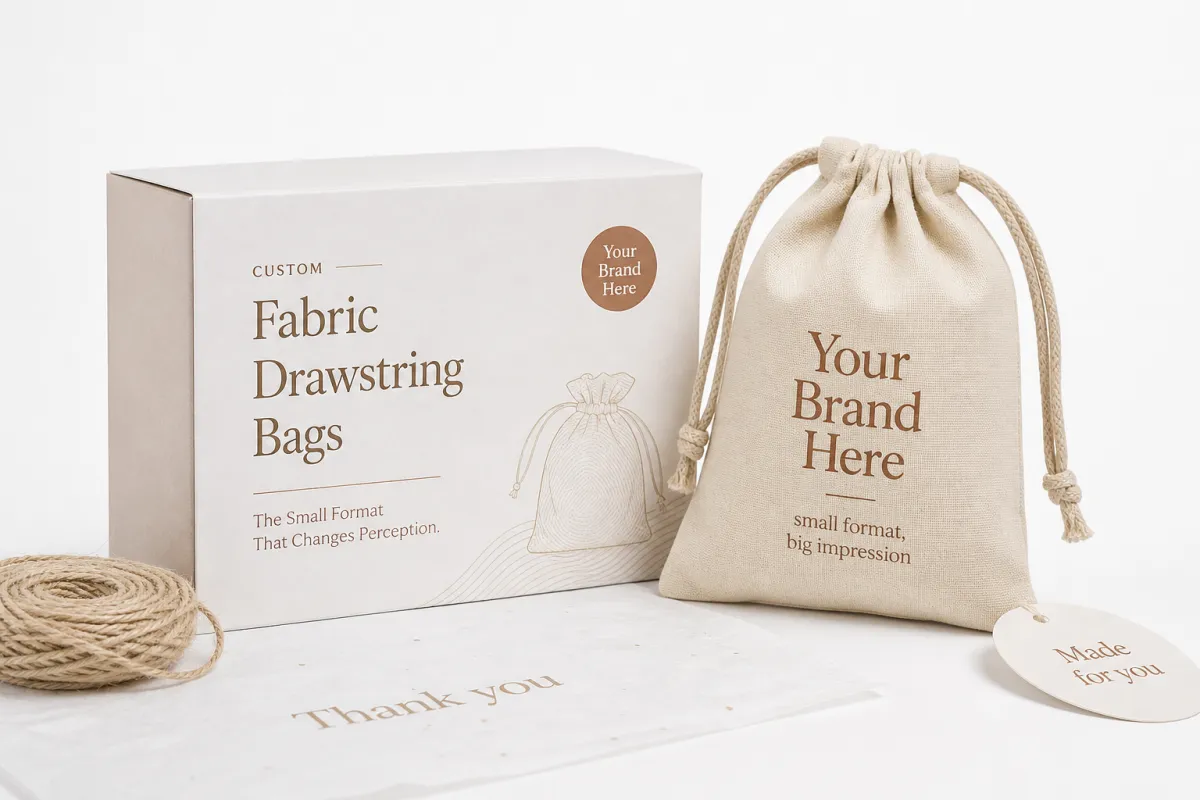
Custom fabric drawstring bags are soft-sided pouches with a cinch closure, usually made from cotton, muslin, canvas, linen blends, recycled fibers, or polyester-based materials. The category looks simple from a distance, though the material and construction choices change the final result far more than most buyers expect. A light muslin pouch for a candle launch does not behave like a heavy canvas bag for an apparel accessory set, and that difference shows up in hand feel, durability, print quality, and the way the bag presents itself once filled.
Brands choose custom fabric drawstring bags over paper pouches or custom printed boxes for a reason. The packaging often does more than protect the product for the first shipment. Jewelry brands use them for rings or chains. Cosmetic companies use them for samples and gift sets. Apparel brands place socks, belts, or sunglasses inside them. Event teams rely on them for conference kits and VIP items. Subscription brands like them because they organize inserts without making the contents feel loose or improvised. That practical usefulness is part of the brand story, not separate from it.
The emotional side matters too. Packaging design is never only about protection. It shapes expectation the moment a customer sees or touches it. A fabric bag feels softer, more personal, and more reusable than rigid packaging in many categories. That feeling carries weight when the product itself is small but the price point is not. If a buyer is paying for care and attention, custom fabric drawstring bags become part of the product story rather than a disposable wrapper around it.
There is also the practical advantage of reuse. Disposable packaging can look fine in transit and disappear in seconds. A drawstring bag can move from shipping to storage to travel, which keeps the brand visible well after the purchase. That is especially useful in Premium Product Packaging, where customers often repurpose the bag for earbuds, cosmetics, sample sizes, accessories, or small keepsakes.
The short version is simple: custom fabric drawstring bags are small-format packaging with a long tail. If the bag is well made, it keeps the brand in view. If it is poorly made, it turns into a reminder of what was cut from the spec.
For that reason, the first decision should never be decoration. It should be use case. A pouch meant to cushion jewelry needs different fabric and seam choices than a pouch meant to hold a lightweight apparel insert. That is where many buyers lose money, because they begin with the artwork and work backward from there. I have watched that mistake happen more than once, and it usually means somebody ends up paying twice, once for the first run and again for the rework.
How Custom Fabric Drawstring Bags Work From Spec to Stitching
The production logic is straightforward, but the sequence matters. With custom fabric drawstring bags, the usual path is to define dimensions first, then choose the fabric, then settle on the closure style, print placement, seam allowance, and finishing details. When those decisions get rearranged, the result often looks fine on a screen and disappoints in the hand.
Dimensions are the anchor because every other choice depends on them. A 4 x 6 inch pouch behaves differently from an 8 x 10 inch pouch. The smaller version may need a tighter drawcord channel and finer stitching. The larger version may need a gusset or a heavier fabric so it does not collapse awkwardly when filled. Buyers sometimes assume size is only about fit. It is not. Size also changes the amount of fabric used, the sewing time, and the final unit cost of custom fabric drawstring bags.
Fabric comes next. Lighter fabrics drape naturally and can feel elegant for gifting, though they offer less structure. Heavier fabrics hold shape better and usually protect contents more effectively. If the bag will sit on a retail shelf or appear in a premium unboxing sequence, the hand feel matters as much as the visual. A 100gsm muslin bag and a 12 oz canvas bag tell very different stories before a logo is even added.
Decoration is where many brands overcomplicate things. Screen printing is common for bold logos and simple artwork. Heat transfer can work for smaller graphics or more detailed designs, though durability depends on the quality of the transfer and how the bag is used. Embroidery adds texture and a premium signal, but it can raise the cost quickly. Woven labels and sewn-in brand tags offer a quieter, durable option that fits well with minimalist package branding. Printed inserts can support the bag if you need instructions, campaign messaging, or a QR code.
Construction details matter more than most buyers expect. Cord length changes how easy the bag is to open and close. A single-drawstring design can look cleaner in some cases, while a double-drawstring design can cinch more evenly. Reinforced seams help the bag survive repeated use. Gusset depth changes capacity and also improves the way the bag stands or folds. Even the top hem can change how premium custom fabric drawstring bags feel in the hand.
"The best drawstring bag is the one that disappears into the user's routine," packaging teams often say. The customer should reach for it again without having to think about why it works.
A good way to compare formats is to place them beside the job they need to do. Custom printed boxes are strong when structure, stacking, and shelf presence are the main goals. Custom fabric drawstring bags make more sense when softness, reusability, and a lower-friction unboxing experience matter more. Neither format is universally better. They solve different problems, and the right answer depends on the product and the brand experience you want to create.
If you want to narrow the field early, begin with three questions: what will the bag hold, how often will it be reused, and what image should it project? Those answers usually point toward the right fabric, closure, and decoration method faster than any trend chart will.
Buyers who compare suppliers should ask for the same technical details from each one: fabric weight, seam allowance, cord material, print method, and packed quantity per carton. That makes custom fabric drawstring bags easier to evaluate on performance instead of just price. If a vendor cannot provide those basics, the quote is probably too vague to trust.
For companies building a broader packaging program, it helps to coordinate the bag with other branded packaging items. A pouch can carry the same logo language as a sleeve, insert card, or rigid box, which keeps package branding consistent across channels. If you are already ordering inserts or other soft goods from custom packaging products, asking for a shared spec style can reduce revision cycles later.
Key Factors That Shape Performance and Brand Fit
The most important decision in custom fabric drawstring bags is fabric selection. Cotton and muslin feel natural and approachable, which is why they appear often in gifts, jewelry, and beauty items. Canvas feels sturdier and carries more body, so it suits heavier products or brands that want a grounded look. Polyester resists moisture better and usually holds color consistently, which can help in travel, sports, or promo use. Blends sit between those extremes and can balance cost with a more polished appearance.
There is a reason buyers keep returning to muslin. It is versatile, easy to print on, and usually friendly on budget. Still, "best" depends on the use case. If your product needs abrasion protection, a light muslin bag may be too thin. If the product is delicate and the customer expects a softer presentation, a heavy canvas pouch may feel excessive. That is the packaging design tradeoff in plain terms: protection, appearance, and cost rarely peak at the same point.
Size and proportion come next. A bag that is too large can feel wasteful and under-filled. A bag that is too small can distort the product, stress the seams, or frustrate the customer when repacking. I have seen buyers over-order oversized custom fabric drawstring bags because they wanted flexibility for future SKUs, only to discover that the extra fabric pushed the cost up and made the product look less considered. A bag should fit the use case, not just the largest item in the line.
Branding choices alter perception quickly. A one-color logo can feel elegant if the placement is thoughtful and the bag color supports it. A two- or three-color print can work when the mark needs more visibility, though it adds setup complexity and can raise unit cost. Large logos can read boldly in retail packaging. Smaller logos can feel restrained and premium. Neither is automatically right. The right choice depends on how much visual authority the brand wants the bag to carry.
| Fabric Option | Typical Feel | Common Use Cases | Approx. Unit Cost at 5,000 pcs |
|---|---|---|---|
| Cotton muslin, 80-100gsm | Soft, light, natural | Jewelry, samples, cosmetics, event gifts | $0.18-$0.32 |
| Cotton canvas, 8-12 oz | Sturdier, more structured | Apparel accessories, premium retail packaging | $0.38-$0.68 |
| Polyester or microfiber | Smooth, color-consistent | Travel kits, moisture-sensitive products | $0.22-$0.40 |
| Recycled cotton blend | Eco-forward, slightly textured | Sustainability-led launches, brand gifts | $0.30-$0.55 |
| Heavy canvas with gusset | Dense, premium, durable | High-touch product packaging, repeated reuse | $0.60-$1.10 |
Those numbers are not fixed quotes. They are the kind of working ranges buyers use to compare custom fabric drawstring bags before artwork is sent in. Quantity, decoration, shipping mode, and finishing details can move price in a noticeable way. Still, the table makes one thing obvious: fabric choice can double unit cost before a logo is even added.
Sustainability also shapes brand fit, though it needs a practical lens. Recycled content is attractive, but it should be matched with realistic expectations around durability and color variation. A bag made from recycled fibers that wears out after one use does not strengthen the story. A better choice is construction that lasts longer and actually supports reuse. For recycled-content or low-chemical claims, third-party standards such as GRS and OEKO-TEX are more relevant than a vague sustainability statement, and ISTA remains useful for transit testing.
Compliance and safety details matter too. If the bags will touch skin or cosmetics, ask about dye safety and odor. If they will be washed, check shrinkage expectations. If they will travel inside a larger shipping system, consider transit stress and whether the bag should be tested as part of a wider package. That is where packaging standards become useful, because they push the conversation beyond appearance and into real-world behavior.
One more point gets missed often: the bag should match the brand's tolerance for upkeep. A white cotton pouch can look beautiful, but it may show staining quickly. A darker canvas pouch may hide wear, though it can soften the sense of luxury. Buyers sometimes focus only on first impression and ignore how the bag will age. Aging is part of the product experience when the customer keeps the bag.
Custom Fabric Drawstring Bags Cost, MOQ, and Quote Drivers
Cost for custom fabric drawstring bags is driven by five variables more than anything else: fabric weight, bag size, print method, decoration locations, and finishing details. Quantity sits underneath all of those. A larger run usually lowers the unit price, but only after setup costs are spread across enough pieces. That is why a 500-piece order can look expensive next to a 5,000-piece order, even when the materials are identical.
MOQ, or minimum order quantity, exists because production is not linear. Someone has to cut fabric, set the print screens or transfer process, prepare cord stock, sew the pieces, finish the seams, inspect the bags, and pack the cartons. Whether the run is 300 pieces or 3,000, some of those steps happen no matter what. That fixed effort is the reason suppliers often set a floor on custom fabric drawstring bags.
What should a buyer watch in a quote? More than the unit price. Ask about sample fees, setup charges, shipping method, and whether the quote includes one or two decoration locations. A quote that looks low at first can become less attractive once freight, proof changes, or extra packing are added. A quote that looks higher may actually be cheaper in the end if the supplier includes better finishing or lower defect risk.
One practical way to compare suppliers is to normalize the details. Are you comparing a 4 x 6 inch muslin pouch to an 8 x 10 inch canvas bag? Those are not substitutes. Are both quotes using the same print method? Does one include a woven label and the other not? Are both based on the same carton count and shipping term? If not, the comparison is tilted before it starts. That is especially true for custom fabric drawstring bags, because small differences in fabric and finishing can shift value more than buyers expect.
The cheapest option trap shows up constantly. A buyer chases the lowest per-unit number, then receives a bag that wrinkles badly, prints poorly, or wears out after a few uses. The real cost is not the invoice. It is the number of customer impressions the bag can generate before it is discarded. If the bag is meant to support branded packaging, reuse matters as much as the first open. I know that sounds a little blunt, but it is usually the part that decides whether the purchase feels smart or just cheap.
Here is a useful comparison for thinking about spend:
- Low-cost muslin run: best for simple giveaways, light accessories, and large quantities where basic visibility is enough.
- Mid-range printed cotton or polyester: best when you need better feel, sharper branding, or more consistent retail packaging.
- Premium canvas or embroidered bag: best when the bag should act like part of the product itself and be reused often.
That framework helps buyers connect price to purpose. A $0.20 bag that gets tossed immediately may be worse value than a $0.55 bag that stays in use for months. On a per-impression basis, custom fabric drawstring bags can compare well with other package branding formats when the reuse rate is high.
For teams that also buy outer cartons, inserts, or pouches, bundling sourcing can help. Coordinating with Custom Packaging Products can simplify artwork, reduce duplicate setup work, and keep brand color treatment more consistent across product packaging elements. It does not remove cost pressure, but it often improves the total program.
Step-by-Step Process and Timeline for Ordering
The ordering process for custom fabric drawstring bags usually starts with a brief, not a quote. That brief should answer five basic questions: what is being packed, what size the bag should be, which fabric feels right, what print method you want, and when you need delivery. If those answers stay fuzzy, the rest of the process slows down quickly.
A sensible workflow looks like this:
- Define the use case and target product dimensions.
- Select fabric weight and closure style.
- Confirm artwork placement and color count.
- Request a sample or blank prototype.
- Approve the final spec and production proof.
- Run production, inspection, and shipping.
That sequence sounds basic, yet the order matters because each later step depends on the earlier one. Many delays happen when a buyer asks for a different bag size after artwork is already approved, swaps fabrics after sampling, or realizes too late that the logo sits too close to the seam. Each of those changes may require a new proof, a new sample, or a new production plan for custom fabric drawstring bags.
Timeline expectations should be grounded in the real production mix. A simple run with standard fabric, one-color print, and no special finishing can often move from proof approval to production in roughly 12-15 business days, though that still depends on factory load and material availability. A more customized order with embroidery, multiple print locations, or unusual fabric sourcing can stretch that timeline. Shipping can add a few days or several weeks, depending on air or sea freight and destination.
Sampling is one of the most useful steps, even when it adds time. A physical sample reveals things a screen mockup cannot show: how the bag cinches, whether the logo stays visible when closed, how stiff the fabric feels, and whether the product actually fits without forcing the seams. If the bag is meant to support retail packaging or premium gifting, that tactile check is worth every extra day. I have lost count of the times a sample caught a seam placement issue that looked tiny in CAD and huge in hand.
Artwork approval also deserves more attention than it gets. On a flat drawing, a logo may look centered and balanced. On a cinched pouch, that same logo can disappear into folds or get partially blocked by the cord. The strongest packaging design reviews check not only logo shape, but also contrast, scale, and seam-safe placement. With custom fabric drawstring bags, the top third of the front panel is often where visibility is won or lost.
For launches tied to trade shows, holiday gifting, or retail resets, buffer time is not optional. Treat shipping delays, proof rounds, and small correction cycles as part of the schedule rather than exceptions. A two-week factory timeline does not mean a two-week total timeline. That is especially true if the bags are one piece in a broader branded packaging program that also includes inserts, labels, or custom printed boxes.
One useful habit is to confirm milestones in writing. Ask for the artwork approval date, sample dispatch date, production start date, and estimated ship date. That creates accountability and reduces the vague "in progress" answers that slow down project management. For buyers ordering custom fabric drawstring bags for a campaign or product launch, visibility is not a luxury. It is the difference between arriving early enough to use them and arriving after the moment has passed.
Common Mistakes That Cause Waste, Delays, and Reorders
The biggest failure point in custom fabric drawstring bags is vague specifications. If the supplier does not know the size, fabric, closure style, print placement, and quantity range, they cannot quote accurately and they cannot steer you away from design problems. Vague briefs create round after round of clarification, and each round pushes the order farther from the original timeline.
Ignoring the use case is the second big mistake. A fragile fabric chosen for shipping protection can tear or pill too quickly. An overly bulky construction can look expensive but feel clumsy for a small product. If the bag will live inside a kit, it may need to slide in and out of outer packaging without snagging. If it will be handed to a retail shopper, it may need a stronger cord and cleaner edge finishing. The bag is not just a visual object. It has a job to do.
Another common issue is approving art without checking scale. Logos often look fine when a bag is flat on a desk, but once the drawstring is pulled, the visual space changes. The same is true for text. A long tagline might fit on paper and vanish in reality. With custom fabric drawstring bags, fewer design elements usually perform better because there is less room for distortion.
Here are the mistakes I see most often in custom fabric drawstring bags orders:
- Over-specifying the bag: too many colors, too many placements, too many special instructions.
- Under-specifying the bag: no fabric weight, no seam preference, no closure detail.
- Skipping the sample: the buyer approves a digital mockup and only discovers the fit problem after production.
- Chasing the lowest quote: the unit price looks good, but the bag fails durability or branding expectations.
- Forgetting the end user: the bag looks strong in procurement but awkward in the customer's hand.
Skipping samples is especially expensive because one prototype can prevent a whole batch of rework. If the logo lands too low, if the cord is too short, or if the bag feels wrong in the hand, a sample catches it early. That is a cheap mistake. A warehouse full of unusable custom fabric drawstring bags is not.
There is also a hidden problem many teams overlook: inconsistency across reorders. If the first run is good but the spec is loose, the next batch may drift in color, print placement, or cord type. That is why disciplined buyers treat the approved sample as a reference point, not just a checkpoint. A good spec sheet protects future reorders and keeps brand packaging consistent over time.
From a packaging buyer's point of view, the real risk is waste. Waste of fabric, waste of freight, waste of time, and waste of customer attention. A drawstring pouch that misses the mark can also undermine trust in the rest of the product packaging system. A customer may not say, "The bag was wrong, so I distrust the brand." But they feel it, and they remember it.
For brands that care about sustainability, waste is not only a cost issue. It is a credibility issue. If the bag is meant to signal responsible design, the construction should support reuse and the spec should avoid unnecessary excess. A well-made pouch that gets used 20 times is a better brand asset than a more expensive one that gets discarded after one.
Expert Tips for Better Custom Fabric Drawstring Bags and Next Steps
If you want better outcomes from custom fabric drawstring bags, start with a spec sheet before you ask for a quote. List the bag size, fabric preference, color, print method, quantity, target delivery date, and the item being packed. That single step reduces guesswork and gives suppliers enough information to answer clearly instead of trading vague estimates.
Order a sample or blank prototype whenever the product is new, the logo is complex, or the bag is intended for repeated reuse. The goal is not to slow the process down. The goal is to make the final decision more informed. A 20-minute test with the real product often tells you more than a week of email discussions. Honestly, that is one of the easiest ways to save yourself a headache later.
Think ahead to reorders. If the bag has to support multiple SKUs, seasonal sets, or event tiers, choose a design that can scale without redoing everything. Simple brand marks, flexible sizing, and a restrained color system usually travel better than highly specific art. That is one reason custom fabric drawstring bags can work so well as an anchor item in a broader package branding system: they can stay stable while the contents change.
It also helps to compare the bag with the rest of the packaging stack. If your outer shipper is a plain mailer and your inner pack is a beautiful pouch, the pouch may do most of the work. If you are already using custom printed boxes, then the drawstring bag may play a supporting role, adding tactile value without repeating the same design language. Good packaging design is about roles, not just decoration.
For teams that care about testing and transit performance, ask whether the bag will be handled on its own or inside another package. If the answer is "inside another package," then the outer system matters too. If the answer is "handed directly to the customer," then the fabric, print, and closure all need to look finished enough to stand alone. Standards bodies such as ISTA are useful here because they remind buyers that packaging performance is measurable, not just aesthetic.
Here is a practical checklist before you place the order:
- Confirm the product dimensions and bag clearance.
- Choose the fabric based on feel, protection, and expected reuse.
- Approve logo placement with the bag cinched, not just open.
- Ask for sample photos or a physical sample.
- Verify timeline, freight method, and any extra setup charges in writing.
When you put those steps together, custom fabric drawstring bags stop being a generic promo item and start acting like a controlled packaging component. That is the difference between a pouch that merely exists and one that actually supports retail packaging, brand perception, and repeat use.
If you are still deciding between a pouch, a carton, or another format, compare the job each one is supposed to do. A pouch may be better for soft presentation and reuse. A box may be better for structure and stacking. Many brands end up using both, because the strongest product packaging systems are rarely one-note. They use the right format at the right stage.
Once you have the brief, the sample, and the timing locked in, the next step is straightforward: compare two or three suppliers, request sample photos, and confirm the spec in writing before production starts. That discipline saves money more often than aggressive haggling does. And if your goal is to make custom fabric drawstring bags feel like part of the product rather than an add-on, that level of clarity is exactly where the value lives.
Custom fabric drawstring bags work best when the details are deliberate, the fabric matches the use case, and the timeline leaves room for proofing. Get those three things right, and the bag can do more than carry a product. It can carry the brand.
What are custom fabric drawstring bags best used for?
They work well for jewelry, cosmetics, candles, apparel accessories, event gifts, and subscription packaging. They are especially useful when you want reusable packaging that feels more premium than a paper pouch or poly mailer. Size and fabric should match the product weight, storage needs, and whether the bag will be kept or discarded.
Which fabric is best for custom fabric drawstring bags?
Cotton and muslin are common for soft, natural presentation and lower-cost branding runs. Canvas is better when structure and durability matter more than drape. Polyester or blended fabrics can make sense when moisture resistance, color consistency, or lower maintenance is important.
How long does it take to produce custom fabric drawstring bags?
The timeline usually depends on artwork approval, sampling, fabric sourcing, and shipping method. A simple order moves faster than a highly customized one with multiple print locations or special finishing. Build extra time into the plan if the bags are tied to a launch date, seasonal promotion, or trade show.
What affects the price of custom fabric drawstring bags most?
Fabric type, bag size, print complexity, stitching details, and quantity are the main pricing variables. MOQ and setup charges can make small runs look expensive on a per-unit basis. Shipping and sample costs should be included when comparing suppliers so the quote reflects the real total.
Can custom fabric drawstring bags be reused after the first purchase?
Yes, reuse is one of their biggest advantages, especially for travel, storage, gifting, and organizing smaller items. A stronger fabric and reinforced stitching help the bag last longer and improve brand visibility over time. Reusable bags often make the most sense when the contents are premium enough to justify a keep-worthy package.

