Buyer Fit Snapshot
| Best fit | Sustainable Mailers for Eco Brands projects where brand print, material claims, artwork control, MOQ, and repeat-order consistency need to be specified before quoting. |
|---|---|
| Quote inputs | Share finished size, material target, print colors, finish, packing count, annual reorder estimate, ship-to region, and any compliance wording. |
| Proofing check | Approve dieline scale, logo placement, barcode or warning zones, color tolerance, closure strength, and carton packing before bulk production. |
| Main risk | Vague material claims, crowded artwork, missing packing details, or unclear freight terms can make a low unit price expensive after revisions. |
Fast answer: Sustainable Mailers for Eco Brands: Film, Print, MOQ, and Carton Packing should be specified like a repeatable production item. The safest quote records material, print method, finish, artwork proof, packing count, and reorder notes in one written spec.
Production checks before approval
Compare the actual filled-product size with the drawing, then confirm tolerance on folds, seals, hang holes, label areas, and retail display edges. Reserve space for logos, QR codes, warning copy, and material claims before decorative graphics fill the panel.
Quote comparison points
Review material grade, print process, finish, sampling route, tooling charges, carton quantity, and freight assumptions side by side. A quote is only useful when the supplier can repeat the same color, closure quality, and packing count on the next order.
Custom Logo Things
Sustainable Mailers for Eco Brands: Smart Packaging Guide
I still remember a rainy Thursday in our Shenzhen facility when a buyer changed one mailer spec for another and cut carton damage by 18% almost overnight, using a 60-micron recyclable poly build instead of a thinner 45-micron film. That number sounds modest until you are staring at 700 replacement units and a launch calendar that already has too many fires on it. sustainable mailers for eco brands are not decoration, and they are not a badge you stick on a carton to feel better. They shape complaints, returns, margins, and the story a customer believes the second the package lands on the porch.
Packaging gets treated like a bag with a logo far too often, especially when teams compare a $0.15 mailer at 5,000 pieces against a $0.29 option without asking about freight from Dongguan to Los Angeles or the extra $180 sample charge from a plant in Guangdong. That thinking survives right up until the first delivery hits a wet doorstep or a carrier stack gets a little too ambitious in the back of a truck. A mailer has to survive conveyors, rough hands in a warehouse, humidity, rain, and the kind of treatment nobody would ever call gentle. If you are sourcing sustainable mailers for eco brands, the real question is not whether the material looks good in a presentation. The real question is whether it protects the product, supports your recycling or compost claim, and stays inside budget once freight, sampling, and print setup show up. Honestly, that is where a lot of brands get lost: they fall in love with the pitch before they check the math.
I have sat through supplier meetings where a brand asked for "eco" packaging without knowing whether its buyers lived in Los Angeles, Calgary, or a rural area where parcels sit in a truck depot longer than anyone planned, and that missing detail changed the spec from an 80gsm kraft mailer to a 70-micron mono-poly bag with stronger sealant stripes. That is how packaging mistakes get baked into a launch. So I will keep this grounded: what the materials are, how they behave, what they cost, and how to brief a supplier without getting buried in vague green language. (And yes, vague green language is my personal least favorite flavor of nonsense.)
Sustainable Mailers for Eco Brands: What They Are and Why They Matter
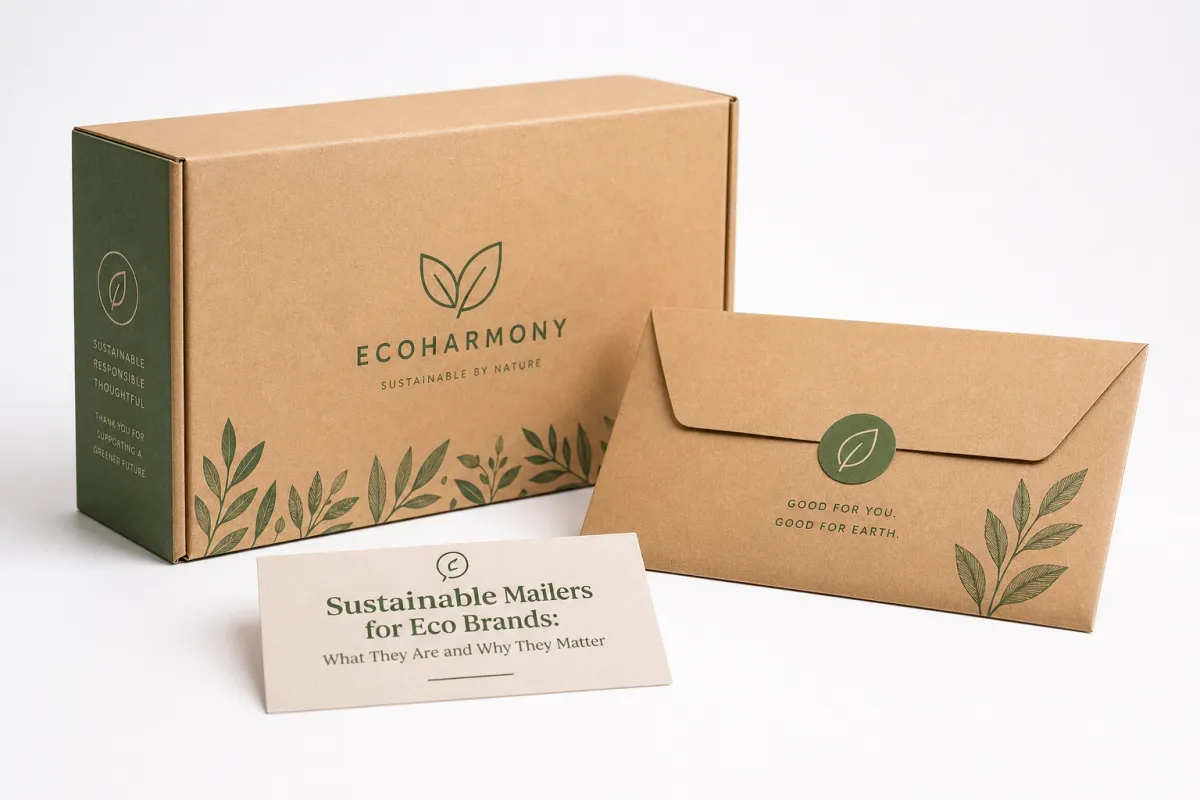
sustainable mailers for eco brands are shipping mailers made from lower-impact materials such as recycled poly, recyclable mono-material films, kraft paper, compostable films, or hybrid constructions That Cut Waste without turning every shipment into a gamble. That definition matters because "eco" gets slapped onto almost anything with a leaf icon and a recycled claim nobody can verify. I have seen suppliers print the word sustainable on a mailer that was still multi-layer, awkward to recycle, and impossible to explain to a customer service team without a long disclaimer. You can imagine the support ticket. I can, unfortunately, still hear it.
The short version is simple. A sustainable mailer should reduce virgin material use, fit the product it carries, and make sense at the end of its life. That might mean curbside recycling, store drop-off, industrial composting, or reuse. The right answer changes by substrate and by market. A mailer that qualifies in one city can become a sorting problem in another, especially when one municipality accepts polyethylene film at drop-off bins and the next one rejects it entirely. That is why I always ask where the customer actually lives before I talk about material selection. A beautiful spec sheet is nice; a realistic disposal path is better.
Eco brands care because packaging is part of the product story. If you sell soap, supplements, athleisure, or skincare, the mailer is the first physical proof of your promise. People notice whether the package feels thoughtful or fake. They also notice when the mailer arrives torn, soggy, or overbuilt like it was designed by someone who has never watched a parcel move through a fulfillment line in Phoenix in July or Manchester in November. sustainable mailers for eco brands need to do both jobs: protect and communicate.
On a factory floor in Dongguan, I watched a brand move from a glossy mixed-material mailer to a plain recycled poly bag with a clean one-color print and a 35mm seal flap. Their unit cost dropped by $0.06, and the bigger win came two weeks later when seam complaints fell by nearly a quarter after transit testing through the Guangzhou-to-Singapore lane. The package looked less flashy. The launch looked more controlled. That is the detail agencies miss when they talk about packaging like it is only branding. I love a pretty unboxing as much as anyone, but I love a low return rate more.
Better material does not automatically mean better sustainability. If a mailer uses less virgin plastic but fails in wet weather and triggers 6% product replacement, the carbon story gets ugly fast. sustainable mailers for eco brands should be judged as a full system, not a slogan on a spec sheet. Material source, print method, barrier performance, disposal path, and verified claims all belong in the conversation, along with the exact resin thickness, seal width, and transit distance from factory to fulfillment center. Anything else is window dressing, and I have seen enough window dressing to last a lifetime.
How Do Sustainable Mailers for Eco Brands Actually Work?
sustainable mailers for eco brands come in a few main families, and each one behaves differently once it leaves the warehouse. Recycled poly mailers use post-consumer or post-industrial content to reduce virgin resin use while keeping the strength and moisture resistance that e-commerce teams rely on. Recyclable mono-material poly mailers are built so the bag stays within one resin family, which can make sorting easier in systems that accept it. Kraft paper mailers bring a natural look and a lower-plastic profile, while compostable films use plant-based or certified compostable inputs. Hybrid options mix paper and film, though those need close review because mixed layers can make disposal confusing fast, especially when a paper face is laminated to a film liner.
Performance is where the marketing deck starts to sweat. Tear resistance matters for products with hard edges, like boxed cosmetics or accessory kits, and a practical spec might call for a 90N tear value or a 50-micron film to keep corners from punching through. Puncture resistance matters for sharp corners and bulky items that press against the seams. Moisture barrier matters if a package spends a night on a wet porch or a week moving through humid lanes in Jakarta, Miami, or Singapore. Seal performance matters too, because a weak adhesive strip turns warehouse staff into unwilling packaging testers, and nobody wants that conversation after a long shift. I have had those conversations in two factories in Shenzhen and one in Ningbo, and they are never charming.
After too many sample rounds, I think about it in practical terms. Recycled poly usually gives the strongest balance of price, durability, and print clarity, especially when the target budget is around $0.15 to $0.19 per unit at 5,000 pieces. Kraft paper feels honest and premium, but it can wrinkle or tear if the item is heavy or the route is rough, which is why an 80gsm sheet may be fine for a T-shirt and a bad idea for a boxed candle. Compostable film can make sense for brands with a very specific disposal story, yet it is not a magic fix. End users still need access to industrial composting under standards such as ASTM D6400 or EN 13432, because "compostable" without a recovery path becomes expensive optimism.
sustainable mailers for eco brands also differ in how they are sealed. Pressure-sensitive peel-and-seal closures are common because they save labor and keep line speed moving, particularly on packing lines in Shenzhen and Suzhou where one operator might close 300 to 500 mailers per hour. Some materials take hot-melt strips better than others, and some handle tamper-evident closures without drama. If a supplier cannot tell you how the seal behaves after heat, cold, or a rough truck ride, I would keep looking. I have seen adhesive lines fail on shipments that sat in cold trucks overnight, and the brand paid for relabeling plus reshipment. Cheap turned expensive very quickly. That kind of savings is the stuff of corporate horror stories.
End of life sits on the other side of the same coin. A mailer can be recyclable, compostable, or reusable, but the claim needs to match the actual construction and the market where it lands. For recycling guidance, I often point teams to the EPA's consumer recycling resources at EPA recycling guidance. For transit validation, the ISTA testing standards are worth understanding because they help separate marketing copy from physical reality, especially when you are testing a 40-pound mixed shipment from a factory in Guangdong to a fulfillment center in California. That kind of validation is not glamorous, but it saves money in the one place it actually matters: the customer doorstep.
To make the tradeoffs easier to read, here is a quick comparison.
| Mailer Type | Typical Use | Approx. Unit Cost at 5,000 pcs | Strengths | Watch Outs |
|---|---|---|---|---|
| Recycled poly | Apparel, accessories, light boxed goods | $0.15 | Good moisture resistance, strong seams, easy custom print | Recycling claim must match local system |
| Recyclable mono-material poly | General e-commerce, repeat shipping programs | $0.18 | Cleaner material story, strong protection, lightweight | Needs clear labeling and correct resin structure |
| Kraft paper mailer | Light garments, stationery, low-moisture orders | $0.24 | Natural feel, strong brand cue, paper recycling familiar to customers | Less moisture resistance, can tear on sharp corners |
| Compostable film | Brands with specific composting claims | $0.41 | Clear disposal narrative in the right market | Industrial composting access is limited in many regions |
| Hybrid construction | Specialty launches, premium presentation | $0.32 | Custom feel, design flexibility | Can be harder to recycle or explain |
If you want to see how brands handled those tradeoffs in real launches, our Case Studies page is a better reality check than any glossy sales deck. If you are comparing mailers with other formats, the broader Custom Packaging Products catalog helps show where a mailer is the right tool and where it is just the fashionable tool. For products that need rigid support, a 350gsm C1S artboard insert or a folding carton may actually be the smarter companion to the mailer.
Key Factors That Decide the Right Mailer
sustainable mailers for eco brands are not chosen by vibes. Product size and weight come first. A 6-ounce apparel order has different needs than a glass serum bottle or a multi-piece accessory kit. Items with corners, hard edges, or a tendency to shift in transit need more puncture resistance and a tighter fit, and that often means specifying a 50-micron film instead of a 40-micron one or moving from paper-only to a paper-plus-film structure. I have watched brands order mailers two sizes too large because they wanted flexibility, then complain when the product slid around and arrived looking sloppy. Oversized packaging is not clever. It is extra air with a shipping label.
Shipping conditions matter just as much. Domestic fulfillment with short carrier routes is one thing. Cross-border shipping with sorting hubs, customs checks, and a rough warehouse network is another, especially if the route runs from Shenzhen to Long Beach and then into a Midwest distribution center. Wet climates change the equation too. A kraft mailer can look beautiful in a studio, then lose its dignity after one soggy doorstep in Seattle or Dublin. If a package will spend time in humid regions, moisture barrier matters more than a brand deck usually admits.
Brand priorities shape the choice as well. Some companies want a matte, minimal look with a single black logo and a calm, premium feel. Others want bold graphics, unboxing messages, and a little more personality. Neither is wrong. What matters is picking a substrate that supports the print and texture you want. Recycled poly handles crisp logos well. Kraft paper gives a tactile, natural feel. Compostable films often need more care with inks and finishing. If tactile design matters, ask for print samples, not just renderings, and compare a one-color matte black print against a two-color PMS job on both paper and film before you sign off.
Claims deserve their own paragraph because this is where teams get sloppy. sustainable mailers for eco brands should not be sold as recyclable, compostable, or recycled unless the construction and market support the claim. "Recyclable" does not mean every curbside bin accepts it. "Compostable" does not mean a backyard pile will break it down. A supplier brochure is not a compliance document. If the claim cannot be backed by the material spec and the intended market, leave it off the print. I would rather see a plain, accurate mailer from a factory in Dongguan than a dramatic one from a supplier in Guangzhou with an unverified claim.
Minimum order quantity matters more than founders expect. A supplier may quote 50,000 pieces at a lovely unit rate, but if your launch only needs 8,000, the cash gets trapped in a warehouse corner nobody talks about. Lead time matters too. Custom print, custom sizing, and specialty film often add days or weeks. If you need a fast launch, stock structures with custom printing may be the safer move. That is why I always ask for the production calendar before I start talking about design, because 12 to 15 business days from proof approval can quickly become 18 to 22 if you add revisions and a port delay.
There is also a practical angle buyers forget until they are already in trouble: line compatibility. If your fulfillment team uses one sealing method and the new mailer needs another, labor cost can jump fast. I once saw a small brand save $0.04 per unit on paper mailers and lose $0.09 in labor because the pack-out team had to baby the seal. That math is not charming. It is a spreadsheet with a headache, especially when the line in question was already running 1,200 orders a day in a warehouse outside Los Angeles.
Sustainable Mailers for Eco Brands: Cost, Pricing, and Budget Tradeoffs
sustainable mailers for eco brands usually cost more than the most basic stock plastic option, but unit price only tells part of the story. Raw material selection, thickness, print coverage, custom sizing, certification, and order volume all affect pricing. A simple one-color recycled poly mailer at 10,000 units can be pleasantly reasonable. Add multiple PMS colors, a tear strip, a custom size, and a certified compostable film, and the quote moves fast. Suppliers are not being dramatic; materials and process time really do move the number, especially when a plant in Ningbo has to switch from a standard extrusion line to a specialty low-temperature seal line.
In one negotiation with a supplier in Guangzhou, a brand wanted the lowest quote they had seen at $0.11 per unit for 20,000 pieces. The catch was that the number excluded freight, import duty, and a 12% overage because the line had a higher reject rate. The "cheaper" option landed closer to $0.19 per unit. The more honest supplier quoted $0.17 upfront, and the total landed cost was lower because the pallet density was better and the defect rate was cleaner. That is why I always tell buyers to ask for landed cost, not just factory cost. The spreadsheet gets less exciting, but a lot more truthful.
The real cost of cheap packaging shows up in returns, damage claims, and customer frustration. If a flimsy mailer causes 3% more breakage on fragile products, the unit savings evaporate quickly. If a premium mailer improves the first impression and cuts support tickets, it can pay for itself before the second reorder lands. sustainable mailers for eco brands should be judged by total economics: material, freight, damage rate, and how much confidence they give the buyer. A $0.22 mailer that lowers replacement costs by $0.37 per order is a smarter buy than a $0.14 mailer that makes the customer service inbox explode.
Sampling has a price too. A proper sample run may cost $40 to $150 depending on complexity, and that is before express shipping from Shenzhen or Dongguan. If you need five material variants, two print directions, and a custom size, it is easy to spend a few hundred dollars before production starts. I do not think that is wasteful. I think it is cheaper than discovering a seam failure after 18,000 units are already in transit. I have seen that movie, and I do not recommend the sequel.
Here is the budget logic I use with clients:
- Spend more when the product is fragile, moisture-sensitive, or expensive to replace.
- Spend more when packaging quality affects conversion or repeat purchase behavior.
- Spend less when the product is low-risk, lightweight, and easy to re-pack.
- Keep artwork simple if the substrate is already doing the branding work.
- Build in a 5% to 10% buffer for freight, sampling, and duty so the quote does not lie to you.
If you are comparing options for a specific launch, our Custom Poly Mailers page is a good place to see how a standard structure can still be customized without turning the budget into confetti. For many brands, a smart recycled poly mailer beats an expensive specialty material that nobody can dispose of properly, especially if the order is landing in North America within a 12- to 15-business-day window after proof approval.
Step-by-Step Process and Timeline for Ordering Sustainable Mailers
sustainable mailers for eco brands work best when the process starts with boring details. That is the kind of boring that keeps a launch from going sideways. You need product dimensions, weight, packaging orientation, fulfillment method, and the exact claim you want to make. If you do not know whether the package needs a gusset, tear strip, or extra seam margin, the supplier will guess. Guessing is how waste gets printed, and the cheapest way to avoid that is to measure the product with calipers before anyone opens Illustrator.
Step one is a discovery brief. Write down the product type, dimensions, target mailer size, shipping lanes, brand colors, and sustainability requirements. If you already know the number of units, include it. A quote for 3,000 pieces and 30,000 pieces can look like two different universes. I once had a client bring me a single sentence brief that said, "Need greener mailer, premium look." That told me nothing useful, except that I was going to do homework for both of us. A better brief includes a target size like 10 x 13 inches, a product weight like 14 ounces, and a finish like matte black on 60-micron recycled poly.
Step two is sampling. Ask for at least two or three options if the product is not simple. A recycled poly sample, a kraft sample, and a mono-material sample can reveal more in one afternoon than a week of email back-and-forth. Do not just hold the samples in your hand. Fill them with the actual product, seal them, shake them, stack them, and leave them in a warm room for a few hours. If you can, run a small drop test from waist height onto a hard floor. For boxed goods, I like to add a 350gsm C1S artboard insert inside the sample so we can see how the mailer behaves with a real retail load, not a featherweight stand-in.
Step three is artwork and technical prep. Dielines, bleed, logo placement, copy checks, and claim verification all matter here. Your printer should confirm the print area, seal zone, and any no-print margins. If you are using a recycled or compostable claim, check the wording before production. I have seen brands approve a line that said "100% recyclable" on a structure that only qualified in specific regions. Legal review costs less than reprinting 12,000 mailers. Strange, but true, especially when the reprint has to move from a plant in Guangzhou to a warehouse in Toronto.
Step four is production timing. A realistic schedule for sustainable mailers for eco brands often looks like this: 3 to 7 business days for sampling, 2 to 5 days for revisions and sign-off, 10 to 20 business days for production depending on volume, and then shipping time on top. If the order is overseas, add buffer for customs and port delays. A founder once told me they wanted "something fast" and then approved three rounds of artwork changes. Fast disappeared the moment revision number two showed up, and the shipment that should have left Ningbo on a Tuesday left the next Friday instead.
Step five is pilot testing. Before you commit to a huge reorder, run a smaller batch through the real packing line and the real carrier network. Send them to different regions if possible. Test warm weather, cold weather, and a few rough deliveries. A clean sample on a desk is not proof. A successful pilot order is proof. That is why manufacturers who know their trade ask awkward questions instead of promising fairy dust, and why a good pilot can save you from a 24,000-unit mistake.
"The best packaging spec is the one that survives the warehouse, the truck, and the customer's porch without drama."
If you want to benchmark your process against what other brands actually shipped, the stories in Case Studies are useful because they show how sustainable mailers for eco brands behave once real orders hit real carriers. That is a lot more honest than an influencer unboxing video with a filtered lamp and a perfect desk, especially when the box has already crossed a port in Long Beach and spent two extra days in a sorting facility.
Build a buffer into the schedule too. A two-day buffer is cute. A five- to seven-day buffer is wiser if the shipment matters to a launch or seasonal campaign. I have watched brands miss a drop because they treated packaging like a footnote. It is not a footnote. It is the first physical product the customer touches, and if it is produced in Shenzhen on a 15-business-day cycle, the calendar needs respect.
Common Mistakes Eco Brands Make With Sustainable Mailers
sustainable mailers for eco brands go wrong in predictable ways. The first mistake is choosing based on the label instead of the shipping reality. A paper mailer can look noble and still fail badly on wet routes. A compostable film can sound ideal and still create disposal confusion if the customer has no access to the right facility. A clever-looking package that fails in transit is just expensive disappointment with branding, usually delivered from a factory in Guangzhou or Dongguan that never got the same weather conditions the customer did.
The second mistake is vague sustainability language. I have seen product pages claim "eco-friendly" without a material spec, certification, or disposal explanation. That is not a claim. That is wishful thinking. If your mailer uses recycled content, say the percentage and the source if you can verify it. If it is recyclable, explain the condition and the market. If it is compostable, explain the standard and where that matters. Clear language builds trust because it gives customers something concrete to believe, such as 30% post-consumer content, a 60-micron film gauge, or an ASTM D6400 certification number.
The third mistake is ignoring total cost. A low unit price can still be a bad deal if freight is heavy, damage rates are high, or the mailer requires extra labor. I saw one brand chase a quote that saved $1,800 on paper. Then they spent $4,200 on damage replacements by the end of the quarter. That is not savings. That is a donation to the return department, and I do not say that lightly. If the factory is in Shenzhen but the fulfillment center is in Chicago, the inland freight and handling cost need to be in the same conversation as the unit rate.
The fourth mistake is overdesigning the package. Fancy coatings, too many print passes, custom cutouts, and extra features can swallow the budget before the package ever ships. There is a reason some of the best-performing sustainable mailers for eco brands are not the most decorated ones. A tight, well-sized mailer with one strong brand mark often does more work than a busy design with three sustainability icons and no actual clarity, especially when the print is clean on recycled poly from a plant in Suzhou.
The fifth mistake is skipping testing. One sample does not prove performance. One supplier does not prove availability. One successful weekend of orders does not prove the structure will hold up over six months. I have learned that lesson the hard way in factory visits where a sample looked flawless until the factory swapped film lots and the seam behavior changed. The line did not look different. The failure rate did. That is why I want at least three random samples per batch and one transit run before I trust a new spec.
There is also a branding mistake I see a lot: brands pick a mailer that looks trendy, then build the whole story around the packaging instead of the product. Your customer cares about the product first. The mailer should support the brand promise, not perform acrobatics for a social post. Honest packaging beats performative packaging every time, especially when the honesty comes from a simple 80gsm kraft sleeve or a matte recycled poly bag printed in one PMS color.
For product teams that need a wider view of packaging choices, our Custom Packaging Products page makes it easier to compare formats before you lock in one direction. Sometimes the right answer is a mailer. Sometimes it is a foldable carton. Sometimes it is both, because real shipping is annoyingly specific and a 350gsm C1S artboard shipper can protect what a soft mailer never could.
Expert Tips and Next Steps for Sustainable Mailers for Eco Brands
sustainable mailers for eco brands get much easier to source once you ask suppliers better questions. Do not start with "What is your cheapest option?" Start with material options, comparable specs, print limits, seal performance, and landed-cost breakdowns. I have negotiated with enough factories in Shenzhen, Guangzhou, and Ningbo to know that the first quote is usually the prettiest one, not the truest one. Ask for the test data, ask for reject tolerance, and ask what changes the price by 10% or more. Suppliers respect precise buyers. They also stop wasting your time, which is a lovely side effect.
My best rule for testing is simple. Weigh the product, order 2 to 3 samples, pack them as a warehouse worker would, and then abuse them a little. Heat, moisture, pressure, stacking, and a short transit run will tell you more than a PDF ever will. If the mailer holds up after a 48-hour humidity soak and a few drops from table height, you are closer to a real launch. If it splits or peels, that is not failure. That is a useful answer. Useful answers save money, and they are especially valuable when a launch is moving through a 12- to 15-business-day production window.
Another tip: write a one-page spec sheet before you start asking for quotes. Include size, product weight, target material, print colors, seal type, claim requirements, target quantity, and delivery window. A good manufacturer can quote from that in minutes. A vague manufacturer will send you a generic answer and call it custom. I have seen that trick more times than I care to admit, and it still grates on me every time. If you want a reference point, a good spec sheet might read "10 x 13 inch recycled poly, 60 microns, one-color black print, peel-and-seal closure, 8,000 units, Chicago delivery, proof approval by Friday."
Honestly, I think the smartest brands treat sustainable mailers for eco brands as a pilot program, not a one-shot purchase. Order a small run, measure damage rates, gather customer feedback, and compare the real landed cost to your previous packaging. Then revise. That is how you build a packaging system that improves over time instead of guessing in public and hoping the warehouse forgives you. A pilot of 2,000 to 5,000 units is usually enough to expose a seam issue, a print shift, or an awkward seal tab.
Here is the short path forward if you are ready to move:
- Build a spec sheet with exact product dimensions, weight, and shipping conditions.
- Request 2 to 3 sample structures and compare them by protection, feel, and disposal path.
- Ask for a landed-cost quote that includes freight, sampling, and any duty exposure.
- Run a pilot order through your real fulfillment line and test the results.
- Scale the version that protects the product, matches the brand, and does not require a paragraph of excuses.
The best packaging decisions are usually the boring ones that work. Not flashy. Not preachy. Just sound. If you want your packaging to support the brand instead of fighting the budget, sustainable mailers for eco brands should be tested like a business tool, not praised like a slogan. Pick the structure that survives the route, fits the product, and makes sense for your customer, then order the first run with your eyes open, your proof approvals on the calendar, and your disposal claim backed by a real material spec.
What are the best sustainable mailers for eco brands shipping apparel?
For apparel, recycled poly or recyclable mono-material mailers usually perform best because they are lightweight, strong, and moisture resistant. If a brand wants a paper feel, kraft mailers can work for lighter garments, but I would test tear resistance and wet-weather exposure first, especially on routes that run through Portland, Seattle, or the UK in November. The best choice depends on how the item ships, how your customers receive it, and whether the disposal claim is actually true.
Are sustainable mailers for eco brands actually recyclable?
Some are, but only if the material matches local recycling systems and the mailer is clean and properly labeled. Mixed-material or heavily laminated mailers are harder to recycle, even if the marketing copy says otherwise. I always tell clients to match the claim to the exact construction, not the sales sheet, and to confirm whether the target market accepts polyethylene film, kraft paper, or only curbside paperboard. If the answer is fuzzy, the claim should be too.
How much do sustainable mailers for eco brands cost per unit?
Pricing depends on material, size, print coverage, order quantity, and features like tear strips or custom seals. At 5,000 pieces, basic recycled poly often lands around $0.15 per unit, kraft around $0.24, and compostable options can reach $0.41 or more, depending on the plant in Shenzhen, Dongguan, or Guangzhou that is running the order. Look at landed cost, not just the quote, because freight and sampling can move the real budget quickly.
How long does it take to make custom sustainable mailers?
Sampling and approval can take a few days to a few weeks depending on revisions and how fast artwork gets confirmed. Production usually adds another 10 to 20 business days based on order size and factory capacity, with 12 to 15 business days from proof approval being common for straightforward recycled poly mailers. Build in buffer time for shipping delays, especially if the mailers are coming from overseas.
Do sustainable mailers for eco brands protect products as well as plastic mailers?
Some do, especially recycled or mono-material poly options, but the right choice depends on the product and the shipping route. Paper-based mailers can protect well for lighter, dry shipments, but they are not always the best for wet or rough conditions. Test before you scale, because the best-looking mailer is useless if it arrives split open or soaked through on a doorstep in the middle of a storm.


