Buyer Fit Snapshot
| Best fit | Sustainable Packaging Cost Analysis Report for Buyers projects where brand print, material claims, artwork control, MOQ, and repeat-order consistency need to be specified before quoting. |
|---|---|
| Quote inputs | Share finished size, material target, print colors, finish, packing count, annual reorder estimate, ship-to region, and any compliance wording. |
| Proofing check | Approve dieline scale, logo placement, barcode or warning zones, color tolerance, closure strength, and carton packing before bulk production. |
| Main risk | Vague material claims, crowded artwork, missing packing details, or unclear freight terms can make a low unit price expensive after revisions. |
Fast answer: Sustainable Packaging Cost Analysis Report for Buyers should be specified like a repeatable production item. The safest quote records material, print method, finish, artwork proof, packing count, and reorder notes in one written spec.
Production checks before approval
Compare the actual filled-product size with the drawing, then confirm tolerance on folds, seals, hang holes, label areas, and retail display edges. Reserve space for logos, QR codes, warning copy, and material claims before decorative graphics fill the panel.
Quote comparison points
Review material grade, print process, finish, sampling route, tooling charges, carton quantity, and freight assumptions side by side. A quote is only useful when the supplier can repeat the same color, closure quality, and packing count on the next order.
A Sustainable Packaging Cost analysis report is not a branding accessory. It is a decision tool, and the good ones expose cost with almost uncomfortable clarity. The expensive surprise is rarely the box itself. Freight, coatings, reprints, oversized dimensions, weak pallet density, and hand assembly often carry a bigger bill than the factory quote suggests. A sustainable packaging cost analysis report gives buyers a way to compare materials, structures, and supplier quotes on the same footing, so unit cost, MOQ, and landed cost can be judged without the usual green gloss.
From a procurement angle, the cost stack is plain enough: substrate, print method, tooling, finishing, assembly, shipping, and waste. Miss one of those, and the quote stops being a quote and starts being a guess. I have seen launch plans where the box line item looked tidy, then the freight bill arrived and pushed the whole program 14% over budget. That kind of miss is not rare. This sustainable packaging cost analysis report is written for brand managers, founders, and procurement teams who want numbers that survive contact with reality. It also helps teams weigh total cost of ownership, not just the first invoice, while keeping an eye on carbon footprint and life cycle assessment where they actually affect the business.
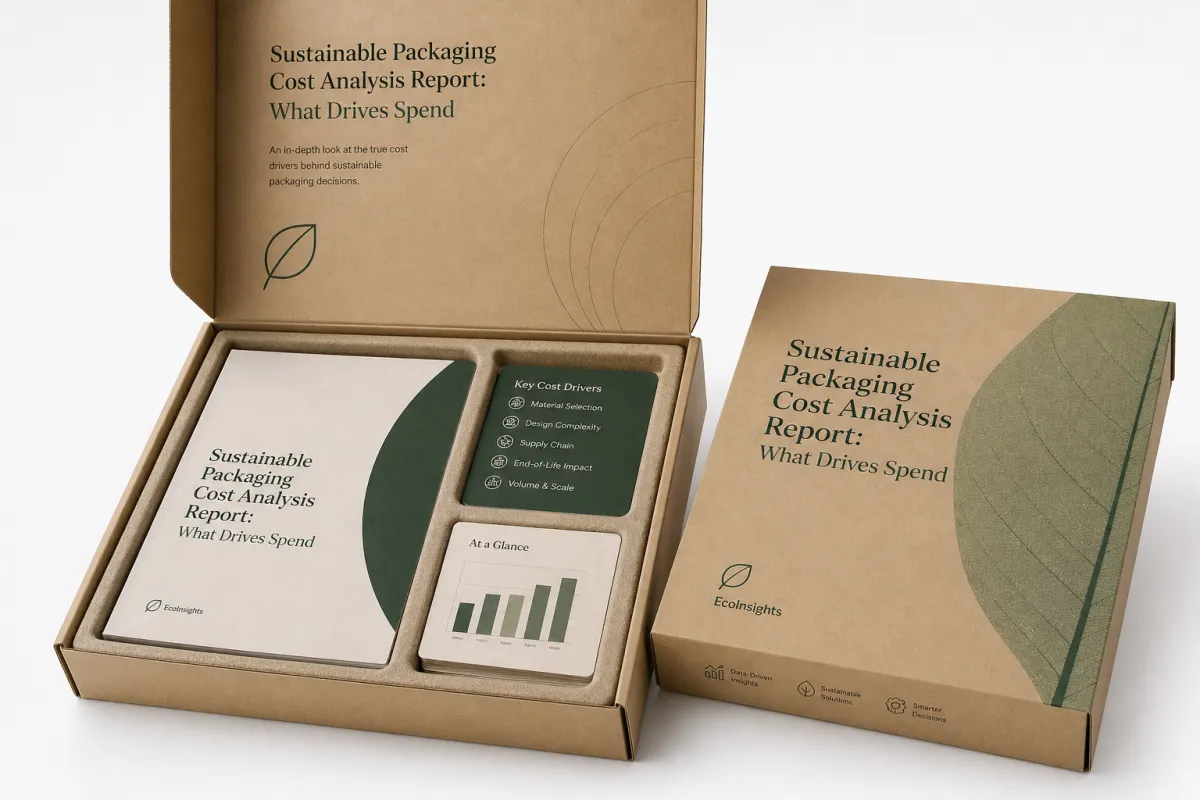
Sustainable Packaging Cost Analysis Report: What Drives Spend
The quickest route to overspending is comparing packaging by unit price alone. That approach feels disciplined right up until the oversized mailer eats freight space, the coating bumps the cost, or the structure crushes in transit and triggers a second run. A buyer can celebrate a low factory price and still end up paying more once pallets, freight class, customs, storage, and damage allowance enter the picture. Savings evaporate fast when the comparison ignores the full trip.
A proper sustainable packaging cost analysis report starts with landed cost. That means factory price plus freight, customs if relevant, warehousing, sampling, rework, and the cost of mistakes. It also means looking at the pack-out process. Flat-packed packaging tends to save labor and warehouse space. Awkward pre-assembled structures tend to do the opposite. A few millimeters, a fold line, or a closure style can change labor time more than buyers expect. Small choices are often the expensive ones.
The main cost drivers are predictable:
- Substrate - recycled kraft, FSC board, corrugated, molded fiber, and compostable film all land in different price bands.
- Print method - flexo, offset, digital, and screen printing each behave differently on setup cost and run speed.
- Tooling - die lines, cutting tools, plates, and molds can create a meaningful first-order expense.
- Finishing - embossing, foil, aqueous coating, soft-touch film, and specialty inks change the quote quickly.
- Assembly - glued cartons, hand-folded inserts, and kitting add labor that rarely shows up in the first headline number.
- Shipping - volume, weight, pallet efficiency, and destination can erase an apparently cheap quote.
- Waste - over-ordering, misprints, and weak compression strength raise the true program cost.
That is why the best sustainable packaging cost analysis report does not begin with “What is your unit price?” It begins with “What is the structure, what is the shipping method, and how is the order packed?” Without that, quote comparison turns into noise. And noise is expensive.
The cheapest quote is often the one with the least honesty attached.
If the packaging has to do real work in retail or e-commerce, the same rule applies. A simple structure with disciplined packaging design, restrained print coverage, and a material matched to the product weight usually costs less than a clever shape that looks impressive on a render. Pretty is not a cost strategy. In many programs, the lowest-risk move is a straightforward format with a clean dieline and a material spec that respects the product instead of fighting it.
For buyers who want to review practical options first, our Custom Packaging Products page is a useful starting point before requesting a formal quote. The goal is to compare formats with a production lens, not a mood board.
What Should a Sustainable Packaging Cost Analysis Report Compare?
A useful sustainable packaging cost analysis report should compare more than the sticker price. It should line up board grade, print coverage, finish choices, MOQ, freight assumptions, and the expected waste rate. If one option looks cheaper because it skips a coating or uses a thinner board, the report should say so plainly. That is the difference between analysis and wishful thinking.
The strongest comparison also checks the hidden tradeoffs. A lighter package can reduce freight and improve pallet density, but only if it still protects the product. A recycled substrate can support sustainability goals, but only if it is available at scale and fits the product’s barrier needs. A sustainable packaging cost analysis report should make those tradeoffs visible instead of hiding them behind one neat number.
For teams managing a launch, the right comparison often includes:
- Factory cost versus landed cost
- Material grade versus product protection
- MOQ versus inventory risk
- Lead time versus launch date pressure
- Carbon footprint versus shipping efficiency
- Life cycle assessment inputs versus marketing claims
That last point matters more than many buyers expect. Sustainability claims are only useful when they can survive procurement questions. A report that compares recycled content, material recovery, and transit efficiency gives the team a cleaner path to decision-making. A sustainable packaging cost analysis report should not read like a brochure. It should read like evidence, with enough detail to stand up in a budget meeting.
Product Details for a Sustainable Packaging Cost Analysis Report
A useful sustainable packaging cost analysis report has to define the actual product under review. “Eco packaging” is too vague to quote properly. The real options are more specific: mailer boxes, folding cartons, rigid boxes, labels, inserts, and shipping shippers. Each behaves differently in production, freight, and shelf presentation, which is why broad language leads to bad comparisons.
Mailer boxes and corrugated shippers usually suit e-commerce, subscription, and direct-to-consumer product packaging. They offer useful crush protection, print well with flexo or digital methods, and ship flat, which keeps freight and storage sane. Folding cartons fit retail packaging, cosmetics, supplements, candles, and smaller consumer goods. They are lighter than corrugated, easy to display, and often better for shelf cube efficiency. Rigid boxes belong to premium branded packaging where presentation matters enough to absorb extra labor and board wrap. They cost more because the build is more demanding. There is no mystery in that.
Material choice changes the budget in practical ways:
- Recycled kraft - a straightforward choice for mailers and inserts, with a natural look and a manageable cost base.
- FSC-certified board - a common choice for folding cartons and premium retail packaging when chain-of-custody paperwork matters.
- Molded fiber - useful for trays, inserts, and protective components, especially where plastic replacement matters.
- Corrugated board - still the workhorse for shipping strength and pallet efficiency.
- Compostable films - useful for certain flexible formats, but often tied to higher price and sourcing complexity.
- Paper-based wraps - practical for inner wraps, void fill, and protective sleeves.
The question is not “Which material sounds greenest?” The real question is “Which material makes financial sense for this product and shipping route?” Heavy items, fragile items, and products moving through rough distribution lanes need honest engineering. Underbuild the pack and damage claims take the savings back, usually with interest. That mistake shows up often in product packaging. Cheap materials can become expensive incident reports.
Barrier coatings and sustainability claims change the quote too. A water-based coating may cost less than a specialty compostable barrier, but that is not a rule. Certification paperwork, ink selection, recycled content requirements, and moisture resistance all shift pricing. Food-safe or moisture-sensitive products raise the stakes further. Vague “eco” language has no place there. A specification sheet and a test plan do.
For a quick orientation on material categories and print methods, references from packaging.org help anchor the terminology before supplier quotes start arriving. That does not replace a sample, but it keeps the conversation from drifting into marketing speak. A sustainable packaging cost analysis report gets stronger when the material language is precise enough to compare one supplier against another without guesswork.
Specifications That Move the Needle
Most quote gaps come from specifications, not supplier mood. In a sustainable packaging cost analysis report, dimensions are one of the first numbers that matter. Oversized packaging wastes board, fills freight space badly, and often forces a stronger material grade than the product actually needs. The money leaks out one box at a time. For small products, reducing each side by 5 to 10 mm can improve nesting efficiency and pallet count. That kind of change looks tiny on paper and meaningful on a freight invoice.
Thickness and strength matter just as much. A folding carton may be quoted on 300gsm, 350gsm, or 400gsm board. A corrugated mailer may move between E-flute, B-flute, or single-wall versus double-wall construction. A rigid box wrap might need 1200gsm greyboard wrapped in printed paper. Those numbers are not decoration. They determine whether the packaging survives transit, stacks properly, and feels premium enough to support the brand. In plain terms, a slightly heavier board can reduce damage and rework, while an overbuilt structure inflates freight and carton cost without improving the job.
Print specs shift price too. One-color outside print is a different cost profile from full-color outside-and-inside coverage with varnish, flood coat, or spot finishing. Buyers often underestimate how much total coverage matters. Heavy ink coverage can slow the press and demand more careful drying. Multiple spot colors increase registration work. Tight brand color tolerance adds control steps. None of that is free, even when the final box looks simple.
Good quote requests include the details that stop the back-and-forth:
- Exact finished dimensions, not rounded estimates.
- Board type, caliper, flute style, or paper grade.
- Print coverage, printed sides, and finish type.
- Need for inserts, dividers, windows, or cutouts.
- Bleed, dieline format, and file version.
- Target product weight and shipping method.
- Any certification requirement, such as FSC or recycled content.
That is the gap between a real sustainable packaging cost analysis report and a rough estimate dressed up as a quote. If the supplier has to chase basic measurements, the number usually changes later. The change is rarely downward.
Buyers also need to compare structures apples-to-apples. A tuck-end folding carton is not the same as a lock-bottom carton. Flat-pack delivery is not the same as pre-assembled delivery. A standard rectangle is not the same as a custom die-cut shape. The more unusual the structure, the more the unit cost moves away from simple material math and toward labor and setup.
If you want a cleaner buying path, our custom printed boxes options make it easier to compare structure, material, and finish without guessing what the quote means. That matters when margin and brand fit both have to survive the same purchase order. A sustainable packaging cost analysis report can only do its job if the specification sheet is detailed enough to hold the line.
Sustainable Packaging Cost Analysis Report: Pricing & MOQ
This is the section most buyers read first, and for good reason. A sustainable packaging cost analysis report only matters if it shows realistic pricing bands by volume. Setup costs are fixed. Material and labor are not. That is why the same box can feel expensive at 500 units and sensible at 10,000. MOQ is not just a supplier preference. It is the mechanism that spreads tooling, setup, and waste across the run.
Here is a practical pricing snapshot. These are broad ranges, because exact pricing depends on dimensions, print coverage, finish, and delivery terms. Even so, they are useful for planning:
| Format | Typical MOQ | Approx. Unit Cost at 1,000 | Approx. Unit Cost at 5,000 | Approx. Unit Cost at 20,000 | Best Fit |
|---|---|---|---|---|---|
| Recycled kraft mailer box | 300-500 | $1.05-$2.40 | $0.48-$1.05 | $0.32-$0.72 | E-commerce, subscription, light to medium product packaging |
| Folding carton, full-color print | 500-1,000 | $0.42-$1.25 | $0.22-$0.58 | $0.12-$0.32 | Retail packaging, cosmetics, supplements, candles |
| Rigid gift box | 500-1,000 | $2.10-$5.50 | $1.35-$3.20 | $0.85-$2.10 | Premium branded packaging, gifting, launch kits |
| Corrugated shipping shipper | 300-500 | $0.90-$2.10 | $0.40-$0.95 | $0.28-$0.62 | Transit protection, heavier products, cube efficiency |
| Molded fiber insert set | 2,000-5,000 | $0.55-$1.80 | $0.30-$0.82 | $0.18-$0.45 | Protective inserts, plastic replacement, nesting trays |
Those ranges point to a useful truth: the drop from 1,000 to 5,000 units is usually meaningful, and the move from 5,000 to 20,000 is where the program starts to feel efficient. Sitting below MOQ means setup cost hangs heavily on every box. Small runs often feel expensive because they are. The math is blunt, not personal.
A solid sustainable packaging cost analysis report breaks the quote into components so the money is visible:
- Tooling - die, mold, plate, or cutter setup.
- Samples - prototype or pre-production proofs.
- Material - board, fiber, film, adhesive, wrap.
- Labor - print, cutting, gluing, assembly, kitting.
- Finishing - coating, lamination, embossing, hot stamp.
- Shipping - cartons, palletizing, freight, destination charges.
Lowering cost without weakening the package starts with standard sizes. Standard sheet sizes and standard die forms reduce waste and improve nesting. The next step is simplifying finishes. A well-executed one- or two-color print can look sharp if the layout is disciplined. Heavy embossing and multiple special effects can be beautiful, but beauty carries a price tag. Fewer finishes usually mean fewer surprises.
Another practical move is consolidating shipments. Multiple small drops are a silent budget drain. If the production schedule allows it, a single freight movement often beats several partial loads. A sustainable packaging cost analysis report should make that visible. If it does not, the report is too polite to be useful.
Landed cost still matters more than factory price. A quote can look attractive until ocean freight, domestic drayage, customs handling, or storage gets added. Buyers who skip that detail usually meet the difference later in finance meetings. No one enjoys those meetings, which is exactly why the math should be handled early. A careful sustainable packaging cost analysis report turns those hidden charges into visible planning inputs before the order is placed.
Process and Timeline: From Quote to Delivery
A sustainable packaging cost analysis report works better when it also maps the buying path. Packaging projects rarely move in a straight line. They pass through review loops, sample approvals, material checks, and production scheduling. Knowing the sequence helps buyers plan inventory and avoid expensive panic orders.
The standard process is straightforward:
- Inquiry - buyer shares dimensions, quantity, target material, print coverage, and delivery destination.
- Spec review - supplier checks board options, structure, MOQ, and lead time.
- Quote - pricing is issued with tooling, sample, production, and freight assumptions.
- Sample - flat sample, white sample, or printed prototype is produced.
- Approval - artwork, fit, and structure are signed off.
- Production - printing, cutting, gluing, or molding begins.
- QC - dimensional checks, color checks, and strength checks are completed.
- Shipping - goods are palletized, booked, and dispatched.
Timing depends on complexity, but these ranges are realistic for many custom runs:
- Quote turnaround - often 24 to 72 hours if the spec is complete.
- Sampling - 5 to 10 business days for standard structures, longer for complex rigid or molded formats.
- First production run - often 12 to 20 business days after approval, depending on finish and material availability.
- Repeat orders - frequently faster, sometimes 8 to 15 business days if tooling and artwork are already locked.
- Freight - transit time depends on mode and destination; local trucking and export freight do not behave the same way.
Delays usually show up in three places: artwork changes, certification checks, and custom tooling. A buyer will often request a small edit after the sample is made, and that edit can push the whole schedule. Certification paperwork can slow things down too, especially if FSC documentation or recycled-content claims need confirmation. Seasonal demand adds another layer. Peak production months fill up quickly. Large orders with unusual specs do not get priority just because the calendar is inconvenient.
A clean spec sheet shortens the process. One version of the dieline, one approved color target, one shipping destination, and one decision-maker on the buyer side can prevent a lot of drift. Fewer handoffs mean fewer errors. A sustainable packaging cost analysis report should tell you whether the project is likely to need one sample round or three. That is a buying signal, not a footnote.
For packaging that must survive rough distribution, transit testing matters too. If the shipment will be handled hard, ask for testing aligned with ISTA transit test methods. It costs less to fail a sample than to fail a live launch. Packaging that looks beautiful on a desk and collapses in a warehouse is just expensive waste.
Why Choose Us for Sustainable Packaging
A serious sustainable packaging cost analysis report should end with supplier evaluation, because the wrong partner can make even a good structure behave badly. Value is not only in selling a box. Value is in matching the structure to the budget, the product weight, the shipping route, and the brand expectation without padding the quote with unnecessary extras.
At Custom Logo Things, the practical advantage is simple: we help buyers choose the material and format that fit the real job. That sounds plain. Good. Plain is often profitable. We focus on clear specifications, stable lead times, and quote breakdowns that show where the cost sits instead of hiding it inside one vague number. If a buyer needs a standard folding carton, there is no reason to force a rigid setup. If a launch needs durable transit protection, there is no reason to pretend a lightweight sleeve will do the job.
Quality control should be visible, not decorative. A useful sustainable packaging cost analysis report should reflect the checks that protect the order:
- Color checks - especially where brand colors need consistent reproduction.
- Dimensional checks - to confirm fit and carton closure.
- Compression checks - for shipping strength and stackability.
- Pack-out validation - to make sure the product fits the final structure.
- Artwork review - to catch bleed, alignment, and finish issues early.
Paper claims also need discipline. If the order needs FSC language, the paperwork should match the claim. No drama, no shortcuts. If recycled content matters, the spec should say so plainly. Buyers can use FSC chain-of-custody standards as a reference point for documentation, and they should ask every supplier to show the same level of clarity. Sustainability is not a vibe. It is a spec.
Response time matters too. A slow supplier makes the entire process harder. Fast quote feedback, realistic minimums, and clear sample comments are not extras. They are part of the service. If the supplier cannot explain why one format costs more than another, the buyer is left guessing. Guessing is how budgets get bruised. A clear sustainable packaging cost analysis report should make the supplier’s logic visible enough that finance and operations can agree on the same line item.
For teams comparing branded packaging options, our branded packaging solutions page is a practical place to review structure choices before locking the production spec. That saves time, and it keeps the conversation centered on what the package needs to do.
Good packaging does three jobs at once: protect the product, support the brand, and stay sane on the invoice.
That is the standard. Anything less is just a prettier problem.
Actionable Next Steps for Buyers
To turn a sustainable packaging cost analysis report into a working purchase plan, start with the facts. Gather dimensions, product weight, target quantity, shipping method, and the sustainability requirements that actually matter to your business. Do not start with design taste. Start with product size and shipping reality. That is what drives the quote.
Then ask every supplier for the same comparison set. If one quote includes freight, tooling, and a printed sample while another excludes all three, the lower number is meaningless. A real sustainable packaging cost analysis report should show:
- Factory price
- Tooling and sample charges
- Material grade
- Print coverage and finishing
- MOQ and production lead time
- Freight terms and destination assumptions
- Risk notes for reprints or structural changes
Here is the decision framework that keeps the process sane:
- Pick the structure - mailer, folding carton, rigid box, insert, or shipper.
- Set the MOQ target - enough volume to dilute setup cost, but not so much that inventory becomes dead weight.
- Approve one sample - test fit, strength, and presentation before production.
- Lock the spec - dimensions, material, print, and finish should stop moving.
- Book production and freight - because delay costs money too.
If your team is balancing retail presentation with transit protection, name both goals clearly. Many programs fail because the buyer wants shelf appeal, operations wants stronger packaging, and finance wants the lowest line on the page. A good sustainable packaging cost analysis report resolves those priorities by showing the cost of each choice. That is the point. You are not buying a slogan. You are buying a package that has to survive a supply chain.
Use the report as a buying tool, not a branding exercise. If the structure protects the product, presents the brand properly, and stays within margin, it is a good decision. If it looks clever but creates freight waste or reprint risk, it is a bad decision dressed in recycled paper. The paper does not care. Your budget does.
The practical takeaway is simple: compare factory price, landed cost, and packaging performance in the same spreadsheet, then approve only the structure that clears all three. A sustainable packaging cost analysis report works when it turns sustainability, protection, and spend into one decision instead of three separate arguments.
Frequently Asked Questions
What does a sustainable packaging cost analysis report include?
It should break down material, printing, tooling, finishing, freight, and MOQ impact instead of showing one blended unit price. It should compare multiple material and structure options so buyers can see where the money goes. Landed cost matters just as much as factory cost, because shipping can change the answer quickly. A strong sustainable packaging cost analysis report also makes the total cost of ownership easier to compare across suppliers.
How do recycled or compostable materials affect sustainable packaging cost analysis?
Recycled board is often competitive, but specialty compostable materials can raise pricing fast. Costs move based on availability, certification, barrier performance, and production waste. The cheapest option is not always the best fit if it creates damage, reprints, or heavier freight. A sustainable packaging cost analysis report should show whether the sustainability gain changes the carbon footprint enough to justify the price shift.
What MOQ should I expect for custom sustainable packaging?
MOQ depends on structure, print complexity, and tooling, but smaller runs usually carry a higher per-unit cost. Standard sizes and simpler finishes can reduce minimum order pressure. A supplier should explain the price jump between low-volume and production-scale orders so you can decide whether the setup cost makes sense. That clarity is a core part of any usable sustainable packaging cost analysis report.
How long does sustainable packaging production usually take?
First orders take longer because sample approval, artwork checks, and material sourcing add time. Repeat orders are usually faster once the spec and tooling are already approved. Custom finishes, new dies, and certification reviews can extend the timeline, so a realistic schedule is better than a hopeful one. Your sustainable packaging cost analysis report should reflect that timing instead of pretending every order moves at the same pace.
What information do I need to get an accurate quote?
Provide dimensions, product weight, quantity, print coverage, material preference, and shipping destination. Include whether you need retail-ready presentation, transit protection, or both. The more exact the spec, the less likely the quote will change later, which is exactly how a sustainable packaging cost analysis report should work. If you also know your recycled content target or FSC requirement, include that too so the comparison stays clean.

