Buyer Fit Snapshot
| Best fit | Sustainable Paperboard Boxes Manufacturer projects where brand print, material claims, artwork control, MOQ, and repeat-order consistency need to be specified before quoting. |
|---|---|
| Quote inputs | Share finished size, material target, print colors, finish, packing count, annual reorder estimate, ship-to region, and any compliance wording. |
| Proofing check | Approve dieline scale, logo placement, barcode or warning zones, color tolerance, closure strength, and carton packing before bulk production. |
| Main risk | Vague material claims, crowded artwork, missing packing details, or unclear freight terms can make a low unit price expensive after revisions. |
Fast answer: Sustainable Paperboard Boxes Manufacturer: Board, Finish, Dieline, and Unit Cost should be specified like a repeatable production item. The safest quote records material, print method, finish, artwork proof, packing count, and reorder notes in one written spec.
Production checks before approval
Compare the actual filled-product size with the drawing, then confirm tolerance on folds, seals, hang holes, label areas, and retail display edges. Reserve space for logos, QR codes, warning copy, and material claims before decorative graphics fill the panel.
Quote comparison points
Review material grade, print process, finish, sampling route, tooling charges, carton quantity, and freight assumptions side by side. A quote is only useful when the supplier can repeat the same color, closure quality, and packing count on the next order.
Sustainable Paperboard Boxes Manufacturer: What to Know
A sustainable paperboard boxes manufacturer is not the company that prints a leaf on a carton and calls it a day. It is the partner that designs packaging to use the right amount of material, protect the product through the rough parts of shipping, and still fit a normal recycling stream when the box has done its job. That distinction matters more than most buyers realize, because a carton that looks responsible but splits on the line or crushes in transit is just expensive waste with better branding.
From the buyer side, the real question is simple: does the box reduce waste without creating a new mess somewhere else? A sustainable paperboard boxes manufacturer should answer that with board grades, material data, structural details, and print choices you can actually measure. Recycled content belongs in the conversation. FSC-certified stock matters when sourcing transparency is part of the brand promise. Lighter calipers can make sense when the product allows it. Box structures that are easier to recycle after use matter too. If those choices stay vague, the sustainability claim is probably vague as well.
Sustainability sits next to freight cost, damage rates, shelf appeal, and the way the package behaves after it leaves the warehouse. A strong sustainable paperboard boxes manufacturer thinks through the whole chain: sourcing, production waste, protection, and end-of-life. That is the difference between a box that sounds green and a box that actually earns the description.
A box is not sustainable because somebody printed a tree on it. It is sustainable when it uses the right amount of board, survives transit, and still fits a normal recycling stream without a lot of drama.
Sustainable Paperboard Boxes Manufacturer: What It Really Means
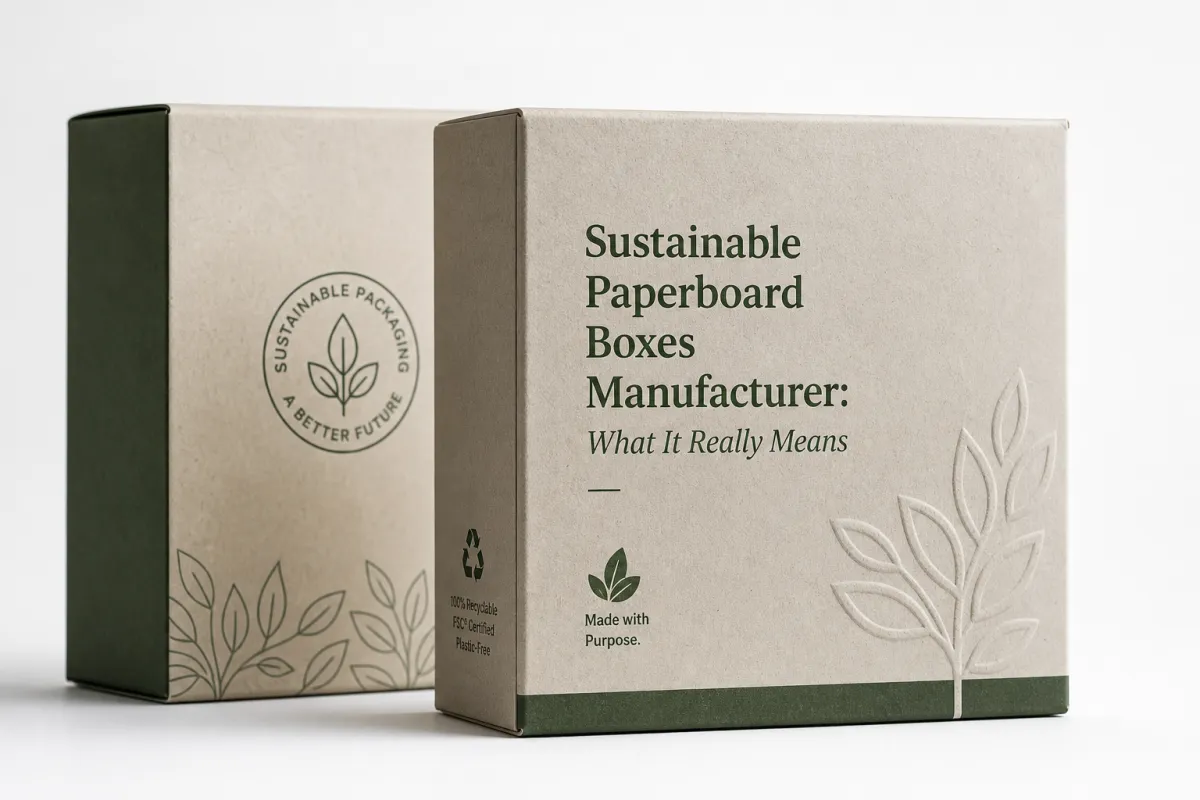
A sustainable paperboard boxes manufacturer does four things well: sources material carefully, designs the structure intelligently, reduces production waste, and avoids unnecessary finishes that make recycling harder. That sounds tidy on paper. The real work is messier. Buyers often treat "eco" as a synonym for "recycled" and stop there, which is how a packaging program can look good in one area while causing problems in several others.
The common terms deserve clearer definitions. Recycled content means the board includes recovered fiber, often post-consumer or post-industrial. FSC-certified stock means the fiber chain is documented under Forest Stewardship Council standards, which is useful when traceability matters. Lightweighting means using less board while keeping the structure sound. Design for recyclability means choosing coatings, inks, adhesives, and laminations that do not turn recycling into a nuisance. A sustainable paperboard boxes manufacturer should be able to explain all four without hiding behind one favorite term.
There is another mistake buyers make often: they ask paperboard to do a job that needs more protection than paperboard can reasonably provide. Folding cartons perform well for cosmetics, supplements, candles, small electronics accessories, apparel inserts, food sleeves, and retail-ready consumer goods. They are a weaker match for heavy glass bottles, fragile high-value components, or products that take a rough route through ecommerce without a secondary shipper. A good sustainable paperboard boxes manufacturer will say that plainly, even when the answer complicates the sale.
That kind of honesty matters because sustainability is not a pass for weak packaging. If a thinner carton saves board but increases breakage, the total environmental impact can get worse quickly. More replacements. More freight. More labor. More customer frustration. A practical sustainable paperboard boxes manufacturer works toward the smallest box that still protects the product and supports the brand. That is where many of the real savings live.
For sourcing transparency, some buyers start with FSC documentation and chain-of-custody checks through FSC. That is not the whole picture, yet it gives you a solid baseline when you want proof instead of promises.
What the best manufacturers optimize
Strong suppliers keep three priorities in view at once: material use, print quality, and distribution performance. A sustainable paperboard boxes manufacturer that talks only about recycled stock while ignoring box geometry misses part of the job. A box that nests efficiently on a sheet, folds cleanly, and stacks well in master cartons usually beats a "green" design that wastes board and drives up freight. Small structural changes can save more material than jumping to a pricier stock grade.
Where paperboard works best
Paperboard does its best work when the product is relatively light, the retail footprint matters, and the buyer wants a clean printed surface. A sustainable paperboard boxes manufacturer can often cut both cost and waste by tightening the dieline or replacing plastic trays with paper-based inserts. If the product needs serious crush resistance, moisture protection, or repeated handling, the box needs to be engineered for that reality instead of hoping paperboard can cover every use case.
What sustainability does not excuse
Green materials do not excuse weak construction. A box that splits at a corner, bows under load, or arrives scuffed because the coating was too delicate is not a win. A sustainable paperboard boxes manufacturer should be ready to explain the tradeoffs between board stiffness and weight, aqueous coating and soft-touch laminate, recycled fiber and surface smoothness. Packaging is a physical object before it is a brand asset, and those details decide whether it works. I've seen more than one "eco" carton fail for the plain reason that nobody tested the corners under real load, which is kind of the whole point of packaging in the first place.
How a Sustainable Paperboard Boxes Manufacturer Builds Better Boxes
The production flow is where the idea becomes a carton that actually holds up. A sustainable paperboard boxes manufacturer usually starts with a product brief, then moves into structural design, board selection, print setup, cutting, folding, and finishing. That sequence may sound ordinary, and that is exactly the point. Ordinary process is what keeps packaging from becoming an expensive experiment.
The brief comes first. The manufacturer needs dimensions, product weight, packing method, shipping method, and branding goals. Without those details, the quote is mostly guesswork. A sustainable paperboard boxes manufacturer with real experience will ask for a sample or at least exact measurements, because even a few millimeters can change how a carton closes, stacks, and protects the product. "Close enough" is a fast way to burn money.
Structural design follows. Good engineers try to nest the dieline efficiently on the sheet so more finished boxes come from less board. They also compare tuck-end, auto-bottom, lock-bottom, sleeve, and insert styles to see which one fits the product best. A sustainable paperboard boxes manufacturer should not default to one familiar style for every order. The box should match the product and the shipping route, not the supplier's habits.
Material selection comes next. Recycled board may be the right choice for a lightweight retail carton, while a smoother SBS board can be better for premium print and crisp folding. Finishes matter too. Aqueous coating usually supports recycling better than heavy lamination, and water-based adhesives are often the cleaner choice when fiber recovery matters. A sustainable paperboard boxes manufacturer should explain those choices plainly, without pretending every green-sounding option has the same impact.
Testing before a full run
Prototyping is not a luxury. It is the cheapest place to catch a bad fit. A sustainable paperboard boxes manufacturer should run samples for closure fit, shelf presence, and basic distribution handling before production starts. If the product is headed into ecommerce, transit testing matters even more. Industry buyers often refer to ISTA-style distribution testing as a useful benchmark, and for good reason: a nice-looking carton is still a failure if it falls apart after one corner drop. The ISTA standards are not magic, but they are a lot better than guessing and hoping for the best.
Why layout efficiency saves money
Nesting matters. Board sheets arranged poorly waste material, and waste shows up in cost, freight, and carbon footprint. A sustainable paperboard boxes manufacturer can often lower total spend by redesigning the layout, trimming unused space, or adjusting the dieline to a standard sheet size. That might save only a few cents per unit, which sounds minor until the run reaches 10,000 or 50,000 boxes. Packaging math has a way of making small inefficiencies expensive.
Why finishing choices need restraint
Finishing is where sustainability often gets undermined. Too much foil, too much film lamination, too much unnecessary UV varnish, and the "eco" carton becomes harder to recycle and more expensive to make. A sustainable paperboard boxes manufacturer should be able to suggest a lighter-touch finish that still supports the brand. Matte aqueous coating, controlled spot color usage, and clean embossing can create a premium feel without turning the carton into a recycling headache.
There is a simple rule here: every extra feature needs a job. If it does not improve protection, branding, or stack performance, it is probably decoration pretending to be strategy. A sustainable paperboard boxes manufacturer will push back when a request is overbuilt, because overbuilt packaging burns material twice - once in the factory and again in shipping.
Cost and Pricing Factors for a Sustainable Paperboard Boxes Manufacturer
Pricing is where buyers often get unrealistic. A sustainable paperboard boxes manufacturer is not expensive just because the word "sustainable" appears on the quote. Price depends on board grade, size, structure, print coverage, coatings, inserts, and order quantity. The same box can swing a lot depending on whether you need a simple one-color carton or a fully printed retail pack with specialty finishing and a tight deadline.
Here is the part people forget: sustainability does not automatically raise cost. In many cases, a sustainable paperboard boxes manufacturer saves money by right-sizing the carton, reducing board thickness, or cutting freight weight. The real cost jump usually comes from premium recycled stock, small minimums, extra proof rounds, or finish choices that slow production. If someone tells you every sustainable box is expensive, they are skipping the math.
| Option | Typical Spec | Common Unit Range | Best Fit |
|---|---|---|---|
| Economy recycled carton | 14pt-16pt recycled board, 1-2 colors, aqueous coating | $0.18-$0.32 at 5,000 units | Supplements, small accessories, entry retail packs |
| Mid-range retail box | 16pt-18pt board, 4-color print, clean die-cut, optional insert | $0.28-$0.55 at 3,000-5,000 units | Cosmetics, candles, premium consumer goods |
| Premium custom carton | Higher-end recycled or FSC stock, spot finish, stronger structure | $0.55-$1.10 at 2,000-3,000 units | Gift sets, higher-value retail packaging |
| Mail-ready paperboard or lightweight corrugated style | Richer protection, higher board caliper, transit-friendly design | $0.60-$1.35 at 2,000-5,000 units | Ecommerce shipments and fragile items |
Those ranges are not a quote. They are a reality check. A sustainable paperboard boxes manufacturer still needs exact dimensions, artwork coverage, insert requirements, and shipping destination before giving a real number. Even so, the tiers help buyers see where the money goes. If you want a lower unit price, the quickest path is usually a simpler structure, fewer ink colors, and a board spec that is strong enough without being excessive.
Hidden costs matter too. Freight can be brutal if the box is oversized. Storage becomes a headache if the order is too large for the warehouse. Revisions cost money if the dieline keeps changing. Damage costs are the ugliest expense of all, because they show up later as remakes, returns, and customer complaints. A sustainable paperboard boxes manufacturer should help you model total cost, not just sticker price.
One useful tradeoff shows up often: better board can reduce damage enough to justify a slightly higher unit cost. If a sturdier carton prevents a 3% breakage rate on fragile products, the "cheaper" box was never cheaper. A good sustainable paperboard boxes manufacturer will say that plainly, even if it makes the quote discussion a little less comfortable.
Process and Timeline: Working with a Sustainable Paperboard Boxes Manufacturer
The best projects move quickly because the brief is clean. A sustainable paperboard boxes manufacturer usually follows a straightforward path: discovery call, technical brief, dieline review, material recommendation, prototype, approval, production, and delivery. Nothing exotic there. The difference between a smooth project and a messy one is whether the buyer has the details ready before the quote request goes out.
A clean brief should include product dimensions, product weight, how the item is packed, whether it will ship direct-to-consumer or sit on a shelf, and what finish the brand wants. A sustainable paperboard boxes manufacturer can quote much faster when the product spec is complete. If the brief says "around this size" or "something eco but premium," expect extra questions. Vague inputs make vague boxes.
Timelines vary. Simple box styles with standard materials can sometimes move from proof approval to production in roughly 10-15 business days. More customized work - structural changes, specialty inserts, new tooling, multiple sample rounds - can stretch to 15-25 business days or more before shipping. A careful sustainable paperboard boxes manufacturer will say that up front rather than pretending every order moves at the same pace.
Delays usually come from the client side more than the factory side. Approval lag, artwork revisions, unclear measurements, and last-minute structural changes are the usual culprits. A sustainable paperboard boxes manufacturer can only move as fast as the information it receives. The quickest projects are not the loudest ones. They are the ones with complete specs and a buyer who makes decisions on time.
What speeds up the project
Three things make a real difference: complete dimensions, final artwork files, and a clear sustainability target. If the buyer knows whether FSC certification matters, whether recycled content is required, and whether the carton must be recyclable in curbside programs, the manufacturer can narrow the options immediately. A sustainable paperboard boxes manufacturer does better work when the target is specific. "Make it greener" is not specific, and it usually sends everybody in circles for no good reason.
What slows it down
Revisions are the usual killer. Changing the die size after sample approval can trigger a new test. Switching from matte to soft-touch coating can affect recycling and production lead time. Even moving one panel's artwork can require another proof. A sustainable paperboard boxes manufacturer can handle those changes, but every change costs time and money. That is not a complaint. It is manufacturing.
For buyers comparing options, it helps to review the supplier's broader capabilities too. Browsing Custom Packaging Products gives you a sense of the box styles available, while About Custom Logo Things helps frame how the team approaches custom work and support. The goal is to choose a sustainable paperboard boxes manufacturer that can handle both the packaging idea and the production reality without turning the project into a long round of guesswork.
What to Check Before Choosing a Sustainable Paperboard Boxes Manufacturer
Not every supplier that uses green language is actually a sustainable paperboard boxes manufacturer. Some are simply better at marketing. The difference shows up in the questions they can answer without hesitation: where the board comes from, what certifications apply, how the box is tested, and what happens if the product needs a different structure. If those answers are fuzzy, the sustainability claim is likely decorative.
Start with sourcing transparency. Ask what board grades are available, whether the stock is FSC-certified, what recycled content is realistic, and whether the supplier can provide material specs. A real sustainable paperboard boxes manufacturer should be able to talk about board caliper, print surface, and finishing choices in plain language. If the answer is "trust us, it's green," keep moving. Packaging should not require blind faith.
Then check engineering support. Good packaging is not just printed; it is designed. The supplier should help with right-sizing, closure style, insert selection, and shipping suitability. A strong sustainable paperboard boxes manufacturer will also talk about local recycling realities, because a box that is technically recyclable but awkward in real use is only half a solution.
Ask for sample photos and finished examples, not just mockups. Real photographs show how the box folds, how clean the print is, and whether the finish looks premium or just shiny. A sustainable paperboard boxes manufacturer with experience should be able to show similar projects without hesitation. Proof matters more than adjectives.
- Material proof: board spec sheets, certification details, and finish information
- Structural support: dieline assistance, insert guidance, and fit checks
- Production clarity: minimum order quantity, lead times, and approval steps
- Performance logic: testing advice for shipping, retail display, and storage
The best partner is not the one with the loudest environmental vocabulary. It is the sustainable paperboard boxes manufacturer that understands the tradeoff between brand presentation and supply-chain reality. If a supplier can talk honestly about both, you are probably dealing with someone worth keeping around.
Common Mistakes Buyers Make with Sustainable Paperboard Boxes Manufacturers
The first mistake is easy to spot: choosing a box that is too large. Extra empty space looks sloppy, uses more board, and often increases freight costs. A sustainable paperboard boxes manufacturer can help right-size the carton, but if the buyer insists on "room to breathe" for no reason, the box will waste material and money. Packing air is not a business strategy.
The second mistake is overprinting and overfinishing. Buyers often ask for foil, gloss, soft-touch, embossing, and specialty coatings all at once, then wonder why the quote jumps and recyclability falls. A sustainable paperboard boxes manufacturer should be willing to push back. A cleaner design with one strong visual idea usually beats a carton that looks like it borrowed every finishing trick in the room.
The third mistake is assuming recycled content automatically solves sustainability. It does not. If the box is underbuilt and the product breaks, the environmental cost gets worse. If the carton is so heavy that freight climbs, the footprint climbs with it. A sustainable paperboard boxes manufacturer balances fiber content with real-world performance. That is the job.
The fourth mistake is vague specs. "We need something eco-friendly for our brand" is not a brief. It is a wish. A good sustainable paperboard boxes manufacturer needs dimensions, product weight, shipping conditions, and finish goals. Without those details, the manufacturer can only guess. Guessing is expensive, and not in a fun way.
The fifth mistake is staring at unit price and ignoring the total picture. Product damage, returns, warehouse space, labor, and shipping all matter. A slightly more expensive carton can easily cost less overall if it protects better and ships more efficiently. A practical sustainable paperboard boxes manufacturer keeps steering the conversation toward total landed cost, because that is the number that actually lands in the budget.
If the packaging plan saves two cents but creates one damaged product out of every fifty, the "saving" disappeared somewhere between the dock and the customer.
None of these mistakes are rare. They show up often enough to be predictable. The fix is plain enough too: better specs, better testing, and a supplier who tells the truth before the order is placed. That is exactly what you want from a sustainable paperboard boxes manufacturer.
Expert Tips and Next Steps for Your Sustainable Paperboard Boxes Program
If I had to narrow it down to one practical rule, it would be this: start with the smallest box that safely fits the product. A sustainable paperboard boxes manufacturer can usually save you more money and waste through right-sizing than through flashy material claims. Bigger is not better. Bigger usually just means more board, more freight, and more empty space.
Another useful move is to test two board options before locking the program. One may be lighter and cheaper. The other may hold up better in transit and retail handling. A sustainable paperboard boxes manufacturer should be able to show you both and explain the tradeoff in plain numbers, not slogans. That is how buyers make decisions that still hold up after launch.
For anything shipping by parcel or moving through multiple handoffs, test the box in real conditions. A flat sample on a desk tells you almost nothing. A sustainable paperboard boxes manufacturer should encourage you to check the carton after actual packing, stacking, and transit. If the product survives the ugly version of the journey, the design is doing its job.
Before you place an order, build a simple supplier checklist:
- Board grade and certification details
- Minimum order quantity and acceptable reorder range
- Sample and proof process
- Expected lead time from approval to shipment
- Finish choices and recycling impact
- Transit testing recommendations
That checklist keeps the conversation practical. A sustainable paperboard boxes manufacturer should welcome it, not dodge it. If a supplier resists simple questions, that resistance is the answer.
For Custom Logo Things, the goal is straightforward: packaging that protects the product, fits the budget, and does not create avoidable waste. If you are comparing box styles or planning a new packaging program, use Custom Packaging Products to narrow the format, then review About Custom Logo Things to understand how the team handles custom work. The right sustainable paperboard boxes manufacturer should make the process easier, not more theatrical.
One last point: sustainability is not a badge you earn by saying the word often enough. It is a set of tradeoffs handled well. A sustainable paperboard boxes manufacturer helps you choose materials, structure, and finishes that make sense for the product and for the person recycling the box later. The practical takeaway is simple: insist on the smallest structure that still protects the product, verify the material claims, and test the carton in real transit before you commit to a full run. That is the standard worth aiming for.
FAQ
What does a sustainable paperboard boxes manufacturer do differently?
A sustainable paperboard boxes manufacturer uses better material sourcing, more efficient box design, and lower-waste production methods. The good ones also balance recyclability, durability, and print quality instead of optimizing for looks alone. They help buyers avoid oversized or overbuilt packaging that costs more to ship.
Are sustainable paperboard boxes more expensive?
They can be, but not always. Price depends on board grade, print coverage, coatings, structure complexity, and order volume, which is exactly why a sustainable paperboard boxes manufacturer should quote from real specs instead of guesses. Simpler structures and lighter materials often offset part of the cost, and freight savings can improve the total number more than people expect.
How long does it take to produce custom paperboard boxes?
Simple projects can move quickly if the specs are clear and the materials are standard. Custom structural work, sample approval, and artwork changes add time, even with a good sustainable paperboard boxes manufacturer. A complete brief is the fastest way to keep the schedule under control.
What should I ask before hiring a sustainable paperboard boxes manufacturer?
Ask about material sources, certifications, sample process, lead times, and minimum order quantities. Request examples of similar packaging jobs and finished box photos. A reliable sustainable paperboard boxes manufacturer should also explain how the box is meant to be recycled or disposed of in real use, not just in theory.
How do I know if the boxes are actually sustainable?
Look for proof: material specs, certification details, and transparent production claims. Check whether the design reduces excess material and shipping waste, because a sustainable paperboard boxes manufacturer should care about both. Also make sure the box still performs well, because broken product is not sustainable, no matter how nice the carton looked on approval day.
In the end, the best sustainable paperboard boxes manufacturer is the one that gives you a box program you can defend on cost, performance, and recycling reality. That usually means better specs, cleaner materials, and less nonsense. If the box protects the product, ships efficiently, and fits the way people actually recycle packaging, you are doing better than most brands already.