Buyer Fit Snapshot
| Best fit | Sustainable Poly Mailers for Artisan Soaps projects where brand print, material claims, artwork control, MOQ, and repeat-order consistency need to be specified before quoting. |
|---|---|
| Quote inputs | Share finished size, material target, print colors, finish, packing count, annual reorder estimate, ship-to region, and any compliance wording. |
| Proofing check | Approve dieline scale, logo placement, barcode or warning zones, color tolerance, closure strength, and carton packing before bulk production. |
| Main risk | Vague material claims, crowded artwork, missing packing details, or unclear freight terms can make a low unit price expensive after revisions. |
Fast answer: Sustainable Poly Mailers for Artisan Soaps: Material, Print, Proofing, and Reorder Risk should be specified like a repeatable production item. The safest quote records material, print method, finish, artwork proof, packing count, and reorder notes in one written spec.
Production checks before approval
Compare the actual filled-product size with the drawing, then confirm tolerance on folds, seals, hang holes, label areas, and retail display edges. Reserve space for logos, QR codes, warning copy, and material claims before decorative graphics fill the panel.
Quote comparison points
Review material grade, print process, finish, sampling route, tooling charges, carton quantity, and freight assumptions side by side. A quote is only useful when the supplier can repeat the same color, closure quality, and packing count on the next order.
Artisan soap shipping looks simple from a distance. Then the first dented label shows up, a lavender bar slides inside its sleeve, and the package that looked elegant on the worktable starts looking flimsy in transit. Sustainable Poly Mailers for artisan soaps solve that awkward middle lane: they are light, quick to pack, and clean to present without turning every order into a cardboard project. For small bath brands, that matters more than it sounds. A few ounces saved on each shipment can add up across a month of orders, and a smoother packing flow can save more than the package itself. For brands shipping seasonal scents, refill bars, and gift bundles, the difference shows up in labor as much as postage.
The word "sustainable" gets used so often that it can lose its meaning. One supplier means recycled-content film. Another means recyclable mono-material polyethylene. A third uses a compostable-looking film that sounds admirable until you ask how it behaves in a damp warehouse, a long route, or a busy packing table. If you are evaluating Sustainable Poly Mailers for artisan soaps, the real test is not the label on the quote sheet. It is whether the mailer holds the product, resists scuffing, protects against a little moisture, and arrives looking deliberate rather than improvised.
Soap is dry. Soap is also easy to underestimate. Handmade bars can scuff, fragrance can rub off onto a weak outer layer, and a loose fit can make a lovely product feel mass-produced. A good mailer cuts weight, speeds packing, and reduces material use, but only if the size, film, and closure match the order. In practice, Sustainable Poly Mailers for artisan soaps are not about virtue signaling. They are about picking a packaging layer that does its job without dragging the whole packout into waste or expense.
If the blunt version helps, here it is: a mailer is a tool, not a moral statement. Pick the right one and it quietly earns its keep.
Packaging buyer reality: the lowest unit price rarely stays the lowest once you add returns, repacking, postage waste, and the subtle cost of a package that makes a brand look unsteady. The savings can vanish fast.
Why Sustainable Poly Mailers for Artisan Soaps Matter
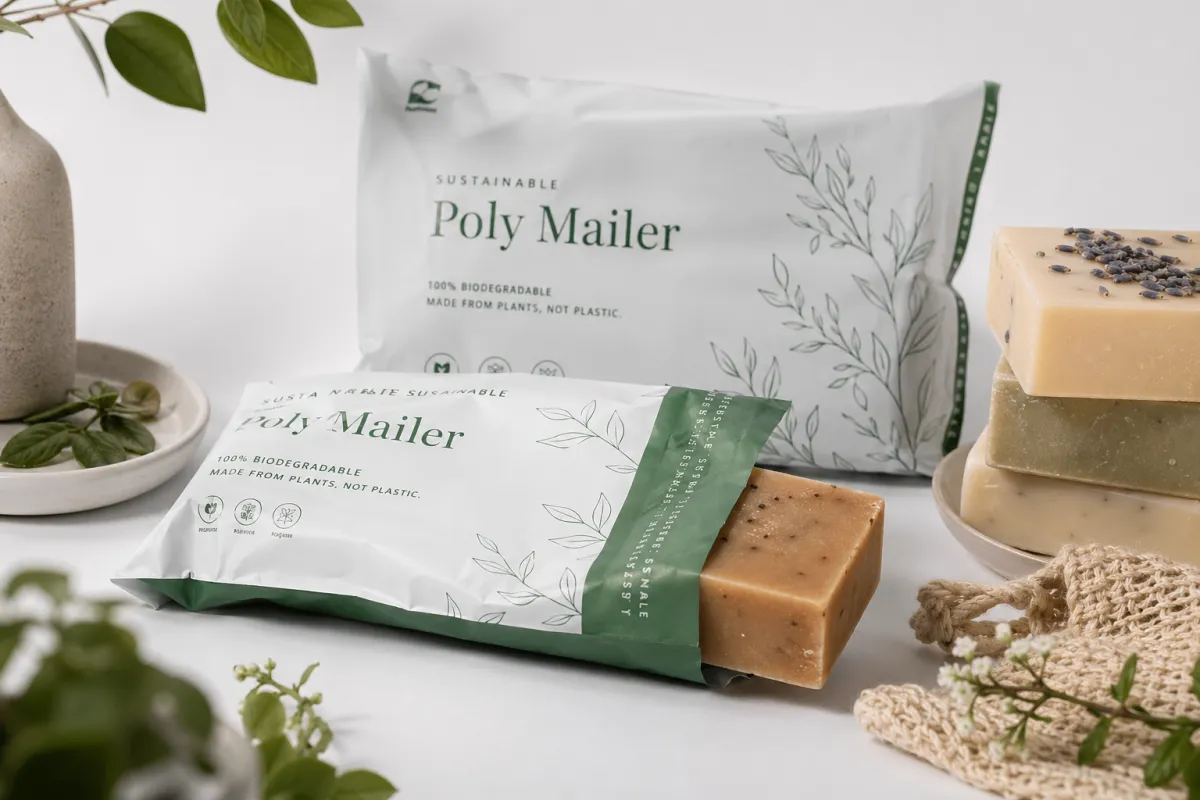
Soap brands often start with boxes because boxes feel premium in the abstract. Sometimes they are. Sometimes they are just expensive rectangles with too much air inside them. For lighter orders, sustainable poly mailers for artisan soaps can do the same protective work with less material and less shipping weight. That matters most when the order is one bar, two bars, or a small repeat bundle. A flat mailer usually packs faster than a carton, takes less shelf space, and leaves less trash at the packing station. If you are shipping dozens of orders a week, that is not a minor convenience. It is labor.
I have seen small soap makers spend a lot of money trying to make every order feel like a gift box, even when the product did not need that much structure. The result was nice on the table and clunky in fulfillment. A branded mailer changes the math. It can be loaded, sealed, labeled, and staged in a repeatable sequence. Once the soap is wrapped, sleeved, or boxed inside, the outer mailer becomes both protective shell and visual finish. Fewer touchpoints. Fewer inserts. Fewer chances to make the packout feel fussy. For brands selling through social media, subscription drops, or a straightforward Shopify flow, sustainable poly mailers for artisan soaps often make more sense than adding a carton just to create the impression of premium.
Not every soap order belongs in a mailer, and pretending otherwise leads to disappointment. Gift sets with jars, brittle add-ons, or multi-item bundles may still need a box or more structure. The question is not whether mailers are always better. The question is which package fits the order pattern without wasting material or forcing awkward handling. If most orders are one to three bars, shipped frequently, and already wrapped well, sustainable poly mailers for artisan soaps usually win on cost, speed, and simplicity.
Customers notice the difference too. A tidy, well-sized mailer often looks better than a box filled with void fill and crossed fingers. It can signal that the brand cares about waste without turning the package into a lecture. Buyers also notice when packaging arrives bulky for no clear reason. Nobody enjoys opening a soap order that looks like it was packed in a panic with a loose stack of cardboard nearby.
The environmental claim still needs scrutiny. Recycled content, recyclability, and compostability are separate claims with separate realities. Recycled-content mailers reduce virgin plastic use, but they still need enough strength to survive transit. Recyclable mailers only help if the receiving system accepts film plastics. Compostable-style films can be a poor fit if the product faces humidity, abrasion, or a long shipping route. Good sustainable poly mailers for artisan soaps balance the claim with the job.
How Do Sustainable Poly Mailers for Artisan Soaps Work?
At the simplest level, a mailer is a film pouch with a closure. The details are what separate a useful one from a frustrating one. The film gives the package its strength and surface feel. The seal keeps the contents inside and helps shield against dust, scuffing, and the little jolts that happen when parcels move through conveyor systems and delivery bins. For sustainable poly mailers for artisan soaps, the best options usually rely on a mono-material polyethylene structure or a recycled-content film that still closes cleanly and resists tearing at the edges.
The outer layer does not need to do every job. A good soap bar is usually wrapped in paper, a belly band, shrink wrap, or a simple box insert before it goes into the mailer. That inner layer protects fragrance, keeps labels clean, and gives the customer a better first touch. The mailer then handles abrasion, light moisture exposure, and the general turbulence of parcel handling. When the fit is right, sustainable poly mailers for artisan soaps keep the package from rattling around like spare change in a jacket pocket.
People get tripped up by the language around materials. Recycled-content, recyclable, and compostable are not interchangeable. Recycled-content means the film includes PCR or post-industrial resin. Recyclable means the material can be collected and processed in the right stream, often through store drop-off film recycling for polyethylene mailers. Compostable-style claims need certification and the right disposal environment, which is not the same thing as a shipping network. If a supplier cannot explain that difference plainly, their sustainable poly mailers for artisan soaps spec deserves a closer look.
Branding fits in without turning the mailer into a billboard. A simple logo, one clean color, and a blank area for the shipping label often outperform a heavy print treatment. Leave a flat label zone. Carriers will not care that your artwork is beautiful if the barcode lands on a wrinkle. For many brands, sustainable poly mailers for artisan soaps work best when they look intentional rather than loud. Simple is not lazy. Simple is usually cheaper and easier to pack.
Testing matters as much as the spec sheet. A supplier should be able to show performance data tied to transit or handling methods such as ISTA procedures. Ask about film thickness, seal integrity, and how the material behaves under compression. If the pitch is all adjectives and no numbers, that is a warning sign. The point of sustainable poly mailers for artisan soaps is not to sound eco-conscious. It is to survive real shipping.
Key Factors That Change Performance and Cost
Film type and thickness drive the first big cost swing. For single-bar orders, a lighter recycled-content mailer can work if the inner wrap is solid and the adhesive closes well. For heavier multi-bar bundles, thicker film usually makes more sense because the package flexes more, gets squeezed more, and sees more handling. More bars mean more stress. That is obvious enough to sound dull, which is exactly why it still gets missed. sustainable poly mailers for artisan soaps need to match the load, not just the budget.
Size is the next major factor. Oversized mailers waste film, create extra movement, and make the package look careless. Undersized mailers stretch the seams, wrinkle the finished packout, and make a thoughtful product look rushed. The right fit is usually just large enough for the wrapped soap plus any insert or promotional card, with a little room for seal margin. Common artisan soap orders often fall into sizes like 6 x 9, 7.5 x 10.5, 8.5 x 12, or 10 x 13 inches. Get the size wrong and even good sustainable poly mailers for artisan soaps look flimsy.
Printing changes the price too. A one-color logo on one side is usually far easier on the budget than a full-bleed design with multiple inks and a custom background. Every extra color, plate, or setup step adds cost. Specialty claims, QR codes, and custom finishes can nudge the number upward as well. That does not mean branding is a waste. It means the mailer needs a clear job. Is it a shipping layer, or is it a major visual touchpoint? For many brands, sustainable poly mailers for artisan soaps only need enough print to feel branded and recognizable.
There is a tradeoff buyers like to pretend away: lower upfront cost versus lower waste and better perception. A rock-bottom mailer can save a few cents per unit, then cost that same amount back in complaints or rework. The opposite can happen too. A heavily branded mailer may look lovely and still be unnecessary if the brand ships low volume and cannot absorb the setup cost. The useful middle ground is the spec that protects the product, fits the order profile, and keeps sustainable poly mailers for artisan soaps from becoming a vanity purchase.
Material claims deserve the same scrutiny. Recycled-content mailers reduce virgin resin use, and that is genuinely useful. Recyclable mono-material mailers may suit brands that want a cleaner disposal path and a simpler story for customers. The Packaging School and Packaging Institute resources are worth consulting if you want broader context before trusting a supplier's language. Just do not confuse eco-sounding terminology with what works for your soap line. sustainable poly mailers for artisan soaps should be judged by fit, handling, and disposal reality.
Pricing, MOQs, and Lead Times to Expect
Pricing depends on whether you are buying stock, semi-custom, or fully custom. Stock recycled-content mailers are usually the least expensive entry point, especially if standard sizes and neutral colors are fine for your line. Custom Printed Mailers cost more because of setup, artwork, and production coordination. Small runs carry the sharpest premium because the factory still has to start the machine, set up the print, and manage the run whether you order 500 pieces or 5,000. That is why sustainable poly mailers for artisan soaps can look affordable on paper and expensive once the order is real.
Here is a realistic planning framework, not a promise carved into stone:
| Option | Typical MOQ | Approx. Unit Price | Best For | Notes |
|---|---|---|---|---|
| Stock recycled-content mailer | 500-1,000 pcs | $0.08-$0.18 | Testing, small batches, fast replenishment | Lowest setup cost, limited branding |
| Semi-custom printed mailer | 1,000-3,000 pcs | $0.16-$0.32 | Growing soap lines, simple logo work | Good balance of cost and brand lift |
| Fully custom printed mailer | 3,000-5,000+ pcs | $0.22-$0.48 | Established brands, repeat orders, strong visual identity | More setup time, better consistency at scale |
| Specialty low-MOQ run | 250-500 pcs | $0.35-$0.90 | Launches, seasonal kits, market tests | Convenient, but the premium is real |
Those numbers shift with print coverage, resin cost, size, and freight. A heavy one-color print can cost less than a simple-looking but awkward multi-color design. A custom size can also cost more than a standard size before branding enters the picture. If you are comparing sustainable poly mailers for artisan soaps, ask for pricing at two or three volume tiers. The jump from 1,000 to 3,000 pieces can be dramatic, and the jump from 3,000 to 5,000 can be oddly tempting if your usage is stable.
Lead times are usually manageable if you plan ahead. Stock mailers can ship quickly, sometimes within a few business days if inventory is on hand. Custom printed runs need proof approval, production, and freight. A practical range is 12-18 business days after final proof for production, plus transit time. Special colors, custom sizes, and multiple revisions add buffer. The week you need packaging urgently is almost always the week the schedule misbehaves. That is why sustainable poly mailers for artisan soaps should be ordered before inventory gets thin.
Hidden costs are where buyers get surprised. Artwork revisions, rush charges, freight spikes, and ordering too few extras can turn a decent quote into a frustrating one. I also recommend keeping a small overage for damage, misprints, and growth. If you sell out a soap scent in two weeks and reorder late, the packaging delay becomes your bottleneck. A small cushion keeps sustainable poly mailers for artisan soaps from slowing down a product line that is otherwise ready to move.
Step-by-Step: Choosing the Right Mailer for Your Soap Line
Start with the product itself. Measure the finished bar after wrapping, not just the bare soap. A bar that looks compact in the mold can swell a little after curing or expand once you add paper wrap, a sleeve, a sticker, or a product card. Write down the exact packed dimensions, the weight of a single order, and whether the soap ships alone or as part of a bundle. sustainable poly mailers for artisan soaps work best when the spec starts with the actual packed form, not a rough guess pulled from a catalog page.
Next, decide what matters most: lowest cost, best presentation, or the clearest disposal story. You rarely get all three at the top of the scale. If speed matters most, a stock mailer may be enough. If brand feel matters more, a printed mailer with a clean logo and one or two colors may be the right choice. If the environmental claim matters most, ask for recycled-content percentages, recyclability guidance, and documentation instead of trusting a supplier's green language on its own. That is how sustainable poly mailers for artisan soaps stay credible.
Then think about the journey. Will the package travel locally, regionally, or across the country? Will it pass through a few hands or many? If the order is likely to bounce through multiple hubs, test the film a little harder. A supplier who understands current transport standards should be able to talk about methods such as ISTA 3A or ASTM D4169 without sounding lost. Those standards are not magic. They are still better than vague promises. Good sustainable poly mailers for artisan soaps should survive normal parcel handling without drama.
Once the field is narrower, request samples. Do not just hold them up and nod. Pack real soap orders, seal them, label them, shake them a bit, stack them, and inspect the corners after a day or two. Check the seal strength, the label area, the surface finish, and whether the mailer wrinkles in a way that makes the brand look sloppy. A sample that behaves nicely on a desk can act differently once it enters a real packing workflow. That is why sustainable poly mailers for artisan soaps should always be tested with actual product.
Here is a practical decision path:
- Choose stock mailers if you are testing demand, shipping low volume, or need a quick restock.
- Choose semi-custom mailers if you want logo visibility without paying for a full custom run.
- Choose fully custom mailers if your monthly volume is stable and the package is part of your brand identity.
- Choose a stronger or larger spec if you ship multiple bars, heavier sets, or awkward bundle shapes.
- Choose a simpler spec if each order is small, wrapped well, and mostly needs outer protection.
That sequence looks obvious until you watch a brand order a beautiful mailer that does not fit the product, then spend the next month apologizing for wrinkled labels. For many sellers, sustainable poly mailers for artisan soaps are the practical middle ground between a plain generic mailer and a box with too much dead space. If you also need cartons, inserts, or branded tape, the broader Custom Packaging Products range can help you match the outer shipper to the rest of the packout, while Custom Poly Mailers keeps the outer layer focused and cost-aware.
Rule of thumb: if the soap is already wrapped, not fragile, and not part of a rigid gift set, start with a mailer sample before you spend money on a box spec. It is easier to upgrade later than to recover cash from overbuilt packaging you do not need.
Common Mistakes With Soap Mailers
The first mistake is buying by price alone. A flimsy mailer can tear, wrinkle, or make the order look careless. That leads to returns, complaints, and a brand impression that is hard to reverse. A few cents saved on sustainable poly mailers for artisan soaps can disappear the first time a customer gets a package that feels underbuilt. Cheap is not a strategy. It is just a number before the damage appears.
The second mistake is ignoring fit. Oversized mailers let the product move around and waste film. Undersized mailers stretch the seams and ruin the finish. Both problems look avoidable because they are. Weak sealing causes a different kind of trouble. A mailer with a poor adhesive strip is not much of a protective package; it is a politely failing envelope. If you want sustainable poly mailers for artisan soaps to perform, the closure needs to stay closed.
Overprinting is another trap. Many brands assume more artwork means more value. Sometimes it just means more cost and more clutter. The soap itself should remain the center of gravity. If the mailer is covered in busy graphics, the package can start to feel overworked. That is awkward in premium beauty packaging and even stranger in a straightforward soap shipment. A restrained design often makes sustainable poly mailers for artisan soaps feel more thoughtful, not less.
Then there is the eco-claim problem. A brand can damage trust quickly by calling a package "eco-friendly" without explaining what that means. If the mailer is recycled-content, say that. If it is recyclable in film drop-off streams, say that. If the package includes a paper insert, use FSC-certified paper where it makes sense and say that plainly. Customers do not need poetry. They need honesty. Clear claims make sustainable poly mailers for artisan soaps look stronger in the customer's hands.
Sample testing is the last mistake to avoid, and it is the one people skip because it feels slow. It is not slow compared with replacing a bad run. A short packing trial can reveal adhesive problems, label wrinkles, scent transfer issues, or poor fit long before those problems show up on a hundred shipments. Good sustainable poly mailers for artisan soaps should be boring in production. Boring means predictable, and predictable means fewer headaches.
- Do not choose a mailer before measuring the packed soap.
- Do not assume a sustainability claim equals better performance.
- Do not print over the label zone.
- Do not skip sample testing because the sample "looked fine."
Expert Tips for Better Unboxing and Less Waste
Keep the design clean. A single logo, one brand color, and a thoughtful finish usually beat a crowded graphic treatment. If your soap line uses earthy colors, soft neutrals, or botanical cues, let the mailer support that story instead of fighting it. The goal is to make sustainable poly mailers for artisan soaps feel intentional, not busy. A customer should notice the care, not the number of design choices shouting at them.
Reduce waste by matching the package size to the packed product and skipping unnecessary fillers. If the soap is already boxed or wrapped, you probably do not need a second protective layer inside the mailer unless the order is unusually fragile. A smaller, better-fitted outer package often looks smarter and ships better. That is one reason sustainable poly mailers for artisan soaps can outperform larger cartons for single-bar orders. Less empty space means less material and less movement.
Small operational details matter more than people like to admit. A flat label zone speeds fulfillment. Easy-open features reduce customer frustration. Batch labels or reorder notes keep the packing table organized. If you run recurring scents or seasonal bundles, a simple color-coded insert can help staff pick the right packout faster without adding much material. Those small choices make sustainable poly mailers for artisan soaps feel polished while keeping pack time under control.
There is also a presentation trick that works better than fancy extras: align the outer package with the product story. If the soap is lavender and oat, the mailer should not look like a neon sports drink. If the line is minimal and apothecary-inspired, the package should stay calm. Customers build an impression in seconds. That is why sustainable poly mailers for artisan soaps should be chosen for visual fit as much as physical fit. A package that looks considered will usually outperform a louder, clumsier one.
If you want a broader environmental reality check, packaging organizations and shipping standards help keep the discussion grounded. Practical references from the EPA recycling guidance and transport testing groups are useful because they focus on actual disposal and handling behavior rather than wishful thinking. That is the difference between a nice-sounding claim and a package that earns its keep. sustainable poly mailers for artisan soaps should be judged like any other production choice: by how well they work, not how polished they sound in a pitch deck.
Next Steps Before You Order Sustainable Poly Mailers for Artisan Soaps
Before you place an order, measure your packed soap, write down your monthly volume, and decide what matters most: cost, presentation, or disposal story. If those priorities are fuzzy, the packaging decision gets messy quickly. Plenty of brands start with broad goals and end up with a mailer that is pretty but inefficient, or efficient but underwhelming. sustainable poly mailers for artisan soaps work best when the brief is specific and the priorities are ranked.
Request two or three sample options, not one. Compare them at different quantities so you can see where the pricing really settles. Then test a full shipment cycle: pack the order, label it, ship it, and inspect the result after normal handling. If the seal stays closed, the fit is clean, and the presentation still feels like your brand, you are probably close. If not, adjust before scaling. That is how sustainable poly mailers for artisan soaps stop being a guess and become a repeatable buying decision.
Build a short spec sheet before you talk to a supplier. Include packed dimensions, bar count, film preference, print needs, target MOQ, and your reorder window. Add any required claims, like recycled content percentage or recyclable material language, and make sure your team uses the same wording everywhere. That cuts down on back-and-forth and avoids the familiar "we thought you meant something else" mess. When a packaging brief is clear, sustainable poly mailers for artisan soaps become much easier to source, compare, and reorder.
The practical move is simple: gather dimensions, request quotes, compare landed cost, and test the mailer on real soap before you commit to a full run. Do that once and you can usually spot the difference between a spec that just sounds eco-friendly and one that actually supports the product. For most small soap brands, the right sustainable poly mailers for artisan soaps choice is the one that protects the bar, keeps shipping costs sane, and still feels like the brand you built. That is the whole job.
Are sustainable poly mailers for artisan soaps better than boxes?
Yes, when the soaps are lightweight, already wrapped, and do not need crush protection. They usually cost less to ship and pack faster than boxes with filler. Boxes still make sense for fragile bundles, premium gift sets, or multi-item orders that need structure.
What thickness should sustainable poly mailers for artisan soaps have?
Use a thicker option for heavier multi-bar orders or mailers that will be handled a lot in transit. Single-bar shipments can often work with a lighter spec if the inner wrap is solid and the seal is strong. Do not buy by thickness alone; fit and seal quality matter just as much.
Can I print my logo on sustainable poly mailers for artisan soaps?
Yes, and that is often the fastest way to make a simple mailer feel intentional. Keep the design clean so the printing does not add unnecessary cost or visual clutter. Ask for a proof before production, because small logo placement mistakes are annoyingly expensive.
How much do sustainable poly mailers for artisan soaps usually cost?
Stock options are cheapest, while custom printed and specialty eco claims push the price up. Small orders usually carry a noticeable premium per unit compared with larger runs. The real comparison is landed cost, not just unit price, because waste, returns, and shipping weight add up fast.
How long does it take to order sustainable poly mailers for artisan soaps?
Stock mailers can move quickly, while custom orders need time for proofing and production. Expect extra time if you want printing, special finishes, or a custom size. Build in a buffer so you are not reordering in panic mode when sales spike.