Buyer Fit Snapshot
| Best fit | Biodegradable Mailer Inserts That Cut Waste projects where brand print, material claims, artwork control, MOQ, and repeat-order consistency need to be specified before quoting. |
|---|---|
| Quote inputs | Share finished size, material target, print colors, finish, packing count, annual reorder estimate, ship-to region, and any compliance wording. |
| Proofing check | Approve dieline scale, logo placement, barcode or warning zones, color tolerance, closure strength, and carton packing before bulk production. |
| Main risk | Vague material claims, crowded artwork, missing packing details, or unclear freight terms can make a low unit price expensive after revisions. |
Fast answer: Biodegradable Mailer Inserts That Cut Waste: Film, Print, MOQ, and Carton Packing should be specified like a repeatable production item. The safest quote records material, print method, finish, artwork proof, packing count, and reorder notes in one written spec.
Production checks before approval
Compare the actual filled-product size with the drawing, then confirm tolerance on folds, seals, hang holes, label areas, and retail display edges. Reserve space for logos, QR codes, warning copy, and material claims before decorative graphics fill the panel.
Quote comparison points
Review material grade, print process, finish, sampling route, tooling charges, carton quantity, and freight assumptions side by side. A quote is only useful when the supplier can repeat the same color, closure quality, and packing count on the next order.
Tips for Biodegradable Mailer Inserts That Cut Waste
I still remember a supplier visit in Dongguan, Guangdong, where the outer mailer looked immaculate, printed in two colors, and stamped "eco" across a 120 gsm sleeve. The carton opened cleanly. The insert inside was 8 mm foam, the kind that can sit in a landfill for decades. I remember standing there thinking, really? That gap between appearance and reality is exactly why tips for biodegradable mailer inserts matter. The story on the outside is only half the package; the inside has to support the sustainability claim with an actual material choice, not a green adjective and a hopeful shrug.
Brands ask me for tips for biodegradable mailer inserts because they want three things at once: less plastic, a better unboxing, and fewer damage claims. Easy to say. Harder to engineer. A 120 g skincare jar needs a very different insert than a 1.1 kg candle set with glass lids and a shipping route that runs through three conveyor hubs before the last-mile handoff. The product weight, the shape, and the route decide whether the insert works or fails. I have seen beautiful packaging lose the argument with gravity. Gravity is rude like that, especially when a box moves from Shenzhen to Toronto in 14 days.
The strongest tips for biodegradable mailer inserts are not about chasing the most virtuous material on paper. They are about matching the insert to the product, the transit lane, and the disposal reality your buyer actually faces. A material certified for industrial composting at 58 C helps only if customers can reach that system. A paper-based insert is pointless if it collapses in a 1.5 m drop test. Protection comes first. Sustainability has to survive that test, not replace it. Honestly, I think a lot of "eco" packaging fails because people fall in love with the story before they test the engineering, which is a costly habit at 5,000 units a run. And yes, that trap is still catching smart teams every month.
Tips for Biodegradable Mailer Inserts: What They Are
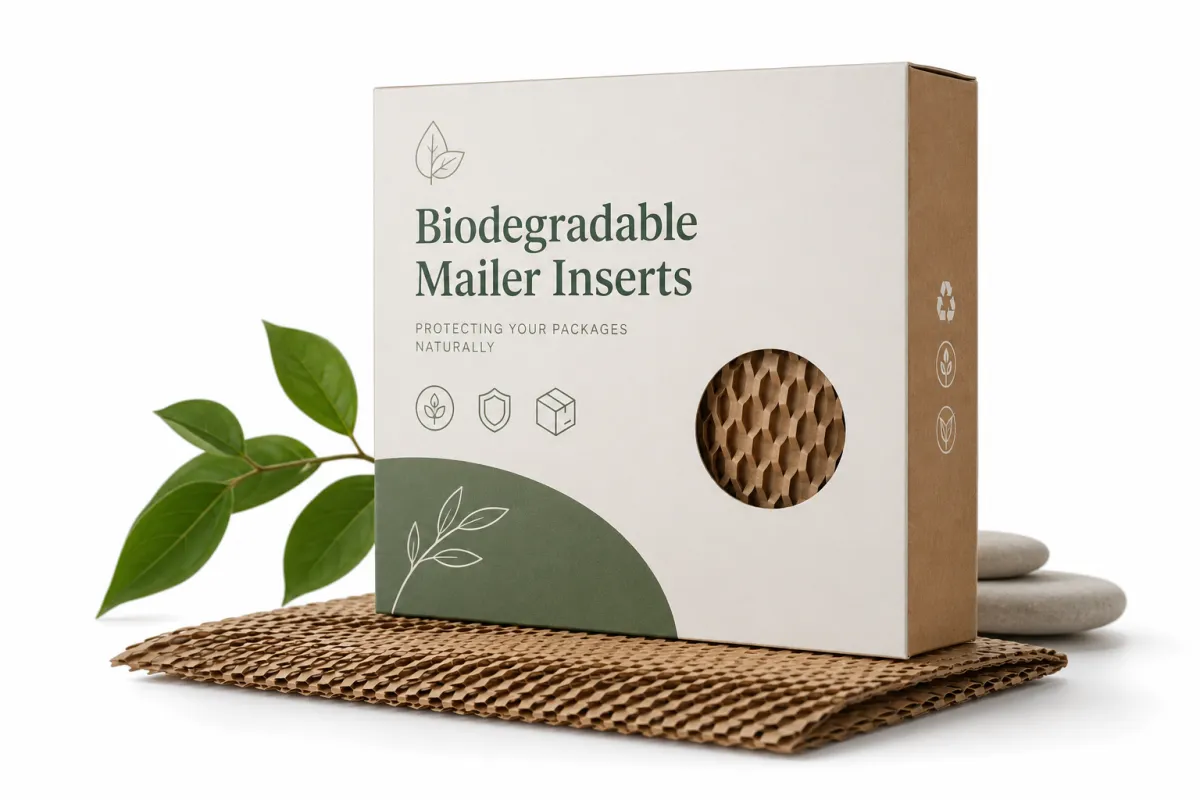
Biodegradable mailer inserts are packaging parts intended to break down through natural biological processes over time, usually with the help of moisture, oxygen, heat, and microbes. The group includes molded fiber cradles, paper pulp trays, bagasse inserts made from sugarcane residue, and starch-based cushioning pieces. The language sounds simple until buyers start mixing up biodegradable, compostable, recyclable, and plant-based. I now open every briefing with a one-page definitions sheet and a 10-minute walk-through; it prevents at least one expensive misunderstanding, and usually one dramatic email thread that nobody wanted to write. If you are collecting tips for biodegradable mailer inserts, start here, because the terminology shapes the rest of the decision.
Here is the cleanest version I use with clients. Biodegradable means a material can break down, though the conditions and timeline can vary widely. Compostable is stricter: the material should break down within a defined composting environment and leave no toxic residue under that standard. Recyclable means it can enter a recycling stream, which is not the same as biodegrading. Plant-based only tells you the feedstock came from plants; it says nothing about whether the insert will break down quickly, cleanly, or at all in a consumer's actual disposal route. I have had to explain that last one more times than I care to admit, especially when a buyer is comparing sugarcane fiber in Pune with molded pulp from Wisconsin. Some weeks, that conversation is basically my job.
Most packaging claims slip because they sound cleaner than they are. A supplier can say "eco-friendly" and still deliver an insert with a coated surface, mixed adhesives, and printed inks that slow decomposition. I once sat in a client meeting for a fragrance brand in Leeds where the buyer loved the look of a molded-fiber tray, then noticed the plastic film wrap bonded to the insert. From five feet away, it looked green. In the waste stream, it told a different story. Details like that matter more than the headline claim, which is a very annoying truth if you sell marketing decks for a living. That is one of the most practical tips for biodegradable mailer inserts: always inspect the hidden layers.
Brands switch for practical reasons. Biodegradable mailer inserts can reduce plastic dependence, simplify disposal messaging, and make the unboxing feel cleaner without sacrificing protection. They also help in procurement conversations, especially when a company ties packaging to FSC fiber, recycled content, or a 30% waste-reduction target in an annual report. Small brands often use that change in a retail pitch deck. Larger brands use it to answer buyers who are tired of plastic-heavy shipments and want proof that the packaging plan changed, not just the copy. I have heard buyers say, flat out, "Show me the material, not the slogan." Fair enough, especially when the order is 25,000 units and the launch date is fixed.
The real challenge is not choosing a "greener" insert in isolation. It is balancing four variables at once: product weight, transit risk, insert geometry, and disposal reality. If the product shifts 8 mm inside the carton, the insert is not doing its job. If the insert arrives in a humid warehouse after a five-week ocean leg, the material may need a coating or thicker walls. The most useful tips for biodegradable mailer inserts start with protection, then sustainability, then cost. Reversing that order usually ends in rework, and rework always seems to arrive on a Friday afternoon in the same spreadsheet with the hidden freight line.
- Biodegradable describes breakdown potential, often without a fixed timeline.
- Compostable requires a specific composting environment, such as an industrial facility at 55-60 C.
- Recyclable depends on local recovery systems and material acceptance rules.
- Plant-based describes the source, not the end-of-life path.
"We thought the insert was the green fix, but the first test shipment crushed two corners in transit. The material was fine; the geometry was wrong." That came from a candle client in my notes from Melbourne, and it still explains the category better than a sales deck ever could. It also captures why tips for biodegradable mailer inserts should focus on fit as much as fiber.
How Biodegradable Mailer Inserts Break Down
Breakdown is not magic. Microorganisms consume the material, but they need the right conditions to do it well: moisture, oxygen, heat, and time. Miss one of those pieces and the process slows dramatically. A tray that behaves beautifully in a compost facility can sit unchanged in a dry storage yard in Phoenix or a low-oxygen landfill environment outside Atlanta. EPA composting guidance makes the point clearly: disposal conditions matter just as much as the material itself. I find that comforting, in a strange way. Packaging has rules. It is not just vibes in a carton. That reality sits at the center of tips for biodegradable mailer inserts because the disposal route decides the end-of-life story.
Common fiber options behave differently. Molded fiber usually breaks down well because it is mostly plant fiber and often uses water-based forming methods. Paper pulp behaves in a similar way, though thickness and density change the outcome; a 2.2 mm wall is not the same as a 3.0 mm wall. Bagasse can be strong for its weight because it comes from sugarcane residue, but the surface finish and any coating affect how quickly it decomposes. Starch blends can work well in controlled composting, but not every formulation behaves the same once it meets humidity and heat. I have handled samples that looked nearly identical and acted like completely different species once they left the lab in Suzhou. For teams comparing options, those differences are some of the most valuable tips for biodegradable mailer inserts.
There is also a clear difference between industrial composting and home composting. Industrial systems control temperature and aeration more tightly, which helps materials break down faster and with more predictability. Home compost piles are less predictable. They may never stay hot enough, long enough, or evenly moist enough to process certain inserts. I have seen brands ask for one disposal message that covers both systems. That shortcut only works if the supplier documentation truly supports it. Otherwise, you are basically asking the customer to become a materials scientist after dinner in a kitchen that tops out at 24 C.
Coatings and adhesives deserve more attention than they usually get. A water-resistant coating can slow moisture penetration, which may improve shelf life and transit performance, but it can also delay decomposition. Printed inks, heavy laminations, and pressure-sensitive labels can create the same tension. I once reviewed a sample from a converter in Portland, Oregon, where the molded fiber itself was excellent, but the adhesive strip used for assembly became the weak point in the compost story. The insert would have passed a showroom test and still missed the end-of-life standard. That is the part that makes people groan, because the invisible stuff tends to be the expensive stuff. If you want practical tips for biodegradable mailer inserts, inspect coatings before you approve the sample.
What the material can and cannot do
A biodegradable insert can lower waste, but it does not excuse weak packaging design. If a 200 g product slides around inside a carton, the best fiber tray in the market will still fail if the voids are too large or the corners are unsupported. I tell clients to think of the insert as a structural part, not decorative filler. That shift in thinking alone saves weeks of sampling and at least one round of "why are these returns higher than expected?" from finance in the final week of Q2. That mindset is one of the most underrated tips for biodegradable mailer inserts because it forces design discipline.
On a factory floor visit in Guangdong, I watched operators run a batch of molded pulp shells through a stack test at 48 C and high humidity. The insert held shape, but only after the wall thickness moved from 2.2 mm to 3.0 mm when the first sample warped. That is the difference between vague packaging advice and real tips for biodegradable mailer inserts. The material choice was correct; the engineering made it survive. And yes, the first failed sample still sat on the table looking smug, which I found deeply irritating.
For brands that ship internationally, the route matters even more. A package that sits in a humid port warehouse for 10 days, then moves through a cold-air facility in Chicago, then lands in a customer’s home has already faced a rough set of conditions. The insert should be designed for that chain, not for a lab-only ideal. That is why I keep repeating the same point: tips for biodegradable mailer inserts must account for the entire trip, not just the sustainability label. Packaging people love to say "final mile," but the package has usually been through a long emotional journey before it reaches that point. Gonna sound dramatic, maybe, but the carton has earned its scars.
Key Factors, Materials, and Cost of Biodegradable Mailer Inserts
Once the chemistry is clear, the buying conversation gets more concrete. I usually look at six variables: material, thickness, tooling, print complexity, quantity, and certification requirements. Those six numbers decide whether a custom insert lands at $0.15 per unit for 5,000 pieces or climbs toward $0.62 when the run is too small and the tooling sits in the quote. For a 5,000-piece order, that spread can change the project fast. If you want tips for biodegradable mailer inserts that survive a purchasing meeting, start with those six levers. It is less glamorous than a mood board, but it tends to save actual money.
Unit price alone can mislead. A cheap insert that increases damage by 2% is not actually cheap if the return rate rises. I have seen a beauty brand save $0.04 per unit and lose that savings in return shipping, replacement product, and customer service time. Landed cost is the better lens. It includes freight, breakage reduction, inventory holding, and any waste fees tied to the old packaging system. I wish more teams would put that number on the same slide as the quote. It changes the conversation immediately, especially when the delta between two suppliers is only $380 on paper and $3,400 after freight and rework. That is why tips for biodegradable mailer inserts should always include landed-cost analysis.
| Material | Best Fit | Sample Unit Cost at 5,000 Units | Notes |
|---|---|---|---|
| Molded fiber | Fragile items, premium kits, glass bottles | $0.21-$0.48 | Strong structure, good compost story, tooling may add $300-$900 |
| Paper pulp | Light ecommerce items, cosmetics, accessories | $0.15-$0.29 | Lower cost, usually easier to source, less impact resistance than denser fiber |
| Bagasse | Food-adjacent goods, gift sets, short runs | $0.22-$0.39 | Good story from agricultural residue, surface finish and mold quality vary by supplier |
| Starch-based blend | Light cushioning, void fill, lower-load products | $0.31-$0.58 | Useful where flexibility matters, but verify composting claims carefully |
That table is only a starting point. At 1,000 units, the cost curve usually climbs because tooling and setup spread over fewer pieces. At 20,000 units, the per-unit cost can drop sharply, especially for molded pulp. I have negotiated runs where the first quote came in 22% higher than the second quote because the supplier revised the cavity layout and cut trim waste. That is a real savings, not a theoretical one. I also remember one quote from a plant in Dongguan so messy I had to read it three times before I trusted the decimal points. Nobody enjoys hunting for hidden costs in a spreadsheet that looks like it was assembled in a storm. Practical tips for biodegradable mailer inserts should always account for volume effects.
Order quantity also changes lead time. A stock insert might ship in 7-10 business days, while a custom molded fiber tray may need 12-15 business days from proof approval, plus another 3-5 days if revisions are required. If printed outer packaging is part of the project, sequence matters. One of the easiest ways to slow a launch is to approve the insert before the outer mailer size is locked, then discover the fit changed by 6 mm. If that sounds familiar, pairing the insert plan with your Custom Poly Mailers early can prevent a lot of rework.
I also pay close attention to certification and fiber sourcing. FSC chain-of-custody paperwork is not decorative; it is a basic trust check. If a supplier claims compostability, ask for the standard name and the test basis. ASTM D6400 and similar references help because they push the conversation away from vague "eco" language and toward documented performance. A seller who can produce data sheets, not just sales copy, usually has a stronger manufacturing process. And if they get defensive when you ask for documentation, that tells you a lot too, usually within the first 90 seconds of the call. That is another one of those tips for biodegradable mailer inserts that protects both brand and budget.
Here is the commercial reality: the simplest structure that still protects the product is often the best one. A two-piece tray may cost more than a flat sleeve, but if it removes 18 g of void fill and cuts breakage from 3.2% to 0.7%, the economics improve fast. That is why I keep bringing buyers back to fit first, material second, branding third. The most useful tips for biodegradable mailer inserts rarely start with the fanciest option. Fancy tends to win awards; simple tends to survive shipments.
For brands comparing options, I often recommend testing three versions: a low-cost paper pulp insert, a denser molded fiber version, and the same structure with a moisture-resistant finish. That comparison gives procurement, operations, and sustainability teams something concrete to react to. It also exposes hidden expenses, such as assembly time, stackability in storage, and whether the insert nests cleanly at scale. I have watched a quote look great on paper and then fall apart when the warehouse team in Nashville tried to stack 500 trays without crushing the corners. Always ask how it lives on the shelf, not just how it looks in a render. That is one of the clearest tips for biodegradable mailer inserts for teams buying at scale.
One supplier negotiation stands out. A converter in Shenzhen quoted me a 4.5 mm fiber tray at $0.27 per unit, then suggested a cheaper coating that would have saved $0.03. The coating would have weakened the compost profile and created a slicker surface that increased product movement. I rejected it. We saved the brand about $1,100 in projected breakage losses across the first 8,000 units. The cheapest quote was not the best quote. I know that sounds obvious, but obvious things have a habit of disappearing the moment a spreadsheet gets exciting. It also reinforces why tips for biodegradable mailer inserts should weigh protection against cosmetic savings.
If you are building a new line, I recommend budgeting for sampling separately. A $150 sample charge, a $60 freight bill, and two rounds of revision can feel annoying, but they are still cheaper than a full production run that misses the fit by 4 mm. Brands that move quickly usually accept that sampling is part of the price of doing it right. The brands that resist it usually pay later, with interest and a warehouse full of product that needs a second carton spec. That is a very long way of saying that tips for biodegradable mailer inserts are really tips for disciplined packaging development.
Step-by-Step Process and Timeline for Switching Inserts
The cleanest switch starts with a packaging audit. List the SKUs that need protection, note the product dimensions to the nearest millimeter, and record the current failure modes. Does the cap loosen? Do corners scuff? Does the item shift vertically or diagonally? I ask for photos from the warehouse, because one image of a crushed corner tells me more than a three-page brief. Tips for biodegradable mailer inserts become operational here instead of theoretical, which is where they belong if you want actual results and not a prettier failure.
- Audit the packout - Measure the item, the carton, the ship route, and the breakage points, then capture at least 3 photos per SKU.
- Request samples - Ask for at least three variants with different wall thicknesses or cavity depths, such as 2.2 mm, 3.0 mm, and 3.5 mm.
- Run testing - Use drop, vibration, and compression checks before approval, including 1.0 m, 1.2 m, and 1.5 m drops.
- Approve specs - Lock the dieline, material, coating, print, and assembly method, plus the exact carton size in millimeters.
- Pilot the launch - Ship a small batch, then measure damage, packing time, and customer feedback before scaling to 10,000 units.
The testing stage should not be casual. I like to see a drop test from 1.0 m, 1.2 m, and 1.5 m depending on the product’s fragility, plus a vibration check if the item rides long courier lanes. If the insert is for glass, I also want a compression review after stacking. These are not academic exercises. They show whether a tray holds the item in place or simply looks tidy on a desk in an office in Bristol. For Brands That Sell premium goods, that difference is expensive. I have watched a package pass a glossy desk test and then fail the real one in a moving van. Reality tends to be unkind to pretty things. Good tips for biodegradable mailer inserts should include real-world testing, not just sample approval.
One cosmetics client I advised ran the first sample through a simple unboxing test with 10 employees in a warehouse near Milan. Five people packed the box in under 20 seconds, three took about 28 seconds, and two struggled because the insert had a left-right orientation that was not obvious at a glance. We fixed the orientation mark, shaved the assembly time to 14 seconds, and reduced packing errors. Small details add up quickly in a live fulfillment line. The warehouse team, by the way, noticed the difference instantly and made sure I heard about it. Loudly, with a stopwatch. That is the kind of operational feedback that makes tips for biodegradable mailer inserts more useful than any rendering software.
Here is a realistic timeline for a custom change:
- Briefing and quoting: 2-4 business days for size, weight, and spec review.
- Sampling: 5-10 business days for initial samples, depending on tooling complexity.
- Revision cycle: 3-7 business days if the cavity, wall thickness, or print changes.
- Approval and production: 12-15 business days after sign-off for many custom fiber jobs.
- Rollout: 1-2 weeks to phase inventory through the warehouse and update packing instructions.
Supplier communication matters as much as the timeline. I always send a packout sheet that lists product weight, fragility level, storage humidity target, and whether the insert must fit inside an existing carton or work with a new one. If the design needs to pair with outer packaging, I cross-check it with the mailer specs. That is also where a second look at poly mailer options can help if the outer layer needs abrasion resistance or moisture protection during a 6-day regional route.
During rollout, I want one person from procurement, one from operations, and one from sustainability in the same loop. If those three teams receive separate information, launch day becomes chaos. If they share the same spec sheet, the move is much smoother. My blunt advice: do not approve disposal messaging until the production insert is confirmed. The customer-facing claim should match the exact material in the carton. I have seen too many claims get ahead of the physical product, and then everybody ends up doing cleanup duty in the weakest possible way, usually after a Friday sign-off. That is where steady tips for biodegradable mailer inserts save time and credibility.
Common Mistakes With Biodegradable Mailer Inserts
The biggest mistake is treating every biodegradable label as interchangeable. It is not. One supplier may mean molded fiber with a water-based finish, while another means a starch blend that needs industrial composting at 58 C. The label can hide important differences in chemistry, certification, and disposal path. That is why I keep asking for the material data sheet, not just the quote. A polite supplier will send it. A great supplier sends it before I ask, usually with a test report from Guangzhou attached. That level of clarity sits near the top of any serious list of tips for biodegradable mailer inserts.
The second mistake is buying the cheapest option before testing. I understand the pressure; a finance team sees a $0.06 saving and wants to move immediately. Yet a fragile product shipped in a weak insert creates hidden costs that are much larger. I saw a supplier pitch a low-density fiber tray that looked fine for a 300 g candle set, then fail at the edge-crush stage because the corners compressed under stacked cartons. Saving pennies can lose dollars. And once those breakage claims start rolling in, everyone suddenly becomes very interested in the packaging budget and the freight memo. The cost of replacement often dwarfs the insert itself, which is why tips for biodegradable mailer inserts always point back to testing.
Storage conditions are often forgotten. Humidity at 60% to 70% relative humidity can change how a fiber insert behaves, especially if it sits in a warehouse for several weeks. Long shipping lanes matter too. If the insert is made in one region, shipped in a sea container, and then stored near a loading dock in Savannah or Felixstowe, moisture exposure can alter fit before the customer ever sees the package. Good tips for biodegradable mailer inserts account for the warehouse, not just the delivery address. The warehouse is not a neutral place; it is basically packaging weather with fluorescent lights and a pallet jack.
Another common miss is the customer handoff. If the insert is compostable in a controlled facility but the customer is never told that, the sustainability story falls flat. If the insert is technically biodegradable but the product page says "home compostable" without proof, trust erodes fast. Disposal instructions need the same care as the packout spec. Clear language beats inflated claims every time. I would rather sound plain than clever if the plain version is the one that keeps a brand out of trouble and a support inbox under 100 tickets. That is one of the simplest tips for biodegradable mailer inserts, and also one of the most ignored.
"We launched too early, and the insert needed a 2 mm deeper cavity after the first 400 orders," a home-fragrance buyer told me in a call from Boston. "The design was close, but close still cost us replacements." That lesson cost them more than the sample budget would have.
Over-ordering before proofing is the final trap. I have watched teams buy 15,000 inserts because the sample looked right in a showroom, only to discover that a real product with a slightly wider cap changed the fit. The fix was simple: one adjustment to the shoulder depth and a different fold line. The waste came from skipping the pilot. The smartest tips for biodegradable mailer inserts often sound boring because they force patience, but that patience usually costs less than rework. Boring is underrated. Boring has a very good track record at 9 a.m. on a production Monday.
Expert Tips for Better Biodegradable Mailer Inserts
My first expert tip is to design around the product shape before you choose the material. A 72 mm diameter bottle with a long neck needs a different cavity than a square skincare jar with a 5 mm overcap. If you start with geometry, the insert can do less unnecessary work, which usually means less waste and lower cost. In practice, that is one of the strongest tips for biodegradable mailer inserts because it trims both material use and failure risk. I know that sounds almost too simple, but the simple answer is often the one that survives a packing line in eight-hour shifts.
Second, standardize insert families wherever possible. If three SKUs can share the same outer footprint and only vary by a 4 mm shim or a folded spacer, inventory gets simpler. I have seen brands reduce reorder headaches by creating one master tray family and using small inserts or paperboard spacers for the variations. That move can cut SKUs by 30% and shorten the reapproval cycle. Fewer parts, fewer mistakes. Fewer chances for somebody to misread a spec and send you the wrong tray on a Thursday evening in August. It is a practical example of tips for biodegradable mailer inserts turning into warehouse efficiency.
Third, ask for documentation every time. I want certificates, material data sheets, and disposal instructions in the same folder. If the supplier offers FSC fiber, I ask for chain-of-custody proof. If they claim compostability, I want the standard named clearly. If they say the insert is biodegradable, I want to know the conditions and the expected breakdown pathway. Good tips for biodegradable mailer inserts always include paperwork, because documentation protects the claim as much as the product. A claim without paperwork is just a story with better lighting.
Fourth, treat the insert, outer mailer, and void-fill strategy as one system. A great insert can be undermined by a weak outer mailer, and a strong mailer can hide a bad insert until the first damage spike appears. I often pair a fiber tray with a matched carton or a moisture-resistant outer layer when the route is long. If you need a flexible outer format for lighter goods, it is worth reviewing Custom Poly Mailers alongside the insert spec so the whole system stays balanced rather than overbuilt in one place and weak in another. In a sample set from Shenzhen, that balance saved 11 g per order and reduced movement by 6 mm.
Fifth, make the insert part of the customer experience. A clean opening sequence, a clear orientation mark, and a crisp message about disposal can turn a utility piece into a brand asset. I have seen customers post unboxing videos because the insert looked thoughtful, not just protective. That does not happen by accident. The structure has to be neat, the messaging has to be honest, and the fit has to feel intentional. If the insert rattles, sags, or arrives half-crushed, no one is filming that except maybe a very annoyed customer with a ring light and a 1-star draft review. These are the sorts of tips for biodegradable mailer inserts that people remember because they improve the experience, not just the waste profile.
For testing, I still like the old-school approach: live product, live packers, live shipping lanes. Standards help too. ISTA methods are useful because they give teams a common testing language, and you can review those methods at ISTA. I do not let a standards document replace reality. A package can pass a bench test and still fail if the warehouse team cannot build it quickly or if the customer opens it upside down and spills the contents onto the table. That has happened. More than once. Nobody was thrilled. Practical tips for biodegradable mailer inserts have to survive both the lab and the loading dock.
One more thing most people get wrong: they over-focus on the insert alone. The best savings often come from reducing the total package system by 10% to 15%, not from making the insert thinner by itself. That might mean removing a redundant wrap, tightening the carton size by 6 mm, or changing the internal orientation so the item nests better. I have watched those changes beat the cost benefits of switching materials. That is the kind of practical, slightly unglamorous truth that tips for biodegradable mailer inserts should deliver. The boring stuff is usually the profitable stuff.
Here is my concise rule set:
- Fit first - measure the product and the transit gap in millimeters.
- Prove performance - test drop, vibration, and compression before launch.
- Verify claims - keep certificates and disposal guidance on file.
- Reduce complexity - standardize families and remove unnecessary layers.
- Measure the whole system - include returns, freight damage, and packing time.
If I had to give one final piece of field advice from the dozens of plant visits and buyer meetings I have sat through, it would be this: the right insert is the one your warehouse can pack quickly, your customer can dispose of honestly, and your product can survive without drama. That combination is rare, but achievable. And that is why the best tips for biodegradable mailer inserts are never just about the material; they are about the full package story, from spec sheet to doorstep. I know that sounds neat, but the real process is usually messier, slower, and more human than the marketing version.
Actionable next step: build a one-page spec with product dimensions, fragility level, shipping route, target budget, and disposal goal, then test three sample options before scaling. If you do that, you will have a real basis for choosing the insert that balances protection and sustainability instead of guessing your way through a production run. It is not glamorous work, but it beats explaining a damage spike to finance with a straight face. For teams searching for tips for biodegradable mailer inserts, this is the most dependable place to begin.
What are the best tips for biodegradable mailer inserts?
The best tips for biodegradable mailer inserts are straightforward: start with the product geometry, validate the disposal claim, and test the insert in the same conditions it will see in transit. If a product is fragile, use molded fiber or a denser paper pulp design. If the route is humid or long, check how coatings and adhesives affect performance. If the customer needs a clear end-of-life path, match the claim to the actual standard and avoid vague language. That combination gives you a better chance of protecting the product while reducing unnecessary plastic. It also keeps the packaging team from having to rewrite the spec after the first damage report.
One more practical version of the same answer: compare at least three samples, run drop and compression tests, and review total landed cost rather than just the unit price. Those are the tips for biodegradable mailer inserts that tend to hold up under pressure. The flashy option is rarely the safest one. The safest one is usually the one that fits, ships, and disposes cleanly without creating a new problem downstream. Or, put a little plainer: choose the insert that works in the real world, not the one that merely photographs well.
FAQ
What are biodegradable mailer inserts usually made from?
Common materials include molded fiber, paper pulp, bagasse, starch-based blends, and other plant-derived fibers. The right choice depends on the product weight, how much corner protection it needs, and whether the insert has to survive moisture exposure during a 3- to 5-day delivery window. I also ask about coatings and adhesives, because those parts can change the end-of-life story even when the base fiber looks fine. The fastest way to get misled is to look at a sample and ignore the glue holding it together. That is why tips for biodegradable mailer inserts always start with material composition.
Are biodegradable mailer inserts compostable at home or only in industrial facilities?
Some are designed for industrial composting, while others may break down in a home compost pile if conditions stay warm, moist, and aerated. The label alone does not prove that result. I always tell buyers to check the supplier's disposal guidance and to avoid customer-facing compost claims unless the standard is clearly documented. Otherwise, you risk promising a backyard outcome from a material that really wants a controlled facility, usually at 55-60 C rather than 22 C on a countertop. That distinction matters more than most sales decks admit, and it sits near the top of practical tips for biodegradable mailer inserts.
How much do biodegradable mailer inserts cost compared with plastic foam?
They often cost more per unit than basic foam, especially at lower quantities or with custom tooling. In a 5,000-unit run, I have seen paper pulp land around $0.15 per unit, while molded fiber can sit closer to $0.21-$0.48 depending on thickness and complexity. The real comparison should also include damage claims, return shipping, and customer perception, because the cheapest insert is not always the lowest real cost. A foam insert can look affordable until the returns pile up and everyone starts muttering about hidden costs. That is exactly why tips for biodegradable mailer inserts need a landed-cost view.
How long does it take to switch to biodegradable mailer inserts?
A stock insert can move quickly, sometimes in under two weeks, but a custom design usually needs sampling, revisions, and production time. A realistic path is 2-4 business days for quoting, 5-10 business days for samples, and 12-15 business days after approval for production. If the insert needs new tooling or a dieline change, add a few more days for revisions. Fast is possible, but only if the spec is already clear and the stakeholders stop changing their minds every other afternoon. Good planning shortens the timeline far more than rushing does, which is another of the useful tips for biodegradable mailer inserts.
How do I know if biodegradable mailer inserts will protect fragile products?
Test them with real products, not just dimensions on paper. Run drop, vibration, and compression checks, then inspect for movement, scuffing, and corner damage. The insert should keep the product stable, pack quickly, and still feel tidy in the unboxing. If it cannot do all three, the design needs another round. In my experience, the insert that feels "almost right" is usually the one that makes customer service unhappy later, especially after the first 500 orders. If you want dependable tips for biodegradable mailer inserts, make testing non-negotiable.
The practical takeaway is simple: pick one product, one route, and one disposal standard, then build the insert around those three facts before you order at scale. That single discipline keeps the packaging honest, keeps damage down, and keeps your sustainability claim from drifting away from the material in the box. If you remember nothing else from these tips for biodegradable mailer inserts, remember this: test the real packout, not the pretty sample, and lock the spec before the launch clock starts ticking.

