Buyer Fit Snapshot
| Best fit | Optimizing Parcel Packaging projects where brand print, material claims, artwork control, MOQ, and repeat-order consistency need to be specified before quoting. |
|---|---|
| Quote inputs | Share finished size, material target, print colors, finish, packing count, annual reorder estimate, ship-to region, and any compliance wording. |
| Proofing check | Approve dieline scale, logo placement, barcode or warning zones, color tolerance, closure strength, and carton packing before bulk production. |
| Main risk | Vague material claims, crowded artwork, missing packing details, or unclear freight terms can make a low unit price expensive after revisions. |
Fast answer: Optimizing Parcel Packaging: Artwork Proof, Packing Count, and Landed Cost should be specified like a repeatable production item. The safest quote records material, print method, finish, artwork proof, packing count, and reorder notes in one written spec.
Production checks before approval
Compare the actual filled-product size with the drawing, then confirm tolerance on folds, seals, hang holes, label areas, and retail display edges. Reserve space for logos, QR codes, warning copy, and material claims before decorative graphics fill the panel.
Quote comparison points
Review material grade, print process, finish, sampling route, tooling charges, carton quantity, and freight assumptions side by side. A quote is only useful when the supplier can repeat the same color, closure quality, and packing count on the next order.
Tips for Optimizing Parcel Packaging: Cut Costs and Damage
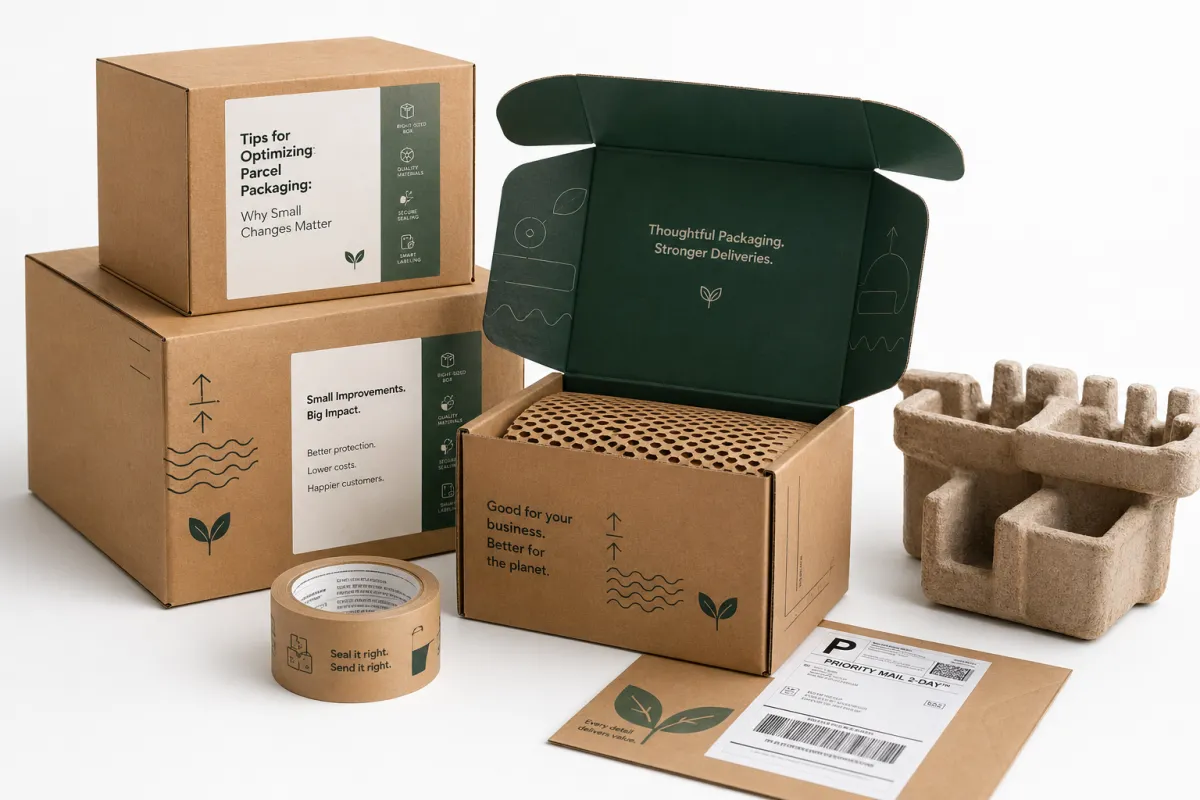
Tips for optimizing parcel packaging start with an awkward truth: one extra inch can quietly distort the economics of a shipment. A 12 x 12 x 12-inch carton holds 1,728 cubic inches. Step up to 13 x 13 x 13, and the volume jumps to 2,197 cubic inches, which is almost 27% more space for the carrier to bill against. That single change can push a parcel into a higher dimensional tier, require more filler, and still leave the product with room to move like a wrench in a coffee tin.
I have watched teams chase savings in the wrong place. They debate tape brand for 20 minutes, then ship a carton that is too large by a full finger width. The tape was never the problem. The box was. The damage lands later, hidden inside freight, claims, rework, and customer service tickets. Shipping behaves less like a single purchase and more like a pressure system, where one poor choice creates three more. That is why packaging needs to be treated as a connected set of decisions: protection, transport efficiency, and pack speed all at once.
One useful shift is to stop thinking about this as box tweaking and start treating it as parcel packaging optimization. That phrase sounds technical, but the work behind it is practical. Track three numbers together: damage rate, carrier surcharge drift, and median pack time. In a lot of operations, a 2% improvement in line speed does more for margin than a 10% drop in filler cost if claims stay flat. The cheapest box can still be the most expensive box.
There is also a behavior side to this. On a busy dock, packers do not have time to solve a puzzle on every order. If the carton family is too broad or the instructions too vague, people improvise. That is when the system starts to bleed money in tiny increments that look harmless on paper.
The arithmetic of “small” oversizing
The smallest box is not automatically the best box. A tight fit can save material, yet a brittle item with no cushion may turn a low-cost shipment into a replacement order. A package packed with generous foam may survive rough handling, but the extra material slows fulfillment and raises transport cost. The better question is not how little material you can use. It is how much risk reduction each extra gram buys.
Teams that use tips for optimizing parcel packaging well stop treating packaging as a one-time purchase and start treating it as a system. A lipstick kit that weighs 500 g does not behave like a 3 kg torque wrench. A 300-piece apparel bundle plays by different rules again. SKU behavior changes the answer every time, and the packaging spec should reflect that instead of pretending all parcels are built from the same physics.
Carriers are not passively accepting whatever ships out the door. Most parcel networks calculate dimensional weight, volume tiers, oversize fees, and zone-based pricing with algorithms that are a lot less sentimental than a pack room manager. If your box is wrong, your label can become your second-heaviest expense. That is not dramatic; it is arithmetic with a tracking number attached. I have seen the same item cost materially more simply because the carton shape wasted air.
Practice note: Good packaging choices can be measured, repeated, and audited. If a pack pattern cannot be measured at scale, it usually turns into a training issue first and a cash leak second.
Think of this as an operating discipline, not a cleanup project. Tips for optimizing parcel packaging trim waste from the pack-out process without stripping away the protection real shipping lanes require. Product lines shift. Promo volumes spike. Carriers revise rules. The packaging spec needs room to adapt, because a design that works this quarter can look silly six months later.
How do tips for optimizing parcel packaging cut damages and freight costs?
The answer is to optimize carton architecture around the route, not the catalog image. If you optimize only for shelf appeal, you get a tidy package that may fail under stack load. If you optimize only for drop resistance, you may pay through dimensional pricing every week. The better strategy is to choose a package style, test it on likely routes, and then lock a repeatable standard for each lane cluster.
In plain terms, map the failure points first, then map the cost points. If a route mix has long sort cycles and heavy conveyor handling, corner support can matter more than a deep layer of loose air fill. If a destination is mostly suburban and lightly handled, you may not need the same level of cushioning. That is the difference between guessing and an evidence-based packaging performance framework.
Use packaging performance metrics in sequence: initial fill ratio, compression response, lane damage trend, and repack frequency. If the first two improve but repacks stay high, you probably solved cushioning and missed the carton closure or orientation issue. These indicators make the trade-offs visible and keep the program out of “looks good, results weak” territory.
There is a second layer to this. Cost reductions from packaging do not only come from cardboard and filler. They come from fewer touches, fewer corrections, and fewer do-overs. One warehouse I reviewed had immaculate damage rates on paper, yet the labor cost was ugly because packers had to re-open one in every 18 orders to fix a bad fit. That is the kind of quiet waste that can kinda wreck a good-looking spreadsheet.
Tips for Optimizing Parcel Packaging in Real-World Shipping
On an active shipping floor, optimization lives in sequence: measure, Choose the Right carton, add cushioning, close correctly, then verify carrier compliance. Skip one step and the whole system leaks money. That is why tips for optimizing parcel packaging begin with the most neglected step of all: exact product measurement. A full metrology setup is unnecessary. What matters is repeatable size and weight capture at the SKU and pack-size level.
The most useful move is to build a cartonization strategy at the SKU family level. If six SKUs sit under 250 g, they do not need ten size variants. If three SKUs carry different fragility classes, they still might share one pack geometry with a swap-in insert. That sounds unlikely at first glance, until you compare the labor savings on the clock and the lower variation in tape defects.
Every layer must earn its place
Picture the pack-out chain as three layers of purpose. The carton provides rigidity and shape control. Cushioning absorbs shock and reduces micro-vibration during transport. Closure keeps everything in place until arrival. Overbuild one layer and another has to compensate, usually at hidden cost. Tape alone can hold a box shut, but it cannot prevent corner crush if the interior movement is left untouched.
Fragile glass usually benefits from right-sized corrugated board plus corner support blocks. That approach often beats wrapping the entire product in thick air pillows. Heavy tools usually need stronger board, often 32 ECT or 44 ECT on selected lanes, plus rigid inserts. Dense items transfer impact differently, and soft fill alone often cannot absorb the force. Apparel behaves differently again. Lightweight and compressible goods usually do better with paper wrap, fold control, and minimal void fill so the carton carries the shipping load rather than excess air. Multi-item kits need modular dividers or adjustable inserts so each item stays put under vibration.
One blind spot shows up again and again: orientation. Rotate a narrow item one way in the carton and it may fail vibration testing; rotate it another way and it passes. That matters for returns too. Expensive foam can still fail if orientation is ignored.
ISTA testing guidance exists for this exact reason. A lab is not required on day one. A repeatable small test routine is enough to start, along with notes on drop score, vibration score, and visible movement after each route simulation.
Overprotection versus efficiency, both are real costs
Every extra layer of cushion carries a price. Add half an inch of fill around each item and you may reduce breakage, yet raise unit labor by 5-12 seconds and push the box into a larger dimensional tier. If claim loss already sits near 0.8%, the added protection may pay for itself. If claims are closer to 0.2%, the extra fill is probably insurance you do not need.
In practice, the sweet spot usually sits between the two extremes. In workshops, I use a simple benchmark: if the package survives testing and packers can complete it in under 40 seconds for high-volume SKUs, the design is usually close to where it should be. If pack time creeps above 60 seconds and corrections show up every tenth order, the caution is already expensive enough to see in labor and fatigue.
Tips for optimizing parcel packaging are built around that midpoint. They are not about stripping out everything until a package looks elegant on a spreadsheet. They are about building a shipping-ready package that protects the item, protects the service promise, and avoids unnecessary rework.
There is a practical reality here that gets missed in many planning meetings: packers do not pack theory, they pack boxes at speed. If a method takes too many motions, the line will quietly drift away from it. That drift is not laziness. It is a sign that the design asked people to do more than the floor can sustain.
Cost, Pricing, and Materials: Where the Money Moves
Packaging managers usually split cost into five buckets: materials, labor, freight, damage, and returns. That view misses two more. Repackaging disruption sits in the background as repeat shipments, support tickets, and inventory strain. Brand damage follows close behind, appearing later as higher refund rates and weaker repeat purchase behavior. If the first five buckets look tidy but the business result still disappoints, those two are often the culprits.
Tips for optimizing parcel packaging only work if every cost bucket is measured. The main spend areas usually include:
- Corrugated board: board grade, flute profile, edge crush strength, style, print coverage, and supplier consistency.
- Inserts and cushioning: paper wrap, molded pulp, air, die-cut forms, honeycomb, foam-free inserts, and any part that holds the product still.
- Tape, labels, and documents: tape width, adhesive type, barcode placement, and required inserts or documents.
- Labor: pick and pack motion, correction cycles, training time, and repacks.
- Parcel pricing: DIM weight, zone effects, oversize charges, and carrier-specific parcel rules.
- Damage and claims: replacement product, outbound freight, inspection, and restock time.
- Retention impact: refunds, coupons, and lost repeat purchases.
Why dimensional economics can dominate raw material savings
Dimensional weight optimization is usually where the margin disappears. Suppose a SKU weighs 1.8 kg and ships in a 300 x 300 x 300 mm carton. If that carton pushes the package into a lower density bracket, freight can rise faster than the savings from removing a few grams of filler. A few spare centimeters can cost more than the cardboard you removed.
Cheap does not equal low-cost. A low-priced board combined with premium fill may create 10% more claims than a moderate board paired with a structured insert. The quote looks better, but the final economics do not. If one fragile category generates claim costs of $10 to $30 per case once shipping, handling, and product replacement are counted, a bad batch of 100 cartons can erase weeks of supposed savings.
Below is a comparison I use often in audits:
| Approach | Typical Cost Range (per unit) | Labour Impact | Protection Profile | Best Use Case |
|---|---|---|---|---|
| Single-wall 32 ECT corrugated + minimal paper fill | $0.18-$0.28 for 1,000-5,000 pcs; volume discounts possible at scale | Low; fast to pack | Good for light, rigid product; limited edge shock | Light retail packaging bundles, apparel, manuals, cosmetics |
| Double-wall 44 ECT + corner board inserts | $0.35-$0.55 per unit for 500-5,000 pcs | Medium; requires insert placement consistency | Better edge retention for heavy tools and dense kits | Heavy metalware, bulk kits, electronics accessories |
| Molded pulp inserts + custom-fit tray | $0.40-$0.90 depending on geometry and recycled content | Higher prep time unless pre-cut at supplier | Very high, especially for glass and ceramics | Fragile, premium, reusable gifting runs |
| Air cushion + 32 ECT corrugated (overfilled) | $0.12-$0.20 for material, but high fill waste | Inconsistent speed unless SOP is strict | Variable; easy to get right and easy to get wrong | Temporary solution only; not ideal for scale |
Volume behavior and long-term economics
Unit economics change sharply at 500, 5,000, and 50,000 orders per month. At 500 monthly units, a premium custom carton can make sense because setup and design costs are spread across fewer shipments. At 50,000 units, standardization wins. Reducing box variants from 14 to 6 can save more through procurement, line speed, and fewer mistakes than a single supplier discount ever will.
Standardizing box sizes is not a restriction on creativity. It cuts SKU complexity, lowers setup errors, and keeps overbuy under control during slow weeks. If you carry 10 small-to-medium SKUs, consolidating to 4 structural profiles can preserve quality in tips for optimizing parcel packaging while making inserts repeatable.
Supplier terms still matter. A 4% annual rebate on corrugated may matter less than removing one avoidable damage category. Lead-time commitments matter too. If a board spec changes and the team keeps using an old dimension, quality slips before the invoice even lands. The board still looks the same to the eye, but the compression result is suddenly different, and that difference usually shows up the hard way.
For branded programs, material choice also shapes perception. A matte 300 gsm C1S stock with FSC-certified board can signal premium intent without unnecessary bulk. Frequent printing calls for caution: Custom Printed Boxes often need lower ink coverage to preserve paper strength. That trap catches more teams than they expect.
Sustainability checks should rest on evidence. FSC guidance helps with chain-of-custody decisions, but procurement still needs to compare transport emissions per shipment rather than rely on board claims alone. A greener board that increases dimensional weight can backfire if it reduces box yield and raises freight.
Every pricing review should compare total delivered cost, not just the unit quote. A penny saved in the carton can be wiped out by a fraction of a percent rise in return rate, and returns are often the place where “cheap” turns expensive.
Step-by-Step Process and Timeline for Rollout
Intent only becomes useful once it lands in operations. Many teams treat optimization as a single design sprint. That approach usually fails. Real packaging change needs stages, checkpoints, and a rollout schedule with hard gates. A proper timeline often takes several weeks. Rushing the work can produce a better-looking box that nobody packs correctly at 7 p.m. on a Friday when volume spikes.
Week-level roadmap that works
- Week 1-2: Audit and baseline. Photograph current packaging for the top 10 SKUs, log dimensions, carton models, filler type, taping pattern, pack times, and damage outcomes by lane, by carrier, and by weight band.
- Week 2-3: Sample and measure. Select 3-5 high-impact SKUs, capture exact outer dimensions, declared weight, and carton void percentage. Build measurement cards that include orientation rules and fragile points.
- Week 3-4: Prototype and internal compare. Run two alternatives per SKU. Keep one version near the current spec and one reduced-bulk version.
- Week 4-5: Pilot in one lane. Pilot on one shift and one site. Operator behavior is part of the design system, not an afterthought.
- Week 6+: Expand with controlled training. Scale only once both cost and damage data remain stable over at least 10-15 shipments per product-day.
Use at least two full business cycles for baseline data, usually 2-4 weeks depending on order volatility. Enough volume is needed to avoid a false read. Seasonal mix matters too, so matched weeks are better than random before-and-after snapshots. I have seen a packaging project look excellent over a slow week and then fall apart when one promo hit the warehouse. That is why patience pays.
What to test, in sequence
Skip the sequence and the test loses credibility. A useful protocol includes drop tolerance, compression stacking, vibration tolerance, and lane simulation. Perfect laboratory parity is unnecessary at the start. Consistency matters more.
- Drop test: verify damage thresholds for edges and corners. Glass and ceramic often fail here.
- Compression test: simulate stack load, especially for warehouse staging where parcels sit 3-8 layers high.
- Vibration profile: route-level vibration reveals movement that never appears in drop events.
- Real-world lane test: move through selected carriers, including hubs known for mixed handling intensity.
A common mistake is to run attractive lab tests and stop there. Field conditions expose different failures. I often see packages that pass drops but fail on sortation conveyors. Documenting tips for optimizing parcel packaging with lane labels and carrier IDs leads to better decisions because the data reflects reality, not just the test bench.
Documentation needs to stay operational, not academic. At each step, capture carton ID, packing pattern, insert batch, tape spec, and closure sequence. Change one variable and the comparison loses force. A spec sheet earns its keep here.
For teams with more than one facility, include a sign-off sheet for each site and maintain one version history. That prevents two familiar kinds of chaos: one location keeps using the old method while another has already moved to the pilot version.
Training belongs in rollout from the start. A fast line is useless if every box is packed differently at each station. Quality systems have known this for decades: instructions and examples outperform verbal reminders alone.
Common Mistakes That Undercut Parcel Packaging
The most common mistake is the oversized carton. It keeps showing up because teams see empty space and assume more fill is the answer. Air is not protection unless it immobilizes the product. If a package rattles, that energy finds the first hard transfer point on the route. Oversized boxes also slow operators down because they have to add more material and still adjust parts by hand.
Failure pattern 1: oversize and overfill
Too much space costs money in two direct ways: extra material and higher parcel tiering. Too much fill costs money in three more ways: procurement, slower pack-out, and inconsistent density. Too little fill is worse for the customer. The goal is controlled fit, not padded emptiness. In many facilities, 15-20% of claim damage comes from product movement rather than impact alone.
For tips for optimizing parcel packaging, the first move should usually be measuring the void ratio you can tolerate. If the current pack leaves 35% unused space, cut that to 15-20% before changing materials. In practice, that shift often reduces both labor and damage, which is rare enough to be worth a pilot.
Failure pattern 2: inconsistent instructions across teams
Different 3PL teams, shifts, and seasonal temp workers create variation. If the SOP depends on each packer’s best guess, claims will vary by operator. Consistency is not paperwork for its own sake. It is risk control. If one site uses 50% tape overlap and another uses 70%, seam failure rises quietly, then suddenly becomes visible in the claims queue.
Use visual cues. A simple red-marked corner-reinforcement rule, such as protect the corners before filling and then lock orientation, costs almost nothing and prevents many avoidable defects. A short training clip, a laminated card, and periodic spot audits go a long way without adding digital clutter.
Failure pattern 3: environment and material mismatch
Temperature swings matter more than many teams admit. Tape peel strength changes. Paper behavior changes. Corrugated board can soften under humidity, and plastics lose elasticity in cold conditions. If carriers expose shipments to long-haul heat or cold, packaging tests need to reflect that. A design that works in a climate-controlled office can fail on the dock at 2 a.m.
The biggest hidden mistake is stopping after launch. Packaging is a living system. New SKUs appear. Promotions alter demand. Carriers revise handling rules. A carton that met targets in January can become non-viable in June when product dimensions shift or a carrier changes zone behavior.
That is why post-launch review matters. Apply tips for optimizing parcel packaging once and walk away, and you are betting against change.
One more quiet failure: teams often forget the final seal. A carton can be perfectly sized and still fail because the closure pattern is inconsistent. Tape angle, overlap, and pressure all matter. A weak seam turns a good design into a bad shipment faster than most people expect.
Expert Tips for Smarter Parcel Packaging Decisions
Practical improvements begin with structure. A carton library of 4 to 7 standard sizes does not limit options; it makes decisions faster. Teams often overfocus on “perfect fit” and underinvest in repeatability. Repeatability brings lower defect rates and steadier costs.
Standardization without stifling flexibility
Build the library by product class instead of by SKU. A useful setup might include retail packaging for apparel and soft goods, a high-edge-support class for fragile items, a dense class for tools, and a multi-item class for kits. Keep an internal matrix with max weight, max longest side, max corner vulnerability, and preferred cushioning method. Training gets easier and procurement becomes clearer.
Package upgrades often miss the structure behind the outer shell. Use a three-step stack: rigid support, restrained cushioning, protective closure. That gives operations, design, and procurement a common language without turning the review into a guessing game.
Use the three data streams together
Damage data, returns data, and customer feedback need to be read together. Damage claims show what fails in transit. Returns data shows what customers tolerate before they ask for money back. Complaints reveal patterns that raw counts miss, especially cases where a product looks damaged even though it still functions. If those complaints spike, the issue may be a seal or tamper-signal problem rather than packaging alone.
That combination catches low-volume defects quickly. If all three data streams improve together, the direction is probably right. If one improves and another gets worse, the spec is still being tuned blindly.
For teams moving at speed, another useful lens is lifecycle stress. A carton design that passes once can drift after 2,000 cycles because operators alter technique. Quarterly stress tests, even simple ones, catch this drift before it becomes a pattern.
Design for people, not just packages
Ergonomics belongs in packaging decisions. A packer who can open, place, and close a box with one steady motion will usually beat a packer who has to tap, shake, fold, and re-fold to make the carton behave. If the line is tiring by 5 p.m., defect rates rise no matter how advanced the material looked during testing.
Reusable templates and pre-cut inserts help a great deal. They can be printed as part of custom printed boxes programs, especially when brand teams want clean unboxing aesthetics. Good package branding should not depend on improvisation at the pack table.
If vendor review is already underway, check whether suppliers can provide print-ready packs aligned with approved dimensions. I often point teams to Custom Packaging Products options and custom branding packs that support consistent materials and repeatable templates. That shortens the pilot stage and removes one source of variation.
Periodicity is strategy, not cleanup
Quarterly reviews for top-volume programs and a six-week review after major product launches keep standards honest. If the review cadence slips, packaging standards drift with it. Make the review a standing calendar item rather than an emergency meeting.
Every review should answer two questions: are protection targets still being met, and did line speed improve or stall? If both look healthy, keep the spec. If one fails, the team already has a framework for adjusting using tips for optimizing parcel packaging instead of panic-ordering more tape.
One detail that separates solid teams from messy ones is how they treat supplier substitutions. A board equivalent on paper is not always equivalent in the field. Small changes in caliper, glue, or flute quality can shift compression performance enough to matter. Honest documentation beats wishful thinking every time.
What to Do Next With Tips for Optimizing Parcel Packaging
Enough theory. Here is a practical action plan you can run next week and still sound disciplined in a leadership update:
- Pick your top three to five SKUs by volume and claim exposure.
- Document current box size, fill method, closure method, pack time, and current cost-to-ship baseline.
- Measure actual outer dimensions and weight at least 30 units per SKU.
- Build two alternatives per SKU: one conservative and one compact-fit variant.
- Run a 2-week pilot on one lane with full data capture and route validation.
Use the results to build a decision sheet. Compare cost per shipment, damage incidents, pack duration, and repack rate. If the compact-fit version saves at least 6-8% in shipping-weight equivalent and lowers damage by 20% or holds steady, scale it. If pack time rises by 15 seconds per box and returns do not improve, revisit the process before a wider rollout. Good optimization keeps the system efficient without making it brittle.
Set a review rhythm and own it
Assign one owner for day-to-day execution and a separate reviewer for weekly variance. A 30- to 60-day cadence works for fast-moving operations. Track hard numbers: damage rate, median pack time, packaging cost, and claim ratio. Do not let “looks fine” outrank evidence.
Train the people who do the work. A two-minute refresher can prevent a 20-minute reclaim action. Use photos from your own line, not stock imagery. Teams absorb standards faster when the bad examples look familiar, and they trust a method more when they have seen it fail before.
Close the loop to customer outcome
Pull the customer signal forward too. A customer who opens a tidy, well-protected parcel is less likely to file a handling complaint or return the item for damage. For premium categories, this can also strengthen branded packaging perception and reduce disputes after purchase.
Here is the action for this week: choose one SKU, one lane, and one carrier mix, then run two tips for optimizing parcel packaging variations for five days straight. Once the data is in, decide by numbers instead of habit. The first reroute of a package family often shows the next best improvement.
Tips for optimizing parcel packaging work best when they are specific, measurable, and repeatable. Start with one SKU family, lock the spec, document the process, and review every 30 to 60 days so the gains last.
If the packaging layer needs to support margin and trust at the same time, treat it as operations engineering with packaging design discipline, not as a decoration line item. The useful goal is not a prettier box. It is a package that arrives intact, fits the shipment profile, and can be packed the same way tomorrow without guesswork. That is the point where shipping gets sharper, faster, and less wasteful.
Frequently Asked Questions
What are the best tips for packaging fragile items?
Use a right-sized carton and a cushioning system that locks the item in place with no movement at the corners or edges. For fragile SKUs, test at least two options and validate them with drop and vibration checks before scaling. Corner and edge reinforcement should come first, especially for bottles, optics, and glass.
How do tips for optimizing parcel packaging reduce shipping costs?
They reduce dimensional weight by cutting excess cubic volume, simplify packing steps, and reduce repacks. A cleaner pack often lowers labor time by seconds per order and reduces damage that drives replacement and support costs. The biggest hidden gain is usually lower claim volume and fewer returns.
How often should parcel packaging be reviewed or retested?
Review packaging whenever products or materials change, carrier routing shifts, or damage and complaint data rise. A quarterly cadence works for most operations, with immediate retesting after any supplier, carton, or tape specification change.
What materials are most useful when optimizing parcel packaging?
Start with strong corrugated board as the base, then choose cushioning to match product behavior. Paper-based fillers, molded pulp, and die-cut inserts serve different needs; air cushioning can work for lightweight flows but adds risk if it is overused. The best material is the one that protects with the least added volume and labor for the order pattern.
What is the fastest way to start optimizing parcel packaging?
Audit top SKUs first, then test two alternatives for each one, including a tighter-fit option. Compare cost, pack speed, and breakage over a short pilot lane. Once the data stabilizes, roll out to one site or shift before expanding across the operation.