Buyer Fit Snapshot
| Best fit | Compare Compostable vs Recyclable Packaging projects where brand print, material claims, artwork control, MOQ, and repeat-order consistency need to be specified before quoting. |
|---|---|
| Quote inputs | Share finished size, material target, print colors, finish, packing count, annual reorder estimate, ship-to region, and any compliance wording. |
| Proofing check | Approve dieline scale, logo placement, barcode or warning zones, color tolerance, closure strength, and carton packing before bulk production. |
| Main risk | Vague material claims, crowded artwork, missing packing details, or unclear freight terms can make a low unit price expensive after revisions. |
Fast answer: Compare Compostable vs Recyclable Packaging: Quote Scope, Sample Proof, MOQ, and Lead Time should be specified like a repeatable production item. The safest quote records material, print method, finish, artwork proof, packing count, and reorder notes in one written spec.
Production checks before approval
Compare the actual filled-product size with the drawing, then confirm tolerance on folds, seals, hang holes, label areas, and retail display edges. Reserve space for logos, QR codes, warning copy, and material claims before decorative graphics fill the panel.
Quote comparison points
Review material grade, print process, finish, sampling route, tooling charges, carton quantity, and freight assumptions side by side. A quote is only useful when the supplier can repeat the same color, closure quality, and packing count on the next order.
Compare Compostable vs Recyclable Packaging: Which Wins?
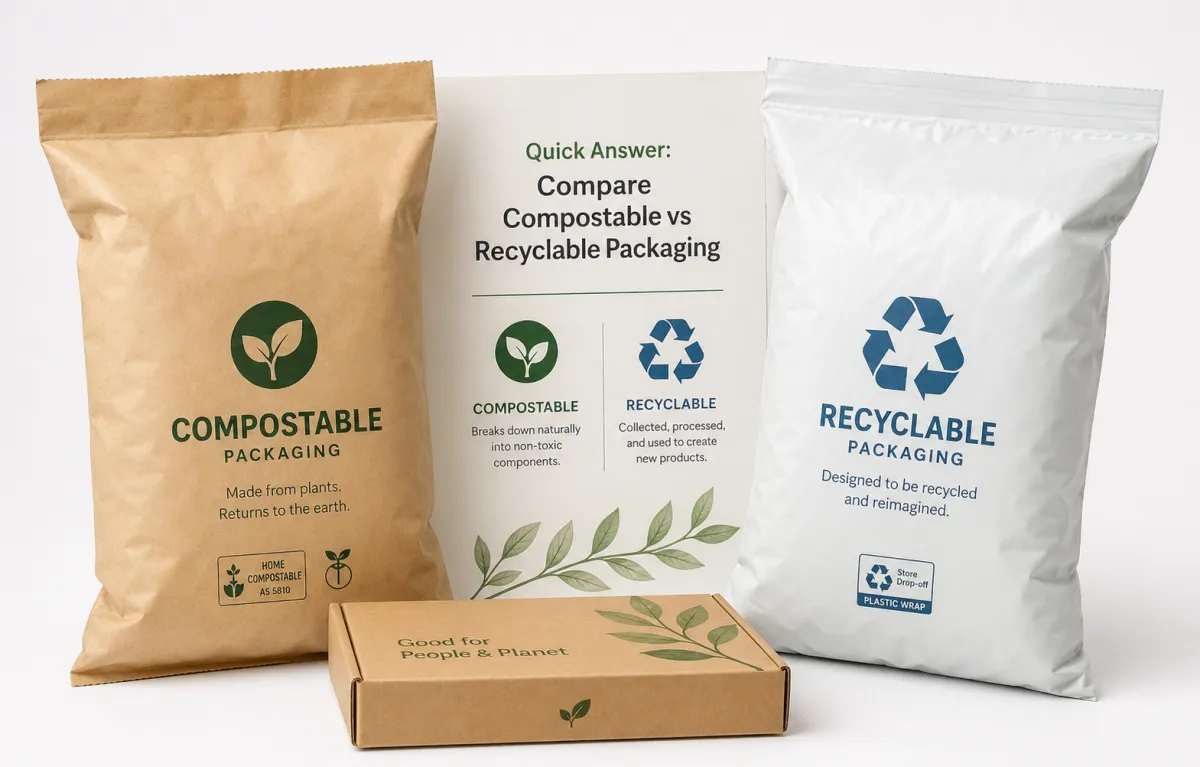
Three years ago, I sat in a launch review where a brand proudly presented compostable sleeves and paper-lined mailers. The problem showed up in one sentence from operations: half their customers were in office towers with no organics pickup, and the building manager was tossing everything into mixed waste. That was the whole story, really. The package could be compostable on paper and still end up behaving like trash. Disposal only counts if people can actually do it. That is the first thing I check every time I Compare Compostable vs recyclable packaging.
If your product runs hot, carries moisture, or has a short shelf life, Compare Compostable vs recyclable packaging and compostable often looks stronger on functional fit, especially in food-service settings where contamination is baked into the use case. If your product is dry, ships long distances, or needs broad regional distribution, compare compostable vs recyclable packaging usually points toward recyclable. That is not a moral judgment. It is an operations judgment, and the difference matters.
Teams still treat sustainability like a label swap. It is almost never that tidy. Raw material choice, conversion quality, shipping behavior, local collection systems, and claim language all pull in different directions. The first question should not be, “Which one sounds cleaner?” It should be, “Which package protects the product, survives the supply chain, and gives customers a disposal path that is real, not theoretical?” Answer that honestly and the rest gets a lot less fuzzy.
I built this analysis the way I would review a packaging brief for a client: product behavior first, marketing second. The decision usually comes down to a few variables:
- protection under load, impact, and humidity
- barrier performance and shelf-life stability
- certifications and claim language that hold up under scrutiny
- access to disposal streams in actual cities, not idealized maps
- total cost, including rejects, rework, and claim exposure
My short version is this: compostable is often the better fit for food-heavy, short-life, contamination-prone use cases, while recyclable is usually better for availability, familiarity, and repeatable production. That is a starting point, not a verdict carved in stone. If you compare compostable vs recyclable packaging through end-of-life behavior instead of brand philosophy, the winner changes by channel more often than most teams expect.
First-pass decision logic
Before design work starts, three questions filter out most bad options:
- Can the product touch the material without leaking oils, acids, steam, or heat damage at the intended temperature?
- Can customers separate the package and dispose of it in a known stream?
- Will the conversion line handle the material without adding rework, downtime, or a fresh failure mode?
If those answers are shaky, concept work can wait. Procurement is not gonna thank you for a beautiful failure.
Which Is Better: Compostable or Recyclable Packaging?
If you compare compostable vs recyclable packaging only at the material level, you miss most of the story. Structure, sealing behavior, print treatment, and recovery path decide the result. The materials below are the ones buyers actually source, not the exotic samples that appear at trade shows and quietly vanish by the next quarter. In sustainable packaging, the substrate is only one variable; the rest is format, distribution, and the reality of local collection systems.
Compostable formats and how they behave
PLA liners are common in flexible packaging and light pouches. They can be clear or lightly tinted, which helps branding, but heat resistance is usually the first limit. Many grades begin to soften around 55-60C. That is acceptable for room-temperature foods and risky for anything near microwave-adjacent claims. Compostable mono-layer films, often in the 25-80 micron range for pouch work, can print well, yet thin gauges can tear at the edge if the seal window is too narrow or the converting line runs hot.
Bagasse trays and molded pulp systems do well in beverage-adjacent and takeout categories. A common 1.5-2.5 mm wall structure gives respectable rigidity without the weight of many rigid plastics. Direct oil exposure still needs a barrier. Brands often add certified bio-based coatings, then complain that the finish loses some sharpness. That trade-off is real. You usually get less gloss and less visual crispness than with coated board unless the print and coating stack are tuned carefully.
Certified compostable films include PLA, PHB blends, and cellulose-based composites. The word certified matters more than people admit. Ask for ASTM D6400 or EN 13432 documentation, and ask for food-contact declarations where relevant. For food packaging, I would also want the supplier’s migration testing summary and a clear statement of intended use, not a glossy brochure with a recycling leaf slapped on top. If you compare compostable vs recyclable packaging without that paperwork, the conversation stays vague and nobody learns anything useful.
Moisture and grease resistance remain the weak spots in many compostable systems. At 80% relative humidity with repeated handling, some PLA laminates soften or separate at the edge unless the barrier architecture is deliberate. Greasy snacks expose the issue fast. Once extra barrier layers are added, the price climbs quickly. That is the annoying part. The more protection you add, the less “simple” the package becomes.
Recyclable formats and where they still perform best
Paperboard still leads for print quality, structure, and premium feel in cartons and retail packaging. A 350-450 gsm paperboard with a water-based coating and sensible fluting can handle demanding graphics and has familiar recovery pathways in many markets. It is not magic. It is just well understood, and in packaging that counts for a lot.
Mono-material plastics in PE or PP families are often dismissed too quickly. In practice, they recycle better where the stream exists, and they are usually easier to convert than multilayer laminates. For coffee pouches, resealable bags, and many Custom Printed Boxes-adjacent inserts, mono-material structures reduce sorting confusion and cut the number of odd failures that show up later in production. I have seen converters breathe easier the moment a finicky laminate gets replaced with a cleaner mono-material build.
Glass remains one of the strongest barriers for perishables and cosmetics. The cost is weight. Freight rises, especially by air, and breakage becomes part of the risk profile. Aluminum has excellent oxygen and light protection, but metallized stacks with stubborn adhesives can still be rejected by material recovery facilities or reprocessing lines. Recyclable claims get fragile very quickly in that situation: the collector may be equipped, while the package itself still fails quality checks.
Recyclable corrugate is often the quiet winner for transit durability and low risk. A double-wall 200-250 ECT corrugate with the right flute profile can handle compression and vibration better than many lightweight compostable mailers when shipments cross regions or spend days in mixed freight.
That trade-off is easy to miss. Compostable can reduce symbolic waste impact in a campaign, while recyclable often has more mature collection pathways. The better choice is not ideological; it is operational. If you compare compostable vs recyclable packaging by the recovery system first, the answer gets less trendy and more useful.
Where each group fits by category
Dry snacks and cereal portions usually do better in recyclable paperboard mailers with an inner moisture-control layer than in compostable alternatives. Hot soups, noodle cups, and greasy prepared foods can suit compostable materials if the local collection system can take them. Cosmetics, with their oils and long shelf lives, generally behave better in recyclable mono-material films or glass. E-commerce inserts and mailers usually favor recyclable corrugate because compression resistance is high and courier networks already know how to handle it.
Detailed Reviews: What We Found in Testing
Now the conversation moves from spec sheets to outcomes. Packaging that looks excellent in CAD and in a clean sample kit can still fail inside real parcels. Comparing compostable vs recyclable packaging in production forces the real issue into view. The useful tests are the boring ones: repeated handling, wet-rub, seal stress, and climate simulation. When teams compare compostable vs recyclable packaging with test data instead of assumptions, the weaker corners show up quickly.
Durability: drop, compression, and shipping wear
In practical handling tests, I use checks similar to ISTA expectations for common mailer profiles: corner and edge drops, static compression, and random stacking. A 1.2 m equivalent drop at several orientations usually exposes weak seams and adhesive failures. Compostable films sometimes score well on soft puncture behavior during light impacts, yet recyclable corrugate and high-ECT boards hold up better under repeated stack compression and long pallet life.
Rigid food formats show the same pattern. A compostable bagasse composite may look strong at first, then show lip deformation after vibration cycles with 3-4% RH drift. A recyclable rigid sleeve tends to hold geometry better. That matters on automated fulfillment lines where cartons run through rollers and conveyors that punish weak corners.
Above 30-40 packs per minute, recyclable options often behave more predictably. Not always. Often. The smaller the process window, the less surprise you want.
Barrier and shelf-life behavior under stress
At 65% RH, standard compostable films and composites often absorb moisture faster than buyers expect. At 80% RH and warm ambient temperatures, seals usually fail before the bulk material does. A 5-gram oil smear test that passes on glossy recyclable film can fail a compostable pouch in minutes if the barrier stack is thin. For products with high fat migration, I would not trust compostable claims without a validated coating and product-specific testing.
For cosmetics and beauty formulas, recyclable or glass structures still protect shelf life more consistently. The issue is not oxygen alone or light alone. It is the interaction between the substrate and the active ingredients. A matte compostable surface can drift in appearance over time, and print color can shift under UV exposure or heat. Brands that sell on finish and visual consistency feel that change immediately, especially in e-commerce returns.
“A packaging decision only fails when someone can see, smell, or feel damage before opening. If the package survives transport but loses trust at checkout, the sustainability claim never reaches the customer.”
Printing and branding quality
Packaging design changes the way the product feels before it is touched. Recyclable boards and rigid formats accept spot varnish, soft-touch coating, and tight CMYK control with less registration drift. Compostable films can carry strong graphics, but small-run color consistency is usually less forgiving, and matte or metallic effects lose edge sharpness at speed. For package branding, that matters if the brand promise depends on a premium visual code.
I have also seen well-executed compostable wraps for ready-meal lines where the graphics stayed minimal, the label area was clean, and the package felt honest. That kind of restraint works. If the design depends on intricate art or heavy metallic treatment, recyclable substrates are the safer route. It sounds blunt, because it is.
Where recyclable structures underperform
Recyclable does not automatically mean cleaner. Laminates that mix plastic and adhesive layers can become dead ends in sorting systems. A shiny coating can push a package outside accepted streams in municipalities that reject contamination above a set threshold. Some paper composites avoid aluminum, then fail recovery because of hard resins or wet-strength additives that regional buyers will not accept. So yes, many buyers default to recyclable. Compare compostable vs recyclable packaging again after a recovery audit, not after a spec review.
My verdict from the testing side is direct: compare compostable vs recyclable packaging across the actual use case, not across a marketing claim. Compostable outperformed expectations in contamination-heavy short-life service windows. Recyclable outperformed in predictable scale and repeatability. If you compare compostable vs recyclable packaging only by headline sustainability language, you end up missing the operational scorecard.
Process and Timeline: From Spec to Ship
Many projects lose time and patience here: not in material selection, but in execution. A team can decide on a format in one meeting and still miss launch because conversion, approvals, and disposal claims were not defined tightly enough. Brands asking whether they can compare compostable vs recyclable packaging quickly usually can, but only for simple swaps. Structural changes take longer, and they tend to pull everyone into a slightly grumpy mood by week three.
From brief to production
A clean process looks like this:
- Product brief: define product chemistry, target shelf life, drop profile, and graphic constraints.
- Material preselection: shortlist compostable and recyclable families with similar mechanical behavior.
- Dieline lock: finalize dimensions with 1-2 mm tolerance for seams and insert geometry.
- Sample rounds: usually two to three, unless the coating stack pushes the count higher.
- Validation: barrier, sealing, print, and disposal-label review.
- Regulatory check: confirm claim wording, ASTM/EN certificates, and any market-specific guidance.
- Pilot: run controlled fulfillment, then release for final approval.
Skip any one of those steps and the schedule starts to slip. Compostable programs are especially sensitive to skipped disposal-claim verification, which can create legal and reputational risk. I have seen teams rush this part, then spend weeks cleaning up language on the back end. Nobody enjoys that.
Typical timelines and where delays start
For a straightforward recyclable redesign with an existing die and minimal structural change, 4-8 weeks is common when supplier lead times behave. A comparable compostable redesign often lands in the 8-14 week range because sourcing, certification, and barrier validation usually add extra rounds. New tooling is the loudest variable. If the job needs fresh die-cut tooling with several plate changes, add 2-3 weeks without much drama.
Barrier testing can add another 1-2 weeks when humidity and shelf-life protocols must reflect the actual product. Food launches often need packaging-law review for compostable claims and contact compliance, which can add another 1-2 weeks. If no supplier already has a pre-approved equivalent format in your volume bracket, plan for the longer path.
When MOQ drops below 5,000 units for a specialized print run, procurement can get slowed by batch scheduling at the converter. Small runs sound simple until they are not. The smaller the first run, the less room there is for tooling cost and the higher your unit penalty. That is one more reason I keep saying compare compostable vs recyclable packaging as a systems question, not a values debate.
Implementation complexity in plain terms
Recyclable formats are usually easier to source quickly because the converter ecosystem is already deep. Compostable can be excellent, but it often needs tighter upstream specification, more incoming inspection, and separate line settings for heat sealing and conversion speed. If the schedule cannot absorb two failed pilot runs, that difference matters more than the branding story.
A workable rollout sequence looks like this:
- Quick refresh path: same format, new graphics, recyclable route, no new barrier - 2 to 4 production cycles.
- Measured transition path: new substrate comparison, 2 pilot regions, dual-label compliance - 6 to 10 weeks.
- Strategic shift path: full material conversion, new conversion settings, claims package and audits - 8 to 14 weeks.
If the brand has a trade show date or retail reset window, put that on the calendar before creative starts moving. Packaging projects love to pretend they live outside the calendar. They do not.
Price Comparison: Upfront Cost vs Total Cost
Price needs a wider frame. Item cost alone rarely tells the truth. The better measure is landed cost and cost per successful unit. That is where many teams lose control. I compare compostable vs recyclable packaging with one formula: (material + printing + freight + rejects + rework + disposal claim exposure) / successful units delivered in spec.
| Format | Typical unit cost (5,000 pcs) | Strength | Weakness | Likely best fit |
|---|---|---|---|---|
| PLA/compostable flexible film | $0.22 - $0.34 | Good for short-life food-adjacent use | Higher barrier costs; disposal path risk | Takeout inserts, single-use food wraps |
| Bagasse/molded fiber | $0.28 - $0.46 | Compostable look, premium texture | Moisture handling and grease limits | Premium coffee, meal kits with dry fillers |
| Recyclable paperboard mailer | $0.16 - $0.30 | Strong conversion compatibility and print | Needs careful coating design for moisture | Retail packaging and gifting |
| Recyclable mono-plastic film | $0.18 - $0.29 | Reliable high-volume conversion | Claims can be constrained by region | Supplements, personal care, dry pantry |
| Corrugated mailer | $0.20 - $0.38 | Excellent e-commerce protection | Higher freight for dense items | Shipped products, repeat fulfilment |
Those ranges shift by 10-20% when print coverage, foil simulation, or die complexity changes. Move artwork from spot CMYK to four-color with white ink and the cost jump shows up immediately, regardless of substrate. A high-coverage full bleed on rigid board, for instance, can raise unit cost by roughly 8-15% compared with a simple logo pass.
What is usually missed in pricing discussions
Freight is the silent variable. A compostable rigid substitute that is 12-20% bulkier at the same volume can push box counts down by 8-12% on truckloads. Extra pallets and extra trips follow. Spoilage from poor barrier is even more expensive than unit cost. One contamination event in a 2,000-unit lot can erase months of margin planning.
Rejected runs add another hidden layer of cost. If the spec tolerances are vague, compostable lots can reject at 2-4% on first pass for seal quality, while recyclable complex laminates can fail at 1-3% for recyclability claims and de-bonding. That is real money leaving the room.
Storage conditions matter too. A compostable film stored in a hot warehouse can lose shape tolerance faster than a cool-stored recyclable film. If your network includes regional facilities in high temperatures, fold that into the total cost model.
When recyclable lowers total cost in practice
Recyclable often lowers total cost when:
- you already have existing tooling
- your carton design needs fast proof cycles
- your supplier has stable inventory of FSC-certified stock
- you run above 10,000 units per SKU
Branded packaging with predictable conversion windows can reduce returns and field complaints enough to offset a small premium. If premium design reduces return rate by even 1-2%, that can outweigh a 3-5 cent per-unit cost increase. That line matters. Cost is not only about what leaves procurement; it is about what never comes back as a problem.
For brand direction, test more than invoice price. I compare compostable vs recyclable packaging against landed cost, claim risk, and cost per successful use because that is the version finance can defend six months later. When teams compare compostable vs recyclable packaging this way, they stop arguing over labels and start arguing over measurable outcomes.
How to Choose the Right Packaging for Your Product
A common mistake is ranking messaging before performance. Weak packaging creates more waste than a package in the “wrong” category that is engineered properly. The practical framework is straightforward and usually exposes the best route quickly. If you compare compostable vs recyclable packaging after you map product risk, the answer is usually clearer than the brand debate suggests.
Step one: map product type and product chemistry
Food and beverage: if the package touches wet oils, steam, or heat, test barrier at the exact use temperature. Cosmetics: look for low chemical migration and stable shelf behavior. Personal care: spills and leakage risk often demand rigid structures or high-bond seals. Ecommerce: crush resistance and fast pack-out matter more than a noble material story. Industrial supplies: durability and returnability usually beat narrative. In those cases, the answer to “compare compostable vs recyclable packaging” rarely comes from branding language.
Dry goods and shelf-stable products are usually simpler to validate in recyclable systems. Short-life meal applications can fit compostable materials if disposal logistics support them. Segment by use case instead of forcing one policy across the catalog.
Step two: test disposal reality before printing claims
If customers cannot find the right bin, confusion becomes part of the product. Compostable packaging can perform well in pilot tests and still end up in landfill because the user has no access to compost collection. Recyclable packaging can suffer the same problem if it uses composites the local stream will not accept. Build the decision around documented recovery options in your actual delivery areas. Support teams can even ask a simple follow-up question: where did you dispose of it?
Match the claim to the route. Compostability claims need the route to exist in your key markets. Recyclability claims need the package to be accepted cleanly in the bins or take-back systems people actually use.
Step three: evaluate risk from claims, compliance, and operations
For compliance, use recognized bodies where possible. ASTM and EN standards help with compostability claims, FSC can support fiber sourcing, and local FTC-style guidance should shape the final claim language. For recovery readiness, ISTA testing frameworks are useful references for distribution stress, and they help prevent field failures that no spreadsheet catches.
If your design includes specialty coatings, confirm recoverability. A package can be marketed as recyclable while still getting rejected in sorting lines. That is where strong brands get caught. Use this decision framework for each SKU:
- Performance requirement: heat, moisture, grease, abrasion, shelf life
- Disposal access: local bins, municipal programs, take-back options
- Conversion readiness: line settings, MOQ, tooling risk
- Compliance: certificate stack, claim wording, audit trail
- Budget: unit cost + freight + rework + support burden
Step four: package the brand story without overpromising
Customers reward specificity. A product packaging line with clear use and disposal instructions beats vague eco language every time. If you produce custom printed boxes or retail packaging with high visual standards, keep the message lean and the instructions obvious. Package branding should help trust, not make the buyer guess. A simple instruction icon for both compostable and recyclable options usually works better than a block of copy that nobody reads.
If the packaging team designs in-house, build a disposal test into the same production schedule. Not in a separate sustainability report. In the same run. That is the cleanest way to keep claims honest and defendable.
Our Recommendation: Best Fit by Use Case
Here is the cleanest practical takeaway. I recommend compostable packaging for short-life, food-adjacent, contamination-heavy channels when disposal infrastructure is confirmed. I recommend recyclable systems for broad retail and e-commerce where durability, cost control, and stream access matter most, especially when the brand is exposed repeatedly at scale. If you compare compostable vs recyclable packaging by use case rather than by category name, the recommendation becomes far more stable.
What I recommend for typical use cases
Use case A: fast-casual meals and greasy takeout
Primary concern: leakage and heat handling. Compostable options can work well if the service network reaches compost-ready customers. If not, a high-barrier recyclable route is safer, with clear disposal notes.
Use case B: dry food and pantry goods
Primary concern: shelf life and long stability. Recyclable with tested barriers is usually lower risk and often lower total cost at 5,000+ volume.
Use case C: cosmetics and personal care
Primary concern: chemical interaction and premium appearance. Recyclable or glass structures usually outperform most compostable options unless a specific certified compostable solution has already been proven.
Use case D: ecommerce inserts and mailers
Primary concern: compression resistance and transport consistency. Recyclable corrugate or mono-material structures are usually the safer operational choice.
Execution sequence before you finalize
Do not choose by trend. Do these four steps:
- Request samples for at least two branded packaging options per category.
- Run your own loading and climate tests, not only supplier claims.
- Confirm disposal instructions and claim pathways for your top 3 sales regions.
- Compare landed and successful-use costs before approval.
If you are evaluating from an existing supplier list, review Custom Packaging Products side by side with expected MOQs and conversion constraints. If the brief includes high customization, check custom printed boxes that can hold performance while still matching disposal reality.
My final recommendation is simple: build a one-page decision sheet for every SKU with three columns — product stress, disposal route, and claim proof. If one of those columns is weak, the package is not ready. That is the cleanest way to compare compostable vs recyclable packaging without getting pulled into slogans, and it is the quickest way to avoid expensive rework later.
For technical references and a better baseline on standards, I lean on industry publications at Packaging.org and environmental policy context from EPA. For forest-sourced fiber validation, FSC guidance remains a useful checkpoint.
FAQ
Is compostable or recyclable packaging better for food brands?
There is no universal answer. Compostable packaging often fits food-service applications when organic disposal is realistic and the package is heavily food-contaminated after use. Recyclable packaging usually works better for dry or shelf-stable foods and brands that need broad disposal access across many regions. To compare compostable vs recyclable packaging, start with whether customers can actually use the intended end-of-life route.
Does compostable packaging really get composted by customers?
Only if customers have access to a commercial composting facility or a municipal stream that accepts that exact material. Without that route, many compostable items still go to mixed waste, especially in areas without separate organic collection. In those cases, recyclable packaging may be the more reliable sustainability choice from a practical and customer-behavior standpoint.
How does recyclable packaging compare on cost?
Recyclable formats are often cheaper to source at scale because they are widely produced and easier for many converters to spec. Total cost still rises when you add mixed-material structures, high-end coatings, or repeated production rejections. Compare landed cost and cost per successful use, not just the carton quote price.
What is the usual timeline to switch packaging materials?
If you are making a straightforward recyclable substitution and the structure already exists, it can move faster. Compostable packaging usually takes longer because material sourcing, certification checks, and performance validation often need extra rounds. New tooling, revised barriers, or higher MOQ requirements can add 2-6 weeks.
How do I choose between compostable vs recyclable packaging for my brand?
Start with product protection and shelf life. Then check local disposal access and customer behavior. Use compostable solutions when the use case is short-lived and disposal conditions are realistic. Use recyclable options when you need broad infrastructure support, stable conversion, and lower implementation risk. Compare compostable vs recyclable packaging from first principles: function first, claims second.