Buyer Fit Snapshot
| Best fit | Price for Metallic Ink Packaging projects where brand print, material claims, artwork control, MOQ, and repeat-order consistency need to be specified before quoting. |
|---|---|
| Quote inputs | Share finished size, material target, print colors, finish, packing count, annual reorder estimate, ship-to region, and any compliance wording. |
| Proofing check | Approve dieline scale, logo placement, barcode or warning zones, color tolerance, closure strength, and carton packing before bulk production. |
| Main risk | Vague material claims, crowded artwork, missing packing details, or unclear freight terms can make a low unit price expensive after revisions. |
Fast answer: Price for Metallic Ink Packaging: What Affects It Most should be specified like a repeatable production item. The safest quote records material, print method, finish, artwork proof, packing count, and reorder notes in one written spec.
Production checks before approval
Compare the actual filled-product size with the drawing, then confirm tolerance on folds, seals, hang holes, label areas, and retail display edges. Reserve space for logos, QR codes, warning copy, and material claims before decorative graphics fill the panel.
Quote comparison points
Review material grade, print process, finish, sampling route, tooling charges, carton quantity, and freight assumptions side by side. A quote is only useful when the supplier can repeat the same color, closure quality, and packing count on the next order.
Ask three buyers for a quote on the price for metallic ink packaging, and three different numbers usually come back. The visual brief might sound identical. The economics rarely are. One carton may ask for a delicate metallic accent on a logo only, while another wants broad coverage across an entire face. That single shift can change the bill faster than most first-time buyers expect. The price for metallic ink packaging is not set by ink alone; it is shaped by the full build, the finishing stack, press time, and the risk attached to keeping the effect consistent. Buyers who look only at the unit line usually miss the part that drives the real spend, and that is why the price for metallic ink packaging can swing so sharply between vendors.
At Custom Logo Things, that pattern shows up often. A team brings in a launch-ready design, asks for a richer presentation, then wonders why the new run costs more than the last one. The answer tends to be measurable, not mysterious: the metallic area grew, the board changed, or the coating sequence shifted. I once watched a sample room approve a package in ten minutes, only to have the production quote jump the moment the metallic band widened by half an inch. That tiny visual tweak was enough to alter the make-ready waste and the inspection load. Even a small change there can move the price for metallic ink packaging by 20% to 60% before a press ever starts. The smartest procurement move is to trace those switches early. Guessing at the price for metallic ink packaging is a good way to create avoidable risk in a budget that is already tight.
Why does the price for metallic ink packaging change so much?
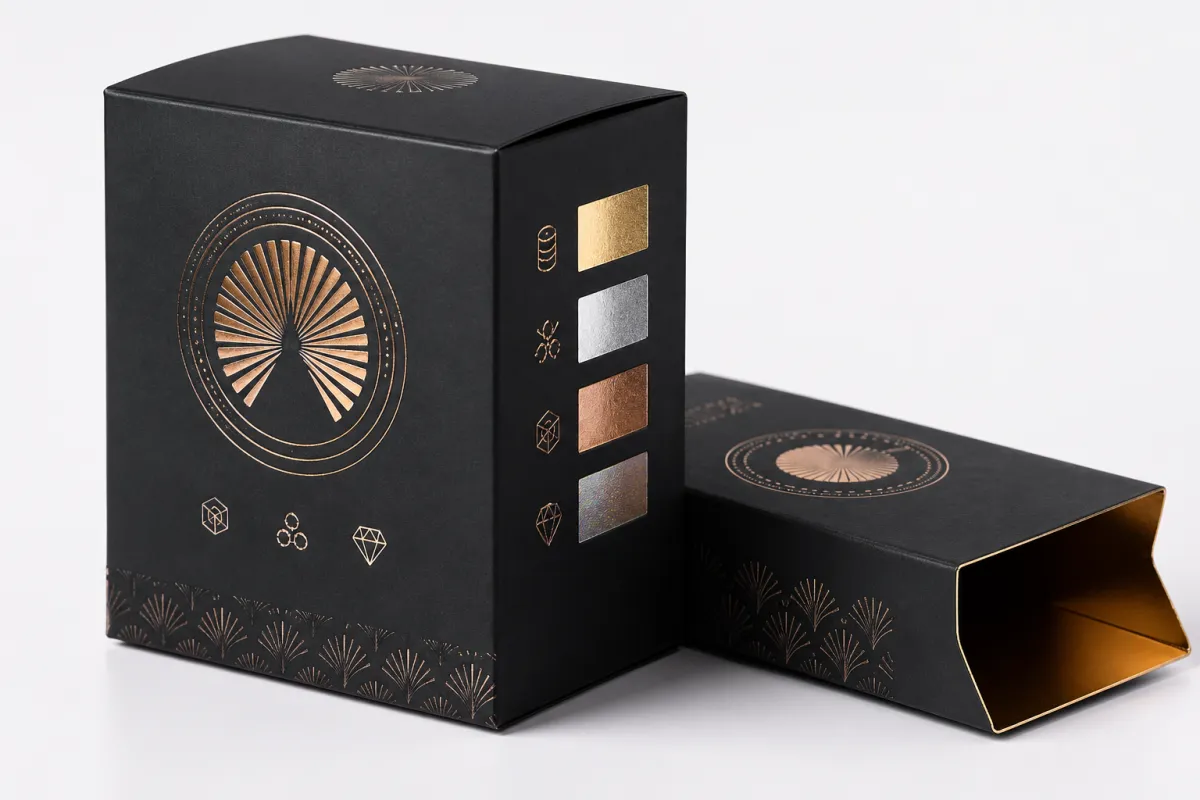
A small change can move the quote as much as a second print color
Picture a realistic production run: 5,000 Custom Printed Boxes sized at 12 inches by 8 inches, built on 350gsm C1S artboard, with CMYK plus one metallic treatment. If the metallic effect touches 8% of the printed area, maybe a logo outline and a thin ribbon line, the job may sit in a lower cost band. Expand that same effect to 24% with a larger logo block and a metallic border, and the unit cost can climb even if the board stays exactly the same. The rise usually comes from additional passes, longer setup, and more inspection time, not simply from more ink on the sheet.
Buyers sometimes ask for the lowest price for metallic ink packaging by asking one narrow question: "Can you lower the metallic rate?" When the metallic line item is quoted at only a few cents, a bigger-than-expected total can look like padding. That is rarely the real story. The larger cost often sits in prepress work, plate count, make-ready waste, and the extra checks needed to keep the metallic effect even across the run. In other words, the quote is carrying the job, not just the ink.
Metallic packaging is a stack of decisions, not one line item
A serious quote usually has at least six moving parts: artwork quality, print method, substrate behavior, number of separations, coating stack, and finishing sequence. Shipping, warehousing, inserts, and die-cut complexity sit on top of that. A shop can advertise a lower base rate and still land at a higher total because the setup for spot metallic is heavier than the buyer assumed.
The better question is not "how much does metallic cost?" The stronger question is "what exact effect does the design need?" A muted premium look on the logo often works well with a spot metallic application and a controlled area. An all-over shimmer tells a different production story. Different presses, different plate counts, and different cure times all shift the price for metallic ink packaging.
The value case is still strong when the spec is controlled
Metallic ink can lift a package quickly at shelf level, especially in retail packaging and premium cosmetics where differentiation matters. Teams often underestimate how much impact they can buy with a restrained accent system. Used carefully, metallic ink can create a premium impression without the cost of full metallic finishing. That pattern shows up in spirits labels, skincare cartons, and electronics accessories again and again. Reflectivity and memory recall arrive without forcing every panel to carry heavy coverage.
Here is the blunt version from a buyer's seat: if the price for metallic ink packaging feels too high, the design may be asking for maximum shine instead of targeted shine. Economics improve when metallic ink is tied to a brand cue that actually guides attention, like a badge, seal, foil-like strip, or callout. Blanket coverage is where cost climbs and return starts to flatten. That is the part people miss until the proof comes back and the math gets real.
A second comparison mistake shows up often. Someone accepts a lower quote, then learns the supplier used a thinner board or a different coating stack. Same number, different construction. That comparison is false from the start. Ask for normalized quotes before approval. Same material, same dimensions, same varnish, same artwork density, same carton style, same freight terms. Only then does the price for metallic ink packaging mean anything useful.
What metallic ink does for packaging and branding
What it does physically: reflection, direction, and shelf signal
Metallic inks deliver controlled reflectivity. Under store lighting, they read as depth and contour, especially on matte surfaces. In practice, that can make a package feel finished and premium without adding structural complexity. The effect does not need to shout. A brushed-metal appearance is possible. So is a brighter, more mirror-like result. The difference comes from ink chemistry, layer thickness, and the way the topcoat is paired with the print.
For package branding, the useful question is not simply "does it look expensive?" The more useful question is "does it guide hierarchy?" On cosmetics inserts, a metallic mark on the brand name and ingredient badge pulls the eye without fighting the hero image. In electronics, a narrow metallic frame around technical details can signal precision and durability. In gift packaging, well-placed metallic accents increase unwrapping value at first touch, which is a small event with large commercial consequences.
Metallic ink vs foil stamping vs standard CMYK
Standard CMYK is dependable and often cheaper. It can also flatten out certain colors and struggle when the design needs more contrast. Foil stamping can deliver a dramatic foil-like look and sometimes outshine metallic ink, but it usually brings tooling costs and more setup risk. Spot foil also depends more heavily on die quality and press control, especially on substrates with variable thickness.
Could metallic be cheaper than foil? In many cases, yes. Could foil be the better choice for specific artwork? Also yes. The right comparison needs the same dimensions, same board, same opacity target, same volume, and same delivery date. A practical rule works well here: for larger metallic fields or repeated pattern textures, metallic ink is often more efficient. For narrow, intricate linework, foil can win on cost per unit in some shops, though only if the form is designed correctly from the start.
Luxury or mainstream: same effect, different budget logic
A luxury line often asks for denser reflective coverage, usually somewhere around 15% to 35% of the front-facing print with tight registration. A mid-market launch may perform better with a 4% to 10% application around logos, numbering, and call-to-action points. The price for metallic ink packaging shifts even when the design intent looks similar on paper, because one buyer wants depth and consistency while the other needs impact in a quick glance.
From a packaging buyer's view, metallic ink is strongest as an in-use differentiator when it sits inside a clear packaging design system, a restrained color palette, and a structure that exposes the intended area cleanly. Touch only the edges, and make those edges highly visible, and you get most of the visual return for less spend. Shine everywhere, and the effect can become expensive while giving back less than expected.
Industry alignment matters too. Spirits buyers tend to care about edition cues and celebratory signals. Beauty teams often care about light behavior under warm retail fixtures. Electronics brands want precision, not flash. The same material can support all four, but the cost story changes depending on how much reflectivity the design really asks for.
Specifications that shape the final packaging cost
Substrate matters more than many buyers expect
Substrate choice changes the job more than many teams realize. Paperboard and coated artboard absorb process changes differently than corrugated stock. A smooth 350gsm C1S sheet can hold metallic detail with stable tone, while the same ink mix on textured recycled board may scatter unless viscosity and drying are adjusted. Film-backed or bio-based label stock often needs extra surface prep. Corrugated can look excellent too, though profile changes may force modified ink volume and stronger pre-runs to avoid mottling.
With branded packaging projects that include both cartons and inserts, it is common to quote different ink settings for each substrate. A single "uniform spec" without those distinctions is usually either padded for caution or optimistic in a way that causes trouble later. The price for metallic ink packaging is typically lower on stable, repeatable substrates and higher when the build mixes multiple materials.
Coverage area and print passes
Coverage percentage is one of the cleanest predictors of cost. Useful bands are easy to think through: under 8%, 8% to 18%, and above 18% metallic coverage. As the job moves upward through those bands, unit cost usually rises in steps because of plate wear, drying time, and added inspection. A single-pass spot treatment can be efficient if it stays cleanly isolated. Multiple passes over dense areas increase cost and raise registration risk at the same time.
Artwork density matters too. Tiny details, tight text, and thin lines in metallic are the hardest elements to hold consistently at scale. Many teams assume line density affects only appearance, yet it also drives setup parameters. Even when the run is stable, high-density artwork can require additional proof checks. That is a hidden but very real part of the price for metallic ink packaging.
Full-panel metallic work changes the production flow again. Ink body, drying sequence, and line speed all behave differently from a CMYK-only job. Throughput drops in some cases because dry-down takes longer and inspection becomes stricter. Ask suppliers to separate the per-unit inking cost from the process overhead so you can model the run honestly. Otherwise, the estimate looks neat on paper and messy in the plant.
Finishes that help or hurt the budget
Finish pairing is where confusion tends to grow. Matte topcoats can improve legibility and reduce glare. Soft-touch and high-smudge coatings can bring extra curing and handling complexity. Embossing may make metallic look more dramatic, yet it adds die complexity and more press setup checks. Die-cut changes near metallic zones can tighten tolerance needs and increase scrap risk. Late-stage changes to finish and structure can push the price for metallic ink packaging up quickly.
Protective layers are not optional in rough distribution use. Beauty and household products often need scratch-resistant or anti-scuff layers to satisfy internal QA. Shipping-heavy retail packaging needs fold and impact performance to hold up in transit. ASTM D4169 and ISTA performance references often guide the testing assumptions, and those assumptions feed straight back into production cost through proofing and reinforcement requirements.
Technical requirements increase inspection cost with a direct impact on cost
Food-safety-adjacent projects often need tighter segregation, more paperwork, and approved suppliers for coating compatibility. Brand color matching is another quiet driver. If your metallic gold has to match an existing Pantone-like appearance under different lighting, re-tests become part of the schedule rather than a one-time check.
Scuff resistance and transfer resistance also change the economics. A matte laminated retail package may handle well in transit and still need less metallic coverage because the finish does part of the visual work. A version without lamination and with higher metallic content may look stronger on screen, then fail in handling and force rework. The price for metallic ink packaging is not a fixed number; it is the cost of a performance agreement.
From a production perspective, "metallic ink only" is one of the most misleading phrases in packaging buying. Most overruns come from the same three technical checks: substrate behavior, finish compatibility, and print registration tolerance.
There is also an honesty issue here. A quote can look clean while hiding a weak assumption about curing time or coating adhesion. That is not a moral failure every time; sometimes it is just a rushed estimate. Still, the buyer pays for those gaps later if nobody asks the right questions up front.
Price for metallic ink packaging: MOQ, unit cost, and quote drivers
Why MOQ changes unit economics so aggressively
MOQ is where many buyers first feel the squeeze. A run of 500 to 1,000 boxes can work for testing, but setup costs spread across very few units. Press calibration, proofs, prepress checks, and plate preparation are often fixed by the job, so the unit price starts higher. Larger quantities amortize those fixed costs more quickly, especially when the design is stable and approved early.
Practical tiering usually looks something like this:
- 500-1,000 units: highest per-unit cost, strongest make-ready impact.
- 2,500-5,000 units: middle tier, where many short-run presses show the biggest drop.
- 10,000+ units: usually the most predictable, lowest per-unit, and easiest place to negotiate secondary costs.
If the choice is between 3,000 and 4,000 pieces, ask for a price ladder. That ladder often explains why the price for metallic ink packaging shifts more than the first glance suggests. One extra thousand units can sometimes flatten the setup penalty faster than a discount request ever will.
| Option | Typical MOQ | Indicative unit range | Where it fits best |
|---|---|---|---|
| Metallic ink accent (spot, 5-10% area) | 1,000-5,000 | $0.26-$0.62 | Logo accents, borders, premium cues in branded packaging |
| Metallic ink full panel (high coverage) | 2,500+ | $0.55-$1.25 | Limited-edition retail packaging, luxury campaign bursts |
| Foil effect alternative | 3,000+ | $0.65-$1.80 | High-precision metallic look on narrow art areas |
| CMYK + varnish only | 500+ | $0.18-$0.45 | Cost-first launches, broad-color branding |
These ranges are directional, not a bid. Region, board grade, press type, currency, and shipping distance can move them. Still, the spread tells a useful story: the price for metallic ink packaging is usually less about the ink itself and more about how much process the design forces the plant to carry.
Hidden quote drivers to ask for in writing
These hidden factors can make or break estimate accuracy:
- Plate cost and plate count, including any special screens needed for the metallic effect.
- Prepress checks for trapping, dot gain, and transparent areas.
- Proofing method: soft proof or hard proof, and whether it is included.
- Sampling and approval cycles if in-house review rounds are required.
- Freight class and destination surcharges; remote fulfillment can erase savings quickly.
- Special handling, anti-counterfeit coding, or serialization for regulated packaging.
If those items are absent from the quote, the final price for metallic ink packaging becomes a moving target. In commercial buying, transparency on hidden drivers is more useful than a low first number that turns into surprise charges later.
Apples-to-apples rules before you decide
Use this checklist before comparing suppliers:
- Same board stock, including weight and finish, not "equivalent" stock from another source.
- Same dimensions and die line, including flap tolerances.
- Same die-cut complexity, same number of folds and creases.
- Same print coverage and same approved metallic area percentage.
- Same coating stack and same clear coat type.
- Same carton or insert material, plus the same shipping terms and destination.
If two quotes fail this test, compare them again. A price for metallic ink packaging is meaningful only when the inputs align. Choosing on number alone and then discovering different finishing or defect assumptions is the kind of mistake that burns time and budget at once.
That tighter comparison often unlocks value. Once variability comes down, rework usually drops too. The result is more reliable product packaging quality and fewer unpleasant surprises in launch week. It also makes it easier to defend a price internally, which is half the battle in procurement.
Production process and timeline for metallic ink packaging
What actually happens from brief to shipment
The sequence is predictable, but every step can affect cost:
- Brief and specification lock, including exact dimensions and artwork.
- Prepress review for color separations and metallic registration risk.
- Quote approval and scope sign-off.
- Proofing, including a hard proof for metallic appearance if needed.
- Sampling, correction, and final approval.
- Production run, inspection, and correction sampling if required.
- Finishing and post-print handling.
- Consolidation, packaging, and shipping.
Most realistic end-to-end timelines for Custom Printed Boxes with metallic accents land around 12 to 15 business days after art approval for moderate runs, assuming the finish stack is not overly complex and revisions stay under control. Complex artwork, multiple separations, or extra finishing can push that to 18 to 25 days. Once the schedule stretches, the price for metallic ink packaging rises too, because labor and queue time rise with it.
What extends timelines and costs
Some delay sources show up repeatedly:
- Late color correction after proofing begins.
- Unclear dieline and die-cut tolerances.
- Last-minute material changes, especially to FSC-certified materials.
- Late approval cycles on proofs or production samples.
- Special inspections required for premium retail packaging distribution.
Buyers can save money and stress by locking dielines and approvals early. The earlier the sign-off, the steadier the price for metallic ink packaging. Removing one revision cycle and one full reproof often trims 8% to 15% from the total cost path, which is not a small number when the order is large.
Standard lead time vs rush workflows
Standard jobs tend to protect quality and flexibility. Rush jobs compress the schedule by shrinking proof rounds and tightening the production window. Faster quotes may arrive, but surcharges often run from about 15% to 40% depending on workload, and the room for packaging design changes shrinks fast. If the design is already locked, rush can work. If the artwork is still moving, rush usually raises both cost and rework risk.
For hard launch dates, backward planning matters more than squeezing the print line. If a launch is fixed in five weeks, leave space for two proofing rounds and at least one week for freight planning. That discipline protects the schedule better than wishful thinking ever does. It is also the easiest way to avoid paying for urgency that was avoidable in the first place.
Quality standards and traceability checkpoints
Quality frameworks matter in commercial buying. If the client or brand team uses formal packaging protocols, include them from day one. FSC-certified material preferences, recyclability claims, and distribution tests should be agreed early. ASTM references and logistics stress tests such as ISTA-influenced drop scenarios are not just compliance language; they are real production cost factors.
If no one tracks those requirements early, the bill appears later in emergency reruns or unsellable stock. That is never a win for the price for metallic ink packaging. And once the cartons are printed, the cleanup is almost always more expensive than the original omission.
One practical disclaimer: sustainability claims depend on the full package structure, not a single ink choice. A metallic accent on a paperboard carton may still be recyclable in some streams, but local collection rules and coating choices can change the outcome. Buyers should confirm the claim with their own compliance team before printing it on pack.
Why choose us for metallic ink packaging and what to do next
At Custom Logo Things, the focus stays on the control points buyers actually lose during production handoffs: consistent quoting, clean prepress communication, and realistic scheduling tied to finished goods needs. The value is structural, not vague. Runs are compared on apples-to-apples terms, breakdowns stay transparent, and finish risks are flagged before they turn into expensive problems.
If you want faster access to reliable numbers, send the right brief first. The most accurate price for metallic ink packaging conversation starts with these inputs:
- Exact dimensions and style of retail packaging, including flaps and tabs.
- Material preference and any FSC or other sustainability requirements.
- Target metallic coverage percentage and where the visual emphasis should land.
- Finish requirements: matte, gloss, soft-touch, anti-scuff, or protective varnish.
- Quantity bands and preferred launch date.
- Shipping destination and whether warehousing or direct freight handling is needed.
If the brand is still in a pilot phase, ask for a sample first. A sample shows how the coating behaves under touch and light. Then request two or three alternatives: one lower-cost structure and one design-intense option. That approach keeps a single assumption from becoming a costly mistake. It also gives the team a real basis for comparing shine, scuff resistance, and color stability side by side.
The process stays straightforward: request for quote, technical review, price model, sample check, then production lock. You can also browse options in the product library and narrow the choice with clear construction standards before the costing discussion begins. A practical place to start is Custom Packaging Products, then see our custom printed boxes and packaging ranges.
Most important of all, the right price for metallic ink packaging is not the lowest number at first glance. It is the one that fits the real volume, the real launch window, and the real tolerance for risk. A strong package branding result starts with a build decision, not a guess.
Honestly, most people miss the same thing: they optimize for the brightest option, then discover the supply chain had already priced in the quiet risks.
So the final decision is simple. Match construction, not just ink. Confirm MOQ, lock artwork, agree on finish and timeline, then review the final ladder. That is how the price for metallic ink packaging becomes predictable and how expensive surprises stay out of procurement and launch execution.
If this is the next packaging campaign, define the target effect, run a limited sample, and treat every variation as a costed scenario. The most accurate price for metallic ink packaging comes from specific input, not from reading the market by eye. In practice, that mindset usually cuts change orders and improves commercial outcomes. The takeaway is simple: narrow the metallic area, standardize the substrate, and lock the finish before quoting. That is the fastest path to a cleaner number and a cleaner launch.
FAQ
What affects the price for metallic ink packaging most?
The biggest factors are usually coverage area, substrate choice, and print method. Coverage controls process complexity and time. Substrate decides how stable the ink lays down and how much handling control is needed. Print method affects plate count, pass count, and drying or inspection effort.
Is metallic ink packaging cheaper than foil stamping?
It can be, especially when metallic coverage is broad and the design suits one efficient process. Foil can become more expensive because of tooling and extra setup. The real comparison is not metallic versus foil in isolation; it is the exact artwork size, board stock, finish, and run size with full costs included.
What MOQ should I expect for metallic ink packaging?
MOQ depends on packaging style, press setup, and whether the run includes extra finishing steps. Smaller runs usually carry a higher unit cost because setup and checks are spread over fewer units. Ask for tiered pricing and confirm the volume breakpoints where unit cost actually improves.
How long does metallic ink packaging production usually take?
Typical production timelines depend on proof speed, artwork readiness, and finishing complexity. If dielines and specs are approved quickly, timeline pressure stays much lower. More revisions, added matte-to-gloss combinations, or stricter finish rules can add days. Rush jobs exist, but they often reduce flexibility and increase costs.
What should I send to get an accurate price for metallic ink packaging?
Send exact dimensions, quantity, material preference, print coverage, finish requirement, shipping location, and target launch date. Share artwork files or clear dielines in the preferred format. Include your price for metallic ink packaging priorities: budget range, visual priority, and speed. The more complete the brief, the tighter and more realistic the quote.