Buyer Fit Snapshot
| Best fit | Packaging Reorder Timing That Prevent Stockouts projects where brand print, material claims, artwork control, MOQ, and repeat-order consistency need to be specified before quoting. |
|---|---|
| Quote inputs | Share finished size, material target, print colors, finish, packing count, annual reorder estimate, ship-to region, and any compliance wording. |
| Proofing check | Approve dieline scale, logo placement, barcode or warning zones, color tolerance, closure strength, and carton packing before bulk production. |
| Main risk | Vague material claims, crowded artwork, missing packing details, or unclear freight terms can make a low unit price expensive after revisions. |
Fast answer: Packaging Reorder Timing That Prevent Stockouts: Material, Print, Proofing, and Reorder Risk should be specified like a repeatable production item. The safest quote records material, print method, finish, artwork proof, packing count, and reorder notes in one written spec.
Production checks before approval
Compare the actual filled-product size with the drawing, then confirm tolerance on folds, seals, hang holes, label areas, and retail display edges. Reserve space for logos, QR codes, warning copy, and material claims before decorative graphics fill the panel.
Quote comparison points
Review material grade, print process, finish, sampling route, tooling charges, carton quantity, and freight assumptions side by side. A quote is only useful when the supplier can repeat the same color, closure quality, and packing count on the next order.
Tips for Packaging Reorder Timing That Prevent Stockouts
A pallet stack can look fine right up until the press room calls and says the next run is dead in the water because the approved artwork is still sitting in proof. Classic packaging behavior. The boxes are there. The usable boxes are not. That is why tips for packaging reorder timing matter: the stockout starts long before the shelf looks empty, and by the time the count feels tight, the delay has already been baked into the schedule.
From a packaging buyer's point of view, reorder timing is not just an inventory problem. It hits production continuity, warehouse space, carrier bookings, customer ship dates, and margin control in one shot. The best tips for packaging reorder timing do not obsess over one number on a spreadsheet. They look at the whole chain and ask where it is gonna break first.
Custom work runs on a different clock than stock packaging. Print approvals, dieline checks, coatings, tooling, and freight planning all add hidden days. Those days do not show up if someone only counts finished units on a sheet and calls it planning. For custom printed boxes, branded packaging, and other forms of product packaging, the reorder date needs to be set with the full production path in view.
The point is simple. Better tips for packaging reorder timing keep product moving, protect margins from rush fees, and cut down the panic that shows up when packaging becomes the bottleneck. Reorder before the floor hits the danger zone. Not after.
A healthy carton count does not always mean a healthy supply chain. If the next run cannot be approved, scheduled, produced, and delivered before the last usable inventory is gone, the stockout window is already open.
Strong package branding and reliable packaging design only solve half the problem. Timing handles the rest. The best tips for packaging reorder timing are built around actual lead times, not optimistic guesses that look nice in a meeting.
Tips for Packaging Reorder Timing: Spot the Hidden Stockout Window
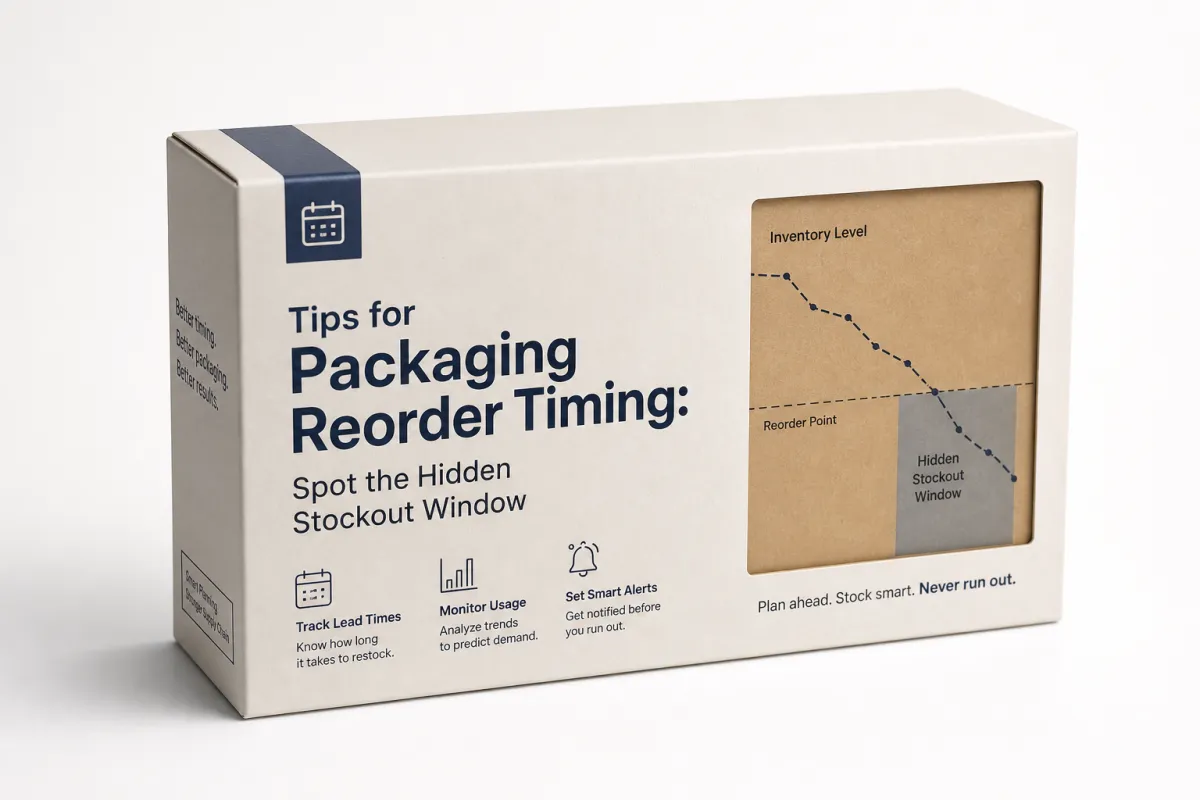
The hidden stockout window is the gap between "we still have boxes" and "we still have boxes that can actually get us through the next production cycle." That gap causes a lot of packaging pain. A buyer may see 8,000 cartons on the floor and think there is plenty of time. Then the supplier needs 12 business days to produce, another 3 to 5 days for freight, and an extra proof round because someone changed the artwork file. Suddenly the window is tiny.
Good tips for packaging reorder timing begin with that shift in thinking. Reorder timing is not only an inventory issue; it is a production continuity issue. It touches the press schedule, the packing line, the warehouse, and the ship date promise to the customer. When one piece slips, the rest start wobbling.
Most shortages happen because buyers count only the finished units they can see. That is the wrong metric for retail packaging, folding cartons, inserts, and shipping shippers. A better metric is days of coverage after you subtract the time needed to quote, approve, produce, finish, pack, and receive the next order. Those tips for packaging reorder timing are dull on paper and very useful in real life.
I keep seeing the same mistake: treating custom packaging like a commodity pallet of stock cartons. It is not. A reorder for custom logo packaging can involve plate checks, knife changes, coating verification, and an artwork approval chain longer than anybody planned for when the count still looked comfortable. The first sign of trouble is usually not an empty shelf. It is a delayed release.
Three dates matter more than the rest: the date you place the order, the date the order must start production, and the date the last safe unit will be used on the line. If the second date is already too close to the third, the reorder is late even if inventory still looks healthy. That is the practical side of tips for packaging reorder timing.
For buyers comparing Custom Packaging Products, the same logic applies across box styles, inserts, mailers, and retail-ready cartons. The product changes. The timing trap does not. If the next replenishment cannot land before the current run is exhausted, the line slows down and the costs start climbing.
Another reason the hidden window gets missed is that packaging sits between departments. Purchasing sees the PO, production sees the usage, and shipping sees the urgency only after the problem is already visible. Smart tips for packaging reorder timing connect those groups with one trigger point, one spec sheet, and one approval path. Simple. Not easy. There is a difference.
Packaging Reorder Timing Basics: Lead Time, MOQ, and Safety Stock
Three numbers do most of the heavy lifting here: lead time, minimum order quantity or MOQ, and safety stock. Once those are clear, reorder timing gets a lot easier to manage. The trouble is that many teams only know one of them, and sometimes not even that one with confidence.
Lead time is the total time from order release to usable delivery. For custom packaging, that usually includes quote review, proofing, prepress, production, finishing, curing or drying where relevant, packing, transit, and receiving. A supplier may say "10 business days," but that number often covers only the factory floor portion, not the full path. The best tips for packaging reorder timing account for every handoff, including the day somebody takes to answer an email they meant to answer yesterday.
MOQ matters just as much. If a supplier needs 5,000 units to make a run workable, that can force a buyer to reorder earlier than planned so the next order lines up with the required quantity. MOQ also affects print consistency. For custom printed boxes and other branded packaging, staying within the same production lot or a closely matched lot can matter for color and finish stability.
Safety stock is the buffer that protects you from demand spikes, freight delays, or a proof that takes an extra day because a file was not clean. A practical way to set it is to measure average weekly usage, multiply by total replenishment time, and then add a small cushion. If a packaging item uses 1,200 units a week and the full replenishment cycle is 3 weeks, the reorder point should not sit at 500 units. That is too thin for most operations.
A useful starting formula is straightforward:
- Reorder point = average weekly usage x total lead time in weeks + safety buffer
- Safety buffer = 10% to 25% of the lead time demand, depending on volatility
- Review cycle = every time sales, seasonality, or supply conditions change
The buffer should move when demand moves. Seasonal runs, retail promotions, and new product launches can shift usage fast. The best tips for packaging reorder timing are not one-time rules. They are habits that live in the planning calendar, even when the calendar is already a mess.
For buyers managing multiple SKUs, a simple tiered approach works well. A high-volume carton can carry a larger buffer because the line cannot sit idle. A slower item may need a smaller buffer but tighter artwork version control. If you are comparing Wholesale Programs, ask how the supplier handles reorder cadence, lot matching, and proof retention, because those details shape timing just as much as price does.
There is also a standards angle worth keeping in view. For transit-sensitive shipper systems, the ISTA test standards are a useful reference point for packaging performance, and FSC-certified fiber can matter for sourcing expectations and customer requirements. Those are not just certification badges. They affect approval timing, documentation, and sometimes the entire purchasing schedule.
Product Details That Change Packaging Reorder Timing
Not all packaging moves through the plant at the same speed. Folding cartons, corrugated shippers, rigid boxes, labels, sleeves, and inserts each have their own production path, and that path changes reorder timing in ways buyers often underestimate. One box style may need die cutting and folding only. Another needs lamination, spot coating, or hand assembly. Those extra steps add time. No mystery there.
Substrate choice matters too. Paperboard stock, corrugated board, and rigid board are not interchangeable in planning terms. Board grade, flute profile, caliper, and surface finish all affect the schedule. If a pack needs a specific board with a particular print surface, the supplier may need more time to source it, especially if the order is tied to a color match or a specialty finish. Good tips for packaging reorder timing start with the material, not just the quantity.
Print complexity adds another layer. A one-color run with a simple logo is not the same as a six-color design with tight registration, foil stamping, embossing, or soft-touch lamination. Those details can require extra setup, proof review, and finish verification. For packaging design teams, the lesson is blunt: every decorative decision has a timing cost, and that cost belongs in the reorder calendar.
Structural changes can reset the clock. If the box dimensions change, if the insert fit changes, or if the product weight changes enough to affect the load on the packaging, the supplier may need to review the dieline, adjust tooling, and, in some cases, make new samples. That is why many of the best tips for packaging reorder timing say to reorder earlier whenever the structure is in question.
Small shifts can be expensive in time. A label that moves from matte to gloss might sound minor, but if it affects ink cure, adhesion, or color accuracy, the approval path changes too. The same is true for retail packaging that must fit shelf dimensions, barcode placement, or planogram rules. A tiny dimension change can trigger a wider review than a buyer expects.
Supply-side variables matter just as much as design details. Paperboard availability, ink matching, coating availability, and freight method all influence delivery. A supplier can have one part of the job ready and still miss the ship date if another component is delayed. That is one more reason tips for packaging reorder timing need to look at the whole build, not one line item.
For branded items, consistency matters. Color drift from one lot to the next can create a mismatch between old and new cartons, which may be fine for internal shipping packs but not great for shelf-facing product packaging. If the packaging also carries the brand experience, planning a little earlier gives the supplier room to keep the print stable.
Here is a practical shortcut: if the item has more than one of these features - specialty ink, foil, embossing, lamination, insert assembly, or structural revision - assume the reorder timing needs a wider buffer. That simple rule avoids a lot of last-minute pressure and keeps tips for packaging reorder timing tied to reality.
Specifications to Lock Before You Reorder Packaging
Before any reorder goes out, the specs should be locked. Finished dimensions, board grade, flute profile if applicable, printing method, coating, insert style, pallet pattern, and carton count per pallet all need to be confirmed. If any of those fields is uncertain, the order can drift, and drift is what creates rushed corrections later. Good tips for packaging reorder timing are really good spec discipline in disguise.
Tolerances deserve more attention than they usually get. If the packaging must fit automated line equipment, retail shelving, or a protective shipper design with tight clearance, a small dimension swing can cause manual rework. That rework costs time at the plant and time at the dock. For buyers working with custom printed boxes, it is usually cheaper to verify tolerances before the order than to fix them after the first pallet arrives.
Artwork control is just as critical. The approved file should be the only file in play, and version history should be easy to trace so no one accidentally reprints an old panel or an outdated regulatory note. A file mismatch can reset proofing, and proofing resets time. That is why the best tips for packaging reorder timing always include version control.
I recommend a one-page specification sheet for every repeat item. It should show the current dieline, approved artwork version, board grade, coating, ink set, pack count, palletization, and any special handling instructions. When the buyer, the plant, and customer service all use the same sheet, reorder timing gets cleaner because nobody is guessing from an old email thread.
A clear spec sheet also helps with change control. If customer service notices a request for a different finish or a different ship date, the sheet makes it obvious whether that change is a minor update or a new production path. That is a practical, everyday benefit of tips for packaging reorder timing: fewer surprises, fewer delays, and fewer repair cycles.
For teams that buy across several programs, pair the spec sheet with the supplier's reorder history. If the last three runs all used the same file and the same board, the next one should not need a fresh debate. If something did change, the records will show it immediately. That is a better use of time than relying on memory and a hazy recollection of "the file from last spring."
Pricing, MOQ, and the Cost of Ordering Too Late
Late ordering often raises total cost even when the unit price looks the same on paper. The added cost can show up as rush setup fees, premium freight, overtime, split shipments, or inefficiency from a partial run. That is why the cheapest-looking quote is not always the cheapest order. One of the strongest tips for packaging reorder timing is to compare the full landed cost, not just the piece price.
MOQ complicates the picture further. A larger reorder quantity may reduce the unit price, but it also increases carrying cost. That tradeoff depends on usage rate, storage space, shelf life, and cash flow. If the packaging is for a product with a short marketing cycle, overbuying can be just as painful as underbuying. Smart tips for packaging reorder timing balance price breaks against real consumption speed.
There is also the hidden cost of disruption. If a line waits half a day for packaging, the labor cost is not just the idle labor. It also includes rescheduling work, warehouse movement, carrier changes, and customer service follow-up. Those costs are easy to miss because they are spread across departments, which is exactly how they like to hide.
Here is a simple comparison that shows why planned timing usually wins:
| Reorder Approach | Typical Unit Price Effect | Added Costs | Best Use Case |
|---|---|---|---|
| Planned reorder | Stable pricing, often in a predictable range at repeat volumes, depending on print coverage and board | Normal freight, standard setup, lower changeover pressure | Repeat SKUs with predictable usage and approved artwork |
| Late reorder with rush request | Unit price may stay close, but total landed cost often rises 8% to 20% | Expedite fees, premium freight, possible overtime or partial-run penalties | Short-term rescue only |
| Emergency buy after stockout | Often the highest total cost even if the quote looks acceptable | Lost production time, split shipments, service recovery work, possible line downtime | Only for unavoidable disruptions |
The table is only a guide. Actual pricing depends on board grade, finish, quantity, and freight lane. Still, the pattern holds: late orders cost more than planned orders once every hidden line item is counted. That is one of the clearest tips for packaging reorder timing I can give.
Here is another practical comparison. Two planned orders of 3,000 units each may look less efficient than one emergency order of 6,000 units, but the planned route often wins because it avoids downtime, reduces pressure on approvals, and keeps freight normal. Once a plant has to stop, the math changes fast.
The cheapest packaging is the packaging that arrives on time, matches the approved spec, and keeps the line running without a rescue shipment.
That is especially true for package branding and shelf-facing product packaging, where a rush correction can also hurt presentation quality. If the box is part of the customer experience, missed timing hits both operations and brand perception at once. Not exactly a great trade.
Process and Timeline for Packaging Reorders
A repeat order should follow a repeatable path. The cleanest process starts with specification review, moves to quote, then proof approval, scheduling, production, inspection, packing, transit, and receiving. The goal is not just speed. The goal is predictable speed. Good tips for packaging reorder timing create a calendar people can actually trust.
There are two kinds of steps in that timeline: the steps the customer controls and the steps the supplier controls. The customer controls how quickly artwork is approved, how complete the spec information is, and how soon the PO is released. The supplier controls scheduling, manufacturing, finishing, and shipment execution. If the customer side is slow, even the best factory schedule cannot help much.
The easiest way to build a reorder timeline is to count backward from the line-down date. Start with the date the current inventory will be exhausted, then add transit time, then production time, then proof time, and finally a buffer. That backward count is more reliable than counting forward from the date someone said they "need to place the order soon." Specific tips for packaging reorder timing should always tie to a date, not a feeling.
A good milestone calendar might look like this:
- Inventory reaches the reorder trigger.
- Quote is requested with the current approved spec sheet.
- Proof is reviewed and approved within 24 to 48 hours.
- Purchase order is released immediately after approval.
- Production is scheduled based on confirmed lead time.
- Inspection and packing are completed before transit booking.
- Receiving is checked against the approved quantity and version.
That rhythm works because it removes guesswork. It also helps buyers spot where time was lost on the last order. Maybe the proof sat in email for two days. Maybe the freight lane slipped. Maybe the spec sheet was outdated and caused a question. Once those causes are visible, the next cycle gets easier. That is a very practical outcome of tips for packaging reorder timing.
For shipping-critical programs, I also like comparing the packaging timeline against the relevant performance standard. ISTA methods can help define the protection level needed for transit, while FSC documentation can matter if the paperboard source is part of the purchasing requirement. You can read more about transit test expectations at ISTA and about fiber sourcing at FSC. Those references do not replace a good reorder plan, but they do support better planning decisions.
One more detail matters here: receiving at the dock is not the same as product-ready inventory. If the cartons must be staged, repacked, or moved to a different line, the handoff needs time too. The best tips for packaging reorder timing do not stop at shipment; they include the time needed to make the packaging usable.
Why Choose Us for Packaging Reorder Timing Support
Custom Logo Things is built for practical packaging work, not theory with a nice font. When buyers need support on reorder timing, they usually need more than a price. They need someone who understands lead times, material sourcing, print setup, and the realities of repeat orders. That is where a steady packaging partner helps. The most useful tips for packaging reorder timing come from people who understand both the production side and the buying side.
Clear communication is the biggest advantage. If the spec sheet is current, the artwork is approved, and the reorder trigger is defined, the rest of the process gets easier to manage. That reduces missed dates and helps align inventory planning with real demand instead of guesswork. It also keeps branded packaging programs more consistent because each reorder starts from the same technical baseline.
A good partner can also flag risk early. Maybe the file has a linked image problem. Maybe the coating callout is missing. Maybe the requested delivery window is too tight for the current schedule. Catching those issues before the PO is released is a lot better than discovering them after the order is already moving. Those are the kinds of tips for packaging reorder timing that protect both budget and schedule.
We also think about the full packaging picture. That includes custom printed boxes, retail packaging, inserts, mailers, and other product packaging that supports the customer experience. If a reorder is part of a larger launch, a seasonal campaign, or a wholesale replenishment cycle, the timing plan should match the business plan. For teams that buy through Wholesale Programs, that timing discipline can make the difference between a smooth replenishment and a scramble.
If you want a supplier-side resource that keeps the process grounded, start with the current spec, the approved file, the usage rate, and the required delivery date. That is the cleanest way to turn tips for packaging reorder timing into a workable production schedule. For buyers who also need a quick reference library, our FAQ page is a useful place to check common ordering questions before the next reorder gets released.
In plain terms, the job is to keep packaging moving without drama. That means fewer surprises, fewer reprints, fewer premium freight bills, and less time spent explaining why the line is waiting on boxes. Good tips for packaging reorder timing help us do that together.
Next Steps for Better Packaging Reorder Timing
The easiest way to improve reorder timing is to build one simple tracker for each packaging SKU. Track average monthly use, lead time, MOQ, approved artwork version, current stock, and the date the next order should be released. That list is not fancy, but it works. Real tips for packaging reorder timing work best when the data is visible.
Assign one owner to watch stock levels and one backup person to approve proofs. That small change matters more than most teams expect. A reorder can stall because one inbox sits untouched, a vacation overlaps with proof approval, or somebody assumes another department already replied. One owner keeps the process moving; one backup keeps it from stopping.
Review the last three orders and mark where time was lost. Was it proof approval? Freight booking? A specification question? A production hold? Once the delay is known, the buffer can be adjusted to match reality. That is how tips for packaging reorder timing become a repeatable operating method instead of a one-time fix.
Before the next replenishment, ask for a lead-time check and confirm the current specification sheet. If the supplier says the schedule has changed, or if the item now needs a different finish or freight method, update it immediately. The best tips for packaging reorder timing only work when the data stays current.
If you want a practical starting point, use this short checklist:
- Confirm current inventory and average weekly usage.
- Verify the approved artwork version and dieline.
- Check the supplier's current lead time and MOQ.
- Add a buffer for proofing, freight, and seasonal demand.
- Release the PO before the reorder trigger becomes an emergency.
That checklist is small, but it prevents a lot of unnecessary pressure. It also keeps the relationship between buying, production, and shipping simple enough to manage. For custom packaging, that simplicity is valuable because every extra day of delay increases the risk of a line stoppage or a rushed reprint.
If there is one final lesson here, it is this: do not wait until the last pallet is spoken for. The best tips for packaging reorder timing are the ones that give production enough breathing room to run cleanly, approve quickly, and arrive with margin left in the schedule.
Use tips for packaging reorder timing as a planning habit, not a rescue plan, and stockouts become much easier to avoid. Lock the spec, count backward from the line-down date, and reorder before the buffer gets thin. That is the move.
How do tips for packaging reorder timing apply to custom boxes?
Custom boxes usually need more lead time than stock packaging because they often include proofing, print setup, and sometimes new tooling. The safest approach is to use average usage, supplier lead time, and a safety buffer instead of waiting for the last pallet. Recheck the timing whenever artwork, dimensions, or coatings change, since those updates can add days or weeks.
What is the best way to calculate packaging reorder timing?
Start with average weekly usage and multiply it by the total time needed from PO release to delivery. Add a buffer for approval delays, freight variability, and any seasonal spikes in demand. A good reorder trigger keeps usable inventory on hand even after the new shipment is in transit.
Which packaging details affect reorder timing the most?
Print complexity, specialty finishes, structural changes, and substrate availability usually have the biggest impact. Tight tolerances or equipment fit requirements can also slow a reorder if samples or approvals are needed. Even a small artwork revision can reset proofing and scheduling.
How can I reduce rush costs with better reorder timing?
Place orders before inventory reaches the danger zone, not after production is already at risk. Keep specification sheets and artwork approvals current so the supplier can move straight into scheduling. Planned replenishment cycles are usually cheaper than emergency buys, which often bring expedite freight or overtime charges.
What should I have ready before placing a packaging reorder?
Have the approved dieline, artwork version, dimensions, quantity target, and desired delivery date ready. Confirm any finishing details such as coating, foil, embossing, labels, or inserts before requesting the quote. Share current inventory and the reorder trigger so the supplier can help verify timing.
