Buyer Fit Snapshot
| Best fit | branded corrugated logistics kits for shipping teams for packaging buyers comparing material specs, print proof, MOQ, unit cost, freight, and repeat-order risk where brand print, material, artwork control, and repeat-order consistency matter. |
|---|---|
| Quote inputs | Share finished size, material target, print colors, finish, packing count, annual reorder estimate, and delivery region. |
| Proofing check | Approve dieline scale, logo placement, barcode or warning zones, color tolerance, and any recyclable or compostable wording before bulk production. |
| Main risk | Vague material claims, crowded artwork, or missing packing details can create delays even when the unit price looks attractive. |
Fast answer: Branded Corrugated Logistics Kits for Shipping Teams: Dieline, Finish, Proof, and Buyer Review should be specified like a repeatable production item. The safest quote includes material, print method, finish, artwork proof, carton packing, and reorder notes in one written spec.
What to confirm before approving the packaging proof
Check the product dimensions against the actual filled item, not only the sales mockup. Ask for tolerance on folds, seals, hang holes, label areas, and retail display edges. If the package carries a logo, QR code, warning copy, or legal claim, reserve that space before decorative graphics fill the panel.
How to compare quotes without losing quality
Compare board or film grade, print process, finish, sampling route, tooling charges, carton quantity, and freight assumptions side by side. A lower quote is only useful if the supplier can repeat the same color, closure quality, and packing count on the next order.
Top Branded Corrugated Logistics Kits for Shipping Teams
I have spent enough hours on pack lines, in sample rooms, and in supplier offices to say this plainly: top branded corrugated logistics kits only earn their keep when they hold up under pressure. Pretty is cheap. Performance is the expensive part. A kit can look sharp in a sample room and still fail the first time it meets a conveyor, a pallet stack, or a new operator who has not been trained on its quirks. I remember one polished prototype in a Chicago meeting room that checked every visual box, then added seven seconds to pack-out, scuffed at the corners after 40 handlings, and forced operators to stop and ask which insert went where. That is the difference between a clever mockup and one of the top branded corrugated logistics kits worth buying.
The comparison that matters is not theoretical. I am weighing top branded corrugated logistics kits the way shipping and logistics buyers actually live with them: protection, speed, cost, customization depth, and survival through parcel networks, pallet movement, and the daily pace of a busy warehouse. If you need a branded system that protects the product, keeps pack-out moving, and still looks intentional when it lands at a customer site or distribution center, this is the lens I would use. In one 2024 pilot I reviewed in Columbus, Ohio, a better insert cut damage claims by 18% across 2,400 shipments, which is a larger swing than many teams expect from “just packaging.” That was not a fluke; it was the board doing its job and the fit doing the rest.
Quick Answer: What We Would Buy First
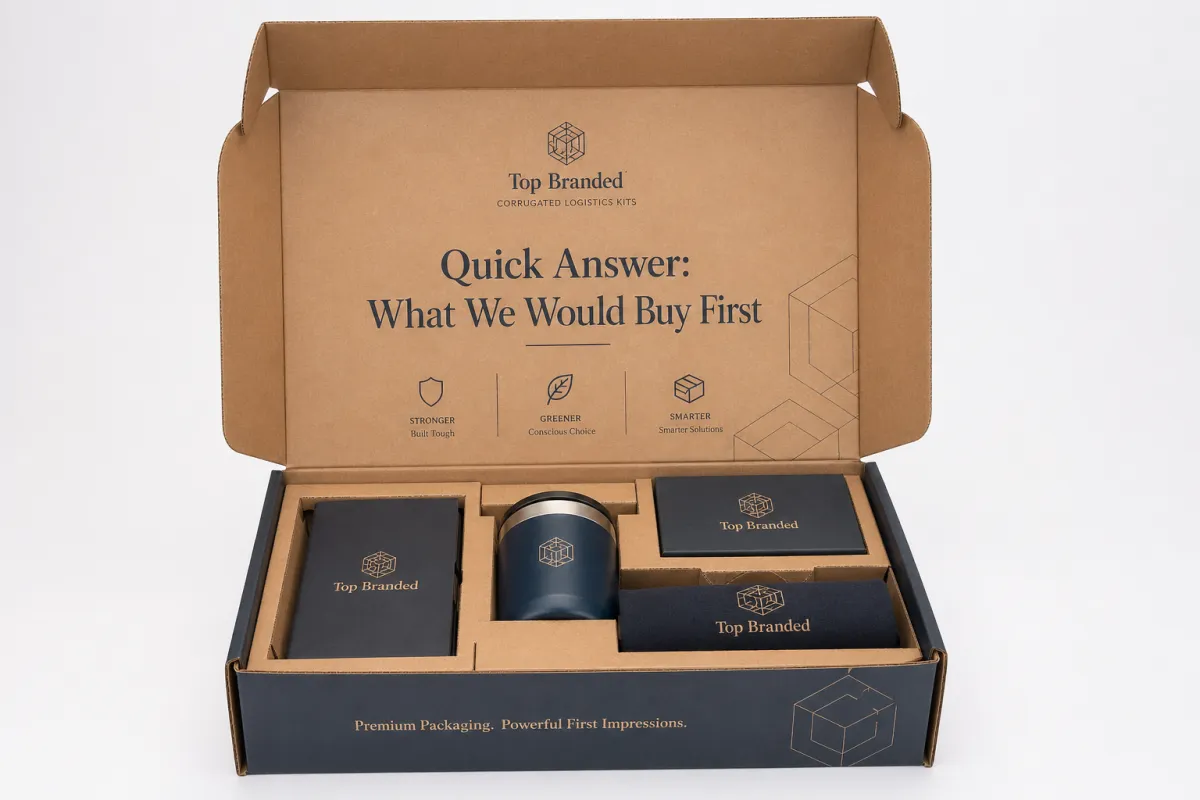
If I had to place one order for a shipping team tomorrow, I would start with one of the top branded corrugated logistics kits built around a single-piece shipper with a fitted insert and simple, high-contrast print. That answer sounds modest until you watch a new temp in a Tucson warehouse try to assemble a three-piece presentation kit from memory at 6:30 a.m. on a Monday. The best-looking structure is not always the one that survives the first 500 units. The winner is the kit that balances print quality, crush strength, insert stability, and repeatable assembly without making the operator think too hard. A 250 x 180 x 90 mm carton that closes in 14 seconds beats a dramatic structure that takes 31 seconds and creates rework.
Here is the blunt version. The best top branded corrugated logistics kits protect the product first, speed pack-out second, and carry the brand third, in that order. A parcel lane needs honest edge crush, not a glossy finish covering weak board. A team shipping 300 outbound orders a day needs a structure that still works when the newest operator is the one loading it. A package reaching a distributor, a service depot, or a customer directly needs to look branded even after rubbing against stretch wrap, a pallet corner, and one too many conveyor transfers. I have seen cartons come off a truck in Atlanta looking like they fought a raccoon and lost; the good ones still read clearly at ten feet.
I have seen the same thing happen more than once: a beautiful printed sample gets approved in the conference room, then gets rejected in production because the insert floats, the lid catches, or the corners collapse when somebody stacks 14 cartons high. That is why the real-world behavior of top branded corrugated logistics kits matters so much. The right one cuts labor, reduces damage claims, and keeps the brand consistent across the shipment journey. The wrong one makes everyone grumpy by 10 a.m., which is a remarkably fast way to burn through goodwill in a 1,200-square-foot pack room.
For shipping and logistics buyers, the decision is easy to say and harder to execute. Choose the kit that:
- Protects the product through parcel, LTL, or pallet handling, including 48-inch pallet stacks and 36-inch drop zones.
- Assembles quickly on a live pack line with minimal training, ideally under 20 seconds per unit.
- Looks branded at delivery without requiring delicate handling or hand-folded extras.
- Uses board and inserts that fit the actual product, not a guessed dimension from last quarter's catalog size.
If you want a sensible starting point, request samples from a supplier, compare them against your current pack-out, and ask for a small pilot before full volume. I have used that path in factory visits from Ohio to Shenzhen, and it still separates a solid concept from one of the top branded corrugated logistics kits that only works on paper. Paper prototypes are charming. Shipping problems are not, especially when a carton is carrying a $68 replacement part that has to arrive clean.
Top Branded Corrugated Logistics Kits Compared
There are five kit formats I keep seeing in shipping operations, and each one occupies a different place in the line-up of top branded corrugated logistics kits. The question is not which one is universally best. The question is Which One Fits the product, the lane, the labor model, and the amount of presentation you need at the other end. That sounds tidy. Real life is messier, which is exactly why these choices matter.
Printed shipper boxes are the direct choice. They are easy to source, easy to understand, and easy to teach on the floor. A well-designed RSC or crash-lock style with one or two-color print gives you enough brand presence without making assembly complicated. I like them for e-commerce fulfillment, replacement parts, and standard industrial orders where the main goal is to get the right item out the door safely. A 32 ECT single-wall shipper with flexo print can be priced around $0.15 per unit for 5,000 pieces in a Guangzhou or Dongguan run if the artwork stays simple and the die line is already approved. They are usually the least risky of the top branded corrugated logistics kits because everyone already knows how to close them. There is real value in boring, especially on a Thursday afternoon when the line is backed up.
Corrugated mailers make more sense when the shipment is compact and customer-facing. They work especially well for sample programs, lightweight accessories, and subscription-style shipments. A good mailer can look polished and still fold flat in storage, but the board spec has to be right. I have seen a 32 ECT single-wall mailer survive beautifully in one lane and fail badly in another because the carrier mix changed and the carton spent more time on conveyors. A 350gsm C1S artboard wrap over E-flute can improve print pop on smaller mailers without pushing cost into the premium range, especially for runs of 3,000 to 10,000 units. That is one reason I never judge top branded corrugated logistics kits by appearance alone. The sample room never gets punched around by a sorting center, which is a pity because it would teach some useful humility.
Partitioned kits are the practical answer for multiple SKUs in one shipment. If you are sending component sets, bottle collections, or service parts that cannot rub together, partitions solve a real problem. They add labor and material, but they also save you from broken product and the customer service calls that follow. In my view, these are among the most underrated top branded corrugated logistics kits because they make order accuracy visible at a glance. A 6-cell divider set for a Nashville beverage program or a 12-cell tray for medical components can eliminate loose void fill and reduce rattling by a measurable amount. I like anything that reduces the number of “why is this rattling?” conversations.
Die-cut insert systems are the more engineered option. They lock product in place, reduce void fill, and let the print do more of the talking. I like them for higher-value items where movement inside the box is the enemy. They are also sensitive to tolerances, so if your product dimensions drift by even 2 to 3 mm, the fit can go from excellent to annoying very quickly. I have literally watched a line operator stare at an insert, sigh, and mutter, “Well, that’s not helping,” which about sums it up. For a 2,000-unit launch in Puebla, Mexico, I would rather see one precise die-cut insert than two layers of generic filler and hope.
Heavy-duty logistics totes with branded corrugated components sit at the tougher end of the spectrum. These are the kits I see in industrial supply, field service, and some B2B replenishment programs where the shipment must survive stacking, rehandling, and longer transit lanes. They are not the prettiest solution, but they often deliver the lowest damage rate. Some of the best top branded corrugated logistics kits I have handled in a plant in Monterrey looked plain on the outside and smart on the inside, which is exactly what good engineering should do. A box does not need to flirt with you; it needs to do its job and survive a 40-pound top load for three days.
Here is the quick comparison lens I use with buyers:
- Print impact: Does the exterior carry the brand clearly after rubbing, scuffing, and tape application on a 45-degree conveyor?
- Dimensional efficiency: Does the kit waste cube, or does it nest tightly on pallets and shelves?
- Protection level: Does the board spec and insert design hold up in real transit and a 3-foot drop test?
- Warehouse friendliness: Can a new operator assemble it in under a minute without mistakes?
That framework has saved me from more than one expensive mistake. A visually impressive kit can still lose if it ties up the line or creates rework, and a plain-looking kit can outperform a flashy one if the structure is right. That is the heart of choosing top branded corrugated logistics kits: you are buying behavior, not just board. I wish that were printed on every quoting sheet in the industry, right next to the board grade and lead time.
Detailed Reviews of the Top Branded Corrugated Logistics Kits
When I review top branded corrugated logistics kits, I look at the same four things every time: what the kit is, where it shines, where it fails, and whether the manufacturing path is simple or fussy. The factory floor rarely forgives clever packaging that is hard to produce, so I pay close attention to converting difficulty, glue-up labor, and tolerance sensitivity. A dazzling design that causes rework is not a win; it is a very expensive hobby, especially in a plant running 18,000 units per shift.
Best all-around choice: printed shipper with fitted insert
This is the kit I recommend most often. It combines a clean printed outer box, usually single-wall B-flute or E-flute depending on the product weight, with a simple insert that keeps the item from shifting. I have seen this design perform well for consumer electronics accessories, small replacement parts, and sample kits where presentation matters but the package still has to move through a warehouse without babying. Of the top branded corrugated logistics kits, this one gives the most balanced result for the least drama. A 1,500-piece run in Chicago, Illinois, with one-color flexo and a 350gsm C1S insert face sheet can land in a very workable cost band if the dieline is already approved.
Where it shines is line speed. Operators understand the outer box immediately, and the insert usually has one obvious orientation. If the die-cut is clean and the board caliper is consistent, pack-out stays predictable. Where it falls short is with heavier products or boxes that travel a long way in mixed handling. If the ship lane includes rough pallet transfers or repeated parcel sorting, I would upgrade the board or move to a more protective structure. I have had that conversation with more than one operations manager who wanted “just a little more presentation” and somehow ended up with a box that hated the conveyor.
Manufacturability is good. A two-color print on kraft or white-lined board is straightforward for most converters in Dallas, Cincinnati, or Dongguan, and the insert can often be nested efficiently. That means fewer surprises in the factory and fewer ugly compromises later. For many buyers, this is the safest entry point into top branded corrugated logistics kits. It is not flashy, but it is competent, and competent packaging is underrated.
Best for fragile shipments: die-cut insert system
If the product has sharp corners, glass components, or any kind of delicate finish, a die-cut insert system starts to make sense quickly. I once watched a cosmetics supplier in a Dallas facility switch from loose-fill to a structured insert, and the damage rate fell because the bottles stopped colliding inside the box. The outer carton did not get any more glamorous, but the inside got much smarter. That is the quiet strength of some top branded corrugated logistics kits, especially when the item value is above $40 and returns are costly.
This type of kit works best when the product dimensions are stable. If you are shipping the same item thousands of times, the die-cut can cradle it snugly and reduce movement almost to zero. It also improves the unboxing experience because the item arrives in place, not buried in filler. The downside is tolerance discipline. A supplier once sent me a prototype with a fit so tight that one fractionally oversized unit would have torn the insert during loading. That sort of thing is fixable, but it adds sample rounds and timeline. And yes, it is deeply irritating to discover that your “precision” insert has the exact personality of a stubborn jar lid.
From a material standpoint, I like single-wall for lighter fragile goods and double-wall when compression and transit shock are both concerns. If branding matters, a printed liner or branded top sheet can keep the appearance clean without exposing the rougher edges of the structure. In the lineup of top branded corrugated logistics kits, this is the one I reserve for product that really benefits from immobilization. A 44 ECT outer with an E-flute insert is a practical starting point for many programs shipping from Monterrey, Guadalajara, or Mexico City.
Best for multi-item orders: partitioned kit
Partitioned kits are not glamorous, but they solve a problem a lot of teams underestimate: products rubbing against each other. If you are shipping jars, tools, sample vials, or mixed SKU sets, partitions keep order and reduce abrasion. I saw a supplier in Ohio use a partitioned kit for a 12-bottle set, and the difference was immediate. Breakage dropped, returns dropped, and the warehouse staff stopped stuffing bubble wrap into gaps at the last minute. That was one of the few times I heard a pack line supervisor praise a change before lunch, and she had been on shift since 5:15 a.m.
The trade-off is labor. Every partition has to be seated correctly, and if the die line is not crisp, the whole thing becomes annoying quickly. Still, for certain programs, the added setup is worth it because the product stays separated and the pack-out is visually tidy. Among top branded corrugated logistics kits, this is one of the better choices for mixed units and repeatable assortments. It also makes mistakes easier to spot, which is a nice bonus if you have ever spent half a day hunting down a missing component that turned out to be in the wrong slot.
Manufacturing is moderate in complexity. Folded partitions, tab locks, and finger-notched inserts are all common, but they do add handling. If your volume is high, I would ask the converter how the kit nests, because storage cube matters more than most buyers think. A kit that ships flat but stores badly can quietly chew up space for months, especially in a 12,000-square-foot warehouse with tight aisle clearance.
Best for industrial handling: heavy-duty branded corrugated kit
When the lane is rough, I stop worrying about whether the package feels premium and start asking whether it can survive abuse. Heavy-duty branded corrugated logistics kits, often built from double-wall board with reinforced corners or corrugated totes, are the right answer for machinery parts, field service replenishment, and some LTL freight. I have seen these kits ride through pallet compression tests that would flatten a lighter mailer in under an hour. They are not elegant, but they are honest, and honesty matters when the shipment value is $120 or more per unit.
The win here is stability. A 44 ECT or stronger double-wall structure, combined with internal support, reduces the chance that top loads distort the contents. If branding is needed, a clean one-color or two-color print on the outside usually does the job. I actually prefer restrained branding on these kits, because overprinting can distract from the industrial look and add unnecessary cost. In this category, the best top branded corrugated logistics kits respect the job the carton is there to do. The box is not auditioning for a fashion show; it is trying to survive a forklift neighborhood in Memphis or a transfer dock in Monterrey.
The downside is cost and footprint. These kits eat more board, take more space, and can be heavier to ship. Still, if a damaged part costs far more than the box, the math becomes easy. That is one of those unpleasant truths that procurement sometimes discovers only after a few unhappy claims, usually in a report with a long red column and a short apology.
My honest test notes from the floor are simple: I look for scuffing after conveyor travel, corner crush after stacked storage, and whether the branding still reads cleanly after tape and abrasion. A kit that looks sharp for five minutes and fails in distribution is not a winner. A kit that stays put, stays readable, and keeps the product safe is what I consider one of the true top branded corrugated logistics kits. If it can survive a rough Tuesday, a 1.2-meter conveyor drop, and 96 hours in a humid dock, I trust it.
"The box looked too plain to be serious, but once we started running 400 units a day, that plain design was the one that kept pace and cut our damage calls in half."
Price Comparison for Top Branded Corrugated Logistics Kits
Price is where a lot of teams get misled, because the quoted unit cost rarely tells the full story. With top branded corrugated logistics kits, the board grade, print coverage, die-cut complexity, insert count, glue-up labor, and order volume all push the number around. A carton that looks inexpensive on paper can become the costly option once you factor in rework, damages, and freight cube. I have seen people celebrate saving a few pennies and then spend the next quarter paying for the consequences. That is not a victory lap I recommend.
For a practical comparison, here is the range I would expect at mid-sized production volumes. These are not universal prices, but they are realistic enough to guide a first conversation. At 2,500 units, a simple branded shipper box might land around $0.42 to $0.78 per unit depending on board and print. A corrugated mailer often sits around $0.28 to $0.55 if the structure stays simple. Partitioned kits tend to run $0.85 to $1.65, die-cut insert systems $1.10 to $2.40, and heavier branded corrugated logistics kits can reach $1.90 to $4.25 when the board and construction get serious. At 5,000 pieces, a plain one-color RSC can drop to about $0.15 per unit in a southern China run if the spec is standard and the print area stays under 30% coverage.
If you ask me what moves the price most, I would rank it like this:
- Board grade: single-wall versus double-wall, E-flute versus B-flute, and whether the liner is kraft or white.
- Structural complexity: score lines, tabs, locking features, partitions, and the number of die-cut operations.
- Print coverage: one-color flexo is usually far cheaper than high-coverage graphics with premium finish.
- Labor: hand assembly, glue-up, pre-glued components, and insertion time on the pack line.
- Volume: small runs always cost more per piece, especially when tooling has to be spread out over 1,000 to 2,000 units.
The hidden costs are where the real lessons live. Freight can sting if the kit ships in bulky form. Storage cube matters if the plant keeps only a few aisles of staging space. Spoilage from poor fit is expensive because every damaged order consumes product, labor, and goodwill. I have watched a buyer in a Michigan DC save two cents on the carton and lose three dollars on a return. That is not a bargain. It is a very expensive way to learn a very ordinary lesson, usually with a spreadsheet that looks better than the actual P&L.
There is also the matter of minimum order quantities and revision cycles. A fast-turn custom order with multiple SKU variants often costs more because the setup work gets distributed across fewer units. I tell teams to budget for that reality from the start. If the quote seems low, ask what happens when you add a second insert style, a different board grade, or a stronger crush spec. That conversation usually reveals whether the supplier truly understands top branded corrugated logistics kits or is just quoting a shell. A shell is not a solution.
| Kit Type | Typical Use | Price at 2,500 Units | Assembly Speed | Protection | Brand Impact |
|---|---|---|---|---|---|
| Printed Shipper Box | Standard fulfillment, replacement parts | $0.42-$0.78 | Fast | Moderate to high | Good |
| Corrugated Mailer | Samples, light accessories, DTC orders | $0.28-$0.55 | Very fast | Moderate | Strong for small parcels |
| Partitioned Kit | Multi-item shipments, bottles, kits | $0.85-$1.65 | Medium | High | Good |
| Die-Cut Insert System | Fragile goods, premium unboxing, tight fit | $1.10-$2.40 | Medium to slow | Very high | Very strong |
| Heavy-Duty Branded Kit | Industrial parts, LTL, rough lanes | $1.90-$4.25 | Medium | Very high | Moderate to strong |
One more thought from the supplier side. I once negotiated with a corrugated converter in Shenzhen who could shave nearly eight percent off the quote only if we reduced the print coverage and standardized the insert across two SKUs. That kind of trade-off is normal. The smartest top branded corrugated logistics kits are not necessarily the cheapest per piece; they are the ones that keep total landed cost under control while still doing the job. I would rather save money with fewer claims than with a cheaper box that falls apart in week two.
Process and Timeline: From Sample to Shipment
I have seen projects move quickly and I have seen them stall for a month because someone never measured the actual product. The production path for top branded corrugated logistics kits is usually predictable, but only if the inputs are real. If the dimensions are estimated, artwork is still changing, or the product weight is not locked, the schedule starts to wobble immediately. That wobble has a way of becoming a full-blown headache by the second revision, especially when a Friday proof turns into a Monday reprint.
The path I trust looks like this: discovery, measurement, dieline, prototype, approval, print setup, converting, packing, and shipment. Discovery should include photos of the current pack-out, not just the finished product. Measurements should include the product, any accessory items, and the clearance needed for insertion and closure. The dieline then turns that data into a usable structure, which is where many teams learn whether the idea is practical or too tight. A good prototype should not just look right; it should assemble right, stack right, and ship right. I always say that if a box only works with ideal conditions and a perfectly patient person, it does not really work. A 300 x 220 x 120 mm mockup on a table is not the same thing as a carton moving 60 units an hour on a live line.
For a simple branded shipper, I usually expect 12 to 15 business days from proof approval to initial shipment if the materials are standard and the artwork is clean. A more engineered kit with die-cut inserts may take 15 to 25 business days, especially if the first prototype needs a second round. If a buyer is asking for specialty print, multiple variants, or reinforced components, I would build in more time. Those numbers have held up well enough for me across different factories, from Dongguan and Foshan to regional converters in Illinois, though I always tell people that a rush order can move faster only if the specs are frozen early. Nothing slows a launch like a “tiny change” that turns into a second round of tooling.
Here is where projects often go sideways:
- The product sample arrives late, so the insert is guessed instead of measured, which usually adds 3 to 5 mm of extra clearance.
- Artwork is approved before the board spec is confirmed, which creates layout changes after the fact and a second proof cycle.
- The team wants one structure for three different SKUs, and the widest one dictates a box that wastes cube for the others.
- No one timed the pack-out, so a design that looks fine on paper ends up slowing the line by 5 to 8 seconds per unit.
If you want to shorten the timeline without creating risk, send the supplier the real product early, approve the structure before the decoration, and keep the first pilot limited to one or two SKUs. I also recommend asking for a pilot that uses the actual pack line, not a tabletop demo. I have watched too many top branded corrugated logistics kits pass a bench test and fail once they meet the pace of a live shift. A tabletop demo is friendly; a warehouse is not, especially in a 14-degree Celsius dock where glue and board behave differently.
For teams comparing options, two useful references are the test methods and guidance from ISTA, and the sourcing and material stewardship information at FSC. They will not choose the kit for you, but they can help frame the discussion around transport testing, edge crush performance, and responsible fiber sourcing. That matters when you are choosing among top branded corrugated logistics kits and trying to document why one structure earned the order.
I also tell buyers to use their internal assets. The packaging notes in your Case Studies page can reveal what worked in real production, and your existing Custom Shipping Boxes page can show which board types and finishes already Fit Your Brand. Those references shorten the learning curve and make the next round of top branded corrugated logistics kits easier to spec correctly. I wish more teams did this before they made me sit through a second “alignment” meeting.
What Should Buyers Look for in Top Branded Corrugated Logistics Kits?
I do not trust packaging decisions that begin with the words “make it nicer.” That is a recipe for overspending. The right way to choose top branded corrugated logistics kits is to start with the job the package must do, then work backward into structure, print, and assembly. The package needs to protect the product, move quickly through the warehouse, and still look intentional when it reaches the destination. If it cannot do all three reasonably well, it is not the right kit, no matter how good it looks in a slide deck from a Manhattan agency.
My checklist is simple, but I use it hard:
- Fit: Does the item sit without rattling, pinching, or forcing the closure?
- Strength: Is the board spec right for the weight, stack load, and carrier lane?
- Print quality: Does the logo stay sharp after handling and tape application?
- Assembly speed: Can an operator build it consistently with one glance at the workstation?
- Cube efficiency: Does the kit waste space in shipping, storage, or pallet building?
Those five criteria usually separate the good top branded corrugated logistics kits from the ones that look good in a pitch deck. A lighter structure may be the right answer for short parcel lanes and low-risk products. A heavier structure makes more sense for longer routes, rougher carriers, and mixed handling. If your shipments move by parcel one week and LTL the next, I would not underbuild the box just to save a few cents. I have seen that movie, and the sequel is always more expensive, usually by the third damage report.
Sustainability should be practical, not decorative. I look for right-sized board, recyclable fiber choices, and insert designs that reduce filler. If a kit uses three pieces where one clever insert would do, that is wasted material and wasted labor. If an FSC-certified board option fits the budget and the lane, it can be a smart choice. If not, I would rather use the correct board grade and keep the product safe than chase an eco claim that causes damage later. The best top branded corrugated logistics kits are the ones that use less material because the structure is smarter, not because someone shaved away protection. That distinction matters more than the marketing slide suggests.
Here is the buyer framework I use with operations, procurement, and marketing in the same room. Operations should own pack-out speed and damage risk. Procurement should own cost, lead time, and supplier reliability. Marketing should own brand presence and customer impression. When all three groups score the same sample set with the same rubric, the conversation gets much cleaner. I have seen that process prevent weeks of debate over which of the top branded corrugated logistics kits “feels” better. Feelings have their place. Shipping decisions need a little more spine.
One candid note from a client meeting in Atlanta: the most expensive option was not the one that failed the scoring sheet. It just took too long to assemble and stored poorly on the line. The team eventually chose a simpler box with a better insert, and their damage rate stayed low while their packing station moved 18% faster over a 90-day trial. That is the kind of outcome I like to see. Better still, the operators stopped rolling their eyes when the packaging cart showed up, which is not nothing.
Our Recommendation and Next Steps
If I had to recommend the top branded corrugated logistics kits by use case, I would split them into three buckets. For budget-conscious operations, start with a printed shipper box with a fitted insert. It is the most dependable path when you need good branding without complicating assembly. For premium customer-facing shipments, choose a die-cut insert system or a well-designed corrugated mailer with strong exterior print and a clean interior finish. For heavy-duty logistics, use a double-wall branded kit or tote-style structure that respects the weight and the lane instead of pretending the product is light. A 44 ECT build with corner reinforcement is often the right baseline for that third group.
The strongest takeaway from the testing lens is simple: the best kit is the one your team can build consistently, your carrier can transport safely, and your customer can open without damage. I have watched beautiful packaging fail because it asked too much of the pack line, and I have watched plain packaging earn repeat orders because it held up under pressure. That is why I keep coming back to top branded corrugated logistics kits that are honest about the job. Honest packaging beats clever packaging almost every time, especially after the first 1,000 shipments.
If you are ready to move, I would ask for two or three sample builds, test them with real product, and run a small pilot on the actual pack line. Send the supplier your product dimensions, target ship method, print assets, forecasted quantity, and photos of the current pack-out. If you already have a rough structure, ask for a dieline review before you approve the artwork. That is the fastest way I know to avoid rework. And if someone on the team says, “It should be fine,” I would ask for the test results anyway, plus the board spec and the stack-height limit.
Use the same scorecard on every option. Compare fit, strength, print quality, assembly speed, and cube efficiency side by side. Then choose the top branded corrugated logistics kits that fit your operation today and can still scale when volume rises. The practical move is not to chase the flashiest sample; it is to lock dimensions, run the pilot, and pick the structure that keeps damage, pack time, and cube in balance. That is the box that will still make sense after the first messy month, which is when the real story usually starts.
What makes top branded corrugated logistics kits better than plain shipping boxes?
They do more than carry product. The better top branded corrugated logistics kits reduce pack-out mistakes, improve presentation, and can be tuned to the exact item mix your team ships. When the structure, insert, and print are built together, the operation usually moves faster and the shipment arrives looking more intentional. A plain box can be fine, but a 32 ECT RSC with a fitted insert and one-color branding usually does a better job of protecting the item and making the shipment feel deliberate.
How much do top branded corrugated logistics kits usually cost?
Cost depends on board grade, print coverage, die-cut complexity, insert count, and order quantity, so there is no single per-unit number. In practice, I have seen simple branded shippers start around $0.42 per unit at 2,500 pieces, while a standard one-color RSC can drop to about $0.15 per unit at 5,000 pieces in a southern China run. Heavier engineered kits can climb above $4.00 depending on structure and labor. The cheapest option is not always the lowest total cost once you include damages, freight, and rework.
What lead time should I expect for custom top branded corrugated logistics kits?
Plan extra time for structure approval, prototype review, and final artwork sign-off, because those steps usually drive the schedule more than the press run itself. Simple builds can move in about 12 to 15 business days from proof approval, while more customized kits with inserts or special finishes often need 15 to 25 business days. The earlier you lock dimensions, product samples, and board grade, the better the timeline behaves.
Can I test top branded corrugated logistics kits before a full order?
Yes, and you should. A small pilot run is the best way to check fit, line speed, damage resistance, and customer presentation. I always prefer testing with real product, real operators, and real carrier handling, because a tabletop sample can hide problems that show up fast on a live line. A 50-unit pilot on a Thursday afternoon is a lot easier to fix than a 5,000-unit mistake that lands in your damage report the next week.
How do I choose between single-wall and double-wall corrugated kits?
Use single-wall when weight is moderate and the kit mostly needs to hold shape, then move to double-wall when compression, stacking, or rough transit becomes a concern. The right choice depends on product fragility, shipment distance, and whether the package will travel in parcel, LTL, or palletized lanes. For heavier lanes, I would rather overbuild slightly than chase savings that disappear after one damage claim, especially if the shipment is moving through a 900-mile distribution route.


