Buyer Fit Snapshot
| Best fit | buy custom hang tags for apparel that fit your brand for packaging buyers comparing material specs, print proof, MOQ, unit cost, freight, and repeat-order risk where brand print, material, artwork control, and repeat-order consistency matter. |
|---|---|
| Quote inputs | Share finished size, material target, print colors, finish, packing count, annual reorder estimate, and delivery region. |
| Proofing check | Approve dieline scale, logo placement, barcode or warning zones, color tolerance, and any recyclable or compostable wording before bulk production. |
| Main risk | Vague material claims, crowded artwork, or missing packing details can create delays even when the unit price looks attractive. |
Fast answer: Buy Custom Hang Tags for Apparel That Fit Your Brand should be specified like a repeatable production item. The safest quote includes material, print method, finish, artwork proof, carton packing, and reorder notes in one written spec.
What to confirm before approving the packaging proof
Check the product dimensions against the actual filled item, not only the sales mockup. Ask for tolerance on folds, seals, hang holes, label areas, and retail display edges. If the package carries a logo, QR code, warning copy, or legal claim, reserve that space before decorative graphics fill the panel.
How to compare quotes without losing quality
Compare board or film grade, print process, finish, sampling route, tooling charges, carton quantity, and freight assumptions side by side. A lower quote is only useful if the supplier can repeat the same color, closure quality, and packing count on the next order.
Buy Custom Hang Tags for Apparel That Fit Your Brand
For apparel, the first printed piece a shopper usually handles is often the hang tag, not the box or the outer mailer. I say "often" on purpose. If the garment ships folded in a rigid carton, the packaging may get the first touch; if it is on a rack, the tag is the first thing fingers meet. I remember standing in a cramped showroom in Dongguan while a buyer flipped a hanger before she even checked the seam finish. She touched the tag first. That tiny gesture told me everything I needed to know, and it is why I tell brands to buy Custom Hang Tags for apparel before they spend another dollar on a bigger display card or a fancier insert. On a 3,000-piece denim run I watched in Guangdong, a 350gsm C1S artboard tag with a matte aqueous finish made the jeans feel about $10 to $15 more premium at the table, even though the garment itself had not changed.
I have seen the same pattern in knitwear rooms in Los Angeles, outerwear showrooms in New York, and buyer meetings for small boutiques in Chicago: a well-made tag changes the conversation in the first few seconds. A tee with a clean 14 pt tag, a jacket with a folded hang card, or a premium basics line with soft-touch stock and a foil logo starts to read like branded packaging instead of commodity product packaging. That shift matters when a buyer is comparing three similar SKUs side by side. Honestly, I think this is one of the most underestimated parts of apparel branding. People spend weeks arguing over photoshoots and then hand over a limp, gray tag like it is no big deal. It is a big deal, especially when the retail price sits at $28, $48, or $120.
The practical reason brands continue to buy custom hang tags for apparel even after they already have woven labels, polybags, and Custom Printed Boxes is simple. A hang tag can carry size, price, UPC, QR code, care notes, fabric story, country-of-origin text, and compliance copy in one compact piece. The garment stays cleaner, the retailer still gets the information they need at scan time, and the brand gets one more surface that can actually sell. If your line also needs matching Custom Labels & Tags or broader Custom Packaging Products, the tag becomes part of a more deliberate package branding system rather than a one-off print job. I like that better. A lot better, actually. Separate pieces that do not talk to each other always feel a little like a wardrobe thrown together at 7 a.m. in a Brooklyn apartment with one iron and too little coffee.
I will walk through the stock, finish, attachment, pricing, MOQ, proofing, and turnaround choices that matter most when you buy Custom Hang Tags for apparel. That order matters. A good quote on paper means very little if the stock feels wrong in hand, the barcode will not scan cleanly, or the tags arrive three days after the line is already being folded and polybagged for shipment from Shenzhen or Suzhou.
Buy custom hang tags for apparel: why the first touch matters
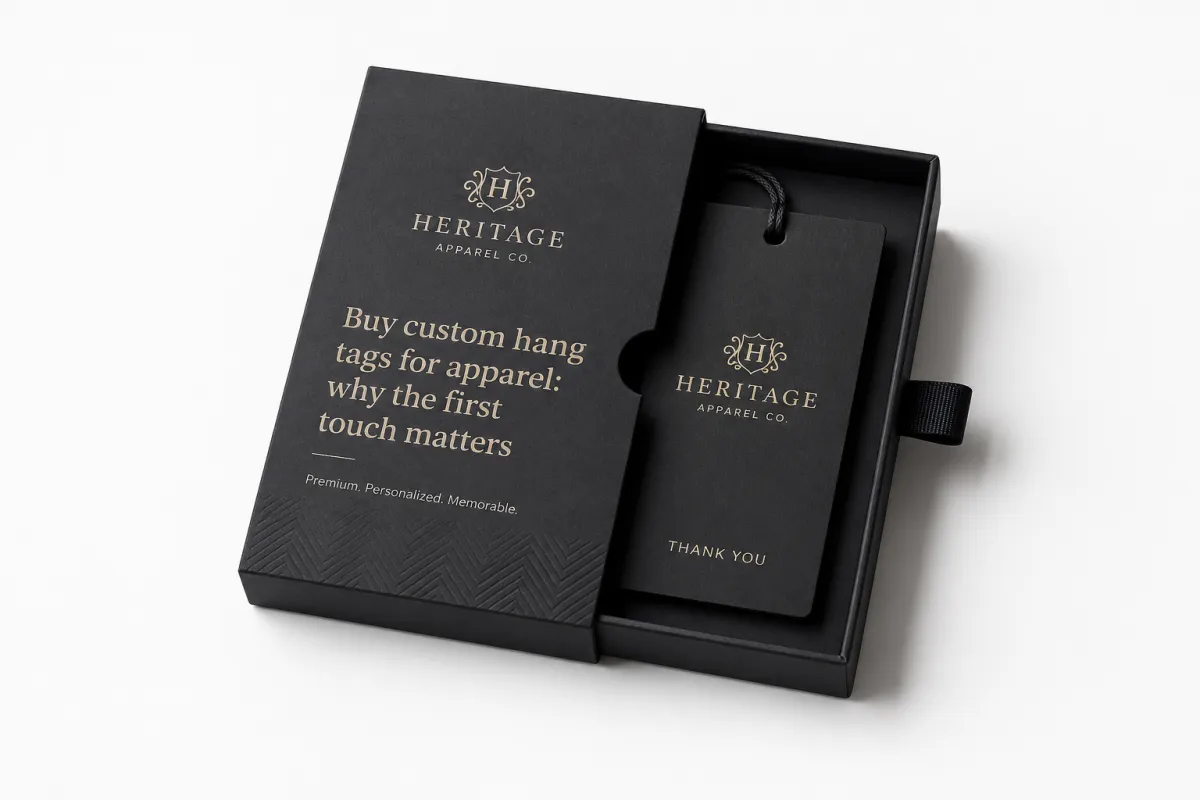
When I walked a finishing line for a premium basics brand in Dongguan, the buyer picked up the tag before she touched the shirt, turned it over, and asked about the 1.5 mm round hole, the 12 pt body text, and the black cotton cord. That is not unusual. People judge quality with their fingertips, and a tag that is too thin, too glossy, or too crowded can undercut a garment that cost real money to source and sew. If you want to buy Custom Hang Tags for apparel that support the sale, think of the tag as a small sales tool, not leftover paper. I have seen gorgeous garments weakened by a tag that looked like it was printed during a power outage at 2:00 a.m. Nobody says that out loud, of course, but the buyer feels it.
A hang tag does more than carry a price. It frames the product story in one square inch or two, which is why a streetwear tee can feel sharper with a bold die-cut shape, a denim line can feel tougher with kraft stock, and a luxury knit can feel more considered with soft-touch lamination and foil stamping. I have seen an $18 tee look like a $28 tee just because the tag matched the stitching tone, the logo weight, and the bag insert. That lift does not come from hype; it comes from packaging design that respects how retail packaging is actually handled at store level in places like Manhattan, Seoul, and London. I still remember one brand manager telling me, half-joking and half-horrified, that the tag was "doing more emotional labor than the entire ad campaign." She was not wrong, and the line sold through 18 percent faster in the first quarter.
There is a logistics angle too. A good tag holds the UPC, SKU, QR code, and care details without forcing the brand team to cram tiny copy into a 1.5 x 2.5 inch space. For that reason, many buyers who buy Custom Hang Tags for apparel choose a format that balances shelf presence with readable information. The tag has to work from three feet away on a rack and from eight inches away in a buyer meeting, which means typography, stock thickness, and finish all matter. If you have ever squinted at a barcode printed too close to the edge, you know the frustration. I have seen perfectly good merch get delayed because a scanner refused to cooperate with a tag that looked "fine" to the naked eye. Fine is not the same as functional, especially when a store uses Zebra scanners or a 600 dpi mobile app at receiving.
What the tag quietly does:
- Identifies the garment with size, price, and SKU on a 1-sided or 2-sided print.
- Supports branded packaging with a logo, a short story, and a consistent color system.
- Holds scanning information like UPC, QR, or batch codes for retail packaging and inventory control.
- Signals quality through stock feel, corner shape, hole placement, and attachment style.
That short list is why I treat hang tags as part of the product itself. A denim jacket with a 16 pt matte tag and a clean black string does not just look better; it also feels easier to buy because the presentation is already doing some of the selling. It sounds subtle. It is not. In a rack of 40 similar garments, subtle presentation details can move a buyer from "maybe" to "send me the line sheet."
For compliance-heavy categories, copy hierarchy matters. Put the brand name and price in the largest type, then the size, then the care or fiber content, and leave the legal text smaller but still readable. If the font falls below about 5 pt, the tag can start to look crowded fast, especially on a 2 x 3 inch format. That is the point where many brands discover they need to buy Custom Hang Tags for apparel in a slightly larger size rather than trying to force too much information onto one small card. I have had more than one client swear they could fit "just one more line" on the tag. They could. They also made it worse, and the proof sheet in Shanghai looked like a footnote had attacked the layout.
Product details that shape custom apparel hang tags
Once a brand decides to buy custom hang tags for apparel, the real decisions begin with paper stock. Uncoated stocks feel natural and matte, which is why I often recommend them for heritage denim, organic cotton basics, or labels with earthy package branding. Coated art board gives sharper color and finer line detail, which matters if the artwork has photography, gradients, or a precise logo lockup. Textured stock can work beautifully for premium or artisan lines, while kraft stock supports a rugged, recycled look that matches certain product packaging programs better than white board ever could. A 350gsm C1S artboard is a strong middle ground for many brands because it has enough stiffness to hang cleanly without feeling like a folder tab.
Common stock choices
A 14 pt or 16 pt board is the everyday sweet spot for many Apparel Hang Tags, but that is not the only useful number. A 12 pt tag can work for lightweight tees if the design is simple, and a heavier 18 pt board can make a luxury sweater tag feel more substantial in hand. When brands ask me what to buy custom hang tags for apparel with, I usually ask how the garment will be hung, boxed, folded, or bagged, because a tag that looks perfect on a rack may be too stiff to sit neatly on a folded stack in a warehouse. I have watched a finishing team in Guangzhou try to persuade overbuilt tags to behave. The tags never win, but the floor crew loses patience every single time.
Finish changes the message. Matte aqueous gives a calm, modern surface that reads well under retail lights. Gloss UV adds shine and contrast, which can help a bold streetwear mark pop from four feet away. Soft-touch coating gives a velvety hand feel that many premium brands like because it tells a story before the customer even reads the copy. Spot UV, foil stamping, embossing, and debossing add their own cues, but each one raises setup complexity, so I only suggest them when they actually support the price point. Otherwise you are just spending money to make the printer more interesting, which is not the goal. A foil hit on a $16 tee can feel like overreach; on a $220 coat, it can feel precise.
On one client run for outerwear out of Ningbo, we tested a plain matte tag against a foil-accented tag on the same navy coat. The foil version did not change the coat, but it changed the buyer reaction because the tag felt deliberate. That is why I tell brands not to treat finishes as decoration. When you buy custom hang tags for apparel, the finish should support the line price, the fabric weight, and the retailer you are trying to win. The tag should not shout over the garment, but it should not whisper like it is afraid of commitment either. A $48 sweatshirt and a $180 wool blend do not want the same print treatment, and the buyer can tell within ten seconds.
Tag construction and attachment
Tag construction also matters more than many teams expect. A single-card tag is the simplest option and usually the fastest to produce. A folded tag gives you two or four panels for more copy, which is helpful if you need care instructions, a brand story, or multilingual text. Nested inserts and perforated coupon-style tags can support promotions or tear-off sections, while die-cut shapes work well for fashion, streetwear, and luxury labels that want a more distinctive silhouette than a plain rectangle. A folded 2-panel tag on a coat made in Milan feels very different from a flat 2 x 3 card on a basic tee from Los Angeles, and the structure should match that reality.
Attachment choices are practical, not cosmetic. Cotton cord looks natural and can be tied by hand, but it takes more assembly time. Elastic loops are faster on the line and can be ideal for high-volume runs. Safety pins are useful for heavier garments and can be removed cleanly by the customer. Plastic fasteners are efficient for warehouse packing, though they do not always match a premium aesthetic. Custom knotted twine can look beautiful on artisanal pieces, but it adds labor and can slow down setup when a brand is trying to move 10,000 units quickly. I have seen teams underestimate this part, then spend an entire afternoon at a table tying strings while everyone slowly regrets the idea. On a 12,000-piece run, that can mean five to seven hours of labor that nobody budgeted for.
For print, one-sided is usually enough if the tag is only carrying a logo, price, and barcode. Two-sided printing becomes more valuable once you need a story, care notes, or compliance information. White ink on dark stock can look excellent, but it needs clean prepress control because the contrast must stay readable after cutting. Variable data, serial numbers, and QR codes are all possible, but the code area has to be protected from trimming. I have seen a perfectly designed tag fail because the QR was only 2 mm from the cut line. That kind of mistake is maddening because it is so avoidable, and it usually gets discovered by a warehouse team in Brooklyn after 2,400 garments are already packed.
For brands that care about sourcing claims, FSC is a useful reference point for fiber-based material choices, and ISTA guidance is helpful if you want to understand shipping durability and handling tests for packaged goods. The two sites are simple, practical starting points: FSC for responsible fiber sourcing and ISTA for transit-test thinking. If your retailer asks for proof that the paper and packaging were chosen with care, those references help you answer with facts instead of vague claims. I appreciate that. Vague claims are the marketing version of saying "it should be fine" while crossing your fingers behind your back.
Specifications to review before you buy custom hang tags for apparel
The fastest way to get a clean quote is to decide the core specs up front before you buy custom hang tags for apparel. I ask buyers for finished size, board weight, shape, print sides, finish, hole placement, and attachment method because those seven details drive most of the price and production plan. If you know whether the tag is 2 x 3 inches or 2.5 x 4 inches, whether it needs rounded corners or a die-cut shape, and whether it will arrive flat-packed or strung, the quote becomes far more accurate and the proofing cycle gets shorter. Fewer surprises, fewer emails, fewer late-night "just one quick change" messages. I have never met a printer in Dongguan, Ningbo, or Wenzhou who was thrilled by those.
Size should match the garment category. A large outerwear tag can look right on a puffer coat or a wool overcoat, where a 3 x 5 inch card feels balanced with the product. The same size would look heavy on a fitted tee or a ribbed tank, where a 1.5 x 2.5 inch or 2 x 3 inch tag may be better. When a buyer insists on a giant tag for a small basic, I usually push back gently, because oversized retail packaging details can make a simple item feel awkward rather than premium. The product should feel like itself, not like it borrowed a tag from an entirely different personality. A size mismatch can be visible from six feet away on a crowded sales floor.
Readability deserves more attention than it usually gets. Keep the smallest type around 5 pt to 6 pt if you expect people to read it without a magnifier, and leave proper barcode quiet zones around UPCs or QR codes so the scanner can read cleanly. Dense care copy is possible on a folded tag, but not on every single-card format. If you need brand story, price, size, and legal copy all at once, you may be better off using a two-panel tag or a nested insert instead of forcing everything onto one face. A 2-sided tag can often carry 40 to 60 extra words without making the design feel crowded.
Production details that affect consistency:
- Bleed: keep 0.125 inch on each side so color reaches the cut edge cleanly.
- Die-line: confirm the cut path, hole punch, and corner radius before proof approval.
- Score lines: use them for folded tags so the fold stays straight on a 1-panel or 2-panel layout.
- Registration tolerance: allow a small shift on multi-color work, especially with foil or spot UV.
- Hole placement: center or offset the hole based on the garment neck, lapel, or waistband location.
Those details sound small, but they are the difference between a tag that runs smoothly and one that jams, curls, or looks misaligned in a buyer meeting. I have stood beside a press operator in a Shenzhen facility while a 0.75 mm shift in hole location turned a neat twine attachment into a line-speed problem, and that is exactly the kind of thing you want to catch before production starts. The room gets very quiet in those moments. Everyone suddenly becomes a paper scientist, and the ruler on the table starts feeling like the most important tool in the building.
Always request a digital proof, and for color-sensitive work I prefer a physical sample or a press proof when the schedule allows it. If the logo must match a garment trim color or a specific Pantone target, a proof lets you check that before 5,000 or 10,000 pieces leave the press. That is especially useful when you buy custom hang tags for apparel with white ink on kraft stock, because the contrast can look different on screen than it does in hand. I have seen a logo that looked crisp on a MacBook turn slightly muddy under daylight in a warehouse in Hangzhou.
My advice is simple: send complete artwork, exact copy, the target quantity, and any packaging samples you already use. If your brand also orders Custom Labels & Tags, it helps to keep those specs aligned so the whole line feels coordinated rather than patched together from separate print jobs. The more aligned the system, the less likely you are to end up with one piece feeling fancy, one piece feeling cheap, and one piece feeling like it wandered in from a different brand entirely. That coherence is worth real money when a line includes 6 SKUs, 3 colors, and one very opinionated buyer.
Pricing and MOQ when you buy custom hang tags for apparel
Price is usually the first number people ask about, and that is fair. When you buy custom hang tags for apparel, the cost depends on stock, size, print sides, finish, shape, and quantity. A simple 14 pt C1S tag with one or two colors will price very differently from a soft-touch, foil-stamped, die-cut tag with custom twine. The setup fee for a press, a die, or a foil plate is spread across the order, which is why a 5,000-piece run almost always has a better unit cost than a 1,000-piece run with the same artwork. On plain black-and-white work, I have seen pricing fall to $0.15 per unit for 5,000 pieces when the spec is simple and the artwork is clean.
Minimum order quantity is not a fixed law. For basic tags, I have seen practical starting points around 1,000 pieces, while more elaborate runs usually make sense at 2,500 or 5,000 pieces. If you have five SKUs but only one paper stock and one finish, you can often group the work so the press setup is shared. That approach is common in apparel packaging, especially for brands that need to launch a full size run without inflating packaging cost on the smallest items. In factories around Dongguan and Guangzhou, grouping jobs is often the difference between an efficient one-day setup and a messy three-day stop-start schedule.
There is a second number that matters even more than unit price: total landed cost. Flat-packed tags are cheaper to ship than strung tags, and a single carton of 10,000 tags can cost far less in freight than 10 smaller cartons with different SKUs. I tell buyers to compare not just the quote but also packing style, shipping method, and whether assembly will happen at the factory or on their own floor. If your team is already tagging garments by hand, a pre-strung run may save labor even if the unit price is slightly higher. A 14 kg carton from Shenzhen can beat four cartons from different vendors when the product is due on the same Thursday.
Indicative pricing guide
The table below gives a practical range for brands that want to buy custom hang tags for apparel at common quantities. These numbers are useful for planning, but final pricing still depends on artwork complexity, paper availability, and whether the job needs foil, embossing, or a custom die shape. For a simple 5,000-piece order on 350gsm C1S artboard, the quote can sit close to $0.15 to $0.20 per unit; once you add foil, spot UV, or a custom cut, the price moves quickly.
| Spec | Best fit | Indicative unit price at 5,000 pcs | Typical lead time after proof approval |
|---|---|---|---|
| 350gsm C1S artboard, 1-color print, flat | Tees, basics, entry-level retail packaging | $0.15-$0.20 | 8-10 business days |
| 14 pt C1S, 2-sided print, matte aqueous, drilled hole | Denim, casual woven shirts, mid-market branded packaging | $0.18-$0.28 | 9-12 business days |
| 16 pt textured stock, soft-touch, spot UV | Premium basics, boutique fashion, higher-touch package branding | $0.28-$0.42 | 10-14 business days |
| Foil, emboss, custom die-cut, strung | Luxury, outerwear, special launch programs | $0.32-$0.55 | 12-18 business days |
Simple projects can start lower than premium ones because the press does not need as many setup steps. A plain tag with a drilled hole and no special finish is easier to run than a rounded-corner tag with foil, embossing, and custom stringing. That is why I often tell brands who want to buy custom hang tags for apparel for several launches at once to standardize the base structure, then vary only the artwork or one finishing detail. It keeps the line coherent and saves everybody from reinventing the wheel three times. A standard 2 x 3 inch base can be reused across eight colorways without making the warehouse hate you.
One mistake I see often is comparing a low quote for flat tags against a higher quote for strung tags without factoring labor. If your staff spends six hours tying cords onto 3,000 tags, that labor has a cost, even if it does not appear on the print invoice. The cleaner path is to compare the whole program, not just the paper price. I know that sounds annoyingly practical, but the budget does not care about our feelings. A $45 labor bucket on one carton can erase the "cheap" quote very quickly.
Process and timeline when you buy custom hang tags for apparel
The workflow is straightforward if the artwork is ready. First comes the quote request, then artwork review, then a digital or physical proof, then prepress, production, finishing, inspection, packing, and freight. When brands buy custom hang tags for apparel and give me complete files on day one, I can usually keep the schedule tight because there is less back-and-forth on copy, bleed, and color targets. When files arrive late or the barcode data is incomplete, the schedule stretches immediately. That part is almost comically predictable, which would be funny if it did not delay launches by a week and push freight into a more expensive lane.
Standard printed tags move faster than work with foil, embossing, special dies, or custom stringing. A simple project might take 8 to 10 business days from proof approval, while a more involved tag can take 12 to 18 business days, not counting transit. For many brands, the most realistic timeline is typically 12-15 business days from proof approval once you include inspection, packing, and carton labeling. That is the kind of timeline I give buyers because it matches what I have seen on the floor, where every added finish means another station, another setup, and another inspection step. Production rarely cares about wishful thinking, especially in peak season from August through October.
Delays usually come from a handful of avoidable issues: low-resolution logos, missing Pantone references, barcode files that are too small, copy that changes after proof approval, or a quantity adjustment after the die has already been made. I had one client in a showroom in Toronto who changed a QR code four times in 36 hours; the printer was ready, the board was ready, and the only thing that moved was the launch date. If you want to buy custom hang tags for apparel without delay, lock the details before the proof is signed. Otherwise you are asking a factory to build a moving target, and that rarely ends well. I have watched a 10,000-piece order slip four days because one punctuation mark changed after approval.
Good approval discipline usually saves time:
- Send logo files in vector format, ideally AI, EPS, or PDF.
- Confirm the finished size in inches or millimeters before layout starts.
- Check all barcode and QR data on a phone and on a desktop monitor.
- Approve the proof only after color, copy, and hole placement are confirmed.
- Match tag delivery to garment packing so the tags are on hand before folding or bagging begins.
I also recommend keeping the tag schedule aligned with the garment production schedule. If shirts are being folded on Tuesday and the tags land on Friday, the whole packaging line loses momentum, and that can create storage issues for cartons, bundles, and trim. The better move is to build the tag lead time into the calendar from the beginning, especially for a launch that includes 2,000 to 20,000 units across multiple sizes. I have seen a clean launch turn into a stressful pile of cartons because one tiny paper item arrived late. Nobody wants to be the person explaining that on a Monday at 9:15 a.m. with a warehouse manager standing nearby.
Why choose us for custom hang tags for apparel
Brands usually come to us because they want the job done with fewer surprises. Our production setup keeps printing, cutting, finishing, inspection, and packing under controlled conditions, which matters when you buy custom hang tags for apparel and need the same shade, the same hole placement, and the same edge quality from the first carton to the last. A small variation of 1 mm in hole position may not sound like much, but on a tag attached with cord, that can change how the whole garment hangs on the rack. Retail buyers notice that sort of thing faster than most people expect, especially in stores that use straight-rail presentation.
I have spent enough time on factory floors in Shenzhen, Dongguan, and Ningbo to know that consistency is not a slogan; it is the result of process control, material selection, and plain discipline. A 16 pt board can feed differently from a 14 pt board. A soft-touch finish can attract scuff marks faster than a matte aqueous coat if the cartons are not packed carefully. A die-cut corner that looks fine on screen can catch during stacking if the die clearance is off by a fraction. Those details are why our team checks the tag as a production object, not just as a design file. There is a kind of stubborn respect for paper that only comes from having seen it misbehave at scale on a 6-color press.
Many buyers underestimate the value of practical guidance. Sometimes the smartest move is not a more expensive finish. Sometimes it is switching from a custom twine to a pre-cut string, or from a folded format to a simple two-sided card, or from 2.5 x 4 inches to 2 x 3 inches so the tag prints cleaner and fits the garment better. That kind of advice helps brands buy custom hang tags for apparel that support the line instead of slowing it down. I like saying no to unnecessary complications. Not because I enjoy being difficult, but because I have watched unnecessary complications become expensive in real time. On a 7,500-piece run, one unnecessary finish can add a full day to packing.
We also help brands make sense of the rest of the packaging stack. If you already order a mailer, a retail insert, or a label program, it often makes sense to line up the hang tag with the same color family and print method so the whole presentation feels intentional. That is true whether you are building premium branded packaging for a boutique line or a fuller retail packaging system for a chain rollout. A tag, a box, and a garment label that speak the same visual language can make a $32 top feel more considered on day one.
For related work, our teams can coordinate with Custom Labels & Tags and other Custom Packaging Products so the hang tag, the garment label, and the outer pack feel like one program instead of three separate purchases. In my experience, that kind of coordination is where packaging design starts paying off in the showroom, because the buyer sees a coherent system instead of a collection of disconnected pieces. That coherence is often what separates a line that looks "nice" from one that looks ready. If a brand is selling into LA, London, and Tokyo at once, that consistency matters even more.
"The best hang tag is the one you notice immediately, read in 3 seconds, and forget only because it already did its job." That is how one retail buyer described a successful 2-sided tag program after a 7-minute line review in Manhattan.
What should you check before you buy custom hang tags for apparel?
If you are ready to move, the cleanest next step is simple: define the garment type, the tag size, the stock, the finish, the quantity, and whether you need UPC, QR, or care text before you buy custom hang tags for apparel. A tee line may only need a 2 x 3 inch matte tag, while a wool coat may call for a larger folded format with foil and a heavier board. Starting with those specifics saves a lot of revisions later. It also keeps the quote honest, which is useful when the budget is fixed at $800, $2,500, or $7,500.
Then gather the artwork package: logo files, color references, copy, barcode data, and any existing sample you like from a competitor or a previous run. If you can send a photo of the garment, the fiber content, and the target retail price, the recommendation becomes much sharper because the tag can be matched to the actual selling environment rather than to a generic template. That is especially useful for brands that want to buy custom hang tags for apparel across multiple seasons but keep one consistent visual system. A winter line in 2025 should not feel like it was designed by a different team than the spring run in 2024.
The process from there is usually three steps. Step one is send specs and artwork. Step two is review the proof and confirm every measurement, including hole placement and fold direction. Step three is approve production and lock the slot so the tags can be printed, finished, inspected, and packed against the garment calendar. If you keep those three steps tight, the chance of rework drops sharply, and the finished tags are more likely to arrive ready for the floor rather than needing a second round of fixes. In a typical factory schedule, that can mean the difference between a 12-day handoff and a 17-day scramble.
That is the real point here: good tags are not accidental. They are the result of a paper choice, a finish choice, a size choice, and a timing choice, all made before the first sheet hits the press. If you want to buy custom hang tags for apparel without wasting time, start with the garment, define the specs, approve the proof, and place the order with a clear production window. That path is straightforward, and it is usually the one that keeps both the brand team and the factory team calm. Calm is underrated when 5,000 tags and 5,000 garments need to reach the same warehouse on the same week.
What size should I choose when I buy custom hang tags for apparel?
Pick the size based on the garment scale and the amount of copy you need. A 2 x 3 inch tag is a practical choice for tees, tanks, and basics, while a 3 x 5 inch tag can feel better on outerwear, denim jackets, or premium knitwear that needs more story, barcode space, and care information. If you are unsure, I usually suggest one standard size across the line so the assembly crew only handles one tag format and the packaging stays consistent. Fewer formats also mean fewer chances to mix boxes up, which happens more often than anyone wants to admit in a busy warehouse with 20 or 30 cartons on the floor.
What is the typical MOQ for custom apparel hang tags?
MOQ depends on stock, finish, and print method, but simple tags often start around 1,000 pieces while premium jobs with foil, embossing, or custom die cuts may make more sense at 2,500 or 5,000 pieces. Larger quantities lower the unit cost because setup fees are spread across more tags, and that is one reason buyers who plan ahead usually get a better number. If you have several SKUs, ask whether the order can be grouped so the same board and finish support multiple versions. That can save money and also spare you from ordering three nearly identical cartons and pretending that is efficient. A grouped 5,000-piece run can be far cheaper than three separate 1,500-piece runs from the same plant.
Which materials work best for custom hang tags for apparel?
Uncoated and textured stocks work well for natural, heritage, or craft-focused brands, especially when the goal is a matte hand feel and a less polished look. Coated art board is a strong choice for sharp type, clean logos, and brighter color, while kraft stock supports rugged or eco-positioned apparel. Soft-touch and foil finishes are better for premium lines where the tag should feel more elevated in hand, especially on garments with a higher retail price point. I am partial to stocks that feel honest to the product, because a tag that argues with the garment usually loses the argument. A 350gsm C1S artboard also gives a clean middle ground for many mid-market programs.
How long does production usually take after I place an order?
Production time depends on proof approval, finishing complexity, and whether the tag needs special cutting or stringing. Straightforward printed tags can often move in 8 to 10 business days after approval, while jobs with foil, embossing, or custom die shapes may need 12 to 18 business days. For a lot of apparel programs, the most realistic window is typically 12-15 business days from proof approval once inspection and packing are included. The fastest way to keep the schedule moving is to send complete artwork up front, confirm the barcode data, and approve the proof quickly once every detail is checked. Waiting three days to approve a proof is sometimes the difference between "on schedule" and "we need to talk about freight."
Can I include QR codes or variable data on apparel hang tags?
Yes, many tag programs include QR codes, UPC codes, batch numbers, or unique variable text. The code area needs enough quiet space around it so a scanner can read it after printing and cutting, and that usually means setting the art carefully before the press run starts. If variable data is part of the job, send the data list early, confirm the file format, and make sure the QR points to a live page before production starts. I cannot stress that last part enough. A beautiful QR code that lands on a broken page is just a tiny square of disappointment, whether the tags are going to Dallas, Dubai, or Dublin.
Why do brands keep coming back to buy custom hang tags for apparel?
Because a well-made tag does three jobs at once: it informs the buyer, supports the brand story, and adds value to the garment without changing the garment itself. I have seen a simple tee line gain a more polished retail presence with a 14 pt tag, a clean matte finish, and a short story panel, and I have seen the same line fall flat when the tag looked thin or poorly printed. That is why the repeat orders happen. Once a brand sees the tag doing its work, it stops feeling optional and starts feeling like part of the product. On a 2,000-unit run or a 20,000-unit run, that difference shows up fast.