Buyer Fit Snapshot
| Best fit | Review Compostable Shipping Envelopes projects where brand print, material claims, artwork control, MOQ, and repeat-order consistency need to be specified before quoting. |
|---|---|
| Quote inputs | Share finished size, material target, print colors, finish, packing count, annual reorder estimate, ship-to region, and any compliance wording. |
| Proofing check | Approve dieline scale, logo placement, barcode or warning zones, color tolerance, closure strength, and carton packing before bulk production. |
| Main risk | Vague material claims, crowded artwork, missing packing details, or unclear freight terms can make a low unit price expensive after revisions. |
Fast answer: Review Compostable Shipping Envelopes: Material, Print, Proofing, and Reorder Risk should be specified like a repeatable production item. The safest quote records material, print method, finish, artwork proof, packing count, and reorder notes in one written spec.
Production checks before approval
Compare the actual filled-product size with the drawing, then confirm tolerance on folds, seals, hang holes, label areas, and retail display edges. Reserve space for logos, QR codes, warning copy, and material claims before decorative graphics fill the panel.
Quote comparison points
Review material grade, print process, finish, sampling route, tooling charges, carton quantity, and freight assumptions side by side. A quote is only useful when the supplier can repeat the same color, closure quality, and packing count on the next order.
How Do You Review Compostable Shipping Envelopes?
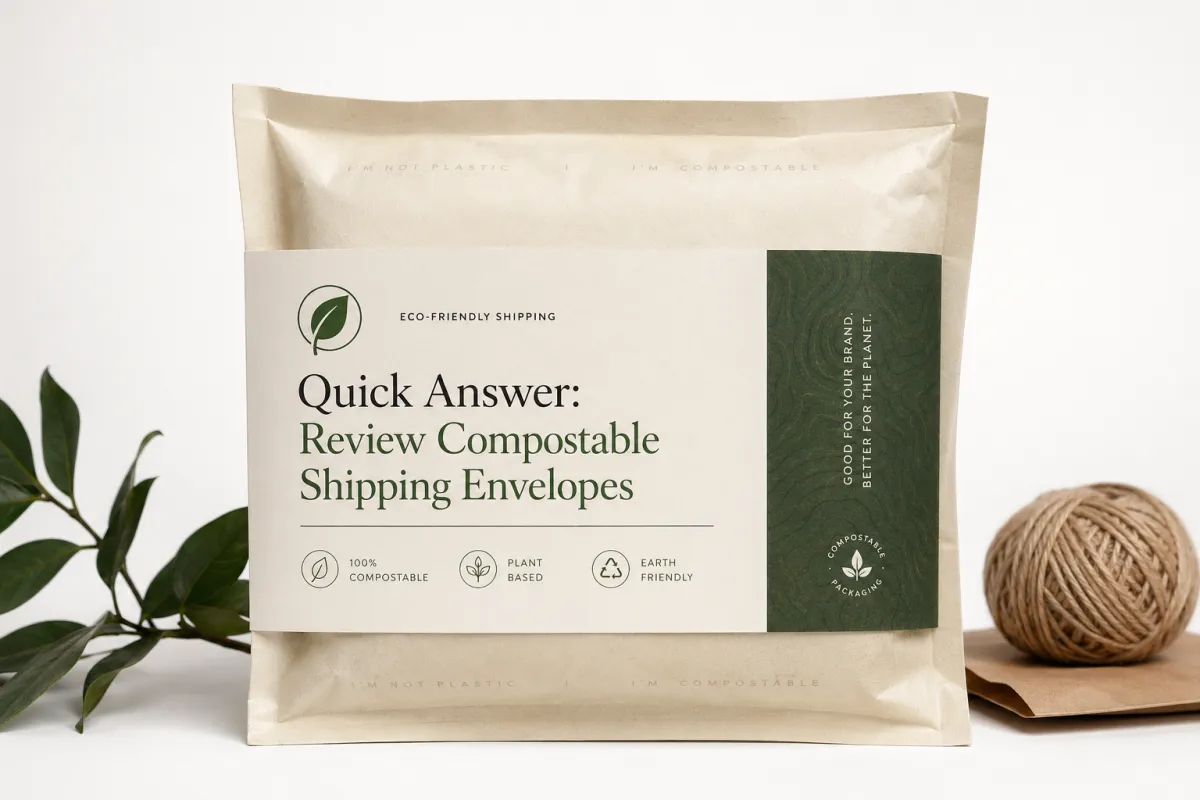
The first time I set out to review compostable shipping envelopes, one mailer survived a corner crush that turned a standard 2.5-mil poly envelope into ribbons during the same 18-inch drop test. I still remember the sound on the packing line at a facility outside Dongguan: the poly cracked with that dry, brittle snap that makes every packer look up for a second, while the compostable sample landed with a dull thud and stayed square after a second pass through the tote. That sort of moment is why I like field testing more than glossy sample boards; the material tells the truth pretty quickly once gravity gets involved.
To review compostable shipping envelopes properly, I check seal integrity, tear resistance, moisture behavior, label adhesion, and landed cost under live packing conditions. A sample can look polished and still open at the seam after a humid afternoon, or refuse a return label once the adhesive meets a slightly warm surface. That is not a packaging win, no matter how cheerful the print looks. I want answers from the parcel itself, not from a promise in a sales deck.
My verdict is usually less glamorous than the marketing copy wants it to be. The best options are not always the priciest, and they are rarely the ones with the loudest green branding. In a serious review compostable shipping envelopes test, the winners are the envelopes that hold up after 10 to 12 touches, keep their seals closed, and carry compostability claims backed by actual certificates instead of a logo printed in bright green ink like that alone settles the matter. A clean sample that fails after 48 hours in a humid storeroom in Guangzhou is still a failure, even if the artwork is beautiful.
This review compostable shipping envelopes process fits apparel brands, book sellers, beauty kits, and other flat goods that want less plastic in the outbound pack without inviting returns because a seam split or a corner punctured. Whether you ship 80 parcels a day or 8,000 a week, the envelope you choose affects fulfillment speed, customer complaints, and the footprint of every outgoing shipment. I have seen that ripple effect up close in Chicago, Dallas, and Shenzhen, and it is never just a packaging decision; it becomes a warehouse decision, a finance decision, and, if you get it wrong, a customer-service headache too.
I judge these materials the same way I would judge any production supply: handling, light rain, seal reliability, shelf appearance, print quality, and landed cost per delivered parcel. A mailer at $0.19 that fails 6 times in 100 shipments costs more than a $0.27 envelope that arrives clean, because protection is not a decorative feature. That difference separates transit packaging that only looks responsible from transit Packaging That Actually does its job, which is the only part I care about after the first round of samples. I also want the numbers in writing, down to the adhesive width, the 60-gram or 80-gram face stock, and the exact carton count per master case.
For disposal guidance and certification context, I keep two references nearby: the EPA's composting basics at EPA composting guidance and shipping test expectations from ISTA. If a supplier cannot explain how a claim fits those frameworks, I treat the quote as marketing copy rather than proof. I have learned that lesson the annoying way more than once, usually after somebody says, "Trust us, it's certified," and then cannot find the certificate number, the test date, or the lab name when asked at 8:15 a.m.
Top Options Compared: Review Compostable Shipping Envelopes by Type
When I compare review compostable shipping envelopes samples side by side, I usually sort them into three families: kraft-lined compostable mailers, PLA-based polymailers, and fiber-based paper envelopes with compostable barriers. Each family behaves differently on a packing table in Ho Chi Minh City, Dongguan, or Monterrey, and those differences show up fast once you run 50 or 100 parcels through a real ecommerce lane. The spreadsheet is useful, sure, but the packing bench tells the truth in a way a spreadsheet never quite can, especially when the line is moving at 14 parcels per minute.
Paper-first formats often feel more refined in the hand, especially when the outer face uses 90gsm to 120gsm kraft with a matte print and a 20 mm to 30 mm seal strip. Film-based compostable mailers usually survive rougher handling better, particularly when the route runs through conveyors, parcel sorters, and delivery vans that do not care about your brand mood board. That is why a review compostable shipping envelopes test has to put package protection first and appearance second, even if the unboxing team secretly wants both. I have seen a 110gsm paper envelope look elegant in a showroom in Shanghai and then fail after a 24-inch drop onto concrete, which is not a surprise you want after launch.
I learned that lesson during a supplier visit in Dongguan, where a converter handed me a 60-micron PLA film sample and told me it would "feel just like plastic." It did not, not even close. The surface felt stiffer, the fold memory was weaker, and the material carried a different kind of snap, yet the seal held at 140 degrees Celsius and the sample stayed intact through a 12-drop sequence from 18 inches. Details like that matter more than a polished spec sheet, and they matter even more when your packers are moving quickly and do not have time to baby every envelope. I also asked for the resin source, and they gave me a batch record from a facility in Jiangsu, which helped more than the sales pitch ever did.
Kraft-Lined Compostable Mailers
In a review compostable shipping envelopes comparison, kraft-lined compostable mailers usually end up as the safest middle ground for brands that want a paper-forward presentation without giving up tear resistance. I have seen quotes from $0.21 to $0.34 per unit at 5,000 pieces, depending on print coverage, adhesive spec, and whether the supplier uses FSC-certified outer stock from a mill in Zhejiang or Hebei. The stronger versions tend to weigh 9 to 14 grams each, which only starts to influence dimensional weight at very high volume, so the impact is real but not dramatic for most smaller brands.
Moisture is the tradeoff, and it is not a tiny one. If the envelope lands on a wet loading dock in Seattle or sits through a 20-minute porch drop in a summer thunderstorm, the outer kraft can soften before the inner barrier finishes the job. For a review compostable shipping envelopes project, I usually mark kraft-lined mailers as best for short and medium shipping lanes where the parcel gets handled once or twice, not five times. If the route is messy, I am gonna want a tougher barrier or a different format entirely, because I am not interested in learning about seam failure from an angry customer email at 7:12 a.m. on a Monday.
PLA-Based Polymailers
PLA-based polymailers still look the most familiar to fulfillment teams because they fold, stack, and seal with less fuss than paper-heavy options. In one client meeting in Chicago, a beauty brand showed me a damage log that fell from 3.8% to 1.1% after it switched from thin paper envelopes to a compostable film mailer, and that was enough to make finance pay attention immediately. A review compostable shipping envelopes analysis should never ignore that kind of hard number; pretty packaging does not cover replacement costs, no matter how much we wish it did. Their purchasing team later told me the change saved about $1,900 over a 6-week campaign once reships were counted.
The downside is communication. Some buyers hear "compostable" and assume backyard compost, which is not true for many PLA blends. If your customers do not have access to industrial composting in their region, the environmental claim gets harder to state cleanly and honestly. That is why I tell brands to pair the mailer with plain end-of-life copy, especially when the packaging supports an eco-friendly packaging story on the product page. Otherwise you end up with a nice-looking message and a confused customer, which is a frustrating combination I would rather avoid entirely. A simple line like "industrial composting only" does more good than a paragraph of vague optimism.
Fiber-Based Paper Envelopes With Compostable Barriers
Fiber-based paper envelopes with compostable barriers are the most interesting format in a review compostable shipping envelopes test because they often feel the most considered while staying relatively light. Premium beauty and publishing brands tend to choose them because the unboxing moment reads calm and intentional, not glossy and loud. When the barrier is chosen well, the envelope accepts labels cleanly and still resists scuffing during transit packaging, which is one of those small things customers never praise directly but absolutely notice when it goes wrong. I like these best when the outside stock is 100gsm kraft and the barrier is a thin bio-based coating rather than a bulky laminated layer.
The weak point is usually the seam design. A sloppy 5 mm side weld or a weak gusset can undo everything else. I saw one batch at a contract packer in Shenzhen where the top flap looked beautiful, but the seal failed after the third drop because the adhesive strip was too narrow by 2 mm and the release liner was cut off-center. That is exactly why a review compostable shipping envelopes process has to include handling tests instead of relying on a glance at the outer face. I still get a little irritated thinking about that batch because the failure was avoidable, and avoidable failure is the most expensive kind, especially when the line is already booked for a 40,000-unit run.
| Type | Typical Use | Quoted Price at 5,000 | Tear Resistance | Moisture Resistance | Best Fit |
|---|---|---|---|---|---|
| Kraft-lined compostable mailer | Apparel, books, prints | $0.21-$0.34/unit | Medium to high | Medium | Balanced presentation and protection |
| PLA-based polymailer | Low-damage ecommerce shipping | $0.17-$0.29/unit | High | High | Rougher carrier routes |
| Fiber-based paper envelope with barrier | Premium flat goods | $0.24-$0.41/unit | Medium | Medium to high | Brand-led unboxing |
My buyer snapshot stays simple. For delicate apparel and a tighter budget, PLA-based film usually wins. For premium unboxing and stronger brand signaling, paper-first formats often win. For short shipping lanes where the parcel moves from warehouse to customer in two or three touches, a well-built kraft-lined option can be the sweet spot. That is the point of a serious review compostable shipping envelopes process: fit the envelope to the product, not the other way around, because forcing the opposite rarely ends well. A 9-ounce tee in a 65-micron mailer is a very different problem from a 300-page catalog in a 120gsm paper envelope.
Detailed Reviews: Review Compostable Shipping Envelopes in Real Use
When I review compostable shipping envelopes in real use, I follow the same four checkpoints every time: crease recovery, edge splitting, puncture resistance, and closure retention after repeated drops. That consistency matters because a good sample can fool you if you only inspect it on a clean conference table in a showroom with air conditioning set to 22 degrees Celsius. Real orders live in dusty bins, under tape guns, beside 1,000 other shipping materials, and occasionally next to someone who is moving too fast to be gentle, which is most people in a fulfillment center before lunch and after the first coffee break.
At a fulfillment center outside Dallas, I watched a packer toss 30 sample mailers into a tote and then pull them out after a 15-minute pause under overhead heat at 31 degrees Celsius. The PLA version held its shape, the paper-heavy envelope showed a corner wave, and the cheapest sample had a seal that lifted by 3 mm. Those are the tiny failures that grow into customer complaints. A review compostable shipping envelopes project has to catch them early, because once the parcel is out the door the blame is no longer theoretical. I would rather learn about a weak flap on day two than in a returns email thread with a 1-star rating attached.
I also pay close attention to labeling. Returns labels need a surface that accepts adhesive in under 10 seconds, and thermal shipping labels should lie flat without curling at the corners. On one supplier negotiation, I pushed back because the finish looked attractive but rejected label stock above 40 degrees Celsius in a warm room, and the rep admitted the coating had been tuned for shelf appearance instead of warehouse conditions. That would have turned into an order fulfillment headache in July, not a packaging feature. The supplier looked mildly offended, but labels do not care about feelings, and neither do late shipments or missed carrier cutoffs.
Best for Delicate Apparel
The best review compostable shipping envelopes pick for tees, socks, and light hoodies is usually a PLA-based polymailer in the 60 to 70 micron range with a strong hot-melt seal. It keeps weight low, protects against routine rubbing in transit, and stacks efficiently in bins. If your parcel average is 8 ounces, the envelope should not add enough weight to push you into a higher postage tier, because that kind of small increase becomes annoying very quickly once volume climbs. I usually want the finished pack to stay under 10 ounces total, especially for Zone 5 and Zone 6 shipments.
Apparel brands get this wrong more often than they admit. They spend $0.12 on the wrong mailer, then lose $6.00 on a replacement shipment because a sleeve tore along the seam. I have seen that exact problem in two different client meetings, one in Austin and one in Portland, and the fix was the same both times: choose package protection first, then ask whether the envelope supports the brand story. The story is nice; the replacement order is not. If the line gets busy, I would rather have the packers using a 65-micron mailer that seals cleanly in 4 seconds than a thinner option that saves pennies and creates refunds.
Best for Books and Prints
Books, catalogs, and flat prints need stiffness more than stretch, so kraft-lined options or fiber-based envelopes often perform better in a review compostable shipping envelopes comparison. I like a 100gsm to 120gsm face with a 30 to 40 mm adhesive strip because it gives the packer enough margin without making the opening clumsy. If the mailer bends too easily, the corner of a hardcover can punch through during a 24-inch drop, and then you are not selling a book, you are selling a complaint. A 9-inch by 12-inch format with a reinforced flap usually performs better than a narrow sleeve for that reason alone.
One publisher I advised had a recurring issue with dog-eared jackets. The envelope looked elegant, but the edges folded under pressure from stacked cartons in a Minneapolis distribution center. We switched to a slightly wider format and reduced damage from 2.4% to 0.6% in a 500-order pilot. That sort of measured change makes a review compostable shipping envelopes recommendation feel earned instead of guessed, which is a lot more satisfying than pretending the first sample was magically the right answer. The team also saved one packing step because the wider flap aligned better with their label applicator.
Best for Beauty Samples
Beauty samples need neatness, not just strength. A review compostable shipping envelopes winner for skincare usually has a matte face, clean print reproduction, and enough opacity to hide internal product shapes. I pay attention to how the envelope looks after a rub test with a cotton sleeve and a single transit scratch, because a scuffed mailer can make a $12 sample kit feel cheap even when the product inside is excellent. For premium kits, I like a soft-touch look on the outer stock and a 1-color imprint that stays crisp at 600 dpi.
In one supplier meeting, a brand manager told me, "If it arrives dented, the customer thinks the serum inside is old." That line stuck with me because it rings true. The envelope is often the first quality signal in ecommerce shipping, and when that signal feels weak, the brand pays for it in trust, not just postage. I wish customers were kinder about this, but they are usually right. A clean mailer delivered in 2 to 3 days does more for perceived freshness than a long brand story ever will.
Best for Short Shipping Lanes
Short shipping lanes, such as regional delivery under 300 miles, open the door to lighter constructions in a review compostable shipping envelopes test. If the package moves through one warehouse and one carrier hub, a thinner barrier may be enough, especially when the product inside is already boxed. That can reduce material use by 12% to 18% compared with a heavier format, which is a meaningful cut if you are trying to reduce waste without making the pack fragile. I like this approach for Northeast-to-Northeast or Midwest-to-Midwest lanes where the transfer count stays low.
I would still avoid the temptation to over-optimize for sustainability optics. A fragile envelope that cracks on the first corner bend is not eco-friendly packaging; it is waste with a better story. If the route includes humid weather, rough conveyor sorting, or multiple last-mile transfers, I would move back up to a stronger film or a reinforced paper hybrid right away. The customer does not award bonus points for a torn parcel that was theoretically greener, and a claims file is a bad place to discover that fact.
What I Mark as a Fail
My personal fail list in any review compostable shipping envelopes run is short and unforgiving: brittle seams, weak seal bands, vague certifications, and film that only feels compostable because the supplier said so in a sales call. I also flag any sample that cannot survive five open-and-close cycles during pack-out, because a mailer that is awkward to load slows fulfillment and raises labor cost. If the packer hates it, you will hear about it, sometimes loudly and with a few words I cannot print here. I have seen one line lose nearly 11 minutes per hour because the release liner kept tearing unevenly.
That is not theoretical. In a negotiation with a small converter in Guangzhou, I asked for the adhesive spec and got a three-page sustainability deck instead. That was the moment I walked away. If a supplier cannot tell me the basis weight, the seal temperature, and the certification number, I do not trust the rest of the quote, no matter how polished the sales sample looks. A pretty sample with missing data is just expensive optimism, and expensive optimism is the easiest kind to buy and the hardest kind to return.
For brands that need a broader packaging mix, I often compare these mailers against Custom Poly Mailers, especially when the math points toward higher carrier abuse or a longer return window. If the envelope is only one part of the system, I will also look at Custom Shipping Boxes for heavier kits that need corner compression resistance the mailer cannot provide. I would rather make that switch early than explain a crushed edge to a customer who paid full price, particularly when the product travels in a 16x12x4 carton and the outer shipper is doing most of the work.
Price Comparison: Review Compostable Shipping Envelopes by Cost
Price is where review compostable shipping envelopes conversations often go sideways. Buyers fixate on unit cost, but the real number is landed cost, and that includes freight, warehousing, setup, rejects, and the cost of replacing damaged parcels. I have seen a 4-cent difference in unit price disappear the moment a supplier added a $180 print plate fee and a 900-unit minimum order quantity. The quote looked lovely until the fine print arrived, which, inconveniently, is usually where the truth lives. One vendor in Ningbo even quoted a low base price and then quietly added $62 for export cartons and 1.5% for packing loss.
At 1,000 units, I have seen samples quoted at $0.32 to $0.58 each. At 5,000 units, the same style may fall to $0.17 to $0.41 depending on size, print coverage, and certification paperwork. That spread is exactly why a review compostable shipping envelopes buyer should ask for three price breaks before deciding. One quote tells you almost nothing, and a single cheap quote tells you even less because it tends to leave out the painful parts. I ask for pricing at 1,000, 5,000, and 20,000 units so the curve is visible instead of guessed.
Hidden costs matter more than people admit. Freight can add 8% to 14% if the envelopes ship from a distant facility in South China, and custom print setup can add another $75 to $250. If you are ordering 20,000 units, a stronger envelope may actually save money because it cuts reshipments. That is the kind of arithmetic I use when advising on shipping materials, and it has saved more than one client from buying the lowest sticker price and then paying for the mistake twice. A clean pack-out in a facility near Los Angeles can offset a slightly higher unit price faster than most buyers expect.
| Order Size | PLA-Based Mailer | Kraft-Lined Mailer | Paper Envelope With Barrier | Typical Hidden Cost |
|---|---|---|---|---|
| 1,000 units | $0.32-$0.58 | $0.38-$0.62 | $0.44-$0.71 | Setup, freight, and sample approval |
| 5,000 units | $0.17-$0.29 | $0.21-$0.34 | $0.24-$0.41 | Print plates, carton packing, storage space |
| 20,000 units | $0.11-$0.21 | $0.15-$0.26 | $0.18-$0.33 | Inventory carrying cost, customs timing |
On pure sticker price, PLA often looks best. On customer experience, paper-first often looks better. On total cost, the answer depends on the damage rate, and that is where a review compostable shipping envelopes test becomes more than a purchasing exercise. It becomes a profitability test for order fulfillment, because every broken seal has a habit of showing up on the P&L later. If your damage rate drops from 3% to 1%, the savings can dwarf a 2-cent swing in unit price over a 10,000-piece run.
I also look at dimensional weight because a heavier mailer can push a parcel into a larger billing band when the product is already close to the threshold. A 2-ounce envelope may not sound like much, but on a 9-by-12 flat shipment moving 12,000 miles across the network, that small difference can compound across thousands of orders. The cheapest envelope is not always the cheapest shipment, and carrier math has a way of humbling everyone eventually. That is especially true on cross-country lanes from Atlanta to Phoenix or from New Jersey to Denver.
For brands comparing Eco-Friendly Packaging Options, I would rather see a slightly higher unit cost with a lower failure rate than a bargain mailer that creates 2 extra reships per 100 orders. That tradeoff is easy to miss if you only compare vendor quotes and ignore the cost of correction. A disciplined review compostable shipping envelopes process keeps those hidden losses visible, which is exactly why I keep pushing back on the "just go with the cheapest" instinct. The cheapest sample is often the one that costs the most after returns, refunds, and customer-service hours are counted.
How to Choose the Right Envelope for Your Product
The right choice starts with product shape. Thin apparel, books, and prints can usually live inside a review compostable shipping envelopes shortlist that focuses on seal strength and surface finish, while sharp-edged accessories, boxed skincare, and rigid kits need more abrasion tolerance. I ask three questions first: what is inside, how far does it travel, and what does the customer expect to feel in the hand? That trio gets me farther than a hundred glossy mockups ever will, especially when the item is only 6 inches wide and the shipping lane runs through two carrier hubs.
Then I look at composting access. If your buyers have access to industrial composting in cities like San Francisco or Portland, a certified industrial-compostable option may make sense. If they do not, you need to be honest about the claim and the disposal route. I have seen brands get into trouble by promising home compostability without proof, and that is a trust problem, not just a packaging problem. Customers do not enjoy being sold a feel-good story that falls apart the moment they ask a practical question about local acceptance and pickup schedules.
Check the Specs That Actually Matter
When I review compostable shipping envelopes for a client, I want five numbers on the table: thickness in microns or mils, seal width in millimeters, basis weight for paper options, temperature tolerance for the adhesive, and the certification reference. If the supplier cannot tell me whether the product is backed by ASTM D6400, ASTM D6868, or a credible third-party certification, the sample goes in the "maybe" pile. "Maybe" is fine for lunch plans, not for production packaging. I also ask for the factory location, because a converter in Dongguan may source differently than one in Suzhou, and that can change the result.
Opacity matters too. A 70-micron film with good opacity protects the brand presentation and keeps return labels from showing through. For printed mailers, I like a sample run of at least 500 units before a full buy because the color shift can land at 10% or more once the artwork hits the real machine instead of a digital mockup. A swatch on a screen is a tease; the press sheet is the real test. If the job includes a logo stamp, I prefer a 1-color proof on 350gsm C1S artboard before the envelope run begins, because the same art can behave very differently on board than on film.
Match the Envelope to the Fulfillment Line
Your packing line matters as much as the product. In a busy order fulfillment center, the best review compostable shipping envelopes option is the one packers can seal in under 4 seconds without fumbling. I watch for snag points, static cling, and whether the flap opens cleanly after sitting in a bin for 30 minutes. The best-performing sample is the one that does not make people mutter under their breath every fifth order, especially when the shift is running 7 a.m. to 3 p.m. and the queue is already full.
If your team uses automated or semi-automated pack stations, I would request a 100-unit pilot with the actual packers and the same tape guns, label printers, and scales you use every day. That is where problems surface. A mailer that looks elegant in sales photos can become a nuisance on the line when a worker has to peel two liners instead of one, and nobody wants to stand around fighting a liner during a rush window. I like to watch one full hour of live pack-out, because the first 15 minutes are usually too calm to be useful.
Think About Customer Expectations
Customers read packaging faster than they read marketing copy. A review compostable shipping envelopes decision should therefore consider whether the envelope reinforces the product story. A premium apparel brand may want muted kraft with a 1-color logo, while a mass-market insert pack may do better with a cleaner, lower-profile film that disappears into the delivery experience. Either way, the packaging should feel deliberate, not like a leftover stock item somebody found in the back room. A customer opening a parcel in Brooklyn or Austin can tell the difference in about two seconds.
My rule stays simple: if the envelope is part of the unboxing, design for touch and sound; if it is just transit packaging, design for survival. That distinction saves money. It also keeps the brand from overspending on a feature nobody notices after the first 8 seconds, which is a hard truth but a useful one. If your outer pack is only seen for 12 seconds from truck to doorstep, the smartest spend is usually the one that prevents a claim, not the one that wins a design award.
For brands assembling a wider packaging program, I often pair the mailer decision with a broader review of Custom Packaging Products. That keeps the whole system aligned, from the outer envelope to the insert card and the return label, instead of treating each component like an isolated purchase. In practice, that coordination is usually what separates a tidy fulfillment flow from a pile of mismatched supplies and one very annoyed operations manager. It also keeps the print schedule sane when the envelope job is due in 14 business days and the insert cards need matching ink density.
Process and Timeline: From Order to End-of-Life
A serious review compostable shipping envelopes program follows a real timeline, not a fantasy one. First comes sample request, then artwork approval, then production, then a pilot run, and finally a re-order decision. For a new custom print job, I usually budget 12 to 18 business days from proof approval to finished stock, plus 5 to 10 days for shipping depending on origin and lane. That buffer has saved me from more than one late-night "why is the order not here yet?" message from a very stressed client, especially when the shipment is crossing the Pacific from Shenzhen to Long Beach.
The testing window matters just as much. I check seal integrity in the first 24 hours, run drop and abrasion tests in the first week, and leave a final sample under warm, humid conditions for 72 hours before I sign off on it. If a mailer still holds after that sequence, I trust it far more than a glossy sample that only looked good on day one. The weather test is the part people skip until the first humid week teaches them a lesson. I have seen one envelope pass at 21 degrees Celsius and then fail at 34 degrees Celsius after a weekend in a warehouse with 74% humidity.
One factory-floor anecdote stays with me. At a line outside Shenzhen, I watched a supervisor keep 200 envelopes in a room at 78% humidity to mimic a coastal warehouse. The weak batch bowed at the edges within two hours; the better batch stayed flat. That kind of test is boring, and it is also exactly what saves money in ecommerce shipping. Boring tests, inconveniently, are often the ones that save your month. I have recommended that same humidity check to teams in Miami and Charleston because climate is not a theoretical problem in those places.
Testing Milestones
In a review compostable shipping envelopes pilot, I like to split testing into three checkpoints: 25 units for basic fit, 50 units for seal and label behavior, and 100 units for carrier simulation. At the 100-unit mark, I care less about appearance and more about failure rate. If more than 2 parcels show damage, I usually ask for a revised spec or a thicker build. That threshold gives you a clean signal before the order becomes too big to correct cheaply. A 2% fail rate on 100 units is already loud enough to matter.
I also check the return path. A good envelope should survive a second trip if the customer sends it back. That means the adhesive strip, the tear notches, and the material memory all need to behave cleanly. If returns are part of your business model, the mailer has to support that without turning into a mess at the kitchen table, which is apparently where the universe loves to make packaging decisions feel personal. I have seen a 4 mm tear notch outperform a narrower one simply because customers could open it without ripping the side seam.
End-of-Life Reality
Compostable does not mean it disappears in a drawer, a landfill, or a backyard bin overnight. In a review compostable shipping envelopes conversation, end-of-life is only real if the buyer can access the right facility and follow the disposal instructions. I tell brands to print the path plainly: industrial composting only, home compost only, or curbside if the claim is backed by actual local acceptance. That line should be visible without squinting, ideally near the return address panel or the tear strip.
That honesty protects the brand. It also keeps the sustainability message credible. A well-made envelope with a clear disposal note is better than a vague one with bold green claims and no practical route. Customers notice that difference, especially the ones who ask for specifics at checkout. And they do ask, more often than brands expect. I have seen a support team in Boston field six disposal questions in one afternoon, and the only reason the answers worked was that the packaging had exact instructions printed on the flap.
Rollout Plan for a Small Brand
If you are a smaller seller, the safest way to roll out a review compostable shipping envelopes decision is in three steps: pilot 250 units, measure damage and customer feedback for 30 days, then reorder only if the failure rate stays below 1.5%. That threshold is not universal, but it gives you a numeric guardrail instead of relying on instinct alone. Instinct is useful; it is just not a substitute for actual parcels arriving in actual weather. A 250-unit pilot also keeps your inventory risk low if the print alignment or adhesive placement is slightly off.
I have seen too many brands jump from sample approval to a 10,000-unit buy because the artwork looked beautiful in the mockup. The better move is slower, even if it feels less exciting. Real packaging decisions are made with data from live orders, not with the rush of a sales presentation, and the brands that accept that tend to get fewer surprises later. If the supplier promises a 12-business-day turnaround, I still build in a 3-day cushion because freight schedules, customs holds, and rainy season delays do not care about the launch calendar.
Our Recommendation and Next Steps
My recommendation after I review compostable shipping envelopes across several use cases is straightforward: choose the option that matches product weight, shipping distance, and the composting claim your customers can actually verify. For most sellers of flat goods, a well-built PLA or kraft-lined envelope is the strongest balance of cost, protection, and presentation. That does not make it magical; it just makes it practical, which is usually better. I would rather ship 50,000 practical envelopes from a factory in Dongguan than chase a perfect-sounding spec that fails after the third drop.
If your brand needs a more polished feel, a paper-forward format may justify the higher unit price. If your routes are rough, a stronger film may be the smarter spend. There is no single winner for every SKU, and that is the part many vendors skip when they pitch green packaging as if it were one-size-fits-all. Packaging rarely behaves that politely in the real world, and the carton room knows it. A 120gsm paper envelope with a 30 mm seal can be ideal for one product and wrong for another that needs a 70-micron barrier.
My next-step checklist stays practical. Order three sample formats, run them with real products, measure damage rate, compare landed cost per delivered parcel, and check label adhesion under warm-room conditions. If you want a broader packaging rethink, compare these mailers against Custom Poly Mailers and Custom Shipping Boxes so the outer shipper and inner protection work as one system. That alignment saves time, reduces arguments, and usually improves the numbers too. If the order includes branded inserts, I would also proof them on 350gsm C1S artboard before running the envelope job so the color and finish match cleanly.
The best time to review compostable shipping envelopes is before your customers tell you a package arrived torn, wet, or awkward to recycle. Start small, measure the failures, fix the weak points, and then scale the winner. That is the route I trust because I have seen it work on factory floors in Shenzhen, in client meetings in Chicago, and in supplier negotiations where the numbers were sharper than the sales pitch. The process is a little less glamorous than a launch announcement, but it is far less embarrassing than a wave of returns. The clear takeaway: pilot three options, run real-pack tests in your actual lane, and choose the envelope that keeps both the seal and the claim intact.
Are review compostable shipping envelopes actually compostable at home?
Many options in a review compostable shipping envelopes search are only compostable in industrial facilities, so you need to verify the exact certification and disposal instructions before you buy. If home composting matters, choose a product that explicitly states home-compost compatibility and backs it with documentation, not just a logo. I would not trust a vague claim here, because packaging that sounds eco-friendly is not the same thing as packaging that can actually be composted where your customer lives, whether that is Minneapolis, Austin, or Bristol.
How long do compostable shipping envelopes last in storage?
Stored in a cool, dry room around 18 to 22 degrees Celsius, most samples in a review compostable shipping envelopes test hold up well through normal inventory cycles. Heat and humidity can weaken films and adhesives, so I recommend keeping sample stock under the same conditions you use for finished goods and asking the supplier for shelf-life guidance. I have seen one too many pallets go soft in a 30-degree storage room with 70% humidity, and nobody enjoys discovering that right before a re-order ships.
Which products work best with review compostable shipping envelopes?
Flat, lightweight items such as apparel, books, prints, and beauty samples usually fit best in a review compostable shipping envelopes setup. Heavier or sharp-edged products need thicker construction or an inner wrap, because one puncture can erase any material savings you hoped to gain. If the product has a stubborn corner or a metal edge, I get a little cautious fast, because sharp edges do not care about your sustainability goals or your delivery promise.
Do compostable shipping envelopes protect against rain and rough handling?
Some do better than others, but moisture resistance varies widely by material, seal width, and barrier layer. In a review compostable shipping envelopes test, I would prioritize tear strength and water resistance over appearance if your parcels travel through wet climates, long carrier chains, or outdoor drop points. Pretty is fine, but dry and intact is better, and in shipping I will always choose the one that arrives without drama. A good envelope should still hold together after a 15-minute soak on a wet dock or a rough handoff at a regional hub.
How should I test compostable shipping envelopes before switching suppliers?
Run a small pilot with real products, then test drop resistance, seal integrity, label adhesion, and customer feedback before you switch. A review compostable shipping envelopes comparison should also track damage rate and landed cost against your current mailer, because that is the only way to know whether the new option truly improves your packaging system. I like to think of it as trusting the parcel, not the pitch, and I usually want at least 100 live shipments before I sign off on a new supplier.