Buyer Fit Snapshot
| Best fit | Custom Packaging Sustainable Minimalism Decision Review projects where brand print, material claims, artwork control, MOQ, and repeat-order consistency need to be specified before quoting. |
|---|---|
| Quote inputs | Share finished size, material target, print colors, finish, packing count, annual reorder estimate, ship-to region, and any compliance wording. |
| Proofing check | Approve dieline scale, logo placement, barcode or warning zones, color tolerance, closure strength, and carton packing before bulk production. |
| Main risk | Vague material claims, crowded artwork, missing packing details, or unclear freight terms can make a low unit price expensive after revisions. |
Fast answer: Custom Packaging Sustainable Minimalism Decision Review: Material, Print, Proofing, and Reorder Risk should be specified like a repeatable production item. The safest quote records material, print method, finish, artwork proof, packing count, and reorder notes in one written spec.
Production checks before approval
Compare the actual filled-product size with the drawing, then confirm tolerance on folds, seals, hang holes, label areas, and retail display edges. Reserve space for logos, QR codes, warning copy, and material claims before decorative graphics fill the panel.
Quote comparison points
Review material grade, print process, finish, sampling route, tooling charges, carton quantity, and freight assumptions side by side. A quote is only useful when the supplier can repeat the same color, closure quality, and packing count on the next order.
Quick Answer: Top Custom Packaging Trends Sustainable Minimalism
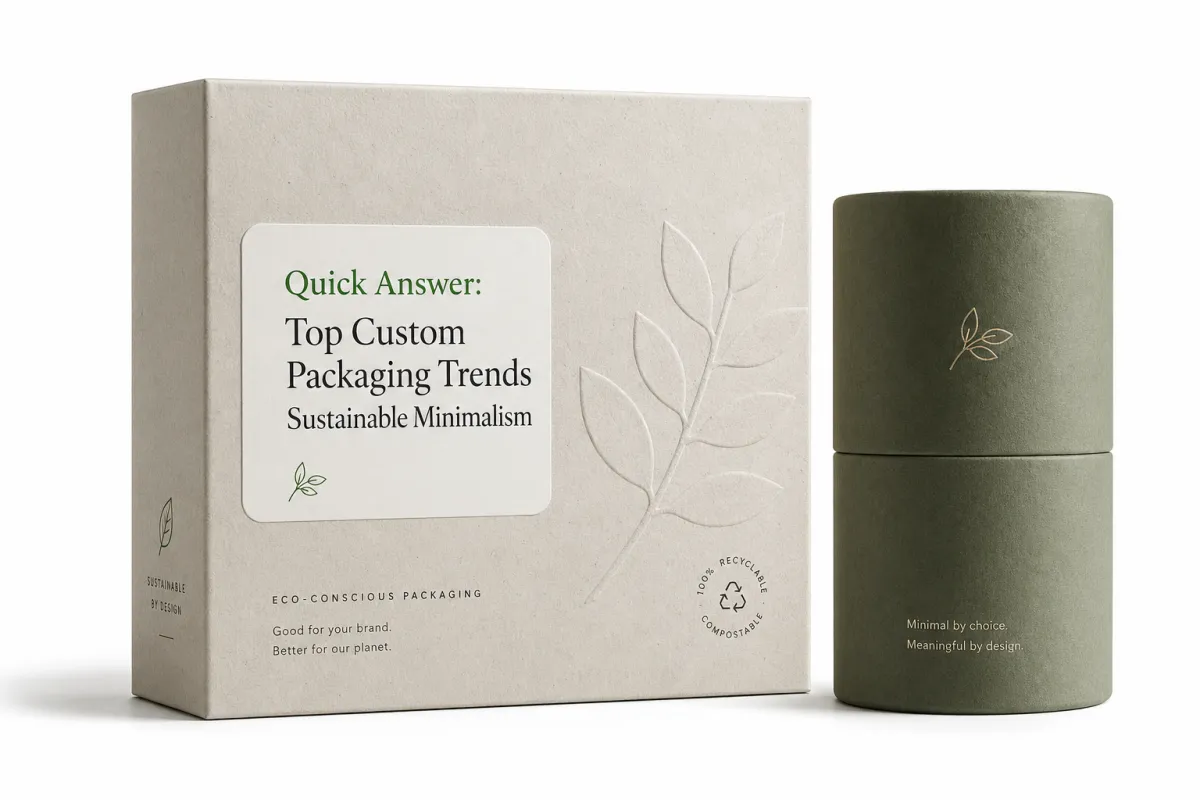
On a damp line visit in Dongguan, I watched a plain kraft mailer outperform a glossy sample tray by a mile, and that was the moment the whole conversation around top custom packaging trends sustainable minimalism snapped into focus for me. The quieter box only wins after the engineering is right. A 350gsm FSC kraft mailer with a one-color black mark can feel more premium than a crowded four-color carton if the folds are crisp, the lid closes square, and the product sits tight with 1.5 mm of controlled clearance. I still remember lifting that first sample at a converter in Dalang and thinking, “This is the box the customer will trust,” which is not exactly the kind of language that shows up in a procurement deck, but it is the truth on the factory floor.
My quick answer is simple: recycled paperboard or FSC kraft, one- or two-color print, right-sized dimensions, and a fiber-based insert that protects the item without filling the carton with foam or void fill. That stack lowers freight cube, cuts pack-out time by 20 to 30 seconds per unit on a busy line, and usually gives brands a cleaner shelf story than a gloss-heavy package that looks loud but ships badly. In top custom packaging trends sustainable minimalism, less material only works if the structure is disciplined, and if the package is pretending to be minimal while hiding three layers of waste inside it, that is just expensive theater with a recycling symbol on the side.
Brands are leaning this way because fewer components usually mean less freight waste, easier recycling, faster pack-out, and a cleaner brand presentation that feels intentional instead of overworked. I have seen a cosmetics client in Shenzhen cut outbound carton volume by 8% simply by shortening the box depth by 6 mm and removing a two-piece insert that nobody needed once the bottle was stabilized. That is why top custom packaging trends sustainable minimalism keeps winning real budget meetings, not just design reviews. The finance team likes it, operations likes it, and the customer does not have to wrestle with a package that feels like it lost a fight with a glue gun.
A lot of minimalist packaging fails because the team mistakes restraint for simplicity. A package can be visually calm and still be highly engineered: 400gsm recycled SBS, a 0.2 mm score allowance, a water-based matte varnish, and a folded pulp tray can do more for perceived value than a pile of foil, soft-touch film, and spot UV ever will. Top custom packaging trends sustainable minimalism rewards precision, not decoration. The irony is that the simpler it looks, the less forgiveness there is for sloppy execution, and packaging machinery in Suzhou or Dongguan has a special talent for exposing every decision you hoped would “probably be fine.”
"We thought the uncoated kraft would read cheap," a beverage buyer in Guangzhou told me after a 12,000-unit run cleared a 2-meter vibration test, "but the 1-color carton looked more expensive than the soft-touch sample because the edges stayed clean and the logo spacing was exact."
If you want the short version before we get into the details, here is the winning stack I would spec for most mid-market brands: a recycled paperboard or FSC kraft structure, a restrained print palette, a box size built around the product and ship method, and a fiber insert that survives drop testing without adding clutter. That formula is the heart of top custom packaging trends sustainable minimalism, and it is the same formula I keep recommending after sample rounds, factory visits in Guangdong and Zhejiang, and plenty of expensive lessons. I have made the mistake before of overcomplicating a package because the mockup looked “a little too plain” on a conference table, and then the plain version ended up being the one that sold through cleanly in stores from Chengdu to Shanghai.
What Are the Top Custom Packaging Trends Sustainable Minimalism Buyers Should Prioritize?
The first priorities are right-sized structures, recyclable fiber-based materials, and restrained print that still feels intentional under store lighting and in transit. In practice, top custom packaging trends sustainable minimalism usually means FSC kraft, recycled paperboard, molded fiber, or corrugated shippers paired with one or two inks, a matte aqueous coating, and an insert only when the product truly needs restraint and suspension. If the package is simplified but the board is too thin, the die line is sloppy, or the insert is doing the job of a better carton, the design is not really minimal at all; it is just underbuilt.
The second priority is production discipline, because the best-looking concept still has to clear the folder-gluer, survive humidity, and arrive with clean corners. That is why top custom packaging trends sustainable minimalism keeps favoring straight answers from the factory: exact calipers, realistic tolerances, low-ink coverage, and coatings that protect the pack without making recycling harder. A package that ships cleanly, stacks efficiently, and opens with a calm, confident reveal will usually outperform louder packaging that spends its budget on decoration instead of function.
Top Custom Packaging Trends Sustainable Minimalism Compared
Kraft Folding Cartons are the easiest place to start if your brand wants a natural look with a controlled unit cost. A 350gsm FSC kraft board with a one-color black or deep green print works well for supplements, candles, small beauty sets, and apparel accessories that need branded packaging without the visual noise of full-coverage graphics. The downside shows up quickly on a crowded shelf: if the typography spacing is off by even 1 mm, the whole carton reads plain instead of premium, so top custom packaging trends sustainable minimalism depends on exact dieline work. I have watched a buyer in Shanghai reject a whole round of samples because the logo sat 2 mm too high; she was right, and the box looked like it was apologizing for itself.
Recycled paperboard boxes feel cleaner and more retail-ready than raw kraft, especially in packaging design for cosmetics, wellness, and specialty food. I usually like 400gsm recycled SBS or a high-bleed white-back sheet when the brand needs better image sharpness, smoother folds, and stronger contrast for Custom Printed Boxes. The tradeoff is cost and moisture sensitivity; if your warehouse sees 68% to 75% humidity, you need to test edge swell and score cracking before signing off. For top custom packaging trends sustainable minimalism, recycled paperboard is the safer shelf player. It is also the option that tends to make art directors smile first and ask questions later, which is charming until the first pallet arrives with a curled lip on one corner after a 48-hour truck route from Ningbo.
Molded fiber trays are the best minimal solution for products that need suspension rather than a thick wall. I have used them for glass jars, small electronics, premium stationery, and gift sets where the product packaging must survive vibration without a lot of filler. They look honest and well made, but they are not always the right answer for high-gloss luxury retail packaging because the texture is more industrial than polished. Top custom packaging trends sustainable minimalism treats molded fiber as a function-first choice that can still feel premium if the outer sleeve is tight. If the geometry is dialed in at a plant in Xiamen or Dongguan, molded fiber can feel almost architectural; if it is not, it can look like the tray came from a hardware store and nobody wants that on a premium shelf.
Corrugated shippers with low-ink print are the workhorse option for direct-to-consumer shipping. A 32 ECT E-flute or B-flute shipper with a single-color mark, tight perimeter fit, and 5 to 8 mm of anti-rattle space can outperform a more expensive mailer if the route includes long transit or multiple handoffs. The look is restrained, almost quiet, but that is often exactly what the unboxing needs. Among top custom packaging trends sustainable minimalism, this is the best value for transit durability. I may be biased, but a well-made corrugated shipper from a converter in Foshan with a crisp one-color print is one of those things that makes operations people nod in a deeply satisfied way, which is not nothing.
Paper-wrap systems with minimal labels are the lightest visual solution, and they work well for apparel, printed goods, and low-fragility gift items. I like them only when the brand story can carry some of the visual load, because the package itself is not doing much structural storytelling. A 2-inch FSC paper wrap with a water-activated label can reduce packaging weight dramatically, but it will not save a fragile item from compression damage. That is the honest boundary line for top custom packaging trends sustainable minimalism. I once saw a team in Hangzhou try to wrap a ceramic item this way and then act surprised when the box lost an argument with a conveyor belt. Nature is beautiful; physics is not impressed.
The tradeoff across all five formats stays the same: the less visual decoration you use, the more the structure has to carry the brand impression. That means board selection, crease quality, adhesive behavior, and tolerances matter more than a mood board ever will. In my experience, top custom packaging trends sustainable minimalism looks strongest when the converter has a disciplined toolroom, a careful gluer setup, and a sharp eye for registration drift. If the machinery is cranky, the package will tell on it immediately, which is rude but useful.
Detailed Reviews: What Actually Works on the Line
Material choice is where top custom packaging trends sustainable minimalism either becomes credible or falls apart. Recycled SBS gives you better print holdout and cleaner contrast, while kraft linerboard gives you a warmer, more natural face that hides scuffs better during warehouse handling. Molded pulp is excellent for suspension and inserts, but it needs the right wall thickness, usually 2.5 mm to 4.0 mm, or it can feel flimsy in hand. Water-based coatings are my go-to for most of these builds because they keep the finish low-waste without creating the recycling headaches that plastic lamination can create. I have had too many conversations with teams in Guangzhou and Suzhou who wanted an “eco” pack and then quietly requested a plastic film because they were nervous about fingerprints. That is not the same thing, and the customer usually notices.
Construction details matter just as much as material. A minimalist package can fail because the die cut is off by 0.7 mm, the folder-gluer drifts during the last hour of a shift, or the adhesive set time is too slow for a humid plant room at 28 C and 75% relative humidity. I have seen a clean, beautiful prototype collapse in production because the front lock tab was designed for a tighter score than the press could repeat across 8,000 sheets. Top custom packaging trends sustainable minimalism only works if the die line is realistic for the actual machine, not the render. Honestly, I think this is where a lot of teams get seduced by the sample room in Dongguan and then get humbled by the line, which is a very expensive form of character building.
One of my clearest factory-floor memories came from a Shenzhen pilot run where a client wanted a nearly blank cosmetic carton with a blind emboss and no varnish. The sample looked excellent on the table, but after 300 units we started seeing rub marks on the corners because the uncoated stock had too much fiber lift for the pack-out speed. We switched to a light water-based coating and the line ran cleaner by 11 seconds per carton. That is the part most people miss in top custom packaging trends sustainable minimalism: the best-looking PDF does not always survive the line. I still laugh a little about how polished the art mockup looked right before the carton started looking like it had been through a minor rainstorm.
For sustainability claims, I trust certification and test methods more than marketing language. FSC certification is the first thing I ask for on fiber-based boards, and ISTA test protocols are what I use to prove the pack can handle transit, especially with FSC sourcing and ISTA shipment testing on the table. If a supplier cannot explain the chain of custody, the board composition, or the exact drop sequence, I slow the conversation down immediately. Top custom packaging trends sustainable minimalism gets stronger only when the claim is supportable. A green badge on a box is not a force field, and customers are getting better at spotting the difference between proof and gloss.
There is also a lot of confusion around compostable and recyclable claims. A molded fiber insert can be a smart choice, but local disposal infrastructure still matters, and a laminated paperboard carton may look eco-friendly while behaving poorly in curbside systems. I have had client meetings where the marketing team wanted a compostable badge, the operations team wanted a low-return complaint rate, and the recycler wanted a plain fiber stream with no special coating. My honest view is that top custom packaging trends sustainable minimalism should prefer the simplest end-of-life path the customer can actually access in their city or region. If the packaging requires a five-minute speech and a recycling legend just to explain itself, it is probably too clever for its own good.
Finish details still matter, even in a restrained package. Blind embossing, restrained debossing, a single high-contrast color, and a matte aqueous coating can all deliver a premium feel without adding waste or complicating recycling. Soft-touch alternatives are useful only if the product really needs a velvety hand feel and the added coating does not interfere with the disposal story. In top custom packaging trends sustainable minimalism, one excellent finish beats three average ones every time. I would rather see a perfect emboss and sharp board edges than a package trying to impress me with a buffet of effects that feel borrowed from 2017 and a display table in a trade-show hall in Guangzhou.
Price Comparison: Sustainable Minimalism Costs and Savings
Separate unit cost from total landed cost before you compare anything, because the cheapest-looking quote often becomes the most expensive package once freight, inserts, setup, and rework are counted. For top custom packaging trends sustainable minimalism, I like to compare a 5,000-piece run, a 10,000-piece run, and a landed cost per shipped order, because those three numbers tell a far better story than a single box price. A box at $0.38 that needs a $0.22 insert and extra packing labor is not really cheaper than a $0.56 one-piece solution that runs clean on the line. I have seen teams celebrate a low quote in Dongguan and then spend the next month paying for it in labor, which is a very special kind of budgeting mistake.
| Option | Typical Spec | Unit Cost at 5,000 | Best Fit | My Verdict |
|---|---|---|---|---|
| FSC kraft folding carton | 350gsm board, 1-color print, matte aqueous | $0.42-$0.68 | Candles, supplements, apparel accessories | Strong value, clean look, easy to recycle |
| Recycled paperboard retail box | 400gsm recycled SBS, 2-color print, tight die cut | $0.55-$0.95 | Cosmetics, wellness, premium gifts | Best shelf presentation for the money |
| Molded fiber tray + paper sleeve | 2.5-4.0 mm tray, minimal sleeve print | $0.78-$1.35 | Fragile items, glass, tech accessories | Best for suspension and low-waste story |
| Corrugated shipper with low-ink print | 32 ECT E-flute, 1-color mark, fit-tested insert | $0.68-$1.10 | DTC shipping, subscription kits, e-commerce | Best transit durability at moderate cost |
| Paper-wrap system with label | FSC wrap, water-activated label, no plastic tape | $0.28-$0.55 | Light apparel, print goods, gifts | Lowest material cost, but least protective |
The savings in top custom packaging trends sustainable minimalism usually come from fewer inks, fewer components, smaller carton footprints, and less void fill. I have seen a supplement brand trim freight by 14% after reducing their box height by 9 mm and switching from a three-piece paperboard insert to a single folded support cradle. On a 20,000-unit order, that kind of change can free up pallet space, reduce warehouse touches, and lower damage claims by a noticeable margin. It also makes the pack-out team a little less grumpy, which, after a long week in a warehouse near Foshan, is basically a financial metric of its own.
Costs rise quickly if you add custom-molded inserts, unusual recycled stocks, or a structural shape that needs multiple tooling revisions. Short runs can also hurt, because a 2,500-piece job still carries setup work on the cutter, the gluer, and the print press even if the design is minimal. In practical terms, a smart minimalist carton might land around $0.42 to $0.95 a unit, a molded fiber solution might push into the $0.78 to $1.35 range, and a highly engineered rigid pack can go much higher if the brand insists on perfect corner alignment and a magnetic closure. That is why top custom packaging trends sustainable minimalism should be budgeted with the whole chain in mind. A neat quote can be comforting, but it is not the same thing as a package that survives real use.
If you are building a flagship product, I would not force the cheapest option just to chase a sustainability headline. A slightly more expensive recycled paperboard box with better registration and a tighter insert can save more money over 12 months than a bargain carton that creates returns, breaks at the corners, or wastes labor at packing. For top custom packaging trends sustainable minimalism, the right number is the one that holds up after shipping, not the one that looks clever in a quote sheet. I know that sounds less glamorous than a spreadsheet full of tiny savings, but the warehouse does not care about glamour, and the customer only sees the box that arrives at their door.
How to Choose: Process, Timeline, and Testing
Start with the product dimensions, because a 2 mm error in width can become a 15 mm problem once an insert, a sleeve, and a shipper are stacked together. I always ask for finished product size, product weight, a photo of the item in use, and the shipping method before we talk about top custom packaging trends sustainable minimalism. If the item ships individually, the box needs different crush resistance than a display pack that only sits on a shelf for seven days in a retail store in Chengdu or Osaka. I have learned not to trust “close enough” dimensions, because “close enough” is how you end up with a beautiful box that rattles like loose coins in a jacket pocket.
Then look at the brand goal and the real disposal path. A natural skincare label that sells through independent retailers may want a kraft finish and a one-color mark, while a premium electronics kit may need a recycled paperboard shell with a molded fiber cradle to keep the parts from rattling. If the customer base is mostly curbside recycling users, I try to keep the structure fiber-only and avoid lamination. That choice matters more than the trend language in top custom packaging trends sustainable minimalism. You can say “eco” all you want in a deck, but the box still has to make sense when it lands in someone’s hands and then, eventually, in their recycling bin in Toronto, Berlin, or Shenzhen.
The timeline is usually straightforward if the decisions stay disciplined. A clean project can move from brief to structure sketch in 2 to 3 business days, prototype tooling in 5 to 7 days, test shipping in another 2 to 4 days, and then production in about 12 to 15 business days after proof approval. Delays show up fast if the dieline changes late, the brand wants to swap board stock after sampling, or the prototype fails fit testing and needs another round. In top custom packaging trends sustainable minimalism, speed comes from restraint, not rushing. The fastest project I ever saw was the one where everybody agreed to stop “just one more idea” from wandering into the room.
The tests that matter are practical, not theatrical. I look at drop testing, corner crush, vibration, scuff resistance, carton fit, and unboxing behavior under warehouse handling, because the box has to survive the same route the product will actually travel. ASTM D5276 drop work and ISTA distribution checks are still the baseline I trust for most DTC and retail packs. If the package slides too easily on a pallet or the corner crush numbers are weak, no amount of clean artwork will rescue it. That is the hard edge of top custom packaging trends sustainable minimalism. Good packaging is supposed to disappear into the experience, not announce its own failure with a crushed corner.
For brands comparing multiple options, I often tell them to request two or three substrate samples, one structural sample, and one full mockup with the actual product inside. You can review those samples against pricing, transit risk, and shelf feel in a single afternoon instead of guessing from a render. If you want a starting point, browse our Custom Packaging Products and match the structure to your product before you polish the artwork. That small discipline keeps top custom packaging trends sustainable minimalism from turning into expensive revision work. The rough truth is that most packaging problems are easier to solve when they are still on the sample table and not already on a pallet headed to a fulfillment center in New Jersey.
One more practical note: build extra time if you need specialty coatings, custom inserts, or a launch tied to a seasonal sell-in. A simple fiber-based carton may only need one prototype, while a rigid pack with a molded tray can take two or three samples to get the lid tension and insert depth right. I have watched a team lose a retail window by 10 days because they approved a pretty sample without confirming the 3 mm lid lift at the corners. Top custom packaging trends sustainable minimalism should be planned with that reality in mind. Packaging schedules have a way of becoming unexpectedly dramatic, and somehow it is always the box that gets the blame.
Our Recommendation on Top Custom Packaging Trends Sustainable Minimalism
My recommendation is blunt: start with the simplest structure that passes protection testing, then add only the smallest visual or structural detail that reinforces the brand story. That means one strong material, one thoughtful print choice, and one real reason for any extra insert or finish. For top custom packaging trends sustainable minimalism, I would rather see a perfect 1-color carton with sharp creases than a complicated box trying to look eco-friendly while wasting board, ink, and labor. I know some people want the box to say more, but a package can say plenty by being well made and not trying to show off.
If the brand is natural, wellness-focused, or artisan-led, I would usually begin with FSC kraft or recycled paperboard, a 1-color print, and a fiber insert only if the product moves inside the box. For Retail Packaging That must sit under bright lights in Singapore, Seoul, or San Francisco, recycled paperboard often gives the cleaner shelf presentation and stronger color control. For fragile items, molded fiber is the better bet because it suspends the product and cuts down on shipping complaints. That is the cleanest practical reading of top custom packaging trends sustainable minimalism. I have seen this approach win with small founders and large buying teams alike, mostly because it does not waste anyone’s time pretending the package is something it is not.
My three-step action plan is the one I still use after years of client meetings, supplier negotiations, and factory floor checks. First, request samples of two or three substrates at the exact caliper you plan to run, because a 300gsm board behaves very differently from a 350gsm board. Second, compare flat-cost and landed-cost estimates, not just per-unit pricing. Third, run a small pilot order of 500 to 1,000 units before you commit to the full 5,000 or 10,000-piece production run. Top custom packaging trends sustainable minimalism looks far smarter after a pilot clears a drop test. It also saves everybody from that awkward moment where the “final” sample is still quietly getting revised after approval, which, yes, happens more often than people admit.
For custom packaging buyers, I would keep the first order simple and honest, then refine only after the pack proves itself. If you want to browse carton styles, shippers, and insert-ready builds, our Custom Packaging Products page is a practical place to start because it shows the structures that already work in production. I have learned the hard way that top custom packaging trends sustainable minimalism is less about chasing a look and more about choosing a package that ships cleanly, stacks neatly, and still feels special in the customer’s hands. That combination is rarer than it sounds, which is probably why it keeps winning.
My final take is that top custom packaging trends sustainable minimalism is not a style fad; it is a disciplined production choice. A good minimalist package uses FSC kraft, recycled paperboard, molded fiber, or corrugated board with enough structural intelligence to survive the line, the truck, and the unboxing. If you keep the design clean, the sizing tight, and the tests honest, the result will feel premium without wasting material, and that is the version of top custom packaging trends sustainable minimalism I would put my name on. I also think it is one of the few packaging directions that gets better the more boring the hype gets, which is refreshing in a field that sometimes acts like every carton needs a confetti cannon.
What materials fit top custom packaging trends sustainable minimalism best?
Recycled paperboard, FSC kraft, and molded fiber usually give the best balance of low-waste appeal, print quality, and real-world protection. I usually start with 350gsm to 400gsm fiber-based boards for cartons and 2.5 mm to 4.0 mm molded fiber for inserts, because those specs hold up well in shipping without adding plastic layers. If the design needs to feel especially refined, I will lean toward recycled paperboard first, then kraft when the brand story benefits from a warmer, more natural look.
Is sustainable minimalism cheaper than premium printed packaging?
Often yes, but only when the structure stays simple and the print stays restrained. A minimalist carton can land around $0.42 to $0.95 per unit at 5,000 pieces, but a custom molded insert or specialty coating can erase the savings quickly if the design gets too ambitious. I have seen packages get more expensive precisely because the team kept adding “one small detail,” and those little details have a habit of multiplying like they pay rent.
How long does a minimalist custom packaging project take?
A straightforward project can move from brief to prototype in about 2 to 3 business days, then into production in roughly 12 to 15 business days after proof approval. If the prototype fails a fit test or the brand changes the dieline late, I would add at least one extra sampling round and 3 to 5 more days. When the process stays disciplined, top custom packaging trends sustainable minimalism usually moves faster than a heavily decorated pack because there are fewer moving parts to argue with.
Can recycled paperboard still look premium in a minimalist design?
Yes, if the board choice, crease quality, and ink contrast are strong. I have seen 400gsm recycled SBS look more expensive than a decorated rigid box when the folds were sharp, the logo spacing was exact, and the finish stayed matte and clean. The trick is to let the structure do the heavy lifting and resist the urge to cover every inch with graphics just because the design software is sitting there looking helpful.
What should I test before approving a sustainable minimalist package?
Test fit, drop resistance, scuffing, corner compression, and unboxing behavior under the same conditions the product will face in shipping and retail. I also like to check the pack at 68% to 75% humidity and after a 36-inch drop, because that is where a lot of minimalist designs show their weak spots. If the box survives those checks with clean edges and a stable insert, it is usually ready for production.