The garment bag gets judged before the garment. Harsh, but accurate. At a trade show booth, buyers touch the bag, read the insert, scan the branding, and decide in a few seconds whether the sample looks organized or improvised. A trade show PVC Garment Bags Packaging Insert checklist keeps the sales team, designer, factory, and booth crew working from the same facts before anyone prints cards, cuts PVC, adds pockets, or promises delivery.
A packaging insert can be a printed card, folded sheet, care guide, size chart, product spec card, QR code panel, reorder form, compliance note, or some restrained combination of those. Inside a PVC garment bag, the insert is not filler. It is a sales aid, a product identifier, a care prompt, and often the only branded piece a buyer keeps after the garment goes back on the rack.
Trade Show PVC Garment Bags Packaging Insert Checklist Basics
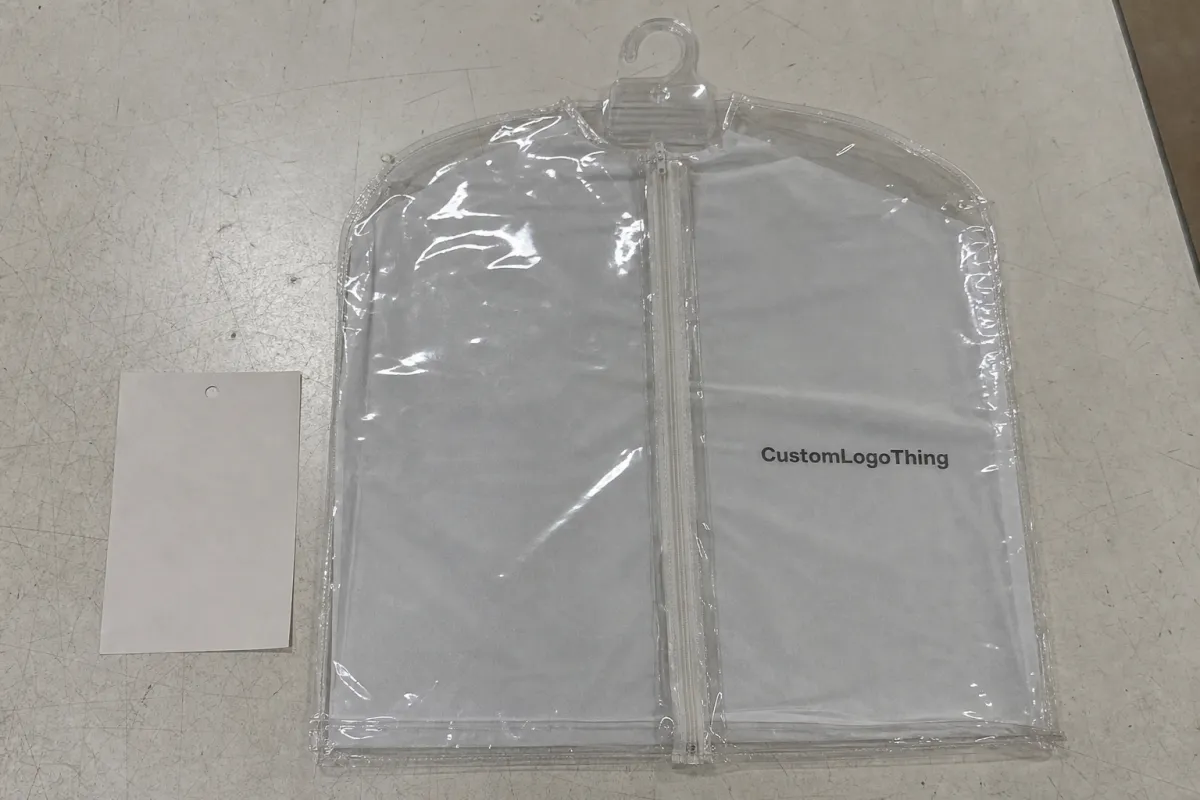
PVC garment bags are common for apparel shows because they protect without hiding the product. Clear visibility matters for suits, uniforms, bridal samples, dancewear, outerwear, costumes, and promotional apparel. The bag keeps dust off the garment, limits light moisture exposure, gives the sample structure, and creates a more finished presentation than a loose hanger and a wrinkled hang tag.
The insert has a different job. It answers questions your rep may forget after four hours of booth traffic: style number, size range, fabric content, available colors, care basics, MOQ, reorder path, and sales contact. If a buyer takes a photo, the insert should make that photo useful later. If the buyer scans a code, it should open the correct line sheet, product page, or reorder form. Do not make people hunt.
The useful version of this checklist starts with three decisions: garment dimensions, bag construction, and buyer action. Are you trying to support a sales conversation, explain garment care, push a quote request, identify samples after meetings, or make a premium garment feel presentation-ready? A reorder insert is not the same as a collection story card. A care card is not a spec sheet. Forcing one small card to do every job usually makes it fail at all of them.
Practical rule: if the insert does not help a buyer understand, remember, scan, compare, or reorder the sample, it is probably printed noise.
Custom Logo Things supports branded packaging for trade show samples, retail kits, and product launches. If you are comparing related formats, review Custom Packaging Products before locking the garment bag too early. Bags solve one problem. Custom printed boxes, folders, sleeves, belly bands, and cards solve others.
How PVC Garment Bags and Inserts Work Together at a Booth
The structure is simple: PVC bag, zipper or snap closure, hanger opening, optional handles, printed logo, and an insert placed where a buyer can read it. That may mean inside the front panel, in an exterior pocket, in a stitched document sleeve, folded around the garment, or attached as a label card for budget orders.
The booth path is not romantic. A buyer sees the garment, notices the clear bag, reads the front card, scans a QR code, asks about pricing, and either takes notes or moves on. You may have twelve fabric benefits. They may have twelve minutes before the next appointment. Design for that reality.
A good insert removes friction. Samples get separated from line sheets. Hang tags fall off. Product codes vanish. Reps answer the same care and MOQ questions until they sound mechanical. A visible insert keeps core information with the garment, which sounds obvious because it is. Plenty of sample programs still miss it.
Placement affects both cost and booth usability:
- Loose insert inside the bag: lowest cost and flexible for small runs, mixed SKUs, or changing product lines.
- Folded insert around the garment: more space for story, care, specs, and QR codes, but slower to assemble.
- Exterior pocket card: clean, readable, and easy to scan without opening the bag.
- Stitched-in sleeve: polished and reusable, though it adds labor, sampling time, and MOQ pressure.
- Adhesive label card: fast and inexpensive, but wrinkles, trapped bubbles, and crooked placement can cheapen the sample.
Trade show handling is rough. Bags get stacked, shoved into rolling cases, hung on racks, pulled down, opened, repacked, and dragged back to storage. Pretty helps. Surviving the show matters more. If the checklist ignores handling, the booth becomes the testing lab, and trade show floors are expensive places to learn basic packaging lessons.
Key Specs to Confirm Before You Design the Insert
Start with bag size. Not colors. Not fonts. Not a brand line that sounds dramatic in the conference room. The insert cannot be designed properly until the garment bag dimensions are locked: width, length, gusset depth, hanger slit position, handle position, zipper placement, seam allowance, and clear viewing area.
Common PVC thickness for lighter garment sample bags runs roughly 0.10 mm to 0.30 mm. Thinner PVC lowers cost and packed weight, but it wrinkles faster and can tear around hanger openings. Heavier PVC gives better structure and a more reusable feel, while freight cost climbs. For premium trade show sample bags, many buyers land around 0.20 mm to 0.30 mm, depending on garment weight, event use, and budget.
Insert formats are usually A5, half-letter, DL, postcard, folded card, or custom die-cut. A postcard-sized card can handle style code, QR code, and quick specs. A folded card gives room for care instructions, size chart, and a short product story. A5 is often readable through clear PVC without covering the garment too aggressively. The right size depends on what must be visible while the bag hangs on a rack.
Material choice changes the feel. Coated paper prints dense color and sharp photos. Uncoated paper feels softer and more tactile, especially for sustainability-led brands. Synthetic paper resists moisture and tearing. Recycled board can support FSC-aligned packaging claims if sourcing and documentation match the claim. Laminated cards survive handling, but they increase cost and may complicate recycling language.
For print, confirm logo colors, QR code contrast, barcode quiet zones, font size, care icons, product codes, and whether the insert needs to match booth signage or other branded packaging. Small type under PVC glare is a trap. A practical minimum for body copy is often 8 to 9 pt if the card is removed for reading, and 10 to 12 pt if buyers must read it through the bag.
Do not skip compliance review. Depending on the market and use, you may need PVC material grade information, suffocation warnings, recycling notes, country of origin language, or apparel fiber and care references. ASTM standards can help frame material and labeling expectations, while organizations such as ISTA publish packaging performance test procedures used across the industry. For paper sourcing claims, FSC certification may be relevant. Not every order needs every label. Requirements depend on product, region, retailer expectations, and distribution path.
Cost, MOQ, and Quote Details Buyers Should Ask For
The main cost drivers are PVC thickness, bag dimensions, zipper quality, handle style, print method, insert stock, insert print colors, folding, pocket construction, packing method, and total quantity. Assembly is the line item buyers underestimate. A loose insert is simple. A card placed into a stitched exterior sleeve on 5,000 bags is labor, not decoration.
Simple printed PVC garment bags often start in the hundreds to low thousands for practical order quantities. Custom pockets, special materials, unusual dimensions, printed zippers, or detailed insert assembly can push minimums higher. Small orders are possible, but they are rarely cheap per unit because setup, dielines, sampling, and labor spread across fewer pieces. That is not supplier drama. It is arithmetic.
| Option | Typical Use | Estimated Unit Range | Tradeoff |
|---|---|---|---|
| Clear PVC bag with loose insert | Budget sample programs, mixed SKUs | $0.65-$1.40 at moderate quantities | Flexible and lower cost, but less polished |
| Printed PVC bag with folded insert | Line previews, uniforms, apparel collections | $0.95-$2.10 depending on size and print | More information space, slower packing |
| PVC bag with exterior pocket card | Premium booth samples, scan-heavy displays | $1.40-$3.20 depending on pocket construction | Clean buyer experience, higher labor and MOQ |
| Heavy reusable PVC bag with premium insert | Bridal, outerwear, sales rep kits | $2.50-$6.00+ depending on details | Strong presentation, heavier freight |
These ranges are planning references, not promises. Freight, quantity, exchange rates, material costs, print coverage, and finishing can move the number. They still help you spot a quote that looks suspiciously clean because key details are missing.
Ask suppliers to quote the complete spec: bag size, PVC thickness, closure type, handle type, print area, number of print colors, insert size, insert paper weight, assembly method, individual packing, carton packing, and shipping terms. If you ask only for “Custom Garment Bags with inserts,” you invite vague pricing. Vague pricing grows teeth later.
There are sensible ways to control cost. Use a standard bag size. Limit print colors. Choose a loose insert instead of a sewn pocket. Put long catalogs behind a QR code. Approve one insert template that works across several sample SKUs. If the campaign also needs boxes, cards, or folders, compare them under Custom Packaging Products so the full sample kit does not look like three unrelated vendors designed it during lunch.
False savings deserve suspicion. Thin PVC can crease badly. Weak zippers fail at the booth. Tiny inserts save pennies while making buyers squint. If the insert needs a magnifying glass, you did not make efficient packaging. You made trash with a logo.
Process and Timeline From Artwork to Trade Show Delivery
A sensible production flow looks like this: confirm specs, prepare the dieline, design artwork, review proof, approve sample, produce bags, print inserts, assemble or pack components, inspect, ship, and receive before the show. Skip steps only if the event deadline has somehow become less important.
Artwork and proofing may take 2 to 5 business days if the dieline is clean and feedback is fast. Sampling can take 1 to 2 weeks, longer for sewn pockets, unusual sizing, printed zippers, or premium insert stock. Production may take 2 to 5 weeks after approval. Freight can add several days by air or several weeks by sea. Customs, weather, and carrier delays do not care about booth numbers.
Lead time shifts for predictable reasons: custom PVC thickness, odd bag dimensions, manual assembly, color matching, special insert paper, proof revisions, and peak production seasons. A trade show PVC Garment Bags Packaging Insert checklist should include timing checkpoints, not just design notes, because late packaging is expensive recycling with a tracking number.
Work backward from the event. Finished packaging should arrive at least two weeks before the booth shipment leaves, not the day before someone boards a plane with panic in their eyes. If garments and bags are being packed together at a warehouse, add time for receiving, inspection, assembly, carton labeling, and corrections.
Approval checkpoints are not ceremonial. Confirm dimensions against actual garments. Test insert visibility through PVC. Scan every QR code. Verify logo color under booth-style lighting. Check zipper movement. Pack one full booth sample exactly as it will ship. Then unpack it and see what moved, bent, scratched, or disappeared behind a seam.
Shipping strategy depends on budget and risk tolerance. Air freight is faster and expensive. Sea freight is slower and usually cheaper. Split shipments can protect deadlines by sending booth-ready sets first and bulk stock later. For high-value events, that split often makes sense. Paying extra freight for 100 finished sets hurts less than missing the show.
Step-by-Step Checklist for Building the Insert Pack
Use this sequence before design gets too polished. Packaging has to survive production, packing, shipping, and booth use. A gorgeous PDF that fails inside the actual bag is not a win.
- Choose the goal. Decide whether the insert is selling the collection, explaining care, helping buyers reorder, supporting reps, or making the sample feel premium.
- Map the information hierarchy. Put product name, style code, size range, material, care basics, price tier reference, QR code, and contact details in a logical order.
- Separate printed details from online details. Static information belongs on the insert. Large catalogs, changing prices, seasonal colors, videos, and long certifications belong behind a QR code.
- Match insert dimensions to the viewing area. Print a paper mockup, place it inside the actual bag, hang it on a rack, and view it from about three feet away.
- Test assembly. Have someone insert the garment, place the card, close the zipper, hang the bag, and pack it in a carton. If it takes forever, multiply that pain by the order quantity.
- Create final approval checks. Confirm bag size, PVC gauge, print colors, zipper, handle, insert stock, insert size, copy, QR code, carton label, and delivery date.
Information hierarchy matters because not all details deserve equal space. Product name and style code should be fast to find. The QR code should be large enough to scan through PVC, usually at least 0.8 to 1 inch square for comfortable booth use. Contact details should not hide in 6 pt type like a legal footnote.
Keep QR destinations specific. A buyer scanning a sample insert should land on the exact collection, style page, appointment form, or reorder path. If the code opens a generic homepage, you turned a sales tool into administrative work. People hate that. They are correct.
The checklist also protects the sales team. If the same fabric, size range, certification, lead time, or MOQ question keeps coming up, answer it on the insert. Reps can still sell. They just stop repeating basic facts like a broken office printer.
Common Mistakes That Make Good Samples Look Cheap
Using the wrong bag size is the classic failure. Too short and the garment bunches. Too wide and the product swims around like it borrowed its dad’s suit. Measure the longest, widest, and thickest sample, then check how it hangs after the zipper closes.
Printing inserts before confirming bag dimensions creates alignment problems. The card may block the garment, sit behind a seam, or disappear under the zipper strip. Design after the real viewing area is known, not after someone guesses from a spec sheet.
Choosing PVC that is too thin can cause wrinkling, tearing around hanger openings, and a low-value feel. Thin material is fine for temporary protection. It is not always fine for buyer-facing trade show packaging. If the sample is premium, the bag should not feel like it came from the back of a discount dry cleaner.
Glare is another quiet killer. Clear PVC can reflect booth lighting, especially under strong overhead fixtures. Pale gray text, low-contrast logos, and delicate thin fonts become unreadable fast. Use contrast. Use space. Use a type size that respects human eyes.
Overloaded inserts look like legal pamphlets. Buyers need fast product value, not a novel about fabric sourcing unless that story helps sell. Keep the front clean: product, benefit, code, QR, contact. Put deeper information on the back or online.
Booth workflow gets ignored too often. Reps need quick answers. Buyers need scan-friendly information. Samples need to return to the right bags after handling. A visible style code and color reference can prevent a lot of end-of-day sorting misery.
Not testing QR codes, barcodes, or contact details is avoidable and embarrassing. Scan every code from inside the bag, through the PVC, under realistic lighting. Check spelling. Check phone numbers. Check email addresses. Then have someone else check them because your brain will politely skip the typo it has already seen twelve times.
Next Steps Before You Place the Order
Gather actual garments first, not just spec sheets. Measure the longest garment, the widest shoulder point, and the thickest folded area if the bag will be packed flat. For coats, gowns, uniforms, or embellished pieces, add enough room so the garment does not fight the bag.
Create a one-page buying brief. Include bag dimensions, material thickness, closure, handle, print placement, insert size, insert material, quantity, event date, delivery address, and packing requirements. State whether the insert ships loose, pre-packed inside each bag, bundled by SKU, or inserted during final garment packing.
Build a physical mockup before approving artwork. Plain paper is fine. Place it inside a sample bag, hang it, photograph it, scan the QR code, and pack it into a carton. This catches size, visibility, and handling problems before production money is involved. Cheap test. Expensive lesson avoided.
Ask suppliers for side-by-side quote options: budget, standard, and premium. That makes tradeoffs visible. One spec does not fit every budget, garment, and deadline. If you need matching product packaging for launch kits or retailer presentations, compare formats through Custom Packaging Products and keep the visual system consistent.
Request a pre-production sample if the order has custom sizing, custom pockets, premium inserts, color-critical printing, or a tight event deadline. Skipping samples saves time right up until it costs more time. For basic repeat orders, a digital proof and material reference may be enough. For a first run, a physical sample is the safer call.
Use this trade show pvc garment bags packaging insert checklist before approving artwork, paying the deposit, or promising your sales team that everything will arrive perfectly. The bag, insert, garment, and booth workflow have to work together. Otherwise, you are shipping good apparel inside mediocre packaging and hoping nobody notices. They will.
FAQs
What should be included in a trade show garment bag insert checklist?
Include product name, style number, size range, fabric or material details, care basics, key selling points, QR code, sales contact, reorder information, and booth or collection reference. Also confirm insert size, paper stock, print colors, placement inside the PVC garment bag, and whether the insert is loose, folded, pocketed, or attached. Add final checks for QR scanning, spelling, logo color, barcode readability, and visibility through the clear PVC panel.
Are PVC garment bags good for trade show sample packaging?
Yes, PVC garment bags work well when buyers need to see the garment while keeping it protected from handling, dust, and light moisture. They are especially useful for suits, uniforms, bridal samples, outerwear, costumes, promotional apparel, and premium sample sets. The tradeoff is that PVC can crease and glare under lighting, so thickness, finish, and insert contrast matter.
How much do custom PVC garment bags with inserts cost?
Pricing depends on size, PVC thickness, zipper style, handle type, logo printing, insert material, insert printing, assembly labor, order quantity, and freight. A simple Clear Garment Bag with a loose printed insert costs less than a heavy PVC bag with a sewn pocket, multi-color print, and premium laminated card. Ask for at least three quote tiers so you can compare unit cost against durability, presentation, and deadline risk.
How long is the lead time for trade show PVC garment bag packaging?
Basic production can take a few weeks after artwork approval, while custom sizing, samples, pockets, special insert stock, or manual assembly can extend the timeline. Build in extra time for proofing, pre-production samples, freight, customs if applicable, and delivery to the booth packing location. Aim to receive finished packaging at least two weeks before the event shipment leaves.
What insert size works best inside a PVC garment bag?
The best insert size depends on the garment bag dimensions, clear viewing area, and how much information buyers need at a glance. Postcard, A5, half-letter, and folded card formats are common because they are readable without taking over the whole bag. Print a mockup, place it inside the actual bag, hang it on a rack, and check readability from normal booth distance before approving production.

