Buyer Fit Snapshot
| Best fit | Unboxing Experience Supplier for Memorable Brands projects where brand print, material claims, artwork control, MOQ, and repeat-order consistency need to be specified before quoting. |
|---|---|
| Quote inputs | Share finished size, material target, print colors, finish, packing count, annual reorder estimate, ship-to region, and any compliance wording. |
| Proofing check | Approve dieline scale, logo placement, barcode or warning zones, color tolerance, closure strength, and carton packing before bulk production. |
| Main risk | Vague material claims, crowded artwork, missing packing details, or unclear freight terms can make a low unit price expensive after revisions. |
Fast answer: Unboxing Experience Supplier for Memorable Brands: Board, Finish, Dieline, and Unit Cost should be specified like a repeatable production item. The safest quote records material, print method, finish, artwork proof, packing count, and reorder notes in one written spec.
Production checks before approval
Compare the actual filled-product size with the drawing, then confirm tolerance on folds, seals, hang holes, label areas, and retail display edges. Reserve space for logos, QR codes, warning copy, and material claims before decorative graphics fill the panel.
Quote comparison points
Review material grade, print process, finish, sampling route, tooling charges, carton quantity, and freight assumptions side by side. A quote is only useful when the supplier can repeat the same color, closure quality, and packing count on the next order.
What should an unboxing experience supplier guide include?
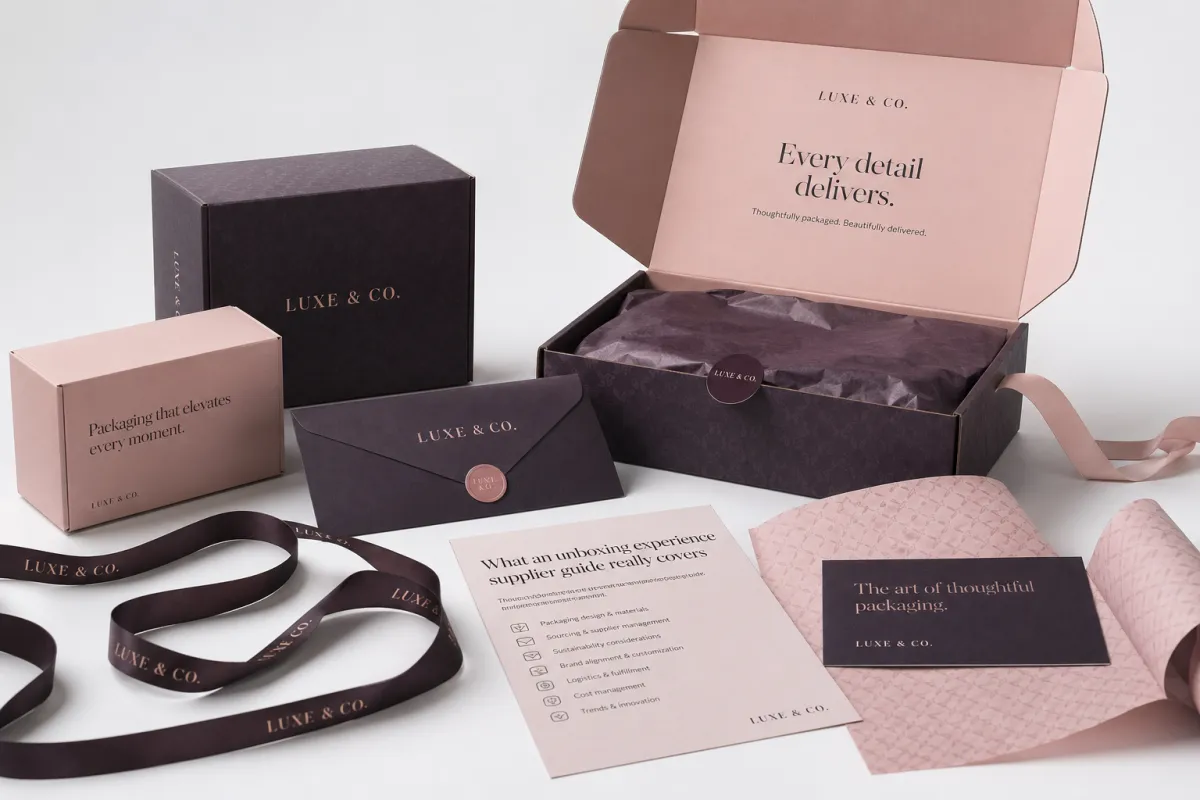
On a production floor in Shenzhen, near a cluster of box plants that run 12-hour shifts, I once watched a premium mailer box come off the line looking almost arrogant: sharp foil, a matte finish that swallowed the glare, and edges crisp enough to satisfy a designer with a ruler in hand. Then the first shipment landed at a client warehouse in Rotterdam and the insert had drifted by just 2.5 mm in transit, enough to bruise one product corner. That mismatch taught the team a blunt lesson. An unboxing experience supplier guide is not there to make packaging look expensive in a render. It exists to protect the first 10 seconds, the slice of time that turns a delivery into a memory.
At its core, an unboxing experience supplier guide maps the whole path a customer takes from outer shipper to final reveal. Brown shipper. Custom lid. Sleeve. Tissue. Insert. Product. Each layer changes how the customer reads the brand, especially if the box is a 350gsm C1S folding carton on the outside and a 2.0 mm grayboard tray inside. Leave one layer sloppy and the whole moment feels accidental, even if the graphics are beautiful. I have seen perfectly good products arrive in packaging that felt a little confused, and customers notice that faster than brands like to admit, usually before the unboxing video reaches 20 seconds.
Brands often treat packaging like a visual exercise, which is how they end up with lovely concepts that cannot survive a factory floor in Dongguan or a fulfillment center in Chicago. A real guide has to translate brand identity into dielines, board calipers, glue flaps, closure tolerances, and assembly steps that make sense on actual equipment. That gap between pretty and producible is where many launches lose time, money, and patience. A deck can forgive ambiguity. A press cannot, especially when the tooling is already cut and the line is waiting for a first sample.
I keep seeing the same pattern. The marketing team wants something "premium but clean" or "giftable but practical," then the supplier receives a mood board, a rough size, and a hope. Hope is not a spec. A proper unboxing experience supplier guide turns taste into measurements and choices into instructions, so the package fits the product, the ship method, and the budget without a weekly firefight. If you've ever sat through one of those meetings where everyone nods at the same vague words, you know exactly why I am suspicious of adjectives and fond of numbers like 118 mm, 72 mm, and 28 mm.
"The box is only the stage. The experience is the sequence, the restraint, the reveal, and the quiet fact that the customer does not have to wrestle the packaging to enjoy what is inside, even if the closure uses two 18 mm magnets and a 1.5 mm board wrap."
How the brief moves from brief to box
The first step in an unboxing experience supplier guide is the intake brief, and the strongest briefs feel closer to engineering notes than marketing wishes. Product dimensions in millimeters. Weight in grams. Shipping method. Fulfillment model. Retail shelf or direct-to-consumer? The emotional target matters too, but it should be stated plainly: "elevated gift moment," "rugged utility," "minimal luxury." A product that weighs 480 grams and ships in a 30 x 20 x 12 cm carton will need a different structure than one that rides in a retail tray for shelf display in London or Milan.
From there, the supplier should recommend structures that fit both the brand and the shipping reality. Folding cartons work well for lighter products, especially when built from 300gsm to 350gsm artboard with a matte aqueous coat. Rigid Setup Boxes create a heavier, more ceremonial feel for jewelry, cosmetics, and corporate gifts, often using 1.5 mm to 2.0 mm grayboard wrapped in printed art paper. Sleeves add a crisp branding layer without overbuilding the package. Custom inserts hold bottles, chargers, or sample vials in place so they do not rattle into damage. A good supplier guide chooses structure before it starts arguing about foil patterns, because structure decides whether the concept can survive a 600-mile truck leg or a 1,200-mile parcel route.
Sampling is where assumptions get tested. I usually want three rounds in an unboxing experience supplier guide: a plain structural sample, a printed proof, and a pre-production sample with the final insert and finish. The plain sample tells you whether the lid binds or the cavity pinches. The printed proof shows where the logo lands and whether the color holds up under 5000K light. The pre-production sample is the real verdict, because glue, lamination, and hand assembly can change the feel in ways a screen will never reveal. I remember one run where the sample looked perfect in hand, then the production unit gained just enough stiffness that the lid felt like it was auditioning for a vault door in a bank in Hong Kong. Not cute.
I still remember a cosmetics meeting where the buyer asked for a soft-touch rigid box with black foil and a magnetic closure that would feel "luxury-level serious." The prototype looked elegant, but the 20 mm magnets were so aggressive that customers had to tug with both hands. That changed the reveal from refined to awkward. Exactly the sort of problem the unboxing experience supplier guide is meant to catch early. If the box is hard to open, the customer notices in two seconds flat, and the brand story takes a hit before the serum bottle or palette has a chance to speak for itself.
Production turns approval into dielines, cutting forms, print files, finishing specs, and QC checkpoints. That is the point where the details stop being abstract. Color targets, board thickness, adhesive choice, insert tolerances, and fold direction all have to be written down. I have seen a 0.5 mm mismatch ruin a box set because the product shifted just enough to nick a printed edge after vibration testing on a route from Shenzhen to Los Angeles. A careful guide treats tolerances like facts, not footnotes. The factories I trust the most are the ones that talk about tolerances like weather, not philosophy.
Then comes co-packing or fulfillment, and that stage can make a beautiful box look careless in one shift. If the pack-out sheet is vague, a line worker may place tissue backwards, omit the insert, or overfill the box until the lid bows by 3 mm. The best unboxing experience supplier guide includes pack-out instructions, photos of the finished sequence, and a note on how long each unit should take to assemble. In one food gifting program I reviewed, clear pack-out sheets cut labor time from 54 seconds to 31 seconds per box across 8,000 units in a facility near Ho Chi Minh City. That difference does not sound dramatic until the invoice arrives, and then suddenly everyone remembers how math works.
Key factors that shape the unboxing experience
Material choice sits at the center of any unboxing experience supplier guide. Paperboard, corrugated board, rigid setup board, and specialty papers all feel different in the hand, and each one behaves differently on the line. A 350gsm C1S artboard with matte aqueous coating might suit a lightweight retail carton. A 2.0 mm grayboard wrapped in printed art paper feels far more substantial in a premium gift set. Corrugated board, especially E-flute or B-flute, adds protection and stacking strength, which matters when the package spends 36 hours on a truck and then another 72 hours in parcel sorting.
Print and finish options shape the customer reaction just as strongly as the structure does. CMYK printing handles photography and gradients well. PMS spot colors help brand consistency across multiple runs and different suppliers; Pantone 186 C, for example, behaves very differently from a loose "bright red" note in an email. Foil stamping, embossing, debossing, soft-touch lamination, matte varnish, and spot UV each change how light moves across the surface and how the fingers react when they touch it. A thoughtful guide chooses those effects to support the brand story instead of piling them on because a sample board looked dramatic under studio lights. I still love a good foil hit, but only when it earns its place on the board.
Structure and protection deserve equal attention because a package that crushes in transit is not premium, no matter how polished the print looks. I ask suppliers to explain edge crush strength, insert retention, and how the design handles drops, compression, and warehouse handling. If a bottle, charger, or skincare set can move even 3 mm inside the tray, that motion can leave a scuff after a long delivery route. A well-built guide accounts for product restraint, corner protection, and the reality of pallets being stacked higher than anyone intended, sometimes 1.8 meters high in a cramped warehouse aisle.
Brand consistency matters too, and that is where packaging either earns trust or quietly erodes it. Color on coated board does not behave like color on tissue paper. Typography that looks sharp on a monitor can fill in if the line weight is too fine, especially below 7 pt. I have stood in a press room where a deep navy looked nearly black under 4000K lamps, then changed under daylight at the loading dock in the morning. That kind of shift is why an unboxing experience supplier guide should include color standards, approved reference samples, and clear tolerances for acceptable variation, usually within Delta E 2 to 3 if the brand wants repeatable results.
Sustainability now sits in the same conversation as tactile quality, and pretending otherwise feels dated. Many buyers want recycled content, FSC-certified materials, soy or low-VOC inks, and packaging that can be widely recycled without losing the premium feel. You can read more about chain-of-custody expectations at FSC, and the ISTA community remains useful when a box has to survive parcel abuse from a regional hub in Memphis or a last-mile depot in Madrid. A practical guide balances recycled content, print performance, and protection rather than treating sustainability like a slogan printed on the inside lid.
One beverage project stays with me because the team wanted a giftable moment but also needed the outer pack to survive a 12-bottle shipper weighing 8.4 kg. We ended up combining a printed corrugated shipper with a separate rigid presentation tray, the sort of hybrid build often produced in Guangdong and assembled in batches of 1,000. That gave the consumer the premium reveal they wanted without risking leakage or crushed corners. Hybrid builds are not always the answer, yet they show how the unboxing experience supplier guide helps brands make tradeoffs with clear eyes instead of crossed fingers.
Unboxing experience supplier guide pricing and cost drivers
Pricing in an unboxing experience supplier guide usually moves with six major levers: board grade, box style, print coverage, finish complexity, insert design, and assembly labor. A 350gsm C1S folding carton with a single-color print and plain tuck flap can land near $0.15 to $0.22 per unit at 5,000 pieces, while the same design at 1,000 pieces may sit closer to $0.32 to $0.48. A rigid setup box with wrapped paper, foil, and a custom insert often sits around $1.80 to $4.50 each at 1,000 pieces, and the number can climb if the build includes ribbon pulls or a two-piece magnetic lid. Final numbers still depend on size, freight, and how many finishing steps the design demands.
Minimum order quantity changes the economics fast, and this is where smaller brands get blindsided. A run of 500 units may cost almost as much to set up as 5,000 units because the die, plates, press setup, and hand assembly do not shrink when the order gets smaller. In one factory-side negotiation in Ningbo, a buyer wanted a highly decorated carton at 300 units. The quote came back more than 60 percent higher per box than the next tier because the line still needed the same setup time. A realistic unboxing experience supplier guide should show how unit price changes at 500, 1,000, 3,000, and 10,000 pieces so the team can choose a volume that makes sense.
Hidden costs are where budgets wander. Tooling for a custom die can run $180 to $450, plating for print plates can add $120 to $260, sample rounds may take three separate proofs, and freight from the factory can jump by $0.42 to $1.10 per unit depending on carton weight and lane. I have seen a project that looked like a $12,000 packaging job drift to nearly $18,000 after two extra proof rounds, a late insert revision, and air freight to rescue a launch date from Guangzhou to Chicago. A disciplined unboxing experience supplier guide asks for all-in pricing, not just the price of the outer shell.
Here is a simple comparison I often use with buyers who need to balance presentation and cost. These numbers are illustrative, but they make the buying logic much easier to see inside an unboxing experience supplier guide.
| Packaging option | Typical MOQ | Example unit price | Best fit | Cost pressure points |
|---|---|---|---|---|
| Folding carton | 5,000+ | $0.15-$0.42 | Light products, retail shelves, sample kits | Heavy ink coverage, foil, tight tolerances |
| Corrugated mailer | 1,000+ | $0.65-$1.40 | Direct-to-consumer shipping, subscription boxes | Custom print, board thickness, insert complexity |
| Rigid setup box | 1,000+ | $1.80-$4.50 | Gift sets, premium launches, corporate kits | Wrapped paper, magnets, ribbon pulls, hand assembly |
| Sleeve plus tray | 3,000+ | $0.55-$1.20 | Cosmetics, tech accessories, retail presentation | Precision fit, registration, extra die cuts |
The highest spend is not always the smartest spend. A brand can get more from a precise matte carton with a clean insert than from a rigid box covered in every special effect under the sun. I worked with a startup that had planned to spend heavily on embossing and a magnetic closure, then shifted budget into a better board grade and a higher-quality insert after testing. The customer perception improved more than it would have with the flashier details, even though the change only added $0.09 per unit at 4,000 units. That is the sort of tradeoff the guide should make visible before anyone signs off on art.
If a supplier quotes only the box and leaves out assembly, storage, or freight, I treat that as a warning sign. Total landed cost matters because the box only helps the brand if it arrives intact, on time, and ready to pack. A practical unboxing experience supplier guide builds the commercial picture around the whole job, not just the printed shell, and that usually means one spreadsheet with 6 to 8 line items instead of one neat but misleading number.
Step-by-step process and timeline
The cleanest projects begin with discovery and technical alignment. A solid unboxing experience supplier guide starts by collecting product dimensions, target weight, shipping method, shelf expectations, and the emotional goal for the reveal, then passes that to a packaging engineer or supplier who can recommend structural options. If the product is 118 mm tall, 72 mm wide, and 28 mm deep, the dieline needs to respect those numbers before anyone builds a mockup in software. I have seen teams try to "fix it later," which is a delightful phrase right up until a production schedule in Suzhou starts slipping by four days.
After discovery, the process usually moves into structure, then sampling, then print approval. I like to break it into a sequence like this: structural sample in 3 to 5 business days, printed digital proof in 2 to 4 business days, and pre-production approval after one more review round if the client is responsive. In a guide, those dates should be written down plainly because "soon" does not help a plant scheduler or a launch manager. "Soon" is the corporate version of shrugging, and a freight forwarder in Shanghai will charge for every day that shrug turns into delay.
Production lead time depends on complexity, but common buckets are easy to track. A simple carton may need 12 to 15 business days from proof approval; a printed mailer with insert work can move in 18 to 25 business days; and a rigid gift box with foil, embossing, and hand assembly may require 25 to 40 business days, especially if the factory is already loaded. If you are using a custom insert with EVA foam, molded pulp, or thermoformed PET, add time for tooling and fit checks. A disciplined guide always builds in buffer because rush orders tend to collect mistakes like dust on a press table, usually right before a 3 p.m. truck cutoff.
Delays usually come from a few predictable places, and none of them are mysterious. Late artwork changes are common, especially if the logo moves after the dieline has already been imposed. Color corrections can take another proof round if the buyer wants the red brighter or the black deeper. Insert revisions often happen after the pack-out team tests the product with a real line worker, not just a designer. I have watched a project lose six working days because a team approved the shell before confirming that a small accessory needed 4 mm more clearance. A thoughtful unboxing experience supplier guide prevents that kind of last-minute scramble.
One warehouse manager told me something I still quote to clients: "A box design that takes two minutes to explain will take 20 seconds to break." He meant pack-out instructions, not aesthetics, and he was right. The faster the supplier can understand the order of operations, the faster the line can produce consistent units. That is why the guide should include one owner for approvals, one master spec sheet, and one final pack-out reference image that everyone trusts, ideally printed at A4 size and posted at the packing bench.
If you want to keep the timeline under control, lock the specs early and freeze them before printing plates are made. Even a tiny change to a logo, coating, or insert shape can ripple through the schedule. A good unboxing experience supplier guide is less about speed for its own sake and more about reducing the number of times the design has to bounce back to engineering, the print room, or the packing line.
Common mistakes brands make
The most common mistake I see is overdesigning the package for a screen instead of for a shipping lane. A box can look stunning in a 3D render and still fail in real use if the board is too light, the insert is too loose, or the closure opens in transit. I once reviewed a luxury mailer that had beautiful interior printing but no practical restraint for the product, so the first vibration test scuffed the lid edge after 84 kilometers of parcel handling. A realistic guide makes function and visual branding work together instead of asking one to rescue the other.
Another issue is ignoring the order of the reveal. If the customer opens the lid and sees loose tissue, a shipping label, a card, a charger, and a product all at once, the moment feels cluttered. The best experiences are paced: outer shipper, branded shell, tissue or sleeve, insert, then product. The sequence shapes customer perception as much as the print does, and a careful unboxing experience supplier guide protects that pacing with layout, photography references, and assembly notes that show each layer in the right order.
Buying finishes before confirming budget is a quick route to trouble. Foil stamping and embossing can be gorgeous, but if the quote comes back 28 percent over target, the team may need to strip features at the last minute, which usually leaves a compromised result. I sat through one supplier meeting where the buyer loved a complex spot UV treatment until the production quote arrived and the change order exceeded the budget by $0.31 per unit across 8,000 units. A sober guide leaves room for options and a fallback plan, ideally with one version that uses no foil and one that adds foil only on the logo panel.
Skipping pack-out testing is another expensive habit. I have seen kits with loose accessories, fragile glass, and multiple SKUs go straight from design to mass production without a real packing trial, and that usually ends with broken pieces or confused workers. Testing the actual assembly flow for 20 to 50 units reveals problems long before they become a pallet of returns. In a proper unboxing experience supplier guide, pack-out testing is not a nice extra; it belongs in the sign-off process, right beside the print proof and the material sample.
Vague instructions are the quiet killer. A supplier cannot guess whether the insert should hold the charger on the left or the right, whether the logo should face the lid or the tray, or whether the tissue should wrap over the top or under the product. A production-ready spec sheet should list measurements in millimeters, color references by PMS or CMYK, closure type, artwork placement, and any assembly sequence that matters. The more exact the guide, the fewer unpleasant surprises after print, especially when a second shift takes over at 11 p.m.
There is also a softer mistake that shows up in brand meetings: people assume premium means more components. That is not always true. Sometimes stronger board, cleaner typography, and a tighter insert do more for brand identity than a crowded package packed with extras. A smart unboxing experience supplier guide keeps the customer experience elegant enough to feel deliberate and simple enough to survive the factory floor. I know that sounds boring, but boring Packaging That Works beats glamorous packaging that arrives damaged, every single time.
Frequently asked questions
How does an unboxing experience supplier guide help reduce packaging mistakes?
It turns creative ideas into measurable specs for size, structure, print, and insert fit, which means the supplier is not guessing at the details. A good guide also forces early decisions about shipping method, product fragility, and fulfillment handling, so the team catches problems before the first production run. That usually cuts revision cycles because design, production, and pack-out expectations are aligned before the order starts. I have watched that clarity save 2 to 3 weeks on a launch calendar more than once, and I wish every packaging project had it from day one.
What should I ask a supplier before starting an unboxing experience supplier guide project?
Ask what materials, finishes, and box styles they manufacture most reliably, then ask for sample options and estimated lead times by quantity. I would also confirm minimum order quantities, assembly support, and whether they can manage structural design, print production, inserts, and fulfillment support in one workflow. If a supplier cannot explain those pieces clearly, the unboxing experience supplier guide will be harder to execute. Honestly, if the answers sound fuzzy, I start expecting fuzzy results, especially on a 2,000-unit order that needs to leave the factory in 15 business days.
How long does an unboxing experience supplier guide project usually take?
Simple packaging projects can move faster, but custom branded packaging usually needs time for sampling, approvals, and production. The timeline depends on artwork readiness, tooling needs, finish complexity, and seasonal factory load, and a rigid gift box with foil or hand assembly will always take longer than a basic folding carton. The safest plan is to lock specs early and give the unboxing experience supplier guide enough time for proofing and freight. I have seen rushed launches squeeze the packaging schedule until something gives, and packaging almost always gets blamed first.
What affects pricing most in an unboxing experience supplier guide?
Material grade, box construction, special finishes, and insert complexity usually drive the biggest swings, with quantity close behind because setup costs spread out more efficiently at higher volumes. Freight, assembly, and storage can add meaningful cost if they are not scoped up front, especially for heavier rigid boxes. A transparent unboxing experience supplier guide should show all of those costs before the first purchase order is cut. If it does not, I would keep asking questions until the numbers stop hiding behind the drama.
How do I know if my unboxing experience supplier guide is truly premium?
It should feel consistent from the outer shipper to the final reveal, not just look good in one photo. The packaging should protect the product, fit cleanly, and open in a deliberate sequence, with print, color, and tactile details all pulling in the same direction. Premium usually comes from precision, and the strongest unboxing experience supplier guide is the one that makes the customer feel that precision in the first 10 seconds and the last. If the customer smiles before they even reach the product, that is usually a good sign, especially when the insert, coating, and closure all line up within a 1 mm tolerance.
A practical takeaway
If you are putting together an unboxing experience supplier guide, start with one page that locks the product dimensions, shipping method, required materials, finish limits, and pack-out order before anyone touches artwork. Then sample it in three stages: structure, print, and pre-production. That sequence catches most failures early, which is where the savings actually live. The best packaging programs are not the flashiest ones; they are the ones where the reveal feels intentional, the product arrives intact, and the team does not have to explain away a bad box after launch. Build for that outcome, and the unboxing experience stops being theater and starts doing real work.