Buyer Fit Snapshot
| Best fit | Source Custom Packaging Suppliers The Way projects where brand print, material claims, artwork control, MOQ, and repeat-order consistency need to be specified before quoting. |
|---|---|
| Quote inputs | Share finished size, material target, print colors, finish, packing count, annual reorder estimate, ship-to region, and any compliance wording. |
| Proofing check | Approve dieline scale, logo placement, barcode or warning zones, color tolerance, closure strength, and carton packing before bulk production. |
| Main risk | Vague material claims, crowded artwork, missing packing details, or unclear freight terms can make a low unit price expensive after revisions. |
Fast answer: Source Custom Packaging Suppliers The Way: Material, Print, Proofing, and Reorder Risk should be specified like a repeatable production item. The safest quote records material, print method, finish, artwork proof, packing count, and reorder notes in one written spec.
Production checks before approval
Compare the actual filled-product size with the drawing, then confirm tolerance on folds, seals, hang holes, label areas, and retail display edges. Reserve space for logos, QR codes, warning copy, and material claims before decorative graphics fill the panel.
Quote comparison points
Review material grade, print process, finish, sampling route, tooling charges, carton quantity, and freight assumptions side by side. A quote is only useful when the supplier can repeat the same color, closure quality, and packing count on the next order.
How to Source Custom Packaging suppliers starts with a hard number, not a hopeful mood: a quote that looks like $0.18 per unit for 5,000 cartons can turn into $0.31 per unit once a $240 die charge, a $95 sample fee, a second proof, and $180 in freight are added. If you are learning how to source Custom Packaging Suppliers, that spread matters more than the headline price. I have seen that exact pattern on folding cartons shipped from Shenzhen to Chicago, where a “cheap” first quote ended up 72% higher than the buyer expected. The invoice was not wrong. The buyer’s assumptions were.
I still remember standing beside a carton line in Dongguan and watching a buyer argue over a 1.5 mm tuck flap that kept springing open after vibration testing. The factory had won the order on price, but the real cost showed up later as another dieline revision, a new structural proof, and a delayed retail launch that missed a spring promotion by 11 business days. That was the moment the lesson became impossible to ignore: how to Source Custom Packaging suppliers is a procurement problem, not a search result. Packaging rewards precision and punishes improvisation.
Packaging is not one category. A broker, a printer, a converter, and a full-service packaging partner all sit in different parts of the chain, and they price work differently. A printer may be ideal for a 2-color sleeve on 157gsm art paper, while a converter is better for a 350gsm C1S artboard folding carton or an E-flute mailer with a white liner. How to Source Custom Packaging suppliers means matching the supplier model to the structure, volume, and finish, not just the logo on the quote. A low number on page one can hide expensive work later.
How to Source Custom Packaging Suppliers Without Blowing the First Quote?
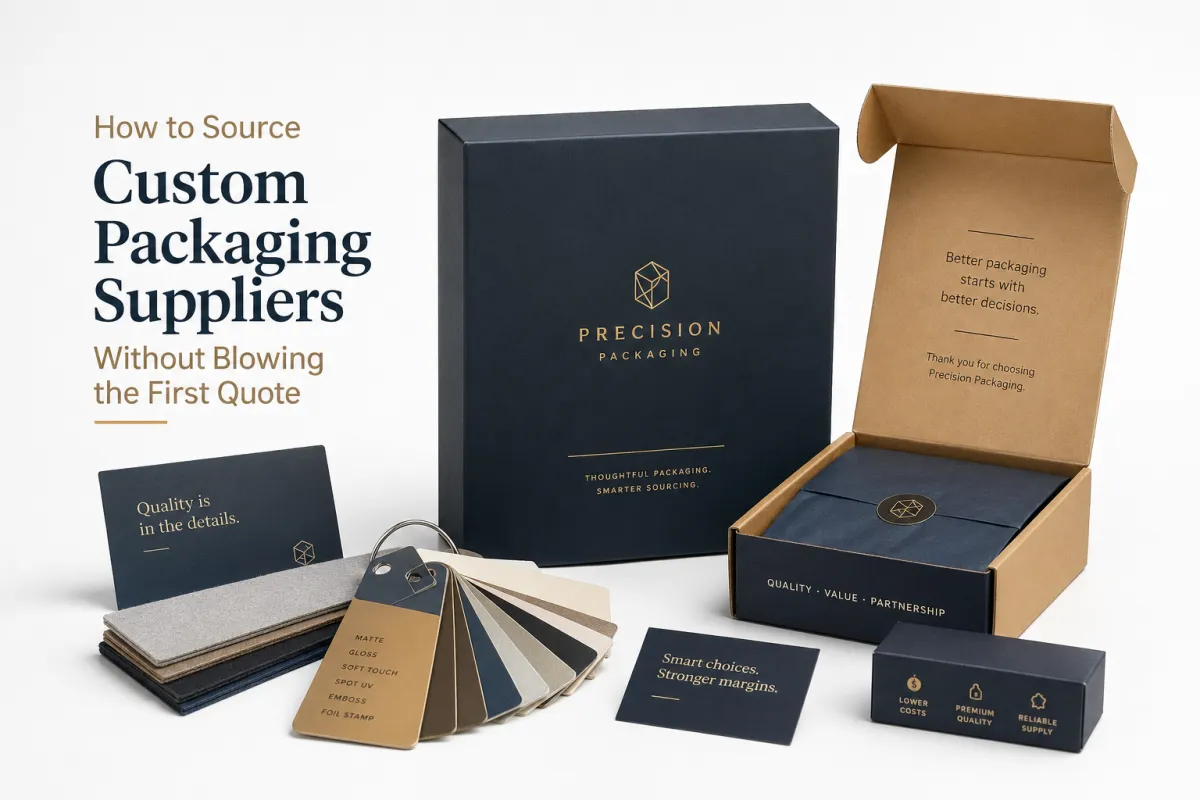
People ask how to Source Custom Packaging suppliers and often start by asking for “the best vendor,” which is the wrong first step. The first quote should be treated as a calibration point, not a final answer. For buyers learning how to source custom packaging suppliers, that distinction is where margins are protected or lost. In one comparison I reviewed, a supplier that appeared 12% cheaper became 9% more expensive after the team added spot UV, inner packaging, and export freight from Ningbo. That is why the first quote matters most as a reference, not a trophy.
The roles inside the Packaging Supply Chain matter more than most buyers realize. A printer prints, a converter forms the board into structure, a broker coordinates multiple factories, and a full-service packaging partner can handle packaging design, dielines, sampling, production, and freight paperwork. If you do not know which of those capabilities you are buying, how to source custom packaging suppliers becomes a guessing game with a purchase order attached. I have watched teams compare two quotes that were solving different problems and call it due diligence. It was not.
At a client review in Chicago, a beverage brand asked why one quote for Custom Printed Boxes came in at $0.22 and another at $0.31 for the “same box.” They were not the same box. One was quoted on 2,500 units with a loose freight estimate and no FSC requirement; the other included FSC-certified board, a solid structural proof, and spot gloss on the front panel. The higher number looked worse until we compared landed cost at the warehouse dock in Indiana. That comparison changed the decision in ten minutes.
| Supplier Type | Best For | Typical Strengths | Common Risks | Pricing Pattern |
|---|---|---|---|---|
| Printer | Flat sleeves, inserts, labels, simple retail packaging | Quick setup, efficient repeat graphics, good for short print runs | Limited structural support, fewer engineering resources | Lower print cost, separate finishing and setup fees |
| Converter | Folding cartons, corrugated mailers, rigid set-up boxes | Dieline support, material conversion, better production control | Specialty finishes may need outside sourcing | Material cost plus conversion plus finishing |
| Broker | Teams needing sourcing support and multiple factory options | Quote comparison, market access, coordination across plants | Margin can be hidden, quality control varies by factory | Factory cost plus commission or markup |
| Full-service packaging partner | Programs with repeat volume, many SKUs, or launch calendars | Packaging design, proofing, sampling, logistics support | Often looks more expensive at first glance | Higher quoted unit price, lower hidden friction |
That table is one of the clearest ways to approach how to source custom packaging suppliers without letting the lowest quote distort the decision. If the job is a simple mailer insert, a printer may be enough. If the job is a rigid gift box with foil stamping, embossing, and a magnetic closure, a converter or full-service partner usually fits better. Buyers often compare apples to oranges and then act surprised when the numbers do not line up. The mismatch usually started long before the quote.
Ask for the exact structure, not just the product label. “Mailer box” is too vague unless it specifies E-flute, B-flute, or a tuck-top mailer with a white Kraft liner. “Premium box” is not a spec either. Is it 350gsm C1S artboard with aqueous coating, or 1200gsm greyboard wrapped in 157gsm art paper? A supplier that helps define those details early is reducing risk in measurable ways. The supplier that keeps nodding through vague language is usually the one I trust least.
And yes, you can be friendly about it. The point is not to sound like a customs officer with a grudge. It is to make sure everyone is quoting the same thing before money starts moving.
How to Source Custom Packaging Suppliers on a Timeline That Works
How to source custom packaging suppliers on schedule begins with a calendar that respects proofing, tooling, and freight, not one built on optimism. If you are serious about how to source custom packaging suppliers, the timeline has to be based on factory reality rather than launch-day hope. A simple folding carton can move through spec gathering, RFQ, quote comparison, sampling, and production in 2 to 4 weeks if every response comes back fast. A custom structure with new tooling, foil, or embossing is safer at 4 to 8 weeks. I have yet to see a launch rescued by wishful thinking and a spreadsheet saved as “final_v7.”
Delays usually arrive in the same places. Artwork changes after the first proof, a dieline needs a second structural check, or sample approval stalls because three people need sign-off instead of one. Capacity creates another bottleneck: I have seen a plant in Shenzhen accept a 6,000-unit run on Monday, then push it back a week because a 50,000-unit food-service order took priority on the same press line. That is normal factory math, not bad luck. It is also why timing needs to be negotiated with real production constraints in view.
One factory manager in Dongguan told me, “If your file changes after proof, your calendar changes too.” He was not being dramatic. He was describing how a 3 mm artwork shift can trigger a plate adjustment, another proof round, and 5 to 7 business days of delay before production starts. If your launch sits behind a trade show, a retail reset, or a holiday shipping cutoff, that small change can become the difference between on-shelf and out of stock. Three millimeters sounds tiny until it costs you a week and a half.
Lead times vary by structure and finish. Digital-print custom printed boxes for 500 to 1,000 units can sometimes be produced in 7 to 12 business days after proof approval, while offset printing with foil stamping, embossing, and a rigid board wrap can take 15 to 25 business days. Add 5 to 14 days for domestic freight, or 18 to 35 days for ocean shipping from Asia to the US West Coast, depending on the route and season. I would build at least 10 business days of buffer into any launch plan that cannot move. The “best-case” timeline is a useful reference, not a promise.
For teams building a spec sheet before quoting, our Custom Packaging Products page helps with structure comparisons and basic starting points. That kind of clarity matters because how to source custom packaging suppliers gets much easier when every vendor receives the same dimensions, board grade, finish, and artwork version. Specificity is cheaper than correction, and correction has a habit of appearing in freight, not in the quote.
Packaging schedules also need padding for human behavior. If one stakeholder takes 48 hours to review proofs and another takes four hours, the critical path belongs to the slower reviewer. I usually recommend building backward from launch day, then adding 20% extra time on top for proof drift, sampling, or a last-minute copy change. That is not pessimism. It is the practical side of how to source custom packaging suppliers without turning the launch plan into a scramble. I have been in enough of those scrambles to know the cure is usually an earlier email.
One more wrinkle: time zone lag. A question sent Friday evening in California may sit until Monday morning in Guangdong or Ho Chi Minh City, and that is a real delay, not a theoretical one. Teams forget this all the time, then act shocked when the calendar slips by three days. It is a very human mistake.
What Custom Packaging Pricing Really Includes
How to source custom packaging suppliers becomes much clearer once you read the quote like a buyer instead of a shopper. The unit price is only one line. Setup charges, tooling, plates, dies, sampling, and freight often matter just as much, especially on orders under 10,000 units. If you are serious about how to source custom packaging suppliers, read every line item as part of the real cost. I have seen a 5,000-piece box order quoted at $0.18 per unit, only to pick up another $320 die charge, $140 in prepress, and $260 in domestic freight. The “cheap” number was never the real number.
The biggest price drivers are usually material grade, print coverage, finishing, MOQ, and run length. A 300gsm SBS folding carton with one-color black print will not cost the same as a 350gsm C1S artboard carton with soft-touch lamination, spot UV, and foil on the logo. If a supplier says “same spec, lower price,” ask them to identify the board caliper, coating, ink coverage, and finishing method line by line. How to source custom packaging suppliers gets a lot less mysterious once every part of the quote can be interrogated. That is the point of the exercise.
Landed cost matters too. Freight from a factory in Shenzhen to a warehouse in Los Angeles, pallet fees in New Jersey, and split shipments to two distribution centers can erase savings fast. I once saw a cosmetics client save $0.04 per unit in production, then lose the gain on a single LTL shipment because the pallets were poorly wrapped and the carrier billed an extra 17% for rehandling. The cartons were acceptable. The logistics were not. The invoice, as usual, did not care about intent.
Payment terms change the math as well. Some suppliers want 50% upfront and 50% before shipment, while others will offer 30/70 or net terms for established accounts in Europe or North America. A lower unit price paired with faster payment can strain cash flow more than a slightly higher price with better terms. If you are figuring out how to source custom packaging suppliers for a launch budget, cash timing is part of cost. Money leaving the account 30 days earlier can hurt more than a penny saved later.
Change fees deserve the same scrutiny. What happens if the logo shifts 2 mm, the carton length changes from 120 mm to 125 mm, or the insert depth needs another 3 mm of clearance? Some factories absorb small revisions once, while others reissue the entire quote and restart prepress. The supplier that explains those boundaries clearly usually handles the rest of the process with similar discipline. In my experience, the answer to a change-fee question reveals more about the operation than a glossy capabilities deck ever will.
If you want one simple rule, compare these four numbers every time: unit price, setup cost, freight, and expected rework risk. That habit will improve how to source custom packaging suppliers faster than adding another 50-column spreadsheet. Large spreadsheets make people feel safe. Four hard numbers make people informed. And they are a lot easier to explain to finance, which is always a small mercy.
Here is a practical comparison I use with teams weighing custom printed boxes against a simpler packout:
| Cost Element | Simple Box Run | Enhanced Retail Packaging | Why It Moves |
|---|---|---|---|
| Unit price | $0.12 to $0.22 | $0.24 to $0.58 | Board grade, print coverage, and finishing |
| Tooling / dies | $120 to $250 | $250 to $650 | More complex structures need more setup |
| Proofing | 1 round | 2 to 3 rounds | Color matching, fit, and structural approval |
| Freight | Modest for local delivery | Higher for palletized or split shipments | Volume, distance, packaging density, and handling |
That table is a decision tool, not a universal price list. The exact numbers shift with region, volume, and material availability, and a supplier in Ho Chi Minh City will price differently than one in Illinois or Rotterdam. Even so, it shows why how to source custom packaging suppliers must include full landed cost, not just the clean unit line that looks easiest to compare. Buyers who skip that step usually re-learn it with their own margin.
The Factors That Separate a Good Supplier From a Risky One
How to source custom packaging suppliers safely comes down to quality control, communication, capacity, and compliance. A careful approach to how to source custom packaging suppliers starts with asking the unglamorous questions that uncover operational discipline. I have walked through plants in Guangzhou where the press room looked polished but the sample library was disorganized, and I have seen smaller operations in Ningbo with excellent process discipline and clean documentation. Appearance is not the same thing as reliability. Some factories are beautifully lit chaos.
Quality control comes first. Ask about color tolerance, sample matching procedures, and whether the factory uses in-line inspection or only final inspection. For branded packaging, a Delta E shift of 2 or 3 can be enough to change how a logo reads under store lighting, especially if the design uses navy, burgundy, or warm kraft tones. If the sample is off, the production run is usually off too. I have watched a brand reject 8,000 units because the red box looked fine on a monitor and wrong under actual retail LEDs.
Communication speed is the second warning light. The supplier that replies in two hours with a clear dieline question is usually easier to work with than the one that takes two days and answers in vague sentences. During a visit to a corrugated plant in Guangdong, the best account manager could explain flute direction, liner weight, and print registration in under 90 seconds. That kind of technical clarity is one of the strongest signs that how to source custom packaging suppliers will end well. It also cuts down the annoying email loop where six people say “please clarify” in slightly different ways.
Capacity is the third filter. A good sample can hide a weak production schedule. Ask how many lines are available, what the monthly output is for your structure, and whether your order is a core job or a side job. If the plant is built for 200,000 folding cartons a week, your 4,000-unit launch run may get treated as a low-priority slot unless you ask directly. That is not always a problem, but it should be explicit. I would rather hear “you are a small order” than discover it after the queue slips twice.
Compliance matters too, especially for food, cosmetics, supplements, and any product that touches regulated goods. Ask about FSC chain-of-custody for paper products, and if your cartons need shipping validation, request performance against ISTA testing protocols. Two useful references are the ISTA shipping test standards and FSC’s certification framework at fsc.org. Not every order needs both, but if your product does, the supplier should be able to explain that in plain language and in writing.
Sustainability claims deserve hard evidence. Many suppliers will say “eco-friendly” without stating recycled content, board traceability, or ink specifications. If the claim is real, they should be able to tell you whether the substrate is FSC-certified, whether the coating is water-based, and whether the pack is curbside recyclable in the target market. That level of detail helps you source custom packaging suppliers that match both brand goals and actual operations. I am wary of any supplier whose environmental answer sounds like a slogan instead of a specification.
“We do not buy the prettiest box,” one procurement director in Minneapolis told me. “We buy the box that arrives on time, matches the proof, and does not trigger a second round of rework.”
A Step-by-Step Way to Build and Score Your Shortlist
If you want a repeatable method for how to source custom packaging suppliers, start with a packaging brief that is specific enough to remove guesswork. That means dimensions in millimeters, material type, print method, finish, target quantity, budget range, and launch date. A brief that says “premium box” is not enough. A brief that says “250 x 180 x 60 mm rigid box, 2-piece setup, 1200 gsm greyboard, 157gsm art wrap, soft-touch lamination, gold foil logo, 3,000 units, proof needed by Friday” gives the supplier something they can quote accurately. It also saves six rounds of clarification emails, which is its own kind of waste.
Then send the same RFQ package to every supplier. Use the same file name, the same dieline, the same artwork version, and the same shipping assumptions. It sounds basic, yet this is where teams lose control. If one vendor quotes a revised file and another quotes a previous version, you are not comparing bids. You are comparing confusion. That is how to source custom packaging suppliers without accidentally rewarding the wrong quote. I have watched a “winner” get selected on the strength of a file error, and nobody enjoyed the cleanup.
I recommend a scorecard. Keep it simple: cost 30%, quality 25%, timeline 20%, communication 15%, and flexibility 10%. Some teams tilt cost higher, which can work for commodity product packaging, but for launch-heavy branded packaging I usually increase the weight on sample accuracy and response speed. Consistency matters more than perfection. Score every supplier using the same scale.
A useful shortlist usually contains three to five qualified suppliers. More than that, and the process slows without improving the decision. Fewer than three, and you may miss the actual market range. I have seen teams spend six weeks gathering quotes from 11 suppliers, then choose the vendor that answered clearly on day two. How to source custom packaging suppliers is often about discipline, not volume. A huge net sounds impressive until it becomes a parking lot.
Do not skip samples. A proper sample tells you more than a polished sales deck. Check board stiffness, crease quality, print density, corner crush, and closure alignment. If you are buying retail packaging, look at the pack under bright light at a 3-foot distance. If the carton will ship to customers, test crush resistance and internal fit. Even a modest sample run can save thousands in reprints later. I have a strong dislike for people who approve cartons from a PDF alone, because that is how expensive surprises are born.
Ask for references or proof of similar work. A supplier that produces cosmetics cartons may not be ideal for subscription boxes with insert systems, and a supplier that excels at rigid gift boxes may struggle with fast-turn custom printed boxes for e-commerce. The right reference tells you whether they have handled a job like yours before, not just whether they can talk about it. There is a difference, and it usually shows up in the deadline before it shows up in the invoice.
Here is a practical scorecard framework you can adapt for a quote review in New York, Toronto, or Manchester:
- Cost: unit price, setup, freight, and revision fees.
- Quality: sample match, color consistency, and defect handling.
- Timeline: quote speed, proof speed, and production capacity.
- Service: clarity, technical depth, and follow-through.
- Flexibility: MOQ options, rush support, and future SKU changes.
Once the scores are in, read the comments before you read the totals. I have seen a supplier lose on price but win because they caught a structural issue nobody else noticed, such as an insert depth mismatch of 4 mm or a flap that would interfere with automated packing. That is competence, not inconvenience. Competence is worth paying for when you are trying to source custom packaging suppliers that can survive real-world production, not just a sample bench. If a vendor spots a problem before the run starts, I call that money well spent.
One more lesson from the hard side: use version control. Label every file with a version number and approval date, and keep the approval chain in one thread if possible. If you have V3 in one email and V4 in another, the packaging design process starts drifting. That drift can create a 1 mm size error, a color mismatch, or a logo placement issue that only appears once the cartons are already on pallets. I have spent too many hours untangling filenames like “final_final2” to pretend this is a minor inconvenience.
And if your team keeps changing the artwork after approval, pause. That is not sourcing strategy; that is self-inflicted chaos.
Common Mistakes That Cost Time, Money, and Reprints
The biggest mistake in how to source custom packaging suppliers is comparing only the unit price. That habit hides freight, overages, sample rounds, quality failures, and the cost of delays. A $0.14 box that arrives late and fails fit testing is not cheaper than a $0.21 box that ships on time and passes inspection the first time. The first one is only cheaper to look at, which is not the same thing as cheaper to own.
The second mistake is vague specs. A supplier cannot quote what you have not defined. Missing measurements, unclear finish details, and unfinalized artwork create quote inflation because the factory is pricing uncertainty. I have seen quotes jump 15% after a buyer finally confirmed that the box needed embossing, not just a matte coating. How to source custom packaging suppliers gets much easier once your brief is detailed enough to eliminate guesswork. Vague briefs are like sending someone to buy groceries with a shrug and a budget.
The third mistake is skipping sample testing. I once watched a food client approve a carton by photo only, then discover that the insert was 4 mm too tight for the jar neck. The boxes had to be reworked, and the delayed shipment pushed the launch by nine business days. That cost was avoidable. Test fit, test print, and test handling. Even a small sample run can reveal issues that a PDF never will. Paper is more honest than people, but it still has to be handled in person.
The fourth mistake is weak contract language. If the agreement does not define lead times, quality tolerances, replacement policies, and chargebacks, disputes become harder to resolve. I am not saying every buyer needs a 40-page legal packet. I am saying the supplier should agree in writing to the basics: what counts as a defect, how quickly a remake will happen, and who pays if the goods miss the approved spec. Specifics prevent arguments later.
Another common error is ignoring the difference between a quoting agency and a production partner. A broker can be useful, especially if you are new to sourcing, but if the broker cannot tell you where the boxes are made, who owns quality checks, and how corrections flow back to the plant, you may not actually know who is accountable. That matters when you are trying to source custom packaging suppliers for a repeat program, not a one-off order. Accountability should not disappear the moment someone forwards an email from another time zone.
Do not forget warehousing. A supplier may offer a low production price but charge storage fees after 30 days or 60 days. If your brand has slow sell-through, staggered product launches, or seasonal inventory swings, those fees can erase the savings. That is why I keep coming back to landed cost. It is the truest answer to how to source custom packaging suppliers with a clear financial picture. If the goods sit in a warehouse in Savannah for six weeks, the unit price becomes a very small part of the story.
Some buyers also underestimate the role of packaging design in the final result. A structure that looks elegant in a mockup may be fragile in production or inefficient in a shipper carton. If the design ignores pallet patterns, dimensional weight, or insert stability, the cost shows up later. You do not want to learn that after 10,000 units are already on the water or in a truck outside Los Angeles. I have seen people discover that problem at exactly the wrong moment, which is usually after they have already told the team the launch is “basically done.”
There is a reason the better suppliers ask a lot of questions. They are not slowing you down. They are trying to prevent reprints. The supplier who asks about pallet height, inner pack count, shelf orientation, and retailer compliance is thinking ahead. That is a good sign. The supplier who barely glances at your file and says “no problem” in ten seconds usually gives me pause, because that sentence tends to age badly.
The quiet trap is overconfidence. The first sample looks good, so everyone relaxes. Then the production run reveals a crease issue, a shade shift, or a shipper carton that adds too much dimensional weight. A bit of skepticism upfront usually saves a mess later. Honestly, that is the job.
Your Next Moves After You Pick Two or Three Suppliers
Once you have a shortlist, how to source custom packaging suppliers becomes a test of execution. After you narrow the field, how to source custom packaging suppliers is less about hunting and more about confirming fit, response speed, and follow-through. I usually recommend a pilot order before you commit to a large production run. A pilot can be 500 to 2,000 units, depending on the structure and the risk profile. It lets you verify print quality, communication, packing method, and delivery timing without exposing the entire program to one failure point. That small spend can save a much larger headache later.
After the pilot, lock down the spec sheet. Save the exact board grade, dimensions, finish, artwork version, and approval owners in one file. If the supplier changes plants, presses, or finishes later, you want a clean baseline to compare against. In packaging operations, drift is the enemy. Version control is how you keep branded packaging looking like the brand intended, whether the boxes ship from Ningbo or the Midwest. I have seen a tiny spec drift turn into a full meeting about why the carton is darker by half a shade.
Set a performance review cadence next. Every quarter, check defect rate, on-time delivery, quote accuracy, and response speed. A good partner should stay within a narrow range on all four. If a supplier starts slipping, you will see it early instead of after a missed launch or a pallet hold. That is a smarter way to source custom packaging suppliers than waiting until something breaks. Small deviations are easier to fix before they become expensive habits.
I also suggest keeping a backup supplier warm, even if you do not place regular orders with them. Market conditions change. Capacity shifts. Material availability changes. If your main partner gets backed up by a large order in Guangdong or a board shortage in the US, having a second source with your dieline and specs already on file can save a launch. That is not over-planning. That is good procurement. The backup does not need to be your favorite; it needs to be ready with the right carton spec and a workable timeline.
Here is the part I tell nearly every buyer: a good supplier relationship is built on clarity, not charm. You do not need the friendliest rep. You need accurate quotes, sample discipline, and predictable production. If a supplier can deliver those three things, how to source custom packaging suppliers gets much simpler the next time you need to buy. Frankly, I will take boring reliability over dazzling promises every single time, especially when the order value is $18,000 and the launch date is fixed.
I have seen brands save more by tightening their sourcing process than by chasing another 5% unit-price cut. The second-order effects matter. A proof approved two days earlier, a clearer dieline, a cleaner freight arrangement, and one less reprint can add up to more savings than the lowest bid ever promised. When you treat how to source custom packaging suppliers as a repeatable system, you build a better packaging program, not just a cheaper order. That difference shows up in margin, and often in sleep.
The search still begins with a quote. It should end with confidence: the right specs, the right timeline, the right landed cost, and a supplier who knows what they are doing. That is how to source custom packaging suppliers the smart way, and it is how I would approach it if I were starting from zero tomorrow. I would still triple-check the die line, though. Some habits are earned the hard way.
One practical takeaway: if you do nothing else, ask every supplier for a full quote breakdown, a sample path, and a written production timeline before you compare prices. That one habit filters out a surprising amount of noise.
How do I source custom packaging suppliers for small order quantities?
Ask each supplier for MOQ ranges by structure and print method, not a single number. For a 500-piece or 1,000-piece run, prioritize digital print, stock-based mailers, or simple folding cartons, and compare tooling fees carefully because a small order can be shaped more by a $120 die charge and a $75 setup fee than by the unit price. If the vendor cannot break those costs out clearly, keep looking.
What should I ask when I source custom packaging suppliers?
Ask for lead times for quotes, samples, production, and shipping so you can see schedule risk early. Request a full cost breakdown that includes tooling, freight, proofing, and change fees, and confirm how quality issues are handled, including replacement policies, tolerances, and approval steps for a 300gsm, 350gsm, or rigid-board structure. I also ask who signs off on final color, because that question prevents a lot of finger-pointing later.
How many suppliers should I contact when sourcing custom packaging?
Three to five qualified suppliers is usually enough to create a useful comparison without slowing the process. Focus on suppliers that match your packaging type, order volume, and region, then use the same brief for every vendor so the responses stay comparable whether the factory is in Shenzhen, Chicago, or Rotterdam. More than that, and the process gets kinda noisy.
How do I compare pricing when sourcing custom packaging suppliers?
Compare total landed cost, not just the quoted unit price, because freight and setup fees can change the real cost quickly. Normalize quotes by order volume, material, and finish, and look at long-term signals such as defect rates, proof speed, and the chance of reprints, especially on orders above 2,500 units. If two quotes look close, ask what each supplier excluded.
What is the biggest red flag when sourcing custom packaging suppliers?
A supplier that cannot explain its quote clearly is often hiding missing costs or weak process control. Slow responses during quoting usually predict slow communication after the order is placed, and if samples look inconsistent or the supplier avoids technical questions about board grade, coating, or tooling, the risk of delays and waste rises fast. I would treat that as a warning, not a quirk.