Buyer Fit Snapshot
| Best fit | Valentines Day Custom Candy Box Design projects where brand print, material claims, artwork control, MOQ, and repeat-order consistency need to be specified before quoting. |
|---|---|
| Quote inputs | Share finished size, material target, print colors, finish, packing count, annual reorder estimate, ship-to region, and any compliance wording. |
| Proofing check | Approve dieline scale, logo placement, barcode or warning zones, color tolerance, closure strength, and carton packing before bulk production. |
| Main risk | Vague material claims, crowded artwork, missing packing details, or unclear freight terms can make a low unit price expensive after revisions. |
Fast answer: Valentines Day Custom Candy Box Design: Structure, Print Proof, Packing, and Reorder Risk should be specified like a repeatable production item. The safest quote records material, print method, finish, artwork proof, packing count, and reorder notes in one written spec.
Production checks before approval
Compare the actual filled-product size with the drawing, then confirm tolerance on folds, seals, hang holes, label areas, and retail display edges. Reserve space for logos, QR codes, warning copy, and material claims before decorative graphics fill the panel.
Quote comparison points
Review material grade, print process, finish, sampling route, tooling charges, carton quantity, and freight assumptions side by side. A quote is only useful when the supplier can repeat the same color, closure quality, and packing count on the next order.
A shopper can decide whether a gift feels special in under three seconds, and valentines day custom candy box design often makes that call before anyone even lifts the lid. In packaging, the box is doing a lot of quiet work: it signals quality, protects delicate pieces, and helps a brand justify a higher price without changing the candy itself. That is why valentines day custom candy box design is more than decoration; it is product packaging, package branding, and a sales tool all at once.
From a packaging buyer's point of view, the strongest results usually come from treating the box as a system instead of a single printed surface. Structure, insert, print area, and closure need to work together. If one part is off, the presentation feels less premium even when the artwork is attractive. The reverse is just as true. A well-built box can make a modest assortment of sweets feel worthy of gifting, which is why valentines day custom candy box design keeps showing up in seasonal retail packaging plans, e-commerce bundles, and promotional kits.
It also spans more formats than many teams expect. Folding cartons are common for lighter assortments. Rigid Gift Boxes bring more substance and a better hand feel. Sleeves and trays add a measured reveal. Windowed formats work well when the candy itself is part of the selling point. Valentines day custom candy box design is not one box type. It is a set of choices shaped by the product, the channel, and the budget.
Why valentines day custom candy box design sells before the candy does
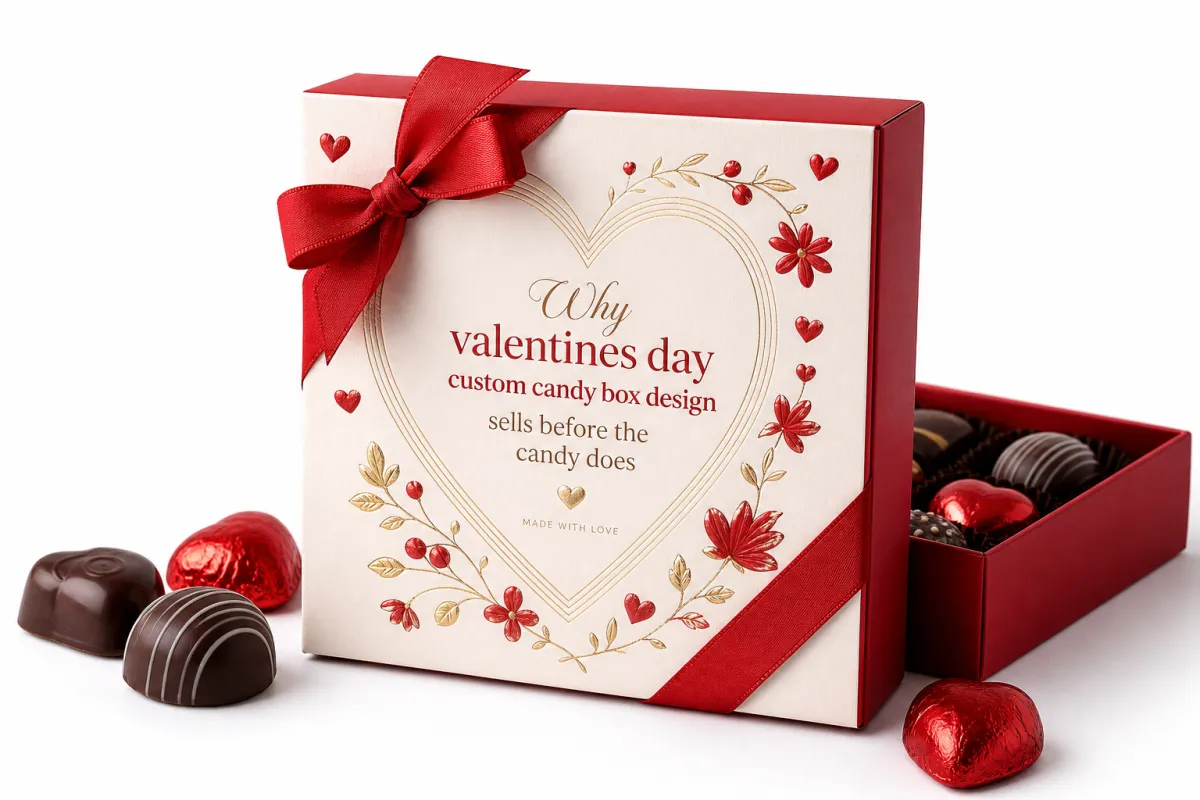
Most shoppers do not inspect a candy box like a production manager. They scan it. They compare it to the box beside it. They ask a faster question: does this feel like a gift or a commodity? That is the real test for valentines day custom candy box design, and it happens long before someone studies flavor notes or ingredient panels.
Color is usually the first signal, though it is never the whole story. Deep reds can suggest romance, but a flat red rectangle still looks ordinary if the finish is wrong. Add a soft-touch laminate, a restrained foil accent, or a well-placed window and the same box can feel more deliberate. That difference matters because perceived value often rises faster than actual fill weight. In seasonal retail packaging, a thoughtful surface treatment can outperform a larger candy count if the larger count is hidden or unbranded.
Structure matters just as much as graphics. A folding carton is efficient and easy to stack. A rigid gift box communicates sturdiness and creates a better opening moment. A sleeve can add motion, while an inner tray can keep assorted sweets aligned. These are not decorative extras floating above the product. They shape the purchase experience, which is why valentines day custom candy box design belongs in the same conversation as merchandising and shelf conversion.
Window placement can be surprisingly persuasive. A small die-cut window shows enough to build trust without giving up the box's identity. Go too large, though, and the structure can weaken or the candy can look less curated. The right size depends on the assortment. Chocolate truffles, sugar-dusted pieces, and molded shapes behave differently inside the package, and the box should respect those differences.
"A candy box is not only holding product. It is pre-selling the gift."
That has been true in more than one project I have reviewed. The package often gets a glance from across a shelf or from the top of an inbox photo, and that first impression either pulls the shopper in or lets the item drift past unnoticed. Valentines day custom candy box design shows up everywhere first impressions matter: retail shelves, gift bundles, direct mail inserts, subscription add-ons, and seasonal promo kits. In each channel, the box is doing a different job. On shelf, it needs stop power. In e-commerce, it needs arrival quality. In a gift set, it needs to coordinate with other items without feeling crowded.
If you want a quick rule of thumb, think of valentines day custom candy box design as a balance between three questions:
- Does the box make the candy look more desirable?
- Does it protect the product through packing, transit, and handling?
- Does it communicate enough brand value to justify the price?
That balance is where branded packaging starts producing revenue instead of serving as background decoration. For seasonal projects, that is often the difference between a box that moves product and a box that just sits pretty on a mockup board.
How valentines day custom candy box design works from brief to box
The process usually starts with a brief that sounds simple and then turns specific fast. How many pieces are inside? What is the largest piece? Are the candies loose, wrapped, or nested in cavities? Will the box sit on a counter, ship by parcel, or do both? Those answers define valentines day custom candy box design more than any mood board does.
Next comes the dieline. This is the technical layout that turns a design concept into a buildable package. It shows panels, folds, glue flaps, lock tabs, and insert locations. A good dieline is not glamorous, but it is the backbone of the project. If the dieline is wrong, even excellent artwork will not save the run. If the dieline is right, valentines day custom candy box design becomes easier to print, assemble, and scale.
The handoff between design and production is where many teams either gain time or lose it. Brand assets need to be clean, images need to be high resolution, and copy needs approval before prepress. One common mistake is treating the visual concept as final while the structural spec is still open. That can lead to depth problems, insert mismatches, or type that lands too close to a fold. For custom printed boxes, those small errors can snowball into expensive rework.
Finishing choices change the feel more than people expect. Matte soft-touch creates a velvety surface that reads premium. Gloss feels brighter and more retail-forward. Foil brings sparkle, embossing adds tactile contrast, and spot UV gives logos or patterns a sharp highlight. Window film, whether clear or frosted, adds another layer of control. The trick is not stacking every finish at once. A disciplined valentines day custom candy box design usually looks better with two strong choices than with five competing ones.
There is also a practical side that buyers sometimes underestimate. A visually strong box can still fail if the candy shifts in transit. Loose inserts, weak locking tabs, or underspecified board thickness can turn a polished concept into a damaged shipment. For parcel-based launches, it helps to think about transit stress early and review ISTA transit testing standards before approving the structure. If the design survives vibration, drop risk, and compression on paper, it is much more likely to survive them in the real world. That is not a theory; it is the kind of thing that saves a lot of headaches later.
One way to keep the project grounded is to separate beauty decisions from engineering decisions. In practice, valentines day custom candy box design works best when the team answers these questions in order:
- What candy needs to fit?
- What structure protects it?
- What print surface supports the brand story?
- What finish creates the right perceived value?
- What shipping path will the box face?
That sequence saves time and reduces the odds of a redesign after proofs arrive. Seasonal packaging has little patience for avoidable change, especially once calendars start tightening.
Key factors that shape candy box design
The product comes first. Candy shape, weight, coating, and fragility determine the cavity size, insert style, and board strength. Truffles with delicate dusting need different handling than solid molded chocolates. Gummies can tolerate a looser cavity, while brittle pieces usually need more restraint. In valentines day custom candy box design, the candy is not an afterthought. It is the measurement that everything else follows.
Brand hierarchy comes next. What should the shopper notice first? Romance cues? Premium signal? Flavor story? A playful tone for younger buyers? The answer shapes typography, illustration, and white space. A box crowded with hearts, script, shine, and copy can feel loud rather than luxurious. A cleaner layout can actually feel more expensive because it gives the eye room to rest. That is a reliable packaging lesson: restraint often raises perceived value.
Substrate choice changes both the economics and the feel. Paperboard works well for light retail cartons and counter displays. Rigid board feels more gift-like because it has more thickness and a denser hand feel. Corrugated is the safer choice when shipping protection is the priority. If the candy touches the packaging directly, ask for a food-safe liner or barrier. Depending on the format, that could mean a coated paper barrier, a PET or PLA window film, or a separate tray that keeps product off the print surface. Sustainability goals matter here too, because every extra material affects recyclability and customer perception.
Color control is another place where many projects drift. Deep reds, metallic inks, and dark backgrounds can look rich on screen and uneven on press if not managed carefully. If a design uses a heavy red field, ask for proofing on the same substrate, not only a digital preview. The difference between a screen mockup and an actual printed sheet can be dramatic. On seasonal work, that difference can decide whether the box reads as elegant or muddy.
For sustainability-minded teams, FSC-certified board is a useful signal. It does not solve every environmental question, but it does support responsible sourcing claims and makes the supply chain easier to explain. See FSC certification guidance if your brand wants to document that choice clearly. You can also reduce mixed materials, simplify inserts, and avoid oversized lamination where a lighter finish will do. A greener valentines day custom candy box design is usually built through a series of small reductions rather than one dramatic move.
Channel choice changes the spec too. A box built for countertop display can get away with lighter board and more delicate embellishment. A box designed for parcel shipping needs stronger closure behavior, tighter insert tolerances, and more crush resistance. A direct mail version may need secondary protection inside a shipper. That is why the same graphic concept can end up as three different product packaging builds. The artwork stays familiar, but the structure changes underneath it.
For teams working across retail packaging and direct-to-consumer fulfillment, the most useful habit is to ask one question before locking the spec: what will happen to the box after it leaves the print room? If it is going to be stacked, shipped, refrigerated, or handled by a third-party picker, the design should reflect that reality. Valentines day custom candy box design is strongest when it respects both the gift moment and the logistics behind it.
Process, timeline, and production steps for candy boxes
Seasonal packaging lives on the calendar, not in theory. A typical production path starts with the brief, moves through structural design, then artwork setup, proofing, sample approval, press run, finishing, and quality inspection. Every step is manageable. The problem is compression. When a project starts late, each step steals from the next one, and valentines day custom candy box design becomes a race instead of a plan.
Lead time grows quickly once custom tooling enters the picture. A simple folding carton with standard coatings may move relatively fast, while a rigid box with foil, embossing, or a multi-part insert needs more setup and more checks. For many runs, a straightforward spec can be ready in roughly 12 to 18 business days after proof approval, while more complex builds may stretch to 20 to 30 business days or longer, not counting freight. Those are practical ranges, not promises, and the exact schedule depends on plant load, material availability, and how quickly the artwork is approved.
There are also ways to shorten the schedule without hurting the outcome. Start with a proven dieline. Lock the copy early. Use standard board calipers where possible. Keep the finish stack under control. A good production partner will usually tell you where the risk sits. That advice is worth listening to, because a one-week delay in proof approval can cost more than a small material upgrade.
Some approval checkpoints slow seasonal work every single time: marketing signoff, compliance review, ingredient copy, barcode placement, and final print proof. If your candy box is part of a larger launch, the packaging should be in the same approval queue as the product claims, not behind them. A beautiful valentines day custom candy box design can still miss ship date if someone is waiting on a legal note about allergens.
Testing matters more than many teams admit. If the box will travel through parcel networks, the structure should be evaluated as a shipping package, not just a shelf item. That means thinking about vibration, compression, and drop behavior. It also means planning the master carton, because the outer pack protects the premium box during transport. The project is rarely only about the candy box itself. It is about the complete distribution chain from print line to customer hands.
One practical way to manage the launch is to map the production steps in a simple sequence:
- Confirm candy count, dimensions, and product fragility.
- Approve the box structure and insert strategy.
- Finalize artwork, legal text, and barcode placement.
- Review a physical sample or hard proof.
- Lock the print schedule and freight plan.
If you want to explore structure options before committing, it can help to review a supplier's Custom Packaging Products page and compare formats side by side. That kind of comparison is especially useful when a team is deciding between retail packaging, e-commerce packaging, and a hybrid solution. Valentines day custom candy box design usually gets better once the format choice is clear.
Cost, pricing, MOQ, and quote drivers
Pricing for candy boxes is usually driven by a handful of variables: box size, board grade, print coverage, number of colors, insert complexity, and finishing. The more you ask the box to do, the more it costs to make. That sounds obvious, but many first-time buyers still expect the price to track only with dimensions. It does not. Valentines day custom candy box design is a system cost, not a square-inch cost.
MOQ changes the math. Setup, die-cutting, plate work, and press preparation all have to be spread across the run. At 500 pieces, those fixed costs sit heavily on each unit. At 5,000 pieces, the same setup becomes much easier to absorb. That is why unit price drops as quantity rises. It is also why low-volume premium runs can be attractive for testing, even when the per-box price is higher. The smaller run protects the brand from overcommitting to a concept that has not been proven in market.
Here is a practical comparison of common options for valentines day custom candy box design:
| Box format | Best use | Typical unit cost at 5,000 pcs | Strength | Main tradeoff |
|---|---|---|---|---|
| Folding carton | Light assortments, counter display, mass retail | $0.18 - $0.45 | Fast to produce, efficient to ship | Less rigid feel |
| Sleeve + tray | Gift sets, retail packaging with a reveal moment | $0.28 - $0.65 | Strong branding surface, controlled presentation | More parts to assemble |
| Rigid gift box | Premium gifting, seasonal collections | $0.85 - $2.50 | High perceived value, durable hand feel | Higher freight and pack-out cost |
| Corrugated mailer | Direct-to-consumer shipping, subscription bundles | $0.70 - $1.80 | Better transit protection | Less gift-like than rigid board |
Those ranges are ballpark figures, and they shift with print coverage, board weight, and tooling. A simple two-color design on a folding carton will price differently than a fully wrapped rigid box with foil, embossing, and a custom insert. A buyer who wants a cleaner quote should give exact dimensions, candy count, ship date, finish preferences, and target quantity in one brief. That one page can save days of back-and-forth.
Hidden costs matter too. Samples are one. Tooling is another. Freight can be significant if the boxes are bulky. Storage becomes real if the boxes arrive too early and have to sit through the season. Last-minute artwork revisions are a classic budget leak because they slow the schedule and force extra checks. A disciplined valentines day custom candy box design process makes those costs visible early instead of discovering them after approval.
If the brand is comparing premium presentation against savings, the question should not be "How do we make the cheapest box?" It should be "Which parts of valentines day custom candy box design move sales, and which parts are just decoration?" That distinction is where smarter spending starts. Sometimes a better paper stock does more than a fourth embellishment layer. Sometimes the insert is worth more than a metallic finish. Sometimes reducing the box footprint saves enough freight cost to pay for upgraded print.
That is the point where branded packaging becomes a commercial decision. It should support margin, not quietly erode it.
Common mistakes in candy box design
The biggest mistake is designing the artwork before the candy dimensions are confirmed. That sounds basic, but it happens constantly. A team builds a beautiful front panel, then discovers the largest piece does not fit the insert cavity, or the box closes with pressure on the contents. The result is wasted space, crushed product, or a rushed structural revision. Valentines day custom candy box design works best when the product spec leads the artwork, not the other way around.
Another common miss is overdecorating the box. More foil, more embossing, more texture, more sparkle. On a mood board, that can look rich. On a shelf, it can look noisy or expensive for the wrong reasons. The finish stack should earn its place by improving shelf appeal or gift appeal. If it does neither, the budget may be better spent on structure, substrate, or a cleaner print layout.
Shipping failures are expensive and preventable. Loose inserts allow candy movement. Weak closures open under vibration. Thin board collapses more easily in stacked cartons. If the box is going through parcel shipping, it should be tested as a package, not admired as a graphic object. A good valentines day custom candy box design will survive handling, not just photography.
Compliance oversights can also slow or derail a launch. Allergen copy, ingredient panels, barcode placement, and legal space all need room. If the design is too tightly packed, the marketing text can end up competing with regulatory information. That is risky. In food-adjacent packaging, clarity is not optional. It is part of the product promise.
Late approvals create another predictable problem: rushed production and color compromises. A project that starts late often has to choose between a partial finish stack, a modified structure, or a compressed proof cycle. None of those are ideal. The closer a seasonal project gets to ship date, the less room there is for experimentation. Valentines day custom candy box design rewards early locking of specs and late-stage restraint.
Here is the pattern I see most often: the team focuses on visual appeal first, then realizes the logistics are more restrictive than expected, and then tries to fix both at once. That rarely ends well. The cleaner approach is to treat aesthetics, logistics, and timing as three equal parts of the same package brief. When those three line up, the box feels intentional instead of improvised.
A few guardrails help:
- Measure the largest candy piece first, then build the insert around it.
- Check whether the box must fit a master carton or ship alone.
- Reserve space for allergens, barcodes, and ingredient copy early.
- Ask for a sample before approving a full press run.
That is the difference between a nice-looking sample and a reliable launch.
Expert tips and next steps for a better launch
Start with the sales goal. Is this box meant to feel luxurious, playful, romantic, or mass-market? The answer changes everything from typography to board choice. A premium gift box might justify rigid construction and foil accents. A mass retail item may need faster assembly and a lower unit cost. Valentines day custom candy box design is most effective when the emotional target is decided before the art file opens.
Test two or three structural concepts with real candy before locking the final dieline. That simple step catches fit problems, cavity issues, and closure weaknesses early. It also shows whether the box feels balanced in hand. A design that looks perfect on a render can feel awkward once it is filled. Real product always tells the truth faster than a mockup, and honestly, that saves more money than most teams expect.
Build a one-page vendor checklist. Keep it practical:
- Exact dimensions and candy count
- Board type and finish preferences
- Target quantity and acceptable MOQ
- Artwork due date and final ship date
- Approval contacts and compliance requirements
That document does more than keep people organized. It also reduces ambiguity, which is one of the main reasons packaging jobs drift.
Make decisions in order of impact. Structure first. Print second. Decoration third. Secondary embellishment last. That order is not glamorous, but it is efficient. It also protects the budget. If a project is overextended, it is easier to trim a decorative layer than to rescue a bad structure. For valentines day custom candy box design, structure is the cheapest place to improve the experience and the most expensive place to ignore.
If the internal team needs a practical starting point, begin by gathering specs and comparing formats in a packaging line that supports your channel. A good supplier should be able to walk through folding cartons, sleeves, rigid boxes, and mailer options without forcing a one-size-fits-all answer. The strongest custom printed boxes are the ones selected for the actual job they need to perform, not the prettiest idea in the room.
Then request a dieline and quote together. Separating those steps slows the process and increases the odds of revision. Once the sample is in hand, review it under real lighting, with real candy, and with the final closure method. That is the moment where packaging design becomes tangible. It is also the moment where small changes are cheapest.
One last practical thought: valentines day custom candy box design should be treated as a revenue decision, not a decorative one. A better box can raise perceived value, improve handling, support package branding, and reduce damage. That is a strong return for a piece of retail packaging that may only sit on shelf for a short seasonal window. If the specs are chosen with care, valentines day custom candy box design does far more than hold candy. It helps sell the story, protects the product, and gives the season a shape customers remember. The clearest next step is simple: lock the candy dimensions, choose the box format that matches the channel, and build the artwork around that structure instead of the other way around.
How do I choose the right size for valentines day custom candy box design?
Start with the exact candy count and measure the largest piece first, not the average piece. Add room for inserts, wrapping, and a little production tolerance so the box closes cleanly without crushing the product. If the candy is irregular, sample the fit before approving the full run.
What materials work best for valentines day custom candy box design?
Use paperboard for lightweight retail boxes, rigid board for premium gifting, and corrugated when shipping protection matters more. If candy touches the packaging directly, ask for food-safe liners or barriers so the presentation stays clean and compliant.
How long does valentines day custom candy box design production usually take?
Simple structures with standard finishes usually move faster than boxes that need custom tooling, foil, embossing, or samples. The fastest path is to approve artwork early, keep specifications fixed, and avoid changing the structure after the dieline is built.
What affects MOQ and unit cost the most in custom candy boxes?
Quantity, board type, print coverage, finish complexity, and insert design have the biggest impact on unit cost. A lower MOQ can be useful for testing, but it usually carries a higher per-box price because setup costs are spread across fewer units.
Can valentines day custom candy box design be made more sustainable?
Yes, by choosing recyclable paperboard, reducing mixed materials, and limiting plastic windows or heavy lamination. You can also simplify the structure, use water-based inks, and design the insert so it uses less material without losing protection.

