If you are evaluating a vitamin brand Hang Tags Supplier, the main question is not whether the tag looks decorative. It is whether the tag makes the product feel retail-ready, organized, and worth the shelf space. A weak tag can make a premium formula look disposable. A good one sharpens the brand, adds hierarchy, and gives the package a finished look without changing the core label system.
That matters in supplements because brands often manage multiple SKUs, lot codes, seasonal bundles, and similar-looking product lines. Hang tags give you a controlled surface for variant messaging, starter-kit details, promotional notes, or a short product story. They are also easy to update without rebuilding the main packaging.
They influence perception before the product is opened. In retail, shape, color, and paper quality are noticed before claims are read. In ecommerce, the tag may appear only in lifestyle photos or unboxing content, but that still affects how polished the product feels.
Why vitamin hang tags matter more than most brands think
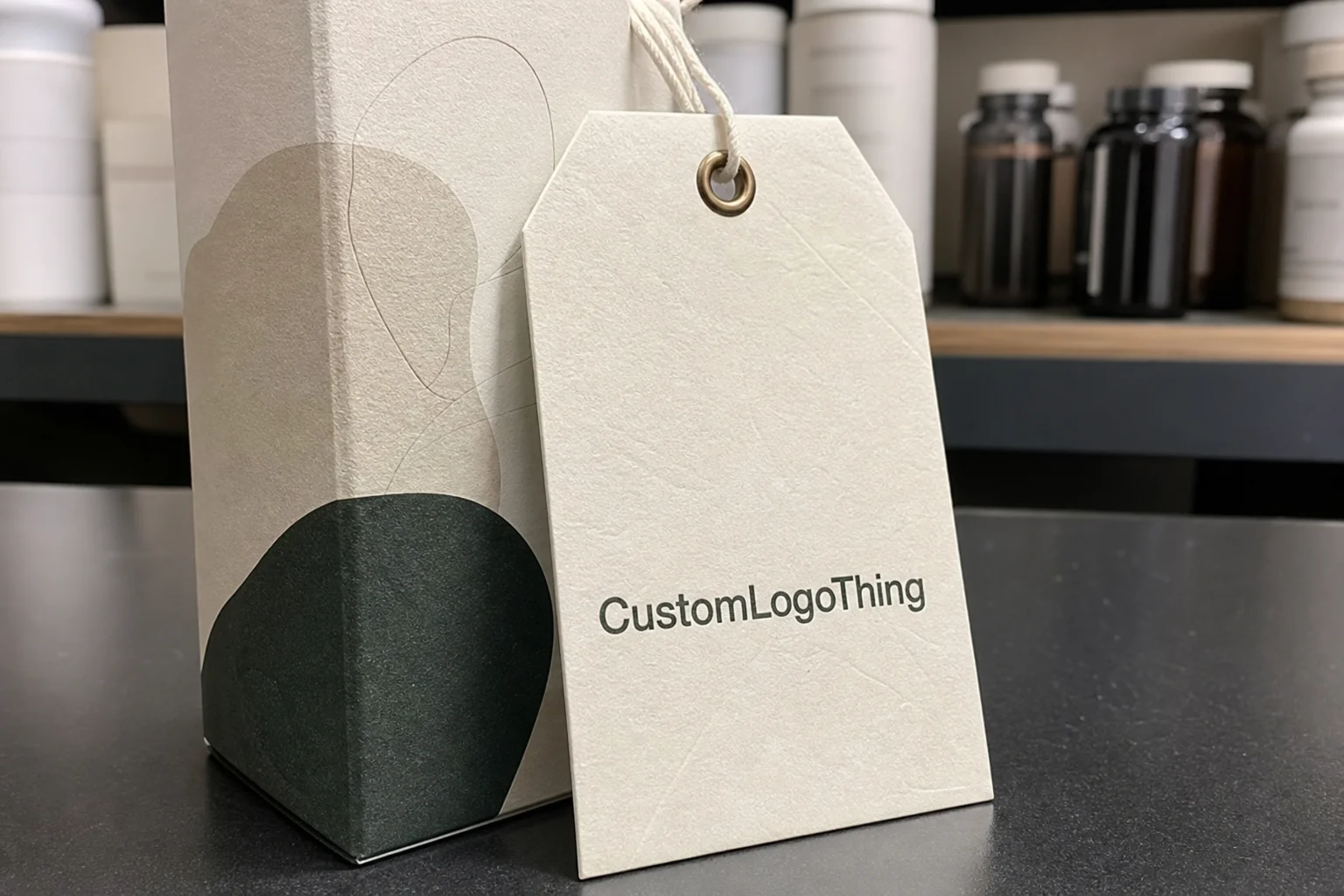
Buyers often treat hang tags as a finishing touch, but for vitamin packaging they can handle visual branding, SKU separation, product education, and price or promotion communication at the same time. If the line includes capsules, gummies, powders, softgels, and bundle kits, a hang tag can keep those pieces visually connected while still making each item easy to identify.
They also solve a practical problem. Direct printing on a bottle or pouch is not always flexible enough for limited runs, launches, or short-lived promos. Tags let a brand test a new message, flag a seasonal offer, or call out a bundle benefit without changing the core label structure. That flexibility reduces waste and keeps the main pack stable.
Stock choice and print quality matter because health products are judged differently from impulse categories. If the tag looks flimsy, scratched, or off-color, customers often read that as a signal about the product inside. A clean tag on an aligned bottle makes the line look more credible. A crooked one does the opposite.
A hang tag will not fix weak branding, but it can make competent branding look deliberate.
For brands comparing packaging components, the hang tag often sits alongside labels, cards, and inserts. Our Custom Labels & Tags page shows how these pieces are often built as one system rather than separate one-off purchases.
How a vitamin brand hang tags supplier handles custom orders
A supplier process should be easy to map: quote, proof, production, ship. If a vendor cannot explain that path clearly, the workflow is probably weak or overly complicated.
The order usually starts with a brief that includes quantity, dimensions, hole placement, copy, artwork files, finish, and the number of SKUs. Pricing then depends on stock, coverage, size, finishing, and whether the shape is standard or custom-die-cut. The proof is the first real chance to catch copy issues, spacing problems, bleed errors, and layout problems before printing begins.
Most buyers should be ready to provide:
- Artwork files, ideally vector-based and editable
- Final dimensions, or at least a bottle or pouch reference
- Front and back copy, including any required product text
- SKU count and variant differences
- Print finish, such as matte, gloss, or soft-touch
- Attachment details, including hole size, placement, and stringing method
For larger or more complex orders, the best vendors usually separate proofing into two checkpoints. First is the digital mockup. Then, for premium finishes or unusual shapes, a pre-production check. That second review matters because tiny type, metallic accents, barcode placement, and die lines all behave differently once the layout is translated into production files.
Incomplete artwork is one of the fastest ways to create delays. Low-resolution logos, missing dielines, or copy that keeps changing after approval all add back-and-forth. Late-stage compliance edits do the same.
Buyers comparing vendors should ask how revisions are handled, whether samples are available, and who signs off on print accuracy. For broader reference points across printed packaging, our Case Studies section is useful because it shows how finishing and stock choices affect the final result across different product types.
Cost, pricing, and MOQ factors that change your quote
Hang tag pricing comes down to material, setup, and complexity. Size matters. Print coverage matters. Shape matters. Finish matters. The more variables you add, the more the price climbs. A simple two-color tag on standard cardstock is a different job from a custom-die-cut tag with foil and soft-touch lamination.
For basic Custom Hang Tags, buyers often see pricing around $0.10-$0.22 per unit at higher quantities, assuming standard cardstock and limited finishing. Mid-range options with full-color print, matte lamination, or rounded corners often land around $0.18-$0.35 per unit. Premium tags with embossing, foil, specialty stock, or a custom silhouette can reach $0.30-$0.60+, especially when quantity is low or the design requires extra setup.
MOQ, or minimum order quantity, is where pricing becomes more predictable. If a supplier’s minimum is 1,000 pieces and you need 300, the setup cost has to be recovered somehow. That is why short runs usually carry a higher per-unit price.
There is another layer buyers sometimes overlook: waste. Intricate die lines, heavy ink coverage, or finishes that require extra handling can increase spoilage during setup and finishing. A transparent quote will usually include that reality instead of hiding it.
Here is a practical comparison that helps separate the options:
| Option | Typical Specs | Approx. Unit Cost | Best For |
|---|---|---|---|
| Basic hang tag | 14pt-16pt cardstock, 1-2 color print, standard shape | $0.10-$0.22 | High-volume core SKUs |
| Mid-range tag | 18pt stock, full color, matte lamination, rounded corners | $0.18-$0.35 | Retail-ready vitamin lines |
| Premium tag | Thick board, foil, emboss/deboss, custom die cut | $0.30-$0.60+ | Hero products and special editions |
| Short-run tag | Low quantity, simple finish, limited variants | Higher per unit | Launches, testing, small batches |
The best quote is the one that matches the product lifecycle. If the formula, regulatory wording, or visual system is still changing, a smaller run protects you from waste. If the SKU is stable and repeats every quarter, a larger order can lower unit cost enough to justify the inventory.
Also ask about shipping, packing, and palletizing. A low print price can turn into a mediocre total cost once freight and handling are added. Total landed cost is the number that matters.
Process and timeline: from quote to delivery
A workable schedule is straightforward. Typical lead time for a Custom Hang Tag order is quote in the same day or within two business days, proofing in one to three days, production in roughly five to ten business days, then shipping on top of that. Specialty finishing, large quantities, or multiple revisions can push the timeline out further.
The fastest jobs usually have three things in common: final artwork, standard dimensions, and quick proof approval. If the dieline is already built and the copy is locked, the supplier can move much faster. If the tag needs to be designed from scratch, or if the brand is still debating what belongs on the back panel, time stretches immediately.
- Request a quote with quantity, size, finish, and artwork status.
- Review the proof for copy, logo placement, bleed, and hole location.
- Approve pre-production once the layout matches the target spec.
- Production runs after approval, then finishing and packing.
- Ship and receive with enough cushion for inspection and distribution.
What slows orders down? Custom shapes, foil, heavy revision cycles, and tiny print that needs reflow. Holiday periods are another predictable bottleneck.
For supplement packaging, timing is also a quality issue. If tags are going into retail kits or subscription boxes, they need to survive packing pressure, transit vibration, and handling without curling, scuffing, or tearing at the hole. That is why finishing choices and board thickness affect both appearance and durability.
For broader packaging validation, standards such as ISTA are worth understanding because shipping stress can reveal weaknesses that never show up on a flat proof.
Spec choices that make vitamin hang tags actually work
Size should be driven by function, not habit. A tag that is too small forces copy into unreadable type. A tag that is too large starts to dominate the package. For most vitamin bottles, a format around 2 x 3 inches or 2.5 x 4 inches is common, though bundle kits and promotional sets often need more room.
Stock selection changes the tone immediately. Coated cardstock gives sharper color and cleaner image reproduction. Uncoated stock feels softer and often suits brands that want a clinical, natural, or minimalist look. Recycled stock can support an eco-forward message, but the surface may mute saturated color. In most cases, 14pt to 18pt stock gives a good balance between structure and cost.
Finish should support the brand position, not fight it. Matte is usually a safe choice for supplements because it reads calm and serious. Gloss adds shine, but it also reflects light and shows wear more quickly. Soft-touch feels premium in hand, though it is not always ideal if the design depends on sharp contrast or very small text. Foil works best as an accent, not a blanket treatment.
There are a few add-ons that improve function more than appearance:
- Rounded corners to reduce edge wear and snagging
- Hole reinforcement to limit tearing around the attachment point
- Stringing or loop options for faster assembly
- QR codes for education, authentication, or subscription links
- Batch or SKU identifiers for warehouse sorting and kit packing
If the tag carries product claims, keep typography conservative. Tiny type is the first thing to fail once the tag is in hand. A hang tag should support the sales story, not try to replace the label or legal copy. The copy should be reviewed before print, not after boxes are moving through fulfillment.
For brands that care about material sourcing, FSC certification is one reference point for paper selection, especially when the packaging story includes recycled or responsible sourcing claims.
Common mistakes when sourcing hang tags for vitamin brands
The most common mistake is choosing the wrong size. Too small, and the tag becomes unreadable. Too large, and it competes with the bottle or pouch instead of supporting it. Another frequent problem is trying to make the tag do too much. If it carries the brand story, promotion, product education, and compliance text all at once, the layout usually fails on hierarchy.
Hole placement matters more than many buyers expect. If the hole sits too close to the edge or slightly off-center, the tag hangs crooked or tears under stress. Attachment choice matters too. A cheap string can make the whole package feel lower value, even if the printing is excellent.
Compliance-adjacent mistakes cause pain later. Aggressive claims, unreadably small text, missing distributor details where required, or a QR code that resolves to the wrong landing page can turn a simple print job into a headache. None of that should be discovered after the tags are already boxed.
One practical way to avoid reprints is to request a sample for larger orders or unfamiliar finishes. A flat digital proof cannot show how a matte coating handles light, whether the board feels stiff enough, or how the tag behaves after handling. Sampling costs money, but it is cheaper than remaking a full run because the finish looked different in hand than on screen.
Color drift is another quiet issue. If the bottle label, carton, and hang tag all use slightly different blues or grays, the product line loses coherence. People may not identify the mismatch consciously, but they do feel it.
Next steps for ordering with less guesswork
If you want a cleaner quote from a vitamin Brand Hang Tags supplier, gather the basics before you send the request: final quantity, tag dimensions, attachment method, stock preference, artwork files, and any required text. The more complete the brief, the fewer the revisions.
Ask for a digital proof, and if the order is large or the finish is unusual, request a physical sample or pre-production check. Confirm MOQ, check the unit cost at your actual order size, and compare the total landed cost rather than print price alone.
If the launch date is already fixed, involve the supplier early. Packaging schedules do not bend around late approvals. A competent supplier can move quickly, but only if the brief is complete and decisions are locked before production starts.
Bottom line: choose tag specs that fit the product, the shelf context, and the order volume. A well-made hang tag supports brand identity, improves the unboxing experience, and helps supplement packaging look credible without trying to become the whole package.
FAQ
What should I ask a vitamin brand hang tags supplier before ordering?
Ask about MOQ, unit pricing, proofing steps, turnaround time, available paper stocks, and finishing options. Confirm whether the supplier can handle your size, shape, hole placement, and stringing method. If you are ordering a premium finish or a custom cut, ask whether they provide a pre-production sample before the full run.
How much do custom vitamin hang tags usually cost?
Simple hang tags usually cost less per unit, while specialty finishes and custom shapes increase the price. The final number depends on quantity, stock thickness, print sides, ink coverage, and finishing. Short runs are more expensive per tag because setup costs are spread across fewer pieces.
What file types do I need for custom hang tags?
Editable vector files are the safest starting point, such as AI, EPS, or PDF. Include logos at high resolution, the final copy, and any color references. If you do not have print-ready artwork, ask the supplier for a dieline or template before laying out the design.
How long does production take for vitamin hang tags?
Most standard orders take about one to two weeks from proof approval to shipping, though custom shapes and specialty finishes can extend that timeline. Fast approvals and final artwork are the best way to avoid delays. Revision cycles are usually what push deadlines out.
What hang tag materials work best for vitamin packaging?
Thicker cardstock is the most common choice because it feels sturdy and hangs well. Matte finishes often suit supplement and wellness brands because they read more restrained than gloss. Recycled or uncoated stocks can work well if the brand wants a more natural or less polished look.