Buyer Fit Snapshot
| Best fit | Void Fill for Ecommerce projects where brand print, material claims, artwork control, MOQ, and repeat-order consistency need to be specified before quoting. |
|---|---|
| Quote inputs | Share finished size, material target, print colors, finish, packing count, annual reorder estimate, ship-to region, and any compliance wording. |
| Proofing check | Approve dieline scale, logo placement, barcode or warning zones, color tolerance, closure strength, and carton packing before bulk production. |
| Main risk | Vague material claims, crowded artwork, missing packing details, or unclear freight terms can make a low unit price expensive after revisions. |
Fast answer: Void Fill for Ecommerce: Production Review should be specified like a repeatable production item. The safest quote records material, print method, finish, artwork proof, packing count, and reorder notes in one written spec.
Production checks before approval
Compare the actual filled-product size with the drawing, then confirm tolerance on folds, seals, hang holes, label areas, and retail display edges. Reserve space for logos, QR codes, warning copy, and material claims before decorative graphics fill the panel.
Quote comparison points
Review material grade, print process, finish, sampling route, tooling charges, carton quantity, and freight assumptions side by side. A quote is only useful when the supplier can repeat the same color, closure quality, and packing count on the next order.
Void Fill for Ecommerce: How to Protect Every Shipment
Void fill for ecommerce looks small on paper. Then a carton hits the dock with a crushed corner, the product has shifted, and the unboxing feels like somebody kicked the box halfway across the warehouse. That is the part people miss. The box did not fail because it lacked packaging in general. It failed because it had too much empty space and not enough control.
That empty space is the problem. Void fill is the material or structure that keeps a product steady inside a shipping carton. It is not just there to occupy volume. It keeps the item centered, limits movement, and helps it survive the repeated shocks, vibration, drops, and compression events that happen in parcel networks. For void fill for ecommerce, the carton is not just a container. It is part protection, part handling environment, part dunnage, and part first impression.
Ecommerce gets hit harder than pallet freight. A parcel can be sorted, tilted, stacked, dropped, and passed through more than one facility before it lands at a front door. That changes the damage profile fast. Breakage is only part of the cost. Refunds, replacement shipments, support time, and bad reviews hit too. Customers remember a crushed package. They also remember that you made them deal with it. That is why void fill for ecommerce belongs in the same conversation as quality control, not in the bargain bin.
The right answer usually depends on the product, the carton, and the labor reality at the pack station. Paper crinkle may fit one SKU perfectly and waste time on another. Air pillows can speed up a high-volume line. Molded pulp or foam inserts make more sense for fragile products that cannot move at all. The cheapest option per roll is often the most expensive option overall. Total cost per shipped order is the number that matters, and so is the cartonization decision that keeps the box from starting out oversized.
Void Fill for Ecommerce: Why Shipped Air Costs More Than You Think
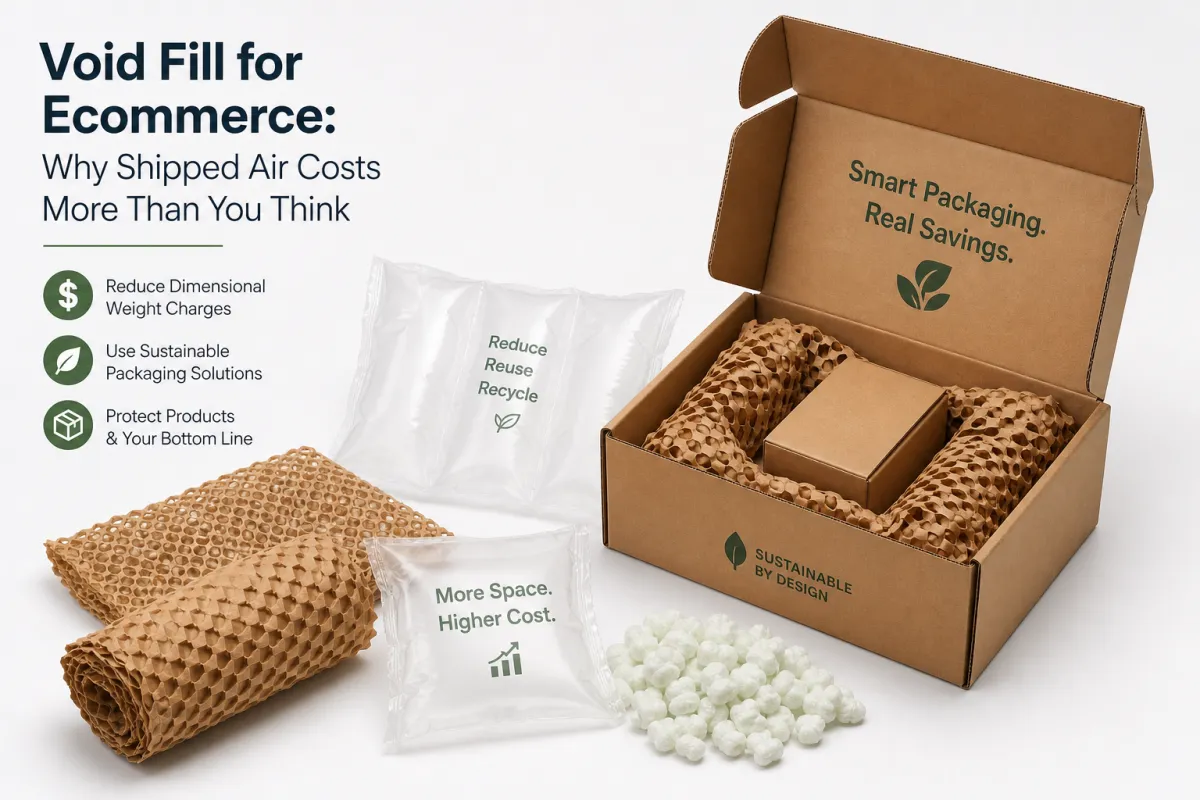
Shipped air costs money because it is not really empty. Every bit of free space inside a carton gives the product room to gather speed before it hits something. That is how a small bump turns into a cracked edge or a scratched finish. I have seen cartons that looked fine from the outside and still failed because the product inside shifted enough to break a function test or ruin the presentation. That is why void fill for ecommerce matters even for items that are not fragile by nature.
Void fill turns a loose package into a controlled one. It cuts movement, absorbs shock, and spreads pressure so the product does not take the full hit at one corner or one side. The mechanics are simple. If the item can slide, it will slide. If it can tip, it will tip. If it can bounce, it usually will. Good void fill for ecommerce stops those movements before they become damage claims.
Presentation matters too. A product that arrives centered feels intentional. A product shoved against one wall of the box feels rushed, even if the item itself survives. Buyers can tell the difference. They may not say it in packaging terms, but they know when a shipment feels careless. That is one reason void fill for ecommerce is part protection, part brand signal, and part risk control.
Void fill is not the same thing as cushioning. Cushioning wraps or pads the product itself. Void fill stabilizes the empty space around it. The two can work together, but they do different jobs. A fragile ceramic item may need both a protective wrap and carton-level void fill. A tougher boxed accessory may only need enough movement control to keep it from banging around.
“The carton failed because it was full of empty space.” That sentence explains a lot of damage reports, and it usually points to a better void fill for ecommerce spec.
Materials behave differently in transit, and that difference matters more than most teams expect. Paper-based fill can lock irregular shapes in place. Air pillows are fast and light, but They Work Best when the remaining void is predictable. Foam offers more consistent restraint, which helps with high-value items. Molded inserts create a custom fit, which is useful when the SKU is stable enough to justify tooling or repeat production. Recyclable paper and molded fiber are also popular when a brand wants a cleaner unboxing path with less waste. The right void fill for ecommerce material is the one that fits the transit risk, not the one that wins a price-per-unit contest on a spreadsheet.
That keeps showing up in reviews and returns for a reason. A damaged package can cost several times more than the original packing choice once replacement, reverse logistics, and support labor are added in. That is the hidden math behind void fill for ecommerce: a few extra cents in packaging can prevent dollars in downstream waste. Packaging standards groups such as ISTA exist because shipping performance should be tested under real conditions, not guessed from a desk.
What Void Fill for Ecommerce Works Best Inside the Box?
The best void fill for ecommerce depends on three things: product fragility, carton size, and pack speed. For fragile or high-value items, foam or molded fiber may be the right call. For repeatable carton sizes and lighter products, air pillows or paper fill often do the job faster. For odd shapes and mixed-SKU kits, paper crinkle can create better lock-in than a rigid insert. There is no universal winner. There is only the fill that fits the risk.
The easiest way to picture void fill for ecommerce is to think of the shipment as a small vehicle moving through a rough network. The goal is not to pack the box so tightly that the product gets crushed. The goal is to create enough resistance that the item cannot build momentum inside the carton. Once that happens, impact energy gets absorbed by the packaging structure instead of the product’s corners, edges, or surfaces.
Placement matters just as much as material choice. Top voids matter. Side voids matter. Corner voids matter even more because corners take the ugliest hits. A carton can look “filled” and still fail if the product shifts toward one side or bounces under the lid. Good void fill for ecommerce closes those movement paths, not just the obvious open area.
Different materials create different behavior. Paper creates friction and interlock, which helps with irregular items like jars, accessories, and boxed kits. Air pillows fill volume quickly, but they work best when the carton shape is consistent and the product does not need much side restraint. Foam gives predictable compression recovery, which matters for delicate electronics or premium items. Molded pulp and molded fiber add structure and can improve the unboxing experience. For eco-focused brands, fiber-based systems can also support recycling goals, depending on local rules and the exact material build.
That last piece matters because sustainability claims should be practical, not decorative. A carton packed with mixed materials that are hard to recycle may look tidy and still create a poor end-of-life story. The EPA recycling guidance is a useful reminder that packaging choices affect what happens after the unboxing, not just during transit. A strong void fill for ecommerce choice balances protection, material recovery, and line efficiency at the same time.
Void fill changes shipping outcomes in three ways. First, it reduces breakage by limiting acceleration inside the carton. Second, it improves presentation because the product stays centered and looks intentional when the box opens. Third, it lowers the odds of a return or reship, which often matters more financially than the packaging cost itself. That is why void fill for ecommerce should be reviewed as a system, not as a single material spec.
There is also a standards angle. Teams that test to ISTA protocols or compare packouts against recognized methods tend to make better decisions because they are using real data. The test itself is not the win. The discipline is. If your packout survives vibration, drop, and compression testing in a repeatable way, you have a much better chance of seeing the same result in the parcel network. That is the real promise behind disciplined void fill for ecommerce selection.
Key Factors That Shape Void Fill for Ecommerce Choices
Product fragility is the first filter. A rigid household item with a durable finish has a very different need profile than a glass bottle, a cosmetic jar, or a precision part with exposed corners. If the item is fragile, irregular, or heavy for its size, void fill for ecommerce has to do more than occupy empty space. It needs to restrain movement in all directions, and sometimes it needs to do that without putting pressure on a specific surface or label.
Carton geometry comes next. Oversized boxes, sharp internal corners, and large top voids create room for movement. A simple layer of loose paper may work for a modest gap, but it can fail when the product sits low in a tall carton or when one side has a wide gap and another side is tight. In those cases, void fill for ecommerce needs to be placed with intent, often with a mix of bottom support, side restraint, and top lock.
Fulfillment speed changes the answer too. Some materials are cheap to buy but slow to place. Others cost more per shipment but save seconds at the station. Those seconds matter. On a high-volume line, even a 6- to 10-second difference per order can affect throughput, staffing, and how well the team handles demand spikes. Good void fill for ecommerce respects labor as a real cost, not a free one.
Paper, air, foam, and fiber are not interchangeable
Paper fill often works well for odd shapes, soft goods in rigid cartons, and situations where the packer needs to build support around the product. Air pillows are efficient for repeatable carton sizes and can move fast on a busy line. Foam can help where impact protection needs to stay consistent and product value calls for a premium feel. Molded fiber or pulp can provide structure and presentation at the same time, especially for brands that want a more refined unboxing path. Each of these options can be part of void fill for ecommerce, but each solves a different problem.
Sustainability and customer expectations add another layer. Some buyers see oversized plastic fill as wasteful, especially when the item itself is small. Others care most about the condition of the product and accept more packaging if it lowers damage. Recyclability, reuse, and perceived waste all shape the final decision. The smart packaging teams do not pretend those concerns are identical. They test the tradeoff, then document why the chosen void fill for ecommerce method won.
Carrier risk profiles matter too. If your products mostly face compression, stronger carton sizing or a structural fill may be the right fix. If vibration is the bigger issue, a material that locks the product in place matters more. If impact is the main problem, you may need a mix of cushioning and restraint. Moisture is its own issue, especially for paper-based systems in humid lanes. The best void fill for ecommerce choice starts with the failure mode, not the sales pitch on the supplier page.
One useful rule: before standardizing any fill method, define the top three risks for the SKU family. Is the problem breakage, scuffing, movement, or presentation? If you cannot answer that, the packout is usually too generic. Once the failure mode is clear, the void fill for ecommerce decision gets easier to defend and easier to train.
Void Fill for Ecommerce Pricing: Material, Labor, and Damage Costs
Price reviews get skewed fast when teams only compare material cost per unit. The cheapest roll or bag is not always the cheapest system. A low-cost fill that adds 12 seconds of packing time can cost more than a higher-priced option that drops into place in 3 seconds. That is the first lesson of void fill for ecommerce economics: material price is only one slice of the total number.
Labor matters because packing operations are full of small delays that pile up. Replenishment, machine setup, jam clearing, and training all carry real cost. If a fill system needs frequent resets or special handling, those minutes add up over a week of orders. For that reason, many teams should judge void fill for ecommerce by cost per packed order, not cost per cubic foot or cost per bag.
Hidden costs often dominate the final picture. A return is not just a refund. It can include customer service time, reverse logistics, inspection, repacking, replacement inventory, and another outbound shipment. A damaged order can also trigger a review that pushes away the next buyer. That is why spending a few extra cents on void fill for ecommerce can be the conservative move if it lowers the chance of a much larger failure.
The comparison below shows how the economics can shift depending on the product, line speed, and carton style. These are practical ranges, not fixed prices, because volume, geography, and supplier terms all change the numbers.
| Void Fill Option | Typical Use | Material Cost per Shipment | Labor Impact | Best Fit |
|---|---|---|---|---|
| Paper crinkle or kraft fill | Irregular items, mixed-SKU kits, moderate voids | $0.10-$0.30 | Moderate; can slow packers if hand-crumpled | Brands wanting strong restraint and a paper-forward presentation |
| Air pillows | Repeatable carton sizes, light to medium products | $0.05-$0.18 | Low; fast on high-volume lines | Operations prioritizing speed and low pack weight |
| Foam fill or inserts | Fragile, high-value, or scuff-sensitive items | $0.20-$0.60 | Low to moderate; depends on cut and fit | Shipments where damage prevention outweighs material spend |
| Molded fiber or pulp inserts | Premium presentation, structured restraint, eco-focused brands | $0.18-$0.45 | Low once standardized; higher upfront spec work | Brands seeking structure, consistency, and recyclable content |
If a shipment has a 2% damage rate and the average failed order costs $18 to replace and reship, the packaging team is not really choosing between a $0.12 or $0.22 fill. It is choosing between a small recurring expense and a much larger failure cost. That is why a smart void fill for ecommerce test looks at total landed packaging cost per order, including damage prevention and customer experience.
Dimensional weight can also change the math. A box that is too large for the product can raise shipping spend enough to erase any savings from cheap fill. In some operations, the fix is not more void fill. It is a better carton size that cuts empty space in the first place. That is the part of void fill for ecommerce planning people skip too often: sometimes the cheapest fill is a smaller box.
For buyers building a business case, the useful formula is simple. Track material cost, labor seconds, box size, damage rate, and return rate for each pilot lane. Then compare cost per shipped order over at least a few hundred units. That gives a much clearer picture than a list price ever will. A disciplined void fill for ecommerce decision usually saves money because it is grounded in shipping behavior, not assumptions.
Step-by-Step Process and Timeline for Rolling Out Void Fill
The best rollouts start with an SKU audit. Look at the Items That Ship most often, break most often, or arrive with obvious empty space in the carton. Those are the strongest candidates for change. During this phase, document carton sizes, product dimensions, breakage patterns, and any complaints about presentation. A good void fill for ecommerce program begins with data you can actually use, not a vague guess that “more filler should help.”
Next, map the pilot in stages. A short audit can take a few days if the SKU set is narrow, or a couple of weeks if the catalog is broad. After that, run a small line test with two or three fill options on the same product group. Keep the conditions consistent: same box size, same packer, same products, same shipping lane if possible. That is the only clean way to see whether void fill for ecommerce is improving the packout or just changing the look of it.
Before launch, set clear test criteria. Measure damage rate, pack time, material usage, box size changes, and customer complaints. If you can, add a simple shake test or a manual movement check at the station. The package should not rattle, tip, or shift when it is handled gently. That kind of basic QC catches failures a spreadsheet misses. With void fill for ecommerce, the best metric is the one that predicts fewer returns later.
Train the packing decision, not just the material
Packer training should read like a decision tree. If the item is light and irregular, use one method. If the item is heavy and fragile, use another. If the carton has a top void greater than a set threshold, add a second layer of support. When the team understands the logic, they are more likely to pack consistently. A successful void fill for ecommerce rollout depends on repeatability, especially during busy fulfillment windows when shortcuts show up fast.
Rollouts also benefit from a review window. After the pilot, compare results against the baseline. If damage improved but pack time worsened too much, the spec may need adjustment. If the carton size can be reduced, test that too. A lot of teams think the first material they test is the final answer. It usually is not. In practice, the best void fill for ecommerce system often comes from two or three small refinements.
A realistic timeline for a focused rollout might look like this: 3-5 days for an audit, 1-2 weeks for pilot testing, a short review and spec revision period, then a staged rollout by SKU family. That is fast enough for a growing ecommerce operation without rushing the decision. It also creates internal buy-in because people can see the numbers before the process changes. If the team can point to lower breakage and stable pack speed, void fill for ecommerce becomes easier to standardize across the catalog.
One practical detail: document the exact setup. Write down carton size, fill type, target fill placement, packer instructions, and acceptable variation. Teams often skip this part, then wonder why performance drifts a month later. A one-page spec sheet is usually enough. For high-volume lines, a photo reference beside the station helps. That is the difference between a good idea and a repeatable void fill for ecommerce process.
Common Mistakes With Void Fill for Ecommerce Shipments
The first mistake is using too little material. If the product can slide, bounce, or tip, the carton has not been stabilized. It does not matter if the outside box looks neat. Internal movement is what creates many failures. In plain language, if you can hear a rattle, the void fill for ecommerce setup probably needs work.
The second mistake is overfilling. Packing until the item is crushed against the walls can warp packaging, crush labels, or create stress points on delicate parts. More material is not automatically better. A carton should feel secure, not squeezed. Good void fill for ecommerce supports the product without deforming the product or the shipping container.
The third mistake is choosing a material that does not match the product weight or shape. A fragile item may need a structured insert instead of a loose cushioning product. A heavy item may need a denser restraint system than a lightweight bag can deliver. The danger here is false confidence. The pack looks protected, then fails under real parcel handling. That is why void fill for ecommerce should be tested under shipping conditions, not just on a packing table.
The fourth mistake is ignoring dimensional weight. A larger box can quietly raise shipping costs enough to erase any savings from the fill itself. This happens often in catalog businesses where one carton size becomes the default for too many SKUs. The carton may be convenient for the line, but expensive in transit. In some cases, the better fix is a tighter box assortment paired with better void fill for ecommerce, not more material in a large carton.
The fifth mistake is treating fill as an afterthought instead of a controlled standard. If every packer improvises, the results drift. One carton will be tight, another loose, and a third overstuffed. That inconsistency is expensive because it creates unpredictable damage and unpredictable labor time. A mature void fill for ecommerce process is written, measured, and reviewed like any other operating standard.
There is another trap worth calling out: designing for the easiest unit instead of the worst-case unit. A stable SKU can make the system look better than it really is. The item that matters is the one with awkward geometry, weak corners, or a glossy surface that scuffs easily. If the system protects the hardest-to-ship item in the family, it is usually strong enough for the rest. That is the real test for void fill for ecommerce.
Expert Tips and Next Steps for Void Fill for Ecommerce
Build a simple packaging matrix. List the product type, carton size, fragility level, and recommended fill material. That one document can save hours of guesswork at the line and cut training errors. It also makes audits easier because everyone can see why a given void fill for ecommerce method exists. The matrix does not need to be fancy. It needs to be used.
Test two or three options side by side before standardizing anything. Side-by-side tests are useful because they expose tradeoffs quickly. One option may pack faster. Another may reduce damage. A third may improve presentation but cost more. Real data from your own SKUs beats a supplier claim, especially when the catalog includes multiple box sizes or product families. That is the most reliable way to choose void fill for ecommerce across a growing operation.
Measure the right metrics, and do not overload the dashboard. Damage rate, returns, pack speed, material usage, and shipping cost per order are enough to start. If the numbers improve on those five points, the process is probably working. If they do not, the fill spec needs another round of testing. A solid void fill for ecommerce decision should make the business easier to run, not just nicer to look at.
Use the findings to write a one-page spec for your highest-volume products. Include carton dimensions, fill type, target placement, and any inspection step the packer should follow. Then expand that method to adjacent SKUs where the geometry is similar. That keeps the rollout manageable. A slow, controlled expansion is usually smarter than a broad switch that overwhelms the team. For many operations, that is the most practical path to better void fill for ecommerce performance.
If sustainability matters, compare paper, molded fiber, and recyclable air options against your actual shipping profile. The most responsible choice is not always the smallest one. Sometimes the lowest-waste path is the system that prevents re-ships and damaged-product disposal. FSC-certified fiber and paper options can also support sourcing goals when they fit the product. The point is to make the package work as a system, not as a slogan.
My blunt recommendation: audit your top five SKUs, pick one pilot lane, and document the exact void fill for ecommerce setup that gives you the best balance of protection, speed, and cost. That one exercise usually tells you more than a dozen opinions ever will. If the box stops rattling, the returns fall, and the line keeps moving, you have the right answer for now.
What is void fill for ecommerce packaging?
Void fill for ecommerce packaging is the material or structure used to stop a product from shifting inside a shipping carton. Its main job is stabilization first, with cushioning and presentation as secondary benefits. It matters most when the box is larger than the product or the item has delicate surfaces, corners, or moving parts.
Which void fill for ecommerce is cheapest overall?
The cheapest material is not always the cheapest system once labor and damage are included. Paper, air pillows, and foam can each win in different cases depending on pack speed, fragility, and carton size. The best comparison is cost per shipped order, not material price alone, because void fill for ecommerce is really a total system decision.
How much void fill should I use in ecommerce boxes?
Use enough to prevent movement in every direction, especially at the top and sides of the carton. The product should feel secure, but not crushed or deformed by the packaging. If the item rattles when the box is gently shaken, it usually needs more or better-placed void fill for ecommerce.
Does void fill for ecommerce affect shipping rates?
Yes, because larger boxes can increase dimensional weight and raise parcel costs. Better void fill can also reduce damage-related expenses, which often matter more than small material savings. The right approach balances protection, box size, and pack efficiency, so void fill for ecommerce helps both transit performance and cost control.
How do I choose between paper, air pillows, and foam void fill?
Choose based on product fragility, sustainability goals, fulfillment speed, and the amount of empty space in the carton. Paper is often strong for irregular shapes, air pillows work well for fast line speeds, and foam may suit highly delicate products. A side-by-side test on your real SKUs is the most reliable way to decide on void fill for ecommerce.
For Custom Logo Things, the practical takeaway is simple: void fill for ecommerce is not just a packaging line item, it is a shipment-quality decision that affects breakage, returns, labor, cartonization, and brand perception all at once. Get the carton stable, match the material to the risk, and measure the result. That is how shipped air stops being a cost and starts becoming controlled protection.