Buyer Fit Snapshot
| Best fit | Design Packaging for Fragile Items That Ship Safely projects where brand print, material claims, artwork control, MOQ, and repeat-order consistency need to be specified before quoting. |
|---|---|
| Quote inputs | Share finished size, material target, print colors, finish, packing count, annual reorder estimate, ship-to region, and any compliance wording. |
| Proofing check | Approve dieline scale, logo placement, barcode or warning zones, color tolerance, closure strength, and carton packing before bulk production. |
| Main risk | Vague material claims, crowded artwork, missing packing details, or unclear freight terms can make a low unit price expensive after revisions. |
Fast answer: Design Packaging for Fragile Items That Ship Safely: Material, Print, Proofing, and Reorder Risk should be specified like a repeatable production item. The safest quote records material, print method, finish, artwork proof, packing count, and reorder notes in one written spec.
Production checks before approval
Compare the actual filled-product size with the drawing, then confirm tolerance on folds, seals, hang holes, label areas, and retail display edges. Reserve space for logos, QR codes, warning copy, and material claims before decorative graphics fill the panel.
Quote comparison points
Review material grade, print process, finish, sampling route, tooling charges, carton quantity, and freight assumptions side by side. A quote is only useful when the supplier can repeat the same color, closure quality, and packing count on the next order.
How to Design Packaging for Fragile Items That Ship Safely
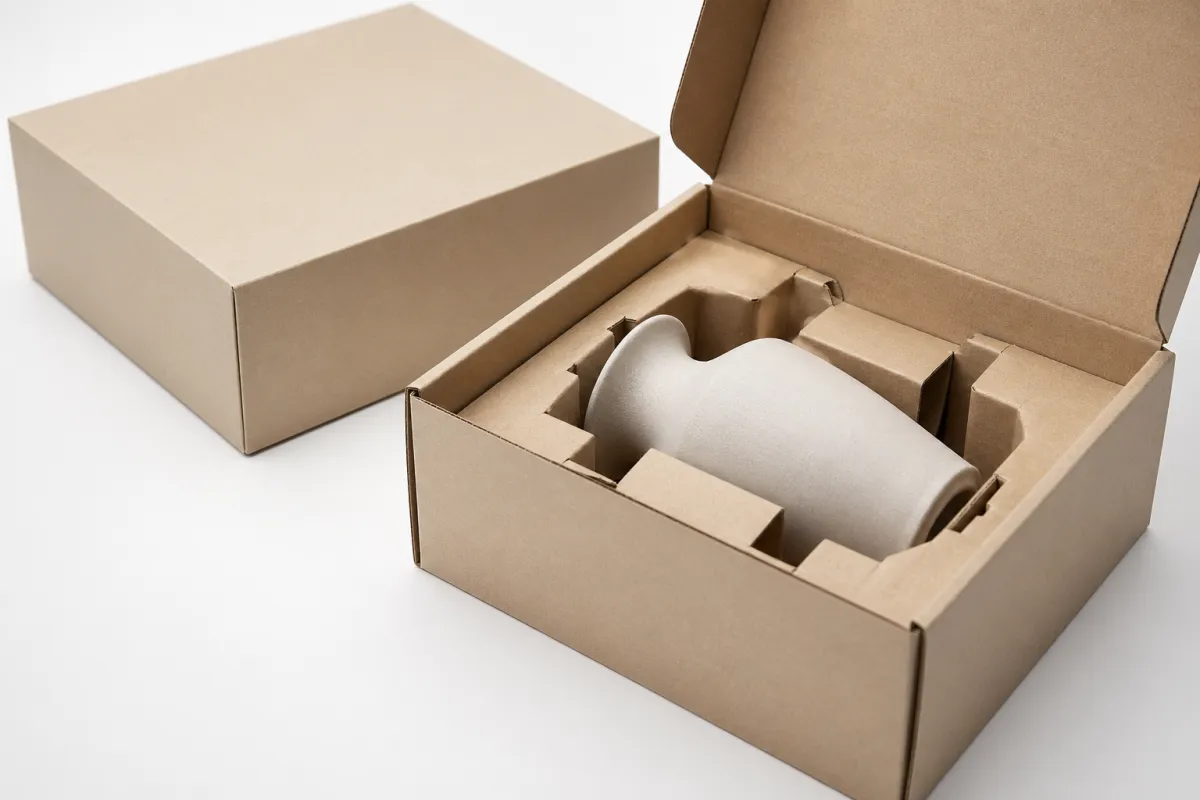
A glass perfume bottle can sail through a tidy shelf test and still crack after a short ride through parcel sorting. The carton looks fine. The corners are scuffed, the tape still holds, and the product is in pieces. I have seen that exact mismatch more than once, and it never gets less annoying.
Teams usually start asking how to design Packaging for Fragile items when return rates rise, support tickets spike, or customer photos start landing after midnight. The hard part is that packaging is never just a box. Product shape, support geometry, vibration, impact, stacking, humidity, and route all act on the same shipment. At Custom Logo Things, we help brands build product packaging that performs during real handling, not just in clean lab conditions. This guide breaks down how to design Packaging for Fragile Items in a way teams can repeat at volume without slowing the line to a crawl. You will see where overpacking starts, why fit matters as much as cushioning, and when custom inserts, foam, molded pulp, or paper-based fill make sense without blowing up the freight budget.
If you want a wider view of available formats, our custom packaging products catalog includes options for custom printed boxes, printed mailers, and branded inserts that can support the design choices below.
For teams building fragile shipping protection systems, the first move is not aesthetic. It is systems thinking: where does stress concentrate, where does it dissipate, and where can packaging geometry buy back margin that materials alone cannot?
How to Design Packaging for Fragile Items Without Overpacking?
A realistic opening problem
A product can pass a 30 cm drop in the lab and still fail after two days in transit with a broken corner. That is not unusual. The box gets shaken, stacked, twisted, and dropped again before it reaches the customer. Parcel systems do that repeatedly. They also do not care how polished the prototype looked on your table.
The simplest lesson I have seen on production floors is also the easiest to miss: good protection depends on control. Control the energy path. Control the movement. Control the compression. If the inner pack lets the item slide, every vibration cycle adds momentum. If the outer carton is strong but the product can bounce inside it, the package can still fail where it hurts most.
How to design Packaging for Fragile Items starts with mechanics, not material shopping.
This is where search intent becomes practical: people want to know whether they should invest in a custom solution or improve the structure they already have. In many cases, the answer is a better packaging for delicate products architecture before any major material spend.
What counts as "fragile" in packaging terms?
Fragile is often used as a broad label for expensive goods, but in practice it means a product with a narrow failure margin under modest force. A 1.2 kg ceramic vase, a 150 g glass vial, an 800 g electronics unit with a board that cannot flex, and a rigid-coated carton with a sensitive surface all belong in this category for different reasons.
Fragile products usually share a few traits:
- Hard, brittle surfaces that can chip or crack from a single point strike, such as glass, ceramic, porcelain, and coated finishes.
- Thin walls or sharp geometry that fold or snap at corners.
- Internal parts that move and react badly to vibration, including lenses, chips, and precision mounts.
- Surface sensitivity where abrasion leaves visible marks fast.
- High centers of gravity that make tipping and corner hits more likely.
Seen this way, how to design Packaging for Fragile items is a force-management problem. Where does impact go? Where does the item contact the carton? Where does acceleration build? If the answer is unclear, the design is still unfinished even if the board looks thick.
The same logic shows up in fragile packaging complaint loops: claims usually reveal a movement pattern first, then an apparent material problem. Good teams stop movement before they start hunting for a softer foam.
One-box packaging is a geometry problem, not a material contest
Teams often reach for more padding. That instinct makes sense, then fails in the warehouse. Too much cushioning can compress, shift, or lose resilience in humid conditions. Extra bulk also pushes dimensional weight upward. I have seen projects add layers to eliminate visible gaps, only to create a heavier shipment that still breaks at the edges. That one stings because it feels like progress right up until the claims come in.
The better approach usually balances three goals:
- Protect the product from impact.
- Protect the carton from crushing.
- Keep assembly fast enough for production volume.
"A fragile shipment is rarely saved by more material. It is saved by better geometry, tighter retention, and consistent assembly."
That principle should guide every how to Design Packaging for Fragile Items decision. A good package also needs to feel deliberate. Premium brands want a clean opening, visible protection cues, and a stackable format that still looks composed after handling. Packaging design and brand tone can meet without one flattening the other.
For repeated success, teams working on how to design Packaging for Fragile items often map packaging constraints to one variable set: movement, orientation, compression, and handling sequence. That keeps trade-offs explicit and traceable.
How Fragile Item Packaging Works: Cushioning, Fit, and Protection
The protection sequence, from inside to outside
The protective sequence usually works in this order:
- Primary stabilization around the product, so sharp edges and protrusions do not touch rigid walls.
- Cushioning layer that absorbs or redirects impact energy.
- Outer shell made from corrugated board with enough edge strength for sorting and stacking.
- Overall fit with no free run-up space and no crush points that send shock straight through the package.
The sequence is simple on paper and less forgiving in practice. A carton with decent edge crush resistance can still fail if the inner item floats and hits the top corner. A foam cradle can look ideal and still collapse if a wall panel is too weak or the route includes pallet stack pressure. That is why how to design packaging for fragile items is always a system decision, not a single-material choice.
For many logistics teams, this same sequence is the practical bridge to packaging validation testing: first secure, then absorb, then shield, then verify fit stability at the end.
Void fill, inserts, molded supports, wraps: what each solves
Void fill handles empty space and can soften moderate shock if the density is right. It fits best when product variation is high and weight stays low. Air pillows are quick and easy, but control is limited for irregular loads. Paper honeycomb fill is cheaper, though it can absorb humidity and lose spring.
Inserts are precise and repeatable. They control orientation far better than loose fill. A custom ESD-safe paper insert around an electronics unit or a stiff partition at the corner can prevent rotational movement that loose fill will never fully stop. For high-volume how to design packaging for fragile items programs, custom inserts often become the anchor point of the whole design.
Molded supports, including EVA, PE, and molded pulp, work well for fixed SKUs that ship again and again. They take impact and pressure if the load path is clear. The first quote can look high, then the returns line tells a different story.
Protective wraps help with thin-skinned glass and products with exposed edges or projections. They reduce scuffing and surface bruising, especially in multi-box shipping where motion is unavoidable.
One overlooked variant in this step is the hybrid approach: an insert for rotation control plus thin paper wrap for scratch protection. It often beats either method alone when you are optimizing for both cost and claims.
Impact versus compression protection
Impact protection matters in last-mile handling, sortation, and transfer across conveyor surfaces. A drop profile usually includes faces, edges, and corners. For perfumes and delicate electronics, this is often the dominant failure mode.
Compression protection matters in warehousing and cross-docking, where cartons can sit stacked for hours. A box that survives free drop may still fail under top-down load if the panels are underspecified or the corners are not supported.
Many fragile SKUs need both. A retail carton for glassware may spend time in a rack, then move through several handoffs before it reaches the store or customer. In that situation, stronger board, better corner bracing, and a compliant inner shell often work better than a single heavy padding layer. Teams get into trouble when they solve one failure mode and ignore the other.
In how to design packaging for fragile items terms, the best programs treat impact and compression as one coupled threat profile, then tune both from the same measurement set.
Fit: neither too tight, neither too loose
If the clearance is too tight, impact energy transfers straight to a fragile point. A 2 mm contact tolerance can decide whether the item survives vibration and humidity or not. Materials do move in transit. Board flex and product inertia combine in ways that are easy to underestimate.
If the clearance is too loose, the item builds speed before it strikes a wall. Picture a marble rolling in a box. Each bounce adds energy. A useful starting point for many medium SKUs is a target void of 10 mm to 20 mm per side, then confirm with vibration testing to see whether movement stays under 6 mm. That is not a universal rule, just a sensible bracket for early design.
In one recent case, a fragrance brand cut void from 18 mm to 12 mm and held movement below 4 mm under simulated transit profiles. Claims dropped, carton size fell, and the packaging started carrying a stronger retail image because it looked tighter and more intentional.
That sort of result is not magic. It is just fit discipline, plus a willingness to admit that the first prototype is usually a guess.
Distribution effects and environment
Packaging behaves differently in hot warehouse aisles, cold loading docks, and humid ports. Paper fibers soften when moisture rises. Some foams get brittle in low temperatures. Tape adhesion can fail at the wrong extreme. A carton that survives in a dry test room may fail once the corners pick up moisture and the seams open just enough to matter.
Humidity changes cushioning more than most teams expect. A 20% humidity swing can alter rebound behavior in paper-based materials. Temperature shifts can change the stiffness of polymers. If your shipments cross climates, build that into the design basis before you lock how to design packaging for fragile items.
For standard references on distribution testing, ISTA test protocols provide practical frameworks used by many fulfillment and carrier partners.
Key Factors in Fragile Packaging Design: Product, Route, and Materials
Product properties that drive the design first
Start with five measurements, not three. Weight matters, but I find the more revealing inputs are:
- Center of gravity and tip risk
- Dominant dimensions and edge radii
- Surface sensitivity to scratching, marking, humidity, and heat
- Internal fragility if any component can move on its own
- Allowable contact whether the product can touch paper, foam, film, or nothing at all
A 1.8 kg glass bottle with a narrow shoulder can be more vulnerable to tilt than a heavier item with a lower center of gravity. A small ceramic sculpture may care more about edge handling than total weight. Electronics inside a decorative shell may need rigid corner retention around the board mounts. Cosmetics with spray valves or glass flasks need puncture resistance as much as cushioning.
When these characteristics are explicit, how to design packaging for fragile items becomes faster and less argumentative. The design team is no longer optimizing by taste; it is optimizing around failure risks.
Route: parcel, freight, domestic, or international
Your route decides the force profile. Parcel networks produce more drops and scans. Pallet freight creates longer static stacking periods. Domestic shipping is often faster, though not gentle. International movement adds transshipments, customs handling, and more dwell time than many teams admit.
Single-box ecommerce shipping behaves differently from shipments into retail distribution. Retail cartons may sit in racking, then get pulled repeatedly. In that setting, stacking and corner stability can matter more than impact. For retail packaging and shelf-ready formats, compression is often the bigger threat even when people assume rough handling is the main issue.
Ask the route questions early: direct to consumer, to a distributor, or through a cross-dock? Does the package travel by air, road, and rail in sequence? Is there a temperature-sensitive leg? Those answers change the assumptions behind how to design packaging for fragile items.
That same route check is part of the fragile shipping protection brief. If customs transit is long, humidity and pressure may become more expensive than one-off impacts.
Board, cushioning, inserts, and protective wraps
Material choice is where budgets get tested. Common options include:
- Corrugated board grades: C-flute and B-flute are common for standard cartons; B-flute often gives better puncture resistance and tighter fit, with ECT values matched to stacking load.
- Paper-based cushioning: molded pulp, paper wraps, and honeycomb; useful where a natural look or FSC-aligned sourcing matters.
- Foam solutions: PE and EVA for higher shock absorption and tighter tolerances, especially in electronics and premium glass.
- Plastic films and wraps: soft layers that reduce scratching and abrasion, especially around caps, lenses, and metallic finishes.
- Adhesive and tape systems: water-based tapes for moisture resistance, or pressure-sensitive options for faster close-down.
If your audience cares about package branding, choose materials that preserve print quality and keep graphics clean. Custom Printed Boxes with a strong deck color and well-placed die-cuts can look premium without adding unnecessary mass if the structure is right.
For teams building large SKU lines, this is where protective packaging materials selection should match both function and expected route stress. The right answer can be a paper insert that looks sustainable and still behaves like an engineered structure.
Sustainability and compliance considerations
More teams now need packaging that performs and still looks responsible. FSC targets and polymer reduction goals can work together when the architecture is redesigned, not just trimmed. A lighter custom insert and a reusable returnable system can outperform oversized foam. Sustainability does not mean weak protection. A package that returns damaged every week is expensive waste with a green label.
Compliance matters too. Electronics may need static control, fragile chemicals need seal integrity, and cosmetics may require leak protection. If the shipment is temperature-sensitive, thermal shock and humidity control become part of the engineering brief. Hazardous products add another layer: labeling, cushioning restrictions, and containment rules all need to be checked before artwork goes to print.
The strongest designs in this space rarely treat how to design packaging for fragile items as an isolated problem; they treat it as a full packaging design system that balances logistics risk, sustainability, and legal constraints.
How to Design Packaging for Fragile Items Step by Step
1) Product audit and failure mapping
Start with disciplined measurements. Record outer dimensions to the nearest millimeter, weight, and the dominant geometry. Mark the weak faces and the heavy side. Then map the "cannot-touch" zones. If a lens, chip, or finish cannot touch the wall of the carton, that area becomes a non-negotiable constraint.
For how to design packaging for fragile items, I always ask a simple question: where does the item first lose function when jolted? Usually it is one of three places: an edge hit, a concentrated face load, or torsion around the center of gravity. A short failure map helps engineering avoid vague assumptions and gives purchasing a concrete reason behind each insert dimension.
That map should be captured as a fragile packaging failure map and not just in a meeting note. If it is not measurable, it will not survive handoff.
2) Choose protection method for the failure mode
The protection strategy should follow the main risk:
- Known drop profile or high-value product: custom insert plus constrained void and controlled cushioning.
- Mixed shapes, variable SKUs: wrap plus managed void fill, along with stronger paneling and corner supports.
- High repeatability, fixed SKUs: molded supports or die-cut inserts with consistent retention points.
At this stage, teams often underrate the role of branded packaging. A clean exterior can stay simple while the inner structure does the hard work. Customers judge the outer impression first, then decide whether the packout felt secure once they open it.
For many categories, the winning answer for how to design packaging for fragile items is a hybrid stack: rigid positioning plus low-profile wrap. It is less obvious than “all custom insert” and often better in cost control.
3) Build inside-out
Do not start with the outer carton and guess your way inward. Build from the inside out.
- Primary product buffer: soft skin, foam corners, or edge pads.
- Secondary retention: insert, partition, or tie-down point that blocks rotation.
- Outer container: corrugated style, board grade, and closure strategy.
During this stage, define assembly tolerances. A good design uses simple motions and repeatable placements. If one operator needs two extra steps per pack and the instruction drifts by 8 mm, a prototype that passed in the lab can fail at production speed.
One reason this matters for how to design packaging for fragile items is that packaging is not only a design problem; it is an execution problem. The best geometry loses value if no one can apply it consistently.
4) Prototype, test, and document in sequence
Do not lock the design from CAD alone. Build prototypes and run a test matrix. At minimum, include:
- Drop testing on six faces and at corner orientations.
- Vibration checks using representative transport durations.
- Corner compression review for stacking.
- Live packing-line trial for 20-100 units at expected cadence.
If a package survives a 1.2 meter drop but fails in the 0.6 meter repeat sequence, stop and revise. Too many teams stop after a visual pass and call it done. Better criteria are measurable: no shift beyond 5 mm, no impact above threshold at fragile points, no cracking at seams, and stable seal strength after humidity conditioning.
For test standards and transport assumptions, Packaging.org offers practical references on durability and sustainable packaging criteria.
In search terms, when people ask how to design packaging for fragile items, this is the part they care about: whether those checks are repeated until claims start trending down.
5) Tune for efficiency and consistency
Protection is only valuable if it can be built at the required pace. If every third pack needs manual rework, labor will erase the material savings. I often see teams spend a little more on a better fit feature and gain 8% to 15% in line speed. That trade can be a very smart one.
If you are building a package system for how to design packaging for fragile items, test consistency at three skill levels: new operator, experienced operator, and temporary substitute. If variation exceeds your gap window, the geometry needs to be easier to execute.
Small process improvements like color-coded insert orientation and one-step edge locking can reduce assembly error without making the pack look less premium.
6) Validate end-user experience and handling quality
Fragile packaging is also a branding tool. A clear package branding system tells the user where to open, how to hold, and where not to cut. Printed handling symbols, easy-open guides, and tamper labels can improve the experience without weakening protection.
The final package should do three jobs: protect the product, guide the user, and represent the brand well. That is where how to design packaging for fragile items stops being only an engineering exercise and starts becoming part of customer experience.
To make this usable at scale, pair emotional touch points with packaging for fragile items metrics. Consumers remember both the first touch and the claim-free outcome.
Cost and Pricing: What Drives Fragile Packaging Budgets
Material cost is only one slice
The visible box is rarely the largest expense. Packaging cost includes:
- Material cost for board, inserts, cushioning, and tape
- Tooling and die costs for custom parts
- Labor and packing-cycle time
- Freight, since size and weight can rise quickly
- Storage and handling cost in the warehouse
- Damage rate penalties and reverse logistics costs
The trap is treating unit packaging cost as the carton price alone. In real operations, how to design packaging for fragile items should be judged by total landed risk, not the sticker price on one component.
That perspective often surprises people who search for how to design packaging for fragile items and expect a single cheapest answer. There is no universal cheapest design, only the least costly path over expected returns and complaint handling.
Compare options by function, not cost alone
| Protection option | Typical material cost per unit | Tooling | Assembly impact | Protection profile | Best for |
|---|---|---|---|---|---|
| Loose air-filled fill | $0.18 - $0.35 | None | Fast, moderate training | Good for impact, weak for repeated edge loads | Small lightweight, low variation items |
| Paper honeycomb or molded pulp | $0.25 - $0.55 | Low to medium if molded | Moderate, compact packout easier | Balanced for movement control and compostable look | General retail and cosmetic inserts |
| Custom insert (paper/foam) | $0.60 - $1.60 | High initial, low per unit | Very consistent, low variability | Best precision retention and repeatability | High-value, odd-shape, branded SKUs |
| Foam block + reinforced carton | $0.55 - $1.90 | Medium | Consistent but requires careful orientation | Strong impact control, higher volume | Electronics and glass in mixed channels |
These figures are common production ranges for medium runs, not fixed rules. Quotes change by region, finish, and quantity, especially at low (<1,000 pcs), medium (5,000 pcs), and high (>20,000 pcs) volumes.
From an SEO and design perspective, teams asking how to design packaging for fragile items often underestimate labor, because a cheaper cushioning material can still cost more if rework rises.
Right-sizing changes the math
Right-sizing is one of the most underrated cost levers in how to design packaging for fragile items. Oversized cartons increase dimensional weight and filler use. A 15% size reduction can cut shipping cost enough to pay for better inserts. A 1 kg product in a box 20% larger by volume can trigger almost double freight under some carriers' cubing formulas.
For example, if a carrier uses dimensional weight with a divisor-based formula, a small jump in carton length, width, or height can push a shipment into a higher billing tier. The math varies by carrier and lane, so the exact break point is gonna depend on the route, but the pattern is consistent: bigger box, bigger bill.
The trap of "cheaper-looking" materials
Lower initial cost can become higher total cost. If fragile cartons fail at a 2% damage rate and each return costs $15 in freight and handling, that is $300 per 10,000 units before replacements and trust damage are counted. Drop claims to 0.4%, and the economics change fast.
When comparing design options for how to design packaging for fragile items, build a simple model:
- Total packaging cost = material + labor + freight + storage + damage handling.
- Compare each design across at least six months of volume.
- Use actual claim cost, not a theoretical target.
This is where a practical drop and vibration testing plan connects directly to finance. Better data reduces disagreement and makes the upgrade decision defensible.
Commercial design decisions for your packaging design system
If growth is part of the brief, premium performance can be justified for higher-ticket SKUs. A luxury glass kit may need custom retention and a stronger carton where mass-market stationery does not. Tiered packaging works well here: durable design for high-risk items, lighter design for low-risk categories. The result is better branded packaging where it matters and less waste where it does not.
Keep the same message in every pricing discussion: a small rise in unit cost for better protection can be a margin saver when how to design packaging for fragile items reduces returns by half.
Process and Timeline: From Prototype to Production
Realistic timeline by phase
A practical fragile packaging project usually needs at least one prototype round and one validation round. In most cases, that is the minimum if damage claims are already above tolerance.
- Discovery (3-7 business days): product audit, route mapping, risk notes, packaging brief.
- Structural design (5-10 business days): first CAD and physical concept.
- Prototype fabrication (4-8 business days): samples for inserts, wraps, and cartons.
- Testing and iteration (5-10 business days): drop, vibration, and fit validation.
- Production approval and pilot (5-14 business days): small run and packaging line confirmation.
- Scale-up: once stable, lock artwork, materials, and operating instructions.
Those windows change with quantity and material lead time. A complex carton with custom printed boxes and a die-cut insert takes longer than a stock box with stock fill. For many teams, how to design packaging for fragile items runs from first sample to stable production in six to ten weeks.
If your goal is a clear answer to how to design packaging for fragile items quickly, plan this timeline up front. Speed comes from early decisions, not expedited approvals at the end.
Common delay triggers
Most delays are predictable, which means they are preventable. The most common causes are simple:
- Waiting on final product samples for hard points
- Unclear art approvals after structural box changes
- Late insert revisions after drop tests expose edge weakness
- Carrier feedback that does not match shipping assumptions
Lock tolerances and route assumptions early. If the route changes from parcel to freight later, the redesign should follow a controlled workflow rather than a panicked rush order.
Pilot runs reduce risk
For high-value or seasonal products, a pilot run before full release is worth the time. A 300-1,000 unit pilot at normal production speed usually reveals packing variation and weak points. It also gives real labor timing data. A design that looks perfect in CAD may be too slow once adhesive tabs and manual alignment enter the picture.
Document everything. One of the biggest breakdowns is that teams never freeze the approved packout in one place. Photos, dimensions, and the order of operations matter as much as drawings.
Supplier coordination and lead-time realism
Custom inserts, specialty laminates, and selected coatings can carry long tool lead times. Stock parts move quickly. Custom components can add two to five weeks in busy seasons. That affects planning and shipping commitments.
If a long lead-time component is part of the design, build a fallback. Keep a tested alternate fill set ready for temporary use while the custom supply is delayed. The fallback package can be weaker than the target package, yes, but it still needs to sit inside your approved tolerance and be documented as temporary.
For teams asking how to design packaging for fragile items and wondering whether an alternate run is "good enough," the right answer is whether it preserves fragile shipping protection claims within acceptable range.
Quality system and repeatability
When the design is approved, create a quality checkpoint with objective criteria:
- Seal strength target
- Insert engagement position tolerance
- Allowed gap and movement window
- Visual defects per batch threshold
Use that checklist at every shift. For fragile SKUs, this is how how to design packaging for fragile items stays stable across operators, suppliers, and seasons.
The checklist should evolve as a live control document. A stable score on every shift is the practical proof that your packaging design works beyond first principles.
Common Mistakes, Expert Tips, and Next Steps
Mistake: oversized cartons and loose fills
Oversized cartons are a classic failure point. Teams think more space means softer handling. Often the opposite happens. Too much space lets the item build speed inside the shell. Loose fill compresses too fast, then stops helping. That is where a lot of claims start.
Weak edge protection causes another recurring problem. Fragile boxes often fail at corners first, then the blame lands on the outer carton. If the corner is not reinforced where the actual impact lands, the system is incomplete.
This is a classic place where people ask how to design packaging for fragile items and then ask for a miracle. There is no miracle—only control points and measurable tolerance.
Mistake: over-reliance on one test
"We passed a drop test" gets treated like a full pass far too often. It is not enough. Skip vibration or compression, and you miss the most common transit failure modes. If one mode was not included, you still do not know how the package behaves in the real world.
In operations terms, this is why how to design packaging for fragile items should be checked by a matrix, not a single headline result.
Expert tips that actually work
These checks show up again and again in real operations:
- Retention points first: identify exact contact points before choosing fill type.
- Protect corners before faces: corners carry most impact energy in parcel handling.
- Test with one-off assembly variations: a 2 mm shift can become a much larger problem in transit.
- Document approved packout: photos, templates, and dimension sheets for every SKU.
- Build training with error-proofing: simple symbols reduce mix-ups at line speed.
The methods are plain, yet they change the claim curve. Teams that document setup often cut rework by double digits. A clear packout standard helps every operator pack the same way, which is the point.
When combined with smart packaging for delicate products geometry, this checklist makes how to design packaging for fragile items both more reliable and easier to forecast.
Documentation and consistency
For stable results, keep one approved reference package file. Include:
- Internal dimensions and tolerance bands
- Allowed clearances
- Material specs with supplier codes
- Closure method and pressure direction
- Photographic examples of pass and fail states
If the documentation is weak, line variation creeps in quietly. A week later, nobody can tell whether the operator packed the test sample or the latest pilot version. Documentation also helps if returns become a dispute.
Teams that keep this discipline find that how to design packaging for fragile items becomes less of a troubleshooting cycle and more of a repeatable playbook.
Action plan for the next 30 days
Work one SKU at a time. Pick a high-incident fragile SKU, map damage risk across three routes, then build two prototypes. Test one version with custom inserts and one with managed void fill. Choose the winner by protection performance and total cost. Then ask two practical questions: can the packout be repeated at the required volume, and does the design stay inside the shipping budget?
Bring design, fulfillment, and support teams into the process early. How to design packaging for fragile items should not sit with packaging alone. The fastest wins happen when logistics and handling teams join the first validation round.
That ties the whole thing together. Whether the goal is lower returns, cleaner retail packaging, or stronger package branding, the result should be a repeatable system where product, route, material, and assembly stay aligned. Before committing to large volume, ask three blunt questions: what fails, where does it fail, and what does failure cost over six months? Teams that answer those questions clearly learn that how to design packaging for fragile items is not only about protection. It is also about margin, trust, and brand reputation.
For project-level material planning, use the quotation pathway to run realistic cost estimates, and review our packaging support resources if you need help matching the structure to the route before production starts.
FAQ: Fragile Packaging Questions
What is the best material for how to design packaging for fragile items?
There is no single material that works for every product. Start with a corrugated structure for frame strength, then choose inserts, molded pulp, foam, or paper cushioning based on movement and pressure risk. Products with hard edges or thin glass often do better with a custom insert and corner control than with loose fill alone. When visual appearance matters, choose materials that also support the brand finish.
How do I know how much cushioning fragile items need?
Identify weak points first, then test how the item moves inside the carton under drop and vibration conditions. If it rattles, rotates, or touches the wall at 20-30% of expected stress, it needs more support. Start with a baseline and adjust thickness, density, and fit through prototypes. In many cases, 10 mm to 18 mm clearances can be tuned better than simply doubling cushioning depth.
Should fragile packaging use custom inserts or void fill?
If the product is high value, has odd geometry, or needs precise protection, custom inserts are usually safer. Void fill can work for simple forms and mixed SKUs, especially when the route is stable. A hybrid is common: custom inserts for positioning and a light fill layer for final stabilization.
How does packaging design affect shipping cost?
It affects direct freight and indirect claims. A larger carton increases dimensional weight and can trigger surcharges. Right-sizing plus efficient insert design reduces freight without weakening protection. Better protection also lowers damage claims and support costs, which improves true cost per delivered unit.
What is the most common mistake in fragile product packaging?
The most common mistake is assuming a thick or heavy carton guarantees safety. If a product can move or rotate, it will eventually hit a stress point. Testing only components is not enough; test the fully packed carton under realistic handling and stacking conditions. That is where hidden defects usually show up.