Buyer Fit Snapshot
| Best fit | custom flexographic printing boxes how they work for packaging buyers comparing material specs, print proof, MOQ, unit cost, freight, and repeat-order risk where brand print, material, artwork control, and repeat-order consistency matter. |
|---|---|
| Quote inputs | Share finished size, material target, print colors, finish, packing count, annual reorder estimate, and delivery region. |
| Proofing check | Approve dieline scale, logo placement, barcode or warning zones, color tolerance, and any recyclable or compostable wording before bulk production. |
| Main risk | Vague material claims, crowded artwork, or missing packing details can create delays even when the unit price looks attractive. |
Fast answer: Custom Flexographic Printing Boxes How They Work: Dieline, Finish, Proof, and Buyer Review should be specified like a repeatable production item. The safest quote includes material, print method, finish, artwork proof, carton packing, and reorder notes in one written spec.
What to confirm before approving the packaging proof
Check the product dimensions against the actual filled item, not only the sales mockup. Ask for tolerance on folds, seals, hang holes, label areas, and retail display edges. If the package carries a logo, QR code, warning copy, or legal claim, reserve that space before decorative graphics fill the panel.
How to compare quotes without losing quality
Compare board or film grade, print process, finish, sampling route, tooling charges, carton quantity, and freight assumptions side by side. A lower quote is only useful if the supplier can repeat the same color, closure quality, and packing count on the next order.
Custom Flexographic Printing boxes can look plain at first glance, yet they are often among the most carefully tuned items in a supply chain. The print may be simple. The engineering behind it is not. Flexography gives corrugated packaging a clean branded face, a fast production path, and a unit cost that starts to make serious sense once the run gets large enough.
For teams comparing Custom Printed Boxes, flexographic packaging sits in a useful middle ground. It is usually faster than many buyers expect, and it often costs less at scale than people assume, but it behaves differently from digital printing and offset printing. When the artwork, board choice, and quantity are working together, custom flexographic printing boxes can deliver dependable product packaging with strong visual consistency. When those pieces fight each other, the same method turns into wasted money and avoidable frustration.
That is why packaging teams, brand owners, and fulfillment operators keep returning to custom flexographic printing boxes for shipping cartons, retail-ready packaging, subscription shipper boxes, food service packaging, and large-volume transit packaging. The appeal is not mystery. It is repeatability, and repeatability has a way of beating prettier promises.
"A good flexo quote is not the cheapest quote. It is the one that prints cleanly, holds registration, and still makes sense after setup, freight, and reorders are counted."
I still remember one client who sent over a gorgeous, photo-heavy layout for a brown corrugated mailer and asked why the proof looked flat. The answer was not that the printer had messed up. The design was built for coated paper, not board with texture and absorbency. That kind of mismatch shows up constantly, and it is usually where packaging budgets start drifting.
Custom Flexographic Printing Boxes: What They Are
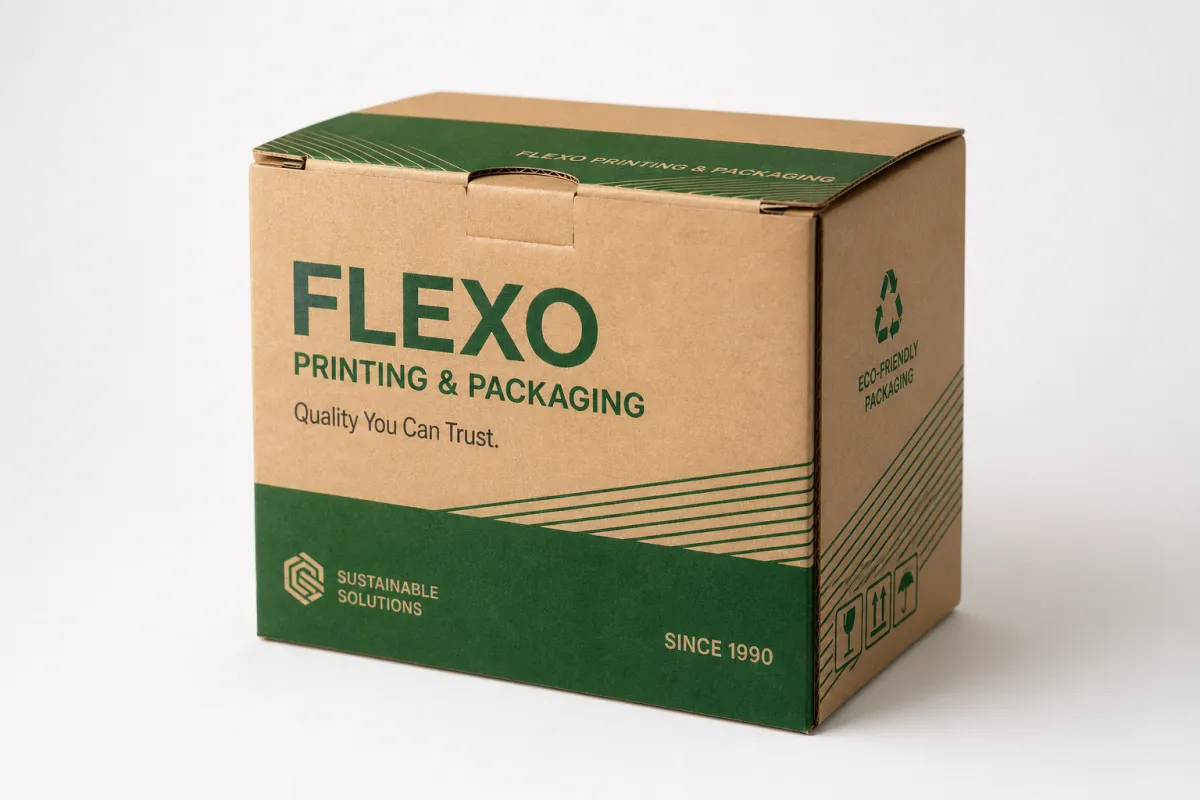
At the simplest level, custom flexographic printing boxes are cartons printed with a relief process. The image sits on a flexible plate, ink is transferred through a metered system, and the design lands directly on corrugated board or boxboard. That technical description matters less than the practical outcome: fast press speeds, strong branding, and a workflow built for volume rather than one-off artistry.
What surprises many buyers is how much engineering hides inside a box that looks ordinary. The flute profile, liner quality, board porosity, print coverage, glue areas, score lines, and stacking strength all affect the result. A buyer may ask for a "simple carton" and still end up negotiating among structure, graphics, transit performance, and budget. Packaging rarely lets you choose only one of those variables.
Custom flexographic printing boxes are commonly used for:
- Shipping cartons that carry a logo, handling marks, or marketing copy
- Retail packaging that needs shelf presence without a premium print method
- Subscription boxes that need consistent package branding across repeated shipments
- Food service packaging where speed and cost matter more than photo-level detail
- Branded transit boxes that support branded packaging without adding unnecessary finishing steps
Buyers choose this route for practical reasons. Flexography is strong on repeatability. It supports high-volume production with predictable ink behavior once the press is set. The economics improve quickly when setup costs are spread across thousands of units, not hundreds. A supplier might quote a far better unit price at 10,000 pieces than at 1,000, even if the board never changes, because plate and press setup are fixed costs that have to be paid somewhere.
There is a tradeoff, and it deserves an honest look. The finish is often cleaner than people expect, but it is not the same as offset printing or high-end digital printing. Flexo handles bold graphics, logos, large type, and direct branding very well. Tiny reverse text, high-detail photography, and soft gradients are less forgiving. That does not make flexo inferior. It makes it specific.
From a buyer's point of view, custom flexographic printing boxes are best understood as a production system, not only a decoration choice. Once that system is dialed in, it can move quickly and efficiently. The task is matching the system to the actual needs of the packaging program instead of trying to make the box behave like a magazine spread.
Are custom flexographic printing boxes right for your packaging program?
This is one of the most useful questions before anyone sends files. Custom flexographic printing boxes tend to outperform when the volume is stable and the design can stay consistent for at least a second run. If your next campaign requires monthly artwork swaps, short runs, or highly personalized inserts, custom carton printing and digital alternatives may avoid unnecessary setup cost.
The practical test is not “Which method is better?” It is “Which method protects quality, timing, and margin at your expected run length?” For many teams, a simple rule of thumb is this: if the design can be locked early and repeated, flexo usually works better; if the design changes constantly, the lead-time and reprint risk rise fast. In those situations, a different print model can be the safer path even if it costs more per piece.
There is also a branding question hiding underneath the math. Some boxes need to look premium. Others need to look reliable, tidy, and durable. Those are not the same job. I have seen brands spend too much trying to make a shipping carton behave like a luxury sleeve, only to discover that the customer mostly notices crushed corners and weak copy. The packaging has to earn its keep.
How Custom Flexographic Printing Boxes Are Printed
The production path for custom flexographic printing boxes begins long before ink reaches board. Artwork has to be prepared for the press, color-separated, checked against dielines, and reviewed for line weight, bleed, and registration. A file that looks perfect on a monitor can fail on corrugated substrate if the type is too thin or the gradients are too delicate.
The next step is plate creation. In flexo, each color generally needs its own plate. That means a one-color logo is simple, a two-color layout is manageable, and a four-color design adds cost, setup time, and registration risk. This is where many buyers lose money: they approve artwork first and think about the press later. For custom flexographic printing boxes, the press should shape the design from the start.
Once the plates are ready, the press crew mounts them, adjusts the anilox roll, and dials in ink transfer. The anilox roll matters because it meters the ink volume. Too little ink and the mark looks weak. Too much and the print can gain, smear, or slow drying. The substrate then runs through at speed, test impressions are checked, and production begins when registration and density are inside tolerance.
The workflow usually looks like this:
- Artwork preparation and dieline review
- Color separation and plate planning
- Plate making and proof review
- Press setup, registration, and density checks
- Production printing and drying
- Converting, die-cutting, scoring, and gluing
- Inspection, packing, and shipment
The good part is speed. Once the job is running, flexo is built to move. The less convenient part is that setup can be unforgiving for tiny runs. If a buyer only needs a few hundred cartons, the plate cost and setup time can overwhelm the savings. That is why custom flexographic printing boxes usually make more sense as quantity rises or as repeat orders become likely.
Common errors tend to appear in familiar places. Low-resolution files make the edges soft. Poor trapping can leave white gaps between colors. Artwork designed for coated paper may look heavier on corrugated board because the liner absorbs ink differently. Even the board surface matters: kraft liners, white-top corrugated, and recycled content boards all change how the image holds.
For buyers working with a supplier like Manufacturing Capabilities, it helps to ask early about plate counts, ink types, and whether the team prefers vector-based artwork or a layered PDF with a confirmed dieline. In flexo, those details save time later. They also save rework, which is usually where budgets start to unravel.
One often-overlooked decision is corrugated carton printing material strategy. Recycled content can be a quality and sustainability win, but it usually demands tighter proof review because absorbency changes the visual density. If your custom flexographic printing boxes include fine text or color-critical elements, asking for a press-ready specification sheet at the start is a better risk filter than waiting for production.
Key Factors That Change Print Quality and Cost
If you want to predict the performance of custom flexographic printing boxes, start with the substrate. Corrugated board is not a smooth, coated magazine sheet. It has texture, porosity, liner variation, and sometimes recycled content that changes absorbency. A kraft liner will usually mute color slightly compared with a white-coated top sheet. Recycled liners can still produce good results, but they may demand more careful ink control if the buyer wants crisp text and a stronger brand color.
Color complexity is the next major lever. A one-color job can be elegant and economical. A two-color design usually remains manageable. Once artwork moves into four colors or more, the plate count rises, registration becomes tighter, and the setup window gets longer. That is one reason custom flexographic printing boxes often look best with bold, efficient design rather than busy detail packed into every panel.
Print coverage matters too. Large solids use more ink, increase drying demands, and can reveal surface irregularities. Fine gradients are possible in some cases, but they are not the safest choice on corrugated stock. If the box is going into retail packaging, a buyer should think carefully about which elements need maximum visual impact and which can stay minimal. On a shelf, a sharp logo beats a crowded story most days.
Finishing adds another layer of cost and complexity. Die-cuts, window patches, varnishes, scoring patterns, glue lines, and coatings all change the final result. Some finishes are functional. Some are visual. Some are both. When buyers stack them together without a plan, custom flexographic printing boxes can become far more expensive than the original quote suggested. That is especially true when multiple small upgrades each look harmless in isolation.
Order volume remains the biggest cost lever. The fixed work of plate making, setup, and proofing does not change much whether the run is 1,000 or 10,000 pieces. That is why unit price can drop sharply as quantity rises. It also explains why two suppliers may give very different quotes for the same design. One is counting setup honestly. The other may be hiding it in a higher piece price.
Custom flexographic printing boxes also need to be judged by use case. For shipping cartons, a strong logo and clear handling marks may be enough. For shelf-facing Custom Printed Boxes, brand color control matters more. For food service packaging, ink migration, coating choice, and regulatory expectations can matter as much as the artwork. The design objective should always match the box's job, not the mood board.
For teams running flexographic packaging programs, it helps to compare print tolerance across the whole carton structure. If compression areas, scoring lines, or tear points are inconsistent, even great graphics lose credibility at receiving dock time. In that sense, print and structure quality are not separate conversations. They are one decision chain.
For many packaging teams, the biggest mistake is treating every box like a branding exercise. In practice, the best custom flexographic printing boxes balance visual identity with structural and shipping reality.
Anyone comparing options should also consider test expectations. Industry references such as ISTA help buyers think about distribution testing, while sourcing programs tied to FSC can matter for wood-based board traceability. Those standards do not design the box for you, but they do shape the spec conversation in a useful way. They also reveal whether a supplier is thinking about the whole package or just the print line.
Custom Flexographic Printing Boxes Pricing: What to Expect
Pricing for custom flexographic printing boxes is a stack of smaller decisions, not one single number. Plate charges, press setup, substrate selection, ink count, board grade, finishing steps, freight, and order volume all shape the final quote. A buyer who focuses only on unit price often misses the real cost of ownership. That mistake shows up later, usually in reprints, storage, or rush fees.
Here is the part that trips people up: two quotes can both say "flexo," but they may include very different scopes. One supplier might include proofing, plate storage, and normal freight assumptions. Another might price only the print run and add charges later for art changes, make-ready, or reprints. That is why comparisons need line-item detail. A price without context is just a number on a page.
A useful way to think about custom flexographic printing boxes is by volume band. The following table gives a realistic comparison framework, though actual numbers depend on board type, print coverage, and supplier structure.
| Print Method | Best Fit | Typical Strength | Indicative Cost Behavior |
|---|---|---|---|
| Flexographic printing | Medium to high-volume corrugated runs | Fast, efficient, repeatable branding | Higher setup, lower unit cost at scale |
| Digital printing | Short runs, variable art, frequent revisions | No plates, quick changeovers | Lower setup, higher unit cost as volume rises |
| Offset printing | Premium graphics on folding carton or laminated board | Fine detail and strong color control | Strong print quality, but not ideal for many corrugated jobs |
For a practical sense of pricing, many buyers see something like $0.18-$0.28 per unit for 5,000 pieces, depending on print coverage, board grade, and finishing. A smaller run can sit much higher on a per-box basis because setup costs are spread across fewer units. A larger repeat order can move the number down noticeably. That is the logic that makes custom flexographic printing boxes attractive for branded packaging programs with stable demand.
One useful field metric teams use is cost per thousand equivalent print units. If the job includes an extra varnish and two color changes, that figure can jump by as much as 20-30% from the baseline for some suppliers, even if the material itself is unchanged. In those cases, the right move is often not a full redesign. It is narrowing the printing intent to fewer colors and cleaner registration points.
Hidden pricing risks deserve attention. Rush fees are common when a launch moves faster than the art department. Plate revisions can cost more if dimensions are not final. Specialty inks, such as metallic or higher-opacity white, may add cost. If the box spec changes after approval, the supplier may need to restart part of the process. That is rarely cheap, and rarely popular with procurement teams.
Ask these questions before you approve the order:
- Who owns the plates after production?
- What is the reprint charge if the box needs another run?
- Does the quote include proofing and make-ready?
- Are freight and palletization included?
- Is the price based on one-sided or multi-color printing?
It also helps to compare suppliers on more than price. A box supplier with stronger Custom Packaging Products support may help you reduce waste through smarter board selection or simpler graphics. That can matter more than shaving a few cents off the unit cost. A cheap carton that causes damage or slows packing is not cheap for long.
For brands with sustainable sourcing requirements, the supply chain conversation may touch recycled content, FSC chain-of-custody paperboard, and waste management practices. The Packaging Corporation and broader packaging industry resources are useful starting points for understanding how material selection and production choices affect the final quote, but the exact economics still depend on the spec. Material decisions, more than most teams realize, often decide whether the budget holds or slips.
And yes, there are times when the quote feels annoyingly high for what looks like a "simple" carton. Usually, though, the hidden work is real: plate tooling, setup, board handling, and the cost of getting the first good sheet off the press. Packaging has a funny way of making the visible part look easy while the invisible part does the heavy lifting.
Production Timeline: From File Prep to Delivery
The timeline for custom flexographic printing boxes depends on how cleanly the project is managed. A straightforward one-color carton with final art in hand can move through proofing, plate making, and production fairly quickly. A complex multi-color retail box with dieline changes and a custom structure is a different story. In packaging, complexity multiplies time faster than most teams expect.
A realistic production path often looks like this: file review in 1-2 business days, proof approval shortly after, plate making in another few days, press scheduling once the board is available, then printing, drying, converting, packing, and freight. For a well-organized job, many suppliers quote something like 12-15 business days from proof approval. Some simple runs move faster. Some do not. The number changes with backlog, substrate availability, shipping distance, and the number of revisions.
The main bottlenecks are familiar. Artwork revisions are the most common delay. Missing dielines create back-and-forth that can stall the plate schedule. Late approvals push the job out of the press slot. If the chosen board is not stocked, the supplier may need extra lead time to source it. In other words, custom flexographic printing boxes reward organized buyers and punish last-minute guesswork.
Buyers should ask a few questions before they commit:
- How long does plate production take?
- How quickly can the supplier return a proof?
- Is the press already booked for the needed window?
- Does the supplier stock the required corrugated board?
- Will converting happen in-house or through a second vendor?
One overlooked issue is launch timing. Packaging rarely exists in isolation. If the carton misses a retail reset, a shipping campaign, or an ecommerce fulfillment window, the delay can ripple through sales and logistics. That is why custom flexographic printing boxes should be planned with extra buffer, especially for new product launches or seasonal programs. A delay of three days can become a warehouse problem, then a customer service problem.
There is also a quality-control angle. Buyers who use custom flexographic printing boxes for retail packaging may want a pre-production sample or press proof if the brand color is strict, the copy includes compliance text, or the artwork uses important visual cues. A proof cannot simulate every variable, but it can catch file errors before those errors become pallets of printed cartons. That alone can save a launch.
For businesses that already know their box sizes and are launching a repeat order, the smartest move is to lock the structure early and keep the artwork stable. That reduces plate churn, shortens the timeline, and makes inventory planning much easier. Stability is not flashy, but in packaging it often wins.
When timelines are mapped correctly, the process starts to look less risky. Teams using corrugated packaging for omnichannel fulfillment often see fewer disruptions because they combine the press schedule with receiving and packing windows instead of managing them separately.
Common Mistakes to Avoid With Flexographic Box Orders
The most expensive mistake with custom flexographic printing boxes is designing for the screen instead of the press. Screens make delicate gradients and tiny type look easy. Corrugated board does not always cooperate. Thin fonts can break up. Reverse text can fill in. Small logos can disappear into the board texture. A design that feels polished on a laptop may become muddy on production stock, and the press does not care how carefully the mockup was presented.
Color matching is another trap. Digital proofs can be useful, but they are not a perfect promise of press output because the board absorbs ink, the anilox selection matters, and ink film thickness changes the way a color reads. Buyers who expect exact on-screen equivalence often feel disappointed, even when the printed result is perfectly acceptable in the real world. That is why custom flexographic printing boxes need proof expectations that match the process, not the presentation software.
Spec mismatch causes avoidable waste. If the artwork is built before the box dimensions are final, you may end up paying for new plates, new proofs, or revised layout files. A half-inch change in a carton can affect panel ratios, barcode placement, and how much text fits on the side panel. For custom flexographic printing boxes, structure should usually be locked before final art approval. That order prevents expensive rework.
Inventory planning creates another kind of pain. Ordering too many boxes ties up cash and storage space. Ordering too few means you pay repeat setup charges sooner than expected. The right quantity depends on demand stability, shelf life, and whether the box is tied to a campaign or an always-on SKU. For custom flexographic printing boxes, the cheapest run is not always the smartest buy.
Finally, poor communication slows everything down. If one person approves the art, another checks the dimensions, and a third handles procurement, revisions can get lost. Approval chains should be clear. File names should be clear. Revision notes should be blunt and specific. This is especially true for custom flexographic printing boxes that have compliance text or retail-facing claims.
Here are the mistakes worth avoiding most aggressively:
- Using hairline fonts and tiny reverse text
- Assuming a monitor proof is a press proof
- Locking artwork before the box spec is final
- Ignoring plate costs and setup charges
- Skipping a clear approval chain
If the packaging carries real brand value, it is worth treating the box like a production asset rather than an afterthought. That mindset cuts waste and makes custom flexographic printing boxes easier to manage across repeated orders. Packaging usually behaves better once people start managing it like production, not decoration.
Expert Tips and Next Steps for Better Results
The best results from custom flexographic printing boxes usually come from a simple discipline: design the box around the process, not the other way around. Start with a print-ready dieline. Build the artwork around the actual folds, flaps, and glue areas. Then decide how much ink coverage the budget can support. That order matters more than most teams realize, and it changes the entire tone of the job.
Match artwork complexity to quantity. If the order is moderate, keep the design efficient. Strong typography, a clear logo, and one or two accent colors often outperform a crowded layout that is expensive to plate and harder to register. If the run is large and the box is central to the brand story, then a more ambitious layout may be worth the added setup. The right answer depends on the use case, not on design ego.
Ask for a sample or press proof when the box plays a major role in retail packaging or ecommerce unboxing. A sample can reveal practical issues that a screen mockup hides: whether the logo sits too close to a fold, whether the ink density feels weak, or whether the box needs a stronger contrast on brown board. For custom flexographic printing boxes, a little testing usually beats a costly surprise.
It is also smart to compare suppliers on the quality of their questions. A serious partner will ask about board grade, order volume, product fragility, storage constraints, and whether the boxes are going into shipping, display, or both. That kind of conversation is often more useful than a generic quote. It signals that the supplier understands the logic behind custom flexographic printing boxes, not just the artwork file.
Before you order, run a quick checklist:
- Confirm the final box dimensions and structure
- Approve the dieline before layout starts
- Check that colors are realistic for corrugated stock
- Compare at least two or three quotes
- Ask who owns the plates and what reorders cost
That is also the right time to review the broader packaging system. Could the same design logic apply to other formats in your product packaging line? Could one print strategy support multiple SKUs? Could the box be simplified without hurting shelf impact? Those are the questions that make procurement and branding work together instead of fighting each other. They also separate mature packaging programs from the ones that keep paying for avoidable revisions.
For brands looking to scale, custom flexographic printing boxes are usually strongest when the design, substrate, and run length all point in the same direction. If your team is ready to evaluate structure, print method, and repeat-order economics, a discussion with Custom Packaging Products can help narrow the options quickly. In many cases, the smartest next move is not a more complicated design. It is a cleaner one.
Custom flexographic printing boxes are not a catch-all answer, but they are a very good answer in the right lane. When the box is stable, the branding is consistent, and the order volume supports the setup cost, flexo gives buyers a practical balance of speed, value, and visual control. That is why it remains one of the most useful tools in modern branded packaging. The actionable takeaway is simple: lock the structure first, keep the artwork press-friendly, and compare quotes by total program cost rather than unit price alone. That is usually where the real savings are hiding.
Frequently Asked Questions
Are custom flexographic printing boxes cheaper than digital printing?
Usually yes for medium to high quantities because custom flexographic printing boxes spread setup costs across more units. Digital printing can be better for very small runs, frequent artwork changes, or highly personalized packaging. The only fair comparison is a side-by-side quote using the same board, dimensions, print coverage, and quantity.
How many custom flexographic printing boxes do I need before the price makes sense?
There is no single threshold, but custom flexographic printing boxes usually become more attractive as volume rises and the artwork stays stable. The break-even point depends on plate costs, number of colors, and the supplier's setup fees. If you expect repeat orders, flexo often becomes more economical because the initial setup is reused and the learning curve is paid only once.
What file format works best for custom flexographic printing boxes?
Vector-based artwork is usually preferred because it keeps text and line art sharp at press scale. Suppliers often want a layered PDF or native design file plus a final dieline with exact dimensions. Before you send files, confirm font outline rules, color specs, bleed requirements, and any restrictions that affect custom flexographic printing boxes.
Can custom flexographic printing boxes handle full-color artwork?
Yes, but full-color designs may require more plates, tighter registration, and a higher setup cost. Simple brand marks, one- to four-color graphics, and bold type usually perform best. For photo-heavy artwork, ask the printer how the substrate and anilox setup will affect detail on custom flexographic printing boxes.
How long do custom flexographic printing boxes take to produce?
Timing depends on proof approval, plate making, press availability, and box complexity. Straightforward orders can move quickly, while complex jobs with custom structures or revisions take longer. Build in extra time for approvals and freight so custom flexographic printing boxes do not hold up launch or fulfillment.
What should I prioritize first if I am planning a new packaging run?
Start with the final box size and structure, then approve the dieline before artwork begins. After that, choose the print method based on volume, color count, and how often the design will change. If you do those three things in order, custom flexographic printing boxes are much easier to price, schedule, and produce without drama.