Buyer Fit Snapshot
| Best fit | Waterproof Label Printing Cost projects where brand print, material claims, artwork control, MOQ, and repeat-order consistency need to be specified before quoting. |
|---|---|
| Quote inputs | Share finished size, material target, print colors, finish, packing count, annual reorder estimate, ship-to region, and any compliance wording. |
| Proofing check | Approve dieline scale, logo placement, barcode or warning zones, color tolerance, closure strength, and carton packing before bulk production. |
| Main risk | Vague material claims, crowded artwork, missing packing details, or unclear freight terms can make a low unit price expensive after revisions. |
Fast answer: Waterproof Label Printing Cost: What Really Drives Pricing should be specified like a repeatable production item. The safest quote records material, print method, finish, artwork proof, packing count, and reorder notes in one written spec.
Production checks before approval
Compare the actual filled-product size with the drawing, then confirm tolerance on folds, seals, hang holes, label areas, and retail display edges. Reserve space for logos, QR codes, warning copy, and material claims before decorative graphics fill the panel.
Quote comparison points
Review material grade, print process, finish, sampling route, tooling charges, carton quantity, and freight assumptions side by side. A quote is only useful when the supplier can repeat the same color, closure quality, and packing count on the next order.
Waterproof label printing cost is not just the price of ink and a roll of stock; it is the price of keeping a label readable, attached, and presentable after condensation, refrigeration, handling, and shipping have all done their work. I have watched labels look perfectly fine on a clean bench, then curl in a cooler, smear after a wipe-down, or lift at the corners before the product even made it to shelf. That kind of failure is not just annoying. It gets expensive fast.
The real question is not simply how much the label costs to print. It is what the label costs to survive until the product is used, sold, or stored. That is why waterproof label printing cost should be judged as a system cost: substrate, adhesive, print method, finishing, size, quantity, and the actual environment on the package all matter together. If any one of those is mismatched, the cheapest quote can turn into the priciest mistake.
Waterproof label printing cost: why the cheapest label can cost more
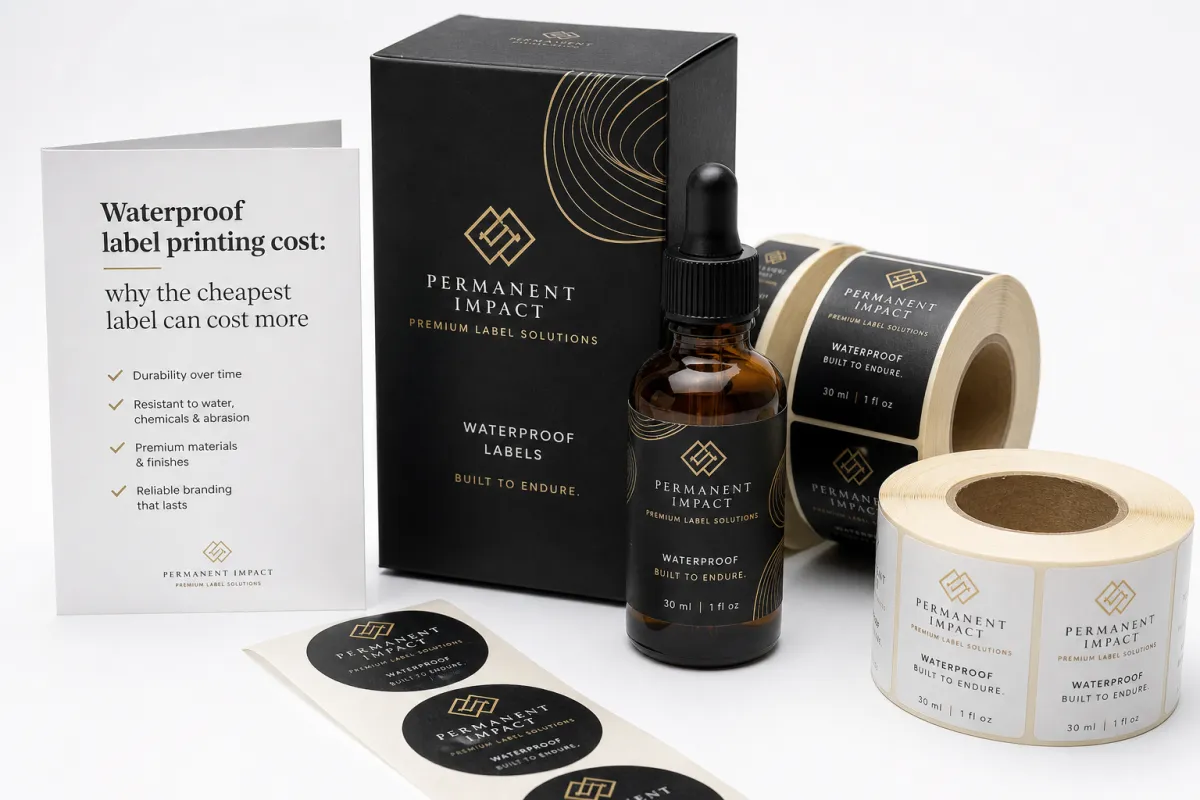
Most buyers have seen this problem unfold. A label looks perfectly acceptable on a dry sample, then it goes into a cold room, a chilled display, or a wash-down area and the edges begin to lift while the ink starts to look tired. If you are shipping into a cooler, that label is gonna tell the truth pretty fast. The reprint is only part of the damage. Someone still has to relabel product, inventory gets interrupted, and the brand takes a hit because the package no longer looks cared for. That is why waterproof label printing cost should always be compared against the cost of failure, not just the lowest quote.
The cheapest sticker is often the most expensive choice in the full production flow. A bargain paper label with a weak adhesive may save pennies at purchase, but if it fails after one cooler cycle, that low price disappears quickly. Buyers often focus on the printed face only, yet waterproof performance depends on the whole construction: the film or synthetic face stock, the adhesive bond, the ink system, and the protective finish all influence waterproof label printing cost.
For a packaging buyer, the better mental shift is simple. Instead of asking, "How low can the unit price go?" ask, "What does it cost to keep this label looking right through storage, transport, and use?" That question usually leads to better decisions because the answer often points toward the lightest durable construction that fits the environment rather than the flashiest premium build. In practice, waterproof label printing cost should be matched to risk, not guessed from a sample that never left the table.
The most expensive label is the one that fails after filling, shipping, and one cold-case cycle.
That does not mean every product needs a heavy laminate or an ultra-tough synthetic. It means the label spec should be tied to the package reality. A jar that sits on a dry shelf needs a different build than a bottle pulled from ice water, and both of those need different things than a pouch that sees oily hands during filling. Smart buyers reduce waterproof label printing cost by right-sizing the construction, not by guessing lower.
If you are sourcing labels across several SKUs, start by grouping products by environment: dry ambient, chilled, frozen, wash-down, and oil exposure. That simple classification often shows where a modest film label is enough and where a stronger adhesive or protective finish is necessary. It also helps the supplier narrow down the right material family, which keeps waterproof label printing cost aligned with the real use case.
What makes a waterproof label truly waterproof
A true waterproof label is not a single material, and that point matters more than many buyers realize. It is a combination of face stock, adhesive, print method, and finishing. If one layer is weak, the whole label can fail. That is why waterproof label printing cost moves up or down based on the whole build, not just the printed image.
The most common face stocks are BOPP, polyester, and coated synthetic papers. BOPP is widely used because it handles moisture well, prints cleanly, and usually keeps the waterproof label printing cost within a practical range for food, beverage, health, and household goods. Polyester is tougher and better for abrasion, heat, and chemical exposure, but it often raises the cost. Coated synthetic papers can sit somewhere in the middle, depending on the coating and the level of protection needed.
Adhesive selection matters just as much. A permanent acrylic adhesive is a common choice for chilled products, while a freezer-grade adhesive is better when labels must bond in very low temperatures. A removable adhesive can work for reusable containers, but it is not the right answer for every waterproof application. If the package surface is curved, textured, dusty, or oily, that changes the equation again. So yes, adhesive choice directly affects waterproof label printing cost, but it also determines whether the label stays put.
Ink and print method also matter. Digital printing is often the best fit for shorter runs and variable data, especially when artwork changes often. Flexographic printing is usually more efficient on larger runs, especially when colors are repeated and the label size is standardized. Offset printing still has a place in some label and packaging workflows, but the finishing system and substrate selection usually decide whether the label is suitable for moisture-heavy use. If a supplier cannot explain how the print system will hold up to condensation or cleaning, that is a warning sign for waterproof label printing cost and for performance.
Topcoats, laminates, and varnishes add another layer of protection. A gloss laminate usually improves scratch resistance and wet durability better than a light varnish alone. A matte laminate may be preferred for premium shelf appearance, though it can show scuffing differently. Spot varnish can highlight graphics, but it is not the same thing as full protection. The right finishing choice is part of managing waterproof label printing cost without overbuilding the label.
For buyers comparing options, it helps to think in terms of expected exposure:
- Splash and handling only - A simple synthetic label may be enough.
- Cold condensation - A moisture-safe adhesive and film face stock become important.
- Ice buckets or wash-down - Lamination or a stronger protective finish usually makes sense.
- Chemicals or abrasion - Polyester and more aggressive finishing often justify the higher waterproof label printing cost.
If you want a broader look at durability standards and packaging testing language, the International Safe Transit Association publishes widely used transit test methods at ista.org, and packaging professionals often reference guidance from packaging.org. Those resources are useful because they remind buyers that a label should be judged in the context of transport, handling, and shelf life, not only on a sample sheet. A label that survives a good-looking proof but fails under real use was never a bargain.
One practical caution: waterproof in label terms usually means moisture-resistant under the intended use, not guaranteed survival under long-term immersion unless the build has been tested for that condition. That distinction matters a lot, especially if the package will live in ice, sit in a wet bucket, or face repeated cleaning.
Waterproof label printing cost factors that change your quote
Material is the first driver. BOPP usually keeps waterproof label printing cost in a reasonable range for many consumer goods. Polyester moves that number up because it is tougher and often chosen for harsher conditions. Coated synthetic paper can be a middle-ground option if the product environment is not extreme. The material decision alone can change the quote more than many buyers expect.
Label size and shape come next. A simple rectangle is easier to convert than a custom contour with narrow corners, tiny internal cutouts, or elaborate shapes that require tight registration. More complex dies increase setup time and waste, which raises waterproof label printing cost. Larger labels also consume more material per piece, so even a plain design can become more expensive if the footprint is large.
Color count matters too. A straightforward CMYK layout may be fine for many brands, especially in digital printing jobs where short-run flexibility matters. On larger orders, spot color matching can improve consistency, especially for brand colors that need to stay stable across repeat production. More colors, richer coverage, and heavier ink lays can all affect waterproof label printing cost, particularly when print coverage is high across the full face.
Finishing is another major lever. A gloss laminate or heavy protective coating increases durability, but it also adds material and labor. If the label only needs to withstand brief moisture contact, a lighter finish may be enough. If the product is likely to be iced, washed, or handled with wet hands, a stronger finish may be worth the added waterproof label printing cost. A lot of buyers try to shave that line item first, then spend more fixing labels that failed too early.
Quantity affects everything. Short runs usually carry a higher unit cost because setup, proofing, and conversion time are spread across fewer labels. As volume rises, waterproof label printing cost usually falls on a per-label basis. That is why the same construction can look expensive at 500 pieces and very reasonable at 5,000.
Special requirements add more cost, but they also solve real problems:
- Freezer-grade adhesive - Needed for cold-chain or frozen storage.
- Chemical-resistant topcoat - Useful for cleaning products and industrial items.
- Variable data - Batch codes, serial numbers, or QR codes may increase handling.
- Heavy lamination - Improves abrasion resistance, but raises waterproof label printing cost.
- Custom die cuts - Improve shelf presentation, but can increase setup time and waste.
Digital printing and flexographic printing also behave differently on the production side. Digital printing usually shines in shorter runs because you avoid plates and can adjust artwork quickly. Flexographic printing typically becomes more efficient once quantities rise and the artwork stays consistent. Offset printing can be part of a broader packaging program, but for roll labels that need to stand up to moisture, the substrate and finish decisions usually affect waterproof label printing cost more than the ink method alone.
Standardizing dimensions across product lines is one of the best ways to cut cost without hurting performance. If three SKUs can share one label size, setup becomes simpler, waste is easier to manage, and the order can often achieve a better unit cost. That kind of planning has more effect on waterproof label printing cost than trimming a few pixels off the artwork.
| Construction | Best for | Typical MOQ | Unit cost at 1,000 pcs | Unit cost at 5,000 pcs | Notes |
|---|---|---|---|---|---|
| BOPP with digital print | Beverages, bath, food, general moisture exposure | 250-500 | $0.18-$0.35 | $0.07-$0.16 | Good balance of appearance and waterproof label printing cost |
| Polyester with laminate | Abrasion, chemicals, cold storage, equipment labels | 500-1,000 | $0.25-$0.45 | $0.10-$0.22 | Higher durability, usually higher waterproof label printing cost |
| Coated synthetic paper | Light moisture, retail packaging, short to medium runs | 500+ | $0.12-$0.28 | $0.06-$0.14 | Can be a sensible middle ground for some waterproof label printing cost targets |
| Freezer adhesive plus laminate | Cold-chain, refrigerated foods, frozen goods | 1,000+ | $0.30-$0.60 | $0.14-$0.30 | Built for adhesion under tough conditions; usually the highest waterproof label printing cost |
Those numbers are illustrative, not a promise. Still, they show an important pattern: waterproof label printing cost is not one number, because the build changes with exposure, quantity, and finish. A buyer who understands that pattern can make smarter tradeoffs and avoid paying for features that the product never uses.
Pricing, minimum order quantity, and how waterproof label printing cost is built
Waterproof label printing cost is built from several smaller pieces, and the quote makes more sense once you see them separately. There is the material itself, the print time, any plates or die setup, the finishing step, proofing, packing, and freight. If a supplier gives only a final unit number without showing the structure behind it, you are missing the part that tells you how to improve the quote next time.
Minimum order quantity, or MOQ, exists because every press run carries setup work. A digital job may support a lower MOQ because it avoids plate making and can move quickly between designs. A flexographic run usually wants a bigger volume to spread its setup over more labels. If the label requires a special die, a freezer adhesive, or multi-step finishing, the MOQ can rise. That is not always a penalty; often it is just the reality of making the job efficient and stable. Still, MOQ has a direct effect on waterproof label printing cost.
A useful way to think about price is to separate unit cost from total project cost. The unit number can look attractive, but if it comes with extra die charges, freight, or an order quantity that creates shelf inventory you do not want to hold, the true project cost may be higher than expected. Buyers who compare total landed cost usually make better decisions than buyers who stare only at the sticker price. That is especially true for waterproof label printing cost, because durability features tend to show up in multiple line items.
Volume breaks are where the math becomes more favorable. If you need 2,000 labels, the per-label price may be close to a 1,000-piece run. If you step up to 5,000 or 10,000, the unit cost often drops enough to justify stocking a little extra. That said, overbuying can create waste if artwork changes often or if product dimensions are still being refined. The right answer is a balance between inventory risk and waterproof label printing cost.
Here is a simple budgeting frame that works well in practice:
- Low quantity - Best for test products, seasonal items, and changing artwork, but the waterproof label printing cost per label is usually higher.
- Mid quantity - Often the sweet spot for many brands, with better unit cost and manageable inventory.
- Higher quantity - Best when the artwork is stable and the label construction will stay in use for a longer run.
For brands with several package types, one of the smartest savings moves is to standardize label width or height where possible. Even small simplifications can reduce setup, lower waste, and improve press efficiency. That has a direct effect on waterproof label printing cost, especially if you are buying on a regular schedule.
Exact quote accuracy depends on five details that should never be skipped: label dimensions, quantity, substrate, finish, and application environment. If a buyer leaves out the fact that the label will live in a cooler, get handled with wet hands, or face oil and cleaning agents, the first quote may understate the real waterproof label printing cost. A good supplier will ask those questions before pricing the job, and if they do not, that is a sign to pause and fill in the blanks yourself.
Process and timeline for custom waterproof labels
The process usually starts with artwork review. A printer looks at the dieline, image resolution, color setup, copy, and any special elements such as barcodes or variable data. If the file is ready, the job can move quickly. If the file needs adjustments, that adds time and can also affect waterproof label printing cost if multiple proof rounds are needed.
Material selection follows. A good vendor earns trust here because the right recommendation is not always the fanciest one. A label for a retail bottle that sits in a refrigerated case does not need the same build as a label for a chemical spray or a frozen food pouch. The right material family can save money while still surviving real use. If the supplier recommends a lighter film, a different adhesive, or a simpler finish, that advice may reduce waterproof label printing cost without hurting performance.
Proofing deserves real attention. A digital proof can help verify layout and copy quickly, but a physical sample is often better if moisture, condensation, or refrigeration are part of the package environment. In some cases, a buyer should request a short test before full production, especially if the label will be exposed to wet handling, cold cycling, or repeated contact. That small delay may prevent a far larger cost later, which is why proofing belongs inside the waterproof label printing cost conversation.
Common timeline drivers include:
- Print-ready files - Clean artwork shortens the schedule.
- New die - Custom cut shapes can add lead time.
- Special laminate or coating - Extra finishing steps affect the schedule.
- Adhesive selection - Freezer or specialty adhesives may narrow material options.
- Final approval speed - Delays in proof approval usually slow the job more than production itself.
For many custom labels, a simple digital job can be completed faster than a more complex laminated run. A practical window might be several business days for a straightforward order and longer for specialty constructions, though every shop runs differently. The point is not to promise a universal date. The point is to understand which choices affect both schedule and waterproof label printing cost.
If you are planning launch inventory, give the supplier the in-hand date, quantity, label dimensions, and application surface details all at once. That helps them estimate the true production path and avoid back-and-forth. It also keeps waterproof label printing cost tied to the real job rather than a rough placeholder.
From a production standpoint, a well-prepared order is easier to quote, easier to print, and less likely to create surprises. Clear specs do not just speed things up; they also protect your budget. That part is boring, but it works.
Why choose Custom Logo Things for waterproof label printing
At Custom Logo Things, the real value is in matching the label construction to the package environment instead of pushing every customer into the most expensive build. That matters because waterproof label printing cost should be driven by use case, not by guesswork. A label that lives on a refrigerated beverage, a personal care bottle, or a reusable container may each need a different solution, and the right answer is rarely the same across all three.
Technical guidance matters here. A buyer may know the artwork and the brand standards, but still need help deciding between BOPP and polyester, or between a gloss laminate and a simpler protective finish. Good packaging support should explain what each option does in plain terms: which one improves scratch resistance, which one handles condensation better, which one lowers the overall waterproof label printing cost, and which one would be overbuilt for the product.
Consistency is another real advantage. If a brand orders labels repeatedly, the construction needs to stay stable from run to run. Color, adhesive behavior, and finish should not wander just because the next production cycle arrived. That repeatability protects shelf appearance and helps buyers forecast waterproof label printing cost over time rather than treating each order as a surprise.
For brands that also need other packaging components, the internal product range can help streamline sourcing. It is often easier to keep a label and tag program organized when the vendor understands broader packaging needs such as shape, format, and application. If you are comparing a few packaging paths, the team can also coordinate across Custom Labels & Tags and related jobs without losing sight of durability or budget.
That kind of support matters even more when lead time is tight. Buyers do not need vague language; they need a supplier who can say whether a quote requires a new die, whether a film stock is available, and whether a finish will push the schedule. Clear communication keeps waterproof label printing cost realistic and helps the project move without avoidable rework.
Strong packaging support should also be honest about standards and testing. If a label is meant for tough transit or recurring handling, a supplier should be comfortable discussing basic adhesion, wear, and distribution expectations. Those conversations are more useful than sales language because they connect the label to the package environment in a concrete way. That is the kind of thinking that keeps waterproof label printing cost anchored in performance.
For teams that want to see how a supplier handles different formats and production methods, our Manufacturing Capabilities page gives a practical overview of the kinds of jobs that can be handled and the production choices that influence final output. That is often the fastest way to determine whether a label idea fits the budget and the application.
Next steps to get an accurate waterproof label printing cost
The fastest way to get a solid quote is to send complete information the first time. Start with the exact label dimensions, then add quantity, shape, material preference, finish preference, and the surface the label will stick to. If the product will face condensation, cold storage, freezer conditions, oil, frequent handling, or wash-down, say so clearly. Those details change waterproof label printing cost in ways that a generic request never can.
Artwork files matter as much as the spec sheet. A final dieline, print-ready PDF, and any brand color references help reduce delays. If the artwork still needs work, mention that up front so the quote reflects both production and prepress needs. A vague file package can create hidden steps, and hidden steps tend to push waterproof label printing cost upward.
It also helps to decide what the real priority is before requesting pricing. Is the goal the lowest unit price, the fastest lead time, or the most durable construction? Those are not always the same answer. A label that has to survive ice, moisture, or cleaning chemicals may need a better film and finish, while a simpler retail package may do fine with a lighter build. Clear priorities make waterproof label printing cost easier to evaluate.
If you are unsure whether to request a proof or a sample, choose the proof when the environment is demanding. A modest test is often worth the time if the label must perform in refrigeration, on curved surfaces, or during repeated handling. That extra step can reveal adhesive or finish issues before production begins, which protects both schedule and waterproof label printing cost.
Here is a simple checklist to send with your quote request:
- Label size and shape
- Quantity and repeat order expectation
- Application surface, such as glass, plastic, metal, or coated board
- Storage conditions, including dry, refrigerated, frozen, or wash-down
- Finish preference, such as gloss, matte, or laminate
- Any barcode, batch code, or variable data needs
If you want the quote to be accurate, do not hide the hard parts of the job. The better the input, the better the pricing. That is especially true for waterproof label printing cost, because durability depends on details that are easy to miss in a rushed request. Buyers who provide complete specs usually get better answers, fewer surprises, and a cleaner production path.
One final practical note: compare specs, not just numbers. A lower quote with a weaker adhesive, a thinner film, or no protection may look appealing until the first cooler run or wipe-down. A better comparison is the one that asks what the label must survive and how long it must stay presentable. That is the real yardstick for waterproof label printing cost. If you send the right details up front, you stop paying for guesswork and start paying for the label you actually need.
How much does waterproof label printing cost per label?
The per-label price depends on size, material, quantity, print method, and finish, so the only reliable figure comes from a spec-based quote. Smaller orders usually carry a higher waterproof label printing cost per label because setup and finishing are spread across fewer pieces, while larger runs usually improve unit cost. If you see a quote that looks unusually low, check whether the construction is actually suitable for moisture, cold storage, or abrasion.
What materials lower waterproof label printing cost without sacrificing durability?
BOPP is often a strong value choice for moisture exposure, and it works well on many bottles and jars. Synthetic stocks can also perform well, but the best option depends on the surface, the product environment, and whether you need a laminate or other protective finish. The lowest-cost option is the one that survives the real use case, not the one that looks cheapest on paper, so waterproof label printing cost should always be judged against performance.
Does laminating labels always increase waterproof label printing cost?
Yes, lamination usually adds cost because it adds material and an extra production step. Even so, it can be worth it when the label needs scratch resistance, chemical protection, or a longer shelf life. If the product only sees light moisture, a simpler build may be enough, which helps control waterproof label printing cost. The key is not whether laminate sounds premium; it is whether the product actually needs that extra layer.
What is the typical MOQ for waterproof label printing?
MOQ depends on the print method, label size, and whether a custom die is required. Short-run digital jobs can support lower quantities, while higher-volume production usually improves unit pricing. A good quote should show both the minimum order and the price breaks for larger volumes so you can see how waterproof label printing cost changes as quantity rises.
How can I reduce waterproof label printing cost on my next order?
Standardize label dimensions across product lines where possible, choose the lightest construction that still handles the actual environment, and approve artwork quickly so you do not trigger new setup work. If you want the most accurate result, send the exact size, quantity, substrate, finish, surface type, and storage conditions together; that is the fastest path to a useful waterproof label printing cost quote. In plain terms, better specs beat bargain-hunting every time.


