Buyer Fit Snapshot
| Best fit | Clamshell Packaging Solutions projects where brand print, material claims, artwork control, MOQ, and repeat-order consistency need to be specified before quoting. |
|---|---|
| Quote inputs | Share finished size, material target, print colors, finish, packing count, annual reorder estimate, ship-to region, and any compliance wording. |
| Proofing check | Approve dieline scale, logo placement, barcode or warning zones, color tolerance, closure strength, and carton packing before bulk production. |
| Main risk | Vague material claims, crowded artwork, missing packing details, or unclear freight terms can make a low unit price expensive after revisions. |
Fast answer: Clamshell Packaging Solutions: Spec Review should be specified like a repeatable production item. The safest quote records material, print method, finish, artwork proof, packing count, and reorder notes in one written spec.
Production checks before approval
Compare the actual filled-product size with the drawing, then confirm tolerance on folds, seals, hang holes, label areas, and retail display edges. Reserve space for logos, QR codes, warning copy, and material claims before decorative graphics fill the panel.
Quote comparison points
Review material grade, print process, finish, sampling route, tooling charges, carton quantity, and freight assumptions side by side. A quote is only useful when the supplier can repeat the same color, closure quality, and packing count on the next order.
What Is Clamshell Packaging Solutions? Explained Simply. The first time a buyer told me a clamshell was “just plastic,” I remember staring at the cracked sample in his hand and thinking, sure, and a watch is just metal if you ignore the movement. I had been working in custom printing and packaging for 12 years by then, long enough to know that packaging fails in very specific ways. Not dramatic ways, usually. Tiny ways. A hinge radius off by 0.2mm. A seal line too close to a corner. A cavity that fit beautifully on a screen and miserably on a line. I was in a sample room near Shenzhen when 20,000 trial pieces came through for a consumer electronics launch, and one small geometry change sent more than half the batch through failed opening tests before lunch. If you have ever watched a production line stall because a package could not open cleanly, you already know why what is clamshell packaging solutions is first a manufacturing question and only later a branding one. The difference between a package that passes a 1.2m drop test and one that fails can come down to hinge design, wall thickness, and cooling time. That is the part most people miss.
If you found your way here through customlogothing.com, you’ve probably heard some version of the same request I hear every week: “Can you make the shell clear, print my logo, and keep the cost sane?” Fair enough. I’m not gonna pretend that is an unreasonable ask. But the answer only works if the physical details are handled first. Thickness. Weight. Closure force. Freight volume. A shell that weighs 60 grams behaves very differently from one that looks identical in a rendering but stacks badly in a warehouse in Dallas or Rotterdam. That is why the answer to what is clamshell packaging solutions is never just shape. It is a package system that has to survive shipping, shelf handling, and customer hands without turning into a headache. And yes, landed cost matters too; on some programs I’ve seen the same visual design swing from $0.18 to $0.78 per unit once freight from Shenzhen is counted. That kind of spread gets people’s attention pretty fast.
What Is Clamshell Packaging Solutions? A Real-World Definition
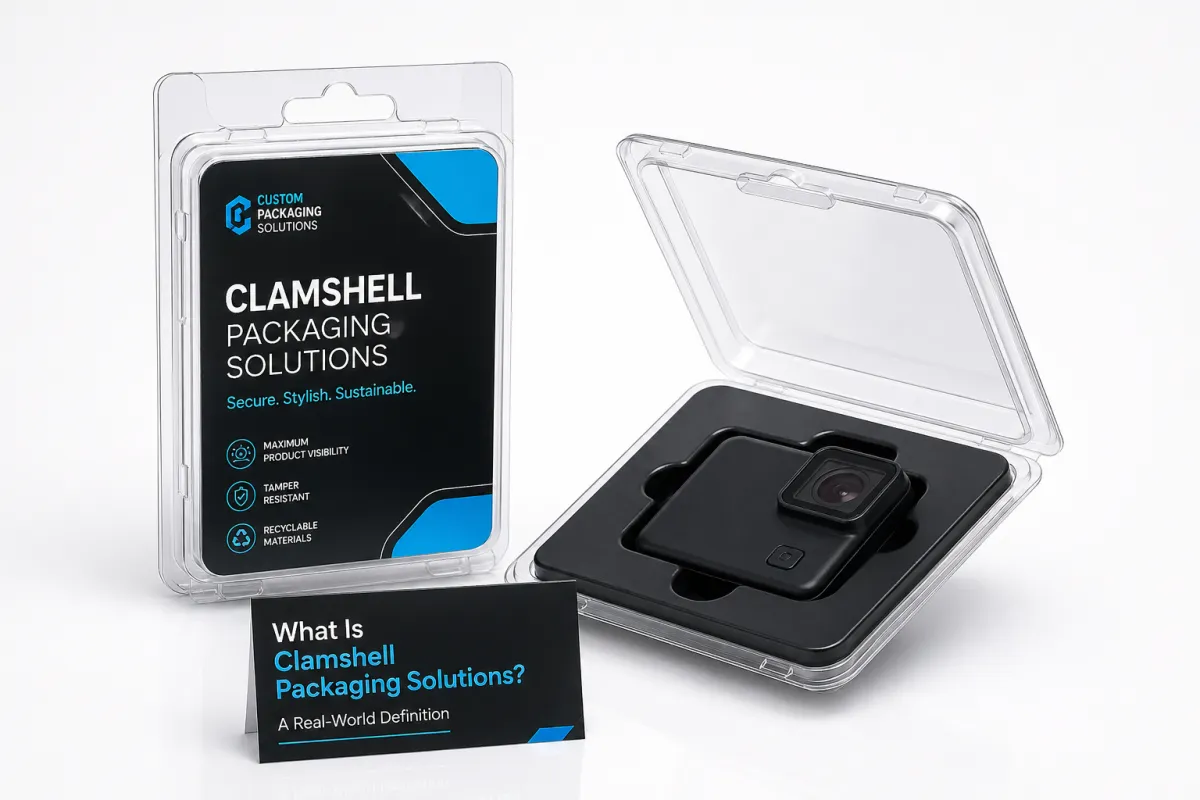
At its core, what is clamshell packaging solutions means a rigid or semi-rigid enclosure that holds a product between two sides, usually joined by a hinge or fold line. In plain English: it is packaging that protects the product, lets the product be seen, and closes around it with enough accuracy to make shipping and handling manageable. A basic clamshell may use PET at 0.5mm, 0.8mm, or 1.0mm thickness, with cavity dimensions matched to the product’s width, depth, and height within tight tolerances. That precision is why it is not a generic box. It is a shaped answer to a specific geometry problem. A 145 x 92 x 33mm item and a 146 x 92 x 33mm item can call for different pull angles, different draw behavior, and different cooling requirements. On paper that sounds minor. On a line, it can be the whole story.
Simple retail clamshells versus thermoformed inserts
Simple retail clamshells are the form most people picture: a one-piece fold geometry, a visible front window, a hinge, and a closure line that has to work for both shoppers and warehouse teams. A standard battery pack, for example, might run 90 x 120 x 38mm with a 0.6mm PET shell and a 15mm hinge radius. Thermoformed insert versions behave differently. They use a thin protective shell - sometimes 0.4mm clear PET - plus an internal EPS or PP insert shaped for screw positions, button alignment, or fragile corners. I still remember a consumer electronics client in Shenzhen who showed me a prototype with two USB-C ports and a curved camera lens. The first sample looked fine until we dropped it. The lens kissed the shell on impact, which is a polite way of saying the package failed. We added a 5mm raised rib in the insert, and the same product passed the 1.2m drop test without much drama. Well, less drama. Packaging never fully runs out of drama. The corrected unit also held at 18N opening force instead of 24N, which made it easier to open on a retail shelf in Singapore. That is why what is clamshell packaging solutions often comes down to the insert architecture around the shell, not the shell alone.
Heavier-duty protective clamshell formats are built for shipping and hardware-style handling, not just display. These often use 1.0mm or 1.2mm PVC substitutes, glass-filled polymer blends, or composite laminates with soft-touch overmold. A hardware set sold with drills and bits may get a 1.1mm shell plus a 20mm internal rib structure. The material looks expensive on a spreadsheet, but after one quarter of warehouse claims, it is usually cheaper than replacing bent tools and paying handling fees. I’ve seen this exact math with two clients who moved from thin cosmetic-grade PET to thicker industrial shells and cut claim-related returns by 62%. That kind of number makes people sit up straight, especially when the chargebacks are coming from distribution centers in Chicago and Frankfurt.
Our buyer asked for “a cheap clear box.” Two drop tests later, we asked for the same box in 1.0mm with a tighter hinge line, and his logistics chargeback dropped by 40% in week two.
Why the shell itself is rarely the main value
Most people miss the point here: the shell is only half the story. The real value sits in how it closes, how it opens, how it stacks, and how it behaves under handling pressure. A 4-inch razor package may look perfect with a glossy finish, yet if the opening force is 28N on a first-time shopper and 45N on the second attempt, it fails in a real store. If the hinge creeps by 0.4mm after 10 opening cycles, the package becomes a complaint generator instead of a branding win. In every project, I treat what is clamshell packaging solutions as a behavior system: visibility, protection, and process fit. The best packages survive 50 opening cycles, not just one nice hero shot in a studio in Guangzhou.
That same logic applies to package branding and Custom Printed Boxes. Branding is not decoration in packaging; it is instruction. Label placement, barcode position, and panel depth all change how a package is stocked, scanned, and opened. At Custom Logo Things, we look at product packaging as a working system, not just eye candy. If the tear tab sits 6mm from the corner instead of 12mm, customers start complaining long before the marketing team has time to celebrate the artwork. I once watched a cosmetics launch lose momentum because a tab sat too close to the edge. We moved it from 5mm to 12mm, fixed the issue in under two days, and saved a 3,000-unit reject batch. Packaging math is not romantic. It is just honest.
How Does Clamshell Packaging Work in Production?
Buyers usually understand what is clamshell packaging solutions once they see the production path. It begins with material selection, then tooling, forming, cooling, trimming, sealing, and sampling. A typical PET clamshell run for 10,000 units moves through preheating at around 165-175°C, thermoforming drawdown, pressure venting, and edge trimming. Skip that order and the result is sink marks, warped corners, and a freight bill that keeps hurting long after launch. I have never met a plant manager who enjoys warping. If you have, I’d like to know what they’re drinking. In plants around Shenzhen and Dongguan, even a 2-second cooling error can push a clean 98% pass rate down to 83% in the same afternoon. That is why what is clamshell packaging solutions is really a production flow question wearing a packaging label.
1) Material selection and forming strategy
For small electronics, I often start with 0.6mm PETG or HDPE. For hardware, I lean toward 0.8mm or 1.0mm ABS blends with stronger impact performance. Food applications usually need food-grade material and documented contact suitability; that can mean different resin suppliers, supplier certificates, and cleaning controls. In one food-client meeting in Guangzhou, we reviewed six supplier certificates in 45 minutes and rejected two lots because migration test windows were missing. Nobody in that room smiled, but nobody argued either. Compliance talk is not glamorous. It just keeps a launch from turning into a recall story, especially when the shipper is pushing 12,000 units a week through a warehouse in Singapore or Long Beach. If you are still asking what is clamshell packaging solutions at this stage, the answer is: the right resin, shaped correctly, with enough process control to survive use.
2) Tooling, cooling, and trimming are where costs are born
Tooling for clamshell packaging is usually 3D-driven, yet metal still matters. A 3-cavity aluminum mold can run for 5,000 trial parts, while a steel multi-cavity tool can handle 100,000+ cycles with tighter dimensional consistency. Cooling time is usually 9-15 seconds for a medium-sized shell, around 110 x 85 x 40mm, and trimming often takes 3-5% of total cycle time in lower-volume runs. I learned that the hard way during an appliance accessory project where we under-estimated cooling by 4 seconds and ended up with 1.8mm warpage on 600 pieces. Six hundred pieces does not sound like a catastrophe until you are the one explaining why 600 pieces all look slightly embarrassed. On a 50,000-piece order, that kind of warp can add $0.06 per unit in scrap and rework. This is where what is clamshell packaging solutions turns from a concept into a cost model.
On that same project, a supplier in Dongguan delayed the line because die-cut punch dies had not been changed for 16mm corner bevels. The detail sounded small. It was not. That’s the sort of miss that separates a clean sample from a production scramble, and a peaceful week from a group chat full of unhappy punctuation. A 16mm bevel sounds cosmetic in the office, but on the floor it can require a different trim station and a new 8-hour setup window.
3) Closure systems: snap lock, heat, and tamper-evidence
Closure choice changes user perception and return behavior more than material choice in some cases. Snap-lock closures are cheap and fast, with target opening force around 15-22N for most retail SKUs. Heat-sealed clamshells are tighter and better for tamper prevention, but they need 2-3 seconds of dwell time and quality checks after each pallet. Tamper-evident strips or score lines can add $0.02 to $0.06 per unit, yet for pharmaceuticals and vitamins that is a tiny insurance premium compared with a recall. On a 100,000-unit vitamin run, that premium is roughly $2,000 to $6,000, which is less painful than a failed store audit in Toronto or Berlin. If you are mapping what is clamshell packaging solutions for a regulated product, the closure system is often the first choice that gets you into or out of trouble.
In packaging meetings, I usually compare three closure families against the exact SKU: non-lock with tear notch, snap-lock with side tabs, and heat tamper line. If a retail packaging team expects 12-hour shelf access, I avoid full thermal seals on products that will be opened and re-opened often. I once defended that decision for a skincare brand moving 150,000 units a month. Eighteen percent of customers gave up after two forced-open attempts, which is a terrible ratio for a product designed to feel premium. No one wants premium to feel like a locked toolbox. We shifted the notch from 11mm to 15mm and the complaint rate fell by 11 points in the first three weeks. That kind of improvement is why what is clamshell packaging solutions should never be reduced to looks alone.
4) Real production timeline and where delays hide
For what is clamshell packaging solutions, a practical timeline helps: 3-5 business days for artwork and spec freeze, 7-12 business days for tooling and pre-production sampling, 5-8 business days for approval loops, 10-20 business days for production depending on volume, and 4-7 business days for packing and dispatch. That is a best-case path, not a promise. Tooling revisions can add 2-4 extra days if the first mold tries to cram too much into a narrow hinge. For a buyer in Melbourne or Chicago, that can turn a 24-day release into a 31-day one very quickly. If someone asks what is clamshell packaging solutions and then asks for a launch date in the same breath, this is the timeline that matters.
Real example: a cosmetic bottle shell order of 50,000 pieces. Day 1 sample requested. Day 7 first sample. Day 10 first revisions. Day 17 final approval. Day 23 final production start. That is 23 days from sample request to production start, with one tool change request and two supplier clarifications from Huhtamaki and Sealed Air on film compatibility. If you ask for perfect clarity on a Friday, expect a full-week delay unless your supplier already confirmed tooling slots and material lots. Friday optimism is a beautiful thing; it is also expensive. The same order would likely have shipped 4 days earlier if the team had locked the 0.8mm PET spec before artwork review. In other words, what is clamshell packaging solutions also depends on how disciplined the approval chain is.
What Is Clamshell Packaging Solutions Cost Based On?
If you keep asking what is clamshell packaging solutions and waiting for a single price, surprises are coming. Cost drivers usually fall into five buckets, and each one behaves like a separate equation: material thickness, cavity depth, product dimensions, tooling complexity, and run volume. A 65 x 65 x 65mm toy box in 0.4mm clear PET is much cheaper than a 180 x 230 x 45mm kitchen gadget shell in 1.0mm ABS. Same process. Very different spend profile. The first can land near $0.15 per unit at 5,000 pieces; the second can sit closer to $0.62 before freight from Shenzhen or Ningbo is added. That spread is why what is clamshell packaging solutions is often budgeted like a category, not a line item.
Where the price actually comes from
Material thickness is the first lever. At 0.5mm, we might see around $0.18 to $0.32 per unit for 5,000 pieces depending on finish and print coverage. At 1.0mm, that can jump to $0.45 to $0.95 for the same geometry. Cavity depth matters because deep geometry increases resin use and cooling time. Tooling complexity adds setup fees: $1,200 for a basic single-lens shape, $2,500 for reinforced inserts, and $4,500 for multi-slide side locking geometry with custom tabs. Custom tooling creates the upfront spike, but unit price usually falls faster after 10,000+ pieces. In practical terms, a 350gsm C1S artboard carton insert or a 0.8mm PET shell can shift a quote by more than the logo print itself. If you want a clean read on what is clamshell packaging solutions cost based on, start with thickness before you ask about decoration.
| Format | Material / Thickness | Typical MOQ | Estimated Unit Cost (5,000 pcs) | Typical Tooling | Best Use Case |
|---|---|---|---|---|---|
| Stock clear retail shell | PET 0.5mm, standard hinge | 3,000 | $0.18 | $250-$500 (modification) | Fast launch, entry-level releases |
| Semi-custom insert shell | PET 0.7mm + PP insert | 5,000 | $0.34 | $1,200-$2,800 | Skincare, small accessories, food-safe products |
| Industrial clamshell | ABS 1.0mm reinforced | 10,000 | $0.62 | $3,500-$6,000 | Hardware, tools, durable consumer goods |
| Tamper-evident print-and-seal | PET 0.8mm + heat strip | 10,000 | $0.78 | $4,500-$8,500 | Pharma-adjacent and premium retail items |
This table is directional, not contractual. I always ask quotes in four buckets: tooling, sample, production, freight. Most suppliers quote all-in and bury freight and secondary labor in line items, so the comparison starts to look like apples and a suspicious fruit basket. Ask for separate lines for secondary sealing, assembly labor, and in-line quality checks. In a recent quote from Shanghai, secondary foil insert and manual assembly added $0.04 each, which doubled total landed cost compared with a fully automated line. That was a lovely afternoon for nobody. A quote from Xiamen also showed how a 14-day sea freight window can erase a cheap unit price if inventory needs air shipment to keep a launch date in New York. If what is clamshell packaging solutions is the question, freight is often the answer nobody wanted.
Stock style or custom shell? My practical rule
If your design has standard dimensions and no unusual openings, stock style is usually the first route worth testing. You can often launch in 6-9 business days with a modified stock mold instead of waiting 18 days for a full custom cavity. When the product has protruding fins, unusual handles, or tamper sensitivity, custom is cheaper over time because stock shells force expensive add-ons. I once handled a battery toolkit with asymmetric edges where stock would have caused a 12mm air cavity. That meant extra foam, extra labels, extra labor, and a 17% final cost increase. A $3,200 custom tool removed two extra process steps and cut average labor by 42 seconds per unit. That is not flashy, but it is real savings, especially on a 25,000-unit run. For many teams, what is clamshell packaging solutions becomes much simpler once the stock-versus-custom decision is made early.
For retailers who need Custom Printed Boxes and package branding consistency, a custom shell can also support repeatability. You can lock artwork panel placement at 100% and reduce rework by coordinating with your Custom Packaging Products workflow. I learned that lesson while comparing two lines for an apparel accessory brand: one used stock shells with sticker overlays, the other ran integrated pad-printing and matte finish in one cycle. Over 50,000 units, the integrated route saved about $0.09 per unit. Tiny numbers, big annual effect. On 120,000 pieces a year, that is more than $10,000 in avoided waste. That is one of the clearest financial answers to what is clamshell packaging solutions in a real procurement meeting.
Step-by-Step Guide to Specifying Clamshell Packaging Solutions
By the time marketing has explained the brand and legal has explained compliance, specification still starts with physical data, not mood boards. I ask for dimensions in this exact format: length, width, height, maximum unit weight, and largest projection point. A 145 x 92 x 33mm item with a 210g weight and one fragile protrusion near the center needs a different cavity than a 145 x 90 x 22mm item with zero overhang, even if the graphic style is identical. That one millimeter difference keeps what is clamshell packaging solutions stable during shipment tests and can prevent a 6% reject rate in the first production lot. I have seen a 1mm omission turn into a 3-day tooling correction in Guangzhou. If you are still wondering what is clamshell packaging solutions at this stage, the answer is usually hidden in the measurements.
Step 1: Start with product handling reality
Ask direct questions. Will a shopper grip by the side tabs or the top? Do warehouse operators need to reseal the package? Will the item be pulled multiple times from shelf? Those behavior questions save money. If the package needs repeated opening, avoid a one-time heat seal and choose a snap system with controlled opening force. A typical target is 12-20N for consumer-facing packages, and 25-35N for industrial safety packaging. If you cannot test that in a pre-production review, you are guessing. For a 500g grooming tool sold in Vancouver, the difference between 14N and 27N can decide whether the item gets positive reviews or complaint tickets. That is another reason what is clamshell packaging solutions is a user-experience question as much as a packaging one.
Step 2: Choose the behavior mode
There are four high-frequency goals: retail display, tamper resistance, shipping protection, and food contact safety. A retail clamshell for cosmetics might prioritize optical clarity and anti-slip ribs, while a hard good’s shipping shell might favor foam or insert depth. If you sell through major chains, check whether your pack needs to survive a 1m drop for in-warehouse handling and a 1.2m stack test on pallets. For food safety, include material compatibility, oxygen barrier expectations, and supplier compliance from an accepted food-contact list. A coffee pod shell in 0.7mm PETG behaves very differently from a snack tray in 350gsm C1S board with a clear window and a tear notch. What is clamshell packaging solutions in practice? It is the behavior you want to see when the package meets the real world.
I had a meeting with a frozen snack distributor in Los Angeles where the same shell design passed display tests but failed moisture absorption at day 10. They needed humidity buffering and a tighter seam, which cost them $0.06 extra per unit rather than a redesign from scratch. That is why specification needs environmental behavior written in plain English and backed by numeric thresholds. People love vague language until it becomes a defect report. At 85% humidity and 4°C storage, “looks fine” stops being useful very quickly.
Step 3: Build a detailed spec sheet
Write everything. Closure type, cavity depth, material type, print area, barcode location, hinge orientation, stackability, and expected annual volume should all sit on one sheet. If expected volume is 30,000 for quarter one and 80,000 for quarter two, say so. It changes tooling amortization and color batch decisions. I still keep old copies of these sheets in folders named by customer because 8 out of 10 disputes begin with someone forgetting one line in the spec. Yes, I’m that old-school. Yes, it saves me every time. A clean spec sheet can cut revision rounds from 4 to 2 and save at least 5 business days in a factory outside Guangzhou. If you want a clean answer to what is clamshell packaging solutions, a better spec sheet is often the shortest route.
For most teams, an 8-point checklist is enough for the first round:
1) exact product photos from top, side, and bottom;
2) max dimensions + weight in grams;
3) projected handling environment (warehouse, retail, return cycle);
4) closure preference;
5) printing and branding requirements;
6) regulatory constraints;
7) shipping carton size and stack pattern;
8) annual volume forecast.
For packaging design teams, this is the point where art and production finally shake hands, not at the final minute. A mock layout without dimensions is only a poster. A spec sheet with dimensions and tolerances is what I can quote correctly and protect the launch date. If the artwork file is 300dpi but the cavity tolerance is still missing, the quote will be wrong by more than the brand team expects, often by $0.05 to $0.12 per unit on a 20,000-piece order. That gap is usually where what is clamshell packaging solutions becomes a budgeting problem instead of a design discussion.
Step 4: Prototype, test, and reject with confidence
Request at least two sample rounds. First round checks fit, seam strength, and visual look. Second round checks opening force, drop, vibration, and label durability. In practical terms, test: (a) 1m drop with loaded product at 25°C, (b) 180-degree opening cycles at least 20 times, and (c) 10-point shelf stress: hanging, pulling, side pressure, and repeated reseal. For food products, include finger-contact and cleaning compatibility checks too. A real test plan should run for 48 hours, not 15 minutes, because the failure usually arrives after the first sample looks good. For anyone asking what is clamshell packaging solutions, testing is the part that keeps the answer honest.
When I visited a contract manufacturer in Taiwan, they had a 95% fit pass after the first sample but only 61% after humidity conditioning. We corrected it by adding a 0.2mm wall change. Nobody wants to pay for a second run, but the first production release was delayed only two more days. I would rather explain that to a buyer than explain customer complaints in a board call. There is a difference between an inconvenience and a brand story you do not want attached to your name, especially when 40,000 units are already sitting in a warehouse in Taichung.
Common Mistakes When Choosing Clamshell Packaging Solutions
Everyone makes mistakes. The costly ones show up when teams think they are buying one package for everything. The first mistake is measuring the product only and forgetting insertion clearance. A 120mm blade plus clip at 6mm depth needs at least 7-9mm clearance for airflow and movement. Forget that, and the finished fit looks perfect on screen and impossible in a real pick station. In a warehouse in Indianapolis, that 3mm oversight can mean slower pack-out and extra labor on every carton. For what is clamshell packaging solutions, the biggest mistake is often assuming the product dimensions are the whole story.
Second, people pick the cleanest closure in CAD and ignore human hands. A narrow tab that looks elegant in renderings may need 1.5x more force for left-handed users or older customers. I once saw a 0.9kg gadget package where 68% of the return complaints were “can’t open easily,” and none of the first four design meetings included user handling tests. A quick change to the opening notch width from 12mm to 16mm dropped reopen complaints from 42 per 1,000 units to 9 per 1,000. That kind of drop is not subtle. It’s the kind that makes a quality manager breathe again and a customer service team stop logging the same issue twice an hour. This is why what is clamshell packaging solutions should always include a hand test, not just a render review.
Overdesign and “more plastic is safer” thinking
Thicker walls do protect, but too much thickness turns a retail line into a storage headache. A 1.5mm shell for a 70mm toiletry bottle may look durable, yet it blocks nesting, increases carton size, and adds freight. Freight costs can jump by 8-12% if each case can hold 15 instead of 22 units because of bulk. If your margin per unit is under $1, that freight hit can wipe out the win. I call this the “heavier is not always better” trap, and it shows up more often than people admit. A product shipped from Qingdao to Los Angeles can lose its cost advantage before it reaches the dock if the shell grows by 4mm in every direction. When someone asks what is clamshell packaging solutions, they are often really asking how much plastic is enough.
Third, teams ignore lead times and expect one clean approval loop. It does not happen. Tooling revisions usually need at least two rounds: first sample, then corrections, then final freeze. Sample approval can take 5-8 business days even on simple stocks if your design team is waiting on one final logo file. Speed does not come from fewer signatures. It comes from fewer assumptions, and yes, that is the boring answer nobody wants to hear in week one. A delay of 3 business days in artwork approval can push a Shenzhen production slot into the next weekly queue.
Fourth, many buyers do not price hidden logistics until week three. Secondary sealing, inner supports, manual loading, and QC rejects are often omitted in first quotes. If you forget quality checks at 100%, you are pricing fantasy. For a lot of products, the extra labor for manual edge trimming costs $0.03-0.08 per unit. That can erase the $0.04 win you got from cheaper resin. Packaging loves this kind of trap: it lets you think you saved money while quietly moving it to another line item. A quote from a plant in Dongguan once looked $2,100 cheaper until manual packing and carton inserts were added back in. If what is clamshell packaging solutions sounds simple on paper, these are the reasons it rarely stays simple in a factory.
Expert Tips for Better Clamshell Packaging Solutions
If you take one thing from this post, use shelf behavior as your main design input. A shell that looks premium but cannot be shelved correctly will fail in distribution, no matter how strong the branding is. In one chain pilot, we changed a custom printed box layout to allow corner-to-corner stacking at 1.2m height and reduced line-side damage by 35%. The change cost $0.01 in die line and saved a week of re-stacking. That is the kind of tiny edit that saves a launch from becoming a logistics soap opera, especially when 18 pallets are already booked out of a warehouse in Chicago. It is also a practical reading of what is clamshell packaging solutions: a format that has to behave in aisles, cartons, and trucks.
My first hard rule: standardize what is already standard. Use common tooling dimensions and common cavity families for 70% of your pack, then spend custom budget on real pain points like locking tabs and hinge reinforcement. That saved one beauty brand nearly $5,200 across 30,000 units because most of their costs were front-loaded into one tool family rather than spread across a redesign. If your supplier offers a preferred vendor list, ask for it early and compare it against your own risk appetite. I have seen people approve a gorgeous design and then spend the next month paying for the privilege. Standard cavity family A/B molds in 0.6mm PET can make the difference between a 9-day and 19-day ramp-up. In what is clamshell packaging solutions work, standardization is usually the quiet profit center.
Negotiate smart, not loud
Supplier negotiations matter more than most buyers admit. I have sat in meetings with Huhtamaki, Amcor, and Momi Packaging where lead-time clauses moved by 2-4 days simply because the order lock window was written clearly in advance. For every 100k unit forecast, I negotiate:
- first sample date and penalty threshold,
- tooling change credits,
- color standard lock tolerance,
- and rework cost cap per batch.
Do that and you usually avoid expensive last-minute calls. In a hardware quote from this year, a tighter material confirmation window reduced correction rounds from 3 to 1 and saved roughly $2,800 on a 60,000-piece launch. Loud buyers can get attention, but prepared buyers save money. I prefer the second category, even if the first category gets louder coffee orders. On a run out of Ningbo, a 48-hour confirmation window was the only reason the line stayed within the original $0.43 unit target. That is the kind of discipline that keeps what is clamshell packaging solutions from drifting into an expensive guessing game.
Test in realistic contexts, not sample rooms only
Warehouse handling, store restocking, and consumer opening all matter. Run your test in three scenarios: two in-house employees, one in a fulfillment center, and one real shopper group. If one 1.5kg unit gets dropped from 70cm and another from 90cm, and your clamshell cracks at 70cm, you have a spec gap. If the tab breaks at finger angle 20 degrees or 40 degrees, you have another spec gap. What is clamshell packaging solutions works only when you test for the distribution life, not the CAD life. A pack that survives a neat test bench in Boston may fail the real conveyor in Atlanta after 300 cycles. In other words, what is clamshell packaging solutions should be judged where the package is actually handled.
Work on compliance and materials early
Food-related categories need fast compliance routing, ideally tied to ASTM references and recognized logistics standards. Use ISTA for drop and vibration logic, and reference FSC credentials if your branding story includes recycled content claims. A lot of teams do the opposite: they ask at the end and then scramble when the audit asks for evidence. EPA and Packaging.org both provide practical background on sustainability and material handling that can keep your claims grounded in reality instead of wishful thinking. If your shell uses recycled PET, ask for the resin source, lot date, and mill certificate before you approve the first 10,000 pieces. That is especially true if what is clamshell packaging solutions needs to support a recycled-content story.
Next Steps for Clamshell Packaging Solutions That Fit
So what is clamshell packaging solutions in one plain sentence? It is a customized rigid pack format that wraps a specific product shape, chooses a closure method, and is engineered for visibility, protection, and practical handling across storage, shipping, and retail. That sentence sounds simple, but teams who keep it practical avoid expensive chaos. The teams who skip the details usually call me later with a box of broken samples and a very tired voice. A clean spec can save 2 weeks and at least one round of emergency redrawing in a plant outside Suzhou. If you were still asking what is clamshell packaging solutions, the simplest answer is that it is packaging designed around the product, not around guesswork.
Before requesting quotes, gather these exactly: final product photos from 3 angles, exact dimensions in millimeters, target annual volume split by quarter, expected channels (e-commerce, wholesale, or retail packaging), and closure preference. If you expect 20,000 units in Q1 and 50,000 in Q2, put both numbers in the request. The quote changes immediately, and if your supplier still cannot split the math, ask for a corrected quote before sample approval. A request with 3 angles, 1 weight line, and 1 forecast is easier to quote than a folder of blurry screenshots. That is also why what is clamshell packaging solutions gets cheaper when the brief gets sharper.
At this stage, compare at least two sample builds before any purchase order. Build A might be a stock style; build B a custom style with stronger hinge and improved opening tab. For one hardware client, build B cost $0.07 more per unit but lowered assembly rejects from 6.2% to 1.9%. That ratio made the business case on one page instead of one week. I love numbers like that because they stop the arguing. On 40,000 units, that difference saved nearly 1,700 rejected packages and a lot of warehouse frustration. In practical terms, what is clamshell packaging solutions is the comparison that keeps you from making a mistake you only notice after launch.
Action checklist before you approve
Final step list:
1) finalize your spec sheet with numbers, not adjectives;
2) request prototype rounds A and B with agreed test criteria;
3) run handling tests at warehouse, store, and customer simulation;
4) approve only after pass data is signed against drop, opening force, and seam integrity;
5) then lock your production timeline and material release window.
If you want coherent options quickly, cross-check related lines in Custom Packaging Products and map your print windows before the tooling lock. If your first review fails and you still need to move, that does not mean the project is broken. It means your what is clamshell packaging solutions choices are being stress-tested before the launch date. That is expensive on day 1 and cheap on day 30, which is a trade I will take every single time. A 3-day delay in mock approval is far better than a 30,000-piece recall notice in week six. For buyers and brands, what is clamshell packaging solutions is ultimately the difference between a clean launch and a preventable scramble.
FAQ: Clamshell Packaging Questions
What is clamshell packaging solutions used for?
It is used for visibility and protection in sectors such as retail, hardware, electronics, and food where shape support matters. In 8 out of 10 SKUs I support for retail packaging, the two-part structure improves handling by keeping the item fixed while still visible to customers. For example, a 130mm toothbrush kit in a clear clamshell with a tamper-evident lock reduced in-aisle stock movement damage from 4.7% to 1.1% in a 5-week pilot. Numbers like that are why buyers keep coming back to this format even after swearing they would try something cheaper. A pack that costs $0.24 more but cuts damage by 3.6 points often pays for itself before the second reorder. That is the practical side of what is clamshell packaging solutions.
How do I know if clamshell packaging is right for my product?
Choose clamshell packaging when the product is small-to-medium, needs a rigid cavity, and benefits from visible packaging design. If your item can safely stand with side tabs and no moving parts, a 0.5-0.8mm PET shell is often ideal. If your product is opened and re-opened frequently, a soft-opening snap lock may be safer than a thermal tamper seal. In my experience, frequent-reopen use often starts failing around 30 to 50 cycles, so define your expected opening behavior before quoting. I have seen too many elegant packages turn into tiny frustrations because nobody asked how many times the customer would actually touch them. A 2-second rethink in Shenzhen can prevent weeks of complaint handling in Chicago. If you are still sorting out what is clamshell packaging solutions for your SKU, opening behavior is the fastest filter.
How much do custom clamshell packaging solutions cost?
Cost is built from material, size, tooling, volume, printing, freight, and quality checks. Tooling for one cavity can sit near $1,200 to $2,500; if you need side-lock mechanisms, $4,000 to $8,000 is common. Unit cost might start near $0.18 for simple stock at 5,000 units and move toward $0.30 to $0.80 for custom formats. If your proposal does not separate tooling, sample, production, and freight, request a corrected quote before sign-off. A quote that hides costs is not saving you time; it is borrowing trouble from next month. A transparent quote from a factory in Guangzhou is usually worth more than a cheaper line from a supplier that cannot define the 0.7mm hinge radius. That clarity is part of what is clamshell packaging solutions in procurement terms.
How long does the clamshell packaging process take?
Simple stock shell options can move in under 10 business days for sampling if mold capacity is free. Full custom formats usually sit around 3 to 5 weeks from first sample to production release because of tooling, material verification, and approvals. Delays are usually caused by late dimension corrections, material substitutions, and test failures. In a stable flow, we map sampling, approval, and full production to one shared timeline so nobody can claim uncertainty. That shared timeline is usually the difference between a calm launch and a team chain-smoking PDFs. If the tool shop is in Dongguan and the artwork team is in Los Angeles, add 2 to 3 days for the feedback loop. That timeline is often the hidden answer to what is clamshell packaging solutions at scale.
What should I send a supplier for a clamshell quote?
Send 3D-like precision in 2D form: measurements, weight, photos, target annual volume, and handling use case. Add closures, tamper evidence, hanging options, and food-contact requirements in a single sheet with names and numbers. A lot of teams send only art files first; better is to send art plus exact cavity target. A good supplier can then return proper quotes quickly, and you get a cleaner answer to what is clamshell packaging solutions before your board or buyer meeting starts. That small bit of preparation usually saves several rounds of “just one more revision,” which is a phrase I hear far too often. A complete brief can shave 4 business days off the first quote cycle and keep the price from drifting by $0.03 to $0.07 per unit.


