Buyer Fit Snapshot
| Best fit | Coextruded Poly Film projects where brand print, material claims, artwork control, MOQ, and repeat-order consistency need to be specified before quoting. |
|---|---|
| Quote inputs | Share finished size, material target, print colors, finish, packing count, annual reorder estimate, ship-to region, and any compliance wording. |
| Proofing check | Approve dieline scale, logo placement, barcode or warning zones, color tolerance, closure strength, and carton packing before bulk production. |
| Main risk | Vague material claims, crowded artwork, missing packing details, or unclear freight terms can make a low unit price expensive after revisions. |
Fast answer: Coextruded Poly Film: Film, Print, MOQ, and Carton Packing should be specified like a repeatable production item. The safest quote records material, print method, finish, artwork proof, packing count, and reorder notes in one written spec.
Production checks before approval
Compare the actual filled-product size with the drawing, then confirm tolerance on folds, seals, hang holes, label areas, and retail display edges. Reserve space for logos, QR codes, warning copy, and material claims before decorative graphics fill the panel.
Quote comparison points
Review material grade, print process, finish, sampling route, tooling charges, carton quantity, and freight assumptions side by side. A quote is only useful when the supplier can repeat the same color, closure quality, and packing count on the next order.
What Is Coextruded Poly Film? A Practical Packaging Guide
I have watched three-layer shipping film perform like one clean sheet on a gauge chart, then survive a 200-parcel drop test that mangled thicker bags made from a simpler blend. That is the plain answer to what is coextruded poly film: a layered plastic film built so each layer carries a different responsibility, which can shift puncture resistance, seal strength, clarity, print performance, and even the way the bag sounds and feels in hand. If you are still asking what is coextruded poly film in practical terms, think multi-layer polyethylene film with the work divided between the skin, the body, and the seal layer. On one run I reviewed from a converter in Dongguan, Guangdong, the outer layer was 1.0 mil LLDPE, the tie layer was 0.3 mil metallocene PE, and the seal layer was 1.2 mil LDPE, and that structure held up better than a heavier single-layer 3.0 mil bag on the same route. That is why I trust a well-built coextruded structure more than a bag that merely looks substantial. The pretty bag can sit there all it wants; the conveyor belt in Ontario, California does not care.
For brands ordering from Custom Poly Mailers, that difference shows up fast. A mailer is not sitting quietly on a shelf where nothing touches it; it gets compressed in trucks, scraped on conveyors, exposed to dock humidity, and pushed through sorting equipment that has no patience for attractive mockups. If you are comparing options in Custom Packaging Products, the film structure is often the line between a clean delivery and an expensive replacement, especially on 10 x 13 inch and 14 x 19 inch mailers moving through hubs in Dallas, Los Angeles, and Newark. I have watched teams obsess over artwork spacing while ignoring the film, which is a little like polishing the hood of a truck while the tires are half flat. That is why asking what is coextruded poly film matters early, before the order is locked and the damage rate starts teaching its own expensive lesson.
What is coextruded poly film? Definition and why it matters
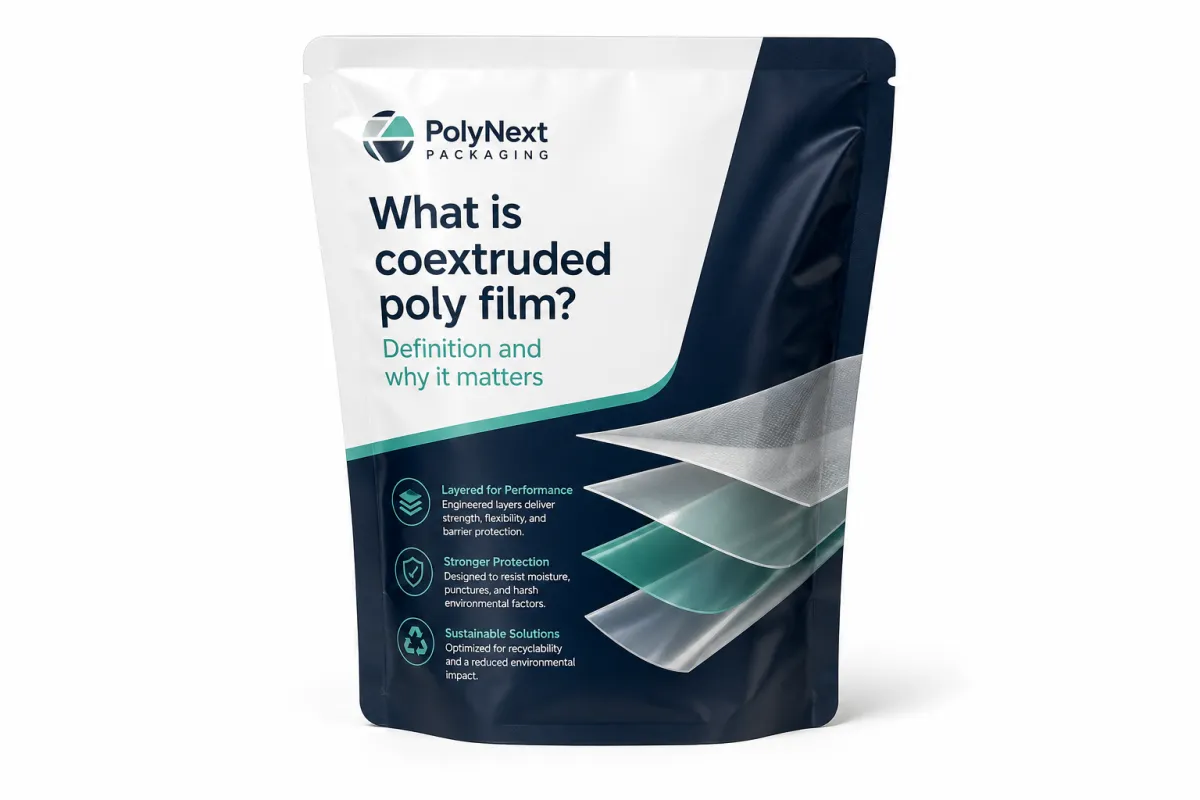
What is coextruded poly film in practical terms? It is a plastic film made by bonding two or more resin layers during extrusion, so each layer can be tuned for a specific job. One layer may carry strength, another may improve sealability, and a third may help with gloss, opacity, slip, or print holdout. On a packaging floor in Shenzhen, I heard an operator describe it as "one layer for the body, one for the skin, one for the grip," while pointing at a 3-layer line running around 180 to 220 feet per minute. That sounds simple, yet the engineering behind it is what keeps a parcel together after a hard hit. I liked that description because it was plainspoken, and packaging people are often at their best when they stop pretending the jargon is the point. In a coextruded polyethylene film, the structure is doing the heavy lifting even when the finished sheet looks ordinary.
The part buyers miss is how invisible the structure can be. The finished film may still feel like one sheet even though the performance profile has changed dramatically. I have seen a 2.5 mil coextruded mailer outperform a thicker single-layer bag because the outer layer resisted scuffing while the inner layer delivered a cleaner seal at 120 to 130 degrees Celsius. That is why what is coextruded poly film is not only a materials question; it is a shipping-risk question. Thickness still matters, of course, but thickness alone is a pretty lazy way to shop for protection, especially if you are moving apparel from a warehouse in Atlanta to customers in Phoenix and Miami during July. The more useful question is how the seal layer, tie layer, and outer layer work together as a multi-layer film.
Poly mailers face a rough life. Moisture from loading docks, compression in cartons, abrasion from pallet wrap, and the blunt treatment of last-mile handling all take their turn. I remember a client meeting for a beauty brand sending roughly 8,000 orders a month out of a facility in Rancho Cucamonga, where we opened three returned mailers and saw the same failure twice: corner punctures from product boxes and one seal that had started to open under pressure. The original spec looked fine on paper, yet the wrong film structure left the mailer vulnerable exactly where the parcel needed support. I still remember the buyer staring at the returns like the bags had personally offended her, which, honestly, they kind of had. That is the kind of moment that makes what is coextruded poly film feel less like a technical phrase and more like a practical safeguard.
I think what is coextruded poly film matters most because it changes the buying conversation from "How thick is it?" to "What does each layer do?" That shift is a little like staffing a factory line with the right people in the right stations. The front desk does not need to do accounting, and accounting does not need to do forklift work. Coextrusion follows the same logic, and buyers who understand it tend to ask sharper questions about performance, printability, and lead time. That is usually where the better quote comes from, too, because now the supplier knows you are not shopping with one eye closed and one eye fixed on the lowest sticker price.
How coextruded poly film works in poly mailers
What is coextruded poly film in a mailer structure? It starts with multiple molten resin streams moving through a shared die at the same time, then cooling into one unified sheet. There is no later glue layer the way you would see in a laminate. The layers are formed together, which helps the film respond more predictably under stress. If one layer is tuned for toughness and another for sealing, the finished mailer can stretch a bit without tearing and still close cleanly on a hot-bar seal or pressure-seal line. On one line I watched in Ningbo, the operator kept a 72-inch web running at a steady speed while a gauge monitor held the film between 2.8 and 3.1 mil, which is the kind of control that makes a supply manager sleep better at night. That simplicity on the outside hides a lot of orchestration behind the curtain, and that is exactly why what is coextruded poly film deserves a closer look before a buyer signs off on a spec.
The real advantage is balance. A mono-layer film relies on one blend to do everything, and that can work for lighter parcels, especially shipments under about 8 ounces where the risk is low. Once the products get sharper, heavier, or more valuable, a coextruded structure usually gives better tear resistance and more forgiving seals. That is why what is coextruded poly film matters so much for e-commerce mailers: the inside and outside of the bag can be tuned separately instead of asking one resin to behave like three different materials. I have tried to explain that to teams who wanted a miracle bag at a bargain price, and that conversation usually ends with me reaching for a sample and saying, "Physics is rude, but it is consistent." In most cases, the right answer is a multi-layer polyethylene film built for the actual parcel.
I still remember a supplier negotiation where the factory manager in Suzhou slid two sample mailers across the table and told me, "Feel the difference, not just the gauge." He was right. One sample had more stiffness and a louder crinkle, while the other had a smoother hand feel and a more dependable seal window at 130 to 140 degrees Celsius. Buyers notice those details immediately, even if they do not always have the vocabulary for them. Gloss, stiffness, noise, opacity, and slip all shape how a bag feels in hand and how it moves on the line. I have even seen an operations team prefer one structure simply because it made less racket on the packing bench, which is not exactly a laboratory metric, but it matters when people have to pack 4,000 orders before lunch at a warehouse near Columbus, Ohio. That sort of real-world handling is why what is coextruded poly film is more about behavior than brochure language.
Transit testing gives that conversation a practical anchor. The ISTA test methods are useful when you want to compare how mailers respond to drops, vibration, and compression. I also ask suppliers to show seal data, because a reliable seal profile matters more than a slightly prettier surface. A mailer that looks polished but opens in transit is still a failure, no matter how nice it looks in a photo. I have had more than one shipment arrive with a gorgeous exterior and a weak seam, which is a deeply annoying kind of disappointment because it looks like success until someone touches it. On a run from a plant in Foshan, one bad seal curve cost us 240 replacement mailers in a single week, and that made the need for hard data hard to ignore. If someone asks what is coextruded poly film good for, the answer is consistency under stress.
What is coextruded poly film cost, and what changes the price?
What is coextruded poly film cost, really? The answer depends on layer count, resin grade, tolerance control, printing, and volume. A straightforward two-layer mailer may add only a modest premium over mono-layer film, while a three-layer custom build with tighter gauge control, custom color, and branded print can move the price up noticeably. In the factory quotes I have reviewed from Shenzhen and Dongguan, the difference rarely comes from resin alone; setup time, waste, and quality control often matter just as much. For example, a 5,000-piece run of a 10 x 14 inch white mailer with a 2-layer structure might come in around $0.15 per unit, while the same size with a 3-layer film, black print, and a matte finish could land closer to $0.20 or $0.22 per unit. I have seen buyers focus on pennies per unit and then lose dollars to reprints, replacements, and customer service headaches. That part never gets the glossy spreadsheet treatment it deserves, especially when the quote is built around coextruded polyethylene film rather than a standard stock bag.
Thickness is the number buyers see first, but thickness and quality are not the same thing. I have watched a sourcing team pay more for a heavier bag that still scuffed and punctured on corners, then switch to a slightly thinner coextruded option that reduced damage claims by about 18 percent in the first month. That is the part many teams overlook: better layer design can outperform a thicker but less engineered film. What is coextruded poly film if not a way to spend resin where it actually protects the shipment? A thicker bag that fails is just an expensive disappointment with a nice number on the spec sheet, and I would rather see 2.7 mil with the right seal layer than 3.5 mil with no useful structure. The right answer is usually about film architecture, not bragging rights.
Here is a useful comparison based on quoting patterns I have seen for 10 x 14 inch and 14 x 19 inch poly mailers at 5,000 pieces. These are planning figures, not universal pricing, but they are close enough to help frame the conversation.
| Film structure | Typical unit price | Best for | Watch-outs |
|---|---|---|---|
| Mono-layer PE | $0.09 to $0.13 | Light, low-risk shipments | Less forgiving on puncture and seal consistency |
| 2-layer coextruded PE | $0.13 to $0.18 | General e-commerce mailers | Slightly higher setup and tighter specs matter more |
| 3-layer coextruded PE | $0.17 to $0.24 | Heavier, sharper, or higher-value orders | More engineering, more sample approval time |
Buyers should also ask about minimum order quantity, because a custom print run may be priced very differently at 3,000 units than at 20,000 units. Setup charges of $150 to $400 are common for custom color matching or plate work, and recycled content can shift availability depending on the resin supply that week, especially if the material is sourced through a converter in Vietnam or Malaysia. If the answer sounds vague, push for puncture resistance, seal strength, opacity, and print targets in numbers. That is the fastest way to separate a real spec from a sales pitch. I would rather hear a supplier say, "We need to confirm that test," than hear a confident guess dressed up as expertise. If someone cannot explain what is coextruded poly film in measurable terms, the quote is probably not ready.
"We were paying for thickness, not performance." That was the line a brand manager said to me after a packaging review in Chicago, and I have repeated it ever since. The math changed their buy, because the failure rate on returns dropped once the film structure matched the product weight, the 12-inch box depth, and the actual parcel route through Memphis and Indianapolis.
How is coextruded poly film made, and what is the timeline?
What is coextruded poly film production, step by step? It begins with resin selection, then blending, then feeding the materials into a coextrusion line where each molten stream travels through a common die. After that, the film is cooled, gauge-controlled, slit, inspected, and either converted into mailers or shipped out as rolls. On a finished mailer line, printing, sealing, trimming, and packing add another layer of scheduling, which is why a film-only ship date and a finished mailer ship date are rarely the same thing. I have lost count of the times someone asked for "the shipping date" as if one machine handled all the steps by itself. If only. On a typical line in Guangzhou, a run might use a 65-mm extruder for the outer layer and a 90-mm extruder for the middle layer, and those numbers matter when the plant is balancing output against gauge tolerance. That is the practical side of what is coextruded poly film: a controlled process, not a guess.
Lead time depends on how custom the build is. Stock structures can move in 7 to 12 business days if the supplier has the right resin and the line is available. A custom three-layer film with spot color, recycled-content requirements, or new artwork often needs 15 to 25 business days, and that does not include sample approval. I have seen projects slip because a tiny registration issue showed up in the artwork, not because the film machine was slow. What is coextruded poly film if not a process where one small decision can affect three downstream steps? A tiny change in ink, seal width, or gusset depth can ripple into a delay if nobody catches it early. For a client in Austin, a proof approved on Monday still needed two additional production days because the PMS green shifted too far toward teal under the glossy top layer.
The sample loop is where many schedules lose time. A factory may send a pre-production sample in 3 to 5 business days, but if your team asks for a revised opacity, a different seal width, or a new PMS color, the line needs another pass. In one supplier review I handled for a subscription snack brand, the first sample looked fine on camera, yet it failed under actual product load because the inner box corners pressed against the side seam. We adjusted the film structure instead of only the artwork, and that prevented a repeat failure. That was one of those moments where I had to say, somewhat bluntly, "The problem is not the logo; it is the bag trying to survive the product." The packaging decision changed after a 19-ounce filled sample passed a 36-inch drop on all six faces. That is also the point where many teams finally understand what is coextruded poly film buying is meant to solve.
The clearest planning move is to ask for an estimated production window, not only a ship date. That detail tells you whether the supplier has accounted for resin sourcing, print proofing, converting, and final inspection. A useful benchmark is 3 to 5 days for early samples, 5 to 10 days for approval, and 7 to 15 business days for production on a standard custom order, with 12 to 15 business days from proof approval being a common target for a straightforward 1-color mailer in white or black. If any of those steps are compressed, the risk usually shows up in quality, not in luck. And in packaging, luck is not a strategy I would ever recommend to a paying client, especially when a missed seal on Friday can turn into 400 damaged parcels by Wednesday. That is why I always tie the schedule back to what is coextruded poly film actually meant to do on the line and in transit.
Common mistakes when specifying coextruded poly film
What is coextruded poly film without a clear specification? Too often, it becomes a vague purchase order. The first mistake is choosing by thickness alone. A 3 mil film can still underperform if the resin blend is weak or the outer layer is too slick for the route. A 2.5 mil film may be the better choice if the layer structure is more thoughtful. I have seen buyers overpay for thickness they did not need and underbuy for the shipping risk they never measured, especially on light apparel going out of a Reno or Louisville warehouse. Then they act surprised when damage shows up, which is a little like being shocked the rain got in because the roof was mostly decorative. A coextruded polyethylene film should be judged by how it behaves, not by the number on the gauge sheet alone.
The second mistake is using broad words like "premium" or "heavy-duty" without defining what those mean. Ask for a puncture target, a seal strength target, an opacity target, and a print requirement. If the test method is unfamiliar, ask the supplier to name it. ASTM F88 for seal strength and ASTM D882 for tensile properties come up often in packaging conversations, and the method matters because a lab number without a method is just decoration. That is where what is coextruded poly film turns into a technical buying process instead of a branding phrase. I would even say that if a supplier cannot explain the test method in plain English, the quote is not ready for polite consideration, whether the factory is in Qingdao or Querétaro. Good suppliers can talk about the structure and the data without hiding behind jargon.
The third mistake is ignoring the actual shipping environment. A film that behaves well in a dry warehouse can still fail in a humid intake room or on a route with hard compression from mixed freight. Temperature swings matter too. I once reviewed a run for a seasonal apparel client whose West Coast shipments rode in warm trailers for hours; the seals were technically acceptable, but the mailers scuffed faster than expected because the outer surface was too soft for that route. The product did not care about the test report. It cared about the truck. That was a frustrating day, mostly because the report looked so neat while reality was out there being messy on purpose, especially after a 98-degree afternoon in Phoenix and a cool overnight handoff in San Bernardino. That kind of route data should shape what is coextruded poly film chosen for the order.
Another mistake is approving artwork on a screen and assuming it will print the same way on a coextruded surface. A glossy outer layer can make dark colors look richer, but it can also make rub marks more visible if the ink system is wrong. If the mailer needs branding, ask for a printed proof, a rub test, and a loaded sample with your actual product. The sample should be tested sealed, dropped, rubbed, and stacked. Empty bags forgive too much and can hide a weak seam until the parcel is already in a tote bin. I have seen too many "perfect" samples collapse the minute they met a real box corner, which is a very efficient way to waste a week and a very expensive way to learn that a 2-inch seal margin was not enough. That is where what is coextruded poly film becomes a test of discipline as much as engineering.
Expert tips for choosing the right coextruded poly film
What is coextruded poly film good for in a buying decision? It is good for matching film structure to shipping reality instead of guesswork. If the parcel is light, quiet, and unlikely to be returned, a simpler two-layer build may be enough. If the shipment is heavier, sharper, or meant to support a premium unboxing, a three-layer structure can earn its extra cents. I usually tell clients to start with product weight, then route, then brand promise. Reversing that order is how teams over-spec a bag. People sometimes fall in love with the idea of "premium" before they figure out what problem they are actually solving, especially when a 16-ounce sweater needs to cross three hubs and a USPS plant in the same week. The smart move is to select the film structure that fits the risk, not the mood board.
Ask the supplier what each layer does. A clear answer is a strong sign. If the outer layer is meant for print and abrasion resistance, the middle layer for stiffness, and the inner layer for seal integrity, you are talking to someone who understands film architecture. If they cannot explain it without hand-waving, that is a warning sign. I once sat in a factory meeting in Dongguan where the technician drew the structure on a scrap label and split it into a 70/20/10 ratio by function. That kind of specificity tells you whether the supplier is selling film or merely moving resin. What is coextruded poly film supposed to do? Exactly this: assign jobs to layers. I love a supplier who can talk like a person and not like a brochure, and who can explain a tie layer without turning the room into a seminar.
Sample testing should use real products, not air. Load the mailer with the actual box, poly bag, or garment insert; seal it; then rub it against a carton edge, drop it from waist height, and inspect the corners. If the bag is for apparel, check static and noise. If it is for beauty or supplements, check moisture protection and seam behavior after compression. The goal is not to admire the sample. The goal is to make it fail in a controlled way before a customer does it for you. I know that sounds a little grim, but packaging has a way of humbling people quickly, especially when a 9-ounce serum box punches through a 2.4 mil film during a test in Miami. That kind of test is where what is coextruded poly film proves whether the layer design was worth the extra cents.
Think in total cost of ownership, not only unit price. A film that costs $0.03 more per mailer can still save money if it cuts replacements, lowers brand complaints, or reduces reprint waste from scuffed artwork. Sustainability claims deserve the same scrutiny. Recycled content, downgauging, and recyclability all depend on the actual structure, not a slogan on the quote sheet. If the bag is all polyethylene, it may be easier to position as recyclable than a mixed-material package, but that still depends on local recycling acceptance and the final construction. For broader packaging context, the EPA's resources on materials and waste reduction at EPA are worth a look, especially if your team is comparing resin choices and waste goals. I still like seeing the numbers side by side rather than trusting anyone who says "eco" with a straight face and no data. That same discipline applies when you decide what is coextruded poly film worth for your program.
- Match film to product risk: light garments need less structure than boxed supplements or sharp hardware.
- Test with load: empty bags hide weak seams and do not show corner punctures.
- Compare full landed cost: include shipping, setup, reprints, and damage replacements.
- Verify sustainability claims: ask what the film is made of, not just what the sell sheet says.
Next steps: evaluate samples, compare quotes, and choose a structure
What is coextruded poly film supposed to help you do next? It should help you make a cleaner buying decision. Start by writing down five details before you talk to suppliers: product weight, box or item dimensions, shipment risk, branding needs, and target lead time. If you do not know your return rate or your damage rate, estimate it from the last 100 orders. A rough number beats a guess dressed up as certainty. I have had to tell more than one team that "we think it is low" is not a measurement, especially if the monthly run is 12,000 pieces and the fulfillment center is already working with thin margins. That is why the best answers to what is coextruded poly film start with the parcel, not the print file.
Then evaluate samples with a simple checklist. Seal it. Drop it. Rub it. Load it. Stack it. Inspect it again after 24 hours if the product is temperature sensitive. That sequence sounds basic, but I have seen teams skip the loading step and then wonder why the seal failed under real pressure. The sample should tell you what happens after handling, not just what happens on a showroom table. What is coextruded poly film worth if the test is too easy? Not much, in my opinion. The bag needs to survive the ugly parts, not the pretty demo, and a 36-inch drop test on a fully loaded parcel in a warehouse in Arlington is a better teacher than a perfect-looking empty sample ever will be. If the structure is right, the sample will show it under stress.
Ask for apples-to-apples quotes. Same dimensions, same thickness range, same print colors, same quantity, same delivery terms. If one supplier quotes 10,000 units and another quotes 25,000, the comparison is already distorted. I also recommend comparing at least two film structures, not just two prices. A simpler build can sometimes beat a layered one if your product is light and your route is short. Other times, the layered option saves enough on damage claims to become the cheaper choice by month two. That kind of tradeoff is exactly why I get a little impatient when people reduce packaging to a single line item, because a difference of $0.02 per unit can be meaningless next to 140 damaged parcels and one unhappy retail account. When people ask what is coextruded poly film doing for the budget, the honest answer is that it changes the cost equation over time.
Here is the shortest honest answer I can give: what is coextruded poly film? It is a layered plastic film built so different layers can handle strength, sealing, print, and protection in one package. If you match the structure to the shipment, you usually get a better balance of cost, appearance, and performance than a one-size-fits-all bag. That is the decision I would make for a mailer order, and it is the one I keep recommending after factory visits in Shenzhen and Suzhou, supplier calls across Jiangsu and Guangdong, and more than a few damaged-parcel postmortems. Packaging can be a weird business, but the good decisions are usually the ones that respect the trip the package has to take. And that, more than anything, is the real answer to what is coextruded poly film in the field.
What is coextruded poly film used for in poly mailers?
It is used to build mailers that balance strength, sealability, and print quality by combining multiple film layers in one structure. For e-commerce parcels, Branded Shipping Bags, and items that need extra protection, what is coextruded poly film gives you more control than a simple single-layer bag. I would use it whenever the shipment has to look good and survive a rough ride, whether it is leaving a plant in Dongguan at 6:00 a.m. or arriving at a customer doorstep in Denver two days later. It is especially useful when the outer layer needs print holdout and the inner layer needs dependable seal behavior.
How is coextruded poly film different from single-layer film?
Single-layer film uses one resin blend to do everything, while coextruded film assigns different jobs to different layers. That layered design can improve tear resistance, sealing consistency, and surface finish, especially when the mailer needs both toughness and strong branding performance. In practice, what is coextruded poly film often comes down to function per layer, and that is a much better way to spec a bag than hoping one blend can do it all, particularly on shipments above 1 pound or on routes that include long truck legs through Texas and Illinois. It is the difference between a uniform film and a structure with purpose.
Does coextruded poly film cost more?
Usually, yes, because the structure involves more engineering, more material control, and often more setup work. The higher price can still be worth it if it reduces damage, improves presentation, or lowers waste from failures and reprints. If you are pricing what is coextruded poly film for a real program, compare the damage rate as well as the unit price. I have watched "cheaper" turn into expensive very quickly once returns entered the chat, especially on a 5,000-piece run that looked fine at $0.13 per unit until replacement costs pushed the true number closer to $0.19. That is why the price per bag should never be the only number on the table.
How long does coextruded poly film production usually take?
Stock structures can move quickly, but custom colors, printing, and special layer designs often extend the timeline. A supplier should give you a production window that includes sample approval, converting, and final packaging, not only the ship date. For planning, what is coextruded poly film production can be fast or slow depending on how much custom work is involved, and the sample round is usually where the calendar starts misbehaving. A common target is 12 to 15 business days from proof approval for a standard custom mailer, with another 3 to 5 days if the artwork needs a revision. Real timelines depend on the line, the resin, and the approval cycle.
What should I ask before ordering coextruded poly film mailers?
Ask about layer structure, thickness, seal performance, minimum order quantity, lead time, and print compatibility. Also ask for samples loaded with your actual product so you can test real-world performance before committing to a full run. That is the fastest way to verify what is coextruded poly film will do for your package, not just what it looks like on paper. If a supplier hesitates, that hesitation is useful information, especially when you need a quote for 10,000 mailers with a 2-color print and a delivery target in 14 business days. The best suppliers answer with specifics, not slogans.
If you are narrowing a purchase this quarter, the cleanest next step is simple: get two coextruded film samples, load them with the real product, and test them under the actual route conditions before you compare prices. That one move usually tells you more than a stack of spec sheets ever will.


