Buyer Fit Snapshot
| Best fit | Corner Board for Freight Protection projects where brand print, material claims, artwork control, MOQ, and repeat-order consistency need to be specified before quoting. |
|---|---|
| Quote inputs | Share finished size, material target, print colors, finish, packing count, annual reorder estimate, ship-to region, and any compliance wording. |
| Proofing check | Approve dieline scale, logo placement, barcode or warning zones, color tolerance, closure strength, and carton packing before bulk production. |
| Main risk | Vague material claims, crowded artwork, missing packing details, or unclear freight terms can make a low unit price expensive after revisions. |
Fast answer: Corner Board for Freight Protection: Material, Print, Proofing, and Reorder Risk should be specified like a repeatable production item. The safest quote records material, print method, finish, artwork proof, packing count, and reorder notes in one written spec.
Production checks before approval
Compare the actual filled-product size with the drawing, then confirm tolerance on folds, seals, hang holes, label areas, and retail display edges. Reserve space for logos, QR codes, warning copy, and material claims before decorative graphics fill the panel.
Quote comparison points
Review material grade, print process, finish, sampling route, tooling charges, carton quantity, and freight assumptions side by side. A quote is only useful when the supplier can repeat the same color, closure quality, and packing count on the next order.
Corner Board for Freight Protection: A Practical Guide
I still remember standing on a dock outside Toledo, Ohio, with a coffee that had already gone lukewarm and a little bitter around the edges, watching a pallet of 42-pound cartons come off a trailer and into a staging lane that had seen better days. The load held together because the corner board for freight protection took the punishment first, with the pallet wrapped in 70-gauge stretch film and banded with two 3/8-inch polyester straps. The forklift operator nicked the pallet harder than anyone liked, the film stayed under tension, and the carton corners never got the direct crush that usually starts the damage chain. That was one of those moments where the packaging did exactly what it was supposed to do, and nobody had to get dramatic about it.
That kind of result does not happen by luck. A well-chosen corner board for freight protection gives a palletized load a rigid edge that can handle strap pressure, stacking force, and the usual bumps that come with real warehouse handling, whether the freight is riding on 48-inch by 40-inch GMA pallets or on tall mixed-SKU stacks that keep everybody on their toes. When the board is sized correctly, the payoff shows up in fewer claims, straighter pallets, cleaner wrap patterns, and less time spent rebuilding loads at the end of a shift. That last part matters more than people admit, because after the third pallet gets touched twice, nobody is in a charitable mood.
Freight damage usually starts at the edge long before anyone notices it in a report. A carton can look solid in the middle and still fold at the corner after a 1,200-pound load has been wrapped, banded, and pushed through a couple of cross-docks in Memphis, Tennessee, or Joliet, Illinois. That is why the corner board for freight protection matters in shipping lanes where pallets are handled by people, machines, and time pressure instead of by a neat diagram on a spec sheet. If the edge gives up, the rest of the load tends to follow like it was waiting for permission.
"The corners failed first, every time," a plant manager told me during a line audit at a corrugated converter outside Atlanta, Georgia. "Once we switched to the right corner board, the straps stopped digging in and the pallets stopped leaning."
That line stayed with me because it gets to the real job of this material. The right corner board for freight protection is not there to make a pallet look tidy for a camera; it is there to survive compression, strap tension, vibration in transit, and the kind of forklift contact that happens when a busy floor has too many moving parts at once. I have seen loads that looked perfect under bright warehouse lights fail in the first mile, and I have also seen a plain, unassuming edge protector quietly carry a shipment from Dallas, Texas to Reno, Nevada without a single complaint. One setup makes you look smart. The other makes you look lucky.
What Is Corner Board for Freight Protection?
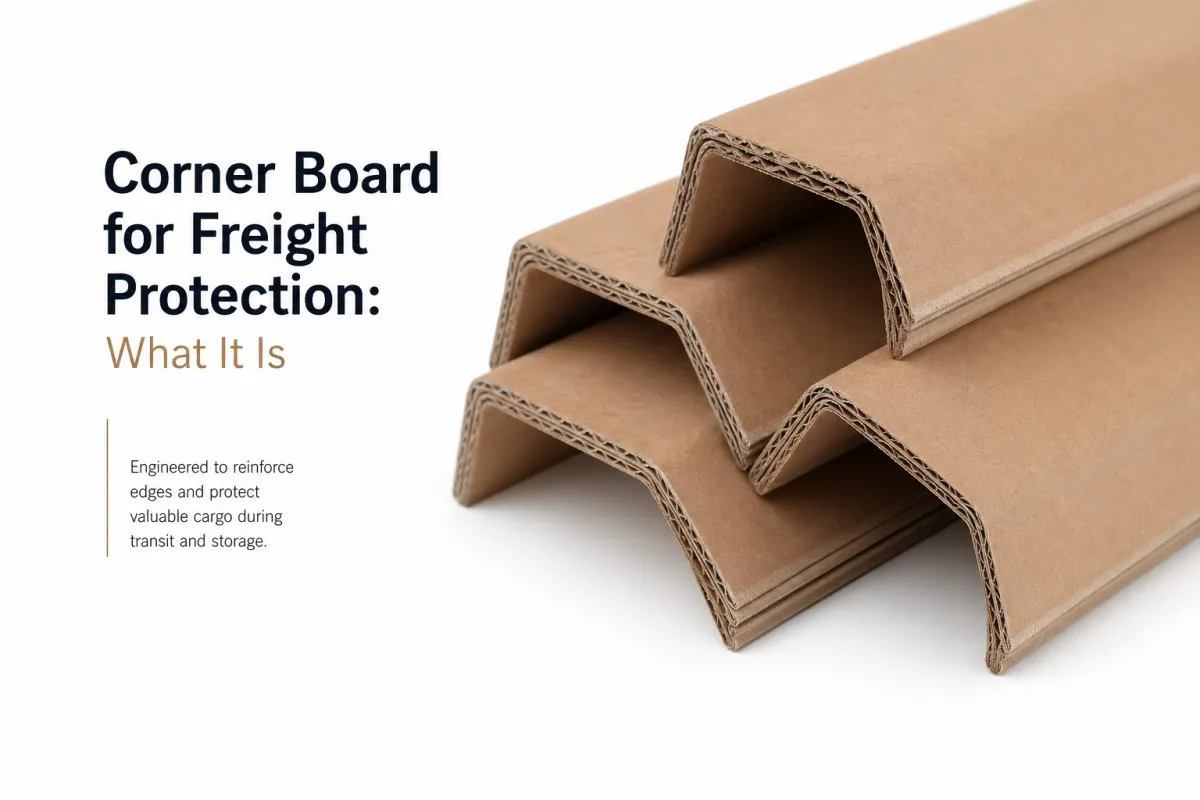
Corner board for freight protection is a rigid edge protector made from recycled kraft fiberboard, laminated paperboard, or solid-fiber construction that reinforces the vertical corners of a pallet load, the top edges of stacked cartons, and in some cases the full height of a shipment from deck to top cap. In plain terms, it is a load-bearing edge guard that helps a shipment keep its shape while straps, stretch film, and adjacent freight apply pressure from the outside. The most common builds I see are 2.0 mm, 2.5 mm, and 3.0 mm thick, with legs ranging from 1.5 inches by 1.5 inches up to 3 inches by 3 inches. If the load is the body, the corner board is the bit that keeps the shoulders from slumping.
The terminology shifts from supplier to supplier, and that causes more confusion than it should. One warehouse team may call it corner board for freight protection, another may say angle board, edge protector, or load stabilizer. The labels overlap, but I still ask for the actual dimensions, thickness, and build before I trust the name on the quote, because I have seen two products with the same description perform very differently under a six-foot stack of mixed cartons in a plant outside Grand Rapids, Michigan. Labels are cheap; performance is the expensive part.
In practice, corner board for freight protection shows up in a few familiar freight situations. I have seen it protect:
- stacked corrugated cartons with 4 to 8 layers per pallet, often on 48 x 40 pallets weighing 300 to 1,400 pounds,
- shrink-wrapped pallets moving through 53-foot trailers, especially on lanes leaving Savannah, Georgia or Norfolk, Virginia,
- drums and pails that need a straighter load face, including 5-gallon pails and 55-gallon drums,
- fragile equipment in export crating, where the load may sit 7 to 10 days before ocean pickup, and
- mixed-SKU shipments where every carton height is slightly different, sometimes by 1.25 inches or more.
The problem it solves is simple to describe and expensive to ignore. Compression from top loads, strap cut-through on narrow edges, corner crush during dock handling, pallet shift in transit, and wrap damage from rubbing against neighboring freight all become more likely when the load has no hard edge. A good corner board for freight protection gives the freight a cleaner outline, and that outline matters more than most people think when a shipment gets stacked three high in a distribution center or sits on a dock for six hours before a pickup window opens. I have watched a dock crew think a pallet looked "fine" right up until the lower layer buckled in the trailer. Freight has a sense of humor like that, though it is the kind nobody laughs at twice.
One client meeting still stands out to me. A beverage co-packer in Charlotte, North Carolina had been losing cases on the bottom layer because the stretch wrap was tight enough to bow the cartons inward, yet not strong enough to stop lateral movement. Once we mapped the failure points, the answer was not more wrap or more tape. It was a better corner board for freight protection spec with 48-inch legs, 2.5 mm wall thickness, and a score line that matched the pallet height, so the load could carry the film tension without collapsing at the edges. That is the part people miss: sometimes the fix is not louder or heavier, just better matched.
How Does Corner Board for Freight Protection Work?
The mechanics are straightforward, and that is part of the appeal. A corner board for freight protection spreads force along a longer line instead of letting a strap, band, or wrapped film concentrate pressure at a single weak point. If a 3/4-inch steel strap lands against a bare carton edge, the pressure sits in a tiny zone. Put a rigid board in that spot, and the same force is distributed across the length of the protector, which lowers the risk of edge collapse. It is basic physics, but it is the kind of basic physics that saves money every week.
I like to describe it as a spine for the load. A pallet without a corner board for freight protection can flex at the corners, especially when the cartons are slick, the pallet deck is uneven, or the wrap film has inconsistent tension. Add the board, and the outer edges act more like a frame, which helps the stack stay straighter while the truck hits bumps, brakes, and cornering forces on a lane that may run 600 to 1,200 miles from Chicago, Illinois to Phoenix, Arizona. I have never met a trailer that politely avoided potholes just because the load was expensive.
The board also improves vertical stability. On a wet Tuesday in a cold storage facility at 34 degrees Fahrenheit, I watched a pallet of frozen desserts lean after a forklift pull because the cartons had no edge reinforcement and the wrap had lost grip in the low-temperature room. With a corner board for freight protection, the same pallet would have had firmer lines to resist that lean, and the top cap would have had something stiffer to push against. It sounds small until you are the one holding a clipboard while everyone stares at a damaged load and tries not to say what they are thinking.
The interaction with other packaging materials is where the value becomes obvious:
- Stretch film: the film keeps the load tight, while the corner board for freight protection keeps the film from digging into soft edges, especially on 80-gauge or 90-gauge wraps.
- Strapping: the board gives the strap a wider bearing surface, which lowers cut-through risk on 16-mm polyester or 19-mm polypropylene bands.
- Corrugated slip sheets: used together, they help the load stay aligned, especially in mixed-SKU stacks with 2 to 4 pallet layers.
- Top caps: a top cap plus corner board for freight protection can reduce crushed top flutes and keep dust off the upper layer during 72-hour staging periods.
Construction matters in the real world. A basic recycled fiberboard protector behaves differently from a moisture-resistant laminated board, and both behave differently in a humid Atlanta warehouse than they do in a dry inland facility in Reno or a refrigerated lane running at 34 degrees Fahrenheit out of Minneapolis, Minnesota. If your corner board for freight protection is going into a long-haul export shipment, I want to know about humidity exposure, condensation cycles, and whether the pallet will sit on the dock for six hours before a container is loaded at the port in Charleston, South Carolina. Those are not side notes; they are the whole story wearing work boots.
For technical references, I often point teams to the industry groups that publish testing and material guidance, such as ISTA for transit testing and FSC for responsible fiber sourcing. Those organizations do not choose the packaging for you, but they give you a cleaner way to validate whether a corner board for freight protection is doing its job under measured conditions, including ISTA 3E vibration and compression checks or FSC Mix documentation from mills in the Southeast and the Pacific Northwest. I trust testing more than optimism, which is a polite way of saying I have been disappointed by "that should hold" more times than I care to count.
Key Factors That Affect Performance and Price
If someone hands you a quote for corner board for freight protection and says the price is high or low without talking about specs, that conversation is incomplete. Thickness, leg length, profile, and material construction all change how the board performs under load, and they also change the unit cost in ways that are easy to miss if you only compare the invoice total. A 2.0 mm board made in a high-volume line in Monterrey, Nuevo Leon does not behave the same as a 3.0 mm moisture-resistant build coming off a laminated line in Grand Rapids, Michigan, and that difference shows up on the dock long before it shows up on the balance sheet.
Thickness is usually the first spec people ask about. A lighter protector around 2.0 mm can work on smaller cartons or shorter regional moves, while a 2.5 mm to 3.0 mm structure often makes more sense for taller, denser loads that see real compression. Leg length matters just as much. A 36-inch edge protector may help on a low pallet, but a 72-inch or 96-inch piece can be the better choice for a tall stack where the corner board for freight protection needs to run nearly full height. I have seen people try to solve a tall-load problem with a short board, which is a little like wearing a rain jacket that only covers your elbows.
Material construction changes the story too. Paperboard, solid fiber, laminated board, recycled content, and moisture-resistant finishes each bring a different balance of stiffness, cost, and environmental resistance. I have seen a recycled board perform beautifully in a dry Midwest distribution center in Indianapolis, Indiana and then fail earlier than expected in a Gulf Coast lane because the freight sat through two humid days before pickup. That is not a flaw in corner board for freight protection itself; it is a reminder that the environment belongs in the spec sheet. The warehouse climate may not sound glamorous, but it absolutely gets a vote.
These factors should drive the choice:
- Freight weight: a 300-pound pallet does not need the same corner board for freight protection as a 1,400-pound mixed load with eight carton layers.
- Stack height: taller loads need longer edges to keep the full vertical line stable, especially above 60 inches.
- Shipping distance: local moves may tolerate lighter board, while long-haul or export freight usually needs more compression resistance.
- Handling intensity: cross-dock freight sees more contact than direct ship freight, so the protector has to be tougher.
- Climate: moisture, temperature swings, and condensation can weaken less-protected board construction in as little as 24 to 48 hours.
Cost is tied to those same variables. Custom sizing adds setup time. Print adds another step. Die cutting, laminated finishes, and tighter tolerances can raise the price too, especially if the line has to run a special knife set or a small-batch adhesive change. If you are ordering corner board for freight protection for a new SKU family, I would rather see the team pay a little more for the correct length and board grade than save a few cents and pay for damaged cartons, labor rework, and replacement freight later. I have sat through enough postmortems to know that a tiny unit savings can turn into a very large warehouse problem.
Value is the better metric. A protector that costs $0.22 but fails on one pallet out of fifty is more expensive than a $0.31 unit that prevents claims and lets the warehouse crew move faster. I have watched teams spend 15 minutes rebuilding a load because a cheap edge protector split under two straps; that downtime eats labor and confidence, and the corner board for freight protection that should have solved the problem becomes the thing everyone blames. Fair or not, packaging is often the first thing to get yelled at, right after someone mutters about the forklift driver.
Corner Board Pricing: What to Expect
Pricing for corner board for freight protection usually depends on board grade, length, width, thickness, and whether you are buying stock sizes or custom dimensions. A standard 48-inch recycled angle board from a converter in the Midwest might land in a lower price band than a 96-inch moisture-resistant profile with custom print and tighter tolerances, because every extra cut, adhesive pass, and quality check changes the converter's cost structure. I have found that the quote often makes perfect sense once you look at what the board actually has to survive.
The cheapest unit price is not always the cheapest landed cost. I have seen a lower-cost corner board for freight protection split under strap tension, which forced a second wrap cycle, extra labor, and a damaged top row of cartons that had to be reworked before the trailer could close. Once that happens, the "savings" are gone in one shift. Nobody ever proudly announces, "We saved three cents and spent forty minutes fixing it," but that is exactly how the math works out.
| Option | Typical Use | Approx. Unit Price | Strength/Notes |
|---|---|---|---|
| Stock recycled board, 36 in. | Short regional pallets, lighter cartons | $0.15 per unit for 5,000 pieces | Good for basic corner board for freight protection on modest loads |
| Semi-custom laminated board, 48 in. | Mixed-SKU pallets, moderate compression | $0.27 per unit for 3,000 pieces | Better stiffness, more consistent edge performance |
| Custom moisture-resistant board, 72 in. | Long-haul, humid, or export freight | $0.39 per unit for 2,000 pieces | Higher protection for sensitive corner board for freight protection applications |
| Heavy-duty 96 in. board with print | Tall pallets, branded industrial shipments | $0.58 per unit for 1,500 pieces | Strong presentation and protection, but costs more to produce |
Those numbers are practical planning ranges, not a promise, because freight class, pallet count, resin adhesive, print coverage, and delivery urgency can move the quote up or down. If a supplier needs to run a rush job and ship it across three states from a plant in Dallas, Texas or a converting line in Queretaro, Mexico, the logistics alone can shift the landed cost on a corner board for freight protection order more than the board material itself. Shipping is never just shipping; it is shipping plus all the little complications that try to sneak in wearing fake mustaches.
Custom dimensions can save money, too, which surprises some buyers. If your load is 58 inches high and you keep buying 72-inch stock pieces, you are paying for 14 inches of waste on every edge. I have seen that happen in a contract packaging line where a plant was over-ordering by nearly 18 percent because nobody wanted to change the spec. Once they dialed in a custom cut, the corner board for freight protection order dropped in waste, and the warehouse stopped trimming every piece by hand with a utility knife. That utility knife, by the way, was acting like it had unionized.
Quantity matters. A 500-piece order often costs more per unit than a 5,000-piece run, and that is normal in converting. Still, if your packaging frequency is only twice a month, it may be smarter to buy in smaller lots than to warehouse six months of inventory. The right corner board for freight protection program should fit your storage space, cash flow, and production rhythm, not just the supplier's minimum order. I have seen more than one warehouse floor get crowded because someone bought "cheap" board in a volume that nobody actually had room to store.
For sustainability-minded teams, it is also worth asking whether recycled content is documented and whether the board can enter the paper stream cleanly after use. The EPA recycling guidance is a useful place to sanity-check end-of-life expectations, especially if your corner board for freight protection is going into customer-facing shipments where environmental claims need to be accurate and supportable. Claims are only helpful if they hold up once somebody asks a real question.
Step-by-Step Process and Timeline
The cleanest way to spec corner board for freight protection is to start with the load, not the catalog. Measure carton dimensions, pallet height, weight per layer, strap placement, wrap pattern, and any temperature or moisture exposure. If the shipment crosses a humid dock in Savannah, sits in a cold room in Denver, or spends two days in a trailer yard near Kansas City, that detail belongs in the spec sheet. I know that sounds obvious, but I cannot tell you how many times the board spec has been built from memory instead of measurement.
I usually ask teams to identify the failure points first. Are the cartons crushing at the top edge? Is the strap digging into a narrow side wall? Is the pallet shifting because the wrap cannot hold the outside layer together? Once you know the weak spot, it becomes easier to Choose the Right corner board for freight protection profile instead of guessing from a stock list. Guessing is a fun hobby for cards and dice, not for freight.
A typical approval process looks like this:
- Measure the load and document the problem area with photos from the receiving dock or pack line.
- Choose a starting spec for thickness, leg length, and board grade, such as 2.5 mm with 72-inch legs for a tall pallet.
- Request samples or short-run prototypes, then confirm the sample construction, score pattern, and edge stiffness against the actual freight.
- Fit-check the samples on a real pallet, not an empty floor mockup, and run a strap test at the planned tension.
- Run a compression or transit test if the shipment is high value, high humidity, or export-bound.
- Approve the final corner board for freight protection spec before production, then release the job to the converting line.
Timeline depends on how custom the job is. A simple stock order can move quickly, while a fully custom run with print, moisture resistance, or special scoring may take longer. I have seen quotes come back in 24 hours, samples in 3 to 5 business days, and production in 12 to 15 business days from proof approval. If the corner board for freight protection order needs to ship with a coordinated pallet program, build in a few extra days for freight booking and dock scheduling. The calendar has a way of getting more crowded right when a plant says it is "just a small change."
Bring the packaging engineer or supplier into the conversation before the first production run if the shipment is fragile, high-value, or export-bound. A $90,000 machine part does not deserve a guess. I once sat in a supplier negotiation where the buyer wanted to save $0.04 per unit on edge protection, but the packaging engineer pushed back because the load was traveling through marine humidity and a six-week export cycle. That extra attention changed the corner board for freight protection spec from standard recycled board to a moisture-resistant laminated build, produced on a line in Monterrey, Nuevo Leon, and the claim rate dropped to zero on that lane. That is the kind of boring decision that makes a finance team very happy later.
Common Mistakes That Weaken Freight Protection
One of the biggest mistakes is choosing a corner board for freight protection that is too short, too thin, or too narrow for the load height. That creates false confidence. The pallet looks protected at first glance, but the real stress points sit above or below the board, and the carton still takes the hit when the strap tightens or the load shifts in the trailer. I have seen this mistake enough times to know that a pretty pallet can still be a fragile one, especially when a 36-inch board is used on a 62-inch stack.
Protecting only the top edges is another mistake. I have seen loads where the upper corners were covered beautifully, but the lower pallet section was left exposed to forklift tines, dock plates, and strap abrasion. That is a weak setup because the lower third of the pallet often sees the roughest contact. A proper corner board for freight protection plan should account for the full handling path, not just the visible top layer, including the first lift out of staging and the last move into the truck. Warehouses are not art galleries; what matters is what survives the trip.
Over-tight strapping causes plenty of damage too. If the band tension is high and the board is not stiff enough, the edges can still crush even though the load appears banded securely. At a facility handling industrial soaps in Pennsylvania, I watched a crew crank down two straps until the board bowed inward, and the cartons underneath showed a clear diagonal crease. The fix was not less corner board for freight protection; it was the right thickness paired with a calibrated strap tension setting, usually around 180 to 220 pounds-force for that SKU. Tension without control is just damage with a better posture.
Storage and handling matter more than some buyers want to admit. Damp warehouse conditions, rough deck surfaces, and reused boards with a bent score line can all reduce performance. A board that sat on a wet floor for two hours may not fail immediately, but it will not behave the same as a dry, clean piece pulled straight from a case pack in the morning. I prefer fresh, square corner board for freight protection on any load with export value or long dwell time. If the protector arrives already tired, the shipment has no chance of starting from a clean baseline.
The final mistake is treating every shipment like the same shipment. A 28-pound master carton on a local milk-run route is not the same as a 52-pound carton going cross-country through two cross-docks in St. Louis, Missouri and one cold-chain transfer in Indianapolis, Indiana. Freight lane, carton weight, and stacking conditions should drive the spec. If a supplier offers one default corner board for freight protection size for every job, that is a sign to ask sharper questions. One-size-fits-all is a comforting phrase for hats, not for freight.
Expert Tips and Next Steps
My best advice is simple: start with the two or three pallet edges that fail most often, and build the corner board for freight protection spec from there. You do not need to over-engineer every SKU on day one. A 20-foot production line, a 40-foot staging area, and a single bad lane can reveal where protection matters most, and that is usually enough to shape a smarter first order. I like progress that starts practical and earns its way upward.
Test the board against your existing wrap and strapping method before making a broad change. The most useful comparison is not theory; it is one lane, one product family, and one set of documented results. If damage drops from 6 claims per month to 1, that tells you more than a spreadsheet full of assumptions. I have seen a simple corner board for freight protection pilot save one distribution center in Louisville, Kentucky nearly 14 hours of rework in a quarter. That kind of result usually gets people paying attention very quickly.
Ask for samples, measure actual damage points, and keep notes on strap tension, pallet height, and humidity. If the sample splits at the score line, that matters. If it handles one more layer of cartons without bending, that matters too. A good supplier should welcome that testing, because the right corner board for freight protection will prove itself on the floor, not just in a quote. If they act annoyed by testing, I would treat that as a clue, and not a flattering one.
Here is a practical checklist I would use before placing a production order:
- Measure the load height to the nearest inch, and note any cartons that vary by more than 1 inch.
- Record carton weight, strap type, and strap tension range, such as 180 to 220 lbf.
- Note whether the freight lane is local, regional, or long-haul, including any cross-dock in Memphis, Dallas, or Reno.
- Request 2 to 3 sample variations of corner board for freight protection with different thicknesses or leg lengths.
- Test one pilot shipment and compare damage, labor time, and claims over a 30-day window.
If you want the cleanest result, choose the corner board for freight protection based on the shipment's real risks, not the lowest quote on the page. That is the approach I have trusted after years on factory floors, in supplier reviews, and in those late-afternoon conversations where everyone is staring at a damaged pallet and asking what should have been done differently. The answer is usually clear once the right board, the right thickness, and the right load profile are matched together. I wish freight were always polite enough to tell us in advance, but it never seems to get the memo.
Start with one lane, one load type, and one clear success metric: fewer crushed corners, fewer strap marks, and less rework. If the corner board for freight protection you choose can hold those three lines steady, you are not guessing anymore; you are building a packaging standard that can actually survive the dock.
FAQ
How do I choose the right corner board for freight protection?
Match the thickness and leg length to the pallet height, carton strength, and strap tension, then test the setup on the exact load you ship. For taller or denser loads, I would usually start with a heavier-duty corner board for freight protection rather than assuming the lightest board will hold up, especially on stacks above 60 inches or loads over 1,000 pounds. Ask for samples and verify the result on one real shipment before you commit to a full run. That small pilot can save a lot of awkward phone calls later.
What is the difference between corner board and edge protectors?
In many warehouses, the terms overlap, but corner board for freight protection usually refers to rigid angle board used on vertical pallet edges and load corners. Edge protectors can be used more broadly for top, side, or strap protection, depending on the supplier and the cut profile, whether it is a right-angle board or a V-shaped protector. I always confirm the dimensions, material, and intended use so nobody orders the wrong format by name alone. One mislabeled box can snowball into a whole receiving mess, and nobody wants that on a busy Monday.
Is corner board for freight protection recyclable?
Most paper-based versions are recyclable if they stay clean and free of heavy contamination. Coatings, adhesives, and moisture barriers can change that, so it is worth checking the supplier's material details Before You Buy, especially if the build uses laminated kraft or water-resistant resin. If sustainability matters on your program, ask for recycled content data and end-of-life guidance for the specific corner board for freight protection you plan to use. Clean fiber and honest documentation go a long way.
Can corner board replace stretch wrap or strapping?
No, it usually works best as part of a system rather than as a stand-alone fix. The corner board for freight protection helps distribute pressure and reduce crush damage, while wrap and strapping keep the load tight and stable, often with 70-gauge to 90-gauge film and 16-mm or 19-mm bands. For unstable freight, I would test all three together on a real pallet before changing the shipping standard. If one piece is doing all the work, that is usually a sign the system is underbuilt.
How fast can custom corner board for freight protection be made?
Lead time depends on whether the size is stock, semi-custom, or fully custom, and that can change the schedule by several business days. Simple samples are often quicker than full production, especially if the board is a standard recycled build, and a straightforward run from proof approval is often 12 to 15 business days. If timing is tight, give the supplier the dimensions, quantity, and ship date up front so the corner board for freight protection quote reflects the real timeline. A clear brief saves everybody from the awkward "we thought you meant next week" conversation.