Buyer Fit Snapshot
| Best fit | Sustainable Packaging for Retail Brands projects where brand print, material claims, artwork control, MOQ, and repeat-order consistency need to be specified before quoting. |
|---|---|
| Quote inputs | Share finished size, material target, print colors, finish, packing count, annual reorder estimate, ship-to region, and any compliance wording. |
| Proofing check | Approve dieline scale, logo placement, barcode or warning zones, color tolerance, closure strength, and carton packing before bulk production. |
| Main risk | Vague material claims, crowded artwork, missing packing details, or unclear freight terms can make a low unit price expensive after revisions. |
Fast answer: Sustainable Packaging for Retail Brands: Material, Print, Proofing, and Reorder Risk should be specified like a repeatable production item. The safest quote records material, print method, finish, artwork proof, packing count, and reorder notes in one written spec.
Production checks before approval
Compare the actual filled-product size with the drawing, then confirm tolerance on folds, seals, hang holes, label areas, and retail display edges. Reserve space for logos, QR codes, warning copy, and material claims before decorative graphics fill the panel.
Quote comparison points
Review material grade, print process, finish, sampling route, tooling charges, carton quantity, and freight assumptions side by side. A quote is only useful when the supplier can repeat the same color, closure quality, and packing count on the next order.
Sustainable Packaging for Retail Brands: A Practical Guide
The fastest sustainability win I have seen was not a compostable film with a polished label and a tidy pitch. It was a 14 mm trim reduction on a folding carton that cut void fill, lowered breakage by 18%, and dropped freight charges by 6% on a 9,000-unit run leaving a plant in Dongguan. I remember staring at that sample on the conference table and thinking, "Well, that is annoyingly effective." That is why sustainable Packaging for Retail brands is rarely just a materials conversation; it is a packaging design, logistics, and brand economics conversation rolled into one, with eco-friendly packaging choices and recyclable packaging claims folded into the same decision.
I have watched buyers fixate on recycled content percentages while overlooking the real leak in the system: oversized Product Packaging That rattled on the way to store shelves and got crushed by the time it reached aisle three. Honestly, I think this happens because recycled content is easy to point at in a deck, while bad box geometry feels less glamorous (and much harder to brag about over coffee). If you are serious about sustainable Packaging for Retail brands, start by asking what is being shipped, how often it breaks, and how much empty space you are paying to move. Those three questions usually tell you more than a glossy spec sheet, especially if the quote is for 5,000 pieces at $0.18 per unit and the freight lane runs from Ho Chi Minh City to Los Angeles.
In practice, the best branded packaging decisions do two things at once. They reduce waste and they make the shelf look cleaner. That sounds simple, but the execution is not simple at all. The packs that perform well usually have a disciplined structure, the right substrate, and a clear recovery route after use. That is the real work behind sustainable packaging for retail brands, and it is where the spreadsheets, sample runs, and slightly awkward factory conversations all start to matter, especially when the proof window is 12-15 business days from approval in a converter outside Pune or Puebla.
"We thought the greener carton would cost more. It cost less once breakage dropped." That was a retailer's operations director in a client meeting last spring, and he was talking about a line of 24-unit home goods SKUs that had been losing money through returns, not just through packaging spend. The cartons were spec'd at 350gsm C1S artboard with a 2-color offset print, and the change paid back in fewer replacement shipments from Chicago to Detroit.
The shift most people miss is plain enough: sustainability is not a side decoration on retail packaging. It is part of the business case. If a change in sustainable packaging for retail brands raises pallet density, cuts dunnage, and improves shelf presentation, it can create value in three places at once. I treat it like an operational decision first and a marketing claim second, because the market does not care how elegant a claim sounds if the box shows up crushed after a 14-hour truck line from Savannah to Atlanta.
What Sustainable Packaging for Retail Brands Really Means
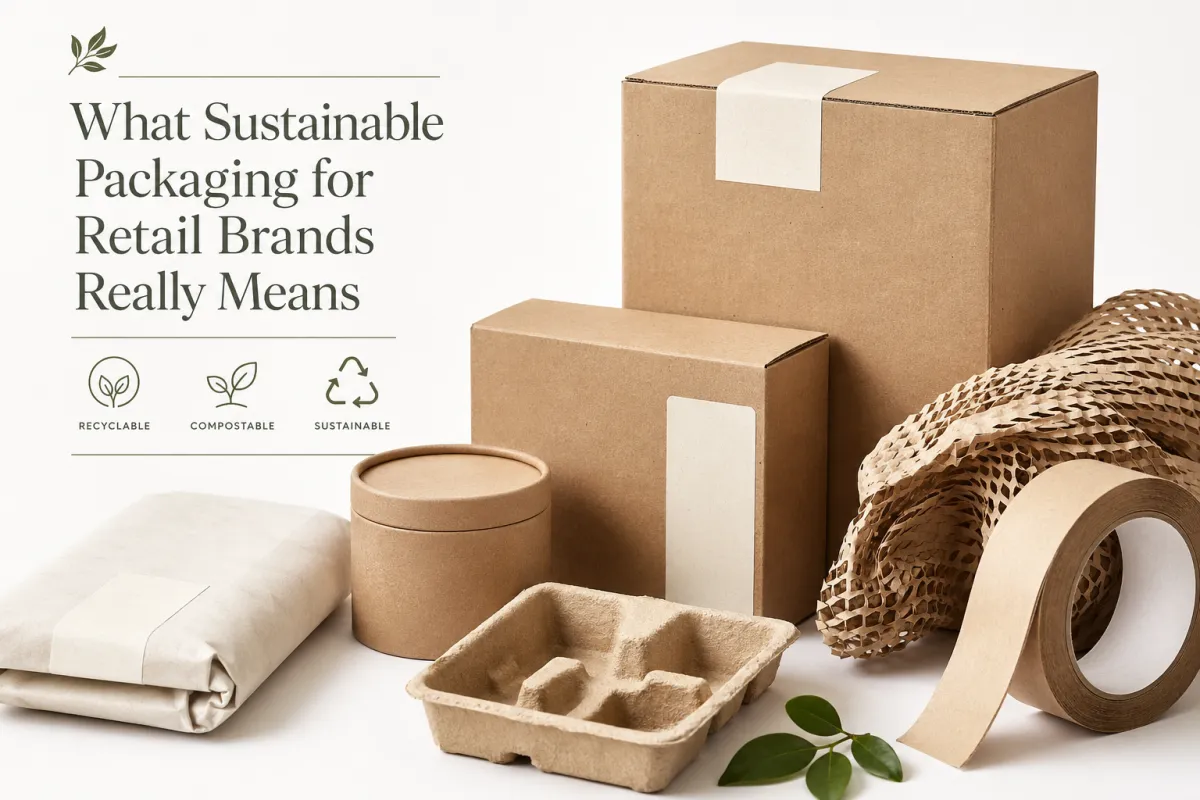
The biggest sustainability win is often not the material itself. It is reducing excess size, weight, and damage in transit. I saw that firsthand on a cosmetics line in Guadalajara that switched from a deep, two-piece rigid set to a slimmer carton with a paperboard insert. The team expected a modest waste reduction. Instead, they found 11% less corrugate use, fewer crushed corners, and a shelf face that looked more disciplined under harsh store lighting. That is sustainable packaging for retail brands in practical terms, not the tidy fantasy version everyone likes to put on a slide.
People use the word "sustainable" to describe four different things, and those distinctions matter. Recyclable means the package can enter a recovery stream where that stream actually exists. Recycled-content means the package includes recovered material, such as 30% post-consumer fiber or PCR plastic. Compostable means it is designed to break down under the right industrial or home conditions, which is a very specific promise. Reusable means the package is built for multiple cycles. Those are not interchangeable, and in sustainable packaging for retail brands, mixing them up can create claims problems fast. I have seen more than one well-meaning team trip over that distinction, and nobody enjoys the legal review that follows, especially when the label text has already been approved for a 40,000-unit run.
I have also seen retail teams chase materials that sounded impressive but created friction on the floor. One apparel chain wanted a compostable mailer for every SKU, but the warehouse team in Leeds was already fighting 7 a.m. shortages and inconsistent bin access. The material was not the only issue; the recovery system was. Sustainable packaging for retail brands has to fit how stores, warehouses, and consumers actually behave, not how a presentation deck imagines they behave. A package that looks noble and causes daily frustration is not a win; it is just a nicer-looking headache, and a pain point that shows up on day two of rollout.
The most useful definition I give clients is this: sustainable packaging for retail brands is packaging that lowers environmental impact without sacrificing protection, usability, or brand impact. If it does not protect the product, the return rate climbs. If it looks weak on shelf, the brand loses value. If it cannot be recovered in the real world, the claim becomes slippery. The strongest sustainable packaging for retail brands programs are built on measurable tradeoffs, not slogans, and frankly that is what separates a real packaging strategy from a branding exercise, whether the job is for a 500-unit pilot or a 75,000-unit national launch.
On a factory floor outside Columbus, I watched operators sort through three carton versions for a private-label food line. The lightest version looked elegant, but it collapsed during stacking at 16 cases high. The middle-weight option used less material than the original and still passed compression at 44 lbs/in2. That one won. It was not the prettiest answer in the room, but it was the best retail packaging answer. Sometimes that is the difference between clever and credible in sustainable packaging for retail brands, and the difference shows up in a shipping report before it ever shows up in a brand deck.
How Does Sustainable Packaging for Retail Brands Work in Practice?
Think of the package lifecycle as a chain, not a snapshot. Raw material sourcing comes first, followed by converting, printing, assembly, shipping, shelf handling, consumer use, and end-of-life. If one link is weak, the whole case for sustainable packaging for retail brands gets shaky. A package with better fiber content can still be a bad choice if it needs a plastic window, a high-ink coverage print, and an extra insert that slows assembly by 9 seconds per unit. Those 9 seconds sound tiny until you multiply them by 8,000 units and watch a production manager in Monterrey stare into the middle distance.
Right-sizing is often the cheapest sustainability move available. When the box matches the product with less headspace, you typically get less corrugate usage, tighter pallet loads, and fewer transit shocks. Mono-material formats help too, especially when you want recovery to be simple. A paperboard carton with an aqueous coating is often easier to evaluate than a multi-layer structure with foil, plastic, and adhesive seams fighting each other. Geometry usually comes before material selection in sustainable packaging for retail brands, even if the board grade gets all the attention, and even if the packaging buyer would rather talk about ink density than nested dimensions.
Performance matters in the real conditions retail packaging faces: warehouse stacking, pallet movement, shelf stocking, and customer handling. I remember a beauty client in Nashville that passed lab tests with flying colors but failed during store resets because staff were opening the pack from the wrong end and tearing the retail display panel. The package had the right material story, yet the wrong human story. For sustainable packaging for retail brands, both matter. A carton does not get to vote on the process, so the process needs to respect the carton, the line crew, and the person putting the item back after a return.
A clear framework helps cut through the noise. Compare each option on three axes: impact, performance, and recovery route. Impact asks how much material, energy, and transport weight the design uses. Performance asks whether it survives compression, vibration, moisture, and handling. Recovery route asks whether it can realistically be recycled, reused, or composted in the markets where it will be sold. That framework has saved me from more bad decisions than any sales pitch ever did, especially the kind with too many adjectives and not enough proof. It also works well when the quote sheet has one line at $0.22 per unit and another at $0.15 per unit for 5,000 pieces, because the cheapest option is not always the cheapest outcome.
Certifications and documentation sit underneath all of this. FSC-certified fiber can support a paper-based claim, but it does not magically make a package recyclable in every municipality. ISTA testing can show transit resilience, but it does not prove a sustainability claim. The point is to back up the story with evidence. For test method reference, I often start with the ISTA library, and for responsible forest sourcing, I check FSC. That kind of paperwork is not glamorous, but it is what keeps sustainable packaging for retail brands from drifting into marketing fluff, especially after the third revision of the claim language.
There is also a simple mental model I use with clients. If the package reduces weight by 12%, protects the product at the same level, and still lands in a recovery stream that customers can actually access, it is probably moving in the right direction. If it only looks green on a slide, I keep digging. The strongest sustainable packaging for retail brands programs are usually the least theatrical and the most disciplined. I know that is not a flashy answer, but packaging rarely rewards flash for long, and it certainly does not reward it after a 600-mile freight run through humid summer weather.
Key Factors That Shape Cost, Performance, and Claims
Material choice is the first lever, but it is not the only lever. Recycled paperboard, FSC-certified paper, molded fiber, PCR plastics, and bio-based alternatives all behave differently on the line and on the shelf. A 350gsm C1S artboard with aqueous coating can be a strong fit for Custom Printed Boxes that need a clean, premium face without blocking recyclability. Molded fiber can work well for inserts and protective trays. PCR plastic can still make sense for certain formats if the recovery path is clear. For sustainable packaging for retail brands, the material has to fit the product, not the other way around. I have watched people fall in love with a material sample and then spend three more meetings figuring out how to make it behave, which is usually a sign that the idea got ahead of the reality.
Structure matters just as much. Thickness, insert design, closure style, cushioning, and empty space all affect performance. I have seen a carton become more sustainable simply by losing a second insert and switching to a tab-lock closure that shaved six seconds off assembly. Less labor. Less glue. Less waste. Those details sound small until you multiply them by 20,000 units. This is where sustainable packaging for retail brands starts to look like process engineering, not just packaging design, and honestly I think that is a healthier way to think about it anyway, especially in facilities where each station has a different bottleneck.
Print and finish decisions can help or hurt recovery. Heavy lamination, foil stamping, metallic inks, and mixed-material windows may look attractive, but they can complicate recycling or reuse. A matte aqueous coating often gives a better balance than a plastic film when you are trying to keep the pack in a paper stream. I have had more than one buyer fall in love with a high-gloss mockup, only to realize the final version had to work harder to stay recoverable. That is a common trap in sustainable packaging for retail brands, and I say that with affection and a little fatigue, because I have been in that room more times than I can count, from Toronto boardrooms to factory floors in Suzhou.
Cost is where theory meets the quoting table. Here is the honest version I give clients: MOQ, tooling, freight, waste rates, and assembly labor can move the real price more than the substrate name on the spec sheet. A clean design can offset a more expensive material. A cluttered design can erase the savings of a cheaper one. On a recent negotiation, a supplier in Dongguan raised the price 11% when we asked for a water-based barrier coating, but we recovered most of that by removing one insert, reducing headspace by 8 mm, and cutting outbound freight by almost 4%. That is the kind of math behind sustainable packaging for retail brands. The box itself was not magically cheaper; the whole system got smarter, and the lead time stayed inside a 15-business-day window after proof approval.
| Option | Typical Spec | Rough Unit Cost at 5,000 Units | Strengths | Watchouts |
|---|---|---|---|---|
| Recycled paperboard folding carton | 350 gsm C1S, aqueous coating, die-cut, 2-color offset | $0.15-$0.19 | Good shelf print, light weight, easy recovery | Needs good structural design to avoid crushing |
| Molded fiber insert or tray | Wet-pressed fiber, custom cavity, no lamination | $0.24-$0.31 | Protective, fiber-based, strong unboxing feel | Tooling cost and mold lead time can be higher |
| PCR PET sleeve or clamshell | 30%-50% post-consumer resin | $0.17-$0.25 | Clear product visibility, good moisture resistance | Recovery depends on local plastic streams |
| Rigid paper box | 2 mm greyboard, wrapped, spot logo print | $1.05-$1.45 | Premium presentation, strong brand impact | Higher material and assembly cost |
| Mono-material kraft mailer | FSC kraft, paper insert, water-based ink | $0.12-$0.18 | Simple structure, lower weight, good e-commerce fit | Less premium feel unless design is sharp |
Those numbers are starter quotes, not universal truth. They assume 5,000 units, moderate print complexity, and no unusual finishing. Add foil, magnets, or a complex insert and the price changes quickly. That is why comparing unit price alone can mislead you. A box that costs $0.15 but saves 2% in damage and 3% in freight may beat a $0.12 box that returns more product to the warehouse. This is where sustainable packaging for retail brands must be measured on total landed cost, because the cheapest-looking option on paper can be the most expensive one in the real world, especially when the returns processor is in Ohio and the retailer is paying inbound and outbound freight.
For product packaging, I like to ask three questions: What is the damage cost? What is the shelf impact? What is the recovery route? If a slightly more expensive carton improves all three, the math usually works. If it only improves one and hurts the other two, the brand may be paying for virtue rather than value. That is not a great trade in sustainable packaging for retail brands, and brands usually notice the mismatch eventually, even if procurement notices it first, often after the first 10,000 units ship and the variance report lands.
Step-by-Step Rollout and Timeline for Retail Packaging
-
Audit current packaging across the best-selling SKUs.
Start with the top 20% of items that drive 80% of volume. Measure box dimensions, fill ratio, damage rate, and return reasons. I usually tell clients to record at least 30 shipments per SKU so they are not acting on a fluke. That audit creates the baseline for sustainable packaging for retail brands, and it also tends to reveal a few awkward truths about how much air is being shipped around for no good reason, especially on the 6 oz and 12 oz formats that never seem to have enough right-sizing attention.
-
Set goals before you touch supplier quotes.
Write down targets for material reduction, recyclability, shelf impact, budget, and operational fit. If the goal is "lower waste by 15% and keep assembly under 12 seconds," that is useful. If the goal is "be greener," that is not actionable. Clear targets make sustainable packaging for retail brands easier to compare, and they keep the conversation from wandering into vague, feel-good territory. A better target might be 350gsm board, 30% PCR, and a landed cost ceiling of $0.21 per unit at 10,000 pieces.
-
Request options, mockups, and costed specs.
Ask for at least two or three build paths, not one. I prefer to compare a paperboard-first concept, a molded fiber concept, and a lower-cost fallback so the business can see the tradeoffs. This is also where Custom Logo Things can help with Custom Packaging Products that are designed around actual retail packaging constraints, not just a pretty render. A render does not have to survive a warehouse floor; a real package does. The cleaner suppliers will give you an art proof in 24-48 hours and a structural sample in 7-10 business days.
-
Prototype and test hard.
Run drop strength, compression, moisture resistance, shelf appearance, and assembly speed checks. For shipping validation, I would rather see an ISTA-inspired sequence that includes vibration and corner-drop stress than a hand wave and a promise. One grocery client discovered that a carton that looked perfect in daylight failed under cooler, damp backroom conditions after only 18 minutes of loading time. That is the kind of failure sustainable packaging for retail brands must avoid. The sample looked lovely. The reality looked expensive. The better cartons passed after a 3-foot drop, a 24-hour humidity cycle, and three full repacks by a store associate.
-
Build a realistic timeline.
A simple spec change may take 2 to 4 weeks, while a structural redesign often needs 4 to 8 weeks, especially if sampling and revisions are involved. Add another week if compliance sign-off is required. If tooling is needed for molded fiber or a custom insert, build in more time. The most common delay I see is not manufacturing capacity; it is a late change to artwork, closure style, or claim language. That is why sustainable packaging for retail brands should be scheduled like a project, not treated like a print order. A supplier in Qingdao may promise 10 business days, but a proof correction can push the handoff to 12-15 business days from approval if someone moves the logo by 2 mm after the die line is locked.
-
Launch, then review the numbers.
After rollout, track damage rate, packaging cost, assembly time, and customer feedback for at least 30 days. If damage falls by 10% and shipping cube drops by 7%, that is not a vanity win. It is a business result. In one line review with a beauty retailer, we found the new pack reduced breakage enough to justify a modest increase in board grade. That is the sort of evidence that makes sustainable packaging for retail brands worth repeating, and worth defending when someone asks why the spec changed in the first place. It also gives the plant manager a reason to keep the new SOP taped to the line.
On a visit to a converter outside Shenzhen, I spent an afternoon watching a folder-gluer line handle two carton versions for the same SKU. The heavier version needed more manual correction, and every correction slowed the line. The lighter version moved faster but suffered from corner crush in the cold room test. The final approved version was neither extreme; it was the middle path. That compromise is often the real story behind sustainable packaging for retail brands. The pretty version lost, the flimsy version lost, and the practical version got the job done in a plant that was running two shifts and one overtime Saturday.
Common Mistakes in Sustainable Retail Packaging
The first mistake is choosing compostable packaging by default without checking whether the local waste system can actually process it. I have seen brands print the word "compostable" on a sleeve for customers in three states where no practical collection route existed. That is not a sustainability win; it is a claim risk. For sustainable packaging for retail brands, the recovery route has to be real. Otherwise the pack is just wearing a label it cannot support, and the legal team will eventually notice when the copy comes back from review.
The second mistake is assuming recycled materials always mean higher cost, lower quality, or weaker shelf performance. That is simply not true. A well-specified recycled paperboard carton can outperform a flimsy virgin-stock pack if the structure is smarter and the print design is disciplined. I have watched buyers save money by reducing finishes and simplifying assembly, even while moving to better-fiber content. It is one of the more common surprises in sustainable packaging for retail brands, and I never get tired of seeing a skeptical face turn into a pleased one after the test results land, especially when the quote lands at $0.16 per unit instead of the $0.21 they expected.
The third mistake is mixing materials or coatings that make a package harder to recycle even when the base material looks eco-friendly. A paper box with a thick plastic film window, heavy lamination, and a glued-on magnet may look premium, but the recovery story gets messy. The package may still be usable, but the claim needs to be framed carefully. If you want proof, study your own line items and compare them with the examples in our Case Studies; the pattern is usually obvious once you see the numbers. That clarity matters a lot in sustainable packaging for retail brands, especially when people are trying to make the pack feel more premium by adding one more thing that nobody asked for, like a foil stamp on a one-color carton.
The fourth mistake is optimizing for sustainability while ignoring product protection. A damaged product often creates more waste than the package saved. Returns, repackaging, and replacement shipping can erase environmental gains quickly. I have seen a retailer lose ground because a thinner mailer looked better in procurement and performed worse in transit. In sustainable packaging for retail brands, protection is not optional; it is the whole foundation. If the product breaks, the environmental argument starts to wobble, and not in a charming way. A 3% damage rate on a 20,000-unit launch can wipe out the gains from a 12% materials reduction.
The fifth mistake is skipping documentation. Without supplier specs, test results, and claim support, your team cannot explain why the package is better. That becomes a problem during retailer onboarding, legal review, or a customer question on social media. If the box says recycled, FSC-certified, recyclable, or reusable, you need the paperwork behind it. Honest documentation is one of the strongest trust signals in sustainable packaging for retail brands, and it is also the least dramatic part of the job, which is probably why it gets neglected until someone asks for it on Friday afternoon, usually at 4:40 p.m.
One pattern shows up again and again: teams start by asking, "What is the greenest material?" I start by asking, "What problem are we solving?" A 4 oz beauty serum, a 2 lb candle, and a 12-piece apparel set do not need the same answer. The better question is how to build sustainable packaging for retail brands that protects the product, meets shelf expectations, and still supports an end-of-life route you can defend. That framing saves time, money, and a surprising amount of internal debate, especially once the merchandiser and the warehouse lead are in the same room.
Expert Tips for Smarter Sustainable Packaging Decisions
Start with one high-volume or high-visibility SKU instead of trying to redesign everything at once. That approach gives you faster feedback and cleaner data. I have seen a single flagship item prove the case for an entire line because it carried both volume and brand visibility. For sustainable packaging for retail brands, a smart pilot is usually more persuasive than a big-bang launch, and it is far less likely to leave everyone staring at a warehouse full of unfinished ideas, half-approved proofs, and a pallet of obsolete inserts.
Ask suppliers for recovery data, test results, and cost breakdowns rather than broad sustainability claims. If they say a carton is recyclable, ask where, under what conditions, and with what components removed. If they say a fiber tray is sourced responsibly, ask for the chain-of-custody paperwork. The more precise the answer, the easier it is to trust. That is especially true in sustainable packaging for retail brands, where claims travel quickly from procurement to marketing to the shelf, and then straight into customer scrutiny if something looks off, such as a matte finish that suddenly starts delaminating after humid storage.
Design for disassembly whenever you can. Minimize adhesives, mixed layers, and unnecessary inserts. A pack that comes apart cleanly is usually easier to recover, easier to explain, and easier to adapt later. One grocery client I worked with replaced two glued parts with a single fold-lock insert and cut assembly time by 22%. That kind of simplification is a quiet win in sustainable packaging for retail brands. No confetti, no dramatic announcement, just a better package and a smoother line from the first carton to the 18,000th.
Test in real retail conditions, not just lab conditions. Humidity, stacking, temperature swings, and store labor can change outcomes quickly. A pack that survives a neat lab drop may still fail after three hours in a humid backroom and a rushed shelf refill. For me, the best testing plans include both a lab protocol and a field observation. That is where I learn whether sustainable packaging for retail brands will hold up after the buyer leaves the room. The room always gets quiet at that point, which usually tells you something, especially if a merchandiser has to reload the shelf twice in one morning.
Measure the business case with a few hard numbers: material use, freight savings, damage reduction, and customer response. If the packaging team cannot point to at least two of those metrics, the case is incomplete. The numbers do not need to be perfect, but they do need to be real. On a recent project, the team got hung up on a 2-cent material increase and ignored a 9-cent drop in freight and returns. That is why sustainable packaging for retail brands should be judged on total effect, not one line item. I have seen too many "savings" evaporate the minute the shipping invoice arrives, especially when an LTL carrier adds a rural access surcharge.
If you are working with custom printed boxes or other branded packaging formats, keep the print story restrained and intentional. More ink does not equal more impact. In fact, the best package branding often uses fewer colors, clearer structure, and cleaner typography so the material itself does some of the work. That is a good rule of thumb for sustainable packaging for retail brands because it protects both shelf appeal and recoverability. The box should help sell the product, not shout over it. A 2-color layout on 350gsm C1S can often look more expensive than a 6-color layout if the proportions are right.
One last practical note: do not ignore assembly labor. I have seen a pack save $0.03 on board and cost $0.07 in additional hand assembly, which is a bad trade when multiplied by tens of thousands of units. A cleaner design can be worth more than a cheaper substrate. That is exactly why sustainable packaging for retail brands should always be reviewed by operations, not just design and procurement. I get why that happens; operations is the room everyone forgets until the schedule slips, the line backs up, and someone has to explain why the shipment missed the 3 p.m. cutoff.
Next Steps for Sustainable Packaging for Retail Brands
Build a one-page scorecard for your top packaging formats and rank them by cost, protection, recyclability, and shelf impact. Keep it simple enough that procurement, operations, and marketing can all read the same sheet without a translation meeting. That shared view is one of the fastest ways to move sustainable packaging for retail brands from concept to action, and it is a lot easier than trying to referee three different opinions from three different departments. If you want a useful benchmark, include target unit cost, board spec, and a 30-day damage rate.
Request samples and apples-to-apples quotes from at least two or three packaging partners. If one quote includes a water-based coating, molded fiber insert, and printed assembly guidance while another leaves those items vague, you do not have a true comparison. Ask for the same unit count, the same print complexity, and the same freight assumptions. The closer the comparison, the better the decision in sustainable packaging for retail brands. Otherwise you are comparing apples to a mystery box, which is a surprisingly common business habit. I would also ask for proof timing and the factory city, whether that is Xiamen, Dongguan, or Ho Chi Minh City.
Run a short pilot on one product line, then compare performance against your current packaging before scaling up. I would rather see a 500-unit controlled test with real damage data than a large roll-out built on optimism. If the pilot shows lower breakage, smoother shelf handling, and acceptable cost, you can expand with confidence. That is how sustainable packaging for retail brands becomes a repeatable process instead of a one-off experiment. The boring version is usually the winning one, and the numbers from a 500-piece pilot are often easier to defend than a sales pitch.
If you want to move faster, use the resources already in front of you. Our Custom Packaging Products page is a good starting point for looking at formats, while the patterns in our Case Studies can help you see how other retail teams handled material changes, shelf constraints, and budget pressure. Those examples are not theory; they are the practical side of sustainable packaging for retail brands. And yes, it helps to see that other teams have wrestled with the same nonsense before you do, especially if their program shipped from a plant in Vietnam or South Carolina on a 12-business-day schedule.
My closing advice is simple. Audit the current pack, test the next one against the current baseline, compare the numbers, and lock the rollout calendar before the first sample is approved. Do not sign off until protection, total cost, and recovery route all line up. That sequence has saved me from more costly mistakes than any trend report ever could. If you do it well, sustainable packaging for retail brands can improve brand value, reduce waste, and support smarter operations at the same time. I have seen it happen, and I am still pleasantly surprised every time it does, whether the launch is in London, Dallas, or a regional chain in the Midwest.
What is the best sustainable packaging for retail brands?
There is no single best option because product weight, fragility, shelf display, and recovery route all matter. For many retail items, recycled paperboard or molded fiber gives a strong balance of protection and presentation, while mono-material designs are often easier to recycle than complex multi-layer packs. The right answer in sustainable packaging for retail brands depends on the product and the market, not on a universal rule. I know that is not the tidy answer people want, but it is the honest one. A 9 oz candle in a suburban chain, for example, may do well in a rigid paper box with a 2 mm board wrap, while a 2 oz serum may need a lighter 350gsm carton with a paper insert.
Is sustainable packaging for retail brands always more expensive?
Not always. Cost depends on material choice, order volume, tooling, print complexity, and the labor needed to assemble the package. Right-sizing, fewer components, and better protection can lower freight, damage, and return costs enough to offset a higher unit price. The real comparison in sustainable packaging for retail brands should be total landed cost, not just the quote on the page. Some of the best savings I have seen came from removing waste, not chasing the cheapest substrate. A carton at $0.19 per unit can outperform a $0.14 carton if it saves one labor step and cuts breakage by 2%.
How do I know if a package is truly recyclable?
Check whether the main material is accepted in the recovery stream where your customers live. Look for barriers such as mixed laminates, heavy coatings, foil, or glued-on components that can block recycling. Ask suppliers for documentation and testing so you can verify the claim instead of guessing. That discipline is essential in sustainable packaging for retail brands. If the answer sounds vague, treat it like a warning sign, because it usually is. A paperboard carton sold in California may be fine, while the same build sold across parts of the Gulf Coast may face different collection realities.
How long does a sustainable packaging switch usually take?
A simple spec change may take a few weeks, while a full structural redesign can take longer because it needs prototyping and testing. Timeline depends on approvals, sample revisions, compliance checks, and whether new tooling is required. Planning early is the best way to keep sustainable packaging for retail brands on schedule. The calendar never seems generous, so give yourself more room than feels necessary. A realistic path is 2-4 weeks for a carton refresh, 4-8 weeks for a structural redesign, and 12-15 business days after proof approval for a converting run in many Asian supply chains.
What should retail brands test before launching sustainable packaging?
Test drop strength, compression, moisture resistance, shelf appearance, and how fast store teams can assemble or open the pack. Check whether the package still protects the product during shipping and returns, since damage can erase the environmental benefit. Make sure any sustainability claims on the pack match the actual material and recovery route, because that is where sustainable packaging for retail brands either holds up or falls apart. I would add one more test too: ask the warehouse team what annoyed them. They usually tell you the truth first, often with a specific example from a 7 a.m. receiving dock or a humid backroom in Phoenix.