Buyer Fit Snapshot
| Best fit | Wholesale Eco Friendly Label Rolls for Packaging Buyers projects where brand print, material claims, artwork control, MOQ, and repeat-order consistency need to be specified before quoting. |
|---|---|
| Quote inputs | Share finished size, material target, print colors, finish, packing count, annual reorder estimate, ship-to region, and any compliance wording. |
| Proofing check | Approve dieline scale, logo placement, barcode or warning zones, color tolerance, closure strength, and carton packing before bulk production. |
| Main risk | Vague material claims, crowded artwork, missing packing details, or unclear freight terms can make a low unit price expensive after revisions. |
Fast answer: Wholesale Eco Friendly Label Rolls for Packaging Buyers should be specified like a repeatable production item. The safest quote records material, print method, finish, artwork proof, packing count, and reorder notes in one written spec.
Production checks before approval
Compare the actual filled-product size with the drawing, then confirm tolerance on folds, seals, hang holes, label areas, and retail display edges. Reserve space for logos, QR codes, warning copy, and material claims before decorative graphics fill the panel.
Quote comparison points
Review material grade, print process, finish, sampling route, tooling charges, carton quantity, and freight assumptions side by side. A quote is only useful when the supplier can repeat the same color, closure quality, and packing count on the next order.
Wholesale eco friendly label rolls matter because the real cost rarely sits on the invoice alone. It shows up in liner waste, roll changes, sensor errors, missed scans, and labels that fail after the line is already moving. For food, wellness, personal care, and retail brands, a well-built roll can cut scrap, keep barcodes legible, and protect shelf presentation without slowing packout.
That is where sustainability stops being a slogan and starts looking like operations. A lower-impact label only earns its place if it feeds cleanly, rewinds evenly, and survives the conditions the package actually sees, whether that means chilled storage, dry warehouse air, or repeated hand contact in retail handling. Brands often learn this the hard way: the sample looks elegant, but the production run exposes every weak point.
The lowest sticker price can hide the highest program cost. One stoppage, one misprint, or one pallet of rework changes the math fast.
Why Wholesale Eco Friendly Label Rolls Win on Waste and Speed
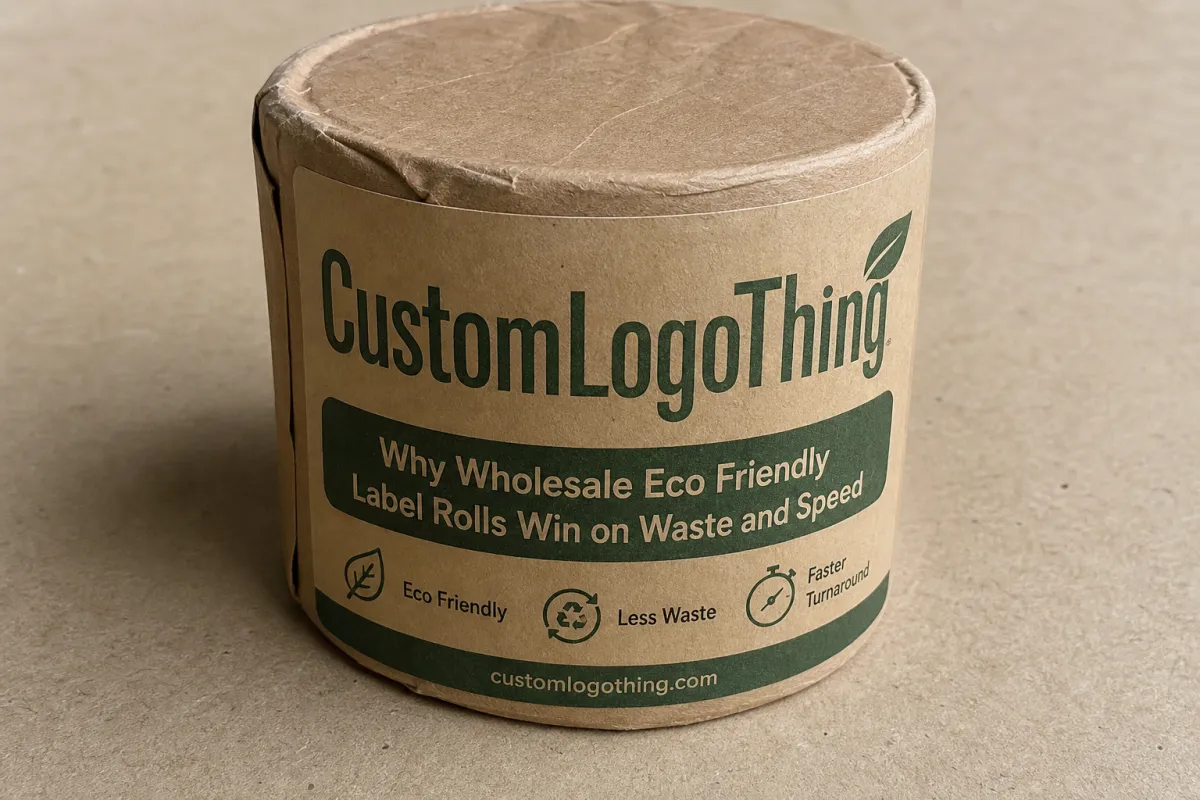
Many buyers begin with face stock and print price. That is a sensible starting point, but it leaves out the part that hurts later. A label that looks cheap per thousand can become expensive if the liner tears during dispensing, the unwind tension shifts from roll to roll, or the applicator has to fight the roll instead of moving it through the line. Wholesale eco friendly label rolls deserve a closer look because they can reduce those hidden costs while still supporting strong branding and dependable application.
Sustainability is bigger than the material on the front of the label. It also includes how much material gets used during converting, packing, shipping, and application. A roll that rewinds tightly, fits more efficiently into cartons, and runs without jamming may save more waste than a lower-priced option that forces operators to trim webbing or scrap labels that drift out of alignment. On a production floor, line efficiency is part of waste reduction, not a separate issue.
The value shows up across categories. Food brands need reliable adhesion on cartons, trays, bottles, and secondary packs. Wellness and personal care labels often need a matte or soft-gloss finish that still carries ingredient copy and batch codes clearly. Retail products need a label that looks intentional under harsh store lighting and stays intact through shipping, stocking, and customer handling. A strong eco-friendly roll can satisfy all of those needs in one specification.
Wholesale buying also brings discipline to the program. Once a team standardizes one label structure across several SKUs or sites, requalification gets shorter, replenishment gets cleaner, and internal approvals get easier to manage. Purchasing can forecast with more confidence. Operations can train once rather than repeatedly. Marketing gets more consistent print appearance across runs. That kind of standardization often produces the biggest operational gain, even if it is not obvious in the first quote.
The EPA has long pointed to source reduction as the first place to look for waste control, and that logic fits labels well: use less material, throw away less scrap, handle less waste. For a broader framework, the EPA's source reduction guidance is a useful reference: EPA source reduction guidance.
For buyers comparing programs across several products, the commercial case is straightforward. Better line behavior, cleaner storage, and simpler reordering often matter more than a small gap in face-stock price. Wholesale eco friendly label rolls should be evaluated as a production asset, not as a stationery purchase. The label is part of the machine path, the compliance story, and the shelf image all at once.
What Actually Goes Into Eco Friendly Label Rolls
A label roll looks simple from the outside and behaves like a precise engineered component in production. Face stock, adhesive, liner, core, and winding direction all affect whether the roll runs properly, whether it can be recovered or recycled in a useful way, and whether it fits the machinery already on the floor. If one of those details is off, the whole run can turn into a problem quickly.
- Face stock: the printable surface, usually paper or film.
- Adhesive: the layer that determines how the label sticks and how it performs over time.
- Liner: the release layer that carries the label through printing and dispensing.
- Core: the tube the roll is wound on, which must fit the dispenser or applicator.
- Winding direction: face in or face out, which affects machine compatibility.
Recycled paper and FSC-certified paper are common choices for brands that want a lower-impact structure without losing print clarity. FSC-certified papers can fit well when sourcing documentation matters and the brand wants a clear chain-of-custody story. If your team wants to see the certification framework at the source, the FSC site lays it out clearly: FSC certification information.
Some programs use film structures designed to reduce material impact while still handling moisture, abrasion, or frequent contact. That is not the right answer for every brand, and it should not be treated like one. Paper is often the cleanest choice for dry goods, shipping cartons, and many retail packs. Film makes more sense when the package faces condensation, refrigeration, oil, or heavy handling. The right substrate is the one that fits the actual environment, not the one that sounds greenest in a presentation.
Adhesive selection matters just as much as face stock. A water-based or lower-impact adhesive can work well for cartons, dry goods, and applications that do not need extreme bond strength. Permanent adhesives make more sense for refrigerated packs, textured surfaces, or products that will be handled often before opening. There is no universal winner. The right adhesive depends on the package, the shelf life, the distribution path, and the temperature swing it will see.
The liner often carries more waste than buyers expect. Conventional release liners remain common, but reduced-weight liners can improve shipping efficiency and lower material use. Linerless systems can reduce waste further where the applicator and line setup are built for them, though not every operation is ready for that move. Buyers should ask how many labels fit in each carton, how much dead waste is created at setup, and whether the liner can be reclaimed or recycled in their region. Local recycling rules vary, and a material that is technically recyclable is not always collected in practice.
Print method and finish matter too. Flexographic printing is often favored for larger wholesale orders because it holds consistency at scale. Digital printing helps when the team needs shorter runs, more versioning, or faster changeovers. Matte and uncoated finishes give a natural look that fits many sustainable brand stories, while gloss and protective coatings can help where moisture, abrasion, or scuffing is part of the job. The point is not to add features for their own sake; it is to match the label to the package environment and the brand promise.
For buyers who need more format choices, size options, and converting paths, Custom Labels & Tags can be a practical place to compare structures before committing to a wholesale run.
Material and Print Specifications Buyers Should Check
The fastest way to avoid expensive mistakes is to lock the technical details before the quote becomes a purchase order. Label size, shape, corner radius, roll diameter, core size, unwind direction, and whether the roll is face in or face out all matter. If any of those points are vague, the label may look right on paper and still fail on the actual applicator.
A sample can look flawless in a lightbox and still be wrong for the machine. That happens when the substrate is too stiff for a tight peel plate, the adhesive grabs too slowly on a curved bottle, or the label gap does not match the sensor on the line. Buyers should confirm the exact equipment model if an applicator or printer applies the labels automatically, because a roll that works by hand may behave differently at production speed. Even small differences in web tension can change how a label peels and lands.
Durability should be checked against the full path of the package, not just the first hour after application. If the product is refrigerated, ask about condensation and chill performance. If it moves through warehouses or retail handling, ask about abrasion. If oil, moisture, or short outdoor exposure are part of the journey, include that in the request. The best eco-friendly label is the one that survives the job without overbuilding the spec and adding cost where it is not needed.
It also helps to ask for the print and performance tests that matter to your line. Adhesion can be measured against common peel and shear methods such as ASTM D3330 or related internal validation. If the package must survive shipping abuse, transit testing aligned with ISTA procedures is worth considering because the issue is rarely just day-one stick; it is whether the label stays legible and attached through distribution. For more on distribution testing standards, the ISTA resource library is useful: ISTA testing standards.
Barcode readability deserves close attention. A barcode that scans in the art file and fails on the finished package creates avoidable friction for receiving, retail placement, and inventory control. Color contrast, quiet zones, coating choice, and print resolution all influence scan performance. If the label includes serialized data, lot codes, or compliance marks, those elements should be checked before the run starts, not after the shipment is already on the dock.
Storage and handling matter too. Labels should sit in stable temperature and humidity conditions so the adhesive does not drift and the liner does not curl. Buyers should ask about shelf life, especially for inventory that may sit in a warehouse before use. A label is a material product, not a digital file; it changes if it is stored badly. That matters more for wholesalers than for small test orders because inventory often sits longer before it is consumed.
For a clean order process, a simple spec sheet should include:
- finished label dimensions and shape
- quantity needed and target reorder volume
- face stock preference and finish
- adhesive type or performance need
- core size, roll diameter, unwind direction, and face-in or face-out winding
- machine model or application method
- barcode, compliance, or variable-data requirements
Pricing & MOQ: How Wholesale Runs Are Structured
Pricing for wholesale eco friendly label rolls usually comes down to five inputs: material choice, print coverage, finish, roll format, and quantity. A simple one-color recycled paper label will price very differently from a multi-color label with a protective coating, a specialty adhesive, or a custom die shape. Buyers who compare only the total invoice miss the real unit economics, which is why cost per thousand labels is the better comparison point.
MOQ, or minimum order quantity, tends to track setup cost, tooling, press waste, and the efficiency of material procurement. Digital programs and stock-based structures can support lower quantities because the setup burden is smaller. Custom dies, unusual shapes, and specialty constructions usually need higher quantities to keep the unit price practical. That is not a penalty; it is how converting economics works. The press, the die, and the waste matrix all have to be paid for somewhere.
For a buyer trying to budget a program, the table below gives a useful working view. These are typical wholesale signals, not fixed price promises, because label size, artwork coverage, and adhesive performance can move the number up or down.
| Construction | Best Fit | Typical Wholesale Price Signal | Buyer Note |
|---|---|---|---|
| Recycled paper with standard permanent adhesive | Dry goods, cartons, basic retail packs | Often on the lower end; for a common run, roughly $18-$32 per 1,000 labels | Good starting point if the package does not face moisture or heavy abrasion |
| FSC-certified paper with matte or uncoated finish | Brand-led packaging programs with documentation needs | Usually moderate; often around $22-$38 per 1,000 labels | Useful when sourcing story and print appearance both matter |
| Moisture-resistant coated paper | Chilled products, handling-heavy retail packs | Often mid-range to higher, around $26-$45 per 1,000 labels | Pay for the coating only if the package actually needs the protection |
| Lower-impact film structure with strong adhesive | Products exposed to moisture, oil, or frequent contact | Frequently higher, around $30-$55 per 1,000 labels | Better for durability, but not always necessary for dry applications |
Those numbers become useful only when they are measured against actual usage. A label that saves one percent in material cost but creates two percent more waste is not a win. A label that costs a little more yet prints accurately, feeds well, and reduces roll changes can lower total cost in a way that does not show up on the first quote. That is especially true for brands that run multiple SKUs each week and need predictable behavior from every pallet.
Buyers should also ask what the quote includes. Tooling, proofs, freight, test rolls, and replacement labels after a production issue can all change the landed cost. That matters more when the rollout spans several SKUs or several plants. If the supplier is quoting only the label and not the full program, the purchasing team should account for the missing pieces before making a comparison.
Standardization can push the unit price down over time. When multiple products share the same face stock, same roll format, or same adhesive family, production gets easier to schedule and purchasing gets easier to forecast. For organizations that want a broader replenishment structure, Wholesale Programs can help frame repeat orders around annual usage rather than one-off buys.
As a practical rule, buyers often see more favorable pricing when they can commit to repeat runs, accept a common size across several items, or forecast a realistic annual volume. That does not mean every order must be huge. It does mean the most accurate quote comes from a real consumption plan rather than a guess. A tidy forecast usually beats a hurried one.
Process & Timeline: From Quote to Delivery
A clean ordering process saves time on both sides. The shortest path usually looks like this: share the label specs, receive a quote, review artwork, approve a proof, run production, inspect quality, and ship. Delays tend to happen at one of those steps, so it helps to know which step depends on the buyer and which step depends on the press schedule.
- Send the spec sheet. Include size, quantity, face stock, adhesive, roll format, and any machine details.
- Review the quote. Check unit price, tooling, freight, proofing, and any test materials.
- Approve the artwork. Make sure the die line, barcode, compliance copy, and brand colors are correct.
- Confirm a proof method. Digital proofs are useful for layout, while physical samples are better for color-sensitive or machine-sensitive jobs.
- Run production. The press and converting steps should include registration checks, count verification, and unwind inspection.
- Ship and receive. Confirm dock access, carton labeling, palletization, and delivery timing before freight leaves the facility.
Lead time depends on the structure of the order. Stock materials with simple repeat artwork can move quickly, often in about 7-10 business days after proof approval if scheduling is open. More custom wholesale eco friendly label rolls, especially those involving new dies, special adhesive systems, or detailed print coverage, often need about 12-15 business days and sometimes more if sampling is part of the process. Rush jobs can happen in some cases, but they usually bring a cost and a scheduling tradeoff. If the supplier is honest, they will tell you whether the lead time is driven by production or by the availability of the material itself.
Proofing deserves a careful look. A digital proof helps with spellings, layout, barcode placement, and version control, but it cannot show the full behavior of the adhesive or the actual print feel on the chosen material. If the label is critical to machine feed or shelf presentation, a physical sample or test roll is worth the extra step. One sample can prevent a full pallet of avoidable waste.
Quality control should not be treated like a formality. Good wholesale runs include registration checks, count verification, core and unwind inspection, and adhesive checks where needed. If the order is intended for a high-speed line, the supplier should understand how much stable roll build and tension consistency matter. That is especially true for bottling lines, sleeving workflows, and high-volume carton application environments. A roll that varies too much from one batch to the next can create problems long after the press room has signed off.
Shipping and receiving can create delays if they are left vague. Dock hours, freight access, pallet height limits, and carton labeling should all be confirmed in advance. If the warehouse has narrow receiving windows or strict appointment scheduling, say so early. Label production may be complete, but the order is not finished until it is in the right place and ready for use.
Why Choose Us for Sustainable Packaging Programs
For a sustainable packaging program to hold together, the label supplier has to act like a production partner, not just a printer. The label must run cleanly, stick properly, and arrive in a format that the line can use without extra adjustments. That is where technical reliability matters more than broad claims. Wholesale eco friendly label rolls only matter if they fit the real packaging environment.
That means understanding both converting and factory-floor use. A buyer may describe a brand goal in broad language, but the actual job is more specific: which substrate prints best, what adhesive is safe on that surface, how the labels should be wound, and how much tolerance the line has for roll variation. A supplier who speaks in those terms can turn a branding request into a specification that works under production pressure.
Documentation matters in sustainable sourcing, especially when several departments are involved. Purchasing wants repeatable pricing and clear replenishment paths. Operations wants dependable feed behavior and predictable count accuracy. Marketing wants the material story to match the brand position. A strong wholesale program keeps those needs aligned instead of forcing each department to solve the same problem separately.
Change control matters too. New SKUs, updated artwork, modified sustainability targets, and shifting shelf-life requirements should not force the buyer to restart the sourcing process. A practical supplier can keep the base spec stable while updating only the parts that need to change. That saves time, and it keeps reorders from drifting into unplanned variation. It also reduces the chances of a well-intended switch creating a manufacturing headache.
A label program stays easier to manage when the spec is locked, the reorder path is clear, and the production team knows exactly what to expect from the roll every time.
For growing brands, that repeatability can be worth more than a one-time discount. The first order is only the start. The real value appears when the second, third, and tenth order all match the same practical standard, with the same unwind direction, the same application behavior, and the same appearance on shelf.
That is why wholesale eco friendly label rolls should be treated as part of the packaging system. They are not a side item. They are a working component of the pack, the pallet, and the brand presentation, and they deserve the same level of specification discipline as the container or the carton.
Next Steps to Order Wholesale Eco Friendly Label Rolls
Start with the basics and keep the request clean. The more complete the information, the faster the quote and proof stages move. You do not need a perfect package brief to begin, but you do need enough detail for the supplier to build a label that will actually work on your equipment and in your storage conditions.
Here is the most useful set of inputs to gather before requesting wholesale eco friendly label rolls:
- finished label size and shape
- quantity needed and expected repeat volume
- preferred face stock and finish
- adhesive requirement or performance condition
- core size, roll diameter, unwind direction, and face-in or face-out winding
- application method or machine model
- barcode, compliance, or variable-data needs
- target launch date or reorder window
Artwork should be sent in a workable format, with any brand color targets, legal copy, or version differences clearly marked. If the label includes barcodes, batch codes, or promotional text, make sure those elements are final before the proof stage. The better the file package, the less time gets lost in correction rounds. Small clarifications at the start usually save the biggest delays later.
If you are not sure which structure to choose, ask for samples or a test roll. That small step can reveal whether the adhesive grabs properly, whether the roll feeds cleanly, and whether the print finish matches the product line. It is much less expensive to find a mismatch on a sample than on a full production order. Buyers who run multiple pack formats often use this stage to compare two or three options side by side.
Build your internal timeline backward from the launch or reorder date. Include proof review time, production, shipping, and receiving. A cautious schedule is usually cheaper than a rush schedule, especially when the label is tied to a production slot or a retail delivery window. For many buyers, the safer path is to approve the proof a little earlier than feels necessary, then keep enough inventory to avoid emergency reprints.
Once the spec is confirmed, the quote is approved, and the proof is signed off, the reorder path becomes simple. That is the practical way to keep wholesale eco friendly label rolls moving smoothly through production, into the warehouse, and onto the package. A good system does not need drama; it needs repeatable inputs and a label built for the actual job.
FAQs
What are wholesale eco friendly label rolls usually made from?
Common options include recycled paper, FSC-certified paper, and select lower-impact film structures when extra durability is needed. The adhesive and liner matter just as much as the face stock, so the whole roll construction should be reviewed before ordering. The best choice depends on moisture, abrasion, and shelf-life requirements rather than appearance alone. A paper label that fails in a chilled case is not a sustainable choice in practice.
Will eco friendly label rolls work on standard labeling equipment?
Usually yes, if the roll matches the correct core size, unwind direction, and outer diameter. Applicator speed, label gap, and adhesive type should be tested on the actual equipment before full production. A sample roll is the safest way to confirm that the label feeds and dispenses cleanly. If the equipment is older or highly sensitive, ask for a test on the exact model rather than assuming a stock size will fit.
What is a typical MOQ for wholesale eco friendly label rolls?
MOQ depends on the material, print method, label size, and whether custom tooling is needed. Digital or stock-based runs may allow lower minimums, while custom shapes and specialty materials often require larger quantities. Ask for tiered pricing so you can see how unit cost changes as volume increases. That makes it easier to decide whether a larger run actually lowers total cost for your program.
How can I compare pricing for eco friendly label rolls fairly?
Compare cost per thousand labels rather than only total order price. Include setup, tooling, proofs, freight, and any testing materials in the landed cost. Also factor in waste reduction and line efficiency, because the cheapest roll is not always the lowest-cost program. A label that reduces setup waste and machine downtime can pay back a higher unit price surprisingly fast.
What do you need from me to quote wholesale label rolls accurately?
Provide label dimensions, quantity, material preference, finish, and adhesive requirements. Include artwork files, machine details, roll direction, and any performance needs such as freezer use or barcode readability. If you have a target budget or launch date, share that too so the quote matches your actual needs. For most packaging buyers, wholesale eco friendly label rolls are easiest to manage when the quote is based on real equipment, real dimensions, and a repeatable reorder spec.