Small changes in label construction can change the whole feel of a beanie. A few tenths of a millimeter does not sound like much until it lands on a ribbed cuff and starts affecting stretch, drape, and comfort. That is the part buyers usually miss. They spend time on logo art, then act surprised when the finished label feels stiff, curls at the edge, or sinks into the knit and disappears.
The stationery woven label Beanies Material Thickness guide matters because beanie labels live in a rough environment. They get stretched, folded, washed, worn under jackets, and handled more than most trims. A label that looks perfect in a proof can still fail in use if the weave is too dense, the backing is too heavy, or the fold adds a ridge right where the cuff bends. Thickness is not a decorative detail. It is part of the product experience.
I see the same mistake over and over: buyers ask for the “best” woven label without defining what best means on the actual hat. Soft beanies need a different label profile than structured cuffed beanies. Promo giveaways need something else again. The right answer depends on comfort, visibility, and how much body the knit can support without looking overbuilt.
Why label thickness changes beanie fit and resale appeal
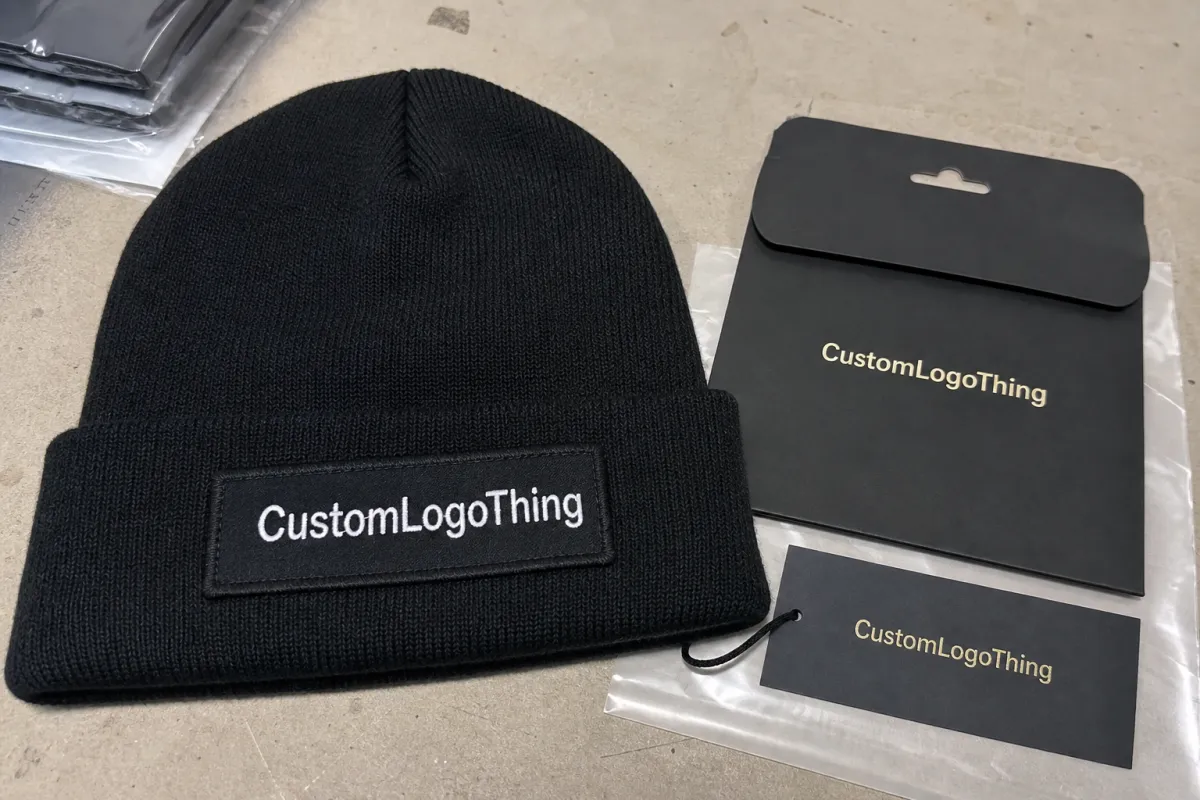
A beanie label is a touchpoint, not just branding. It sits where hands notice it and where the forehead or crown may feel it. That means thickness affects more than appearance. It changes how the hat wears, how the cuff recovers after stretching, and whether the label feels like part of the garment or something stuck on top of it.
Retail buyers usually want the label to read clearly from a few feet away. Promotional buyers often want the opposite: clean branding with minimal interruption to the knit. Outdoor and workwear programs sit somewhere in the middle, where durability matters more than a soft, nearly invisible feel. Same artwork. Different outcome.
Practical rule: on soft, slouchy beanies, keep the label lighter; on structured cuffed beanies, a little more body is acceptable if the edge stays smooth.
Resale appeal also changes with label profile. A beanie that feels polished on a rack usually has a label that sits flat and does not fight the shape of the hat. If the label is too tall, too stiff, or too wide for the knit, the whole product starts looking heavier than it should. That is a subtle problem, but buyers notice it immediately once they compare samples side by side.
The cleanest decision is usually the simplest one: match the label to the fabric weight and the intended wear. If the cuff is soft and stretchy, the label should be low-profile. If the cuff is dense and holds shape well, the label can carry a little more structure. Anything else is guessing.
How woven label construction creates thickness and handfeel
Woven labels are made from interlaced yarns, so thickness is not controlled by one factor. Yarn count, weave density, edge finish, fold style, and backing all contribute to the final feel. A label can look thin in a proof and still feel bulky after it is folded, stitched, and pressed onto knit fabric.
Damask is the most common construction for beanies because it balances detail and flexibility. It can hold small lettering better than simpler weaves, but a dense damask build can also feel firmer in the hand. Taffeta is flatter and lighter. It works well for interior labels or clean, simple marks where softness matters more than micro-detail. Satin-style woven labels feel smoother, but they can read fuller because the surface reflects more light and often uses a different yarn structure.
Edge construction matters just as much. A straight-cut label may feel lighter, but if the edge is not controlled well it can fray or irritate the wearer. Folded labels hide raw edges and often look cleaner, though the fold adds bulk. Center folds, end folds, and mitred folds all change how the label sits once stitched. The fold itself can create more perceived thickness than the face weave.
Backing is the other big variable. Sew-only labels are usually the lightest. Heat-seal or iron-on backings can improve application consistency, but they also add stiffness. That stiffness can be useful on a structured cap. On a knit beanie cuff, it can feel like overkill fast. If the label needs to flex with the garment, a lighter backing or no backing at all is usually the safer starting point.
For buyers comparing trim types, it helps to step back and compare label families instead of judging one sample in isolation. Our Custom Labels & Tags page is useful if you want to compare woven labels, printed labels, and hangtags before locking the final spec.
The spec choices that control handfeel, durability, and visibility
Most thickness problems come from a handful of spec decisions. None of them sound dramatic on paper. Together, they decide whether the label feels clean or clunky.
Thread count and weave density are the first controls. Higher density usually gives better detail retention, especially for small text and fine logos. The tradeoff is handfeel. A denser weave tends to feel firmer. If the logo is simple, you can often reduce density without losing brand recognition. If the artwork is crowded, the label may need more structure just to keep the design legible.
Color count matters too, though not always in the way buyers expect. More thread colors do not automatically make a label thicker, but they do make the weave more complex and can affect how tight the construction needs to be. More complexity often means more setup, more proofing, and sometimes a slightly stiffer result.
Width and height also change the outcome. A wider label has more surface area and usually reads more premium, but it can be harder to keep flat on a small cuff. If the label is too tall for the available space, the edges start fighting the knit. That is where puckering shows up.
Placement is the final variable people underestimate. Front cuff branding can tolerate more body because it sits on a flatter plane and carries the visual load. Side seam labels and interior labels need a gentler profile because they touch skin or bend with the hat. If a label lands where the cuff folds sharply, even a good weave can feel wrong.
- Dense weave improves detail, but it can make the label feel firmer.
- Wider labels increase visibility, but they also create more edge to manage.
- Fold style changes both appearance and bulk at the seam.
- Backing often changes stiffness more than the face weave does.
The right way to think about the stationery woven label Beanies Material Thickness guide is this: thickness is part of the design spec, not a cleanup decision after artwork approval. If the label is not sized and built for the knit, the final beanie will show it.
Stationery woven label beanies material thickness guide
Start with the beanie, not the label. Measure the cuff thickness, note the knit structure, and feel how much stretch recovery the fabric has. A rib-knit cuff with strong recovery can usually handle a slightly fuller label. A soft, loose beanie needs a lighter profile so the garment keeps its drape.
Then decide what the label is supposed to do. Does it need to read like a premium brand badge? Blend quietly into the garment? Survive hard wear in a workwear or outdoor setting? That answer should shape the thickness choice more than a catalog image ever will. I have seen buyers choose the heaviest option because it looked “more substantial,” then approve a lighter sample because it actually wore better.
There is no single perfect thickness for all beanies, but there are useful starting points. For many front-cuff woven labels, a face thickness in the 0.20-0.35 mm range before sewing is a practical middle ground. Taffeta-style labels can sit closer to 0.15-0.25 mm if softness and low profile matter. Folded labels with backing often move into the 0.35-0.70 mm range once finished, and that is where the risk of bulk starts to rise.
Those numbers are only a starting point. Sewing, folding, heat sealing, and garment stretch can change the perceived thickness more than the raw caliper measurement. A label that measures thin on a table may still feel chunky once the stitch line and edge finish are added. That is why the sample on the actual beanie matters more than the specification alone.
Use the beanie as the test surface every time. Stretch the cuff. Fold the hat. Press the label edge with your thumb. Then wear it for a few minutes and check whether it digs in, rolls, or rides up. A label that feels fine in the hand can still be wrong on the head.
- Confirm the knit. Rib, jersey, slouch, and chunky knits all behave differently.
- Set the goal. Decide whether the label should be bold, soft, or nearly invisible.
- Compare two or three builds. Change thickness, fold, or backing one at a time.
- Test on the real beanie. Stretch, fold, and wear it before approving bulk production.
- Check after wash. Look for curling, puckering, or edge scratch once the fabric relaxes.
| Label build | Approx. thickness before sewing | Feel on a beanie | Best use | Typical price impact |
|---|---|---|---|---|
| Damask woven label | 0.20-0.35 mm | Clean, balanced, flexible | Retail beanies, cuff branding | Baseline to medium |
| Taffeta woven label | 0.15-0.25 mm | Light, flat, understated | Interior labels, simple marks | Usually lower |
| Satin-style woven label | 0.25-0.45 mm | Smoother, slightly fuller | Premium branding, gift sets | Medium |
| Folded label with backing | 0.35-0.70 mm | Firmest, most structured | Workwear, outdoor products | Higher |
For most buyers, the best result comes from choosing the thinnest build that still keeps the logo readable. That keeps the beanie comfortable and avoids the “patch on top of fabric” look. The label should support the garment, not overpower it.
Cost, MOQ, and quote factors that change unit price
Price moves faster than most people expect once the spec gets complicated. Dense weaving, extra colors, special folds, backing choices, and low quantities all push the unit rate upward. A simple one- or two-color woven label is usually easier to price than a detailed logo with tiny type, even if the finished label looks thinner.
MOQ is the other lever. Higher quantities spread setup costs across more pieces, so the per-unit price drops. Lower-volume runs almost always carry a higher rate, and sometimes a separate sample or setup fee. Buyers often try to save money by keeping the order small and the artwork complex. That is usually the wrong trade.
For rough planning, many simple woven label orders land somewhere around $0.08-$0.25 per piece at higher quantities, while more detailed or specially finished labels can move into the $0.25-$0.60 range. That spread is wide because the quote depends on thread count, label size, fold style, and finishing. At smaller volumes, unit cost can climb quickly. The exact number matters less than understanding what is driving it.
Ask for a quote broken out by quantity, color count, fold type, and backing. That makes it much easier to see whether the jump comes from the weave itself or from one spec choice that can be simplified. If adding a second thread color changes the price a little, fine. If adding a folded edge nearly doubles the quote, you probably have a design problem, not a purchasing problem.
Packaging around the labels also affects the total program cost, even if the label line item is the main event. If the beanies ship with hangtags or retail inserts, buyers often specify FSC certified paper, recycled paper, or post-consumer waste content. Corrugated cardboard and kraft paper remain the practical defaults because they protect well and are easy to source. If sustainability claims matter, verify terminology through resources like packaging.org and check certified paper language with FSC.
One caveat: greener packaging should never be so light that it crushes the product in transit. A clean label inside a damaged carton is still a bad delivery. That sounds obvious. It gets ignored a lot.
Production steps and timeline from file review to delivery
Good production starts with artwork review, not weaving. The supplier should confirm logo size, weave direction, color count, fold style, and final placement before anything is made. Tiny text is where problems show up first. If it looks cramped in the proof, it will usually look worse in thread.
The typical workflow is simple: artwork review, spec confirmation, digital proof, sample or pre-production approval, weaving, cutting, finishing, inspection, and shipping. Repeat orders move faster because the spec is already known. First-time custom projects take longer because the sample stage does real work.
Timelines vary, but a straightforward woven label order often takes around 12-15 business days from proof approval to completion. Add time for complex finishes, multiple revision rounds, or physical samples. If the order needs two thickness options compared side by side, build in a few extra days. That is normal, not a delay.
Inspection matters more than people think. A decent QC check should verify color consistency, edge integrity, stitch cleanliness, cut accuracy, and whether the label sits flat after folding. For beanies, I also look at stitch tension on the cuff. If the needle line pulls the knit too tight, the label can distort the fabric even if the label itself is fine.
Shipping prep should be treated as part of production, not an afterthought. Small label bags are often packed into corrugated master cartons with kraft paper or recycled filler for protection. If the labels are traveling with finished garments, outer packaging needs enough crush resistance to survive stack pressure and transit vibration. Some buyers also ask for basic drop and vibration standards, especially when the goods move through multiple handling points before reaching retail.
Common mistakes that make labels feel bulky or cheap
The biggest mistake is approving from artwork alone. A proof shows shape, color, and layout. It does not show handfeel. Once sewn onto knit fabric, a label may stand up more than expected, sit too high, or feel harder against the skin than anyone wanted.
Over-detailing is a close second. Tiny lettering and thin outlines can look great on screen, then collapse in weaving. To keep every line, the supplier may need a denser weave, and that often creates a stiffer label. Buyers sometimes insist on preserving every detail, then wonder why the finished piece feels busy. The answer is usually simple: the design is too ambitious for the size.
Skipping a wash test is another easy way to waste money. Some labels relax nicely after laundering. Others hold a hard edge or start to curl. On a beanie, that matters more than it does on flat apparel because the cuff flexes constantly. If the label cannot survive that movement, it is not ready for bulk approval.
Placement errors are expensive because they are hard to correct later. A thick label placed on a sharply bending cuff can create a ridge. A label set too close to the forehead side can feel scratchy. A clean front placement usually works better because it gives the logo visibility without putting the label in the most sensitive spot.
- Test on the actual beanie. Paper mockups hide most fit issues.
- Keep the artwork proportional. Small labels need simpler graphics.
- Watch the edges. Curling usually shows up after stretch or wash.
- Match the label to the use case. Retail, promo, and workwear should not use the same build.
There is also the matter of consistency. If one sample looks fine and the next feels firmer, the spec is probably too loose. Buyers should document the exact winning combination: size, thickness, fold, backing, stitch method, and placement. That sounds boring. It saves reorders from drifting.
Expert tips and next steps for cleaner beanie orders
The cleanest beanie usually comes from the thinnest label that still keeps the logo readable. That is the sweet spot. Enough structure to hold the mark, not so much that the cuff feels overbuilt. If the design needs more body to stay visible, add it deliberately and stop there.
Use the production beanie as the test surface every time. Knit density, dye saturation, and stretch all affect how the label reads in real use. A label that looks perfect on a flat white swatch may feel wrong on a dark ribbed cuff. That is not a failure. That is why samples exist.
Document the approved spec once the right sample is found. Save the thickness, fold style, backing, placement, thread colors, and stitch method. Reorders are smoother when no one has to guess what “same as before” actually means. The more hands that touch the order, the more useful that record becomes.
For brands building a stable beanie line, the best move is usually to keep the label build consistent across seasons and only adjust the face artwork when needed. That protects fit, keeps costs predictable, and avoids the slow drift that happens when each order gets “slightly improved.” Slightly improved is often code for inconsistent.
The stationery woven label Beanies Material Thickness guide works best as a production checklist, not a one-time read. If you use it to compare the beanie, the label build, and the wash behavior before bulk approval, you will usually get a cleaner cuff, better comfort, and fewer unhappy surprises once the shipment arrives.
FAQ
How do I use a woven label thickness guide for beanies?
Start with the beanie fabric first. Rib knit, jersey knit, and slouch styles all change how a label feels once it is sewn on. Then compare two or three sample builds on the actual hat so you can judge softness, visibility, and edge comfort together. The best guide balances look and wearability instead of chasing the thickest option.
What thickness is best for a soft ribbed cuff beanie?
A thinner, tightly woven label usually performs best on ribbed cuffs because it flexes with the knit instead of sitting stiffly on top. If the logo must stand out, use a compact weave with clean edges rather than a bulky backing. Check the label against a stretched cuff so it does not ripple when worn.
Does a thicker woven label cost more for beanies?
Often yes, but the bigger drivers are weave density, color count, fold style, backing, and order quantity. A very detailed design can be more expensive even if it looks thin, because it needs more weaving precision. Ask for a line-item quote so you can see exactly which spec changes affect price.
How long does production usually take for custom beanie labels?
Simple orders often take about 12-15 business days after proof approval, while first-time custom projects take longer because sampling and revision rounds add steps. Complex finishes or slow artwork approvals can extend the schedule further. Build in extra time if the beanie launch depends on matching the label to garment production.
What is the most common mistake when ordering woven labels for beanies?
The biggest mistake is approving a label from artwork alone without testing it on the real beanie fabric. That is where thickness problems show up, especially at the cuff where stretch and contact are highest. A quick sample test usually prevents the bulk, scratchiness, or curling that causes reorders.


