Buyer Fit Snapshot
| Best fit | Ecommerce Packaging Custom Printed projects where brand print, material claims, artwork control, MOQ, and repeat-order consistency need to be specified before quoting. |
|---|---|
| Quote inputs | Share finished size, material target, print colors, finish, packing count, annual reorder estimate, ship-to region, and any compliance wording. |
| Proofing check | Approve dieline scale, logo placement, barcode or warning zones, color tolerance, closure strength, and carton packing before bulk production. |
| Main risk | Vague material claims, crowded artwork, missing packing details, or unclear freight terms can make a low unit price expensive after revisions. |
Fast answer: Ecommerce Packaging Custom Printed: Cost and Process should be specified like a repeatable production item. The safest quote records material, print method, finish, artwork proof, packing count, and reorder notes in one written spec.
Production checks before approval
Compare the actual filled-product size with the drawing, then confirm tolerance on folds, seals, hang holes, label areas, and retail display edges. Reserve space for logos, QR codes, warning copy, and material claims before decorative graphics fill the panel.
Quote comparison points
Review material grade, print process, finish, sampling route, tooling charges, carton quantity, and freight assumptions side by side. A quote is only useful when the supplier can repeat the same color, closure quality, and packing count on the next order.
Ecommerce Packaging Custom Printed: Cost and Process
Ecommerce packaging custom printed turns a shipping container into a brand signal, a protection system, and, if the spec is done badly, a hidden labor tax. That sounds dramatic until you compare two identical orders leaving the same warehouse. One goes out in plain brown board. The other arrives in a printed mailer with the logo placed cleanly, the structure sized correctly, and the insert keeping the product from rattling around like a coin in a dryer. Same item. Very different impression. Customers feel that difference fast, usually before they even reach the product.
I've watched brand teams spend weeks polishing ad creative, then approve packaging with about ten minutes of attention. The box is not an afterthought. It is the first physical proof that the promise was real. In ecommerce, that proof matters because the customer cannot touch the product in advance, so the package ends up carrying more weight than people expect. A plain shipper can do the minimum. Ecommerce packaging custom printed can do the minimum and still say, "This brand knew what it was doing."
What Does Ecommerce Packaging Custom Printed Include?
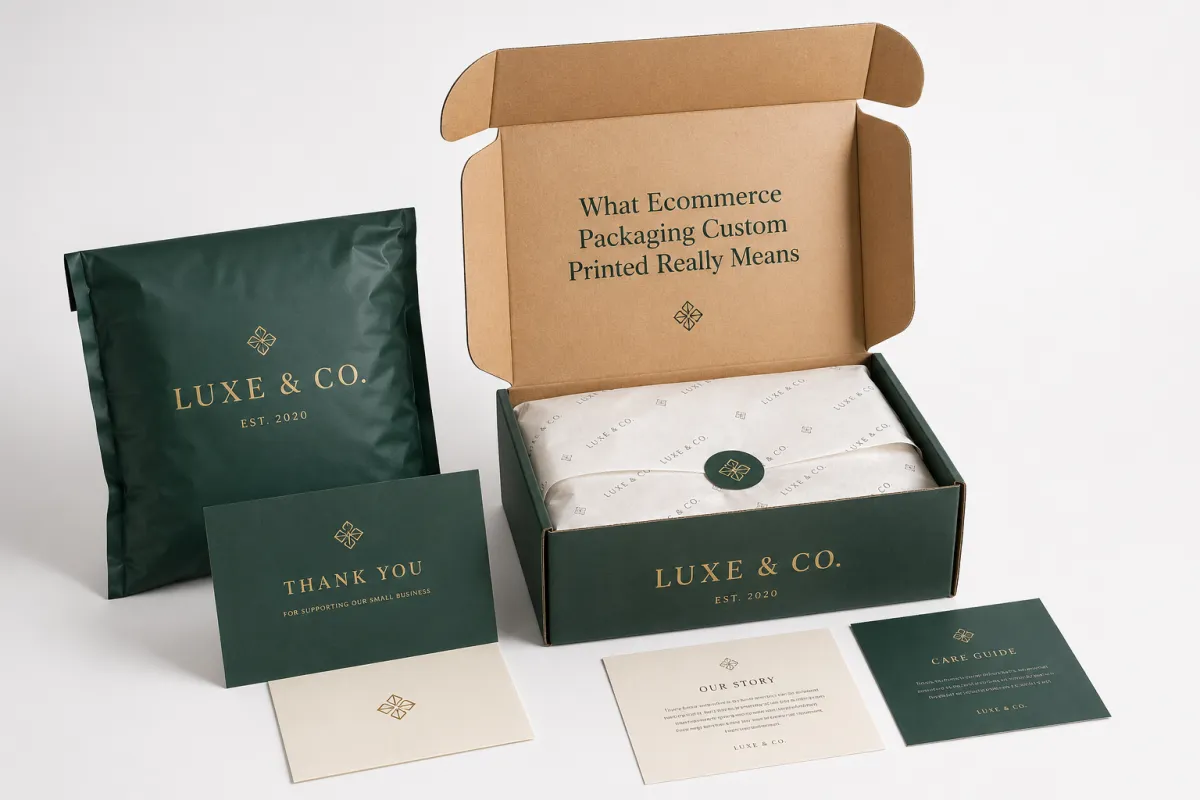
Ecommerce packaging custom printed is bigger than a prettier carton. The category covers mailers, corrugated shippers, folding cartons, inserts, tissue, labels, tape, sleeves, and sometimes printed dunnage or branded outer wrap. The point is not decoration for decoration's sake. The package has to protect the product, move through the warehouse without slowing the line, and reinforce the brand in a few quick seconds.
That mix changes by category. A direct-to-consumer skincare brand might use a printed folding carton inside a mailer. A subscription box might rely on the outer shipper as the entire branding surface. An apparel brand may lean on tissue, stickers, and a label because the garment itself does not need heavy structural protection. Same umbrella term, different mechanics. The logic stays consistent: control damage, control cost, and make the package feel intentional instead of generic.
From the buyer's side, the value is not only visual. It is operational. A package that is sized correctly can reduce void fill, lower return rates, and improve pack-out speed. A package that is overdesigned can do the opposite, which is why ecommerce packaging custom printed has to be judged as a system, not a mood board. I have seen brands fall in love with a presentation box and then discover it added 18 seconds per order. Multiply that by a few thousand orders a week and the math gets ugly pretty quickly.
The best programs usually justify the spend in three ways. First, they reduce damage because the structure matches the shipping path. Second, they lift perceived value, especially for products that compete on presentation as much as formula or features. Third, they make repeat purchasing easier to remember because the package becomes part of the brand memory. Ecommerce packaging custom printed can support all three, but only if the structure is chosen for the real world and not for a render on a screen.
A package can look inexpensive on a quote sheet and expensive in the warehouse. Add a little extra pack time, a bit more freight cube, and a few more damaged returns, and the cheap option stops being cheap.
That is the basic business case. Ecommerce packaging custom printed can improve unboxing, protect product packaging in transit, and make a company look more disciplined. Cost still matters. So does speed. So does print quality. The order of priorities matters even more: function first, brand expression second, and only then the nice-to-haves.
How Ecommerce Packaging Custom Printed Works
The process usually starts with three questions: what is being shipped, how is it shipping, and what should the customer feel when it lands? Those answers shape the structure, the print method, the finish, and the budget. A 6-ounce cosmetic item in a rigid mailer is a very different problem from a 3-pound accessory in a corrugated shipper. If those two briefs get treated the same, one of them is gonna disappoint someone.
The technical work begins with dimensions. Product measurements are translated into a dieline that accounts for clearance, folds, glue zones, tuck flaps, and any insert cavities. Artwork is then built around that template with bleed, trim, safe zones, and fold lines clearly marked. Good packaging design teams ask for the dieline first because even strong graphics fail if a logo lands on a crease or a barcode sits too close to a seam.
Proofing is where many brands underestimate the labor. A digital proof is useful for file review, but a physical sample is better for fit, color behavior, and how the structure performs once it is folded, loaded, and handled. For ecommerce packaging custom printed, a proof is not just a color check; it is a production rehearsal. If a supplier catches a board mismatch, an overprint risk, or a sizing issue at that stage, the fix is manageable. If it shows up after 20,000 units are already in motion, the correction is no longer cute.
Production typically moves through printing, cutting, creasing, folding, gluing, and finishing. Some packaging ships flat for efficient storage. Some arrives pre-assembled. Flat-pack formats are common in high-volume operations because they save space and keep the fulfillment team moving. Premium programs sometimes justify pre-formed cartons or specialty mailers when labor is less constrained and the presentation is doing more of the heavy lifting.
Operational fit matters as much as the visual result. Ecommerce packaging custom printed should match the way your team actually picks, packs, and ships orders. If the pack station needs tissue, a voucher card, and a protective insert, those pieces need to move through the same sequence every time. If a warehouse uses two stations, the structure should not force five extra hand motions that break the rhythm. Those little irritations are the sort of thing that show up in labor reports before anyone admits the package is the problem.
For teams comparing formats, it helps to look at the whole system instead of one carton in isolation. You can review Custom Packaging Products alongside the structure you already use and see where a change in format may save time, reduce void fill, or improve presentation. That comparison usually tells a more honest story than unit price alone.
The cleanest programs are staged: brief, structure, artwork, proof, production, fulfillment. Skip a step and the schedule gets messy. Compress all of them without planning and the costs tend to reappear later as rush freight, reprints, or damage claims. Packaging work has a way of punishing shortcuts, even when the shortcut looked clever at the time.
What Drives Cost and Pricing in Custom Printed Packaging
Pricing for ecommerce packaging custom printed is shaped by a few specific levers, and the first one is material choice. A simple kraft corrugated mailer usually costs less than a white SBS folding carton with heavy ink coverage and a soft-touch finish. Structure matters too. A self-locking mailer, a standard RSC shipper, and a specialty presentation box each carry different die, setup, and conversion costs.
Print coverage changes the number in a visible way. One-color printing on natural kraft board is not the same as full-bleed four-color artwork on a coated sheet. More coverage means more ink, more press time, and more chances for make-ready waste. Special finishes add another layer: foil, embossing, spot UV, matte lamination, soft-touch coating, and aqueous coatings all affect price. Ecommerce packaging custom printed can still be economical with premium details, but the details need a job to do. Decorative excess is just expensive decoration.
Quantity changes the math sharply. Setup work does not vanish because the order grows. Die cutting, plate setup, press calibration, proof handling, and conversion labor all happen before the first box ships. At 500 units, those fixed costs are spread thinly, so the per-unit number is high. At 5,000 or 10,000 units, the same setup gets diluted enough to make the package look much more affordable. Short runs carry a premium even when the design is simple.
Hidden costs show up later if the buyer is not careful. Samples may be billable. Freight can swing depending on pallet count, destination, and whether the order needs liftgate service. Storage matters if the packaging arrives in bulk and sits before use. Assembly labor is easy to miss too. A custom insert can save damage, but if it adds 12 seconds per pack-out, that labor has to be paid for somewhere. Finance teams often discover this the hard way after the first replenishment cycle.
The smartest way to evaluate ecommerce packaging custom printed is total landed cost, not printed box price. A slightly more expensive carton that cuts return rates from 4 percent to 2 percent can outperform the cheaper option quickly. The same is true if better sizing reduces DIM weight or a flatter pack format lowers warehouse storage demand. The lowest quote is not always the best value, and the quote sheet rarely tells the whole story.
| Packaging option | Typical use | Common print approach | Rough unit range at 5,000 pcs | What usually drives the price |
|---|---|---|---|---|
| Kraft corrugated mailer | Light-to-medium products, direct ship orders | 1-color or 2-color flexo | $0.34-$0.60 | Board grade, box size, print coverage |
| White folding carton | Cosmetics, supplements, small retail packaging | Offset or digital print | $0.28-$0.55 | Board caliper, color count, coating choice |
| Premium presentation mailer | Gift sets, subscription kits, launch boxes | Full-color with specialty finish | $0.78-$1.45 | Lamination, foil, embossing, insert work |
| FSC-certified branded shipper | Sustainability-led ecommerce programs | Water-based inks or flexographic print | $0.38-$0.72 | Certified board source, size, print complexity |
Those ranges are planning numbers, not promises. Low volume, a complex dieline, or heavy ink coverage can move the quote quickly. If the package needs to support sustainability reporting, ask about FSC-certified paperboard and review chain-of-custody details through the FSC system. If the box must survive distribution hazards, test against the right transit profile instead of guessing and hoping.
Brands that want a cleaner shipping story usually get the best results when the budget is split across three layers: structure, print, and handling. That framing keeps the decision practical. The structure protects. The print sells. The handling saves time. If one layer is bloated, the whole program starts to feel overpriced.
Key Factors That Decide Whether the Packaging Performs
Good ecommerce packaging custom printed has to survive the actual shipping lane. Not the studio. Not the mockup table. The actual lane: conveyor drops, trailer vibration, stacking pressure, temperature swings, and the occasional rough handoff. Protection comes first. Product weight, fragility, center of gravity, and ship distance all influence whether corrugated board, folding carton, or a hybrid structure makes sense.
Material selection deserves more than a default answer. Corrugated board is the workhorse for many ecommerce programs because it handles crush and compression better than a lightweight carton. Folding carton still has a strong place for cosmetics, supplements, and other lighter categories where the outer pack doubles as retail packaging or shelf-ready packaging in a secondary channel. Recycled stocks can support sustainability goals without hurting print quality, but recycled does not automatically mean right. The board still has to fit the product.
Print clarity is the next filter. A strong package branding system uses hierarchy: logo first, product name second, support copy third. If every surface is shouting, the package feels busy rather than premium. Restraint often looks more expensive than crowding. A clean two-color layout on kraft can feel more deliberate than a full-coverage design that buries the message under too much ink.
Operational fit decides whether the package survives daily use. A good format stacks efficiently on a pallet, stores flat without warping, and opens quickly on the pack line. If a mailer requires too much assembly, the warehouse will feel it. If it nests neatly, teams notice the difference within the first week. Ecommerce packaging custom printed should support labor, not fight it.
Testing matters. For transit validation, many teams use protocols aligned with ISTA test standards or relevant ASTM methods such as ASTM D4169. The technical labels can sound dry, but the point is straightforward: if the package cannot handle vibration, compression, or drop events in a controlled test, it is not ready for broad shipment. A decent sample run can expose weak corners, glue failures, or inserts that shift under load.
The best packaging usually looks calm. Not empty. Calm. It says the brand knows exactly what the product needs, and nothing more.
That calm look usually comes from disciplined packaging design: less ink on the outside, better structure inside, fewer surprises in the warehouse. Ecommerce packaging custom printed works hardest when it feels invisible during fulfillment and memorable after delivery.
A practical shortcut helps here. If your current packaging already survives shipping, compare the old and new structures side by side before changing materials. The question is not whether a prettier box can be made. The real question is whether a better box can be made without adding failure points. That distinction saves money and prevents avoidable rework.
Step-by-Step Process and Timeline for Ecommerce Packaging Custom Printed
The cleanest way to manage ecommerce packaging custom printed is to treat it like a project with checkpoints, not a one-off purchase. Start with a brief that includes product dimensions, target weight, ship method, budget ceiling, order volume, and brand goals. If those inputs are fuzzy, the quote will be fuzzy too. A supplier can only spec what it can see.
From there, request structure options. A supplier might recommend a corrugated mailer, a folding carton, or a custom insert system depending on the product profile. This is the moment to ask awkward questions. How much void space is left? Does the box require tape? Can it survive a one-meter drop? Is the board strong enough if the outer carton gets compressed in a stack? Those are not theoretical questions. They are the ones that keep ecommerce packaging custom printed from becoming a damage problem later.
Artwork prep usually comes next. The printer provides a dieline, and the brand builds graphics to fit it. Files should generally be vector-based, with font outlines if requested, correct bleed, and all key text inside safe zones. A digital proof checks placement and content. A physical sample checks fit and finish. For high-value launches, both are worth the time.
- Confirm product dimensions and target pack-out method.
- Approve the dieline before final artwork is built.
- Review bleed, safe zones, and fold-line placement carefully.
- Request a sample if the product is fragile, premium, or unusually shaped.
Once proofing is signed off, production begins. For straightforward jobs, proof approval to delivery can land around 12-15 business days if the supplier already has materials in stock and the artwork is clean. Add specialty finishes, new tooling, or heavier order quantities and the schedule can stretch to 18-25 business days or more. That is normal. A rush timeline often looks possible right up until the pressroom needs one more correction.
Shipping and receiving need their own buffer. Freight can be a quiet source of delay, especially if the order is palletized, cross-country, or waiting on carrier scheduling. Brands that launch well usually build an extra week into the plan. Not because the supplier is slow, but because ecommerce packaging custom printed is only as reliable as the weakest handoff in the chain.
For companies comparing formats, this is a good moment to revisit Custom Packaging Products and map the order flow against the catalog. A package that looks ideal on paper may be a poor fit if it adds too much assembly or eats shelf space in the warehouse. Timelines are easier to hold when the structure is chosen with operations in mind.
Before placing the order, ask for five things: final dieline, approved artwork PDF, proof sign-off, estimated freight date, and a reorder trigger. That last one gets forgotten often, and it should not. A good packaging program is built to repeat, not just to survive the first launch.
Common Mistakes That Cause Delays, Waste, or Weak Branding
The first mistake is ordering the wrong size. Too tight, and the product gets scuffed or crushed. Too loose, and the package needs extra void fill, more tape, or an insert that was never priced in. Ecommerce packaging custom printed only pays off when the fit is deliberate. Otherwise, the brand is paying for ink on top of a bad structure.
The second mistake is approving artwork too quickly. Bleed, contrast, and fold-line placement matter more than many teams expect. A logo that looks crisp on screen can sit awkwardly on a seam. A barcode placed too close to a crease can scan poorly. Dark ink coverage on a low-grade board can look muddy once the run is printed. Small errors are cheap to catch before production. They are not cheap after 10,000 units have been converted.
Overdesign is another trap. More finishes do not automatically equal better package branding. Foil, embossing, soft-touch coating, and spot UV can all be effective, but each one should have a clear reason to exist. If the box already ships inside a mailer and the customer never sees the outer surface, the premium finish may be wasted. Teams often want the package to do everything. Usually it does three things well and one thing badly.
Timeline mistakes are just as common. Brands often leave no time for revisions, sample approval, freight, or a second proof round. Then the schedule gets blamed on the supplier. In reality, the order simply started too late. Ecommerce packaging custom printed needs calendar space, especially if the product launch is tied to a marketing push or seasonal demand spike.
A final issue is treating sustainability as an afterthought. Recycled content, FSC sourcing, and right-sized packaging are all easier to build into the spec early than to patch on later. If sustainability is a brand promise, the packaging has to reflect that promise in the material spec, print plan, and end-of-life profile. Otherwise the message rings hollow.
Here is the practical rule: if the packaging cannot be explained in one clear sentence, it is probably trying to do too much. The best ecommerce packaging custom printed programs are simple enough to manage and specific enough to defend.
Expert Tips and Next Steps for Smarter Ordering
Start with a packaging matrix. The idea is simple: list products by size, weight, fragility, and order type, then map each one to the structure it actually needs. Some SKUs may justify fully Custom Printed Boxes. Others can stay plain or use a minimal printed label. That split saves budget where the customer never sees the extra spend.
Ask suppliers for a quote that breaks out materials, printing, finishing, sampling, freight, and assembly. If a quote is only a single number, it is hard to compare fairly. A transparent quote lets you see where the cost sits and where there may be room to adjust. For many brands, the biggest savings come from reducing finishing complexity rather than chasing a slightly lower board price.
If budget is tight, start with one hero SKU. That is the most honest test. Launch ecommerce packaging custom printed on the product that ships most often or earns the strongest margin, then watch how customers respond. Real orders teach more than a spec sheet. If the package lowers damage, supports repeat buying, and does not slow the team down, expand from there.
There is a strong case for staged branding too. A small brand might begin with printed mailers and labels, then add inserts, tissue, or specialty coatings later. That sequence keeps the program flexible. It also avoids the common mistake of overcommitting to a package before the operations team has enough shipping data to justify it.
For sourcing, think in terms of reorder discipline rather than one-time creativity. Set minimum stock levels, review lead times quarterly, and assign one owner for final approval. Without that structure, packaging becomes a fire drill. With it, ecommerce packaging custom printed becomes a reliable part of the supply chain instead of a recurring scramble.
Here is the simplest buying checklist I would use: 1) lock product dimensions, 2) confirm material and print method, 3) review a proof or sample, 4) build a freight buffer, 5) decide the reorder point before launch.
That sequence keeps the project grounded. It also keeps people from arguing about aesthetics before they have solved fit, damage, and labor. In packaging, the glamorous choice is often not the smart one. The smart one is the one that survives the lane and still looks good when it reaches the customer.
One last practical takeaway: write the packaging spec in a single sentence before you order. If you cannot say whether the goal is lower damage, faster pack-out, better presentation, or some mix of the three, the project is not ready. Ecommerce packaging custom printed works best when the objective is plain, the structure is right-sized, and the process is boring in the best possible way.
FAQs
How much does ecommerce packaging custom printed usually cost?
Cost depends on material, box style, print coverage, quantity, and finishing, so two packages that look similar can price very differently. A short run with heavy coverage may cost more per unit than a larger run with simpler print. Ask for a landed-cost quote that includes freight, samples, and any assembly so the number reflects the full spend.
How long does ecommerce packaging custom printed take from proof to delivery?
Simple jobs can move quickly, but the real timeline depends on proofing, sample approval, production capacity, and shipping distance. Custom structures or specialty finishes add more time because they require extra review before the run starts. Build in a buffer for revisions and freight delays so packaging does not hold up launch or replenishment.
What file types work best for ecommerce packaging custom printed artwork?
Vector-based files such as PDF or AI are usually preferred because they stay sharp at print size. Use the supplier's dieline, keep text inside safe zones, and outline fonts if the printer asks for that step. Confirm color expectations early so the printed result matches the brand as closely as possible.
What is the best material for ecommerce packaging custom printed boxes?
Corrugated board is a strong choice for shipping protection and heavier products. Folding carton works well for lighter items where presentation matters more than crush resistance. Recycled and recyclable options can support sustainability goals, but the final choice should still fit product weight and transit conditions.
Can small brands order ecommerce packaging custom printed in low quantities?
Yes, but low quantities usually come with a higher unit cost because setup expenses are spread across fewer pieces. Digital printing or simplified finishes can make shorter runs more practical for early-stage brands. A good strategy is to start with one high-volume SKU, then expand once demand and reorder patterns are clearer.
For brands that want stronger control over cost, damage, and presentation, ecommerce packaging custom printed is usually worth the planning effort. The key is to match the structure to the product, the print method to the volume, and the timeline to the reality of production.

